



Abstract
Musicians often engage in imagery to improve their practice and performance, however, there are experiences that shape preferences and varying approaches to how they engage with imagery and how they may teach imagery. Mental practice and imagery research offers varied nomenclature that span motor-sensory adaptation, refinement, expressive lucidity and goal-orientation that point to self-regulatory concepts in music learning. Exploring what teachers may conceive imagery to be, how teachers formulate upon their early understandings of imagery and how they currently engage with imagery in impactful teaching practice from personal experience is an under-researched area of investigation. This phenomenological study investigated three higher education piano teachers’ use and approaches to imagery by analysing perceptions, attitudes and applications of imagery in teaching within a masters-level music performance course in Melbourne, Australia. Interpretive phenomenological analysis (IPA) revealed differing conceptions of imagery and how it is utilised as a pedagogical tool and the value teachers hold for engaging imagery as a means of approaching planning, performance and reflective practice. The findings highlight social and experiential underpinnings to how imagery is conceived and used as a pedagogy. The study offers implications to activation of imagination in imagery conceptions in applied learning experiences and usage in teaching practices.
Introduction
The understanding and use of imagery in the improvement of music practice and performance is gaining an increased interest in music education research. Musicians may use imagery in mental practice away from their instruments – a practice that can be extended to thinking, hearing and moving through self-generated audiated prompts (Gordon, 1999). Research on mental practice has included fine motor remembering of actions (Jeannerod, 1995) which involves the deliberate use of imagination in creating and transforming mental representations of a movement into a mode of performance (Chaffin et al., 2016).
Musicians’ imagery has more recently been defined as something more complex than “mental practice” that involves a wide range of mental activity both with and without the instrument (Moran, 2009). Mielke and Comeau (2019) highlight issues around various terminologies involving mental imagery, mental skills, mental practice, internal representations, visualisation, finger practice (Driskell et al., 1994). Godøy (2019) emphasises the sound-motion embodiment in which imagery is “perceived and conceived holistically as coherent units . . . combining sensations of sound and body motion” (p. 161). Kalakoski (2001) suggests that “mental imagery not only stands at the intersection of memory and perception, but also at the intersection of several sense modalities” (p. 54)
Holmes and Calmels (2008) suggest imagery incorporates “regeneration of parts of a brain representation/neural network involving primarily top-down sensorial, perceptual and affective characteristics, that are primarily under the conscious control of the imagery” (p. 433). Imagined perceptual experiences can occur in various sensory modalities, incorporating a complex, dynamic array of approaches. It can involve audiation, gesture, kinaesthetic, tactile, internal and external visual representations that may be spontaneous, subconscious and strategically triggered by deliberate actions. This is consistent with how athletes and exercisers describe their imagery experiences (Driediger et al., 2006; Nordin & Cumming, 2005). Despite cognitive research emphasising the importance of mental practice, the imagery component of music learning remains an intriguing aspect of music engagement, learning strategy and performance, specifically its application and refinement in practice at all levels.
Imagery in the form of mental prompts can initiate a range of self-regulatory behaviours optimising learning. Self-regulation, as a key component of metacognition engages “self-generated thoughts, feelings, and actions that are planned and cyclically adapted to the attainment of personal goals” (Zimmerman, 2000, p. 14). Imagery can involve all three self-regulatory phases: forethought, performance and self-reflection. Taruffi and Küssner (2019) note the heuristic and strategic application of imagery in planning and reflection, whilst McPherson (2022) identifies the performance phase imagery attributes via the constant monitoring and management of regulatory behaviours.
Music Imagery Research
Imagery research points to the integration of both physical and mental practice behaviours and distinguishes between joint and solely physical and cognitive tasks (Gerling & Dos Santos, 2017). Physically moving fingers across the keyboard may improve retention of movement accuracy (Goss et al., 1986), and promotion of motor anticipation (Bernardi et al., 2013). Imagery can be present in cognitive tasks such as mental rehearsal (Bird, 1984), general emotional impact of imagined music (Jakubowski, 2020) and the use of model performances on goal oriented skill acquisition (Cash et al., 2014) such as deliberate practice (Lehmann & Ericsson, 1997), as well as perceptual “viewing” of the score and/or instrument (Fine et al., 2015). These examples offer a range of mental practice strategies that aims to align the mental image with the desired performance.
Elaborating these points, imagery can infuse both mental visualisation and physical miming, inducing refinement of physical movements (Bernardi et al., 2013). Imagery use has been shown to enhance musical confidence (Munroe-Chandler et al., 2008) and improve retrievable mental images of sequences of behaviour (Bandura, 1997) beyond general improvement of performance. Examples can include the conductors silently reading the score, instrumentalists engaging in audiation of their solo part (Brodsky et al., 2008), considering actual performance with audiated goal-setting (Bailes, 2009) that collectively aim at refining both imagined playing and self-efficacy in attaining it. Godøy and Jørgensen (2001) support the idea that the presence of different modality elements simultaneously occur and can enhance imagery perceptions and impact. Despite the increasing number of studies that acknowledge the benefits of mental practice/imagery for musicians both in the practice room and as performers on stage, its pedagogic application in the piano studio by teachers remains an under researched area.
Imagery or mental practice involves various sensory modalities including auditory, gustatory, kinaesthetic, olfactory, tactile and visual modalities. Cumming and Williams (2012) conceive imagery processing through both first and third person perspectives involving refinement of self-observation from the front, behind, above, the side perspective.
Mielke and Comeau (2019) organise and clarify terminology in the field of mental practice in music performance, clearly delineating between physical practice and mental practice and further separating mental practice into visual, kinaesthetic, motor and auditory imagery capacities. Gates (2021) presents the various vague understandings and applications of what imagery is and what explores its musical application, underscoring how imagery can be used to great effect pedagogically within teaching and learning contexts. What is clear, is that “all individuals, regardless of age, gender, or skill level, are capable of using imagery as a means to enhance cognitive, behavioural, and affective outcomes” (Munroe-Chandler & Guerrero, 2017, p. 1). This brings to the surface the range and complexity of various imagery conceptions and possible influence on teacher practice.
The Teaching of Imagery
Studio music teaching represents instructional, relational and interpersonal dynamics (de Bruin, 2018), Burwell (2012) refers to enduring dynastic traditions and individualised approaches based on reproducing the “master” rather than allowing for the students’ meaning-making processes to evolve. Gaunt (2008) suggests “teachers are the musical agents, the models and the motivating forces for their students” (p. 215) yet the investigating of how teachers approach imagery as a pedagogic tool is largely underexplored. The ways in which teachers reflect on their beliefs and apply this pedagogically can influence their students’ learning behaviours, reinforcing the need to understand more clearly approaches incorporating imagery use.
(Authors, 2019) highlights a range of strategies for teaching instrumental music that include modelling, scaffolding, coaching, reflection and exploration. Applied practically in diverse contexts, these strategies can allow the teacher to model and scaffold actions, but also illustrate the visualisation of physical movements (Bernardi et al., 2013), thoughts and descriptions of imagery use as retrievable sequences of behaviour (Bandura, 1997). Coaching and promoting of cognitive/physical exploration can metacognitively activate self-realisation and performance reflection as well as describing sensations of pictorial or audiated imaginings (Bailes, 2009).
This study investigates the perceptions and application of imagery by three higher education piano teachers working in a conservatorium in Melbourne, Australia. The study seeks to gain an insight into the reflections and experiences of these teachers feel imagery is in relation to music learning and teaching, examining how they utilise imagery pedagogically in crafting skills in their students. This study explores the experiences of performer teachers, teachers who have performed professionally, investigating their current perceptions and applications of imagery in their roles as higher education teachers and how they instil imagery as a self-learning tool for students to develop in their own practice. The research questions are:
Methodology
A phenomenological approach enabled examination of individual beliefs and attitudes of participants, and the meanings participants attribute to their knowledge and use of imagery in their own practice and teaching. Phenomenological studies often seek differences and idiosyncrasies in the lived world understandings (Husserl, 1999) and interpretive phenomenological analysis (IPA) enables the individual participant’s to reveal contextually specific experiences related to the phenomena (Larkin et al., 2006).
Qualitative research of this kind emphasises participants’ subjectivities, their “cognitive, meaning-disclosing contribution to what we experience” (Gallagher & Zahavi, 2008, p. 24). The incorporation of lived experiences that foreground “storied descriptions people give about the meaning they attribute to life events” (Polkinghorne, 2007, p. 479) enables a deeper understanding into their subjective meanings behind these experiences. The study employs narrative techniques applicable in qualitative research (Bruner, 2004). In-depth exploration and reflection of participants’ actions, perceptions and feelings about their use and comprehension of imagery cognitively, pedagogically and strategically, can reveal meaning disclosing assumptions, and epiphanies.
Data Collection Methods
Ethical permission was obtained to explore higher education piano teachers’ perspectives. Semi-structured interviews were implemented to investigate participants’ understanding, whereby they recalled, reflected on and recounted imagery experiences and the emergent feelings and perceptions related to what imagery meant to them. The study was concerned with personal meaning and development and sought to reveal “individual experience and the richness of the individual cases” (J. Smith et al., 2021, p. 46). The methodology applied an inquiring attitude that explored meaningful aspects of participants learning and teaching (Josselson, 2007). Establishing contextualised perspectives of music performer-teachers’ subjective experiences ensured inductive data driven analysis, rather than being deductive of any a priori attitudes. A funnelling technique during the interviews facilitated a focus on more specific, lived and experiential remembrances and perceptions (J. Smith et al., 2021). Funnelling as a qualitative research strategy begins with open-ended questions and gradually narrows to more specific and fine-grained experiential recollections and reflections (Groth et al., 2016).
An interview guide was created to address the aims identified above and pilot interviews were conducted with higher education music teachers to substantiate the validity of the interview guide and semi-structured questions (Appendix). The guide was refined through increased focus on the process, exploring development and refinement of imagery over time. The interviews of 50 min duration involved questions used as prompts rather than a rigid construct to allow for deep and multi-layered thinking (J. Smith et al., 2021). The data were audio recorded and transcribed verbatim by the researcher and analysed.
Selection of Participants
Participants were recruited utilising a combination of convenience and criterion sampling. All were piano faculty members at an Australian conservatorium of music which provided a convenience sample. The eligibility criteria for the participants were that (1) they were currently employed at the university as a piano teacher (2) they had attained at least 10 years career as a professional piano teacher in higher education (3) and they had performed professionally and were able to draw upon these experiences for the interview. Potential participants were sourced from recommendations from the institution and were then contacted by email and provided with a brief description of the project and an invitation to participate. The sample of three included one late career, and two mid-career higher piano education educators, and included two male and one female, and three ethnic backgrounds including significant piano studies in Australia, USA and the UK. All three participants have continued to cultivate distinguished performing career in Australia and overseas, performing Western Art music. They have taught at an Australian conservatoire, ranging between 10 and 25 years. A convenient time and location for interviews was ascertained with participants. To develop rapport and trust, confidentiality was assured, an important aspect of qualitative research (B. Smith & Sparkes, 2016). The anonymised names used reflect the gender of the original sample, the pseudonyms chosen were Avery, Blake and Casey.
Data Analysis
The analysis approach involved (1) multiple readings of the interview transcripts, (2) the grouping of thematic ideas placed into hypothetical categories and (3) a constant-comparative method of analysis by the initial researcher across each case was used to identify common themes that drew on the coding of initial ideas into codes. Throughout process of the constant comparative method, the researcher continually sorted through the data collection, analysed and coded the information, reinforcing theory generation through the process of theoretical sampling. This involved an oscillation between empirical evidence in the literature review and meaning making from the data. Bracketing, the restraining of assumptions, was key to maintaining a scientifically open attitude (Husserl, 1964). A second independent researcher utilised the same method of analysis to gather codes 4) Based on comparison across the data set between the two researchers and constant reference to the research questions, initial codes were updated, revised and refined. These were then grouped into larger groups of similar thematic material. Group codes were then reduced into a list of subcategories and categories and then arranged into three major themes (Saldaña, 2013).
Validation and Triangulation Procedures
Member checking of the data by an independent researcher maintained triangulation, validity and reliability of the data (Lincoln & Guba, 1985). Member checking occurred through the clarification of key words and phrases used by the participants (Reason & Rowan, 1981). The researchers maintained a reflexive objectivity in examining the data through all stages of the research process (Conrad et al., 1993). Interpretation involved looking beyond description, towards a deeper experiential account that portrayed the participants’ own perception of their experience. Epoché across the research process maintained an open, enquiring attitude that emphasised impartiality and quality throughout the interview and analysis process (authors, 2021). Participant voice was illustrated through the use of verbatim quotes that exposed both the culture and phenomena under analysis (Barrett & Stauffer, 2009). This is shown through direct participant quotes that were hermeneutically analysed that provided idiosyncratic, and at times powerful lived experiences.
Findings
The participants provided rich discussion and description of what imagery means to them and how they applied it in their own practice and studio teaching. Each participant offered slightly different interpretations of how they understood imagery as a facet of mental practice in their formative learning experiences, and how they applied their concepts of imagery in teaching contexts now. This dynamism is reflected in the presentation of data, juxtaposing deductive themes rather than separation by case.
Three major themes arose from the analysis. These are represented as discovery and growing confidence; initial imagery experiences; use as a self-regulatory vehicle.
The first theme, discovery and growing confidence reflects the attunement of imagery and mental practice in their own learning and realisation of how imagery may be utilised and built upon as learners. Initial imagery experiences spans the self-realised journeying beyond self-discovery, preconceptions, pursuing of epiphanies and building upon and perhaps on top of other teachers’ more simpler and less considered ideas in their personalised beliefs and approaches to using imagery in their studio classroom. The third theme, imagery use as a self-regulatory vehicle represents the planning, in the moment and reflective teaching applications of imagery used by these teachers.
Discovery and Growing Confidence
The three participants each discussed a development of imagery use through evolving embodied awareness in their learning contexts. Each participant presented a personalised sense of understanding of what imagery was and described their positioning of imagery within a mental practice approach. At a young age, Blake recorded himself and analysed his own playing though visualising himself performing as he listened to his recording. Blake recounted that, “I don’t think my teacher told me. I just recorded and listened myself . . . moved my fingers over the keyboard, following the music, calibrating my fingers to the musical expression I was hearing.” This self-discovery of imagery allowed Blake to realise how recorded prompts provided an alternative to the more traditional rote physical practice. He elaborated on this in his mental projections, “I would sit at my desk with the score in front of me, “seeing” the keyboard in front of me as I move my fingers in time to the recording.”
Avery was drawn to discussing photographic imagining of the score devised through the need to learn new repertoire: I was hard-working but had bad eyesight. I was considered a poor sight reader by my teacher. I made myself memorise. I focused on images of sections – not pages, just the first few lines of each section, imprinted in my mind’s eye. Repetition of playing and picturing the score in my mind embedded it. The more I did this, the more I remembered, the more I could devote to character and emotion, the better I got.
Casey began studying in Europe with a prominent teacher, who organised a regular series of concerts. He found a desperate need to meet the exacting requirements of this teacher and an adjustment to practice technique: I was given a hectic schedule that forced a change in practice. I needed to absorb the scores quickly, get the notes in my fingers. A teacher in Europe taught me to apply a very careful and planned practice and used a reflection journal highlighting what worked and what didn’t, noting issues and challenges. I used these journals to devote focus away from the piano to attain success – practice on trains, stretching my fingers this way, shape my hand that way, hearing the recording as I imagined playing it accurately and musically.
Casey’s study experience illustrated the increasingly onerous concert demands placed on him from his teachers and recalled this saying, “I remember distinctly there was a period of time where I was nervous on stage, and then a time where I felt very comfortable and confident” and part of that development included working on the psychological aspects of performance, such as “using imagery to relax before a performance, spending a couple of minutes where I imagine myself in a specific place where I felt relaxed, a tranquil nature setting somewhere totally away from the concert hall.” Casey utilised imagery as an intense focus on audiation and motor sensory accuracy but also as an effective coping and anxiety reducing strategy.
It was evident that Casey engaged in imagery as a form of practice that was planned, exacting and efficient. Through imagining the sounds and motions with accuracy, it reinforced the speedy and efficient learning of pieces. Through the use of his imagination to help with certain technical difficulties, he imagined exactly where to place his fingers and how his arms would move for certain difficult jumps on the piano, whereby imagery became an essential and affirming aspect of his goal orientation and learning. Casey engaged in imagery through the distance between current capacity and the imagined ideal. Casey stated that he would: “imagine my hands moving over the keyboard and the goal becomes clearer, and I can feel and sense what I need to do more clearly in that moment to achieve the refinement of that goal.”
Each participant articulated an experience of discovery in the sensemaking of evolving perceptions and pedagogic interactions. It included imagery, drawing on a range of symbolisms in which mental practice movements, imaged feelings, audiation and motor sensory precision is synchronised with that which is heard in the inner ear. Imagery represented a reflection on learning and self-awareness and emergent understandings gained through a refining process through thought, actions and experience.
Initial Imagery Experiences
Early learning experiences can shape the depth and breadth to which the participants conceive and utilise imagery and mental practice. These initial experiences may become self-directed strategies, which develop into pedagogic devices that are then passed on to students in their teaching.
Avery discussed her family background, and how this led to the practice of embodying a character or personality: I come from a theatrical background in my younger years. There’s a link between acting and music. When I practice piano, I create a character or become one of the characters and think about the different ways of interpreting it, acting it out and conveying the personality. I try to convey this approach to my students, encouraging them to inhabit the character they find within a piece.
Blake referred to a more emotional flow between music and imagery: If the music was happy or sad, and an image in my mind emerged from that, I didn’t consciously conjure up something, it just emerged. In my early development, I tried capturing sad or joyous musical expression through remembering certain moments and events in my life. My teacher emphasised this when I was young and it’s my go-to for imagery strategy.
Casey explained how he felt he needed to create a: Musical image that could turn into something communicative. An early teacher asked me to make up stories that complemented the emotional context of the piece. I found this effective in transforming my ideas into musical expression. I found it an engaging and exciting aspect of practice.
Casey described the use of visual images that could motivate an emotive intent being perceived in passages of music: I use images such as the flickering of light, or a chandelier of crystals turning around and catching different shards of light to capture dazzling musical moments, or a flame flickering . . . moving like water . . . I transfer these mental ideas to sensory ones, trying to feel the lightness, balance, and speed in my fingers. I equate this inner mental picture with sound and try to get my students to use imagery in this way. With young kids, I often ask them to make up a story. Sometimes this conjures an emotional response, others I sense a more physical one.
Casey elaborated on his use of imaginative allegoric prompts, incorporating literary and psycho-cinematic practice both when at the piano, but also in the absence of it. Allegorical imagery for Casey engaged a multifaceted threading of pictures, text and imagination transformed into captivating and creative learning experiences and powerful performance expression. For Casey, the focus of imagery was an object, an external experience visually conceived and appropriated. This aligned with Blake and Avery, whose imagery experiences were also internally generated, in as much as they were the embodiment of physical movement or gesture.
Casey implemented perceptions of imagery as a literary or pictorial sense in which pictures or metaphors were used as emotional or mental inspiration or trigger points. A metaphor or simile as a figure of speech can be used to suggest or conjure a likeness between two things. In other words, metaphors draw a direct and prescient comparison in which a word or phrase, image or representation literally captures the essence of an imagined or ideal conception. Avery, through her formative experiences found resonance in the creating of imagined characters, enacting them viscerally through pianistic expression. Each participant highlighted idiosyncratic elements of imagery but also emphasised the conveying of their understanding of imagery to their students through their own experiential and highly personal understandings.
Use as Self-Regulatory Vehicle
Participants discussed the effect that self-regulation played on their own learning and the role it played in imbuing their students with a sense of planning and control of imagery as a viable and impactful learning strategy. In regard to using imagery in teaching, Casey stated that: This is now an integral part of my pedagogical approach. I realised 15 years later I am encouraging my students to find ways to create emotions. It’s become an engaging and relational facet of discussion with my students – images worked for me, but for them it may be using fairytales, pictures or something that awakens their imagination.
Casey went on to explain that through the use of relating stories to music, his students “plan for characters and emotions, but mentally design where they will change character, they reflect on this and embody this through movement and gesture throughout a work.”
For Avery, her ability to perform from memory also became a strength and asset. Her focus on committing music to memory transformed her confidence. She developed pedagogic techniques such as tapping on the lid of the piano whilst imagining the sound, and feeling how to play the rhythm with the fingers, and directed these in her teaching. Avery suggested that “imagery practice provides a practice focus of lifting the notes off the page. Planning on changing starting points imprints the score in the head and repetition develops memory, rhythmic and pitch accuracy, it removes errors.” Avery reflected on the efficacious result of strategising described how mental practice-oriented imagery required students to reflect, recall and identify elements of their playing enabling students to become more adept at improving. Avery asserted “that their practice is very much problem solving and getting the student to make decisions through imagining where they are on the score and how they need to respond in relation to present capacity and the end goal.” This reflected the refinement of learning and self-regulatory process.
Blake applied his understanding of imagery as a regulative strategy by directing students’ hearing and conception to “what they want to hear, the motions that they need to sense to create this sound, and the confidence that they need to feel in performance.” Blake saw imagery as a distinct mental practice technique, an appraisal in the moment of what one hears moderated with what one wishes to conceive: As a way of thinking, I reflect on where my mind sends me. I don’t think about or encourage pictures or colours. I think the best way to engage a student here is understanding their mindset and in imagining the perfect performance in their own mind, encouraging imagery, mental focus with what they are hearing with and without the piano, embracing a positive sense of process and acting this out in performance.
Blake’s sense of mental imagery relied on planning and listening to ideal models, but also of placing oneself centrally as the performer, with control of that sound and expressive capacity. This method equips students and empowers them with a positive orientation to a musical concept. Blake encouraged a more positive feeling towards practicing and performing. Blake said he, “encouraged anxious students to try to superimpose a different feeling, and to experience a deep engagement with the learning process. I urge them to be enamoured with this process, of embracing the working out.”
Superimposing a contrasting, more positive feeling on top of latent negativity can engage imagery as an intentional control and modulator of emotions, supressing anxiety and worry by casting a positive and comforting sensation. Blake’s urge to embrace the process of planning and reflection within practice provided a means of building confidence, self-efficacy and self-fulfilment. This was a considerably different approach, when compared to the imagery used by Avery. There is a common thread of grasping control and focus of the moment, with Avery’s repetitive memory challenge approach starkly contrasting with Blake’s positive autonomous and self-efficacious approach to imagery.
Discussion
The three participants describe and interpret imagery and its role within the wider conception of mental practice use in different ways. Each crafted their own individualised approaches to devise understandings and apply principles of imagery in the teaching of others. They were not always taught what imagery is or how to use it, but rather, imagery evolved as a self-learning or self-adapting process that feed into each participant teachers’ experiential awareness. Aligning with Cumming et al.’s (2005) sports-related findings, these educators engage in imagery as an observational self-learning technique that helps improve their own as well as pedagogically shaping their students’ learning.
This included participants utilising a range of imagery concepts, relating to a scene or object, a mood or an emotion to be expressed. Black (2022, p. 268) refers to the “mental pictures created through spoken figures of speech” that involve far more than rhetoric, but a fully imaginative and creatively dynamic spectrum of imagery and storying that can produce an essence of emotion desired to be captured in performance. A participant from this study developed a “photographic ear” to gain access to memorised musical sequences. The participants link speech to music and use visual images as the inspiration for conjuring imagery, such as “jewels catching in the light,” “flame flickering,” or “moving like water” to better express the emotive intent being perceived in passages of music. Findings highlighted using emotionally-laden imagery (Vianna et al., 2009), particularly the idiosyncrasies even between these three participants. Teachers intertwined metaphors and imagery of objects, colours and scenarios in creative ways such as asking students to think of a character further elaborate this heuristic imagery use (Antonietti & Colombo, 2011) targeting a particular “experience or mode of performance” (Barten, 1998, p. 94).
Responding to the first research question, participants derive their pedagogical approach and strength first and foremost through their own learning and experiential encounters, most powerfully influencing their understanding and attitude of what imagery is. Regarding imagery as a facet of mental practice, the findings suggest the perception of sensorial and affective characteristics can play an important part in the way we engage in practice and reflect on practice outcomes. Beyond visual, kinaesthetic, motor and auditory modalities, we illustrate an emotional aspect that can be involved across physical and mental practice. Emotive capacity is an aspect of student development that grows and can become more refined as an effective part of a student’s practice toolkit. Concomitant to this are the participants’ phenomenological lived experiences journeying from learner to teacher through a process of becoming adept performers and pedagogically replete teachers (authors, 2022).
This study concurs with Finch and Oakman (2022) and Haddon (2007) that highlight the idiosyncratic nature of how imagery can be adopted by learners and taught by teachers in developing one’s confidence and ability to perform from memory. This study highlights how imagery development and attunement cultivates a complex and multifaceted mindset threading emotion and interpretation, technical mastery, cognitive flow, embodied actions and memorisation. This can be a form of skilled tonal imagery (Pike, 1974) which presents as reproductive (memory-based) or productive (creative). The learner can potentially imagine with increasing sophistication, internal images which may involve the cognitive oscillation between current ability and the perception of an improved iteration (Keller, 2012).
Imagery involves complex intersectionalities that thread the physical and mental. Modalities of imagery are embodied not just through visual, kinaesthetic, motor and auditory as suggested by Mielke and Comeau (2019) but also as a facet which involves the emotional elements of imagery. Table 1 identifies, classifies and threads these practice strategies as a set of often interconnected imagery modalities. Mental practice strategies include auditory and visual modelling, priming and the evocation of expressive intent. This table below can be used by teachers to help in their awareness and strategic application to calibrate pedagogic approaches using imagery/mental practice strategies. Though imagery is conceived as an interconnected and multi modal facet of learning, the table adopts a phenomenological perspective orienting performers lived experience to the closest corresponding modality. The analysis of participants explanations highlight the personalised approaches taken, often reflecting how these teachers were taught or influenced when they were learning the piano and developing their own pianistic skills and self-regulatory processes.
Participant imagery modalities and mental practice strategies.
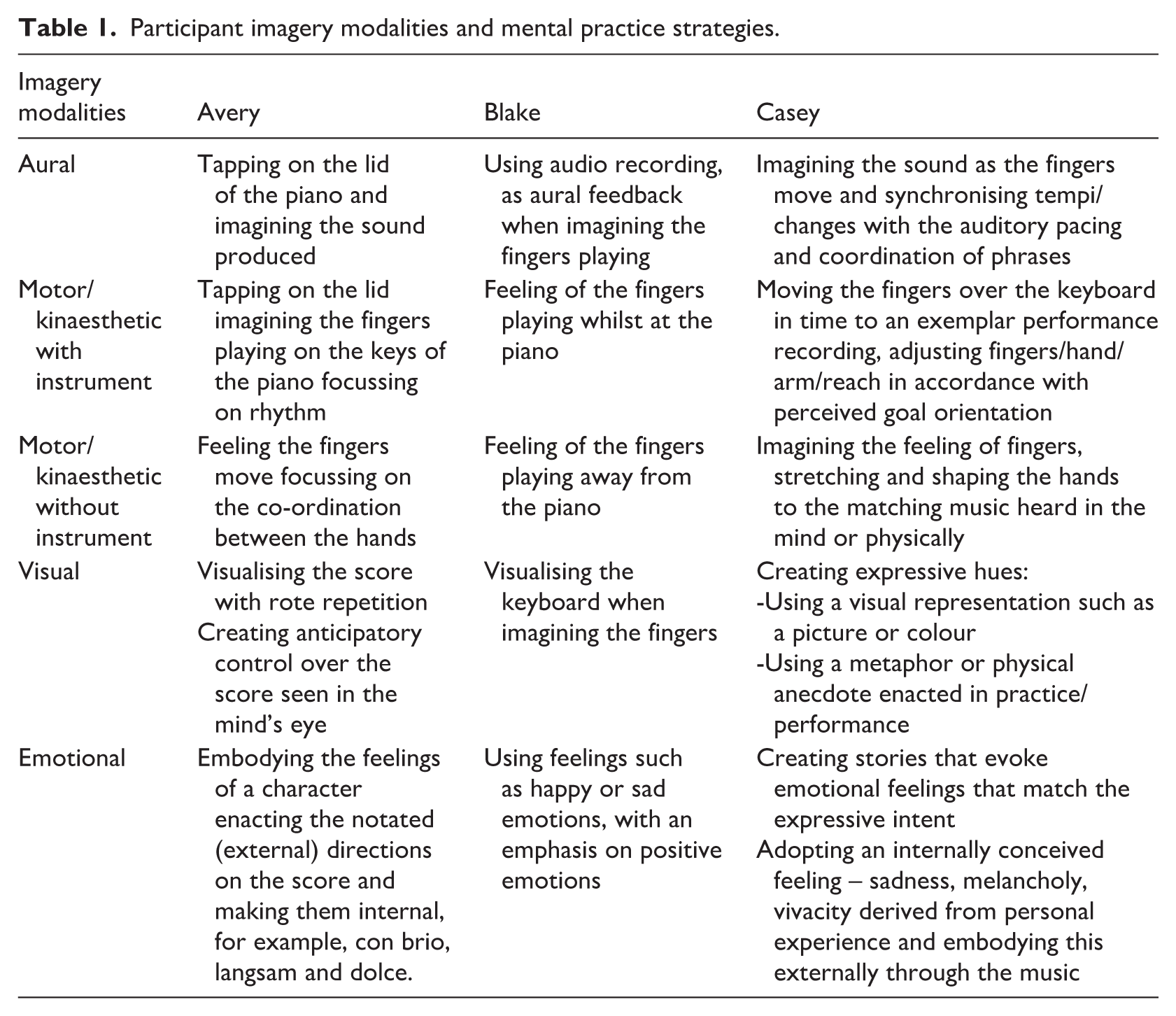
Phenomenologically making meaning from the participants experiences, imagery is a powerful self-driven aspect of cognition that promotes the personalised formation of creative process. This construction firstly finds use as a problem-solving attribute, which over time has evolved within a teacher’s pedagogical toolkit to be used as a mechanism for learning and improvement for others. At the hands of these teachers, imagery was applied in a range of ways as a catalyst for self-regulative and imaginative calibration. Phenomenologically, self-reflection of the imaginative imbues our subjective experiences, recrafting and rebuilding memories and expectations as they are being lived and practiced (Minkowski, 1970).
Conclusion
These three highly experienced performers and educators all have encountered imagery in their music learning, practising and performing in idiosyncratic and evolving personalised ways . These higher education piano teachers discovered imagery through happenstance, explorations of reflective practice and self-generated, self-regulative thoughts designed from how to learn better. While there are varying ways to engage in imagery, this study highlights the idiosyncratic, yet at times familiar experiences of imagery in music learning. This study reveals how teachers can be shaped by early formative experiences, and how pedagogic understandings lay in practices and approaches often absorbed from their own teachers (Cranston-Gingras et al., 2019). It encourages all piano teachers to consider if imagery was a part of their learning, if it is a part of their pedagogic toolkit, compelling reflection and reflexivity to perhaps new ways of teaching. By investigating a range of imagery modalities, the study concurs with previous research that suggests visual, kinaesthetic, motor and auditory forms of imagery. The findings presented offer illuminating examples of these imagery modalities and also contribute to the occurrence and impact of emotional imagery as a viable modality within the learners’ perceptual field of thinking and learning.
Limitations reside in this study only examining three participants who work in the same location. While these participants were selected because of their abilities as professional musicians and teachers, the intention is not that they be considered representative of the wider musical population, rather that these represent a relevant perspective of the experiences of classically trained musicians. The interviews here are necessarily limited by the musical and cultural backgrounds of the interviewer, the interviewees and their experiences.
This study of these three piano educators, and table mapping provides insights into the diverse nature of how imagery can be introduced by the teacher, discovered by the student and applied as a series of mental practice strategies that can improve piano practice and performance. The implications of the study point to how imagery/mental practice is an invaluable tool, helping students gain independence from the score, and from prior conceptions of expression and musicality as they gain confidence in their own mental imagery perceptions and musical possibility. Imagery may still be considered and undervalued and underutilised aspect of piano pedagogy, the three participants in this small scale qualitative study highlight the diverse and incongruent nature of what taught, stumbled upon, developed, and found to be a successful and self-efficacious process, this highlights the need for more research in the area of imagery and mental practice as a prominent pedagogical focus, and the need for professional development opportunities educating teachers in how to use a range of imagery techniques in their pedagogical toolkit. By highlighting the individual’s capacity to devise and create and evolve imagery understandings a regulatory processes over time emphasises the organic and unbridled nature with which imagery can take hold on an individual’s approach to learning.
Imagery can operate as a powerful cognitive gateway involving the storying and embodiment of ideas, feelings, impulses and artistry. By creating pictorial or metaphorical ideas that relate to or represent the music and our meaning making allows students to engage creatively as a performative expression of self. In the music studio, where teachers and students often follow a didactic master-apprentice approach, imagery may offer a relational, empathic and democratic form of connectivity that promotes creativity, critical thinking and dialogic interactions that enhance teacher-student engagement, curiosity and enjoyment in the piano studio.
Footnotes
Appendix

Author Contributions
Dorothy Li: Writing – original draft. Brad Merrick: Writing – review & editing. Leon Rene de Bruin: Writing – review & editing.
Funding
The authors received no financial support for the research, authorship, and/or publication of this article.
Declaration of Conflicting Interests
The authors declared no potential conflicts of interest with respect to the research, authorship, and/or publication of this article.