




Abstract
Today, diversifying the music curriculum is considered a matter of social justice. Although including non-Western and contemporary genres in education is seen as an obvious move, in the context of South African scholar education, the introduction of alternative musical practices has resulted in a misalignment between the curricular conceptual framework and the values of the musical practice. Social realist theorists argue that conceptual knowledge is important because it allows knowledge to be transferred by students. But this is only possible if students can integrate abstract understanding with their empirical experiences, a process described by Maton as semantic waving. Using document analysis, a senior secondary African music curriculum from South Africa is examined for the potential it offers for such integration and application of knowledge. The analysis reveals the complexities of musical knowledge and its articulation in published curricula. It concludes that issues of equity are complicated by curricular structures which do not provide conceptual coherence, and thereby constrain knowledge-building opportunities.
Introduction
In the quest for social justice and equity in music education, many countries have diversified their programmes in a shift away from Western Art Music (WAM) curricula that foreground the performance and analysis of canonical texts. Yet the WAM curricular design has proved resilient, and curricular innovation has often resulted in a curriculum at odds with the transmission practices of the genre (Carroll, 2019; Green, 2008). This article examines the South African senior secondary music curriculum’s inclusion of Indigenous African Music (IAM; Department of Basic Education [DBE], 2011). While African music curricula can be found in many African countries, scholars note the dominance of WAM in those curricula, for instance in their persistent reliance on WAM theory of music (Ligoya, 2013; Mapana, 2013; Musakula, 2014). Their research suggests a lack of alignment between WAM theoretical concepts and IAM practice, resulting in a fundamental lack of curricular coherence.
The South African Curriculum and Assessment Policy Statement (CAPS) for Music (Grade 10–12) outlines an elective subject that students can choose as one of seven subjects for their nationally certificated, matriculation qualification. 1 Three optional ‘streams’ are included: WAM, Jazz, and IAM, with the choice of stream made by the school. To date, very few schools offer the IAM stream (A. M. Carver, 2021; Nguku, 2022, p. 36), with WAM being offered by the majority, and some schools offering Jazz (Rungan, 2023). The limited take up of the IAM stream may be due to several factors, for example teacher competence (Buthelezi, 2016; Drummond, 2015; Msimango, 2023), lack of resources (Mulungo, 2024; Nompula, 2011), or persistent derogatory attitudes towards African knowledge (Drummond, 2015, p. 105; McConnachie, 2016, p. 3; Nguku, 2022, p. 54). However, this article aims to show the role of the curriculum itself in its low take-up by asking the question: To what extent does the IAM stream of the South African Music Curriculum demonstrate coherence between different kinds of musical knowledge and what are the implications for equity?
To explore this question, a brief introduction to social realist theory and Maton’s (2013) concept of semantic waving outlines the theoretical framework. Next, the methodology, textual analysis, is explained, followed by the presentation of examples from the curriculum documents. The data analysis draws on the concept of Maton’s semantic waving to consider the alignment between the conceptual frameworks articulated in the curriculum documents and the implied IAM practices. Finally, the discussion considers the importance of curricular coherence for equitable music education. First, however, context is provided regarding recent curriculum change in South Africa.
Background to the South African Music Curriculum
In South Africa, the process of establishing a post-apartheid curriculum to align with the democratic ideals of the country’s new Constitution was turbulent. 2 The first post-apartheid curriculum, Curriculum 2005 (C2005) was published in 1997. Outcomes-based education (OBE) was chosen for C2005, because its constructivist basis represented a complete contrast to the positivist curricula of the apartheid era (Chisholm & Leyendecker, 2008, p. 201). The apartheid era ‘Christian National Education’ was characterised by a deeply authoritarian and hierarchical conceptualisation of knowledge (MacMillan, 1967), and OBE’s constructivist approach, and its celebration of local knowledges and generic skills was seen as emancipatory. However, few South African teachers were adequately prepared for such a major philosophical shift (Chisholm & Leyendecker, 2008, p. 202; Jansen, 1999, p. 147) and within 5 years, C2005 had seen its first set of revisions. Two further revision processes followed, culminating in the current curriculum, the National Curriculum and Assessment Policy Statements (CAPS), Grades R–12 (DBE, 2011). 3 This curriculum, effective from 2012, abandoned OBE, and returned to clearly stated content and assessment requirements.
Importantly, the process of South African curriculum reform was driven by philosophical arguments about knowledge, in particular, the social realist work of Bernstein (2000).
4
Johan Muller (2007) explains the findings of the C2005 Review Committee: The Review found that the curricular form of C2005 was under stipulated, under-sequenced and its pacing requirements under-signalled. It was a form of invisible or competence pedagogy (Bernstein, 2000) which provided minimal markers as to what should be learnt or evaluated at what level. (p. 25)
Consequently, the CAPS stipulates that all subjects and levels have clear statements regarding what should be learned and assessed. This article considers the consequences of that stipulation for the IAM curriculum. It too, draws on social realist ideas, in particular those of Maton (2013, 2014), whose work on knowledge is built on Bernstein’s theories.
Theoretical Standpoint: Conceptual Knowledge Is Transferable Knowledge
Social realist thinkers argue that mastery of conceptual knowledge is essential if knowledge is to be transferred and applied to new and different contexts (Bernstein, 2000; Maton, 2014; Young, 2008). Without conceptual control, knowledge is more likely to be confined to the context of its enactment. To give a musical example, novice guitarists may know how to form basic guitar chords by using chord shapes, without knowledge of the fretboard, or the relationships between chords and keys. They may successfully play the chords of a song, but their knowledge remains context dependent. To play a different song independently, or change the song’s key, they need to build conceptual understanding. Hands-on knowledge can certainly develop over time and include tacit conceptual understandings (Gamble, 2014), but ultimately, access to a conceptual framework holding knowledge together is necessary to solve complex problems in multiple ways and contexts. Access to the organisational principles underpinning musical knowledge allows learners to go beyond individual applications of knowledge. In this way, conceptual, knowledge, relevant to a musicians’ praxis, is crucial to developing problem-solving where knowledge must be applied in new contexts. This kind of knowledge transcends empirical experience, or ‘know-how’. It depends on access to the conceptual frameworks underpinning a knowledge practice, and to the internal connections between concepts. As Wheelahan (2010) puts it, ‘Rather than learning the isolated and unconnected contents of disciplinary knowledge, students need to learn the systems of meaning’ (p. 96).
Maton (2013) asserts that this requires students to make deliberate connections between abstract and empirical knowledge. Successful teaching and learning depends on connections being forged between the two in a process he calls ‘semantic waving’ (Maton, 2013). Put simply, learners are most able to build their knowledge when they can move between an immediate, experiential, form of knowledge, and the relevant, conceptual understanding underpinning their empirical understanding. This is not a binary in which different forms of knowledge are in conflict. Maton (2014) argues that on their own, each is limiting (p. 142). Further, Maton (2013) asserts that students are advantaged the more they can make connections between more complex systems of knowledge, and their relevant empirical understanding (p. 19).
From 1997, post-apartheid curricular revisions took the South African R-12 curriculum from OBE, which relied on generic standards to be met, to clear statements of what was to be learned and assessed. This implied that for an oral practice, such as IAM, the curriculum should provide explicit content across both practical and theoretical topics.
Methodology
With this theoretical foundation, the South African senior secondary school Music Curriculum is considered to investigate whether curricular structures provide opportunities to connect abstract and concrete understanding. The data sources are curriculum documents: the CAPS Music document itself (DBE, 2011), and selected examination papers and their memoranda (DBE, 2015a, 2015b, 2020a, 2020b). The analysis does not rely on techniques such as semiotics or textual discourse analysis (Denzin & Lincoln, 2000, p. 639), but on careful attention to the use of language, and by considering the implications of the often brief curricular statements. Studying both the CAPS content statements and selected examination material enables a consideration of their alignment or non-alignment. The textual analysis considers the relation of individual concepts to larger explanatory frameworks, and the potential for students to make connections between those concepts and their likely empirical experiences. Next, selected content from the South African curriculum documents is briefly described, followed by analysis and interpretation using Maton’s concept of semantic waving.
The South African CAPS for Music
The Music Curriculum is structured around three Topic areas:
Topic 1: Music Performance and Improvisation
Topic 2: Music Literacy
Topic 3: General Music Knowledge and Analysis
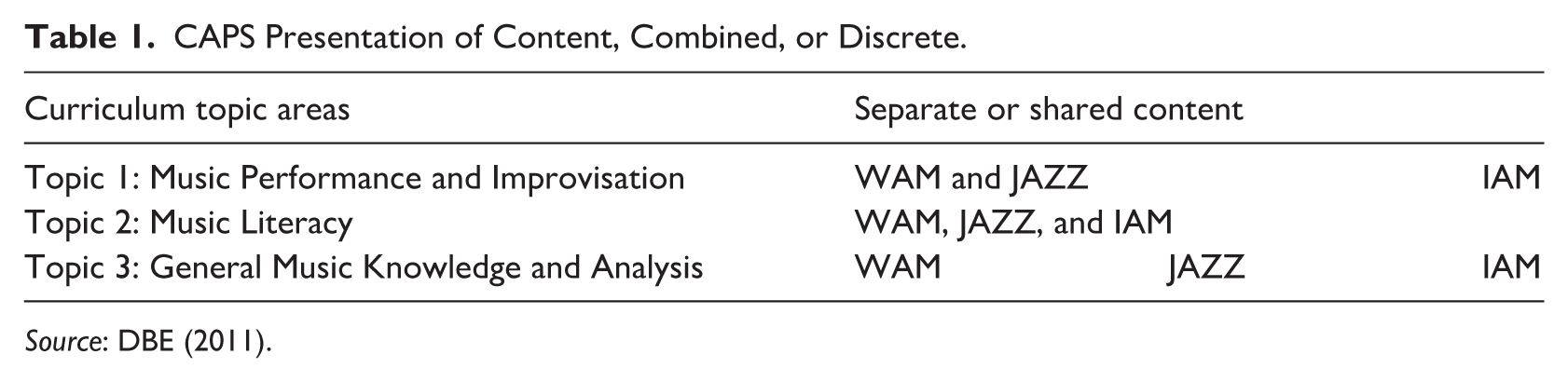
There is some flexibility regarding choice of stream (WAM, Jazz, or IAM), as one can be followed for Topic 1, and another for Topics 2 and 3, for example. Also, there is a degree of overlapping content, with some shared by more than one stream, as shown in Table 1.
CAPS Presentation of Content, Combined, or Discrete.
Source: DBE (2011).
Each school year is divided into four teaching terms. 5 The CAPS presents separate tables for each Topic, each term, with content set out in bullet points.
Topic 1: Performance and Improvisation
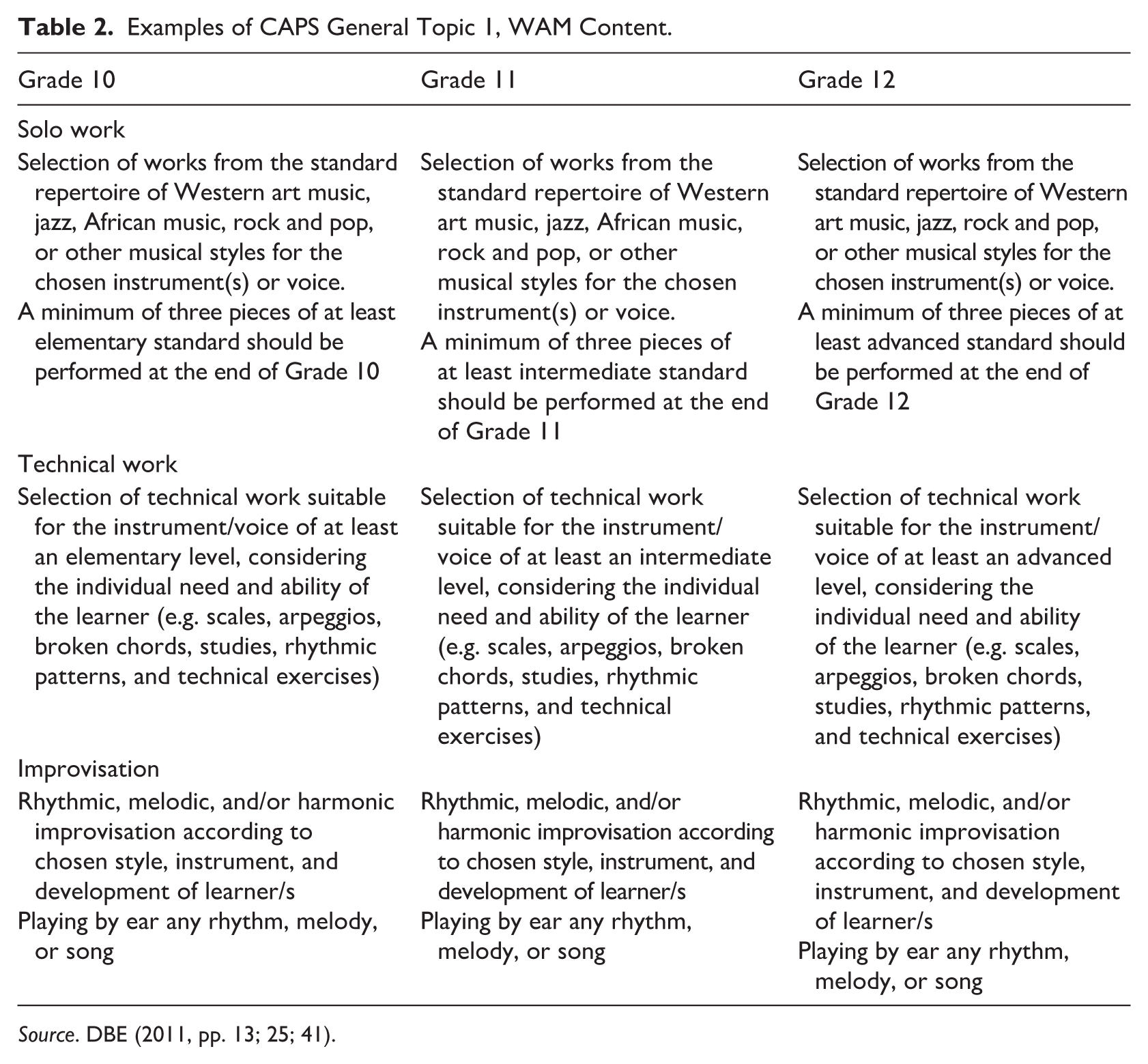
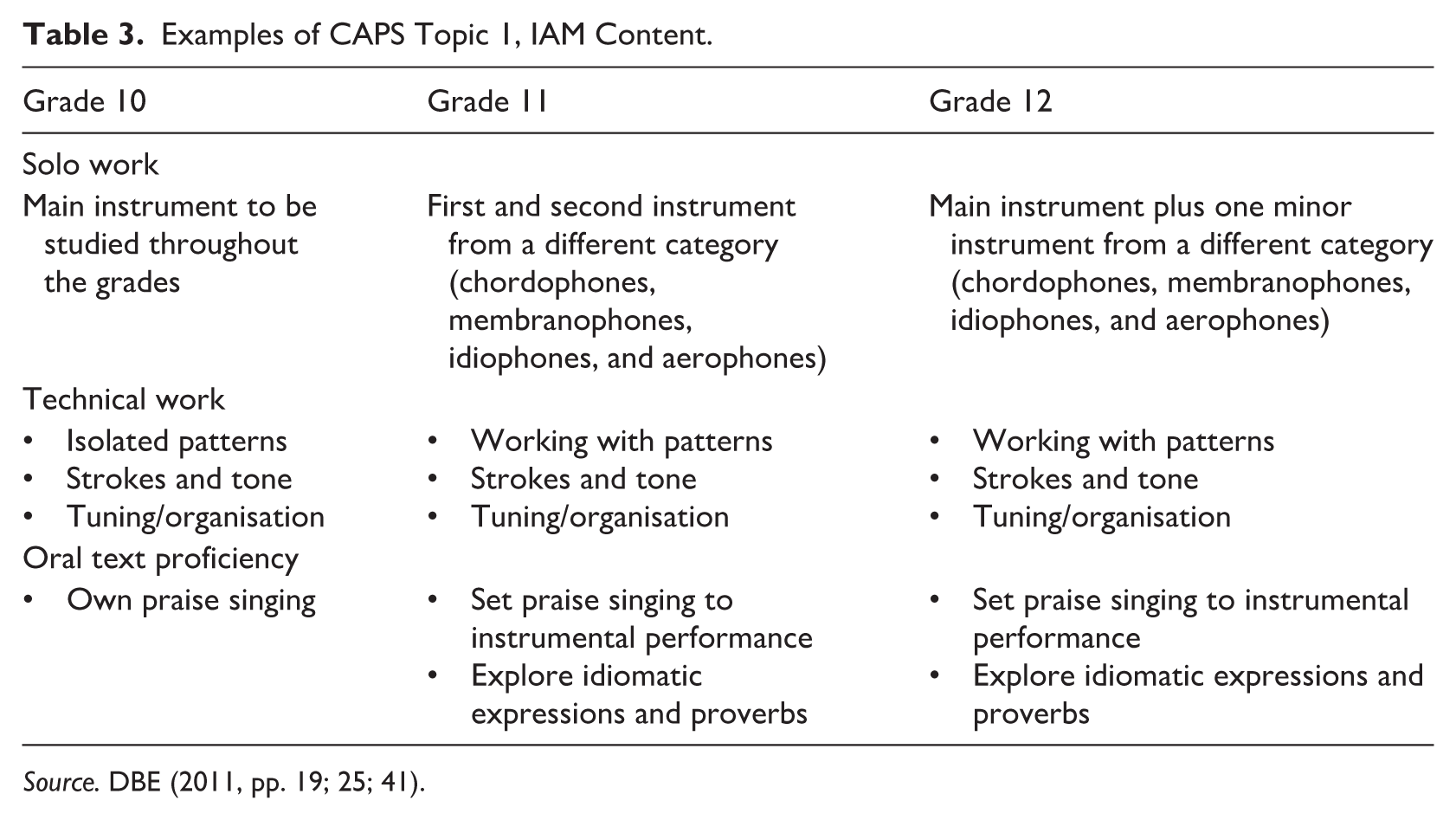
Tables 2 and 3 show examples of the Topic 1 content, taken from Grades 10, 11, and 12 for WAM/Jazz, and IAM respectively. 6 These content statements should be interpreted in the light of the fact that this Topic concerns performance, a knowledge area not easily specified through language. As the tables show, statements are repeated almost verbatim each term. They cannot specify precisely what should be taught and learned but rely on interpretation by knowledgeable teachers. For the WAM/Jazz content, this is possible because the statements gain coherence through their connection to the graded music examinations of Trinity College, and the Associated Board of the Royal Schools of Music (ABRSM), first introduced in South
Examples of CAPS General Topic 1, WAM Content.
Source. DBE (2011, pp. 13; 25; 41).
Examples of CAPS Topic 1, IAM Content.
Source. DBE (2011, pp. 19; 25; 41).
Africa in the late 1800s (Lucia, 2007, p. 180). These examinations, along with those of the South African music examination board, UNISA, are highly regarded in South Africa and provide a kind of unquestioned formula for music education in the country. In the repetitive WAM/Jazz statements, progression is implied by the descriptors ‘basic’, ‘intermediate’, and ‘advanced’. These are benchmarked against graded material from the examination boards. 7
Like the WAM/Jazz content, the IAM content has brief, repetitive statements, shown in Table 3. As might be expected, these are quite different to the WAM/Jazz section, but here there is no equivalent of the external music boards for IAM that could provide a model. While there are certainly knowledgeable IAM practitioners in South Africa, there is no common pedagogical approach within the practice, or taught in teacher preparation courses, that would allow consistent interpretation of the CAPS IAM statements. IAM, as portrayed in the CAPS, suggests a collection of traditional and neo-traditional practices. These would have some commonality, but do not offer a tradition shared by a community of IAM practitioners that could provide a standardised understanding of the CAPS statements, and how progression should be measured.
These challenges may be the reason that, as yet, no assessment guidelines have been published for Topic 1 of the IAM stream (A. M. Carver, 2021; Nguku, 2022; Pooley, 2020), providing no clarity on either the content statements themselves, or assessment details. While the lack of IAM assessment guidelines could be due to the difficulty of managing diverse performance traditions and standards, without trustworthy and consistent assessment criteria, IAM performance is undermined. This is illustrated by the fact that to date, no students have offered IAM performance as part of their Grade 12 national assessment (Nguku, 2022).
Topic 2: Music Literacy
As shown in Table 1, Topic 2 has the largest proportion of content shared by all three streams, despite consisting almost exclusively of WAM theory of music. It is oriented towards literacy in staff notation, and fluency with WAM theory of music. Most of the examination content for all three streams is based on WAM theory.
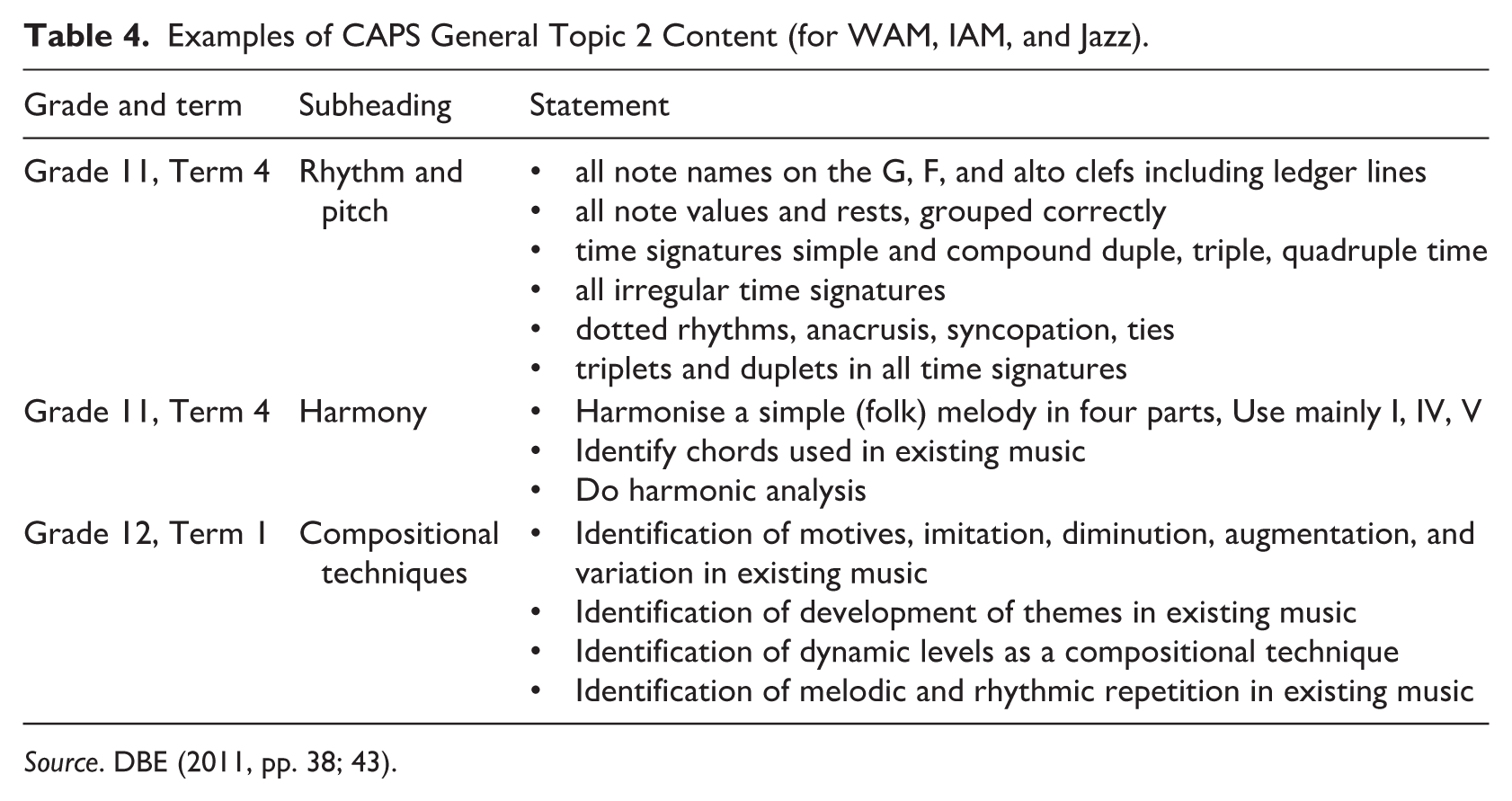
The Music Literacy content is set out under subheadings. Examples are shown in Table 4. Each bullet point suggests further detail obvious to those schooled in the WAM tradition. Each unambiguously references abstract content that implies further specific conceptual detail (tonal and metric systems, and so on), and that concept’s place within larger conceptual frameworks. Progression is indicated by a gradual increase in complexity, with basic rhythm and pitch introduced first, moving on through scales and keys towards harmony and form. The logical end point of this course is an understanding of tonal-functional harmony. Only in Grade 11 is IAM specific content introduced. Table 5 provides examples of the content. Unlike the presentation of WAM content (see Table 4), which implies a level of detail going beyond the statements themselves, the IAM terms are less defined. For example, under the subheading Rhythm and Pitch, the statement ‘philosophy of duality of time signatures in African music: 12/8 as an interface of 4/4 experienced practically – then written as a horizontal harmonic procedure’ references the concept of meter. However, there is also a reference to harmony, and the complex wording could lead to confusion. The statement elaborating Pulse indicates that ‘Rhythmic structural principles’ include ‘space, complementation, sharing, bonding, creative spontaneity’. While the WAM/Jazz content focusses on musical structure, it is not clear, for instance, whether ‘sharing’ and ‘bonding’ refer to features that can be heard or performed, or to social relationships amongst participants.
Examples of CAPS General Topic 2 Content (for WAM, IAM, and Jazz).
Source. DBE (2011, pp. 38; 43).
Examples of CAPS IAM-specific Topic 2 Content.
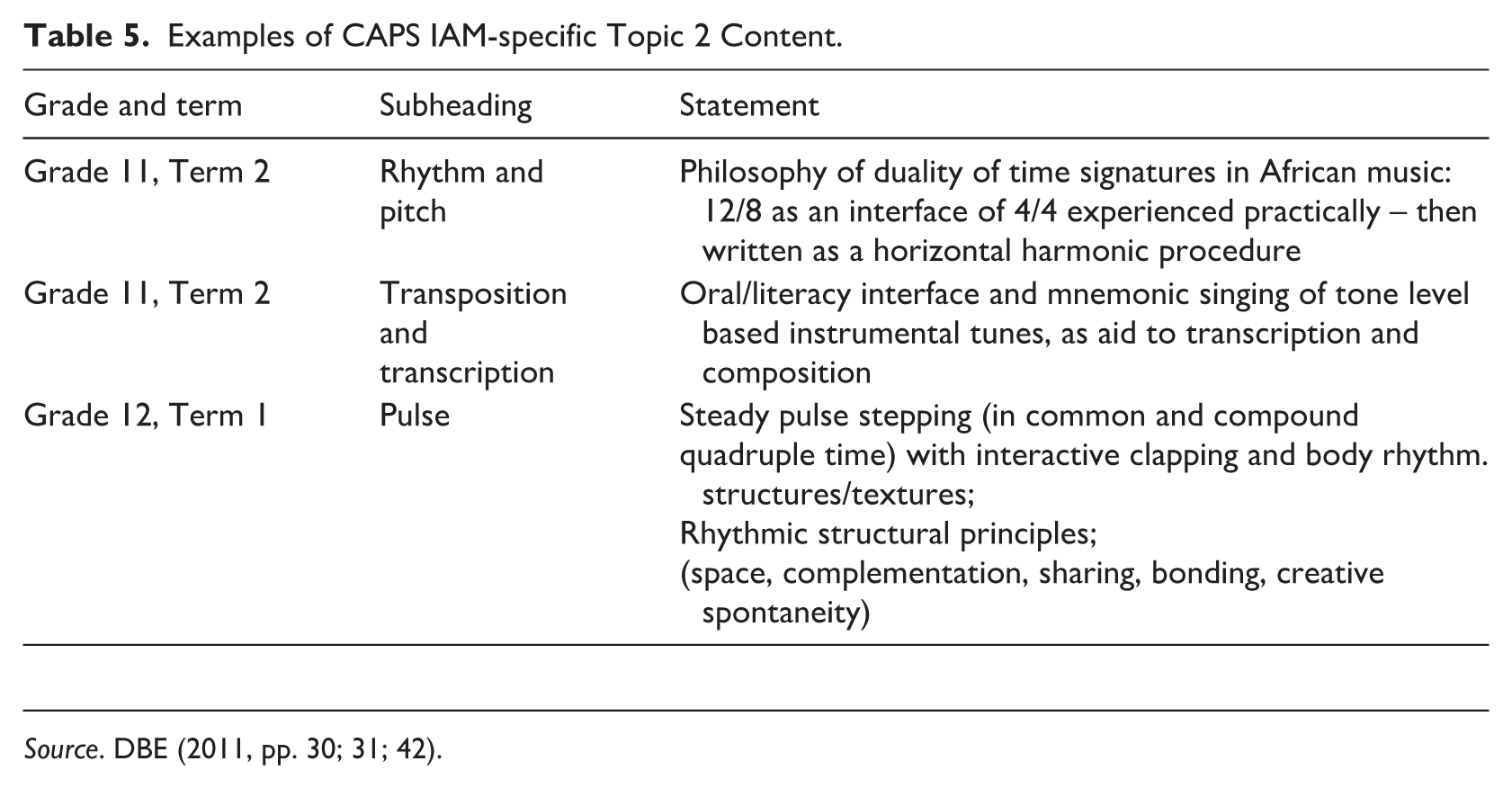
Source. DBE (2011, pp. 30; 31; 42).
Topic 3: Music Knowledge and Analysis
Topic 3 covers musical works, traditions, and styles, and it is the only Topic in which content is articulated separately for each stream, after two introductory terms of shared content. The WAM and Jazz streams draw on their respective canons, with named works presented chronologically. The IAM content is more eclectic, with three distinguishable themes: traditional music, ‘modern constructs’ (DBE, 2011, p. 48), and philosophical understanding. The first two imply examples of sounded music, but the third, like the references to ‘sharing’ and ‘bonding’ seen above, suggests something less tangible. Content examples for each stream are shown in Table 6.
Examples of CAPS Topic 3 Content, Grade 10, Term 3.
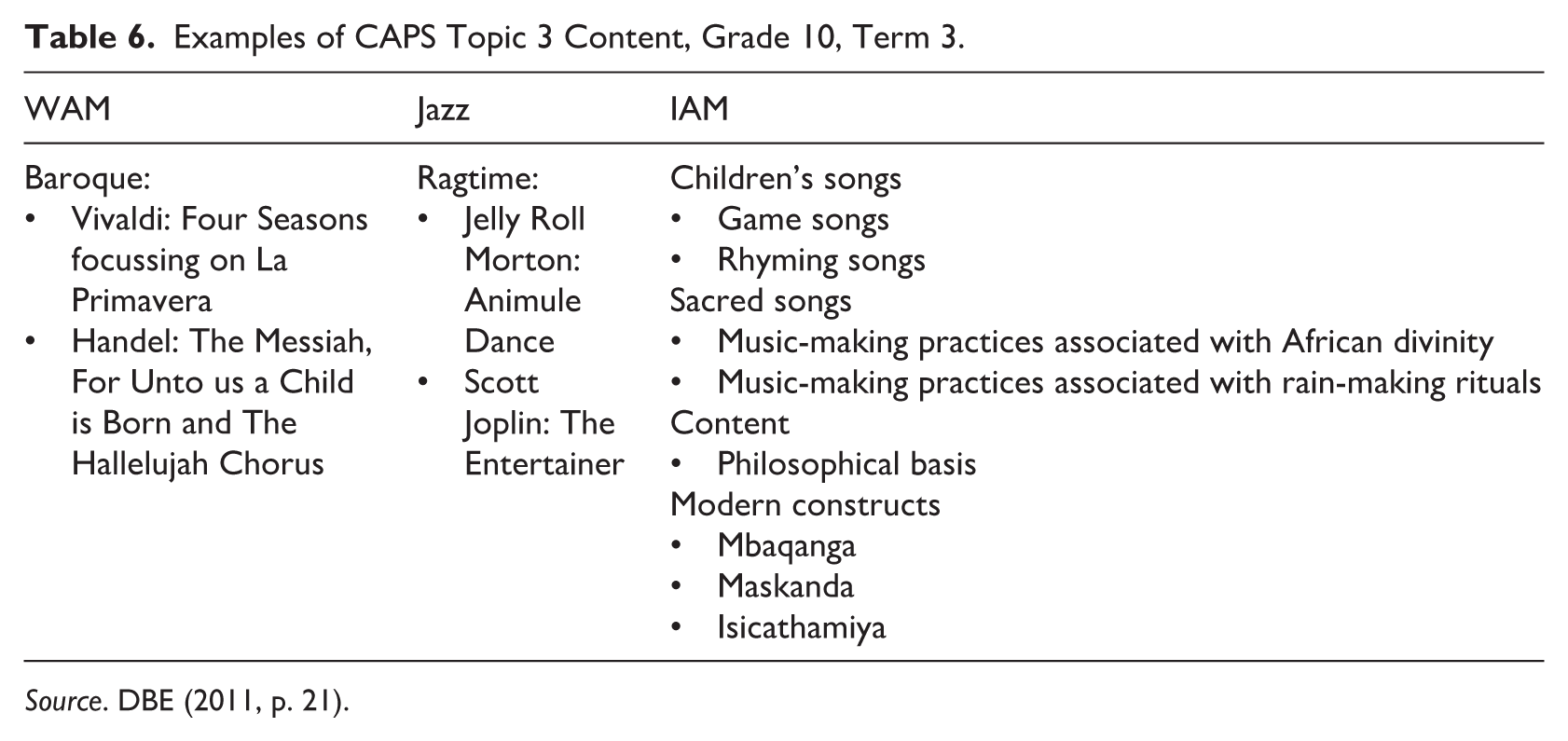
Source. DBE (2011, p. 21).
Although the content statements do not over specify how the Topic 3 content should be managed in the classroom, the Grade 12 examination papers reveal what is required for each stream. WAM and Jazz students must apply the concepts of Topic 2 to describe specific musical works, showing their understanding of musical structure and the stylistic characteristics of different works. For example, a question on the fourth movement of Beethoven’s Symphony No. 6, Op. 68 asks students to describe form, instrumentation, and mood/atmosphere. The memorandum indicates that answers must include direct links to particular musical features, such as the F minor key creating an ‘ominous’ mood, the wide dynamic range depicting the ‘ebb and flow of the storm’, and the diminished 7ths adding ‘drama’ (DBE, 2015b, 2015a).
In contrast, the IAM examination questions do not require any evidence for answers, but instead, propositional statements that can be memorised are sufficient. With little specificity in the IAM content statements, model responses in the examination memoranda become the de facto curriculum, providing ‘facts’ that can be memorised for the examination. 8 Table 7 provides examples of the model answers to an examination question from November 2020 (DBE, 2020a, p. 20).
Example of CAPS Examination Question With Model Responses (IAM Stream).
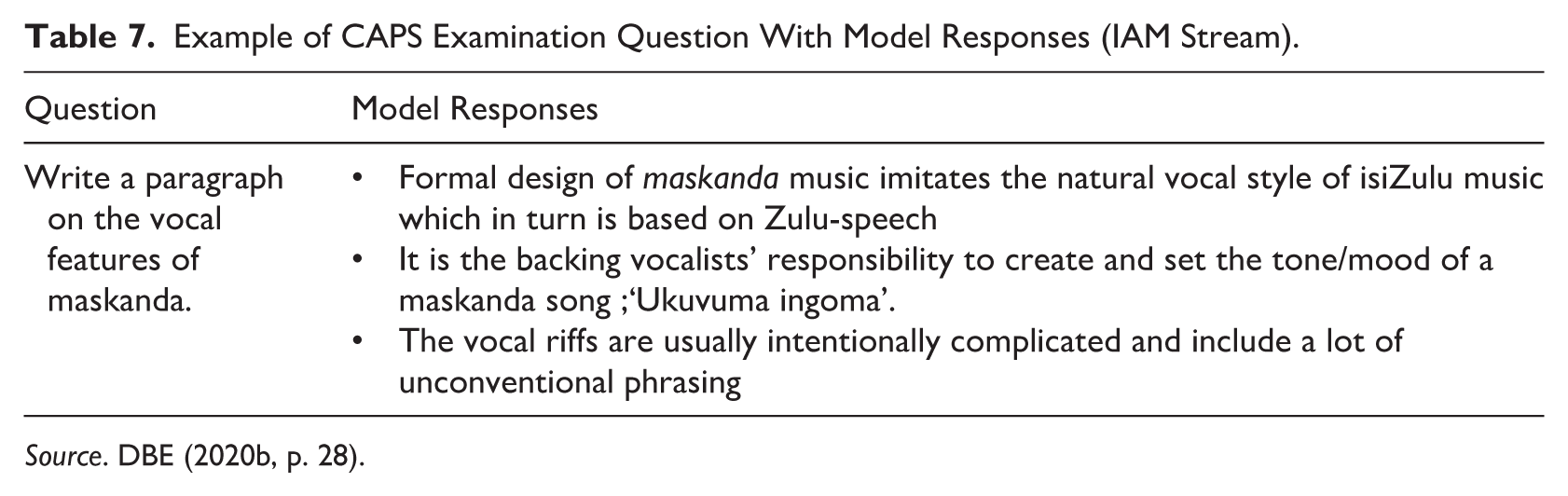
Source. DBE (2020b, p. 28).
Further explanation of the musical features of maskanda, how they relate to Zulu speech, or how they ‘set the tone/mood’ are not required. There is no suggestion that a musical description of what constitutes a ‘complicated’ riff, or ‘unconventional’ phrasing, is necessary. These reference intersonic features but do not require students to show deeper understanding. Also, the specialist IAM concepts presented in the IAM Topic 2 statements are not anywhere in evidence in the memorandum responses.
Analysis
Maton (2013) asserts that knowledge building relies on students’ ability to move fluently between abstract, conceptual knowledge, and the related empirical understanding, in a process he calls semantic waving. For this to be achieved, however, a curriculum must have the potential for these connections to be made, suggesting the need for clear internal coherence. This brief description indicates that that the IAM curriculum suffers from a lack of coherence on different levels. The content statements of Topic 1 do not reference a curricular pathway clearly enough for schools to confidently offer this option to students. They do not unambiguously reference what should be learned, or how it should be assessed. Consequently, IAM Topic 1 is not followed by schools, limiting the possibility for students following other IAM Topics to make links between conceptual content and empirical understanding gained through performance.
The general Topic 2 content is underpinned by the logic of WAM, despite forming part of the IAM curriculum. Although note values, tonal systems, and chords, for example, can be enlisted by many African traditions (Agawu, 2012; Kubik, 2010; Nketia, 1975) some CAPS bullet points are counterintuitive to African perceptions of musical structures. For example, grouping notes ‘correctly’ according to WAM conventions might be inappropriate or even irrelevant in some African traditions. The WAM-centric list does not correlate with the values, priorities, and complexities of African musicking (M. Carver, 2012), resulting in a fundamental lack of coherence. Furthermore, the specialist IAM Topic 2 concepts do not present a credible alternative to WAM theory because they are not articulated in enough detail to provide access to the relevant conceptual frameworks through which students might develop conceptual control.
Although the IAM specific terms create the impression of specialist knowledge, their complexity is not unpacked via links made to musical examples anywhere else in the curriculum. For instance, it is not clear how the concepts ‘sharing’ and ‘bonding’ are made manifest in musical structure and music activity, or how they relate to other important concepts. Such conceptual unpacking is a necessary if students are to go beyond basic recall to apply their knowledge to new problems.
One result of the ill-defined IAM content statements is IAM Topic 3 examination questions that rely on rote learning, rather than application of knowledge. While the WAM and Jazz memoranda answers show the need for students to apply theoretical concepts to show their musical understanding, no level of analysis is needed for the IAM questions. They suggest statements that can be memorised without their deeper significance, or their place within larger frameworks, necessarily being understood. Without links being made to specific musical examples to facilitate contextualisation, the specialist IAM concepts remain locked in their abstract form and are of little use when it comes to supporting Maton’s (2013) semantic waving. In sum, the lack of alignment between different kinds of curricular knowledge restricts the possibility for connections to be forged and for semantic waving to take place. Abstract conceptual content remains abstract, disconnected from relevant wider conceptual frameworks and, also from empirical understanding. This dislocation provides no opportunity for knowledge building through semantic waving.
Discussion
Curriculum documents cannot describe in fine detail everything about the intended knowledge, skills, and values. But teachers must be able to interpret the documents. This short account of the South African CAPS content shows how incoherence can result when a musical practice and the supporting conceptual language are misaligned, and when concepts are referenced with insufficient contextualisation. This South African case has lessons for international music educators seeking equitable pathways to diversity. First, it shows that a curriculum needs clear direction regarding what is required, and how learning should progress. The poorly stipulated IAM Topic 1 has resulted in no candidates, minimising the possibility of experiential understanding of the abstract concepts included in the other CAPS Topics, and also undermining the knowledge practice. Second, it shows that conceptual frameworks referenced in curricula must align with the musical practice in question. The unquestioned use of WAM theory might be considered problematic, but replacing it with a set of concepts where neither their relations to one another, nor the music they reference, are made clear, is unlikely to solve the problem. Third, language needs attention because it is the medium of communication in curricula and classrooms. Terminology gives us a way to ‘see’ musical phenomena and bring a level of control over our musical experiences (McPhail, 2023, p. 121). Genre-specific concepts, such as ‘sharing’ and ‘bonding’, are not insignificant, but unless terms coherently elucidate meaning, they could be restricted to their abstract form, disconnected from musical experience. Such abstraction cannot bring conceptual clarity or significant learning. Fourth, every musical practice has specialist knowledge, some of which might be difficult to articulate in words. But without careful curricular attention to genre-specific knowledge, such ‘intangible’ knowledge could be treated superficially. Where knowledge cannot be defined it can result in essentialism, because knowledge that cannot be explained risks being exoticised. Where the complexity of knowledge cannot be unpacked, the conclusion might be drawn that the knowledge practice is easy, less rigorous, and less valuable for formal education. Yet knowledge that is crucial to a musical practice and referenced in a curriculum deserves the kind of attention that makes it accessible to students.
The analysis shows that the themes of injustice and inequity in the South African IAM curriculum lie partly in the dominance of WAM values in the IAM curriculum. But to see this as the main issue is to oversimplify the problem. A deeper failing of the IAM curriculum is its failure to show coherence. It does not show the interdependence of the knowledge and skills across the three Topics. Yet mastery depends on control over these connections. The resulting incoherence within the IAM curriculum may be the reason for its low uptake in South African schools. Further, rather than portraying equity between WAM and IAM, aspects of the IAM content, such as the poorly stipulated Topic 1, and reliance on rote learning in Topic 3, suggests a dumbing down of knowledge and fundamental inequity between the different streams. Together, these portray IAM as a knowledge practice that is not worth acquiring. Indeed, it supports a worrying perception that persists amongst South African music teachers of IAM as deficit, less rigorous, and less worthwhile than WAM (Drummond, 2015, p. 105; McConnachie, 2016, p. 3; Mkhombo, 2019, p. 147; Nguku, 2022, p. 54). These attitudes may be entrenched by streamed curricula that seem to set up a binary between ‘Western’ and ‘other’. Such unequal outcomes contradict the stated aims of the South African Curriculum to value indigenous knowledge systems and ensure that ‘the educational imbalances of the past are redressed’ (DBE, 2011, p. 5).
As a performance art, music is a compellingly practical knowledge area. Myriad traditions are learned within communities of practice, based on playing, and without much attention paid to a formal ‘theory’. Furthermore, a curriculum that is theory-heavy can alienate students. It is easy to see conceptual knowledge as the source of music education’s problems. Yet while oral genres are sustained in communities through hands-on learning, classrooms cannot meaningfully re-enact these practices long-term. Classrooms may not manage to consistently provide the mentors, the community of musicians, or the time required for the transfer of skills. Therefore, recontextualisation in the classroom needs something more. It needs to value knowledge, both concrete and conceptual, and to prioritise connections between these. For this, it needs a carefully articulated conceptual framework flexible enough to fit the musical practice, and, teachers equipped with the skills to build this knowledge in nuanced ways (Carroll, 2019; McPhail, 2017).
Conclusion: Finding Curricular Coherence
Internationally, part of the task to diversify music education is to include diverse music practices, many of which are built on oral tradition. While highlighting a South African case, this article shows the challenge faced beyond South Africa, that of bringing alternate genres into formal curricula. In particular, the article brings into focus the importance of conceptual frameworks and their alignment with empirical musical understanding.
The South African case shows how the conceptual language inherited from WAM cannot be seen as unquestioningly suitable for all musical practices. Yet whilst being wary of WAM oriented theory, this is not a call to abandon theory altogether. Carefully framed conceptual knowledge remains foundational to school curricula and assessment schemes. The implications for further research are twofold. First appropriate frameworks for the diverse genres must be developed. These frameworks should reflect the values of their respective genres, be they practical, theoretical, philosophical, or social. Second, ongoing research is needed to identify pedagogies that are both conducive to individual musical practices, and supportive of knowledge frameworks. This requires highly nuanced work, but anything less short-changes students and increases the likelihood of marginalisation and inequity.
Footnotes
Acknowledgements
The article began its life as a panel for the International Society for the Sociology of Music Education’s 2021 conference presented by myself, Christine Carroll, Saul Richardson, and Jack Walton. I am indebted to them for their contribution to my thinking and for their support and encouragement.

Author Contribution
Funding
The author received no financial support for the research, authorship, and/or publication of this article.
Declaration of Conflicting Interests
The author declared no potential conflicts of interest with respect to the research, authorship, and/or publication of this article.