




Abstract
This qualitative study explored music teachers’ perceptions of technology use in Fujian Province of China through the lens of the Unified Theory of Acceptance and Use of Technology 2 (UTAUT2), which identifies key factors that influence technology adoption. The study conducted semi-structured interviews with 14 music teachers and applied deductive thematic analysis. The results revealed five key dimensions facilitating technology acceptance among music teachers: Performance Expectancy, Effort Expectancy, Social Influence, Facilitating Conditions, and Habit. Surprisingly, there was little qualitative evidence that Hedonic Motivation played a role in their technology adoption. The findings indicate that music teachers in Fujian Province of China prioritise teaching effectiveness, operational simplicity, institutional networks, support resources, and established practices rather than personal pleasure when adopting technology. These considerations exhibit complex interactions in higher music education within this regional Chinese context, where differences in cultural values subtly but significantly shape teachers’ technology adoption decisions. This study extends the UTAUT2 model to a non-Western context, deepening the understanding of technology integration in music education while providing insights into technology enhanced instruction across cultural contexts.
Keywords
Introduction
The landscape of music education has been changing under the ubiquitous influence of technology. Technology in music education encompasses various digital tools: hardware such as computers and mobile devices; software such as digital audio workstations (DAWs); web-based tools such as online platforms; and emerging technologies such as artificial intelligence (AI) (Holland, 2000; Merrick, 2012; Ruthmann & Hebert, 2012; Shin & Jung, 2024). These technological tools, ranging from interactive media to AI, are reshaping the ways in which music is taught and learned (L. Cheng, 2025; King & Himonides, 2016; Ruthmann & Mantie, 2017). Research demonstrates the multifaceted impact of technology in music education, transforming pedagogical approaches across composition, performance, theory, and assessment while enhancing student engagement and expanding access to diverse musical experiences (Cayari, 2018; Crawford, 2017; Dorfman, 2022; Lam, 2023; Ng et al., 2022). Technological advances have particularly empowered educators to develop comprehensive musical competencies in students, including technical skills such as intonation, rhythm, and expressiveness (Giddings, 2022), as well as aural skills, music literacy, collaborative musicianship, and creative composition (Buonviri & Paney, 2020; Cremata & Powell, 2015; Dorfman, 2017; Horton, 2024).
The benefits of integrating technology in music education extend beyond enhanced accessibility, engagement, and personalised learning opportunities (Calderón-Garrido et al., 2020; Crawford, 2017; Merrick & Joseph, 2023). As Earle (2002) emphasises, “integration is defined not by the amount or type of technology used, but by how and why it is used” (p. 7). Andoniou (2024) further notes that technology integration in the post-pandemic era involves the purposeful application of digital tools to support teaching and learning while achieving curricular goals and meeting the needs of diverse students. This strategic alignment of technology with pedagogical goals enables digital tools to serve specific music learning outcomes across multiple domains. For instance, notation software and AI-assisted platforms can enhance skills in composition, literacy, and technical proficiency when aligned with curriculum goals (Johnson & King, 2024). However, successful integration depends first on educators’ willingness to adopt these technologies. The COVID-19 pandemic highlighted the importance of this relationship, as educators who were willing to adopt new technologies demonstrated greater adaptability in maintaining students’ engagement (Merrick & Joseph, 2023). While some educators face challenges including inadequate pedagogical training, limited technological infrastructure, and insufficient institutional support (Calderón-Garrido et al., 2020), others embrace technology as essential to sustaining their teaching practices (Beirnes & Randles, 2023). Understanding the factors that influence music educators’ technology adoption decisions is therefore crucial to effectively supporting the broader integration of technology in music education contexts. In this context, adoption refers to music educators’ conscious decision and their initial action to use technological tools in their teaching practice.
Music Education in China
Music education in China has adapted in response to the political and social climate, frequently serving as a tool for shaping national identity and values (Ho, 2013). The content of music education often reflects themes of national prosperity, Chinese cultural rejuvenation, Confucian values, socialism with Chinese characteristics, and personal ideals (Ho, 2018). These cultural characteristics can influence the promotion of music technology applications in China in various ways, especially in the context of national policies promoting the application of music technology and linking it to national educational goals and teacher professional development (Zhang et al., 2021). Such policies often translate into government- or school-led promotional campaigns for designated music technology platforms, directly influencing adoption patterns at the institutional level. When studying technology integration in music education in China, researchers should consider this educational paradigm, which may differ fundamentally from Western approaches. Specifically, the Chinese educational environment emphasises collective harmony rather than individual expression. High power distance culture in China makes teachers more susceptible to the influence of superiors, peers, or official opinions when using technology (Huang et al., 2019).
Existing research on technology in music education in China has identified several key predictive factors for technology use. For instance, Zhang et al. (2021) established that a composite of teachers’ individual beliefs significantly predicts their technology adoption intention. Other studies have confirmed the positive impact of digital technology on student motivation and professional competence (Wan, 2023) and have explored the link between e-learning adoption and academic performance, noting that this relationship can be moderated by students’ resistance to innovation (Bai, 2024). However, these statistical relationships alone inadequately reflect the complex cultural and contextual considerations that influence how technology integrates with the unique educational paradigm of China. The research gap lies in the lack of qualitative exploration of educators’ lived experiences and decision-making processes as music education in China negotiates the integration of traditional teaching philosophies with modern technological requirements (Mei & Yang, 2021). Therefore, this study explores the experiences of music educators integrating various technologies in their teaching practices, examining how traditional pedagogical approaches, such as teacher-centred teaching and the emphasis on musical skill mastery, and the socio-political context of China influence their adoption of technology.
Conceptual Framework
This study employs the Unified Theory of Acceptance and Use of Technology 2 (UTAUT2) as its conceptual framework to investigate dimensions influencing technology adoption in music education in China. UTAUT2, developed by Venkatesh et al. (2012), extends the original UTAUT model (Venkatesh et al., 2003) by addressing limitations in the application of technology acceptance theories in non-organisational contexts such as education. While the original UTAUT integrated eight prominent technology acceptance models, it was primarily designed for contexts where technology use was frequently mandatory. UTAUT2 better explains voluntary technology adoption, increasing variance explanation in behavioural intention from 56 to 74%, and in technology use from 40 to 52% (Venkatesh et al., 2012, 2016). This enhanced explanatory power provides a comprehensive theoretical foundation for understanding factors that motivate voluntary technology adoption. It is particularly applicable to research with music educators, who have been shown to voluntarily use a variety of technological tools in their teaching (Burns, 2020; Waddell & Williamon, 2019).
UTAUT2 incorporates seven core constructs that influence technology acceptance and use. Four constructs were derived from the original UTAUT model: Performance Expectancy (PE) captures a belief that technology improves job performance, which in music education means enhancing various aspects of music teaching and learning, such as performance skills, composition abilities, and music appreciation; Effort Expectancy (EE) addresses perceived ease of use and learning associated with the technology, manifesting in music educators’ ability to integrate digital tools into teaching contexts including rehearsals, lessons, and classroom activities; Social Influence (SI) considers the pressure or support from colleagues and superiors, operating through professional relationships including department leadership, peer music educators, and broader music education communities; and Facilitating Conditions (FC) addresses available resources and technical support, including access to specialised music equipment, software, and suitable spaces. Three additional constructs are included in UTAUT2: Hedonic Motivation (HM) refers to the enjoyment associated with technology, which for music educators manifests through the satisfaction derived from tools that enhance creative expression and musical engagement in teaching contexts; Price Value (PV) considers the benefit-cost ratio, a worthy consideration given the often specialised nature of music technology investments; and Habit (HA) reflects increased likelihood of technology use due to repeated experience, as demonstrated when music educators incorporate digital tools and online platforms into their regular instructional routines following various periods of sustained use.
Educational researchers have validated the UTAUT2 framework across various technologies including AI tools (Xu et al., 2024), e-learning platforms (Zacharis & Nikolopoulou, 2022), blended learning (Azizi et al., 2020), and massive open online courses (Tseng et al., 2019). Existing empirical studies also support the relevance of UTAUT2 to music teachers specifically. He and Ren (2025) investigated pre-service music teachers in higher education in China using an extended UTAUT2 framework, finding that all core constructs (i.e., PE, EE, SI, FC, HM, PV, and HA) significantly and positively influenced behavioural intention to use generative AI tools, with SI, HA, and FC showing the strongest effects. Additionally, they identified the need for future research to transition from quantitative to qualitative approaches to better understand the underlying mechanisms of technology adoption. The application of UTAUT2 to music education in China offers advantages for understanding technology adoption through cultural-specific manifestations. For example, the hierarchical nature of Chinese education systems likely amplifies factors such as SI compared to Western contexts. This is because teachers in China typically prioritise institutional directives and peer consensus when making technology adoption decisions (Huang et al., 2019; Zhang et al., 2021). The simultaneous embrace of technological advances and traditional pedagogical methods in China has also created a tension that UTAUT2 is well-positioned to explore. This tension can manifest as teachers balancing collective learning traditions with interactive technology on digital platforms. UTAUT2 constructs capture these competing pressures, such as SI reflecting how institutional expectations and peer adoption patterns influence teachers’ decisions between traditional and technological approaches.
Although some studies in China have used the original UTAUT model to investigate music teachers’ technology adoption and integration (e.g., Zhang et al., 2021), and recent research has applied UTAUT2 quantitatively to pre-service music teachers (He & Ren, 2025), this area lacks qualitative investigation. While quantitative studies have identified significant relationships between all UTAUT2 constructs and adoption intention, qualitative research is needed to explore the underlying processes and cultural meanings that shape music teachers’ technology adoption experiences. Therefore, this study seeks to fill the following research gaps: 1) lack of qualitative research on how music educators perceive, make decisions about, and integrate technology in their teaching practices; and 2) limited application of UTAUT2 in non-Western music education settings, particularly in China. By employing UTAUT2 as the analytical framework, this qualitative investigation explores how the constructs of the framework are represented and interrelated within the context of music education in China. This approach maintains theoretical consistency by systematically examining teachers’ experiences through the lens of established UTAUT2 constructs, enabling direct comparison with existing quantitative findings while revealing the cultural processes underlying these relationships. This helps to deepen theoretical knowledge of technology adoption frameworks and enhance empirical understanding of their cultural manifestations in non-Western educational settings. The methodology aligns with the overarching question of what drives technology adoption in music education in China, while providing theoretical extensions to UTAUT2 through its application in this specialised educational domain.
Literature Review
Global Context of Technology in Music Education
Research examining technology integration in music education has flourished across diverse geographical contexts, revealing both universal trends and region-specific variations. In the United States, many studies have explored how music educators adapt to technological demands, emphasising the provision of technological competencies aligned with 21st-century learning needs such as digital literacy, creative problem-solving, and adaptive expertise, and the importance of teaching students to use technology for developing musicianship (Bauer, 2020; Dorfman, 2022). These practitioner-oriented textbooks not only highlight PE by emphasising the effectiveness of technology in improving music learning outcomes but also emphasise EE by discussing user-friendly interfaces and easy-to-integrate features. At the same time, they highlight HM by emphasising how enjoyment and intrinsic pleasure in music creation drive teacher and student engagement with digital tools.
European research presents alternative perspectives. For example, Calderón-Garrido et al. (2020) examined digital competencies and technology usage habits among music educators in Spanish universities, finding that their teaching practices often remain limited to superficial applications and highligting the need for effective technology usage habits. This emphasis on habitual usage patterns directly relates to the HA construct in UTAUT2, while their focus on perceived benefits of technology aligns with PE. In Asian contexts, a study of Korean primary music teachers (Kim, 2021) suggests that effective implementation of blended learning depends on targeted professional development, particularly the interdependence between training and successful technology integration, which underscores the importance of institutional support and facilitation. These findings correspond to FC in UTAUT2, while teacher concerns about technology complexity reflect EE, and the influence of school policies represents SI. While these studies span different educational levels and geographical contexts, they demonstrate convergent evidence for the same underlying constructs that form the foundation of UTAUT2. The consistent emergence of these themes across diverse contexts provides empirical support for applying UTAUT2 as the analytical framework for investigating technology acceptance by music educators in China.
Studies across regions confirm that technology integration in music education is a global phenomenon with diverse applications. Eiksund et al. (2020) examine technological applications in Nordic educational contexts, including loop station conducting and iPad composing, while King et al. (2017) provide a comprehensive anthology covering technological initiatives worldwide from laptop orchestras to virtual choirs, examining both practical applications and theoretical perspectives. A scoping review by Lam (2023) identifies eight types of technological tools for enhancing creativity in K-12 music education, with sequencer software and GarageBand being the most prevalent. These works demonstrate how educators can adapt technology tools to specific cultural and educational contexts.
Research indicates that technology integration supports fundamental musical skill development, including aural skills through digital technologies (Buonviri & Paney, 2020), performance capabilities through self-regulated learning technologies (Waddell & Williamon, 2024), and possibilities for creative expression and compositional possibilities through DAWs and generative AI (Johnson & King, 2024). The COVID-19 pandemic has accelerated technology adoption, compelling music educators globally to adapt their teaching methodologies (Joseph & Lennox, 2021). These adaptations reveal specific universal challenges, such as technological inequity, teacher proficiency gaps, and infrastructure limitations in digital environments (Calderón-Garrido et al., 2020; Crawford, 2017), which could directly impact music educators’ decisions to adopt technology. These challenges are related to EE and FC of the UTAUT2 framework, while the need for adaptation during COVID-19 provides insight into how HA occurs under external pressure. Therefore, understanding how music educators in China respond to these challenges within their unique cultural context is also the focus of this study in exploring technology acceptance factors.
Technology Integration in Music Education in China
The Chinese context presents unique characteristics that influence technology integration in music education. Traditional Chinese pedagogical approaches emphasise teacher-centred instruction where music educators maintain authoritative roles in knowledge transmission, contrasting with technology-rich environments designed to foster learner autonomy (H.-Y. Cheng & Ding, 2021; Law & Ho, 2009). This presents implementation challenges, including high dependence on teacher instruction among students accustomed to teacher-led classrooms. Recent empirical investigations have documented significant developments in technological applications within diverse music education settings in China, from augmented reality applications in university piano instruction to new media platforms in primary and secondary classrooms (Mei & Yang, 2021; Yu, 2021). Comparative studies have confirmed the efficacy of online tools in enhancing schoolchildren’s musical comprehension compared to traditional methods (Yao & Li, 2023). These findings from university piano studios, primary and secondary classrooms, and K-12 school environments suggest technology has great potential to complement established pedagogical approaches in music education in China. While respecting traditional pedagogical frameworks, technology can support fulfil a variety of pedagogical purposes, including the development of performance skills, the enhancement of musical literacy, and theoretical understanding.
The Chinese government plays a leading role in shaping the implementation of educational technology in music education through policy frameworks and directives. These governmental influences manifest through multiple channels such as financial incentives aimed at promoting technologies or pedagogical approaches, infrastructure development to support technology integration in schools, and ideological considerations to ensure that technology use aligns with national educational goals and civic values development (Ho, 2013, 2025). For example, China has committed to modernising education in its 2035 Development Plan and has established a policy framework to set priorities for digital transformation, including development of intelligent campuses, integration of modern technology in teaching practices, and establishment of comprehensive digital resource sharing systems to transform educational delivery (State Council of China, 2019). Therefore, this policy-driven implementation context leads to a unique pattern of technology adoption by music teachers under the influence of cultural-institutional characteristics in China.
Research has begun to focus on the technology adoption factors among music teachers in China. Quantitative research by Zhang et al. (2021) found that a composite factor called Individual Beliefs, which combined PE, EE, SI, and HM from the UTAUT2 framework, positively and significantly influenced music teachers’ Behavioural Prediction regarding technology use. However, this quantitative approach may overlook the qualitative dimension of how teachers implement technology in the educational context of China. Additionally, music education in China faces the unique challenge of balancing technological modernisation with cultural preservation priorities emphasised in national curriculum guidelines (Ministry of Education, 2022). This context suggests that understanding music teachers’ technology integration in China requires consideration of both general acceptance factors and specific cultural elements. The unique tension between technological modernisation and cultural preservation likely affects how constructs such as HM and HA manifest among music educators in China, potentially differently than in Western contexts. The present study addresses identified research gaps by qualitatively exploring the technology perceptions and practices of music teachers in Fujian Province of China, thereby contributing to theoretical understandings of technology acceptance within China’s educational landscape.
Methodology
This study employed a qualitative approach to examine how music educators perceive, make decisions about, and integrate technology in their teaching practices, with particular attention to the cultural dimensions that influence their adoption decisions. Qualitative research focuses on in-depth understanding within educational and cultural contexts (Lichtman, 2023; Patton, 2015). This study specifically examines music educators’ technology adoption decisions in institutional contexts within Fujian Province of China, which has relatively high availability of technological resources because it is located in a more economically developed region of China. The choice of qualitative methodology aligns with approaches in investigating technology integration in music education settings (Crawford, 2017; Pinhati & Siqueira, 2014). Although quantitative methods effectively evaluate effects or measure outcomes, they often fail to capture the complexity of individual experiences and decision-making processes (Maxwell, 2005). As this study aimed to understand how and why music teachers viewed and used technology, an exploratory qualitative approach that emphasised a rich, in-depth understanding was aligned with the research objectives (Creswell & Creswell, 2017). This methodological approach enabled the study to examine how and why institutional environments, cultural considerations, and individual perspectives could shape music educators’ technology adoption within Chinese educational settings. Before data collection, ethical approval was obtained from the ethics committee of the authors’ university, and written informed consent was obtained from all participants.
Research Design
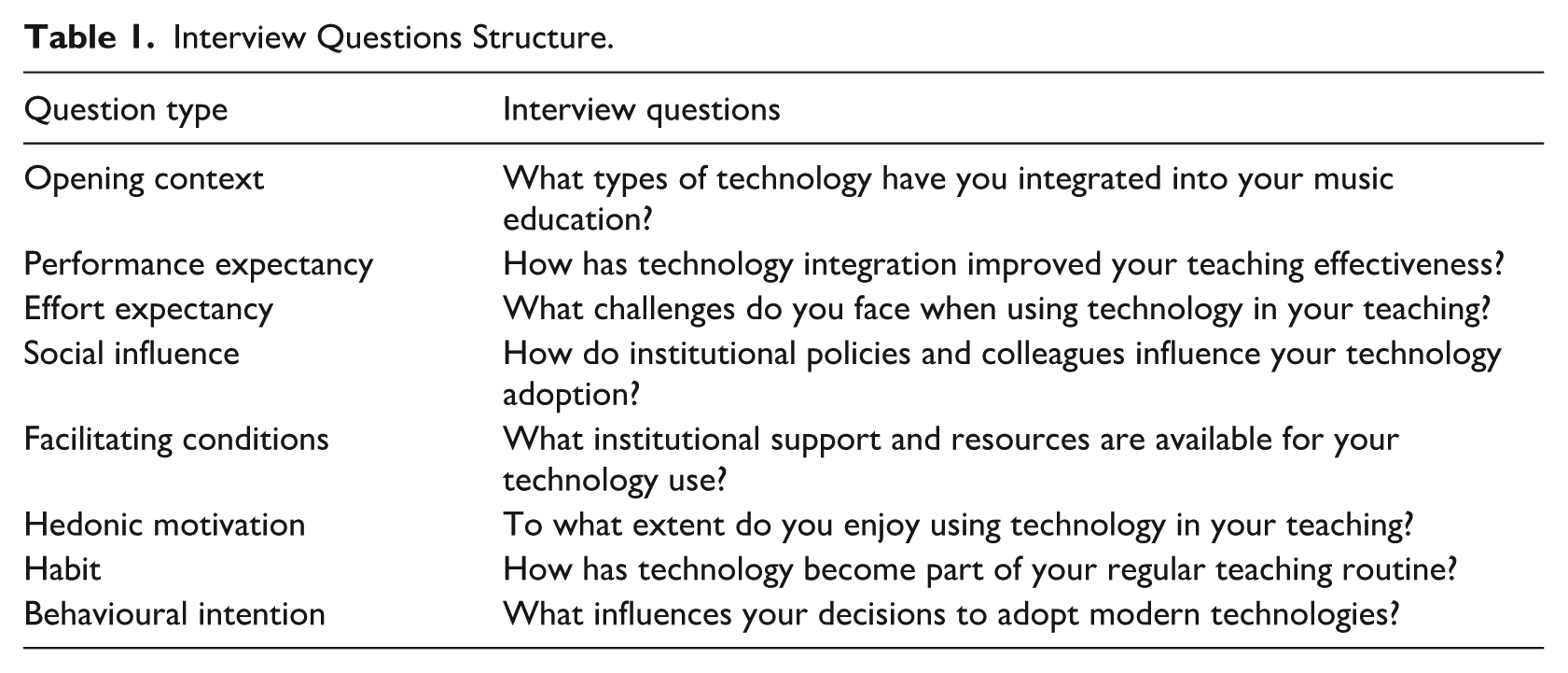
This exploratory qualitative study used semi-structured interviews to collect data on participants’ technology integration experiences. Semi-structured interviews were chosen because this approach balances flexibility and structure (Bryman, 2016). Music educators were interviewed about their experiences using technology, their perceived benefits, and their motivations associated with technology use in music education. Table 1 lists the interview questions based on the UTAUT2 framework (Venkatesh et al., 2012). Specifically, the questions explored factors influencing music educators’ technology adoption decisions in China (Zhang et al., 2021), including PE, EE, SI, FC, HM, and HA. Although the UTAUT2 framework suggests that users consider the monetary cost of technology in a consumer environment (i.e., PV), this study did not consider this factor as it may be less applicable to the educational setting in China. This is because educational institutions in China often have funding mechanisms such as project grants to cover technology costs, and individual educators are typically not personally responsible for purchasing or maintaining the technology used in the classroom.
Interview Questions Structure.
Sampling and Participants
A purposive sampling strategy recruited in-service music educators (N = 14) from higher institutions in Fujian Province of China. The geographic focus on Fujian Province was deliberately chosen to provide an in-depth understanding of technology adoption within this specific regional context, rather than attempting to represent the whole picture of diverse education in China. Diversity within the regional context was ensured by including music teachers from various institution types, specialisations, teaching experience levels, and technology use backgrounds. This approach allowed for an in-depth understanding of the regional educational context while capturing a range of relevant experiences and perspectives (Patton, 2015). The selection criteria included: 1) currently working as a music teacher in a university/college in China; and 2) minimum 2 years of teaching experience. The final sample size was determined through theoretical saturation, where no new substantial insights emerged from additional interviews (Glaser & Strauss, 1967). Recruitment was facilitated through collaboration with the Fujian Music Education Association and higher education institutions within the province, supplemented by snowball sampling techniques (Parker et al., 2019).
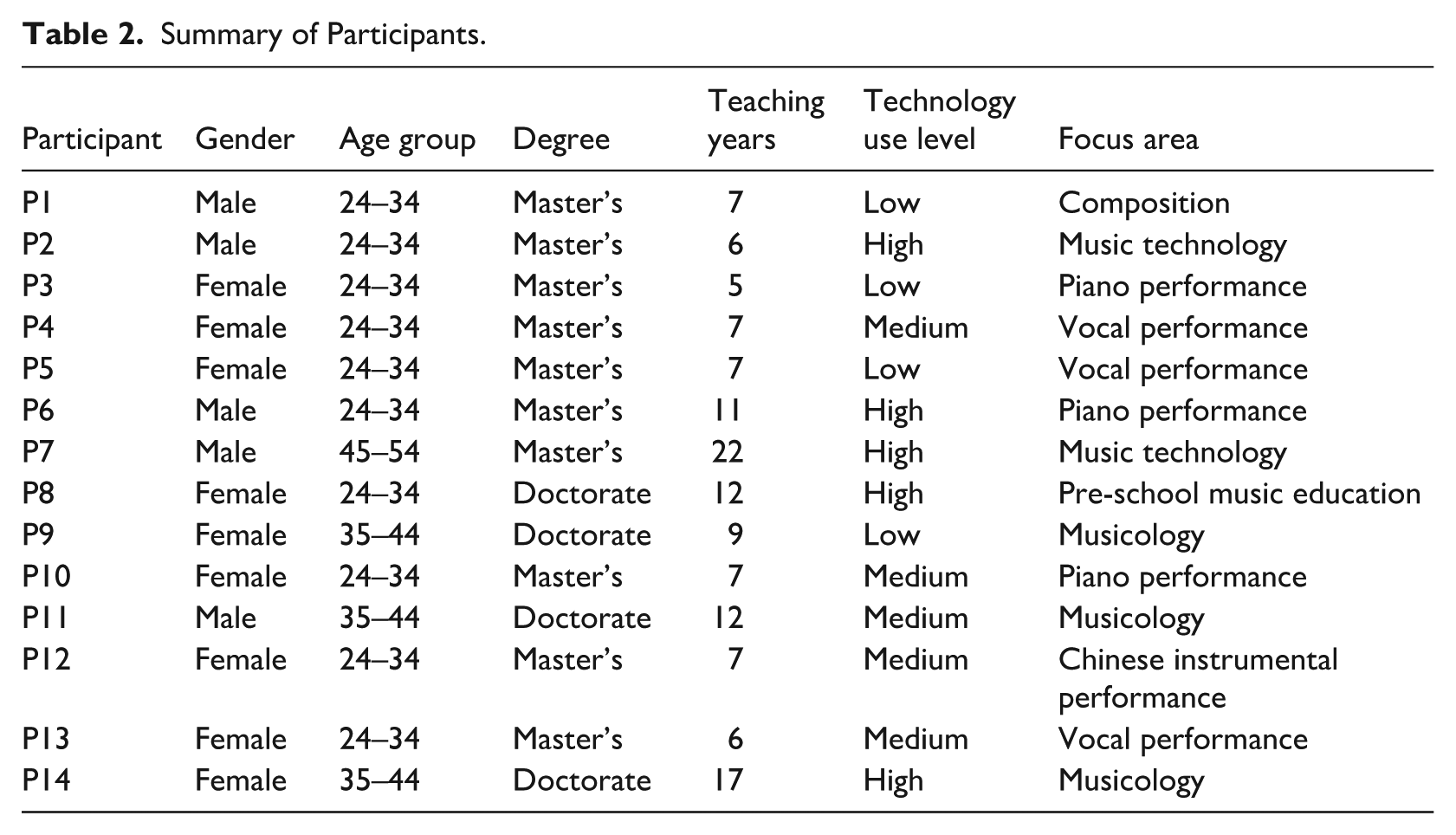
To provide a clearer picture of the participants involved in this study, their demographic information and professional backgrounds are summarised in Table 2. The participants were primarily female (n = 9), aged 24 to 54 years. The majority held a master’s degree (n = 10), with their teaching experience ranging from 5 to 22 years. This high proportion of advanced degrees, while not formally required for teaching positions, reflects current realities in higher education across China where competitive job markets and institutional promotion requirements have made such qualifications increasingly common. Participants’ prior experience with technology varied, with most reporting moderate (n = 6) or high (n = 5) usage levels. Their areas of focus spanned a variety of musical disciplines, including vocal and instrumental performance, music technology, musicology, and composition.
Summary of Participants.
Data Collection
Semi-structured interviews were chosen as the primary method for data collection because they have been effectively employed in previous studies examining ICT and E-learning integration in music education (Biasutti et al., 2023) and for investigating IT educational practices in Chinese contexts (Ho, 2004). The interview protocol contained open-ended questions designed to ensure consistency across participants while allowing them to elaborate on their experiences and perspectives. This protocol was piloted with two music educators prior to formal data collection, with minor refinements made to improve clarity and cultural appropriateness. The interviews were conducted online through various secure videoconferencing platforms commonly used in China due to the limitations of COVID-19. Each interview lasted 45 to 60 min. All interviews were conducted in Mandarin Chinese by the lead researcher to ensure consistency in questioning and cultural understanding.
Data Analysis
The data analysis followed a deductive thematic analysis approach guided by established methodological literature (Braun & Clarke, 2006; Fereday & Muir-Cochrane, 2006), with UTAUT2 as the analytical framework. Following verbatim transcription of all interviews in Mandarin and verification against original recordings, the lead researcher engaged in thorough data familiarisation through repeated reading of transcripts. For reporting purposes, selected quotes were translated from Mandarin Chinese to English using rigorous back-translation procedures, where a bilingual researcher translated the English versions back to Chinese to verify translation accuracy and preserve conceptual equivalence. The coding phase employed UTAUT2 constructs (PE, EE, SI, FC, HM, and HA) as predetermined categories for identifying and classifying central themes. This framework guided the systematic coding process in which the lead researcher analysed each transcript using NVivo software to assign relevant data segments to appropriate categories.
Theme development involved an iterative analytical process where the lead researcher first examined coded extracts within each theoretical dimension to identify patterns unique to music education in China. This detailed review revealed recurring relationships and conceptual clusters that formed the basis for preliminary themes. The researcher then re-examined these emergent themes against both their constituent codes and the complete dataset to ensure accurate representation of participants’ experiences. This recursive process allowed for refinement of theme boundaries and hierarchical relationships, resulting in a thematic structure that captured both the theoretical framework and contextual nuances. Figure 1 provides an example of the coding process in this study.
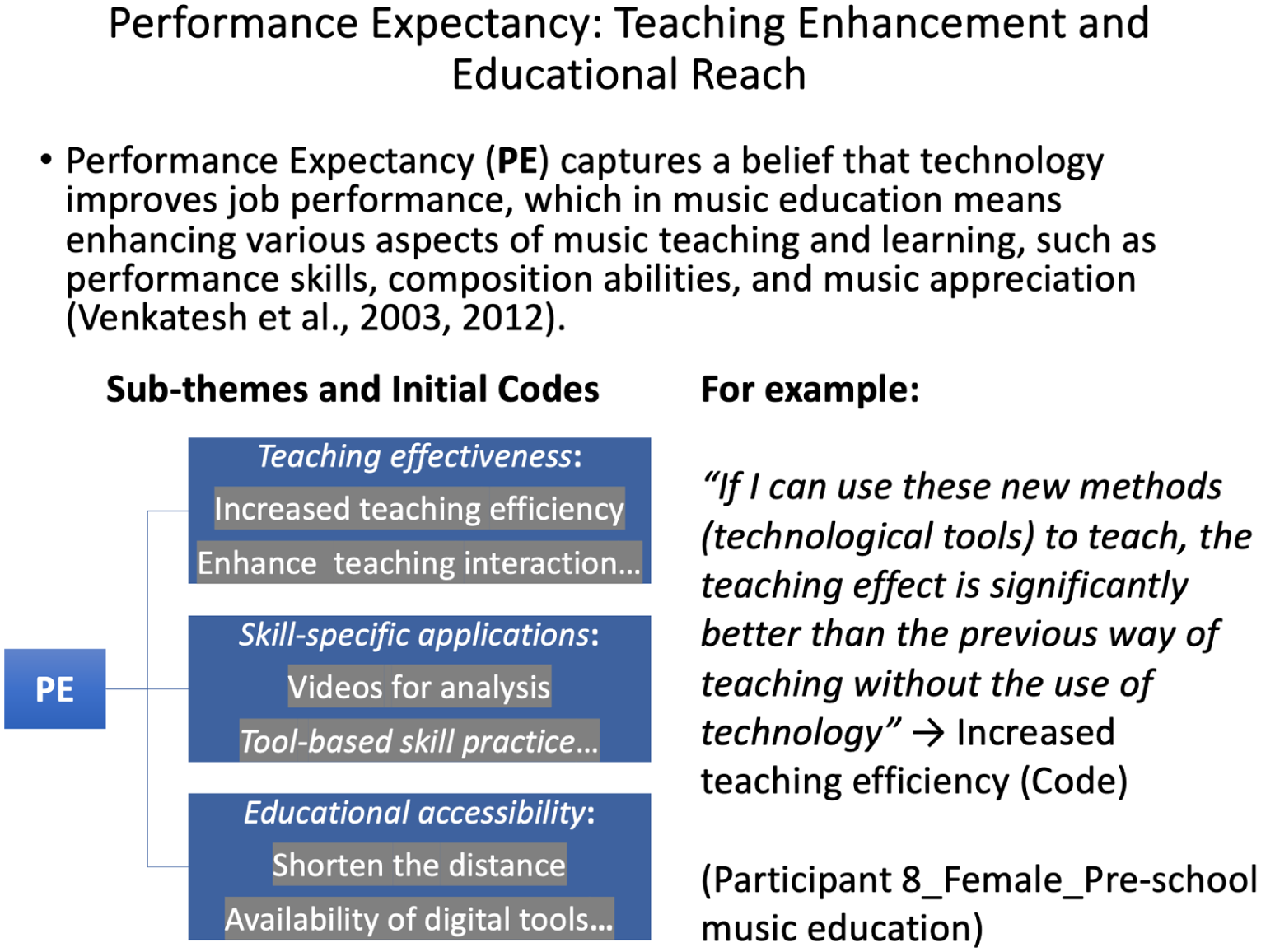
Example of thematic analysis process.
To enhance the trustworthiness of the findings, consistency in coding and interpretation was assured through rigorous cross-checking between the two experts, a procedure that adhered to the established protocols of the larger research project. Given that the other team members were not proficient in Mandarin, their cross-checking contribution involved reviewing the coding framework and examining translated coded excerpts to confirm conceptual consistency and theoretical alignment. Member checking was conducted with two participants who reviewed preliminary themes and interpretations to validate their accuracy. Throughout the analysis, an audit trail documented all methodological decisions, ensuring transparency and analytical consistency.
Findings
Analysis of music educators’ experiences with technology acceptance and use in China revealed six main themes, each primarily corresponding to one of the UTAUT2 constructs, though with some interconnections between themes reflecting the complex nature of technology adoption. Specifically, these themes include PE (teaching enhancement and educational reach), EE (balancing ease of use with learning investment), SI (institutional and professional networks), FC (resources and infrastructure support), HM (pragmatic considerations over pleasure), and HA (the interplay of voluntary and mandatory practice). These identified themes demonstrate the relevance of the UTAUT2 constructs across various educational contexts (e.g., Tamilmani et al., 2021; Tseng et al., 2019; Xu et al., 2024).
Performance Expectancy: Teaching Enhancement and Educational Reach
The analysis of interview data reflected music educators’ perceived benefits of technology in this theme. The first sub-theme, teaching effectiveness, revealed how participants reported technology transforming their teaching methods. For instance, a pre-school music educator with 8 years of experience emphasised how technology has clearly improved their teaching approach: “If I can use these new methods (technological tools) to teach, the teaching effect is significantly better than the previous way of teaching without the use of technology” (P8). This transformation appeared linked to the availability of resources (FC), as teachers with better technological infrastructure reported more positive outcomes.
The second sub-theme involved skill-specific applications, particularly in performance-based courses. One vocal teacher (P13) described the use of video for technique analysis, demonstrating how technology can provide detailed feedback and opportunities for self-reflection that traditional methods cannot provide. The technology used in this example is the everyday use of mobile phones, and such applications indicated interplay between PE and EE, as teachers found these tools uncomplicated to use, and directly applicable to their existing teaching practices. The third sub-theme concerned educational accessibility, where technology served as a bridge across geographical boundaries. A piano teacher (P3) noted technology can “shorten the distance,” expanding access to masterclasses and resources, particularly beneficial in China’s vast geographical context. This benefit seemed to be even more valuable when supported by institutional infrastructure (FC) and positive peer experiences (SI).
Effort Expectancy: Balancing Ease of Use With Learning Investment
The analysis revealed a multifaceted relationship between perceived ease of use and actual technology adoption in music education in China. The data highlighted two sub-themes of EE that influenced teachers’ technology acceptance. The first sub-theme, immediate ease of use, focused on teachers’ initial interactions with technology. Several teachers emphasised the importance of intuitive interfaces and straightforward functionality. One piano teacher (P3) preferred “an easy-to-use function that can be plugged in directly,” reflecting a preference for technologies that could be implemented with minimal initial effort. Another teacher (P8) noted: “The basic functions are quite clear – you can start using them right away without reading a manual,” highlighting how immediate usability encouraged adoption. The second sub-theme, learning effort requirements, revealed specific concerns about ongoing investment in mastering modern technologies, including time for initial learning, adapting to updates, transferring materials to new platforms, and balancing technology management with instructional responsibilities. A Chinese instrumental teacher (P12) expressed: “Your free time will be spent learning a lot of this knowledge, this technology,” highlighting concerns about the sustained effort required for proficiency.
Technologies that receive adequate institutional support for training appear more likely to be accepted and integrated into teaching practices, revealing interactions between EE and FC: “With proper training support, even complex systems become manageable” (P7). This kind of interconnection suggests that technology adoption depends not only on the perceived ease of use alone, but also on how it aligns with available support systems and expected performance benefits.
Social Influence: Institutional and Professional Networks
The analysis revealed that institutional policies, departmental culture, and professional networks emerged as key sub-themes within SI in music education. Each sub-theme shaped teachers’ technology adoption decisions while interacting with other UTAUT2 factors. At the institutional level, formal policies and administrative support created a foundational framework for technology adoption: “Well, the college and its policies are also very supportive, such as the purchase of packages for teachers engaged in music-related instruction” (P5). This support extended beyond material resources, as shown by P6’s observation: “They use this . . . media advertising . . . to increase the popularity and impact of my courses.”
Departmental culture appeared as a powerful influence on adoption patterns. A music technology specialist observed: “Most of them just need to learn how to use PowerPoint, that is enough” (P7), revealing how departmental norms could limit innovation. Also, professional networks operated both within and across institutions. The practice described by P1 of inviting colleagues from other universities demonstrated how these networks provided practical support and shared innovation examples. This peer influence enhanced PE and reduced EE through collaborative learning: “My school is now encouraging us to use more technology stuff to teach . . . It encourages us to apply for some of the high-quality courses” (P14).
Facilitating Conditions: Resources and Infrastructure Support
This theme showed that FC worked at multiple levels in music education settings in China, creating an ecosystem that influences technology adoption. It included two sub-themes on institutional investment and resource availability. In the first sub-theme, significant institutional investment emerged as a crucial enabler: “The college has invested about 850,000 yuan (CNY) to build a studio for me . . . This studio can meet all the needs of music production, video recording” (P2). This investment provided technical capabilities and strengthened PE and SI through demonstrated institutional commitment.
Within the second sub-theme, resource availability notably shaped teaching practices, with well-equipped teachers (P2, P7, P14) showing higher technology integration levels. As one teacher noted: “There is some very expensive equipment there . . . it can interact instantaneously . . . the lights, the multimedia, the windows – they are all on” (P14). This suggested that FC positively impacted EE by reducing technical barriers. However, resource allocation varied widely across institutions, creating gaps in technological competence. While some teachers received comprehensive support, others (P11, P13) faced resource constraints limiting their technology integration. This variation created a feedback loop with SI, where better-equipped departments became innovation centres while others struggled. This also suggested that FC could act as an underlying factor that facilitates or constrains the effects of other UTAUT2 factors.
Hedonic Motivation: Pragmatic Considerations Over Pleasure
In this theme, the data showed inconsistencies with the UTAUT2 framework in terms of HM. Contrary to theoretical expectations, participants consistently demonstrated a pattern where pragmatic considerations superseded enjoyment when adopting technology. The first sub-theme, professional identity prioritisation, emerged from participants’ responses about technology enjoyment. Nine out of 14 music teachers explicitly subordinated personal enjoyment to professional utility: “I use this software because it allows me to give my students a feel for what harmony is, not because . . . (I) particularly enjoy the technology itself” (P6). Similarly, P10 reinforced this pattern: “Well, I always ask whether it helps to students’ learning . . . and my personal enjoyment of the technology is secondary.” When questioned about enjoyment factors, participants often redirected the conversation to student outcomes and professional effectiveness, demonstrating a clear pattern of HM’s diminished role.
The second sub-theme, workload-enjoyment tension, pointed out that concerns about workload consistently outweigh the potential for pleasure in technology use. A musicology teacher’s (P9) admission about lacking energy to learn new software exemplified how effort-related concerns could influence technology adoption decisions, while considerations of enjoyment or pleasure in using technology appeared less prominent in teachers’ narratives. This sentiment was echoed by P3: “The software must save me time first; the entertainment value is the icing on the cake, not a requirement.” This pattern was particularly prevalent among many experienced teachers who valued efficiency over enjoyment, suggesting that in the educational context in China, the pleasure potential of technology may be subordinate to more practical concerns about time management and professional efficiency.
Habit: The Interplay of Voluntary and Mandatory Practice
The analysis of HA revealed a complex interplay between individual agency and institutional requirements in technology adoption. Habit development followed two distinct pathways: organic integration through positive experience; and mandated adoption through institutional requirements. Some teachers described a natural evolution of practice: “Well, my teaching style and teaching action (teaching piano with technology) have become a fixture” (P6). This organic habit formation resulted from positive interactions between PE, EE, and successful experiences. Conversely, institutional mandates could accelerate HA formation, though with different psychological implications. As P10 expressed: “We were forced to use them . . . because (curriculum reviews) will require teachers to use these technologies in a large class.” This mandatory pathway highlighted the strong interaction between SI and institutional policy in shaping technology use patterns.
These two pathways often interacted, with mandated practices evolving into voluntary habits when supported by positive experiences and adequate FC, while voluntary habits could be reinforced by institutional requirements. This suggested that HA in China’s educational context was shaped by the combined influence of individual and institutional dimensions.
Discussion
Theoretical Implications and Model Extension
The research reveals a complex interplay among PE, EE, SI, FC, and HA that extends beyond the linear relationships typically examined in quantitative studies. The qualitative evidence suggests these factors operate through mutually reinforcing mechanisms rather than isolated pathways. For instance, when institutions provide a strong technological infrastructure (FC), they tend to form professional learning environments (SI), which in turn may improve pedagogical effectiveness (PE) and encourage a pattern of continuous use (HA). A particularly noteworthy finding is the limited role of HM in this context, contrasting with previous quantitative studies that found it to be a significant predictor (e.g., Azizi et al., 2020; Moorthy et al., 2019). This difference suggests that the significance and interactions of UTAUT2 constructs may be culturally contingent, supporting the need to examine the generalisability of theoretical models across diverse cultural contexts (Venkatesh et al., 2012).
The rich descriptions from participants suggest that technology adoption in music education in Fujian Province involves complex, interrelated processes that evolve over time. These findings provide an opportunity to extend the theoretical framework to better reflect the distinct aspects of technology integration in music education settings. One potential way is the integration of Technological Pedagogical Content Knowledge (TPACK) (Mishra & Koehler, 2006), which emphasises the role of technological competence in effective teaching and learning. Prior research has explored the feasibility of a UTAUT2-TPACK model for teachers’ acceptance of blended learning technologies (Apandi & Raman, 2020). Given the importance of technological proficiency in music educators’ adoption decisions (Zhang et al., 2021), future research could further develop the UTAUT2 framework by incorporating a domain-specific technological competence dimension for music education. This would address the unique requirements of music technology integration identified in this study, particularly regarding the specialised knowledge needed to effectively combine musical pedagogy with appropriate technological tools.
Practical Implications
This study identified several successful implementation patterns that offer insights for educational institutions and policymakers. While these findings emerged from the context of music education in Fujian Province of China, they have broader relevance beyond this regional setting.
The study identified effective practices such as vocal performance instructors using recording technology with detailed digital annotations, enabling students to review performances and feedback repeatedly. This approach aligns with research on how technology enhances self-regulated learning by capturing, summarising, and analysing performance (Waddell & Williamon, 2024). Similarly, comprehensive digital studio environments improved pedagogical skills and collaboration among faculty, extending Cremata and Powell’s (2015) study on digital collaborative spaces, implying that digital music environments can facilitate professional growth among instructors while fostering pedagogical innovation.
Additionally, the cultural context of education in this region of China requires researchers to pay special attention to social and institutional considerations. Given the strong influence of professional networks (SI) identified, institutions could benefit from establishing mentorship programmes where experienced teachers guide colleagues in technology integration. Observations regarding teacher stress and fatigue during technology adoption indicate the need for support mechanisms that address well-being while respecting cultural norms. The “digital divide” (Prensky, 2001) within higher education institutions emerged as a significant concern. Disparities in resource allocation create uneven opportunities for technology adoption, potentially reinforcing existing inequalities in educational opportunity. This suggests the need for policy interventions that address infrastructure gaps while remaining sensitive to local contextual variations.
Limitations and Future Research Directions
This study presents limitations regarding geographical scope and methodology. The research examines music educators in Fujian Province, similar to other music education studies in China that have focused on specific regions such as Guangdong and Jilin Provinces (Zhang et al., 2022; Zhou et al., 2024). However, the findings may not be directly applicable to other regions of China where resource availability and cultural contexts vary. The sample may not fully reflect urban-rural differences in technology integration, curriculum implementation, and teacher competence (Yu & Leung, 2019). Furthermore, the qualitative approach, while revealing a rich context, does not determine the relative strength of relationships between constructs.
Future research could include longitudinal studies examining how adoption patterns evolve over time, particularly the transformation from mandatory to voluntary usage. The relationship between cultural values and technology acceptance deserves deeper exploration, especially considering findings that teachers’ enjoyment of technology appears less important than anticipated. Comparative studies across different regions of China could provide valuable insights into how local contexts influence technology adoption. Mixed-methods investigations could combine qualitative explanatory power with quantitative predictive capabilities to enhance understanding of technology acceptance in specialised educational contexts. These investigations could advance both theoretical understanding and practical implementation across diverse educational contexts.
Conclusion
This study enhances understanding of technology acceptance in music education by revealing the complex interplay between theoretical constructs, cultural influences, and practical challenges. An examination of music educators’ experiences in Fujian Province of China through the UTAUT2 framework reveals patterns of technology adoption that hold significance beyond this specific context. The findings demonstrate that while technology acceptance factors are universal, their manifestation and relative importance vary significantly across cultural contexts. This highlights the potential need for culturally sensitive applications of such models in educational settings with strong traditional pedagogical foundations. This research offers practical guidance that can inform technology integration strategies not only in other parts of China but also in diverse global contexts with similar institutional characteristics. Future implementation of music technology across international settings could benefit from considering these interrelated factors in a holistic manner, adopting appropriate technological innovations while respecting distinct pedagogical traditions.
Footnotes
Acknowledgements
This paper is based on a portion of the author’s doctoral dissertation. The author would like to express sincere gratitude to Professor Andrew King and Dr Helen Prior for their valuable guidance and constructive feedback during the doctoral research.

Ethical Considerations
The study protocol was assessed and approved by the FACE Ethics Committee of the University of Hull, UK (Ref No. 1920PGR01). Informed consent was obtained from all individual participants included in the study.
Author Contributions
Funding
The author received no financial support for the research, authorship, and/or publication of this article.
Declaration of Conflicting Interests
The author declared no potential conflicts of interest with respect to the research, authorship, and/or publication of this article.
Data Availability Statement
The datasets generated during the current study are not publicly available due to ethical restrictions protecting participant confidentiality and privacy but are available from the corresponding author on reasonable request with appropriate ethical approval.