




Abstract
This article reports on a small-scale experimental pilot study examining instrumentalists’ techniques for aural learning of new melodies from various cultural traditions, with the goal of contributing to a contemporary understanding of multimusicality. It examines what strategies musicians employ to learn new melodies and whether these strategies vary when the musicians are asked to learn melodies from unfamiliar music-cultures. The study participants (n = 12) were recruited from an arts department at a third-level institution in Ireland. Several were multimusical, with a high level of training and/or experience in two or more music-cultures. The article identifies three broad learning strategies deployed by study participants, which at times overlapped or were used simultaneously. These are named ‘segment-by-segment’, ‘joining-in’ and ‘chords-before-melody’. While learning strategies are based on experience and existing knowledge, genre and music-culture background proved to be poor indicators of the strategies deployed in the experimental task. Participants applied the same learning toolkit to both familiar and unfamiliar musics, but individual strategies differed based on a number of parameters. The findings raise interesting questions about multimusicality, and they suggest further research is needed to more fully explore these questions.
Introduction
In a paper presented at the Fourth Annual Meeting of the Society for Ethnomusicology, Hood (1960) introduced the concept of ‘bi-musicality’: the state of being familiar with or conversant in two (or more) music-cultures. Hood described bi-musicality as a particular dictate for trainee ethnomusicologists, who must move beyond ‘passive observation’ of other musics and learn to hear – and, eventually, play – in the musical idioms of their research participants. The concept has remained important in ethnomusicology, even as it has been questioned and revised. While less well discussed in the music education literature, bi-musicality is equally a music education term and idea. Just as there are myriad music-cultures and musical idioms, so there is a diversity of approaches to teaching and learning, which may vary both among and within music-cultures (Rice, 2003). Multimusicality is more accessible and attainable today than ever before in history, given digital platforms’ abilities to connect musicians and listeners across the globe and to expose listeners to unfamiliar musics and music-cultures. Indeed, multimusicality has reshaped ‘the musical map of the world’, due to the results of globalization and major changes in communications technologies over the course of the 20th century and beyond (Nettl, 2015, pp. 70–71).
This article reports on a small-scale experimental pilot study examining instrumentalists’ techniques for aural learning of new melodies from various cultural traditions, both familiar and unfamiliar. The study was conducted in 2023 with undergraduate students (n = 12) at Dundalk Institute of Technology (DkIT), a third-level institution in Ireland. It seeks to explore individual approaches to ear-learning tasks and multimusical encounters, as well as the potential implications of multimusical training (whether formal or self-directed) on individuals’ learning strategies. It grows out of my own disciplinary position as an ethnomusicologist specializing in research on popular music teaching and learning. In what follows, I first briefly review the contemporary literature on bi-musicality, with particular focus on its place in the music education literature. I then outline the pilot study’s methods, sample and ethical considerations. I present the study findings, identifying and discussing three broad learning strategies utilized by participants, noting how these were applied to both familiar and unfamiliar musical idioms. I close with a discussion of how the pilot study might be implemented in future work in order to capture a larger and more diverse sample of instrumental learners, and thus to better inform our understandings of multimusicality.
Literature review
Multimusicality is not only the preserve of ethnomusicologists (Hood, 1960, p. 55): it has long been a feature of some music-cultures, as a result of conquest, inter-group communication or both (Davis, 1994). Musicians are often multimusically skilled, as ‘the ability to move between different performance traditions has long been a necessary skill required of musical specialists, particularly those working in urban contexts, in a variety of traditions around the globe’ (Cottrell, 2007, p. 85). Musicians, both amateur and professional, have increasingly sought out sounds, instruments and skills from unfamiliar music-cultures in order to enhance their own work and/or enjoyment (Deschênes, 2018). The concept of multimusicality is, moreover, no longer used to refer only to a binary divide between ‘Eastern’ and ‘Western’ musics: Cottrell (2007) in particular has noted that an ability to move among multiple idioms from the same broad musical tradition – in his case study, among ‘various Euro-American musical styles’ – is also ‘a form of local bimusicality’ (p. 86).
New concepts and terms have been proffered to replace, build upon, expand and move beyond Hood’s original concept, with its troubling ‘West and the rest’ binary. These include multimusicality (Davis, 1994), polymusicality (Brinner, 1995; Nettl, 1994), intermusicality (Monson, 1996; O’Flynn, 2005a, 2005b; van den Dool, 2016), transmusicality (Deschênes, 2018), omnimusicality (Rodriguez, 2015) and dialogical-musicality (Haddon, 2016). While no one term appears yet to have been collectively agreed as the singular, definitive replacement for ‘bi-musicality’, from the proliferation of alternatives it appears there is a consensus that a new term or terms, and a corollary revitalization of the theory, are needed. This has implications for both ethnomusicology and music education, the latter as scholars from both disciplines increasingly note and discuss the roles that global musics and multimusicality may play in contemporary music teaching and learning (e.g. Kertz-Welzel, 2018; Nettl, 2015, pp. 385–389).
Music education researchers have noted both positive and negative aspects to multimusical repertoires and pedagogies. Haddon (2016) suggests that simultaneous practice in multiple music-cultures can benefit learners’ musicianship skills: specifically, in her study, UK music students focused on Western art music noted that concurrent participation in a Javanese gamelan ensemble had benefits for their musicianship in their primary genre and instruments. Haddon also notes benefits to the students’ learning approaches, as they added further strategies for learning and transmission to their skillsets, as well as the development of a more general open-mindedness toward unfamiliar musics. Haddon argues that the benefits of such learning are available even to those who do not seek, or have available to them, a high level of proficiency in or understanding of both music-cultures: ‘Although bi-musicality may be the prerogative of only those who can maintain expertise concurrently in more than one musical style, “dialogical-musicality” may be a positive construct informing the learning of those participating in more than one musical culture at any level’ (p. 233). Other authors suggest that engagement in multimusical practices at primary schools promotes greater empathy, cultural sensitivity and positive intergroup relationships among young learners (Good et al., 2022; Howard, 2018).
Wong et al. (2011) take these conclusions one step further, arguing that multimusical listening on its own (i.e. without active multimusical practice) produces significant, positive effects. Their study used functional magnetic resonance imaging (fMRI) to compare the affective processing of monomusical versus bimusical adults. They specifically examined individuals without significant formal musical training – in other words, those whose musical worlds were shaped primarily through ‘everyday’ listening. These authors argue that ‘enculturation as bimusicals fundamentally and qualitatively changes how music is processed in the brain’; their study results, they argue, ‘speak to the possibility of a more complex music-brain relationship in bimusicals’ (p. 4091).
On the other hand, Avis (2019) argues that, when delivered uncritically, multimusical education systems may serve to perpetuate colonial and imperial ideals, as he found in the case of a bimusical conservatory curriculum in Chennai, South India. Pedagogical approaches in this conservatory, Avis writes, privileged colonial epistemological assumptions and typical Western art music transmission modes over those of Hindustani classical music. He concludes, ‘Bi-musical education can play a role in destabilising established and dominant narratives as Haddon and others suggest; however, this should be tempered and enhanced through acknowledgement of the ways in which bi-musical education can perpetuate the discourses it is claimed it challenges’ (p. 47). Emielu (2011) similarly notes that the implementation of bimusical curricula may fall short of its lofty goals. He writes that while bimusicality is officially incorporated into formal music education in Nigeria, it ‘exists more in principle than in practice’ (p. 366). Similar to Avis, Emielu notes the problematics of teaching African traditional musics through Western art music methods and epistemologies: ‘To most observers and critics in Nigeria, the idea of bi-musicality is lopsided, reflecting more of European concepts, theories, forms and aesthetic benchmarks while forcing African music to adapt its structure, analysis and aesthetic appreciation’ (p. 367).
O’Flynn discusses the role that the inclusion of multiple musics may play in music education practice and policy, and his approach is instructive in conceptualizing a way forward for multimusical education. He notes that a multi- or intermusical approach better reflects broader society, in which ‘people pick up and learn all kinds of music in a variety of ways’, while also making space for unique local musical forms, including children’s music-cultures (O’Flynn, 2005a, p. 202, 2005b, p. 199). Crucially, O’Flynn (2005a, 2005b, 2006) includes transmission practices in his conception of intermusicality and advocates for the inclusion of both informal and formal modes of music learning within the curriculum, reflecting the variety of transmission modes found throughout the world while also de-hierarchizing more traditionally Western approaches, the imposition of which is problematic in multimusical curricula as noted by Avis and Emielu.
The methodological approach in this study (detailed in the next section) arose from placing two research articles into conversation: one from music education, the other from ethnomusicology. The first of these is Green’s (2012) article on musical ‘learning styles’ and ‘learning strategies’ in instrumental lessons. She defines ‘learning style’ as ‘a relatively “hard-wired”, inbuilt, or unchanging tendency or trait in the individual, which comes into play spontaneously when the individual is learning, or attempting to learn’; a ‘learning strategy’, on the other hand, is ‘an approach which arises as a result of prior experience and/or conscious choice, and which is susceptible to environmental influences, adaptation and development’ (p. 45). Learning strategies, Green notes, ‘involv[e] the conscious adoption of steps or tactics . . . geared towards achieving explicit goals’; they may be influenced or suggested by teachers, or picked up through individual practice and experience (p. 59).
In her study, also a small-scale pilot project, Green played audio tracks for 15 students, aged 10 to 17, in one-on-one instrumental lessons – first the full track, and then an isolated instrumental riff. She then asked them to work out the pitches on their own instruments. She conducted the research in three stages over a series of 9 weeks, working first in the genre language of ‘pop/funk’, then Western art music, and finally a piece of the student’s own choosing. The pilot project comprised the early stages of what would eventually become her ‘Hear, Listen, Play’ (HeLP) pedagogy (Green, 2014); the methodology was also implemented in the Ear-Playing Project (EPP) (Varvarigou, 2014; Varvarigou & Green, 2015).
Within these exercises, Green (2012) identified four broad categories of learning strategies employed by her participants. She names these strategies ‘impulsive’, ‘shot-in-the-dark’, ‘practical’ and ‘theoretical’. Green and her colleagues found these strategies to be consistent when implementing the methodology on a larger scale through the EPP (Varvarigou & Green, 2015, pp. 711–713). While Green (2012) and Varvarigou and Green (2015) refer to these four categories as ‘learning styles’, taking them (as the students’ first attempts to learn the pieces) as more natural, ‘spontaneous’ or phenomenologically embedded, I believe we might call these ‘strategies’ as well, using Green’s own definition, quoted above. She notes that as the lesson went on, students adopted various other strategies, at times suggested by Green (2012) herself, in order to ‘cope with the task’ (p. 51). Notably, some of the strategies she mentions the students adopting at second and later attempts ‘seemed to overlap’ with the approaches she identifies as more innate ‘learning styles’; I suggest this further emphasizes the four approaches’ conscious and tactical nature, and I will treat them as ‘learning strategies’ going forward.
The second article that provided inspiration and direction for my own pilot project is van den Dool’s (2016) ethnomusicological study of intermusical learning among young musicians in Kathmandu, Nepal. Specifically, he examines their approaches to pop, rock and jazz, which he identifies as ‘unfamiliar musics’ for these learners. Van den Dool writes that young musicians in Kathmandu approach these unfamiliar genres ‘using the same learning strategies they deploy in Nepali music’, and they ‘transfer specific practices and learning strategies from their local music culture into unfamiliar systems’ (pp. 85-86).
These two studies, placed in conversation with one another, suggest the value of attending to specific, embodied learning strategies for deepening – and potentially reshaping – our understanding of multimusical learning. Green’s study suggests that learners within the same music-culture can and do employ varied individual learning strategies, doing so consciously and tactically. Van den Dool’s study, meanwhile, suggests that they may deploy these same strategies, forged through their studies of familiar musics, when approaching intercultural or multimusical learning tasks.
Methods
The research design for the pilot study was loosely adapted from Green’s (2012), though with some notable divergences based on my own circumstances, as well as my particular interest in multimusicality. While Green’s research design was more holistic and embedded in her role as instrumental teacher, my approach isolated and focused on the learning strategies deployed in the listen-and-play-back task, with the added dimension of including multiple pieces from different music-cultures.
Each participant was asked to listen to three audio recordings of melodies, each about 1 minute in length, and replicate them on their primary instrument. The melodies were drawn from three different music-cultures and genre categories: Western popular, Indian classical and Irish traditional. Each recording consisted of an instrumental solo with simple, genre-appropriate accompaniment: piano melody with block chords for Western pop, flute melody with drone for Indian classical, and heterophonic banjo and accordion melody for Irish traditional. These broad categories were chosen based on my pre-existing knowledge about musical activity within DkIT, given my role as a music lecturer there. All of the students involved in the music degree programmes have a level of familiarity with Western popular music, as it is an explicit component of instruction. Given Ireland’s particular (bi)musical landscape, including the required inclusion of traditional music in secondary school music teacher training in both the Republic of Ireland and Northern Ireland (O’Flynn et al., 2022) – a sort of uneasy or incomplete educational bimusicality, as O’Flynn (2005a) notes – I reasoned that many of the research participants would be somewhat familiar with Irish traditional music, either through explicit study or through hearing it within their everyday soundscapes. Finally, I selected Indian classical music because I knew that no one within the department played it, as I wanted to include one category that was certain to be wholly unfamiliar to all of the participants.
The order in which the melodies were played was predetermined by me, and it varied: 50% of participants first heard the melody from the genre with which they were most familiar (mainly Western pop, but occasionally Irish traditional), while the other 50% began with an unfamiliar genre (Indian classical music in all cases). Participants were given complete control of the playback device (an old laptop) to interact with the audio recordings as they wished. They were given a maximum of 7 minutes to listen to and attempt to replicate each melody.
Once participants had listened to and played all three melodies, they were asked to respond to a series of questions about the exercise:
What did you find easiest about that?
What was the most difficult part for you?
How do you typically go about learning a new piece on your own?
Would you have approached this differently on a different instrument?
The study participants (n = 12) were instrumental musicians recruited from Dundalk Institute of Technology. A recruitment email was sent to all undergraduate students within the Department of Creative Arts, Media and Music, which houses degrees in music performance, musical theatre, music production, theatre, creative media and film. Interested participants were asked to identify their primary instrument(s), their music education background (broadly speaking) and the main genre(s), style(s) or music-culture(s) in which they play or have received training (see Table 1). DkIT presented a particularly interesting research site for this study, as its music degree includes performance training in Western popular, Western art and Irish traditional music, meaning that all students on that degree programme achieve a high degree of multimusicality by the end of their course. As noted below, only some of the research participants were students on this programme.
Study participants’ primary instruments and musical styles.
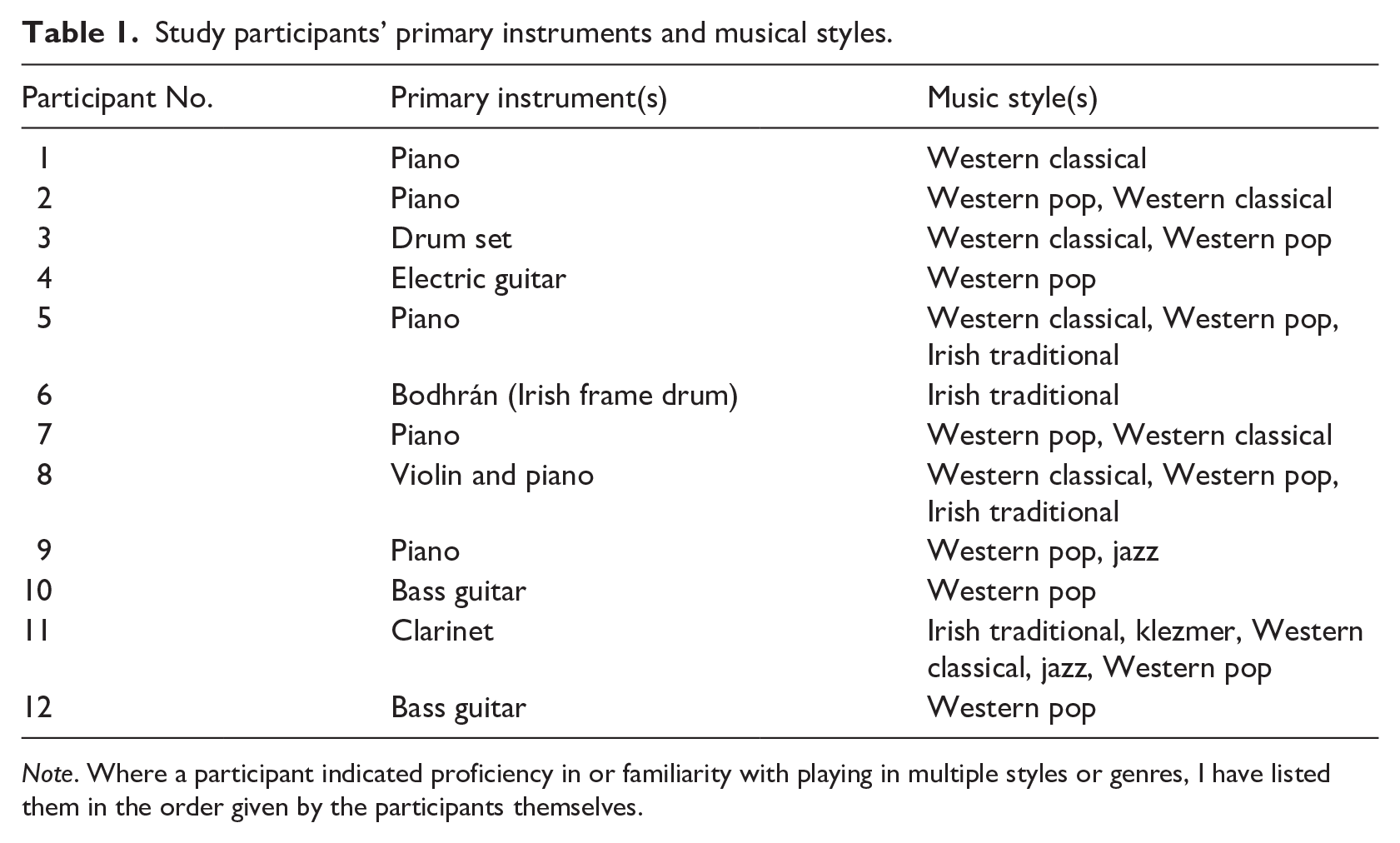
Note. Where a participant indicated proficiency in or familiarity with playing in multiple styles or genres, I have listed them in the order given by the participants themselves.
The 12 participants came from the institution’s music performance, music production and theatre degree programmes. Experience levels ranged from an exclusively self-taught participant who had begun learning their instrument during the COVID-19 lockdowns in 2020 and 2021 to a mature student who had been playing for several decades and had received private lessons on multiple instruments. 50% of the participants were international or Erasmus exchange students, primarily (though not exclusively) from other European Union countries. This comprised an overrepresentation of international students in relation to department demographics: while these three programmes all have significant minorities of international students, none approaches an even split between students from Ireland and those from elsewhere. Of the 12 participants, only one (Participant 7) stated that they prefer to learn music using staff notation; the rest preferred aural learning, though the majority could read staff notation, a skill that is covered in both the music performance and music production degrees.
The responses recorded in Table 1 are limited in that they only capture the music-cultures and styles in which the participants self-reported as playing; it does not extend to their listening practices. The short interviews with participants suggested that many of their listening practices are very multimusical: for example, one participant stated that they regularly listened to Chinese and Japanese popular and traditional music, while another noted that the previous summer they had worked as a sound engineer at a traditional music festival in their home country in central Europe. When asked, though, both were adamant that they did not consider themselves proficient in these genres, indicating a clear split in their concepts of expertise, between musics to which they listen and musics in which they play.
Ethical approval for this project was granted by School of Informatics and Creative Arts Research Ethics Committee at DkIT. Because the participants in the sample were all students in programmes on which I lecture (and many had previously been or were currently in my classes at the time of the study), a crucial ethical concern was to ensure that participants did not feel participation in the study was required, nor that it would affect their grades. To that end, I communicated in recruitment emails, and repeated verbally at the beginning of each individual’s session, that participation was voluntary, anonymous and would not affect their marks or their degree in any way. Additionally, I emphasized to each participant that the goal of the study was not to measure their success or failure at the task, but rather to understand the process by which they went about it. While measuring success more quantitatively would have provided interesting further results (as in, e.g., Woody & Lehmann, 2010), explicitly rejecting any form of grading, marking or assessment as part of the project seemed to help the participants feel more comfortable. Given my dual position as both researcher and teacher in this situation, I do not think it would have been appropriate to measure their success at the ear-listening tasks, as this might have felt too much like grading for comfort; this is one of the study’s limitations. For future research with larger samples outside of my own institution, quantitative measuring in this way can provide interesting and useful further data.
Findings
I identified three broad categories of learning strategies utilized by the 12 participants during the study: ‘segment-by-segment’, ‘joining-in’ and ‘chords-before-melody’. I will describe and discuss each in turn below.
1. Segment-by-segment: Playing a short segment or phrase of the recording and learning that, then moving on to the next one, working to eventually link the segments or phrases together. Employed by 10 participants (83%). There were two broad approaches to this: a. Playing back: listening to the recording, then attempting to play the segment that had just been heard. b. Playing along with: attempting to work out the melody while the recording was playing.
Most participants employed both sub-strategies simultaneously or alternated between the two. Additionally, one participant (Participant 7) used a variation on this: they sang along with the recording, then worked out on the piano the segment they had just heard and sung. Several others (Participants 2, 3 and 11) also used singing, humming or whistling, usually after pausing the recording, to help them work out the melodic intervals on their instrument.
While the drum set (played by Participant 3) is not a melodic instrument per se, Participant 3 treated it as one for the purpose of this study, working out the melody using approximate or relative pitch relationships: while they noted that the pitches were not an exact match, they worked to replicate the overall shape of each melody using the differently tuned tom drums, and occasionally the snare drum as well. This was an unexpected, yet fascinating, response to the study.
2. Joining-in: Playing the entire piece on a loop, and jumping in to play or work out portions of the melody, chords and/or accompanying rhythm. Employed by four participants (33%).
The focus of each iteration or loop of the melody varied by individual. Participant 5 focused on the melody on the first loop, then began adding chords on the second. Participant 6, meanwhile, playing accompanying rhythms on the bodhrán throughout, focused on finding a stylistically appropriate rhythm and timbre in their playing. It is worth noting here the difference in approaches taken by Participants 3 and 6: while Participant 3 used the drum set as a melodic instrument and worked to replicate the recorded melodies, Participant 6 used the bodhrán as a rhythmic instrument, focusing on percussive accompaniment rather than melodic replication. I did not give either percussionist instructions as to how to interact with the recordings or their instruments, curious to see how they would interpret the brief through their phenomenological knowledge of percussion playing.
3. Chords-before-melody: Working out a piece’s underlying harmonic progression and then filling in the melody.
Employed by three participants (25%), all only in the case of the Western popular melody. Participant 9 used a related strategy for the Irish traditional melody, working out the scale being used before the individual notes. This strategy overlaps with the others listed above: Participants 2 and 4 used the chords-before-melody learning strategy as part of a segment-by-segment approach, while Participant 9 used it as part of a joining-in approach.
All of the above strategies involved extensive use of trial and error. There were small shades of difference in, for example, approaches to larger intervals, levels of precision when approaching ornamentations or whether the segments used for segment-by-segment learning consisted of complete phrases or shorter clusters of notes; overall, however, the strategies diverged mainly along the lines of, first, how participants interacted with the audio recordings, and second, how (and whether) they addressed the pieces’ harmonic structures.
A key finding in this study was that, while learning strategies were clearly informed and shaped by experience including prior music education, genre and/or educational background could not be neatly connected to particular strategies. For example, Participant 2 stated that their preferred approach is to first work out a song’s chords and then fill in the melody afterward. This approach may seem more closely connected to formal piano learning based in Western art music approaches, given that genre’s tendency to emphasize theory and harmonic structures. However, when I asked Participant 2 about their educational background, they explained that they are ‘all self-taught’. They further explained that they hear chords and can name them fairly quickly, but they visualize the keys on the piano when doing so, rather than envisioning traditional staff notation. They also mentioned they use sounds from well-known popular songs to help them identify harmonic progressions quickly:
[I] kinda listen for the root note. I’m kind of, I’m very used to doing that? And then hearing the tonality of it and then just going from there. And then hearing certain, I suppose like musical tropes, in a way? You know you hear it in a lot of songs. Like Radiohead ‘Creep’, is that like C to E major sort of chord and I just know that sound so.
I initially considered naming the ‘joining-in’ strategy the ‘session strategy’, in reference to Irish traditional music sessions, where musicians commonly report learning by joining in or playing along (Waldron & Veblen, 2009). This fits with Participant 6’s use of the strategy, as the only participant who was monomusical in Irish traditional music. However, the same strategy was also deployed by Participant 5 (multimusical, with Irish traditional music as a second music-culture learned during their third-level studies) and Participants 9 and 12, who had no playing experience in Irish traditional music. Thus, while the strategy suits well the culture of Irish traditional music, it is also deployed by musicians who work and play in other music-cultures not necessarily associated with this style of learning, aligning with O’Flynn’s (2005a, 2005b) assertion that ‘people pick up and learn all kinds of music in a variety of ways’ (p. 202, p. 199).
Discussion
These three observed strategies do not match neatly with those identified by Green (2012). What I have termed the ‘joining-in’ strategy could, perhaps, be aligned to Green’s ‘impulsive learning style’ – a quick response to the music with little time for reflection before attempting the task. However, to call the joining-in strategy ‘impulsive’ would belie these participants’ intentional and conscious use of this tactic. Segment-by-segment could reliably be called a ‘practical’ strategy, which Green identifies as a ‘quite pragmatic’ approach in which participants ‘spontaneously broke down the task into what could be conceived of as “practical” components’ (p. 54). The greater incidence of a ‘practical’, component-based approach among third-level students versus younger learners (83% of participants in my study versus 33% in Green’s), as well as the perceived absence of Green’s ‘shot-in-the-dark’ strategy in my own data, could potentially be attributed to age and experience. As with Green’s ‘impulsive’ approach, though, I find the ‘practical’ descriptor insufficient to explain my data, as participants using the joining-in strategy were also being practical and breaking the task down into components; their engagement with the recording was simply different. None of the participants matched Green’s ‘theoretical’ category – asking many questions of the teacher-researcher prior to playing – but this may have been a result of the study design rather than their learning strategies, as I was not researching in the role of the participants’ instrumental teacher.
Van den Dool’s (2016) assertion, meanwhile, that learners apply strategies from their primary or familiar music-cultures when learning unfamiliar musics also fails to hold true for this study’s results. There is a certain level of similarity between approaches to familiar- and unfamiliar-sounding melodies, inasmuch as participants who used segment-by-segment strategies tended to use them for all three melodies; the same is true of two who used joining-in strategies (Participants 5 and 6). Participants 9 and 12 are the exceptions: Participant 9 deployed a joining-in strategy only for the Indian classical and Irish traditional melodies, while Participant 12 used a joining-in approach only for the Indian classical and Western pop melodies. Moreover, for many participants the approaches did differ slightly when faced with unfamiliar-sounding melodies, particularly the Indian classical piece. A number of the participants focused more in that melody on identifying the main notes that were held for extended lengths, rather than the piece’s many trills and ornamentations; however, this approach was less common for the Irish traditional melody, which also featured a number of ornamentations. Some strategies only appeared for specific pieces – for example, the working out of chords for the Western pop melody by Participants 2, 4, 5, 7 and 8 – and were not included for others.
Based on this data, which is admittedly small in scale, I will suggest that van den Dool’s claim is broadly true, but in a more nuanced way: these music learners have at their disposal a number of learning strategies, and they select from within this strategic toolkit when faced with a music learning task. As the participants communicated to me at the end of the exercise, they selected strategies according to the nature of the melody being replicated and the limitations of the instrument being played. While this may mean differences between how they approach familiar versus unfamiliar musics, the underlying set of strategies is shared.
With that said, the response from the most multimusical research participant is illuminating. In response to the question about how they typically learn new pieces, Participant 11 responded, ‘Well that really depends on the genre’. They explained their process for a number of different musical styles. Some of these tactics were based on stylistic appropriateness, such as aural learning for Irish traditional music and staff notation for Western art music. Others were based on experience – Participant 11 mainly uses staff notation when learning klezmer, ‘just because that’s what I had access to’ when initially learning the music – and still others on pragmatism and availability: for Western pop, they noted, they would use any of these strategies, ‘depending on what I have’. While ‘success’ was not measured or important in the exercises, as discussed above, it is worth noting that Participant 11 was the only one who managed to replicate the Indian classical melody nearly in full, including its many ornamentations. Clearly this musician’s multimusical experience, as well as their extensive toolkit of learning strategies, made approaching and learning an unfamiliar music more readily accessible for them.
The differences in approaches across different musics points to another potentially significant finding: that the students heard and experienced musics with similar underlying tonal systems as different musics. Western art and Irish traditional music draw on broadly similar tonal structures; and yet, the participants approached them as different musics, though perhaps ones with less ‘distance’ between them (Baily, 2001, p. 86) than between either genre and Indian classical music. Furthermore, participants indicated that instrumentation and timbre on the recordings mattered: several stated that they found it easier to replicate melodies played by the instruments on which they were completing the study, even in cases where the recorded instrument and played instrument had similar affordances (e.g. banjo and guitar). The order of testing does not appear to have affected outcomes in any way.
While small in scale, the findings from this pilot study point to the potential usefulness of such research for (re)shaping our understandings of multimusicality, and they provide a foundation for future research using this methodology. When implementing the study design again on a larger scale, I would, first, source longer recordings and allot greater time for the test. In the pilot study, recording lengths were limited by time allotted; I believe it would be more fruitful to present a song or song section as a complete work, so that participants can better place the music within its sonic and structural context. It also became clear during the study that the 7 minutes allotted to each melody were insufficient for those who wanted to attempt to replicate the full recording, so a less strict timeframe would be beneficial as well. A future study would, moreover, include questions about participants’ listening habits in addition to their playing proficiencies, in order to account for the potential multimusicality of their sound worlds, as discussed above and in line with findings from the literature review. Finally, a future study would plan more fully for the inclusion of percussionists. As discussed above, I did not give either of the two percussionists specific instructions on how to interact with the recordings, and they approached it in vastly different, nearly opposite ways. The openness of the study approach allowed for this fascinating divergence, which may not have surfaced otherwise; but it is difficult to draw conclusions about percussionists or percussion instruments based on these findings.
It would be both interesting and instructive to extend such research outside of the rather limited sample with whom the pilot study was conducted. In particular, I would like to see this methodology applied cross-culturally and internationally, to include musicians whose music-cultures and sound worlds are noticeably different from these European-educated students, such as the young musicians in van den Dool’s (2016) study for whom Western pop and jazz were unfamiliar musics. As part of such a study, it would be especially interesting to see how musicians outside of Ireland respond to Irish traditional music, and whether they too experience it as a significantly different music than Western pop.
Conclusion
This article has reported on the findings of a pilot study examining learning strategies and multimusicality among instrumentalists in Ireland. While by no means generalizable, it has provided interesting and valuable insights that might shape future, more far-reaching research on this topic. It identifies three broad categories of learning strategies employed by participants – segment-by-segment, joining-in and chords-before-melody – which overlap with but do not exactly replicate findings from previous research by Green (2012) and van den Dool (2016). These divergences in findings further suggest the value of implementing experimental multimusicality research on a wider, ideally international and cross-cultural scale, in order to better inform future theorizing of this important concept.
Footnotes
Authors’ note

Author contribution(s)
Data availability
The data from this study is not publicly available and is only accessible by the researcher. Data was collected through recorded interviews, the sharing of which could compromise individual participants’ anonymity.
Declaration of conflicting interests
The author declared no potential conflicts of interest with respect to the research, authorship and/or publication of this article.
Funding
The author disclosed receipt of the following financial support for the research, authorship and/or publication of this article: This project was funded by the Creative Arts Research Centre, Dundalk Institute of Technology.
Ethical considerations
This project was reviewed by the Research Ethics Committee in the School of Informatics and Creative Arts, Dundalk Institute of Technology (application no. 7). Ethical approval was granted on 14 March 2023.
Consent to participate
All participants indicated their informed consent to participate in the study via written consent forms.
Consent for publication
Not applicable.