




Abstract
Focussing on the Australian early childhood sector, this study extends advocacy for supporting children’s identity development through music. The Australian Early Years Learning Framework (EYLF) advocates that educators honour children’s right to a fulfilling childhood alongside their capacity to navigate change and transitions. This value is encapsulated in the EYLF’s title, ‘Belonging, Being and Becoming’. Music is primarily discussed in Learning Outcome Five as a means of encouraging children to be confident and communicate effectively. This study utilised a 3-month practitioner enquiry at a long-day care centre. Participatory observations and arts-informed methods were employed to capture children’s voices and learning dispositions. Data analysis referred to the four areas of the identity concept proposed in the EYLF. The results highlight the value of ‘Musicking’ in fostering a sense of belonging, self-discovery and cultural appreciation. Music performances and co-creation have emerged as opportunities for children to express agency and celebrate individual identities. Pedagogical sensitivity and multi-modal experiences are proposed for opening up learning opportunities for young children.
Introduction
In the Australian context for early childhood education (ECE), the Early Years Learning Framework (EYLF) serves as an overarching guideline for educational practices nationwide. The policy encourages educators to honour children’s right to cherish their present childhood, foster awareness of social and cultural heritage and gender and facilitate continuous learning through change and transition (Australian Government Department of Education [AGDE], 2022; Department of Education, Employment and Workplace Relations [DEEWR], 2009). The framework’s essence is represented in its title, ‘Belonging, Being and Becoming’. Music is primarily discussed in the learning outcome section as a mode for children to become effective communicators. Children ‘share and project meanings’ using representations from music and art (AGDE, 2022, p. 58). Similar to Reggio Emilia’s philosophy, which calls for respecting children’s 100 languages (Malaguzzi, 1996), music is seen as a means for children to express and explore. This research underscores the importance of music for children’s identity development in Australia and other societies that value play-based learning and aesthetics in early childhood education.
As practitioner enquiry, an endeavour to contribute hands-on insights and create a new understanding of a particular context (Newman et al., 2018, p. 10), this study reflects on musical practices to support preschoolers’ identity development. The researcher served as a permanent part-time teacher at the case study centre and worked as an e-learning piano teacher for young children with the Orff-Schulwerk qualification. 1 This research, based on a 3-month study at an Australian childcare centre, explores the role of music in facilitating children’s identity development and addresses the following questions:
RQ1: Can musical activities nurture children’s identity development?
RQ2: What role do musical activities play in supporting children’s identity development?
RQ3: What teaching strategies support identity development through music, and how do these reflect on teachers’ identities?
The introduction provides a contextual understanding of this study, followed by a literature review of its theoretical background. The methods section elaborates on the workplace context, participants and data collection and analysis. The key findings included the synthesis of diverse learning activities and teaching strategies. The conclusion discusses the limitations of this study and future practice and research.
Literature review
Identity development through Musicking
Several studies have acknowledged the role for music in facilitating young children’s identity development (Barrett, 2010; Hargreaves et al., 2002, 2012; Niland, 2019; Simones, 2021; Trevarthen, 2002). The concept of identity has been a significant focus of interest in psychology and sociology for many years, and research advocates have drawn insights from both fields. Drawing insights from self-esteem and social-constructive theories, this study considered the following aspects to be important parts of children’s identity: self-perception, feelings and interpersonal relations (Hargreaves et al., 2002). As identity is not an-end product but concerns both ‘here and now’ and ‘evolving experiences, children’s identity development’ can be described as an integral process of ‘Belonging, Being and Becoming’ (DEEWR, 2009, p. 23). More specifically, the Australian Early Year Learning Framework (updated Version 2.0)2 proposed four aspects related to young children’s identity development: (1) Children feel safe, secure and supported; (2) Children develop emerging autonomy, interdependence, resilience and sense of agency; (3) Children develop knowledgeable and confident self-identities and a positive sense of self-worth (4) Children learn to interact with others through care, empathy and respect (AGDE, 2022, pp. 30–37).
With a focus on exploring the idea of ‘music in identities’, which refers to the ways how music influences and modifies one’s identity (Hargreaves et al., 2002), this study acknowledges the notion of ‘Musicking’ (Kagan, 2012; Small, 1998). In particular, Musicking can be understood as ‘to take part, in any capacity, in a musical performance, whether by performing, by listening, by rehearsing or practicing, by providing material for performance (what is called composing), or by dancing’ (Small, 1998, p. 15).
Through Musicking, children learn to regulate and explore their emotions. The practice indicates an evolving comprehension of the self and emotions as part of identity formation (Barrett, 2010, p. 407). As music may contribute to shaping children’s feelings, motivation, action styles and energy (DeNora, 2000, p. 53), it can be a ‘resource in and through which agency and identity are produced’ (p. 5). Quality teaching and interactions are proposed to nurture children’s sense of self-esteem, feelings of security and self-worth as children express their emerging identity through Musicking (Young, 2018). Active listening, involving one’s concentration, sensory experiences and responding, often necessitates attentiveness (Thomas, 2015; Wu & Tan, 2020) through which children experience an awareness of their present being (Stroud, 2011).
Through Musicking, children collaborate and build pathways into the social world (Ilari, 2016). From late infancy, children begin to develop an awareness of their identities. Children utilise ‘social markers’ (e.g. age, gender, friends and family) to express aspects of who they are (Cooper, 2014, p. 281). Studies also have acknowledged the venue of music in creating sustainability (Reimer, 2003; Turino, 2008), such as exploring multicultural insights (Coss, 2013) and integrating with social-ecological environments through participatory music (Wolcott, 2016). Children have intrinsic experiences exploring relationships (Clarke et al., 2012) and may develop friendships and a positive sense of identity (Niland, 2019). In early childhood education, indigenous music, folk songs and vocal play provide valuable opportunities for creative expression and cultural engagement.
Music playfulness
Exploring the second research question requires an understanding of children’s dispositions of learning in their early years. In alignment with early childhood education theories across cultures, music education research acknowledges the importance of playfulness for young children (Hooper, 2023; Niland, 2009; Van Vreden, 2018; Young, 2007). Similar to a socio-cultural viewpoint, music can be a ‘zone’ or context for children’s playful engagement. With proper ‘scaffolding’ (Wood et al., 1976, p. 90), children extend their learning and development by interacting with others and their environment. Singing in early childhood is deeply connected to children’s playful, curious, spontaneous and creative attempts to make sense of their immediate musical environment (Barrett & Tafuri, 2012). In the long term, researchers call for fostering children’s playful attitude to make sense of the world, which is not limited to childhood (Huhtinen-Hildén & Pitt, 2018, p. 24). Music may also inspire children to initiate broader playful learning where the continuous ‘wonder’ (van Vreden, 2018, p. 5) nurtured through Musicking may last throughout one’s life.
Musical play is diverse. As children often exhibit spontaneous exploration (Niland, 2019), teachers should establish an inviting environment that supports play-based learning. Children may imagine and create meaning through music elements, such as tone, colours, melody and rhythm, while also exploring their cultures and communities (Coss, 2013). Musical play may involve experiences through singing, composing, performing, improvising, listening and many other forms (Reimer, 2003). Moreover, children’s musical play can be a multimodal experience integrating with other creative art forms (Ewing, 2013; Gibson & Ewing, 2020).
Pedagogical improvisation
Teaching can be considered as an improvisational profession (DeZutter, 2011). By embracing improvisation, educators foster interaction and dialogue, empowering themselves and learners to reach their full potential (Huhtinen-Hildén & Pitt, 2018). Improvisation underpins the key value of action research in creating change. Drawing insights from Orff-Schulwerk approach, improvisation (often music and dance/movement improvisation as a unity) provides an ever-expanding opportunity for opening and facilitating possibilities that enable creative and interpretative expressions (Haselbach, 2011, p. 212; Kugler, 2011), aligning with the EYLF’s emphasis on pedagogical flexibility (DEEWR, 2009).
As children’s Musicking encompasses various forms, teachers may act as facilitators, co-players and coaches. Children engage in improvisatory song-making through self-directed, peer-directed and group-learning activities (Simones, 2021). For example, to nurture children’s music appreciation, teachers can initiate guided musical play using strategies such as modelling (good listening), preparing quality resources, providing repeated listening experiences and encouraging children to focus on certain elements (e.g. salience or change of tones) (Thomas, 2015). Moreover, as ‘participatory music’ develops a sense of community and bonding (Turino, 2009), teachers can utilise group time to transform Musicking into a space for ‘sustained shared meaning’ (Siraj-Blatchford et al., 2008, p. 29). Action songs, playing instruments and singing greetings in the children’s home languages can be engaging.
Children can explore music through improvised curriculum and multi-sensory learning. Experiencing music through art and using the body as an instrument fosters a delightful sense of sensory integration (Huhtinen-Hildén & Pitt, 2018). Researchers discuss children’s ‘expressive musical improvisation’ and acknowledge that visual art, such as a drawing, can inspire music-making (Higgins et al., 2010, pp. 62–63). Furthermore, ‘improvisational interaction’ is advocated for creativity in music education, encouraging children to draw music maps and share musical ideas as a visual representation of what they hear (Kondo & Wiggins, 2019, pp. 21–24).
Significance of this study
This study broadens the scope of research on early childhood music education by providing insights into curriculum development and teachers’ professional learning. First, employing arts-informed enquiry (Knowles et al., 2008) empowers the children’s hundred–languages (Malaguzzi, 1996) and their agency to reflect through creative ‘narratives’ (Barrett & Stauffer, 2009). Such research highlights the importance of pedagogical improvisation. The preschoolers at the case study centre had a strong interest in drawing and painting; thus, the participants were invited to try musical imagery activities. This responds to calls for creative methods of listening to children in research in early childhood settings (Gibson & Ewing, 2020). Accordingly, creativity and playful interactions emerged.
Moreover, this action research leads to reflection on teachers’ identities and professional development. The study was conducted from the perspective of an enthusiastic generalist, supplemented by extended experiences. Instead of an external specialist music teacher, the author’s dual identity as a researcher and permanent part-time teacher at the case study centre led to an in-depth contextual understanding of the early childhood education sector. The researcher may share similar concerns and expectations to those of practitioners. As studies have urged exploring the practice and well-being of non-music-specialist/generalist pre-service teachers (Biasutti et al., 2015; Holden & Button, 2006), this study offers practical insights and responds to calls to promote teachers’ confidence in music education (Joseph, 2019; Wright & Kanellopoulos, 2010).
Method
Workplace context: Iris Bay
Iris Bay (pseudonym) is a long day care centre founded 40 years ago in a northern district of Sydney. It was accredited as meeting National Quality Standards across all quality areas in 2019. Iris Bay advocates a holistic approach, drawing insights from diverse theorists, including Malaguzzi, Hedges, Gardner, Dewey and Vygotsky. Music is a compulsory element of weekly programming, and educators are encouraged to lead group activities and provide supportive resources. The children enrolled from multicultural backgrounds, including China, Japan and Europe.
For validity and credibility, the action research underlines a cyclical process of ‘think-do-think’ that usually involves four stages: choosing to change, planning for change, creating for change and sharing lessons (MacNaughton & Hughes, 2009; Newman et al., 2018; Woodrow & Newman, 2015). The researcher’s (practitioner’s) passion for facilitating children’s learning through music led them to stage one. The second stage involved critical reflection on the researcher’s teaching practices, a literature review and preparation of ethical considerations. The third stage, implementing the curriculum and making changes, took place alongside data collection. The final stage relied on thematic data analysis and reflection on key literature. Based on the participants’ consent, the findings were shared in a presentation with participating families and the teaching team at the case study centre.
The data were collected from multiple sources over 3 months, involving 16 observations and the documentation of ten experience plans and reflection. The author was responsible for leading group time and facilitating the children’s spontaneous play. The learning experience stemmed from the children’s interests and the researcher’s intentional planning for nurturing identity development through Musicking. For example, ‘yarning circle’ was a routine half-hour group morning session where children often took turns to share ideas on certain topics. The author took the chance to facilitate discussions about music, such as children’s favourite songs and musical plays. This generated ideas for curriculum delivery that followed the children’s lead. During the proposed activities, children may ask for repetitive play and extension activities. Some were inspired by children’s interests in using props and their requests for incorporating other art forms when singing their favourite songs (e.g. setting up a dress-up corner for role play, dancing and drawing with music). The emergent practice reflected the advocates of action research in early childhood (MacNaughton & Hughes, 2009), as the process enhanced the author’s understanding of pedagogical flexibility and improvisation. The data were collected from a range of musical activities:
Group sessions: musical instrument play, musical games, singing and movement;
Spontaneous play: playing the instrument, musical statue, free dancing (sometimes with props, e.g. ribbons, bubbles)
Table activities: music station (music appreciation and musical imagery).
Thirty-six children from two cohorts, junior preschoolers (aged 3–4 years) and senior preschoolers (aged 4–5 years), participated in group activities, with five (two girls and three boys) focussed with extensive observation. The rationale for selecting these five children included consideration of sex, cultural background, attendance (attending the centre regularly for 5 days) and age. Participatory observation was implemented to empower the author as an active researcher and teacher (MacNaughton & Hughes, 2009). Observations in the form of running records, learning stories, jotting, work samples and anecdotal observations were analysed. As children’s musical narratives and Musicking together reflect their identity development (Barrett, 2010; Niland, 2019), children’s expressions and discussions constitute important data.
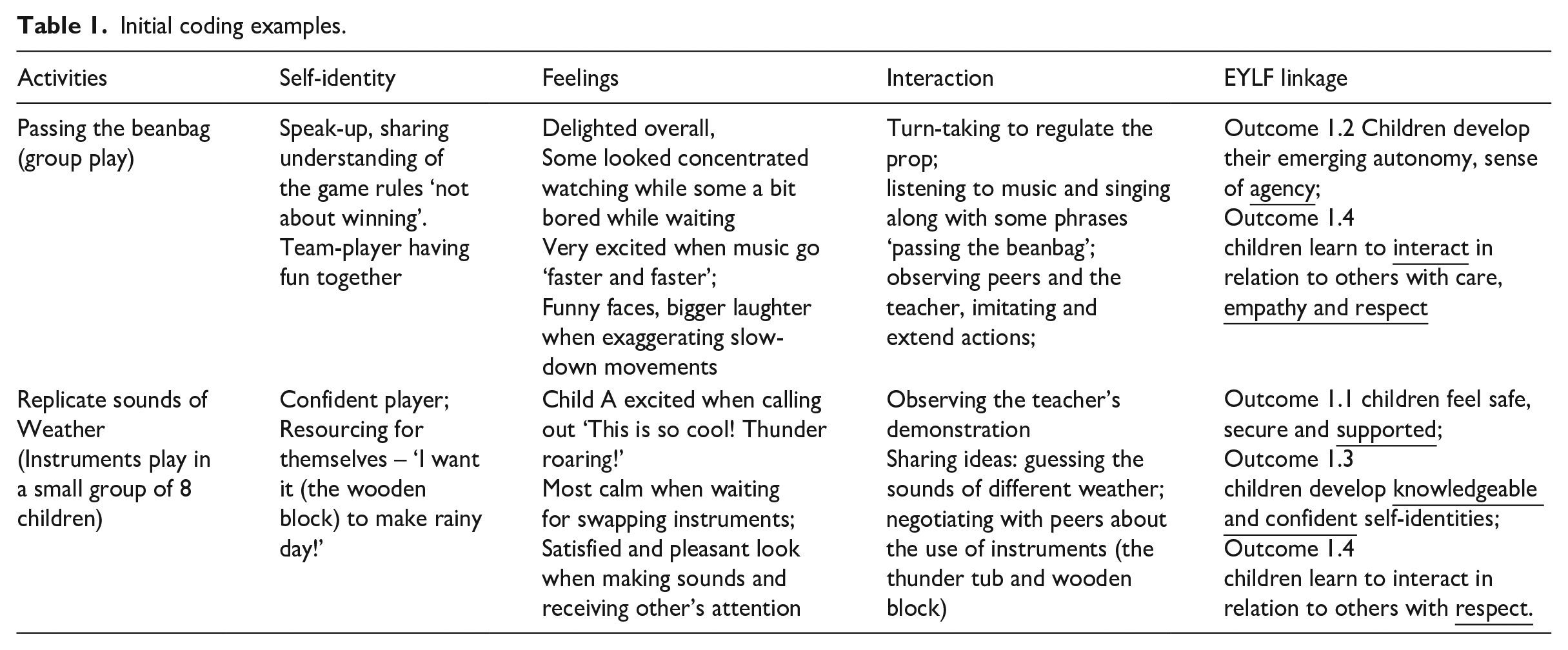
Based on a thematic analysis approach (Braun & Clarke 2006), data analysis was conducted through several rounds of coding; this primarily involved descriptive coding labels, emotion coding and value coding. Data analysis first refers to early studies that acknowledged the three major ways in which music influences individuals: interpersonal relationships, feelings and self-identity (Hargreaves et al., 2002). For example, the initial coding involved grouping children’s Musicking into self-perception, feelings (verbal and nonverbal expressions) and interaction. This study then cross-checked the four areas of the identity concept proposed in EYLF Outcome One (AGDE, 2022). Eventually, the ‘activities’ evolved into themes involving ‘events’ using exemplars of children’s identity development as presented in the Results section. Relevant supportive teaching strategies, which were an important part of the experience planning cycle, were also included. Table 1 provides a brief overview of the initial data processing.
Initial coding examples.
Results
Musicking holds significant value in facilitating children’s ‘belonging-being-becoming’. Through the enacted musical activities, children displayed agency, socio-emotional development and emerging self-identity as confident learners.
Emerging agency through group Musicking
Group music sessions fostered the children’s emerging agency and respectful interaction. Particularly using creative movements, children learn to interact with others with respect. One of their favourite games was ‘passing the beanbag’. As children explored the change of tempo and mood, they demonstrated a growing awareness of observing and responding while enjoying the ‘playfulness’ of music. While some children expressed disappointment when they did not hold the beanbag at the end, others called nout, ‘It’s not about winning!’ Similar experiences were observed with action songs such as I’m a Digger and Highway Number One. Children often requested the repetition of specific games in which their learning experiences extended as their autonomy and sense of agency increased.
In such circumstances, musical play functioned as a zone in which children explored rules and interpersonal relations (Vygotsky, 1978), and the researcher served as a co-player, encouraging the children to extend their expressions and model caring for the group. As Musicking together is important for early identity development (Niland, 2019), teachers may facilitate a supportive peer culture and an inviting environment. These strategies are also useful in instrumental play, in which children learn to share and self-manage by watching a teacher and their peers.
Celebrating milestones and awareness of cultural diversity
Through musical performances, children celebrated their developmental milestones and shared a sense of belonging. During the study period, senior cohort preschoolers were about to experience graduation ceremonies. Two songs were selected: My Body Makes Music and Thank You. For approximately 6 weeks, the children practised singing and dancing as part of their daily routine. In the beginning, teachers provided examples of actions for both songs to help children create their own ‘fun’ poses. For example, when singing the lyrics ‘Thank you’, some started hopping and clapping with some blowing kisses instead of waving hands. While some children initially expressed anxiety or fatigue during rehearsals, none exhibited boredom or withdrawal. On the day of the graduation, the group proudly donned gowns. This performance became a symbolic action (Huhtinen-Hildén & Pitt, 2018) and collective effort through which children celebrated their achievements while also expressing gratitude to their loved ones.
Given that music embodies values and beliefs (Clarke et al., 2012), teachers may capture this unique moment empower themselves and the children to appreciate cultural diversity. Missed opportunities were observed during this practice. The original plan was to sing My Body Makes Music in English and Spanish, reflecting a child’s cultural background. With catchy lyrics, the group were very engaged in making movement and followed the child’s lead. However, limitations due to staffing (limited availability of Spanish-speaking teachers) and educator confidence in a second language led to inconsistency in rehearsal, and eventually it turned out to be an English-only performance. As musical creativity can be understood as a ‘situated cultural and social activity’ (Burnard, 2012, p. 22), their learning of a new song could have served as a special zone that enabled teachers and children to enrich their cultural understanding as co-learners.
Recognition of self-Identity as confident and involved learner
Through song sharing, vocal play and composing, children develop knowledgeable and confident self-identities because they feel recognised for who they are (DEEWR, 2009). During this study, children amused themselves by nominating their favourite songs and singing. A sense of pride was evident, and some mimicked their peers and demonstrated their ‘singing voices’. In yarning-circle time, the children enjoyed vocal play using ‘vowels’ as they extended their interest in creative literacy. As they became familiar with the pentatonic tune, pitch and letter pronunciation, they experimented with ‘funny sounds’. As one child initiated excitedly, ‘I have a good one; no one used before! Bo bo bo bo. . .’ The group responded with laughter and other fun choices. Creativity and confidence were fostered through such a playful activity.
This research suggests that exploring musical instruments helps foster children’s confidence. In both spontaneous exploration and guided play, the children learned to choose learning materials and displayed curiosity regarding texture, rhythm and pitch. Some children enjoyed their ways of playing instruments and were keen about sharing with their peers, such as placing little objects in a singing bowl while shaking and listening; this reflected the fun of improvisational interaction.
Song-making also reflected children’s awareness of identity and socio-emotional development. The invented songs of young children reflect their interests and emotional states because they sing about people, objects and events integral to their daily experiences (Barrett, 2010, p. 405). As Figure 1 shows, children were invited to make a Selfie-Song. Inspired by the idea of using visual art to foster children’s music-making (Higgins et al., 2010), the researcher initiated this activity by introducing herself with a drawing sung to the tune of Brother John with the words, ‘I am XX, I am XX. I am 36, I like rainy days. . .’ As the drawing served as an open-ended conversation, the children took turns making their selfie-song. One girl shared her novel ideas and created ‘I am XX, I am XX, I am
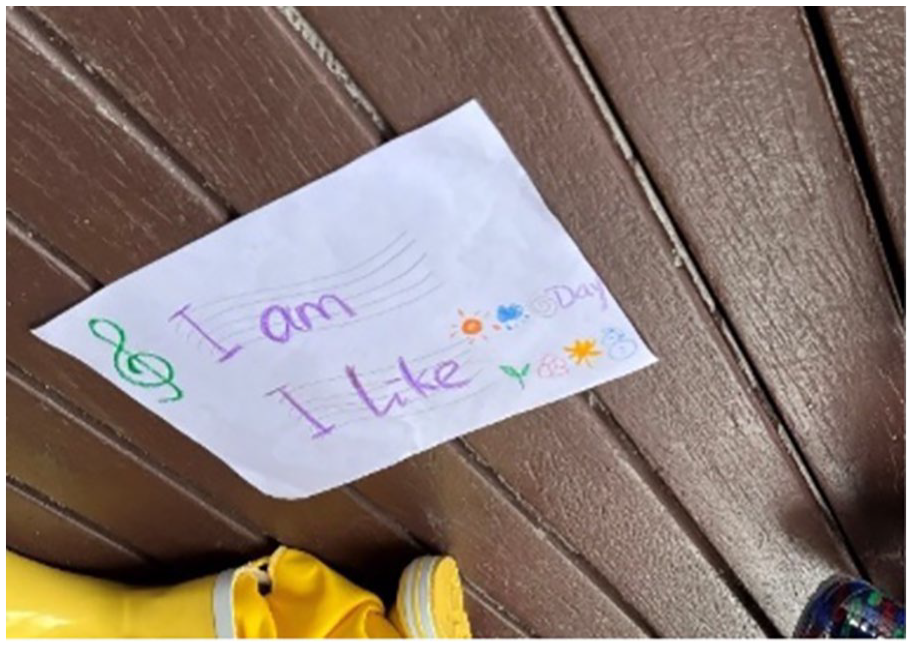
Making a selfie-song.
By promoting play-based learning, the researcher took the role of coach and co-learner, encouraging children to lead. For young children, music-making and song creation serve as forms of musical storytelling that make sense of their experiences, organise their worlds and perform and embody their identities (Barrett, 2010, p. 406). Therefore by listening to the children’s ideas and valuing their musical narrative, the researcher gained insights into their interests, competencies and self-identity. Such information is crucial for informing and refining the daily curricular. As the children were given equal opportunities to express themselves, the researcher focussed on the children’s emotional cues during spontaneous exploration. The use of graphic notation served as a tool to prompt children’s imagination and encouraged them to ‘tune in’ to the music. This approach acknowledges the importance of pedagogical sensitivity (Huhtinen-Hildén & Pitt, 2018), where educators care for children’s needs and emerging interests, seizing teachable moments to empower their learning of and through music.
Creativity and autonomy in musical imagery
Drawing inspiration from children’s enthusiasm for drawing and painting, several ‘musical imagery’ activities were introduced. The participants actively listened to the music and then reflected on their feelings. Discussion started with open-ended questions such as ‘What do you hear in the music?’ and ‘How do you feel?’ Many children eagerly shared their interpretations and created ‘stories’ inspired by the music, sparking further interest and participation from their peers. Once the children were familiar with music appreciation, they became passionate about drawing imaginary scenarios. One boy, Luc (pseudonym), listened to the Lion King album and named his story ‘One Night in the Jungle’. He declared that this movie was his favourite and asked to replay the music several times. Following an immersed experience lasting about 20 min, Luc finished his drawing and called out proudly, ‘This is Simba and me, under the sky!’ By including himself in the picture, Luc demonstrated his growing autonomy and capacity for discovery (EYLF Outcome 1.2). Figure 2 shows examples of the children’s creative narratives.
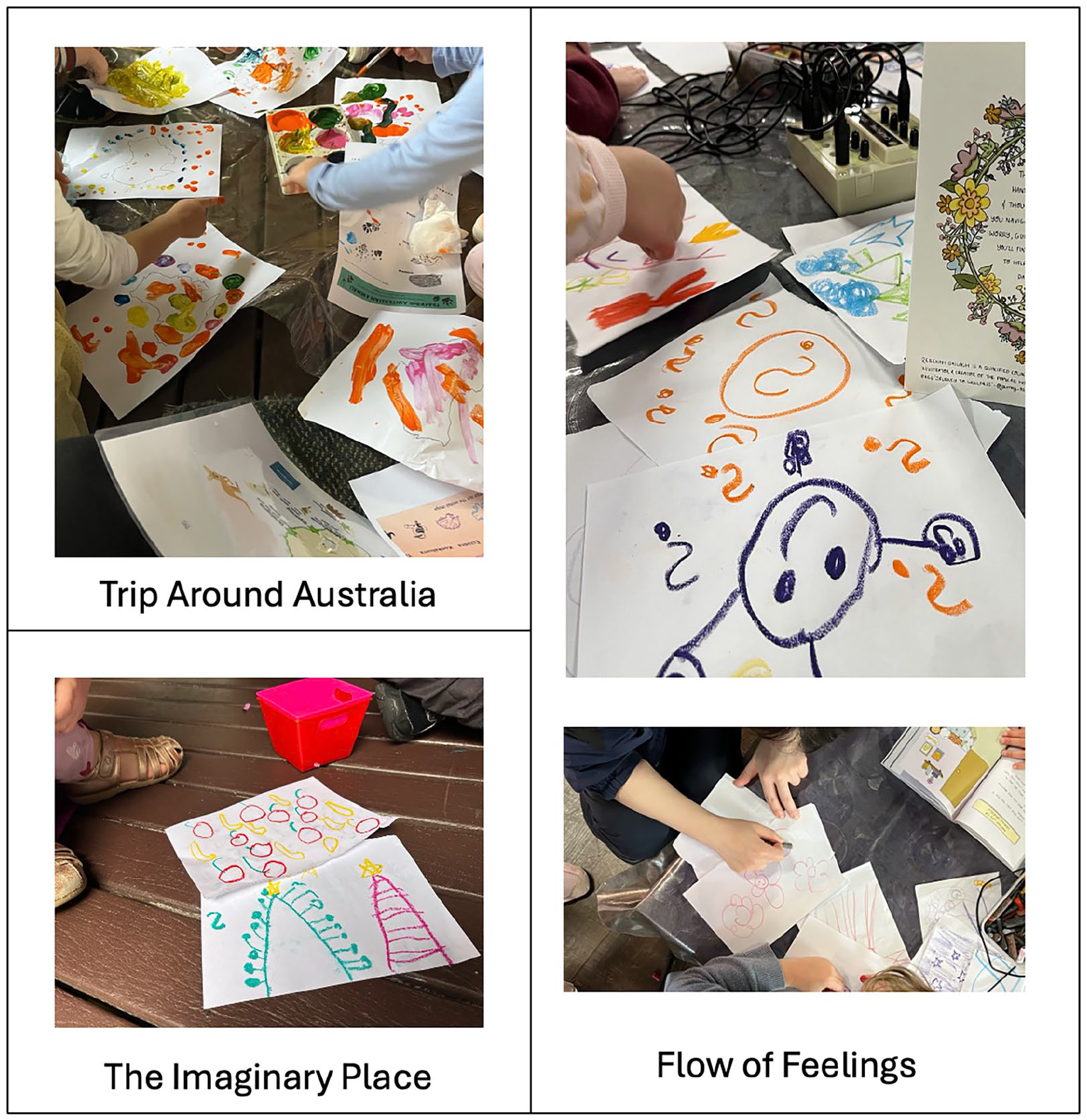
Music imagery.
Children loved Highway Number One and often imitated animals in the song. They were invited to make a finger painting around a map of Australia (The left upper picture). Children also listened to festival music with bright tones and drew imaginary places with crayons (the left bottom picture). Some drew Christmas markets, and others drew candy and parties. When listening to classical music and exploring feelings, children drew question marks and scribbled with the flow.
As children explore their identity through the creative arts, teaching strategies are created from interdisciplinary insights. As a co-player, the researcher helped the children feel secure and supported (AGDE, 2022; DEEWR, 2009) by providing an inviting environment, scaffolding their focussed listening and demonstrating multimodal experiences (Gibson & Ewing, 2020). Figure 2 displays the various tools used to support children’s immersed play. Different genres of music were explored, including nursery rhymes, classical music and folk songs (e.g. Shenanigan soundtracks).
Conclusion
Implications for practice
This study underscores the importance of respecting children’s ‘playful nature’ through Musicking. Children’s creativity sparks pedagogical improvisation, with a reciprocal dynamic interplay where teaching and children’s expression enrich each other. Based on the children’s interests and central resources, this research explored various extension activities such as musical imagery, creative play of instruments (e.g. singing bowls and replication of the weather). While this study provides examples of diverse kinds of musical play, more practices can be integrated throughout daily activities, for example transitions during pack-away, hygiene routines and etc. In particular, children’s agency could be nurtured through self-initiated Musicking, especially during their free play time (Gluschankof, 2019). The findings also reflect the challenges of catering to individual needs in group settings due to children’s varying interests and learning dispositions. Sometimes, behaviour management posed difficulties. For example, when playing musical instruments, children enjoy making fun with their peers as they were also developing the idea of turn-taking, respect and self-regulation skills. Allowing sufficient time and space, and more importantly, teacher’s belief in children’s strengths are meaningful to extend their interest in music.
To support young learners, educators, who are often multitasking, may take on flexible roles and adapt their approaches to creating individual learning opportunities (Huhtinen-Hildén & Pitt, 2018). After arranging the environment and resources, the researcher often sat down to play with children and discuss their ideas about music (as shown in Figure 2). No matter whether it is a group session or children’s spontaneous exploration, ‘musical instruction for a child does not begin in the music lesson; playtime is the starting point’ (Orff, 1932/2011, p. 68). Playful learning can occur in diverse forms, such as creative movements, vocal play, listening and instrumental play (Barrett & Westerlund, 2017). Skills are needed, while, more importantly, educators can become good enough to capture teachable moments and facilitate a supportive environment for children.
Professional development
As music is an act of both cultural and individual creation (Reimer, 2003), teachers’ professional development is significant in facilitating young children’s Musicking. The dual role of general educator and researcher was demanding, which, however inspired the author to advocate for zone for practitioners’ learning and collaboration in daily practice. Beyond a personal passion for music, a strength-based viewpoint helped the researcher stay motivated to learn for and with the children (Joseph, 2019). Reflecting on pedagogical improvisation in music education (Higgins et al., 2010; Kondo & Wiggins, 2019), this study underscores the importance of teachers’ ‘professional ambition’ (Young, 2018, p. 12) and valuing their curiosity and reciprocal interactions with children. Witnessing children’s creativity and discoveries during musical exploration can encourage educators to reflect on their roles as co-learners. As Vygotsky (1931/1987) advocated ‘through others we become ourselves’ (p. 105), Musicking with children empowers teachers’ exploration of their evolving identities too. Moreover, this research acknowledges studies that advocate partnering with specialists and offering sustained training to help non-specialist educators enhance their music abilities and confidence (Ibbotson & See, 2021; Simones, 2021).
Limitations and future research
Owing to time constraints, there was limited opportunity for engaging other key stakeholders to share their insights. More collaboration among the teaching team would contribute to diverse uses of music and children’s understanding of different genres. This study noted that children’s home language might be overlooked due to the backgrounds of teachers, which had not been adequately discussed. It reflects advocates of exploring practitioners’ cultural identities and children’s multicultural music experiences (Lum, 2012; Marsh, 2008). It would also be valuable to conduct longitudinal studies engaging in partnerships with families and communities and creating a nurturing environment for children (Barrett & Tafuri, 2012). Incorporating creative arts, this study values aesthetics and proposes an interdisciplinary approach (Coss, 2013; Young, 2018). Besides visual art applied in this study, literacy, drama and dance warrant further research. This study missed out on the use of technology, which can also play an intriguing role in young children’s musical lives. Music-inspired STEAM projects also have a significant potential for achieving sustainable lives (Van Vreden, 2018).
In conclusion, this action research responded to preschoolers’ interests and explored the possible roles of music in nurturing children’s identity development. Despite a focus on the Australian context, this paper provides a snapshot of ‘learning through music’ and acknowledges valuing playful learning that aligns with educational philosophies in many societies. Since identity development is quite a dynamic process, early childhood practitioners (and music teachers) can be inspired by a ‘broader’ viewpoint of valuing children’s Musicking (Niland, 2019, p. 30).
Footnotes
Acknowledgements
I would like to thank the editors and reviewers at International Journal of Music Education for their insightful feedback and constructive suggestions. The authors would like to thank SAGE Author Services for providing language proofreading. Their assistance helped improve the clarity and readability of the article.
Author contribution
Declaration of conflicting interests
The author declared no potential conflicts of interest with respect to the research, authorship, and/or publication of this article.
Funding
The author received no financial support for the research, authorship, and/or publication of this article.
Ethical considerations
This study is based on the author’s action research conducted within her workplace, where she holds a dual role as both educator and researcher. The action research is part of the University of Sydney’s Master of Teaching Degree, and adheres to the ethical guidelines set forth by the University of Sydney Ethics Committee. The data and findings are derived from the author’s reflection on teaching practices. No identifiable information from participants is included. Parental consent and permission of the workplace director were obtained before the action research. Pseudonyms are used to ensure children’s confidentiality.
