




Abstract
Guided listening is vital in music education, fostering self-expression, skill development, and academic achievement. Yet, its limited use in Israeli high schools creates a gap between its recognized value and practice. This mixed-method study examines guided listening integration in secular Jewish-Israeli high school music programs based on four philosophical and pedagogical approaches—esthetic, Praxial, active, and peer instruction—to understand teachers’ objectives, methodologies, implementation, and optimal learning environments. Data was collected from an online questionnaire, structured interviews, direct observations of Western Art Music History lessons, and the researcher’s reflective journal. Key findings: (1) teachers tend to use a repeated five-step teaching pattern (reviewing, lecturing, analyzing, listening while following a score, summarizing); (2) teachers usually do not write lesson plans with detailed, step-by-step guidelines; and (3) teachers use recommended guided listening approaches in a limited capacity, likely due to pressure from preparing students for exams, and the perception that such methods are not fully suitable for Israeli high school music students. The paper explores teachers’ challenges in adopting guided listening pedagogical methods while balancing curriculum demands and promoting inclusivity. It offers recommendations for policymakers and educators on professional development and curriculum revisions, emphasizing detailed lesson planning for effective learning outcomes.
Introduction
Guided listening is a fundamental component of music education, offering students a pathway to explore and comprehend the intricate world of musical compositions and their historical contexts (Davis, 2011; Nowacki, 2012; Piragasam et al., 2013; Spruce, 2016). However, effective integration within high school music programs poses significant challenges due to curricular demands, lack of teacher training, and teachers’ perceptions of its ability to engage students (Johnson, 2011; Lowe, 2012; Nowacki, 2012; Scott, 2011; Sloboda, 2001; Spruce, 2016; Strauss, 1988; VanWeelden et al., 2019). This study examines guided listening practices within Israeli high school music classrooms to explore teachers’ educational objectives and instructional methodologies and the influence of curriculum constraints. By offering practical recommendations, this research aims to enrich pedagogical practices in high school music education thereby cultivating deeper music appreciation among students.
Literature review
Guided listening for meaningful and engaged learning
The literature discusses four distinct principal philosophical and strategic approaches to guided listening (see Table 1), each of which plays a different significant role in classroom listening instruction and offers advantages in enhancing musical understanding, supporting student identities, fostering connections with music, and enhancing engagement with musical content and context.
The four guided listening philosophies.

Esthetic approach
The esthetic Approach to music education is not a specific method but a philosophical perspective prevalent since the 1950s. It structures music listening around esthetic elements (harmony, melody, rhythm, etc.). Traditionally, it involves score analysis and lecture-centered teaching methods (Finney, 1941; Reimer, 1972). However, contemporary researchers such as Spruce (2016) have challenged the traditional esthetic approach by advocating for a broader understanding of music listening and encouraging active engagement with the music itself.
For example, Spruce shared a jazz listening unit focused on Billie Holiday’s song “Strange Fruit.” Instead of simply identifying jazz as a genre, Spruce encouraged students to listen actively and discern distinctive elements such as jazz-like phrases, rhythms, and tonal characteristics within the song. This goes beyond surface-level analysis and encourages students to immerse themselves in the music. Furthermore, Spruce guided students through a series of creative exercises inspired by the music that included composing phrases or musical motifs inspired by the jazz elements and more. By actively engaging with the music and expressing themselves creatively, students gained a deeper understanding and connection to the genre.
One should pause to consider why Spruce chose such a culturally charged song for an activity focusing solely on the musical elements—jazz style and blues-notes—while minimizing the profound cultural context of “Strange Fruit,” which is about Black males lynched by White mobs. This raises ethical questions about whether and how such a song should be taught in music history (Howard, 2020).
In addressing this issue, Reimer (2021) argued against criticism of the traditional esthetic approach, questioning whether we should abandon teaching Western musical culture to prioritize diversifying music lessons with “multicultural” compositions. Reimer emphasizes that he is not opposed to teaching non-Western cultures but advocates for doing so carefully and thoughtfully (p. 4).
Praxial approach
The Praxial approach, also known as Music Education as Praxis, is based on the philosophical ideas of Elliott (1995) that were further developed by Silverman (2013, 2020). It focuses on performance, critical thinking, and embracing diverse perspectives to help connect the music to broader societal themes. For example, Silverman’s students examined Nas’s song “I Can,” 1 which interpolates Beethoven’s “Für Elise,” and explored the connection between Beethoven’s life and struggles with the rap genre’s challenge to social norms. Through repeated listening sessions and discussions, the students actively analyzed cultural, political, and musical aspects, fostering a range of diverse interpretations and offering various insights and drawing parallels between Beethoven’s revolutionary nature and Nas’s call for a revolutionary mindset. One student remarked, “Beethoven was a revolutionary in his time, and Nas asks children to be revolutionary, stick to a goal, and work hard to achieve it.”
Silverman encouraged students to analyze the musical structure, thus deepening their understanding of the song’s intentions. She had them write and perform a new stanza for the rap song. The students’ responses showed their ability to critically analyze the themes, cultural contexts, and musical connections present in the song, which align with the goal of the Praxial Approach to foster diverse interpretations and active engagement in music education (Silverman, 2013).
Active approach
The active approach is grounded in the philosophical principles of the constructivist theory of teaching and learning (Brooks & Brooks, 1999). This approach prioritizes analytical and performance-based learning, thereby encouraging participation through questions, discussions, and various forms of expression and intuitive responses (Scott, 2011, Strauss, 1988). Lowe (2012) emphasizes the necessity for teachers to organize listening activities prior to the beginning of the lesson to prevent student distraction and make the most of valuable class time. This includes selecting specific listening segments, setting up technological aids, such as audio systems and presentations, and formulating clear and practical listening tasks that are visually presented to students throughout the activity.
One of Lowe’s suggested strategies involves distributing worksheets or handouts to students, allowing them to jot down their impressions, comments, and additional thoughts while listening to the music. Such active engagement through writing helps students process their thoughts and observations. She suggests using three types of listening practices: structural listening, stylistic listening, and historical listening. Each type aims to engage students in discovering musical characteristics, style differences, and historical contexts.
For example, Lowe demonstrated an interactive approach with the opening march from Tchaikovsky’s Nutcracker Suite. To identify the musical form and the musical gesture, she prompts students to listen to the first thirty seconds of the march and create a script imagining the participants in the scene. In another activity, students are asked to draw graphic illustrations corresponding to different parts of the music, resulting in a graphic map depicting the ascending and descending sounds.
Peer instruction and technology integration
Peer instruction is an interactive teaching technique designed to foster classroom interaction, engage students, and address challenging aspects of the material. Introduced by Mazur (2009), this approach emphasizes active student engagement and collaborative learning. Bowen (2011) extended this approach to a technology-based “hybrid course” in music education, utilizing technology for pre-class preparation and transforming the classroom into a platform for in-depth learning, critical thinking, and active engagement. By embracing such pedagogical strategy and incorporating peer instruction for guided listening, the music classroom evolves into a dynamic forum where students actively engage in discussions, scrutinize compositions, and explore various facets of music history.
For instance, in a lesson about Franz Schubert, instead of offering concrete facts about the composer, the teacher might present an intriguing scenario that invokes curiosity, encouraging students to explore digital resources to investigate Schubert’s influences and musical legacy prior to class. Lectures serve as a catalyst for deeper exploration, prompting students to ask questions, voice opinions, and explore societal and cultural implications reflected in Schubert’s music. This well-integrated use of technology, along with intriguing inquiries and open-ended discussions, cultivates an environment that promotes curiosity, critical analysis, and active involvement among students (Bowen, 2011).
High school music programs and the Western Art Music History class in Israel
Israeli public education is government-mandated and socio-religiously segregated into four sectors: Jewish Secular, Jewish Religious, Jewish Ultraorthodox, and Arabic-speaking populations. Each sector follows a distinct curriculum adapted to its community’s needs (Ehrlich & Badarne, 2020). Even though the general education curricula are segregated, the music education curriculum functions differently, offering a more unified approach. The National Music Curriculum is shared across all sectors, while allowing up to 30% elective content to accommodate local cultural traditions (Ehrlich & Badarne, 2020; Lev, 2018).
In secular Jewish schools, electives may focus on classical, jazz, middle eastern (traditional or contemporary), or contemporary popular music like rock, pop, musicals, and more. Arab schools can include traditional Arabic music and instruments like the oud and qanun. Interestingly, some Jewish programs also study Arabic music due to shared cultural roots. Conversely, music programs in the Arab sector often choose to study classical music instead of the unit on Arabic music. Religious Jewish schools incorporate liturgical and traditional Jewish music (Ehrlich & Badarne, 2020; Israeli Ministry of Education [IME], n.d.a, n.d.b, 2018; Interview with Kuppervaser, July 4th, 2024 [personal communication]).
Additionally, there are unique music programs with different curricula for outstanding students in the field of music, such as the program at the Thelma Yelin High School of the Arts. These programs are designed to cater to the advanced needs of talented young musicians. Three of our nine participants (Rani, Gilad, and Jacob) were teachers who taught in such programs.
Music programs are open to all students but require a musical background, performance test, ear training evaluation, and an interview for admission. Despite this flexibility, socio-religious contexts influence student enrollment preferences (Interview with Kuppervaser, July 8th, 2024, [personal communication]; IME, 2018).
Music curriculum assessments are divided into two types: External State Core Assessments and Alternative School Assessments, following a meaningful learning model that emphasizes purposeful and deep understanding (Gunstone, 2015). External assessments are standardized tests administered by the state to ensure students meet national educational standards. Alternative assessments include portfolios, project-based tasks, performance activities, and narrative evaluations, providing a broader view of each student’s progress and unique talents (Kuppervaser, 2019).
Table 2 illustrates the learning model of the music curriculum in Israeli high schools.
High school music programs in Israel.

High school students who complete the matriculation exam in music receive accreditation in music programs at universities and colleges, sometimes shortening their learning course from 4 years to three or even less. This accreditation framework in Israel is parallel to the Advanced Placement (AP) program in the United States, which offers undergraduate university-level curricula and examinations to high school students. Colleges and universities in the US may grant placement and course credit to students who obtain qualifying scores in the examinations (Gurantz, 2021).
However, there are differences in the accreditation systems of the U.S. and Israel. The one that is relevant to our research is that of the U.S., where non-musician students may choose to take a music appreciation course and receive college admission credits; in Israel, such an option is not available, and only music majors may take the music history course as part of the curriculum. Despite the difference in target audience, both courses share the common goal of fostering enjoyment and respect for music and understanding music’s cultural and historical contexts (Thompson et al., 2023).
The current research focuses on the Western music history class, which underwent a transformation from the traditional “Western Art Music History” to the “History of Musical Creation” course. As described in the aforementioned approaches, the Ministry of Education in Israel has undertaken a shift from lecture-based teaching toward fostering meaningful, student-centered learning (Kuppervaser, 2019). However, the question arises as to how teachers in the Israeli music programs should respond to this change, especially since there is no mention of guided listening or practical strategies for implementing meaningful learning in the transformed music history class in the newly defined curriculum. This discrepancy raises concerns about the effectiveness of the curriculum in promoting active engagement and exploration.
This study examines how music teachers in Israel incorporate guided listening into their music history classes when they are not guided by the curriculum.
Moreover, since “Music History” is a mandatory course in the music program, it presents an opportunity to address other widespread and common problems encountered by teachers in similar teaching settings, both locally (in Israel) and globally.
Research questions
What methods do music teachers use for guided listening in Israeli high schools?
How do music teachers perceive and utilize guided listening to promote meaningful learning, active participation, and engagement in music history class?
What impact does the curriculum have on the teaching methods employed by music history teachers with respect to guided listening?
By investigating these aspects, the study aimed to provide insight into the effectiveness and implementation of guided listening as a pedagogical approach in high school music education.
Methodology
This study used a mixed-methods protocol. An online questionnaire collected quantitative and qualitative data. Structured interviews, direct observations, and the researcher’s journal provided rich qualitative insight into the participants’ experiences. This mixed methods approach leveraged the strengths of both methodologies, enhancing the trustworthiness of our findings (Headley & Plano Clark, 2020).
Research tools
Four main research tools were used: (1) an online questionnaire (seven demographic questions, three open questions, one multiple-choice question, and one Likert style question [see Supplemental Appendix 1]); (2) structured interviews with the teachers conducted before and after classroom observations (see Supplemental Appendix 2); (3) direct observations of 49 music history classes; and (4) the researcher’s journal, which documented personal impressions, thoughts, and questions during the observations.
Questionnaire
The primary purpose of the questionnaire was to gather data on teaching approaches for guided listening in high school music history classes in Israel. Therefore, the questions were designed to assess the frequency and evaluate guided listening sessions, to identify teachers’ perceptions of their self-efficacy in their instruction, and to identify specific effective activities (see Supplemental Appendix 1 for full questionnaire).
Interviews
Over the course of the 2019 to 2020 academic year, we conducted two structured interviews with each of the nine Group 2 participants. Preliminary interviews (12 questions) were conducted before classroom observations; reflection interviews (8 questions) afterward. The preliminary interviews asked about class content, guided listening approaches, the definition and importance of guided listening, and curriculum integration. The reflection interviews delved deeper into instructional practices and experiences, questioning techniques, additional listening methods, and adherence to the curriculum. The interviews were recorded (audio) and transcribed for further analysis.
Observations
We observed and recorded a total of 49 classes in real-time, with 4 to 10 observations per teacher. Audio recordings and a research journal were used for documentation.
Participants
Group 1: Online questionnaire
The online questionnaire was distributed at the beginning of the 2019 academic year with the assistance of the national high school program coordinator at the time, who emailed the questionnaire’s link to high school music program coordinators across the country. The link was also posted by the researchers on various Facebook music-teacher groups to enhance distribution. In total, 33 music history teachers completed the questionnaire.
The respondents (12 men and 21 women) included a diverse group of professionals in music history, music theory, and ensemble instruction. Notably, 18 also held positions as music program coordinators. The participants had varied academic qualifications (BA, 10; MA, 13; PhD, 3; college certificate, 7). All but two were certified educators. In terms of teaching experience, 6 had 1 to 5 years, 14 had 5 to 15 years, 8 had 15 to 25 years, and 5 had over 25 years’ experience in music education. Similar patterns were observed regarding their experience teaching music history.
Group 2: Interviews and observation
Group 2 comprised nine teachers who underwent interviews and observation. Five of them, originally in Group 1, had agreed in the questionnaire to further participation and had provided contact information. The remaining four were recruited based on their reputed effective teaching methods (i.e. purposive sampling, Obilor, 2023).
To achieve coherence and reliability, we ensured that the teachers represented different districts in Israel.2,3 Details and demographics of this second group are in Tables 3 and 4.
Group 2 participants.

Note. T = music history teacher; PC = program coordinator.
Pseudonym.
School’s socio-economic index (1–10), Our study involved teachers from schools with high socio-economic indices (6–8) as per the Central Bureau of Statistics’ 2019 classification. To protect privacy, we do not disclose detailed socio-economic data of students, teachers, or local authorities and the provided general socio-economic data does not capture the socio-economic diversity. See CBS report.
Position.
Number of observations conducted.
Participating schools.

The numbers were retrieved from: https://www.allschool.co.il/, which sources data from the Ministry of Education, the ICT and Information Systems Administration, the Economy and Budgets Administration, the National Authority for Assessment and Evaluation in Education, and government databases. They are accurate as of July 2024.
We did not find an official source for the number of students in each music program; these figures, obtained from an interview with Kupperverser, are accurate as of July 8, 2024. This lack of official documentation highlights the importance of our research, as no publicly accessible data exists on Israeli high school music programs, including student numbers and demographics. Such transparency is essential for further exploring the unique phenomenon of music high school programs in Israel and presenting it to an international audience.
Data analysis
Data from the questionnaires, interviews, observations, and researcher’s journal were examined and analyzed alongside the recordings and using triangulation and thematic analysis (Boyatzis, 1998). Content categorization (main and sub-categories) was executed by repeated observations and the search for significant patterns to identify shared or unique meanings, connections between categories, and relationships with existing literature.
Trustworthiness
The following measures (based on Stahl & King, 2020) ensured that the data was trustworthy.
Credibility. Recognized methods such as direct observation and structured interviews. Triangulation via mixed methods (quantitative data and qualitative insights).
Transferability. Detailed descriptions and background data to allow comparisons across contexts, facilitating findings’ application to similar educational settings globally.
Dependability. In-depth methodological descriptions and adherence to established protocols. Diverse participants and multiple data collection methods to reduce bias and enhance research robustness.
Confirmability. Rigorous data analysis, including triangulation, to validate conclusions.
Ethical issues
Ethical considerations were addressed and approved by Bar Ilan University’s ethics committee (Approval No. E.MUS.2019-20, March 25, 2019) and the state’s chief scientist (Case no. 10626, May 1st, 2019). Following the recommendations of Birk and Shindledecker (2020), participants were fully informed about the study, provided their consent, and understood that they could withdraw at any time. Participants’ anonymity and confidentiality were safeguarded throughout the research process. Participants were contacted at various stages of the study to clarify information.
Anonymity and confidentiality
Participants’ privacy was ensured by using an anonymous online questionnaire to collect initial data. Their identities were only revealed to the researcher if, at the end of the questionnaire, they provided their name and email for further involvement. All disclosed personal information was securely stored and used only for follow-up research. Pseudonyms were used for analysis and reporting.
Findings
Data analysis led to three main observations: (1) teachers tend to follow a characteristic five-step teaching pattern (see below); (2) lesson plans typically lack operative instructions: teachers seem to prefer general goals and points for teaching; and (3) teachers’ capacity to implement recommended guided listening approaches is limited due to exam pressure and reservations about some of the approaches’ suitability for high school music students.
Characteristic five-step teaching approach
This established pattern seemed to serve as a framework for managing classroom instruction while navigating the extensive material required for matriculation exams.
Reviewing
Teachers first prompt students to recall previously covered material, aiming to actively engage them in the class. Some students were engaged with this strategy; we observed that many remained passive and showed limited interest.
Multimedia-based lecturing
Next, teachers would introduce multimedia aids (e.g. YouTube videos or PowerPoint presentations) to enrich their lectures, exemplify discussed concepts, and show how different genres reinterpret musical works. Leah explained, “By exposing students to diverse interpretations of the same piece, they can develop a deeper appreciation for music’s versatility and the impact of different genres and contexts on musical expression.”
In this context, Leah was observed not only frequently utilizing YouTube videos but also often allowing her students to access her computer and select videos they found relevant to the subject being studied. In a reflective interview, Leah elaborated that by granting this level of freedom, she believes a connection is forged between her and the students, fostering an environment where they feel comfortable approaching her and sharing their musical preferences. She asserted that breaking such barriers improves the students’ rapport with her as both a teacher and program director.
Musical analysis
In this phase, the teacher guides the students through musical analysis, aiming to prepare them for attentive listening by identifying various elements in the musical score. The interviews, observations, and questionnaire responses all gave evidence that teachers perceive this stage as crucial in guided listening. As Gyora expressed,
Analyzing and engaging with the musical score is the core of guided listening. It makes the listening process engaging and age-appropriate. I believe that the process of analyzing a score allows high school students to connect with the composer and era of the composition and experience the music.
Results from the questionnaire (Supplemental Appendix 1, Q8; Figure 1) indicated that most teachers (23 out of 33) identified musical analysis and music making (13) as the activities consuming the most class time. Use of visual aids, verbal explanations, or social contexts were not deemed time consuming.
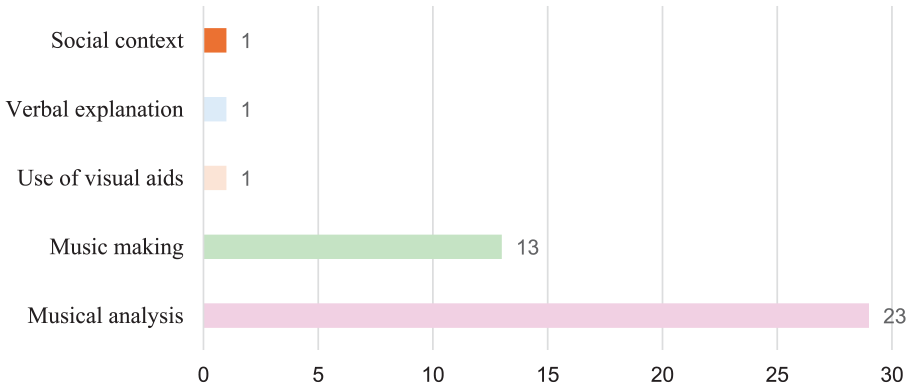
Distribution of answers regarding which guided listening activities take up most class time (n = 33).
Listening while following the score
The online questionnaire responses indicated that about two-thirds of the teachers (23 out of 33) described guided listening activities as the ability to follow a score while listening (Supplemental Appendix 1, Q11). The teachers mentioned that they often emphasized different aspects when following the scores, such as paying attention to notation and markings or tracking individual instruments or vocal lines to discern subtle nuances in the music.
Out of our nine Group 2 participants, three—Gyora, Ido, and Shiri—also emphasized their preference for the score-following technique. During interviews, they agreed that reading a score is a crucial skill for musicians, transforming passive listening into active engagement with the music: Shiri highlighted the importance of students discovering musical elements within the score independently, enhancing their connection to the music; Giora agreed and further emphasized the cultural and historical significance embedded in musical notation, explaining that “This historical document [the score] gives some kind of reflection to a cultural, social, historical mindset, and from this [the students] learn, not only what that is in the notes but also what they reflect”; and Ido stressed the importance of using the score judiciously and incorporating engaging activities such as worksheets to support students with varying skill levels and that he promoted peer learning and careful selection of short scores to ensure student success and sustained engagement.
Summarizing
Finally, the students are asked to summarize key concepts, thus reinforcing learning and facilitating retention for future assessments. Gilad explained, “This step ensures continuity in students’ musical education and effectively prepares them for exams.”
Lesson planning: Absence of operational instructions
All nine Group 2 participants expressed and demonstrated a preference for a structured yet flexible teaching approach that allows them to plan lessons broadly rather than following rigid operational instructions. In other words, they outline the material to be covered in general without specifying detailed goals.
For instance, we observed a lesson taught by Lior on Chopin and Romantic music. He began with the traditional lecture format, discussing the characteristics of Romantic-era music, emphasizing Chopin. When he noticed a lack of engagement among the students, he decided to incorporate examples of music preferred by the students. In the reflective interview, Lior stated:
Spontaneous and flexible teaching seems more suitable for high school students. Planning a lesson with operative goals is more appropriate for . . . elementary school or kindergarten. In high school, adaptability allows me to connect with students more effectively without being limited by predetermined actions.
Jacob, an expert music history teacher, encountered an unexpected challenge during a session centered on multicultural music from around the world. His original strategy involved a structured presentation where each student was to present a different topic supported by YouTube clips. However, a projector malfunction disrupted Jacob’s plans, rendering the multimedia aspect of his lesson inaccessible. Jacob improvised and adapted his approach, transforming the situation into an opportunity for dynamic engagement and an interactive auditory experience. Instead of relying on visual aids, he challenged his students to immerse themselves in the sounds and rhythms of multicultural ceremonial and communal music. Each student was tasked with presenting their chosen topic through audio only; the other students had to identify the group playing, distinguish whether the vocals were male or female, suggest the attire worn in the video clip, and deduce the purpose behind the musical performance—perhaps ceremonial or funerial. Furthermore, they were prompted to determine the specific tribe, country, or region from which the music originated.
In reflecting on his teaching philosophy, Jacob highlighted the importance of flexibility in lesson planning. By embracing unexpected challenges as opportunities for creative thinking, he was able to maintain the momentum of the lesson and facilitate meaningful learning experiences for his students.
These two examples underscore the perspectives shared by our participants, illustrating their preference for a teaching approach that prioritizes adaptability and responsiveness. When asked about their rationale for this approach during interviews, teachers noted that embracing spontaneous occurrences in class is pivotal for fostering connections with students and anchoring them to the lesson content.
Rejection of alternative teaching methods for guided listening
When discussing alternative methods for guided listening (e.g. singing, musical performance, game-based activities, graphic notation interpretation, intuitive kinesthetic movements, role-playing scenario), the six male Group 2 teachers expressed reservations, deeming them more suitable for younger pupils. Their concerns centered on potential embarrassment for students and teachers, the consumption of valuable class time, and diverting students’ attention away from the core material, potentially impacting their performance in matriculation exams.
On the other hand, the three female teachers expressed willingness to try other teaching strategies, although concerned about necessary training or proper resources. For Dganit, the demanding curriculum restricts her from pursuing more creative teaching strategies; she leans toward lecture-based, multimedia teaching to prepare students for their exams. We observed Leah attempting to incorporate graphic notation techniques into her class, but this was spontaneous, and the students did not fully understand the assignment and its rationale.
Analyzing the online questionnaire (Supplemental Appendix 1, Q11) yielded similar results. The majority (23 teachers) described guided listening activities as score-following and musical analysis but given more class time, they would incorporate other strategies (instrument-playing sessions, experimenting with different instruments to recreate elements of the music being studied, and encouraging graphic/visual expression of the music) or intuitive expression of the music (e.g. students responding to changes in the music through physical movements).
Discussion
Methods for guided listening used by Israeli high school music teachers
Our findings indicate that Israeli high school music teachers predominantly utilize a structured five-step approach for guided listening, which deviates from the recommended contemporary approaches in the literature. While this method aligns with some aspects of the esthetic approach advocated by early Reimer (1972), it primarily relies on lecture-based teaching methods, potentially limiting broader understanding and all-class engagement. This stands in contrast to recommendations from contemporary esthetic guided listening researchers (Egermann & Reuben, 2020; Guo et al., 2020; Reimer, 1993, 2021), who emphasize interactive, student-centered learning experiences.
Regarding the Praxial approach, although some teachers aimed to integrate cultural and community contexts into the curriculum, they often defaulted to conventional lecture-based methods instead of student involvement and cultural context integration (Elliott, 1995; Silverman, 2013, 2020). This was evident in the observations and the analysis of the questionnaire data, which showed that teachers rarely engage in social issues, contrary to the recommendations of the Praxial listening philosophy. Nevertheless, some teachers expressed openness to incorporating the Praxial approach further if provided with proper training and additional teaching hours.
While some elements of the active approach, such as score following and question-based discussion were observed, again, there is a predominant reliance on multimedia-based lecture instruction, hindering opportunities for self-exploration, active participation, and engagement, thus posing challenges for teachers to fully embrace more interactive and student-centered approaches (Brooks & Brooks, 1999; Scott, 2011; Strauss, 1988).
Peer learning, although present in some instances, lacked structured interaction and collaborative problem-solving, contributing to a more passive learning environment.
Although this study noted areas in which teaching diverges from recommended methods, it is important to note that music history is just one part of the high school music program (see Table 2). Students also participate in alternative assessments involving multi-stage research and a performance project, aspects not examined in our study. Thus, we should exercise caution when identifying shortcomings in the music history class, which is just one component of a broader program.
If pedagogical changes are to be initiated to overcome the curriculum’s lecture-based teaching style and encourage teachers to implement recommended guided listening methods, they must be supported by curriculum planners. Therefore, while teachers should enhance their understanding of guided listening, support from the Ministry of Education is crucial for this pedagogical shift.
Perceptions and utilization of guided listening to promote meaningful learning
Teachers greatly valued guided listening for its ability to stimulate discussions and enhance understanding of musical scores. However, the pressure to prepare students for matriculation exams often hinders the utilization of non-lecture-based methods, resulting in limited opportunities for inclusive class participation and meaningful engagement. Additionally, teachers expressed reservations about alternative methods, posing significant barriers to the implementation of holistic guided-listening pedagogical strategies.
Impact of curriculum on teaching methods in guided listening instruction
While the curriculum extensively covers Western music history, there is a significant gap in effective teaching methods to convey its rich content, particularly regarding guided listening techniques. Teachers predominantly rely on lectures due to time constraints, potential classroom disruptions classroom, and perceived unsuitability of other methods for high school students. To integrate guided listening into music history lessons, time and curriculum demands must be effectively managed by integrating changes into the curriculum itself and providing teachers with comprehensive guidance on content and teaching methods. Bowen’s (2011) approach offers valuable insights into updating the curriculum to incorporate guided listening while addressing contemporary learning challenges.
Recommendations and further research
Recommendations for curriculum and policy planners
Music history teachers could benefit from professional development opportunities exploring diverse guided listening instructional approaches. Workshops, seminars, and online courses should focus on methodologies that emphasize active participation and technology integration. Curriculum guidelines should be revised to encourage the adoption of non-lecture-based methods, thereby creating a more dynamic and inclusive learning environment. By providing resources showcasing the effectiveness of alternative activities, policymakers can empower teachers to implement these approaches with confidence and creativity.
Recommendations for music history teachers
The findings of this study recommend teachers to do the following: (1) Challenge traditional teaching methods by experimenting with holistic approaches that promote active listening, creative expression, and peer learning. (2) Collaborate with colleagues to share practices. This can facilitate professional growth and innovation. A follow-up study could investigate how a “community of practice” (Wenger, 1998) might lead to collaboration between teachers in other locations. (3) Create detailed lesson plans with specific objectives and strategies. This can enhance student engagement and comprehension.
Limitations and recommendations for further research
The current study included only a small number of participants, all teaching in Jewish secular schools in Israel; most participants held Ph.D. degrees, which might not represent other educational contexts. These limitations provide avenues for future research, such as expanding the sample populations to Jewish religious and Israeli-Arab schools and using larger samples for improved generalizability. Comparative studies between Israel and other countries would be worthwhile. Examining guided listening instruction in teacher training programs and investigating novice teachers’ experiences with guided listening instruction could provide valuable insights into its effectiveness or areas for improvement. Performing longitudinal studies to track the impact of guided listening on graduating students over time could further enhance understanding. Furthermore, exploring the influence of remote and hybrid learning models due to the COVID-19 pandemic is recommended.
Supplemental Material
sj-docx-1-ijm-10.1177_02557614241292359 – Supplemental material for Guided listening as meaningful learning: A study of Israeli secular Jewish High School music programs
Supplemental material, sj-docx-1-ijm-10.1177_02557614241292359 for Guided listening as meaningful learning: A study of Israeli secular Jewish High School music programs by Sharon Lagon Rozenbaum and Atara Isaacson in International Journal of Music Education
Footnotes
Authors’ note
This research was carried out as part of the requirements of a PhD dissertation (2023) under the supervision of Dr. Atara Isaacson, Bar Ilan University.
Declaration of conflicting interests
The author(s) declared no potential conflicts of interest with respect to the research, authorship, and/or publication of this article.
Funding
The author(s) received no financial support for the research, authorship, and/or publication of this article.

Supplemental material
Supplemental material for this article is available online.
Notes
References
Supplementary Material
Please find the following supplemental material available below.
For Open Access articles published under a Creative Commons License, all supplemental material carries the same license as the article it is associated with.
For non-Open Access articles published, all supplemental material carries a non-exclusive license, and permission requests for re-use of supplemental material or any part of supplemental material shall be sent directly to the copyright owner as specified in the copyright notice associated with the article.
