




Abstract
This study explores how higher music education institutions position themselves in relation to wider social and political forces and the expanding professional responsibilities of musicians in increasingly complex Nordic societies, which in this study includes Finland, Sweden, Norway and Denmark. By asking how the political—including various local and global social-ecological values, relations and power structures—is manifested in contemporary higher music performance study programs, the study aims to identify the challenges and possibilities of institutional change within higher music education in the Nordic context. Theoretically, we engage with Gert Biesta’s understanding of public pedagogy as an intrinsic part of educational endeavors that engage with the political and societal, thus promoting and serving as a catalyst for transformative change within higher music education. The data consists of five focus group interviews (n = 13) and a questionnaire (n = 29) addressed to the teachers and leaders of music performance programs in four higher music education institutions. We identified five emerging change identifications in the Nordic higher music institutions: (a) changing teacher roles, (b) students as change agents, (c) artists and/as citizens, (d) aesthetic and epistemic paradigm shifts, (5) negotiating institutional boundaries. The findings suggest that although the concept of public pedagogy is not yet fully established within these institutions, all three forms, (a) pedagogy for the public, (b) pedagogy of the public, and (c) pedagogy of publicness, are emerging. However, resistance to change could hinder higher music education from staying relevant amid current societal challenges and turbulence. By integrating public pedagogy into the daily practices and discourse of higher music education, both the necessary adaptation to political upheaval and the pedagogical and artistic identities of teachers and students could be strengthened.
Keywords
Introduction
It is hardly credible today to claim that any institution is politically neutral. Faced with rapidly changing social, ecological, and political conditions on a global scale, the deceptive claims of political neutrality have disconnected universities from society (Davids & Waghid, 2021) and freed educational professionals from the responsibility of reflexivity and struggle (Clarke & Phelan, 2017). As Noam Chomsky (1967) affirmed, the “responsibility of intellectuals,” particularly among the privileged minority in Western democracies, lies in the power that comes from political liberty, access to information, and freedom of expression. This responsibility makes higher education professionals inherently political actors (Giroux, 2004) and obliges institutions to accept their role as a “critic and conscience of society” (Davids & Waghid, 2021, p. xii). Political awareness within higher education institutions is “driven as much by a democratic imperative as it is by moral responsibility,” promoting both individual engagement and the institutional purpose of higher education in a democratic society (Davids & Waghid, 2021, p. xv). Similarly, music education professionals are urged to develop “the capacity to read political environs” (Schmidt, 2017, p. 18). They are increasingly considered public professionals assigned with societal responsibility (Gaunt et al., 2021; Georgii-Hemming et al., 2020; Westerlund & Karttunen, 2024) to reconsider their stance on political issues and advocate for democracy, social justice, and environmental change by deliberately ceasing to pursue political neutrality in the classroom and beyond (Kanellopoulos, 2016; Laes et al., 2024; Woodford, 2019).
This study explores how higher music education professionals currently position themselves in connection to broader societal and political forces and their expanding professional responsibilities in Nordic societies, including in this study Finland, Sweden, Norway, and Denmark. The contextual framing is based on the shared ideals of Nordic societies, which are generally considered safe, equal, democratic, and progressive and have a constitutional right to academic and artistic freedom (Greve, 2017). Political neutrality has long been a guiding principle in establishing the Nordic welfare model to support international diplomacy and social appropriateness (Martela et al., 2020; Möller & Bjereld, 2010). However, Nordic countries face radical social changes and reactionary politics related to relationships between the North Atlantic Treaty Organization (NATO) and the European Union (EU), mass migration movements, geopolitical threats, and increasing socioeconomic polarization.
Due to these social-ecological changes, Nordic higher education institutions have encountered increasing pressure to maintain quality while also increasing equity in their quickly diversifying societies (Fägerlind & Strömqvist, 2004). This has led to a narrow view of how quality defines institutional legitimacy, and the ideals of inclusion, diversity, and equity have almost become opposing values to the maintenance of high artistic quality in institutional music education (Laes et al., 2021; Westerlund & Karttunen, 2024). Innovative approaches to tackle social challenges are often resisted in higher music education institutions due to their “structural conservatism” (Ski-Berg, 2023, p. 18), which calls for a critical reassessment of the discrepancy between “the artistic and social purpose of music” (Gaunt et al., 2021, p. 4). Recent studies reveal, however, that higher music education institutions are committed to change processes primarily due to external pressures and the demands placed on institutions to ensure their financial viability and socio-political legitimacy (Ski-Berg, 2023; Ski-Berg et al., 2024; Ski-Berg & Røyseng, 2023).
Rather than considering change as something impelled by external pressure that must be resisted or promoted, this study aims to identify change as it may already manifest within institutions through teachers’ everyday practices, curriculum development, and student encounters. Changes are examined through the concept of a public pedagogy (Biesta, 2012) that “connects the political and educational and locates both firmly in the public domain” (p. 684). Public pedagogy scholars have reconsidered the role of educational knowledge, agency, and authority as moving beyond traditional formal settings into the realms of public space and political struggle (Charman & Dixon, 2024; Giroux, 2004). Following Gert Biesta (2012), we consider public pedagogy an intrinsic part of institutional, educational endeavors that promote the transformative politics of higher music education (Biesta et al., 2025). By using public pedagogy reflexively as a theoretical-methodological lens, we aim to articulate the political potential of higher music education professionalism (Schmidt, 2017) and suggest strategies for bridging the often-conflicting position between artistic quality and societal engagement—a challenge for transformative change in higher music education (Gaunt et al., 2021; Laes et al., 2021; Ski-Berg, 2023; Westerlund & Karttunen, 2024).
Institutional change in higher music education
Recent European research points out that for institutional change to be relevant, higher music education must challenge its traditional conservatory model (Almqvist & Werner, 2024) and develop leadership skills in innovation, democratization, and transdisciplinary collaboration (Almqvist & Werner, 2024; Gaunt et al., 2021; Gaunt & Westerlund, 2021; Sarath et al., 2017; Ski-Berg, 2023; Stepniak & Sirotin, 2019). Such leadership awareness can deconstruct “entrenched hierarchical relationships” and boost new sustainable initiatives (Gaunt et al., 2021, p. 4). Rather than “accessorizing” institutional leadership with change agendas (Ski-Berg et al., 2024, p. 8)—such as through creating strategic plans that are not followed by meaningful action—a genuine commitment is needed for “going forward to negotiate what is legitimate and to meet societal needs (e.g., social equity, employability, health, and well-being)” (p. 9) when educating future musicians. However, a hasty transition within higher music education institutions’ policies regarding societal awareness can actually be counter-productive and result in a reluctance among teachers, as the key actors, to enact genuinely transformative change. Veronica Ski-Berg’s (2023) study points out three areas within institutional change programs in higher music education that demand critical consideration: (a) the pitfalls of decentering authorities—for example, by assuming that student-centeredness automatically fixes outdated teaching practices; (b) the realities of institutional change, including how new content and methods as such do not guarantee renewal; and (c) the overt use of institutional power in leadership, revealing a discrepancy between strategic planning and professional needs.
An alternative to institutional change as top-down policy is to consider the agency and ethics of key actors through proactive societal engagement and political realities (Schmidt, 2024). In addressing the complexity of the change process within higher music education institutions, Patrick Schmidt uses the Stakeholder Assembly on Power Relations in Higher Music Education (PRIhME) project to articulate “ecological policy action.” This ecological framing underlines the “systemness” (p. 296) of institutional change, wherein time and space are needed to “foster an emerging social contract where a hegemony of equity is given space to be enacted, replacing the still dominant hegemony of hierarchy” (p. 270). The ecology metaphor describes how we can conceptualize and enact the co-constitutive nature of politics and power relations embedded in the construction of change policies. We also lean toward Schmidt’s (2024) conclusion that individuals and organizations need to “nurture autonomy that can critically construct accounts of one’s work, that is, generating accountability that address how, to whose benefit and toward what ends chosen models operate” (p. 271).
In our examination of the identification of, possibilities for, as well as resistances toward institutional change, we hypothesize that higher music education institutions can be methodological sites for a “mode of rupturing” (Davids & Waghid, 2021, p. 8) by investigating higher music education teachers’ reflections on the connections between learning, teaching, and the public sphere that may point toward ecological policy action as a catalyst for institutional change in higher music education.
Public pedagogy as a theoretical-methodological lens
Public pedagogy concerns the interconnections between knowledge and power, authority and civic responsibility, and the institutional and public spheres (Biesta, 2012; Charman & Dixon, 2024; Giroux, 2004), which represent critical considerations for higher music education. First, by articulating the “thickness and complexity of the pedagogical encounter” (Biesta, 2012, p. 29), public pedagogy intrinsically challenges the instructional learning model still at the core of conservatory-based practices in higher music education. Second, public pedagogy blurs the power hierarchies defining the educative agent and the producer and receiver of knowledge (Charman & Dixon, 2024; Sandlin et al., 2010). Hence, it challenges the modernist ideal of the musician, whose only task of performing music for their (knowledgeable) audience is deemed a sufficient form of social engagement. In contrast, public pedagogy frames musicians as professionals who carry social responsibility and must engage with “fundamental questions relating artistry to social responsibility and citizenship” that “demand much more than thinking on the job” (Gaunt et al., 2021, p. 7).
While this public professionalism does not equate with social activism, it acknowledges the inseparability between the artist and the public, and how “collective powers actually may benefit individual artistic endeavours” (Carson & Westvall, 2024, p. 11). Against this backdrop, the question of what is taught in music performance study programs becomes inseparable from what it means to invest in public life and locate oneself in the public sphere.
Since much of the literature on experimenting with public pedagogy is situated beyond institutional contexts (Charman & Dixon, 2021), we anchor our understanding of public pedagogy on Biesta’s (2012) theorization of how educational questions become political questions as they enter the public sphere. Through public pedagogy, higher music education can illustrate its “political significance” without losing its “pedagogical identity” (Biesta, 2012, p. 685)—or artistic quality. Biesta (2012) distinguishes between different “modes” of public pedagogy, which affect how the potential of public pedagogy manifests and how these modes can maintain, challenge, or change power relationships between different actors at the intersections between education, democracy, and citizenship.
The first mode is designated “a pedagogy for the public” (Biesta, 2012), an approach based on instruction and educating an audience about something. While this mode opens access to higher forms of music performance for audiences, it may perpetuate a narrow outlook on how performers interact with the public. This approach may manifest in how certain mannerisms and behaviors are expected from performers and audiences in Western classical music concert halls based on the long-rooted traditions of expertise and meritocracy (Odendaal et al., 2020). Aiming at such pedagogy for the public alone may have less room for challenging the given conditions.
The second mode is “a pedagogy of the public,” which takes a step toward conscientization, “a process aimed at the generation of critical awareness” (Biesta, 2012, p. 692). While this approach opens up more possibilities for democratic practice, it contains an imperative that the audience or learners must internalize a certain kind of agency “to become better (political) actors” (p. 692).
Hence, Biesta proposes a third mode of combining the educational and the political through a public pedagogy “as an enactment of a concern for ‘publicness’ or ‘publicity,’ that is a concern for the public quality of human togetherness and thus for the possibility of actors and events to become public” (p. 693). Whereas the role of the public pedagogue in the first two modes is that of an instructor or a facilitator, the third mode presents the public pedagogue as someone who interrupts. This pedagogical interruption (Biesta, 2010) does not entail prescripted situations, goals, or outcomes for the educational work. A pedagogy of interruption challenges the dominant trajectories in music performance and higher music education. It suggests a move from individualism (Westerlund et al., 2022) and political neutrality (Laes et al., 2024) to practicing self-reflexivity, embracing uncertainty, and investing in the political and moral dimensions of the profession (Biesta et al., 2025; Westerlund et al., 2022). In other words, while each mode in Biesta’s three modes of public pedagogy does not exclude the others, together they reveal the complexity of the interrelationship between the educational and the political.
The present study adopts a reflexive, pragmatic stance that does not make a distinction between the epistemological and methodological (Brinkmann, 2013), but operates inbetween the empirical material, methodology, ethical apprehension, and theoretical foundations. Therefore, public pedagogy in this study is understood as a theoretical-methodological lens that allows and calls for a critical approach in self-conscious recognition of the political dimensions of higher music education in relation to a meaningful institutional change.
Study design
The rationale of this study was twofold. First, higher music education professionals in the Nordic countries share the ideals of Nordic welfare and democracy (Greve, 2017), which may support the co-generation of knowledge about how higher music education systems could shape professional mental models (Goleman & Senge, 2014). Second, to advance higher music education institutions’ organizational response to societal changes (Ski-Berg & Røyseng, 2023), higher music education professionals could benefit from public pedagogy as a catalyst for new knowledge and shared practices (Biesta, 2012; Charman & Dixon, 2021). Two main research questions defined the focus of the study:
Research Question 1 (RQ1). How do Nordic higher music education professionals in music performance study programs identify the emergence of public pedagogy, as articulated through societal engagement and institutional connections with political life, in their professional contexts?
Research Question 2 (RQ2). How do these identifications inform the challenges and possibilities for institutional change within higher music education?
Data generation and analysis
The data for this study was generated between December 2023 and March 2024 using focus group interviews and a qualitative questionnaire to map how public pedagogy was understood and what kind of institutional change identifications could be articulated by higher music education professionals. Public pedagogy was used as a reflexive pragmatic lens to generate a collaborative site for reflection and to stimulate dialogue (Hofmann, 2020). Hence, in both the interviews and the questionnaire, the participants were introduced to the concept in an open-ended way, aiming to encourage reflection rather than to suggest a single ontologically stable or independent notion of public pedagogy. This methodological approach complies with Mats Alvesson’s (2003) “reflexive pragmatism view,” which avoids a simplistic belief in the purpose of data “to reveal reality” and instead appreciates how “various theoretical viewpoints can be considered and [. . .] applied” in the generation of data (p. 14).
The interview participants were recruited through discretionary snowball sampling, and five focus groups were conducted in four higher music education institutions in Finland, Sweden, Norway, and Denmark. Altogether, 13 higher music education teachers or lecturers, professors, and/or study program leaders from music performance programs (arts management, church music, classical music, folk and traditional music, instrument pedagogy, jazz, and popular music) participated in semi-structured focus groups, each lasting for 90 min. The interview guide included three themes: public pedagogy and public spaces as learning environments in music performance study programs; societal engagement in higher music education; and the relationship between higher music education and political life. The interviews were audio-recorded via Microsoft Teams and transcribed.
A qualitative questionnaire was sent through the email lists of music performance study programs in six Nordic higher music education institutions. The questionnaire included the same three conceptual main themes as the interviews, organized through open-ended questions. It also included questions with nominal and Likert-type scales, which were not used in the thematic analysis. Unlike quantitative surveys, qualitative questionnaires do not require large, statistically representative samples, fixed response options, or numerical data. Instead, they prioritize open-ended, exploratory responses, purposeful sampling, and thematic analysis to gain deep, context-specific insights. We received 29 responses, yet we were unable to receive responses from Sweden despite sending invitations to three different institutes. With the questionnaire, we aimed not only to reach more participants, but also to provide an opportunity for individual critical reflection on the themes, in contrast with focus groups where participants may seek consensus in the collegial context. Hence, the focus groups and questionnaire were handled as one data corpus (Table 1).
Data Collection.
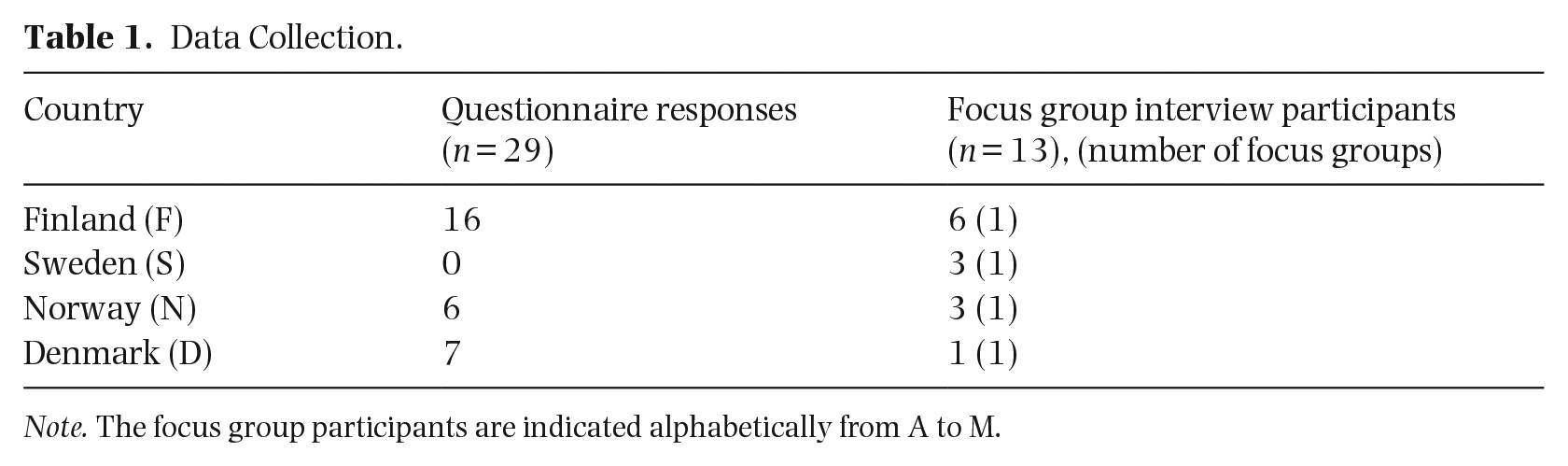
Note. The focus group participants are indicated alphabetically from A to M.
Qualitative, reflexive, thematic (Braun & Clarke, 2006), and data-driven analysis (Alvesson & Sköldberg, 2017) was utilized to iterate themes from the data and situate them within broader social, cultural, and political contexts. This helped us to understand the implications and significance of the findings more profoundly, with an emphasis on participant voices and meaning-making (Braun & Clarke, 2006), as well as theoretical understanding (Alvesson, 2003) through a public pedagogy lens. We analyzed the data collectively through three analysis rounds using Braun and Clarke’s (2006) thematic analysis process: (a) familiarization with the data, (b) generating initial codes, and (c) searching for and developing themes for the reporting of the findings.
Ethical statement
This study was reviewed by The University of the Arts Helsinki Ethical Review Committee. The participants gave their written informed consent according to the guidelines of the Finnish Advisory Board on Research Integrity (TENK, 2023). The researchers articulated the voluntary nature of participation, including the right of participants to discontinue participation at any time without consequences. All of the empirical material was pseudonymized and direct identifiers removed.
Identifications of institutional change in Nordic higher music education
Changing teacher roles
The data contained an abundance of examples of the increasingly dynamic role of teachers in higher music education institutions in response to growing demands for institutional reflexivity. While the concept of public pedagogy was unfamiliar to most participants, most reported incorporating it into their teaching, often mentioning public spaces such as schools, libraries, and community centers. Over half of the questionnaire respondents agreed that societal engagement was a necessary part of higher music education, and the majority agreed that utilizing public pedagogy as an articulation for that engagement could help increase the societal dialogue in higher music education. Some respondents articulated how higher music education institutions have changed since their own student days: “dramatic, you might say from the school I was studying at. I had lessons with a teacher and that’s it. And the teacher didn’t necessarily care about what I would do when I left [through] the door” [I5, PM, D]. As teachers today, many participants highlighted the separation between their artistic and pedagogical professional identities: “I’ll answer in my two capacities as a violin player and as a pedagogue” [I1, PB, F], while others advocated for an integrated approach:
You can be an artistic practitioner with a pedagogical mindset. You can be a pedagogical practitioner with an artistic mindset, and they can flow together with different kinds of balances and synergies. [I5, PM, D]
The teachers acknowledged that teaching in higher music education today included a critically conscious, and even somewhat cautious, “sense of political identity” [I2, PD, F]. The teachers saw their responsibility, on one hand, as facilitating spaces and dialogues within which students could engage with complex issues, and on the other hand as maintaining political neutrality: “I keep my opinions outside the classroom, because my role as a teacher is to protect each student and all my students should feel safe in a teaching room” [14, PJ, N].
Students as change agents
Over half of the questionnaire respondents thought that public pedagogy would increase opportunities for students to engage with local communities, and many saw it as a way for students to explore new venues for music-making. The teachers emphasized the role of the students in changing educational needs, which manifested in increased social awareness and demands to improve equity, diversity, and inclusion in the higher music education context and music field more broadly. They pointed out how students today had more diverse cultural backgrounds and could be critical actors in institutional change, thus sharing the expanding social responsibility with their teachers:
This [change] is not necessarily being driven by the structures of the institution, but it’s more being driven by the students . . . This generation of students are much more socially aware and have a real sense of wanting to have a positive impact in society and in the world. [I1, PC, F]
Besides being from more diverse backgrounds, students were increasingly involved in societal engagement, where their educational interests also extended beyond the “traditional” settings of music professionalism. Some participants were concerned that higher music education institutions did not fully reflect contemporary Nordic societies: “I think if it represented society at large more than it does, we would maybe have other types of discussions as well” [I4, PK, N]. The lack of diversity was identified in decision-making processes, the recruitment of students and staff, and the overall educational environment. Direct demands to include students from broader ethnic and socio-economic backgrounds than “white middle class” were made. One of the participants explicitly admitted that “I regard this school as an elite education” [I4, PK, N], while also mentioning that change was led by the students, who “just have to do something that feels right in their guts and their hearts and be involved in music on many different levels.”
Some participants characterized students as intermediaries between art and the public, using their artistic skills to democratize access to the arts and challenge elitist perceptions of music performance. This role was seen as a “community force of change” [I2, PD, F], where students contributed to societal shifts through their creative work. Students were acknowledged for their political activism, particularly in confronting racism or other “hidden spots” [I4, PJ, N] within institutions. At the same time, a discrepancy between hyper-individualism and community spirit was identified. The curricular and pedagogical emphasis on artistic uniqueness was seen as a traditional value of conservatory-based education that contradicted more recent calls for a sense of community, which are needed for growing into collective artistic professionalism.
The teachers were highly aware of their impact on students and their responsibility to prepare them with broader skills for future roles beyond traditional music performer careers, instead of following one-dimensional learning paths that do not adequately serve most students. Peer learning was highlighted as essential, with teachers acting as facilitators to help students connect and share their diverse “working methods, or context, or reflection, or whatever” [I4, PK, N]. This shift toward democratic learning environments suggested that the future of higher music education may lie in increasing collective student-led initiatives rather than sticking to the master-apprentice model of teaching.
Artists as/and citizens
Many of the participants challenged the “traditional” image of a musician performing for audiences in concert halls by envisioning more outreach activities complementing musicians’ future professional milieus. Significant musical skills were considered important but not enough to pursue professional musicianship. There was an emerging call for more collective learning across genres: “Instead of being uninterested in each other, we can be curious, we can listen. We can learn from each other, and that’s a huge change” [I4, PJ, N]. This represented a shift away from traditional, isolated artistic practices and a “narrow interest in highly skilled expert musicians,” which has been considered to be potentially harmful to contemporary music professionalism (Odendaal et al., 2020, p. 362).
The responses widely addressed the opinion that higher music education teaching involved more than just the craft of music—it also involved engaging with societal issues: “We are constantly debating and reflecting on about the hot topics of the society, cultural appropriation, and inclusion and diversity” [I2, D, F]. Such a transformation was also in opposition to existing institutional structures, requiring teachers to perform balancing acts to preserve traditional “conservatory values.” The participants debated whether higher music education institutions should focus solely on educating “experts” or emphasize “citizen education.” Some argued for a clear separation between the two, while others believed that artistic education should inherently involve social and political engagement. Many participants employed the concept of artistic citizenship, which was mentioned several times in the questionnaire responses and interviews. However, it had different interpretations, creating two parallel understandings of “artists as citizens” and “artists and citizens.” While the first understanding entailed an expanded notion of music professionalism, in contrast, the latter entailed the musicians’ responsibility to serve “the public.” The first interpretation, “artists as citizens,” represented a move beyond the individualistic approach to musicianship:
I see this as a tendency to move away from this entrepreneurship kind of professional career in the music business, to opening up music education more into this artistic citizenship where the musicians are an active part of our society. [I4, PK, N]
The other interpretation, “artists and citizens,” manifested when one of the interviewees referred to concerts with invited audiences as a way of preparing students to perform for a wider audience:
Of course, we also invite the public to our concerts, even when they happen here in the [university]. So, I mean that aspect, at least a lot of what we do, is engaging with the public. [PG, I3, S]
Aesthetic and epistemic paradigm shifts
The teachers identified significant changes in artistic knowledge creation, illustrating how music-related knowledge was increasingly created collaboratively in higher music education institutions and the public sphere. Artistic knowledge was considered to extend beyond musical knowledge toward the ability to “working with the often very complex creative processes and willingness to share, communicate, and expand one’s practice” [I4, PK, N]. Another participant noted a shift in how knowledge was valued, particularly the need to recognize oral traditions alongside written music, and to understand that “different music needs different tools” [I4, PJ, N]. This shift entailed blurring the boundaries between the performer and the audience, alongside the ability to change perspective and transform musical knowledge.
These identifications indicated radical aesthetic and epistemic shifts in both teachers’ and students’ roles. One participant described the developmental steps from a dualist to a more holistic approach among higher music education professionals: “Sometimes they were struggling against one another like it wasn’t artistic to be teaching or to be in pedagogy. And when you were in pedagogy, it was difficult to be an artist” [I5, PM, D]. The same participant described how, for some graduating students, “the reality just was a shock,” and lamented how educational institutions might perpetuate “unrealistic dreams” related to music professionalism. Many students entered the field with narrow, idealized notions of artistic practice, which often clashed with the realities of working life:
[W]e are actually feeding that myth. So, the way that we navigate, when we look toward what is an artistic practice in the future, it’s way too narrow. We have to open up, we have to broaden our perspective of what it is to be an artistic practitioner. [I5, PM, D]
Musicians increasingly work as entrepreneurs and freelancers and in a more dynamic connection with society. Against these changing roles, the participants reflected on the entrenched expectation that artists and their work should remain politically neutral. Several of them challenged the notion of “neutral” or “absolute” music, arguing that political, societal, and power structures inform all music. While some proposed a more subtle stance, others suggested that critical awareness unavoidably positioned artists as political subjects. For example, one participant questioned whether the political identity of the institution could be equated with the political identity of the institution leaders “because each leader has a personal identity” or “artistic personalities,” and they were often twofold. The participant continued: “Maybe we are supposed to be neutral, but we can’t really. Maybe awakeness and [being critical] already are an activist position” [I2, PE, F].
In their reflections on public pedagogy, the participants considered that it emphasized collective knowledge creation rather than just showcasing final artistic results. Public pedagogy was an effort to extend “real-world traditions” into academia. One participant metaphorically described this extension as a “crack in the wall” [I2, PD, F], symbolizing the bridging of academia and the “real world.” The paradigmatic shift that stemmed from the participants’ reflections on public pedagogy culminated in realizing an epistemic paradigm shift that worked “the other way around; [public spaces] provide some kind of pedagogical tools or pedagogical content to us” [I2, PF, F].
Negotiating institutional boundaries
The participants highlighted that pedagogical boundary-crossing would support higher music education institutions to respond to society’s diverse needs. This perspective was reinforced in the questionnaire responses that agreed that higher music education institutions should better support students and teachers in their societal engagement and that higher music education leaders should engage in active dialogue with stakeholders and policymakers. The curriculum was identified as a critical driver of change, with suggestions to incorporate more elements—such as diverse learning environments and community engagement—into music performance study programs. Curriculum decisions were seen as inherently political, which indicated that recognizing music’s political nature in the curriculum was crucial for institutional change. It was also noted that institutional leadership must stay informed about relevant research and teaching practices to facilitate these changes effectively.
Despite idealistic intentions, practical obstacles hindering the implementation of such change were identified. These included resistance to new approaches, adherence to traditional methods, and the challenge of changing long-standing mental models among educators: “Maybe the teachers teach what they have learned” [I3, PH, S]. Some educational and curricular innovations were viewed as too radical or “luxurious” [I3, PH, S], due to practical difficulties in adopting novel ideas and the overall institutional ambivalence over change. While the participants saw the timely need to strengthen societal engagement within higher music education, practical issues such as resource allocation and curriculum reform were seen as obstacles to engaging with such processes. These issues called for a more “proper dialogue” between leaders and students [I1, PC, F]. This proper dialogue
has to be a dialogue where all voices are really heard and considered. Responding to the changing world [is to] constantly discuss and debate how we need to change and how we need to evolve as an institution. [I1, PA, F]
There was frustration over the lack of more profound discussion about change, possibly due to a desire to avoid criticism, maintain a harmonious workplace, and not take the risk of disrupting the status quo: “I don’t think we as individuals maybe, or we as a society, and definitely not as an institution, that we give this enough focus” [I3, PI, S]. At the same time, there was a recognition that without a mutual commitment to change, “We are an empty institution” [I1, PA, F].
The participants addressed the tensions they faced amid the increasing political turbulence in the world. Some participants said that discussing societal issues without party political stigma had become difficult. There was growing concern that almost any societal issue was now viewed solely through a political lens:
It becomes harder to address general questions about human rights and all those things without perhaps pushing a political agenda [. . .] because it feels like almost anything is a political debate nowadays [. . .] I think that is problematic. [I3, PG, S]
This shrinking space for democratic dialogue challenged higher music education professionals to (re)articulate the societal responsibility of music professionalism without being seen as promoting a specific political agenda. While higher education institutions are unavoidably political (Davids & Waghid, 2021), many teachers felt they could not take a stance on the burning questions of the day—such as climate action or military conflicts—in the same way as students, partly due to their privileged position within the Nordic welfare system that publicly funds higher education institutions. This privilege created a paradoxical dynamic where teachers and leaders were aware of their political influence but were cautious of political engagement to maintain a stance of political neutrality: “Where do we stand then as teachers? How do we navigate that? What is our professional responsibility to the institution and our responsibility to the students?” [PC, I1, F].
Another perspective on negotiating the boundaries between institutions and society was expressed through the need to advocate for the arts in society: “I think many of us here, both students and teachers, feel kind of an urge to want to defend what we are doing” [I3, PG, S]. In this way, teachers seemed to find empowerment in allying with students to challenge institutions’ political neutrality.
Discussion
In this section, we return to the primary aim of this study, which was to identify change “as it may already” manifest in higher music education institutions rather than as something to be either resisted or promoted. Leaning on Biesta’s (2012) concepts of pedagogy for the public, pedagogy of the public, and pedagogy of publicness, we discuss the findings through Schmidt’s (2017) argument that higher music education professionals need to develop a capacity “to read political environs” (p. 18) and create a hegemony of equity as opposed to hegemony of hierarchy (Schmidt, 2024).
Pedagogy of publicness, as an advanced mode of public pedagogy, is about creating spaces where individuals can experience “publicness”—engaging with others in ways that foster mutual understanding, democratic interaction, and pluralism. This approach encourages higher music education professionals to take critical responsibility for the educational response to the demands of society—beyond responses “for” and “with” the public, since education is more than just a function of existing social and societal orders. The concept of pedagogy of publicness can serve as a lens to further understand higher music education professionals as public professionals (Gaunt et al., 2021; Georgii-Hemming et al., 2020; Westerlund & Karttunen, 2024) as it assumes that they are political actors (Giroux, 2004) and responsible intellectuals (Chomsky, 1967; Davids & Waghid, 2021) who can take the lead in higher music education’s organizational response to society. While the two other modes of public pedagogy were also contributing to the multifaceted emergence of societal engagement in higher music education, the third mode of pedagogy of publicness connected with many respondents’ ideas about “artistic activism” and “rebellious pedagogies,” which we interpreted as pedagogical interruption (Biesta, 2010), allowing for freedom, difference, and the possibility of something new emerging from public interactions and leading to new visions of how musicians can navigate an increasingly complex society as artistic citizens.
However, the higher music education professionals focused more on resolving the political neutrality dilemma than engaging with more radical development through interruption and resistance. While they unanimously viewed public pedagogy as potentially expanding students’ possibilities to develop their own roles in society, they thought that institutional structures still hindered more deliberate enactment of transformative change in higher music education. The idea of engaging with more radical forms of public pedagogy, of deviating from institutional boundaries and exposing the teacher’s political role—which may conflict with the institution’s demand for political neutrality—caused particular caution. Some respondents were ambivalent about how much higher music education can change and move away from the conservatory tradition. While the curriculum was considered both a catalyst for and an obstacle to institutional change, the capacity of teachers to facilitate and respond to the students’ needs was considered crucial, and institutional change was seen as feasible primarily through the students’ initiatives and actions. As a result, we raise a concern about whether higher music education professionals in egalitarian Nordic societies can genuinely nurture autonomy and accountability (Ski-Berg, 2023) toward ecological policy action (Schmidt, 2024). Without a reconsideration of the political as an intrinsic part of higher music education, teachers may remain at a level of political neutrality even if they have the individual capacity to read and react to the policy environment and the changing needs informed by the immediate level of student interactions.
Widespread access to digital spaces and social media was considered to have radically changed the expectations of how musicians ought to interact with and for the public, leading to higher music education professionals being tasked with balancing the pressure of fast-paced entrepreneurial needs with reflective educational practices. This shift manifested in the respondents’ reflections as a move from viewing music professionalism as purely individualistic toward valuing sharing and collective efforts. The findings indicated a tension between “dynamic” entrepreneurialism and “authentic” artistry within the changing roles of musicians. While some considerations of activist approaches within higher music education emerged, the respondents highlighted the need to protect educational environments that support all students, where they could explore their roles as artists and citizens regardless of the level of their personal socio-political engagement. Overall, and across institutions, teachers’ responses suggested an ethos that favored safeguarding rather than risk-taking.
Public pedagogy was chosen as this study’s theoretical-methodological underpinning to suggest a new conceptualization of alternative educational endeavors, interactions with the public, and societal engagement within higher music education institutions. Public pedagogy was identified, in many variations, as a catalyst to (a) initiating change processes and creating more inclusive structures, (b) developing new, accessible performance practices, (c) promoting equality and diversity in and through music practices, (d) introducing ecological and societal issues into curricula, and (e) supporting more holistic pedagogical approaches within higher music education. The participants’ reflections indicated change identifications related to power relations and dynamics within institutional contexts, implicitly addressing the educational and political task of higher music education professionals by acknowledging that “questions about the content and purpose of education are [. . .] fundamentally political questions” (Biesta, 2006, p. 26).
Through Biesta’s (2012) distinction between the three modes of public pedagogy—pedagogy for the public, pedagogy of the public, and pedagogy of publicness—we further elaborated our analysis of how interacting with the public and engaging with society in and through artistic and educational endeavors can take different forms in higher music education. We identified all three modes emerging in the data. Pedagogy for the public was described as educating the public with a clear separation between educators and the public—such as in the concert hall context, identified as the established form of public engagement in traditional music professionalism. While the autonomous position of this arrangement was questioned by proposing new venues for music performances within higher music education, the fundamental idea of top-down “educating the public” was not explicitly challenged. Pedagogy of the public emerged within collective engagement and dialogue, which were identified through various examples of community music endeavors outside higher music education institutions, such as within schools, refugee centers, or prisons, and were described as becoming or already being embedded as an element in the curriculum.
The findings provided new articulations of recent changes in the roles of students and teachers, and of aesthetic-epistemic paradigm shifts within higher music education environments, including contemplating crossing and maintaining institutional and artistic boundaries. Earlier studies have highlighted the need to advance institutional change processes in higher music education by envisioning new processes (Ski-Berg, 2023) and developing leadership skills (Almqvist & Werner, 2024). This study utilized a bottom-up strategy to explore change identifications from current higher music education practices, including student–teacher interaction, curriculum development, and professional thinking. The findings indicated that while public pedagogy as a conceptual tool can help endorse already existing practices, it may also pave the way to further problematizing the power hierarchies of knowledge expertise (Bull, 2024), questions of aesthetic disruption (Løvlid, 2024), and the political agency of the teachers (Houmann, 2024). However, future research is needed to further unfold social change discourse (Kertz-Welzel, 2022) within institutional music education: Why change? Whose values are considered or disregarded? And what counts as meaningful change?
Concluding thoughts
In this study, we examined how higher music education actors positioned themselves against the expanding professional responsibilities of musicians as citizens in complex societies. Inspired by the concept of public pedagogy, we investigated the intersections between education, democracy, and citizenship within higher music education. Our findings showed that while the concept as such needs to be better established within higher music education, the participants provided evidence that all three modes of public pedagogy are at play: pedagogy for the public, pedagogy of the public, and pedagogy of publicness (pedagogical interruption). The findings indicated ambivalence in how much institutional actors can or want to change, without jeopardizing their traditional political neutrality. Such ambivalence can prevent higher music education from remaining relevant to current societal challenges. We suggest incorporating public pedagogy into the everyday work and discourse of higher music education to enhance political identifications without juxtaposing teachers’ and students’ pedagogical and artistic professionalism.
Footnotes
Acknowledgements
The authors thank the participants who dedicated their time to this study.
Author Contributions
Declaration of conflicting interests
The author(s) declared no potential conflicts of interest with respect to the research, authorship, and/or publication of this article.
Funding
The author(s) disclosed receipt of the following financial support for the research, authorship, and/or publication of this article: This research was undertaken as part of the project “Performing the Political: Public Pedagogy in Higher Music Education,” funded by the Research Council of Finland (2023–2027), grant number: 355247.
