




Abstract
Using a deductive approach, this article explores how synthesizing existing theoretical frameworks—UNESCO’s domains of education encompassing formal, informal, and nonformal learning, Folkestad’s dimensions of learning (the situation, learning style, ownership, and intentionality), and Green’s characterizations of informal learning—can enhance our understanding of students’ experiences of music-making across diverse contexts. It explores previous theoretical perspectives and empirical research on music education across these domains, incorporating a global perspective and discussing the varied interpretations of “non-formal” learning. The article highlights how a continuum between formal and informal learning is challenged by more fluid and nuanced understandings presented here. Drawing on empirical material from an ongoing study in Norwegian upper secondary schools, this work demonstrates the practical implications of a nuanced approach to understanding music learning contexts. Observations and interviews from collaborative learning settings offer insights into the interconnectedness of formal, informal, and non-formal learning domains. By offering a critical examination and synthesis of existing theoretical perspectives, this article contributes to broadening the discourse on music education. It underscores the need for a comprehensive approach to research and education practices that fully acknowledges the complexity of learning experiences across various contexts.
Keywords
Introduction
Many researchers in music education have argued that music learning is not limited to what happens in the classrooms of schools and universities, but also includes other situations where students encounter music in their lives (Creech et al., 2020; Dahlberg, 2013; Folkestad, 2006; Green, 2011). Despite this understanding, research in music education tends to focus on one of these contexts at a time, even though musical development in the student seems to happen across many situations and contexts, as argued by Dahlberg (2013). Coombs et al. (1973) suggested that education should be understood as mutually beneficial across formal, non-formal, and informal domains. As we mark the 50th anniversary of their work, it is evident that the validation of informal learning has increased, but questions remain about the advancements made in cross-context research within the field of music education. One reason for the scarcity of cross-context research may be the lack of appropriate theoretical tools to facilitate this kind of research. Using a deductive approach, this article explores how synthesizing existing theoretical frameworks can enhance our understanding of students’ experiences of music-making across formal, informal, and non-formal domains.
When researchers in music education investigate music activities across contexts a continuum between formal and informal learning is primarily used (Cain, 2013; Espeland, 2010; Finney & Philpott, 2010; Folkestad, 2006; Green, 2002). When widening the scope and looking at education research outside the field of music, the three domains of formal, informal, and non-formal education, as introduced by Coombs et al. (1973) for UNESCO, are widely adopted (Mayombe, 2020; Rogers, 2014; Shastina et al., 2020; Singh, 2015).
Coombs led some of the earliest comprehensive studies on informal and non-formal learning (Coombs, 1968; Coombs & Ahmed, 1974; Coombs et al., 1973) through his engagement with UNESCO’s International Institute for Educational Planning. 1 The definitions of formal, non-formal, and informal learning used by UNESCO are built upon these studies. Therefore, in this article, these categories are referred to as UNESCO’s domains.
First, I will provide an overview of key theoretical perspectives and empirical research on music education across formal, informal, and non-formal domains, incorporating a global perspective by including research from Africa, Asia, Europe, North America, Oceania, and South America. Next, I will apply these theoretical perspectives to a larger empirical study on collaborative learning contexts within the music program at Norwegian upper secondary schools. 2 Empirical examples from the larger study will be used to elaborate on practical implications of the theoretical context categories with the purpose of developing a more nuanced understanding of how learning is intertwined with social contexts. These analyses will facilitate a synthesis of the dimensions for learning—“the situation,” “learning style,” “ownership,” and “intentionality” (Folkestad, 2006)—with UNESCO’s domains of formal, non-formal, and informal education (Coombs & Ahmed, 1974). Finally, I will discuss this synthesis’ potential implications for further research on learning across contexts in music education.
In this article the term “domains” refers to the overarching categories of formal, informal, and non-formal education, as conceptualized by Coombs et al. (1973) and utilized in UNESCO’s framework. “Situations” is employed to describe specific, concrete instances within these domains where music learning occurs. Following Folkestad (2006), “situations” can also specifically denote the physical locations where music learning occurs. “Contexts,” on the other hand, is used more broadly to denote the general environments or settings in which these learning situations take place. When referencing other research, I will sometimes use the terms employed in those studies.
Previous theoretical perspectives and empirical research
This article investigates a potential synthesis of three theoretical perspectives: UNESCO’s domains for lifelong learning (Coombs & Ahmed, 1974), Folkestad’s (2006) learning dimensions, and Green’s (2008) characteristics of informal learning. To provide context, I will discuss studies in music education that align with UNESCO’s domains, explore instances in music education where the term “non-formal” is used in different ways, and present research that offers additional theoretical insights into research across formal, informal, and non-formal domains in music education.
The three main theoretical perspectives
Coombs (1968) argued for higher recognition of education outside the formal education system as early as the 1960s. He coined the term non-formal education which he describes as “this shadowy ‘other system’ of education” (Coombs, 1968, p. 138). He elaborated further on this understanding and later defines formal, non-formal, and informal education like this:
Informal education [. . .] is the lifelong process by which every person acquires and accumulates knowledge, skills, attitudes and insights from daily experiences and exposure to the environment [. . .] informal education is unorganized and often unsystematic; yet it accounts for the great bulk of any person’s total lifetime learning. [. . .] Formal education [. . .] is [. . .] the highly institutionalized, chronologically graded and hierarchically structured ‘education system,’ spanning lower primary school and the upper reaches of the university. Nonformal education [. . .] is any organized, systematic, educational activity carried on outside the framework of the formal system. (Coombs & Ahmed, 1974, p.8).
In the field of music education the works of Green (2002, 2008) and Folkestad (2006) are much cited when it comes to analyzing informal aspects of learning. Green (2002) interviewed professional and semi-professional popular musicians between 15 and 50 years old to investigate their learning trajectories. She concluded that popular musicians predominantly learn informally outside institutions. She developed a method for music teaching based on these findings, and summarizes informal popular music learning by how learners:
choose the music for themselves.
copy music by ear as their main method of skill-acquisition.
learn alone and alongside friends through self-directed learning, peer-directed learning, and group learning.
tend to assimilate skills and knowledge in haphazard, idiosyncratic, and holistic ways.
emphasize personal creativity through the integration of listening, performing, improvising, and composing (Green, 2008, p. 10).
Folkestad (2006) criticized how research on informal music learning tends to be unclear about in what ways the learning should be categorized as informal. He suggests the use of four dimensions for analyzing music learning in a continuum between formal and informal regarding:
The situation: whether the learning takes place inside or outside an institutional setting. Formal and informal is used as a way of pointing out the physical context in which learning takes place.
Learning style: whether music is predominantly learned in writing or by ear.
Ownership: whether the decisions of the activity is owned by the teacher or if it is self-regulated.
Intentionality: whether the mind is directed toward learning how to play (a pedagogical framework) or toward playing (a musical framework). (Folkestad, 2006, pp. 141, 142).
When seen in relation to each other these three perspectives may form a more elaborate way of understanding music education across contexts. UNESCO’s domains (Coombs & Ahmed, 1974) offer a richer understanding of the learning contexts by including non-formal situations, Folkestad’s (2006) dimensions provide some distinctions in a formal/informal continuum, and Green’s (2002, 2008) research yields important insight on characteristics of informal learning.
Empirical research using UNESCO’s domains
A substantial amount of research in music education utilizes the domains formal, informal, and non-formal similar to UNESCO’s definitions with or without citing Coombs and Ahmed (1974). Several African studies use this categorization (Andang’o, 2019; Miya, 2004; Quan-Baffour, 2011). Quan-Baffour (2011) employs the term non-formal for how folk song is used as a tool to teach modern agricultural technics in Ghana. Miya (2004) uses the terms informal, non-formal, and formal in her study on the performing arts role in churches in Kenya.
Andang’o (2019) advocates for synergy between formal, non-formal, and informal music education in Kenya, asserting that their positive interaction in reality is typically lacking. She offers definitions of these terms in the Kenyan context, paralleling Coombs and Ahmed’s (1974) usage in general education, albeit without direct reference. She characterizes formal music education as rule-governed and delivered in schools, colleges, and universities. Informal music education, according to Andang’o, transpires through social interactions among family, friends, and colleagues. Additionally, she defines non-formal music education as organized, out-of-school education and training experience, highlighting that community music activities exemplify this category. While acknowledging cultural differences, it appears that organized activities existing outside formal, hierarchical educational structures exhibit similarities in both Kenya and Norway, the latter providing empirical illustrations for this article.
The lectorate Lifelong Learning in Music has conducted a substantial amount of research on perspectives on topics highlighted in its name (Mak, 2006; Smilde, 2004, 2021). The categories formal, non-formal, and informal are integrated in much of the research conducted within that project. Relating to Folkestad (2006), Mak (2006) sees these categories in relation to the question of who controls the learning process, where the learning takes place, and what learning outcomes are valued. He describes each of the three categories for learning within conservatoire settings. In his model, learning that takes place at a conservatoire can be either formal or informal, while he considers learning outside a conservatoire to be non-formal. Teacher regulated learning is either formal or non-formal depending on where it takes place, according to Mak (2006). Finally, he characterizes all student regulated learning as informal. Thus, this model allows learning to be informal and formal at the same time if student regulated learning takes place at a conservatoire. Learning can also be both non-formal and informal at the same time if student regulated learning takes place outside a conservatoire.
Poblete et al. (2019) and Poblete (2021) use the categories formal, non-formal, and informal in their research on the musical upbringing of students in music education in Chile. These studies delineate the categories in a manner akin to the definitions provided by Coombs and Ahmed (1974), but do not provide explicit citations.
Mok (2011), on the other hand, relates her research on music education outside formal settings in Hong Kong to Coombs and Ahmed’s (1974) categorization, but unlike them she tries to define the contents of non-formal learning. She claims non-formal learning tends to be relatively systematic and that it varies whether it is preplanned or not. Coombs and Ahmed’s (1974) theories conversely limit their scope to defining where and how non-formal education is situated globally. Considering how the categorizations from Coombs and Ahmed are sometimes used without citations may be seen as an illustration on the impact Coombs and Ahmed’s (1974) research has had within the field of education.
Diverse usage of the term non-formal
The term “non-formal” is used in diverse and sometimes conflicting ways within research in music education. The previous section showed research using the term similar to Coombs and Ahmed’s (1974) theories. The term is used differently within the Musical Futures 3 program in the United Kingdom. D’Amore (2006) introduced the term “non-formal teaching” in a “resource pack,” based on Green’s (2008) principles for informal learning, published to assist teachers in the Musical Futures program. Here, “non-formal” refers to a teaching practice, not a domain for learning. The term describes the principles guiding teachers’ work with students in the program.
Wright (2016a) argues that there are different ways to interpret the meaning of formal, non-formal, and informal learning and claims that the area of pedagogy is missing in Folkestad’s (2006) model. She suggests that the category of pedagogy should be included in the model to incorporate Green (2002, 2008, 2014) and D’Amore’s (2006) work on informal learning and non-formal teaching. Building on D’Amore’s (2006) descriptions, Wright (2016a) suggests that non-formal teaching might be seen as the partner of informal learning. She asserts that non-formal teaching emphasizes inclusive, barrier-free learning, group collaboration, tacit knowledge acquisition, democratic teaching practices, peer-to-peer teaching, teacher facilitation over expertise, and the positive impact of these qualities on student skill development in creativity and emotional literacy.
The principles of Musical Futures have been applied in action research globally: Brazil (Narita & de Carvalho Cascelli de Azvedo, 2016), Canada (O’Neill & Bespflug, 2011; Wright et al., 2012), Cyprus (Papazachariou-Christoforou, 2023), Ireland (Gubbins, 2023), New Zealand (Wang & McPhail, 2023), Singapore (Chua & Ho, 2013), and Wales (Evans et al., 2015). These studies report better inclusion and student involvement in music classes.
The principles of Musical Futures have been criticized by Hall et al. (2021). They question the program’s claims of inclusiveness and argue that it may exemplify the neoliberalization of schools by legitimizing reduced resources for music education. The concept of learning alongside friends is also critiqued for potentially contradicting principles of democratic education with the latter’s focus on social tolerance and inclusion of everyone (Espeland, 2010).
A considerable amount of research on music education at secondary schools in Singapore advocates for the integration of non-formal within the continuum between formal and informal education (Chua & Ho, 2013, 2017; Ho, 2013; Ng, 2020). Ho (2013) demonstrates the value of applying Folkestad’s (2006) learning dimensions to non-formal education in this context. In Ho’s (2013) analysis, non-formal situations are understood as community settings, and the learning style is characterized by its flexibility. The ownership of the learning process is typically shared between adults and peer leaders. Intentionality within non-formal education is explained to have a mix of musical and pedagogical framing.
Ng (2020) proposes a synthesis of formal, non-formal, and informal pedagogies in popular music programs in Singaporean secondary schools. He suggests that these pedagogies align with a behaviorist-cognitivist-constructivist continuum in learning. Formal instruction draws from behaviorist and cognitivist theories, while informal learning embodies social constructivism. Ng places non-formal pedagogy on a formal-informal continuum.
Based on the characterizations of non-formal teaching provided by D’Amore (2006), Mak (2006), and Mok (2011), Chua and Ho (2013) argue that the nature of non-formal teaching offers students opportunities to develop values such as responsibility, empathy, support for others, and improvisation to find solutions.
To summarize the use of the term “non-formal” in previous literature, several studies suggest that non-formal education should be understood somewhere in a continuum between formal and informal education (Chua & Ho, 2013, 2017; Ho, 2013; Mok, 2011; Ng, 2020). Studies also provide definitions of how non-formal education is conducted by describing approaches like tacit learning and teachers more as facilitators. These understandings of non-formal education do potentially not align with Coombs and Ahmed’s (1974) definition of non-formal as an “organized, systematic, educational activity.”
Elaborative theoretical perspectives
The following theoretical perspectives elaborate on Green’s (2002, 2008) and Folkestad’s (2006) theories allowing for more nuances in the understanding of learning in the formal/informal continuum.
Cain (2013) questions Green’s (2002, 2008) dichotomy between formal and informal pedagogies, arguing that formal and informal are not opposites when applied to pedagogy. The literature endorsing informal education tends to do so on ideological grounds by portraying it as ideal, authentic, or liberatory (Cain, 2013). By comparing a case study of contemporary pedagogy that should be considered formal in relation to Green’s (2002, 2008) informal pedagogy, Cain (2013) encounters a lot of similarities between the two. Both Cain’s (2013) informant that represents formal pedagogy and Green’s (2002, 2008) informal pedagogy emphasize working with contemporary popular music and the use of the ear rather than western classical music and notation. Cain (2013) argues that both pedagogies differ from the pedagogies of for example Dalcroze, Orff or Kodaly, and consequently should not be seen as opposites.
Wright (2016b) suggests that Folkestad’s (2006) four dimensions of learning should be understood as constantly shifting sliders on a mixer in the formal/informal continuum. She argues that the placement of the sliders on the formal/informal continuum mixer probably will shift many times during a music activity (Wright, 2016a).
Espeland (2010) discusses Green’s (2008) and Folkestad’s (2006) theories and proposes a two dimensional matrix for analyzing music education on the formal/informal spectrum. The context, which Espeland describes as either institutional or private, is indicated as a horizontal line. The question of control and organization which Espeland describes as either sequential/teacher controlled, or non-sequential/student-controlled, is indicated as a vertical line. This allows for more nuanced analyses where for example student-controlled music activities within a university setting can be understood as different from student-controlled settings outside the university.
In order to come closer to a synthesis of these theories, it is helpful to avoid considering formal and informal pedagogy as opposites (Cain, 2013), but rather understanding the different dimensions of formal/informal learning (Folkestad, 2006) as constantly shifting sliders on a mixer (Wright, 2016a) or seen as functioning in a two dimensional matrix (Espeland, 2010). These elaborate theories do not include perspectives from non-formal education. This leads me to the research design of the larger empirical study on collaborative learning context within the music program at Norwegian upper secondary schools providing examples for this article.
Research design
In the larger study that provides empirical examples for this article I have employed a qualitative research design to explore participants’ personal experiences of music-making across various contexts. Students were recruited via emails sent to the leaders of the approximately 40 music programs in Norwegian Upper Secondary Schools, resulting in the selection of nine students from four different schools across Norway. To ensure a degree of homogeneity within the group, participants were recruited who played either electric guitar or bass. These instruments were selected based on the assumption that students playing them are more likely to engage in music-making outside school.
Empirical material was generated by the author between May and October 2023, utilizing participant observation (Fangen, 2020) in formal ensemble classes as well as in various informal and non-formal ensembles. Through these observations, thick descriptions (Geertz, 2017) were produced of some situations where Norwegian secondary school students play and learn music together. Subsequently, semi-structured interviews (Kvale & Brinkmann, 2015) were conducted to explore the students’ experiences and meanings derived from music-making across different contexts. These interviews were transcribed verbatim.
The combined empirical material from the transcriptions and field notes were subject to a theory-driven thematic analysis (Braun & Clarke, 2006). For the purpose of this article situations of collaborative music-making were then organized and categorized into six distinct ensemble contexts illustrated in Tables 1 to 6.
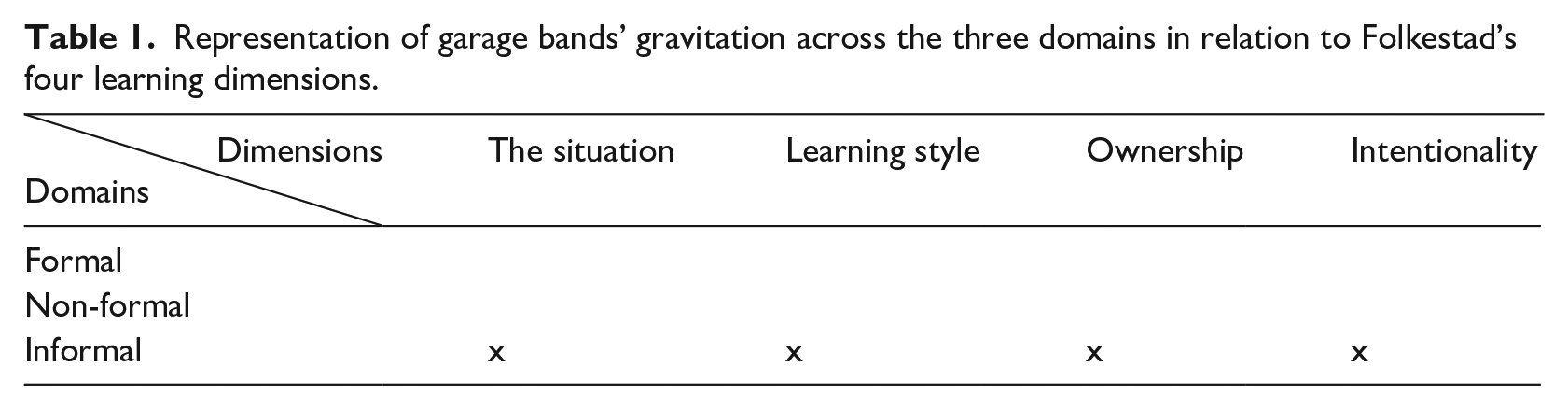
Representation of garage bands’ gravitation across the three domains in relation to Folkestad’s four learning dimensions.
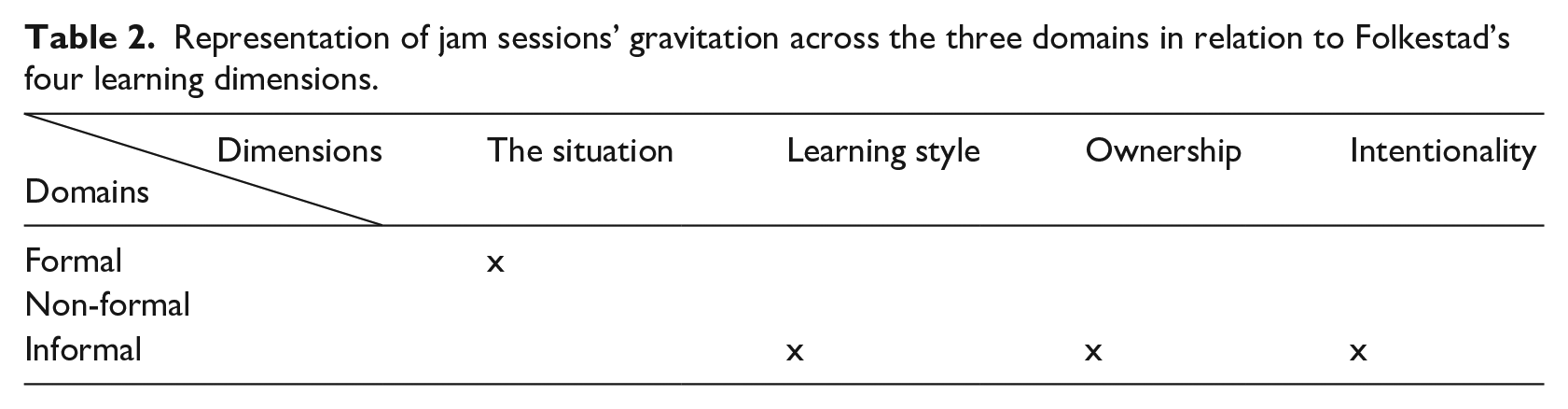
Representation of jam sessions’ gravitation across the three domains in relation to Folkestad’s four learning dimensions.
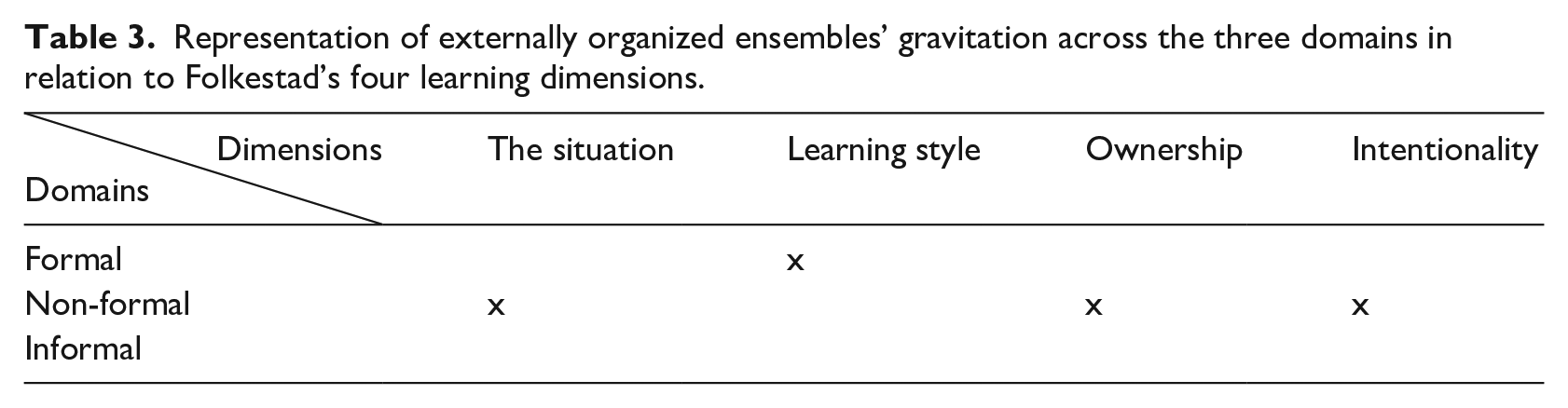
Representation of externally organized ensembles’ gravitation across the three domains in relation to Folkestad’s four learning dimensions.
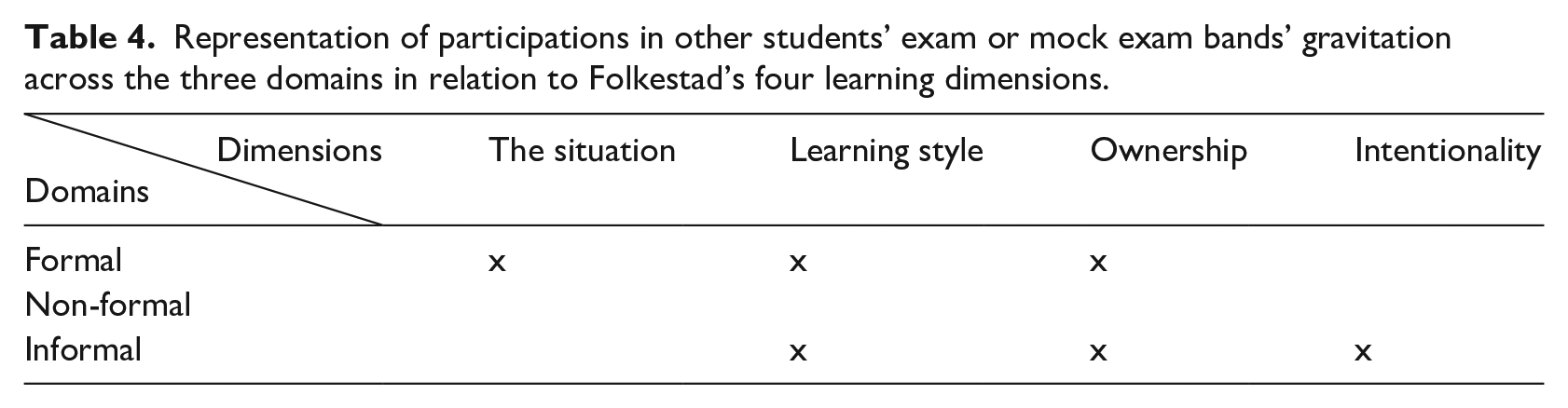
Representation of participations in other students’ exam or mock exam bands’ gravitation across the three domains in relation to Folkestad’s four learning dimensions.
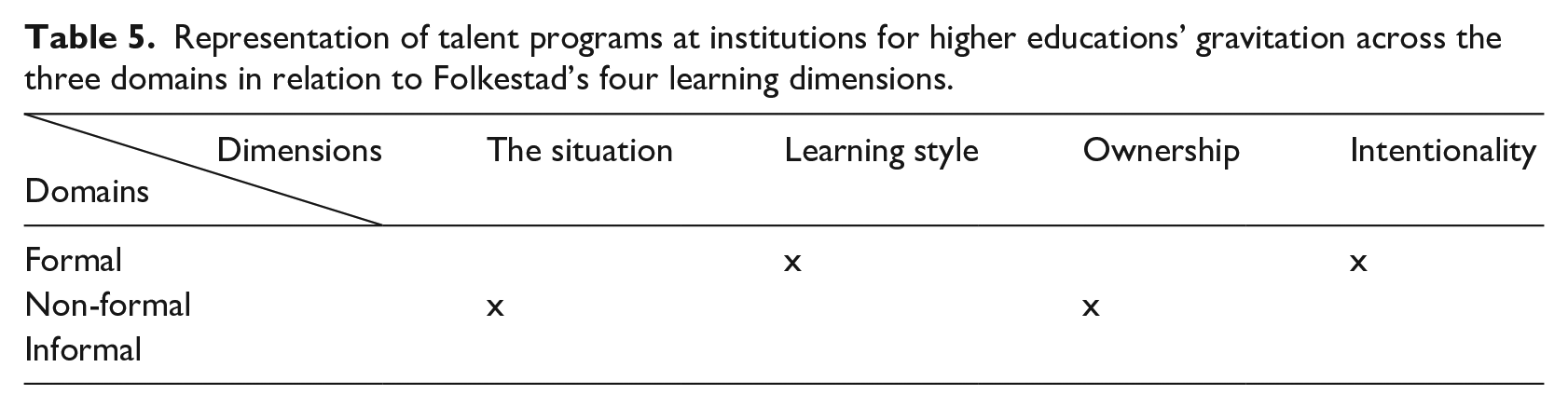
Representation of talent programs at institutions for higher educations’ gravitation across the three domains in relation to Folkestad’s four learning dimensions.
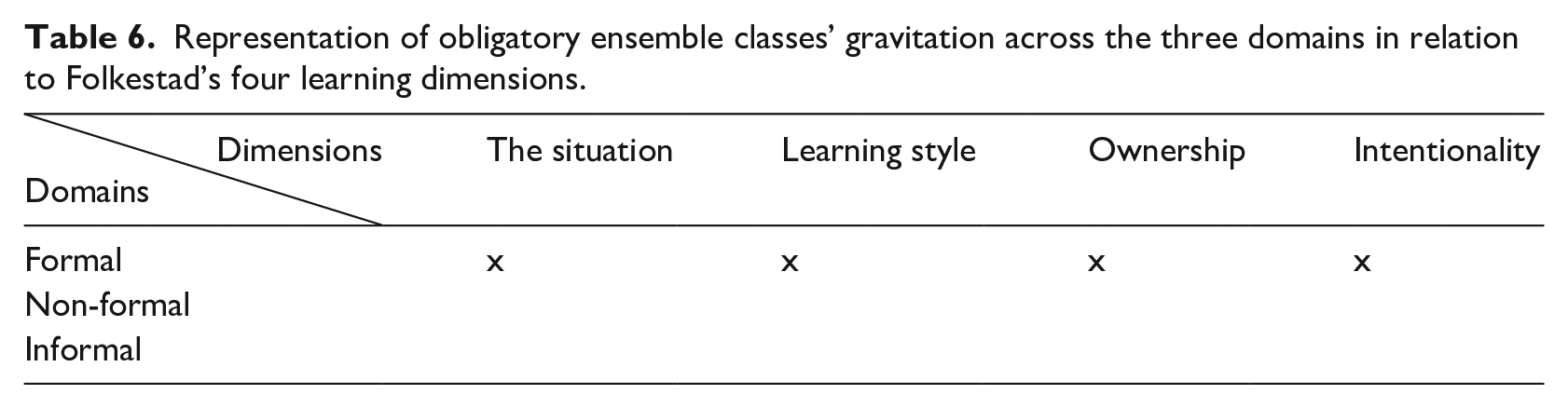
Representation of obligatory ensemble classes’ gravitation across the three domains in relation to Folkestad’s four learning dimensions.
Despite my extensive experience as a teacher within the music program in Norwegian upper secondary schools, I functioned here as an outside researcher.
Toward a synthesis
In the following section, I will explore how Folkestad’s (2006) learning dimensions and Green’s (2008) characterization of informal learning can be applied in combination with Coombs and Ahmed’s (1974) domains of formal, informal, and non-formal education to examine the six identified ensemble contexts. Tables 1 to 6 depict how these contexts can be understood as gravitating toward UNESCO’s three domains (Coombs & Ahmed, 1974), in Folkestad’s (2006) learning dimensions: the situation, learning style, ownership, and intentionality. It is important to note that the placement of the six contexts within this framework is a suggestive interpretation of the situations. These empirical examples will serve as reference points when Folkestad’s learning dimensions are further elaborated in the subsequent section.
Garage bands
Two of the participants were observed while playing in garage bands, and they explained in detail about their experiences there. One played in a metal band together with students in his class, the other in a punk band with friends outside school. The metal band mainly practiced at a local biker club, while the punk band practiced at a communal rehearsal space. Both bands primarily played their own music that they composed collectively by ear. The rehearsals were explained as being as much about hanging out as playing music. These music activities gravitate toward the informal domain across all of Folkestad’s (2006) dimensions. The music activity is situated informally at a biker club and a communal band room. The learning style is composing music collectively by ear. Although not explicitly included in Folkestad’s (2006) theory, Green (2002, 2008) recognizes collective composition as part of informal learning. The ownership lies with the students as the decisions of where, what, and when was made by the bands, and the intention of the activity was described as primarily involving playing and hanging out. See Table 1.
Jam sessions at school
Several participants described engaging in unplanned jam sessions with peers during breaks or even occasionally skipping classes to jam at school, using the school’s music equipment. These activities were formally situated, in accordance with Folkestad’s (2006) dimension “the situation,” as they occurred at school during school hours. The learning style was explained as haphazard, making it informal in accordance with Green’s (2008) descriptions. The ownership gravitates toward the informal domain as the decisions of the activity were made by participating students. The intentionality also gravitates toward the informal domain as the participants explained the activity as mainly focusing on playing together. See Table 2.
Externally organized ensembles
Three students were observed participating in ensembles organized by entities external to the music program at upper secondary schools. These ensembles included a rhythm and blues/jazz band organized as part of the local School of Music and Performing Arts (SMPA), 4 a classical string orchestra organized independently yet receiving financial support from the municipality and engaging in collaboration with the local SMPA, and an independent big band also financially supported by the municipality. These ensembles operated outside of the students’ formal domains. Their organization and systematic approach to education correspond to the characteristics of non-formal domains (Coombs & Ahmed, 1974).
These ensembles were situated at SMPAs and a public elementary school, which might suggest a formal situation (Folkestad, 2006). Nonetheless, these locations do not constitute the participating students’ formal educational settings, aligning them more closely with Ho’s (2013) characterization of non-formal situations as community settings.
The primary emphasis in these ensembles, as observed and described, was on learning to perform written music, aligning them with a formal learning style (Folkestad, 2006; Green, 2002, 2008).
Folkestad (2006) does not explicitly address non-formal domains, whereas Ho (2013) extends Folkestad’s framework to include them, suggesting that non-formal ownership should be understood as divided between adults and peer learners. This description somewhat applies to the rhythm and blues/jazz band, a smaller ensemble where teachers and students collaborated musically. In contrast, for the other two ensembles, decision-making authority predominantly resided with teachers and adult leaders.
These ensembles were noted for their strong emphasis on playing and performing music, resonating with the informal domain. Concurrently, students sought these ensembles to learn specific music genres more profoundly, resonating with the formal domain. This dual focus on intentionality aligns with Ho’s (2013) definition of non-formal intentionality. See Table 3.
Participating in other students’ exam or mock exam bands
In the music program in Norwegian upper secondary schools, performance exams and mock exams are parts of the assessment system. These assessments often involve students other than the one being examined and are typically held as concerts. The organization of who plays with whom is often conducted informally, with a high degree of prestige associated with being invited to play in other students’ exam bands, as explained by Ellefsen (2014). The location of these exams can vary; they can be held within the school or at local concert venues or churches.
The participants described various approaches for learning music for mock exams. Some were provided with detailed scores or notated chords, while others learned by ear. One student mentioned using the website Songsterr 5 for tablatures when playing metal music as a starting point, although he also pointed out that tablatures may contain errors since anyone can freely post them at that website. Consequently, the learning style here gravitates both toward the formal and informal domain.
The ownership of this situation is complex gravitating toward both the formal and informal domain. Exams and mock exams are formal and mandatory, initiated by the school and teachers, but students have the autonomy to choose their repertoire and band members, adding an informal aspect to ownership. The participants explained the intention of this music activity to mainly be about playing and helping peers with their mock exams. They did not emphasize learning in these situations. See Table 4.
Talent programs at institutions for higher education of music
As explained by Stabell (2018) it is common for higher music education institutions to offer talent programs for young aspiring musicians. This may be seen as a recruiting arena for these institutions and a context where youth are socialized into higher music education environments.
This can be considered a non-formal situation from a secondary school student’s perspective. Even though the environment is a formal institution, it is not that particular student’s formal institution according to the characterization of formal education as “the hierarchically structured ‘education system’” (Coombs & Ahmed, 1974).
One student, who participated in a talent program, emphasized reliance on sheet music for learning. This means the learning style within this situation gravitated toward the formal domain. Ownership primarily resides with the hosting institution, which exercises control by selecting participants through auditions, and determining both the timing and the content of the music activities. Possibilities for learning new music was highlighted as the main objective by the participant. Consequently, the intentionality gravitates toward the formal domain. See Table 5.
Obligatory ensemble classes
The ensemble classes are an obligatory part of the music program in Norwegian upper secondary schools, and typically take place within the school premises, thus being formally situated. All participants were observed and interviewed regarding their experiences in these classes. They described the music played as largely notation-based, aligning the learning style with the formal domain (Folkestad, 2006).
Despite this general trend, variations were noted. In one observed ensemble class students were learning a song by Sting using various learning approaches simultaneously. A flutist read sheet music, guitarists and vocalists learned by ear, and a bassist used tablature. Thus, the learning style gravitated both toward the formal and informal domain simultaneously.
Based on observations and what participants expressed in interviews, it appears that the obligatory ensemble classes were intended to be governed by democratic principles, with an emphasis on the inclusion of all students.
Several participants also expressed frustration with this approach because it can lead to extensive compromises in terms of how instruments are grouped together and what music repertoire is chosen. The students explained that the music learned usually was chosen by the teachers. Some participants also mentioned that students were sometimes grouped together, allowing them to collaboratively select their own tunes. In both cases it was the teachers’ interpretation of the curriculum that guided the content of the lesson, as it also includes objectives where students are expected to make their own musical choices. Therefore, ownership mainly gravitates toward the formal domain in this situation.
Several participants emphasized the importance of learning to play in a manner expected by their teachers, who were responsible for assessing them. Consequently, the intentionality gravitates toward the formal domain as learning is the main objective. See Table 6.
Discussion
Building on the short empirical accounts presented in the previous section, the following section aims to discuss some issues and develop new insights to Folkestad’s (2006) dimensions by examining their relationship with UNESCO’s domains and Green’s (2008) characteristics. Through this approach, the aim is to reach a more nuanced understanding of learning in the diverse situations in which students in the music program in Norwegian upper secondary schools are engaged.
The situation
As demonstrated, learning within the music program in Norwegian upper secondary schools occurs across a multitude of diverse situations. According to both Folkestad’s (2006) and Coombs and Ahmed’s (1974) theories, formally situated learning should be understood as learning that takes place at a school. Nonetheless, there is considerable variation in the nature of the learning taking place at school.
Students in the music program in Norwegian upper secondary schools attend mandatory graded lectures for higher education qualifications, constituting formal education as defined by Coombs and Ahmed (1974). Alongside, they engage in non-obligatory music activities at school, like exam bands and jam sessions. These activities, while not strictly formal, occur within the school setting, aligning with Folkestad’s (2006) dimension the situation.
Participants in the study also engaged in informal music activities outside school, including garage bands playing at a biker a club, and a communal rehearsal space. These experiences correspond with Folkestad’s (2006) characterization of informal learning regarding the situation and Coombs and Ahmed’s (1974) definition of informal education.
While placing these music activities on a continuum between formal (school-based) and informal (outside school) accounts for some of the diverse learning situations like the mentioned garage bands, it does not comprehensively capture the nuances of all the various learning situations. Therefore, I consider the concept of non-formal situations, as described by Coombs and Ahmed (1974), as a relevant addition. Their definition of non-formal education applies to many situations where students in the music program in Norwegian upper secondary schools learn, which do not fit strictly into the formal or informal domains.
For example, the observed big band and string ensemble situated at a local SMPA and a primary school can be perceived as non-formal from the perspective of upper secondary school students. This is because these schools do not form part of the upper secondary schools’ “institutionalized, chronologically graded and hierarchically structured ‘education system’” (Coombs & Ahmed, 1974). In contrast, a primary school building is considered a formal situation for its own students.
Likewise, the earlier mentioned talent program, hosted at an institution for higher music education, can be understood as constituting a non-formal situation for the secondary school students participating in the program, as that institution is not their formal educational institution.
Obligatory elements of the music program may take place in non-formal situations such as when exams are conducted at local churches, which Strauman (2021) defines as non-formal contexts. In some instances, obligatory elements of the music program may even occur within informal situations if an ensemble class performs at a local mall.
The learning style, or rather the learning approach
The learning style is perhaps the most challenging of Folkestad’s (2006) dimensions to align with UNESCO’s domains (Coombs & Ahmed, 1974). As demonstrated by the empirical material, the question of how music is learned varied across all three domains. Nonetheless, some differences emerged when examining the predominant learning approaches within each domain. This observation underlines the significance of this category when analyzing music-making across contexts.
The term “learning style” itself presents a potential issue. In educational research, learning style predominantly refers to Gardner’s (1985) theory of multiple intelligences, which posits that different learning styles are tailored to various intelligences, such as verbal, logical, kinesthetic, and spatial intelligence. As highlighted by Johansen (2013), Folkestad’s (2006) use of this term can lead to confusion since he is referring to the various approaches people employ in learning. To mitigate this potential misunderstanding, I prefer to refer to this category as learning approach. I will use the term “learning approach” in place of “learning style” throughout the following sections and in Table 7.
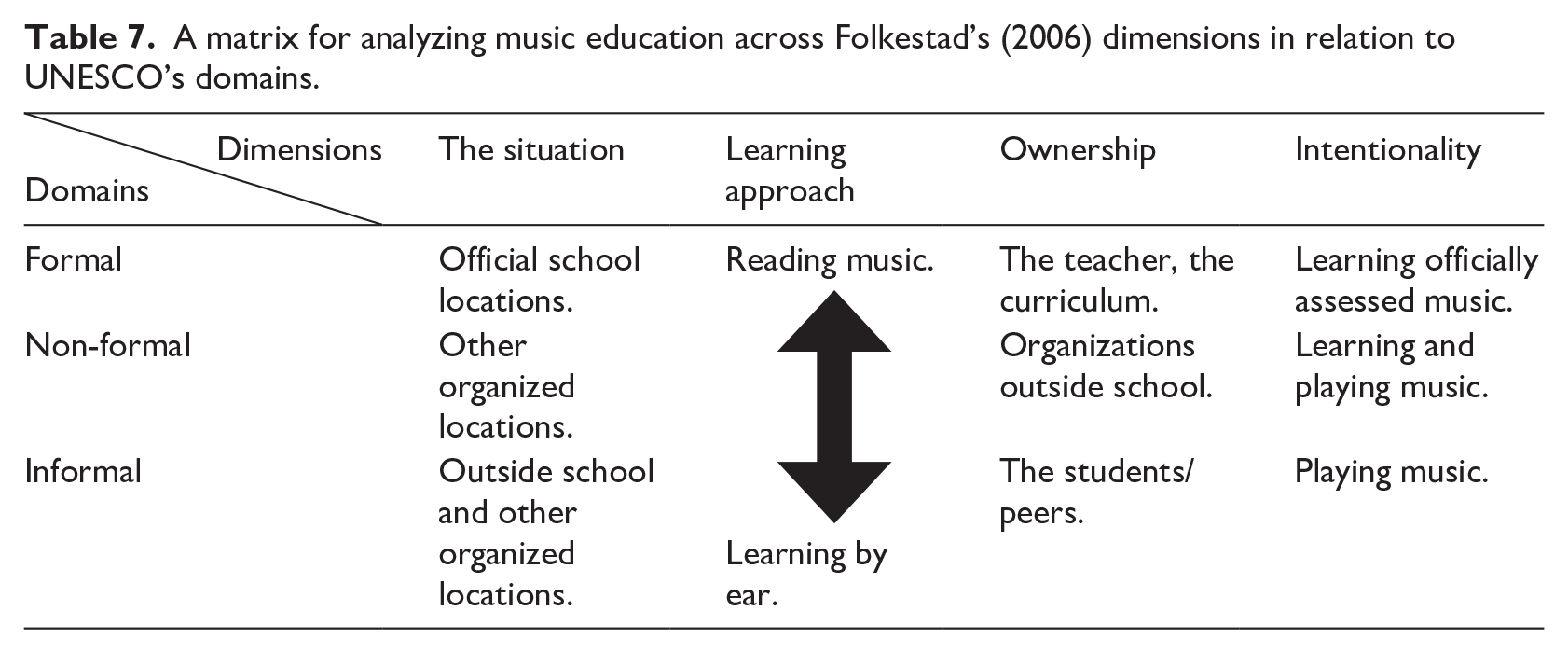
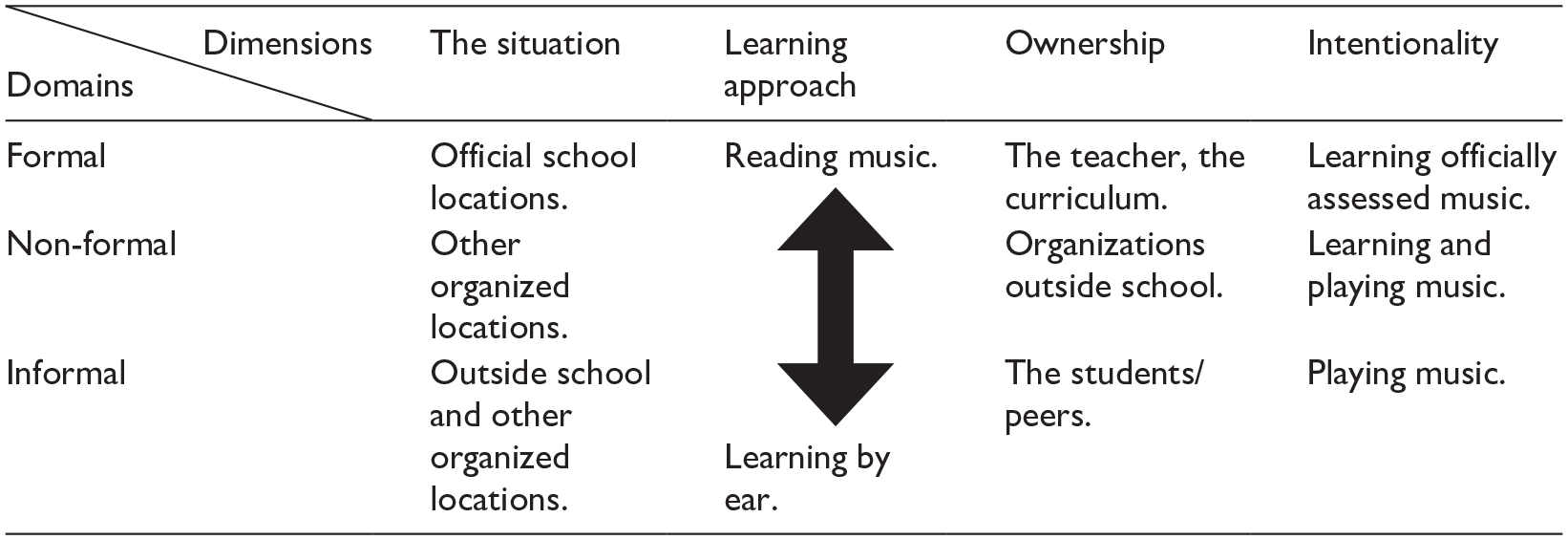
A matrix for analyzing music education across Folkestad’s (2006) dimensions in relation to UNESCO’s domains.
Green’s (2002, 2008) and Folkestad’s (2006) research both categorize learning music by ear as informal, which is supported by participants’ descriptions of learning approaches used in situations like the metal band’s practices in a biker club and informal jam sessions at school.
Green’s (2008) characteristics of informal learning as haphazard, idiosyncratic, and holistic, along with a focus on personal creativity, resonate with Coombs and Ahmed’s (1974) descriptions of informal education as unorganized and unsystematic. This raises the question of whether learning by ear must necessarily be haphazard and unorganized, or if it can also be structured and systematic?
Jazz and popular music programs in higher education for music, which often emphasize informal learning approaches like learning by ear, have existed in Norway since the mid-1970s. 6 Consequently, music teachers in Norway teaching at different levels likely incorporate learning approaches considered informal. These learning approaches could, therefore, be viewed as formal since they are extensively used in formal music education. This notion gains further support from the empirical material, where learning by ear was observed as a learning approach in obligatory ensemble classes.
It is important to note that the previous research upon which Folkestad (2006) bases his theory is both limited and somewhat dated, conducted from the late 1990s to the early 2000s. At that time, programs in higher education for jazz and popular music were limited, and the informants in his research likely had classical backgrounds. Within academia, there has been a shift toward more formally educated jazz and pop musicians and teachers.
What is considered as formal learning approaches in Folkestad’s (2006) theory may even occur simultaneously with informal learning approaches. Wright (2016b) suggests that constantly shifting between formal and informal elements in lectures can be understood as adjusting sliders on a mixer. Observations in the study revealed that these “sliders” can even be at different positions simultaneously concerning how music is learned. For instance, students learned the same Sting song by ear, using tablature, and reading sheet music concurrently.
This illustrates the challenge of defining formal, non-formal, and informal learning approaches. This category remains relevant for analytic purposes, although it can be seen functioning even more as a continuum compared to the other three dimensions identified by Folkestad (2006). In Table 7, the “learning approach” dimension is represented with a bidirectional arrow to illustrate that this aspect was observed to be more fluid and continuous than the other three dimensions.
Ownership
Ownership in music activities can be viewed along a continuum concerning decision-making (Folkestad, 2006). I will now discuss the dynamics of ownership in the formal, informal, and non-formal domains.
In the formal domains, ownership was observed to be more complex than might initially be assumed. Key decisions, such as scheduling and the necessity of exams and mock exams, were determined by the teacher’s interpretation of the curriculum. Despite these constraints, students exercised ownership by choosing participants, content, and learning approaches for these assessments. Similarly, students reported being occasionally encouraged to choose their own repertoire in ensemble classes. Despite this encouragement, they expressed concerns about the teachers’ evaluations of their musical choices. Thus, even with reports of some degree of student ownership within the formal domains, the participants perceived this domain as predominantly controlled by teachers.
The dual nature of ownership noted in the formal domains, aligns with Ho’s (2013) characterization of non-formal ownership as being shared between adults and peer leaders. In contrast, the non-formal situations in the study did not involve students choosing content for the music activities. Instead, the repertoire, participants, and scheduling were determined by the leaders of the respective organizations. The big band and the classical string orchestra had long traditions performing these genres. This aspect was explained by the participating students as part of the attraction, as they had chosen to join these ensembles to learn these specific genres more profoundly than what was offered at school. The repertoire, the organization, and the learning approach were clearly defined in these ensembles. The characteristics of these ensembles align with Coombs and Ahmed’s (1974) descriptions of non-formal education as systematic educational activities organized outside the formal system.
In the informal situations, such as the punk band and metal band, ownership was observed to strongly reside with the participating students, aligning with Folkestad’s (2006) theory. The freedom to determine content and organization was a key factor attracting students to these musical activities. A participant involved in a punk band emphasized self-expression through their engagement with the band as their primary motivation for involvement in music.
In conclusion, the dynamics of ownership were observed to be distinct across the three domains. These distinctions did not reflect a continuum with gradually increased student ownership from informal, through non-formal, to formal domains, as argued by Ho (2013). Instead, a higher degree of student ownership was observed in the formal ensemble classes compared to various non-formal ensembles. This may be attributed to the emphasis on a democratic educational approach that values students’ individual decisions, as outlined in the curriculum of the music program in Norwegian upper secondary schools.
Intentionality
It appears that the intentionality across all the music activities the students were engaged in aligns with both learning to play (gravitating toward the formal end of the continuum) and simply playing (gravitating toward the informal end of the continuum), as per Folkestad’s (2006) theory. Yet, certain situations, like the punk band, were observed as gravitating more toward playing, and the obligatory ensemble classes more toward learning.
Participants highlighted the significance of quantitative assessment for music selected by teachers in formal ensemble classes. While Folkestad’s (2006) theory does not address the concept of assessment, it is central to Eraut’s (2000) description of formal learning. This focus on quantitively assessing externally specified learning outcomes may necessitate students engaging with music they are less familiar with, thereby requiring them to concentrate on learning to play that music. Thus, this process aligns with Folkestad’s (2006) notion of formal intentionality, where the emphasis is on learning to play.
The students participating in non-formal ensembles, such as the big band and the classical string orchestra, identified learning to play the genres offered by these ensembles as their primary intention. These ensembles were composed of a mix of young secondary school students and adult amateur musicians. Whereas the secondary school students viewed these activities as opportunities for learning, the adult amateurs primarily considered them chances to engage in music playing. This divergence in perspectives indicates that intentionality in these non-formal settings encompasses both playing and learning to play, aligning with Ho’s (2013) characterization of non-formal intentionality as a combination of musical and pedagogical framing.
A more haphazard approach to music-making was emphasized by participants in informal situations such as the punk band, the metal band, and jam sessions. Social aspects of the activity were highlighted as more important than conscious learning, aligning with definitions of informal learning (Coombs & Ahmed, 1974; Folkestad, 2006; Green, 2008). On the other hand, learning to play metal music and exploring different methods for doing so were also described by participants, thereby highlighting elements of pedagogical intentionality within the informal domain.
In conclusion, the analysis presented here illustrates that formal intentionality can be understood as learning music that is often officially and quantitatively assessed. Informal intentionality, in contrast, emphasizes playing music for its own sake. Non-formal intentionality merges these concepts, representing engagement in playing and learning music that are not subject to quantitative assessment. This also suggests that formal, informal, and non-formal intentionality exist on a continuum, showcasing a range of musical learning and engagement.
A visual representation
The discussions so far have prepared the ground for a reconsideration and synthesis of existing theoretical frameworks, aiming to deepen our understanding of formal, non-formal, and informal learning in music education. The following visual representation draws on the insight that the domains of formal, non-formal, and informal are not rigid trichotomies, but exist along a three-dimensional continuum. UNESCO’s domains (Coombs & Ahmed, 1974) are positioned vertically, while Folkestad’s (2006) dimensions are placed horizontally. This approach is intended to provide a nuanced perspective for examining the complex interplay between these dimensions within music education. See Table 7.
Conclusive remarks and implications for further research
The formal/informal continuum commonly used in research in music education seems to oversimplify the diverse learning experiences discussed in this article. The reconsideration and synthesis of existing theoretical frameworks suggested here expand on a two-point continuum, illustrating that music activities, as exemplified by students at the music program in Norwegian upper secondary schools, can simultaneously gravitate toward various dimensions on the formal/non-formal/informal spectrum.
The previous discussions have shown that expanding upon Folkestad’s dimensions to include non-formal domains unveils significant complexities within music education. Introducing the non-formal domain into “the situation” dimension has enabled a more nuanced differentiation among the diverse contexts in which students engage, effectively distinguishing between distinct out-of-school activities like the punk band and the classical string orchestra. This nuanced approach challenges the traditional intermediary view of non-formal learning between formal and informal contexts, revealing instances where formal contexts exhibit a higher degree of student ownership compared to non-formal ones.
Moreover, revising “learning style” to “learning approach” mitigates confusion with existing educational theories and more accurately captures the continuum of learning approaches across domains. The inclusion of assessment as a crucial component of intentionality underscores its significant role in shaping students’ experiences within formal learning environments.
Understanding the dynamics of these diverse learning experiences might contribute to a higher recognition and comprehension of all situations that contribute to students’ musical development. These perspectives may be equally relevant in higher education, where many students also participate in a range of music activities across different situations. For instance, a classical violin student might also play in an informal folk music ensemble, or an electric guitar student might participate in a big band organized non-formally outside school. Exploring these dimensions in higher education could yield insights different from those in upper secondary school, and similar research could be extended to primary school students. This could further be expanded to music education in other parts of the world. As illustrated by Andang’o (2019), UNESCO’s domains are also relevant within music education in Kenya.
The term “non-formal teaching,” commonly used in music education studies, does not align with the definitions provided by UNESCO (Coombs & Ahmed, 1974). This misalignment underscores the risks of essentializing specific learning approaches within the non-formal education domain. It is crucial to acknowledge that non-formal education encompasses a wide range of learning approaches, indicating that it should be recognized as a distinct domain rather than being reduced to a set of specific teaching methods. Therefore, this article focuses on understanding the dynamics between these domains, rather than delving into the specifics of teaching methods.
The discussed theoretical perspectives potentially open new avenues for exploring issues of exclusion and inclusion in music education, with gender being one significant area. While previous research indicates that girls may struggle with inclusion in informal music domains (Ellefsen, 2014; Green, 2002; Nielsen & Johansen, 2021), non-formal domains may present different participation dynamics, as suggested by higher participation rates of girls in Norwegian SMPAs (Jordhus-Lier et al., 2021). Additionally, the experiences of students who do not conform to binary gender norms in these domains remain underexplored. The theoretical perspectives discussed present a more nuanced matrix regarding the various learning domains, which may help elucidate experiences of students of diverse gender identities.
Ethnic minority inclusion is another critical area for further research. In Norway, ethnic minorities appear less included in non-formal contexts like SMPAs (Jordhus-Lier, 2023; Jordhus-Lier et al., 2021), while my experiences as a musician suggest greater inclusion in some informal settings. Theoretical perspectives that distinguish between informal and non-formal domains could provide clarity in such research, addressing limitations of theories that conflate these categories.
Further research that utilizes the theoretical perspectives discussed in this article could prove particularly valuable in studies exploring comprehensive music education, encompassing all aspects of learners’ lives rather than focusing on a single domain. This nuanced approach to categorizing learning situations could encourage more inclusive teaching practices and enhance the recognition of diverse music educational practices across all learning domains.
