




Abstract
This scoping review addresses internationally published empirical studies on the subject of technology-enhanced creativity. The study aims to identify the types of technological tools used to enhance students’ creativity and examine how technological tools can support students’ creativity in K-12 music education. This review selected and analyzed 17 studies published from 1987 to 2022 in peer-reviewed journals using a rigorous five-stage scoping framework. Data extraction and analysis were conducted in Covidence. The results revealed eight types of technological tools used to enhance creativity in the music classroom, in which sequencer software and GarageBand were the most commonly used type of technological tools and applications respectively. Technology’s support for creativity was also discussed from the perspectives of Lubart’s four roles of computers: (a) computer as nanny, (b) computer as pen-pal, (c) computer as coach, and (d) computer as colleague. The results showed a dearth of research on how technology can become students’ partners to help them generate creative ideas. Based on the findings, this review concluded with implications and recommendations for future research.
Keywords
Adopting technology in education is a prevalent trend around the world by virtue of the positive notion that technology affords a productive way of learning (Artym et al., 2016; Smeets, 2005; Vanderlinde et al., 2010). While developing students’ creativity has increasingly been recognized as a crucial goal in education worldwide in the past 20 years due to the associated economic and social benefits (Choe, 2006; Shaheen, 2010; Wyse & Ferrari, 2014), the connection between two critical areas in educational settings has drawn researchers’ attention to investigate how technology can support students’ development of creativity. Related studies suggested that technology administers emergent tools to teachers to facilitate students’ creativity (Henriksen et al., 2016) and offers opportunities for students access to a creative environment (Loveless, 2003; Lubart, 2005).
Regarding K-12 music education, the national curriculum for music in different countries has progressively inscribed the use of technology to foster students creativity. In New Zealand, the new music curriculum proposed in 2007 mentioned the inclusion of technology in music creation: “students work individually and collaboratively to explore the potential of sounds and technologies for creating, interpreting, and representing music ideas” (Ministry of Education, 2007, p. 23). In the UK, the National Plan for Music Education stated that technology “encourages imaginative thought, reflection and engagement in the musical process” (Department for Education, 2011, p. 36). In Finland, the Finnish National Board of Education (2014, as cited in Huovinen & Rautanen, 2020) suggested that students in grades 7-9 should be guided to use technology creatively and expressively in music education.
Although the adoption of technology for creating music has been advocated by various national music curricula and are becoming more common (Gouzouasis & Bakan, 2011), there is a scarcity of research concerning the effects of technology-enhanced learning interventions on creativity for K-12 music education (McDowall, 2009; Nikolaidou, 2012). Further, some recent systematic reviews have been conducted to render a clear picture of how technology is connected to creativity development in education. However, those reviews focused on broader educational levels, such as STEAM education (Aguilera & Ortiz-Revilla, 2021), well-rounded educational settings (Li et al., 2022), and K-12 education and teacher education (Gündoğdu & Merç, 2022). Thus, to date, no scoping or systematic review on technology-enhanced creativity in K-12 music education has been conducted. This study aims to explore the types of technological tools used to enhance students’ creativity and investigate how technology can support students’ creativity in K-12 music education. The findings of this review could therefore inform future research about knowledge gaps in the existing literature and act as a precursor to a systematic review in the future (Munn et al., 2018).
Methodology
A scoping review was employed in this study to examine all relevant studies, summarize research findings, and identify research gaps in the existing literature. This review was conducted based on Arksey and O’Malley’s (2005) five-stage framework. The five stages are outlined as follows: (a) identifying the research question, (b) identifying relevant studies, (c) study selection, (d) charting the data, and (e) collating, summarizing, and reporting the results.
Stage 1: Identifying the research question
The research questions of this scoping review are as follows:
What are the technological tools to enhance students’ creativity?
How does the technology support students’ creativity?
Stage 2: Identifying relevant studies
Seven online databases were used to identify the relevant literature via ProQuest and EBSCO. The online databases included (a) ERIC, (b) Education Research Complete, (c) British Education Index, (d) Teacher Reference Center, (e) Australian Education Index, (f) Education Database, and (g) Education Magazine Archive. The keywords combination used in this search were (a) music OR musical, (b) creat* OR making OR compos*, (c) online OR techno* OR application, and (d) K12 OR K-12 OR primary OR elementary OR secondary OR high school OR middle school. With the use of Boolean operators, the keywords can widen the search results and result in a broad coverage of the available literature.
Stage 3: Study selection
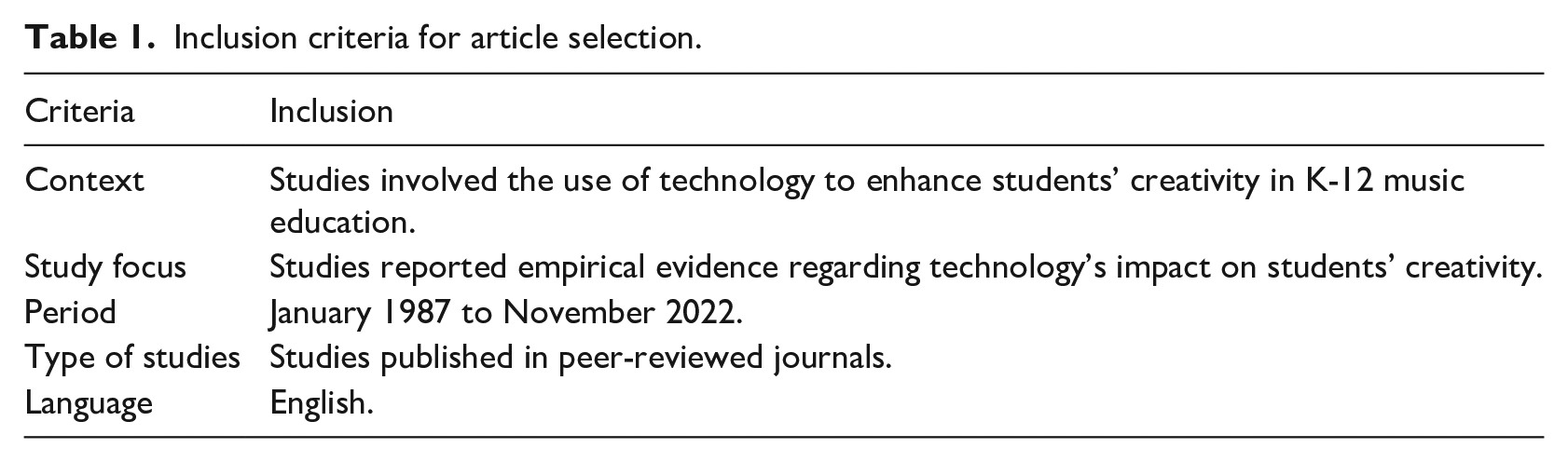
As shown in Table 1, inclusion criteria were developed for article selection. As one of the aims of this scoping review is to investigate how technology can support students’ creativity in K-12 music education, only the studies that reported empirical evidence regarding technology’s impact on students’ creativity in K-12 music education were included. The period of the search was restricted from January 1987 to November 2022. The specific time frame could be attributed to the fact that major notation software, such as Finale established in 1988 and Sibelius established in the early 1990s, were developed in the late 1980s (Webster & Williams, 2018), and the development of microprocessors in the 1980s prompted the use of music technology equipment in schools (Gall & Breeze, 2008). To ensure the studies’ validity, reliability, and quality, only articles published in peer-reviewed journals were included. Despite no restricted research location, studies are limited to those published in English.
Inclusion criteria for article selection.
The initial search through the seven databases yielded 1,377 records. A total of 474 duplicate articles were identified across different databases and removed, resulting in 903 articles for the title and abstract screening process. Following the inclusion criteria, 873 irrelevant articles were removed, and 30 articles were eligible for the full-text screening process. For the 30 articles, 9 of which were excluded due to inappropriate study focus, and 4 of which were removed due to wrong context. Thus, a total of 17 articles were selected for this study. Figure 1 illustrates the articles selection process based on the PRISMA statement (Page, 2021).
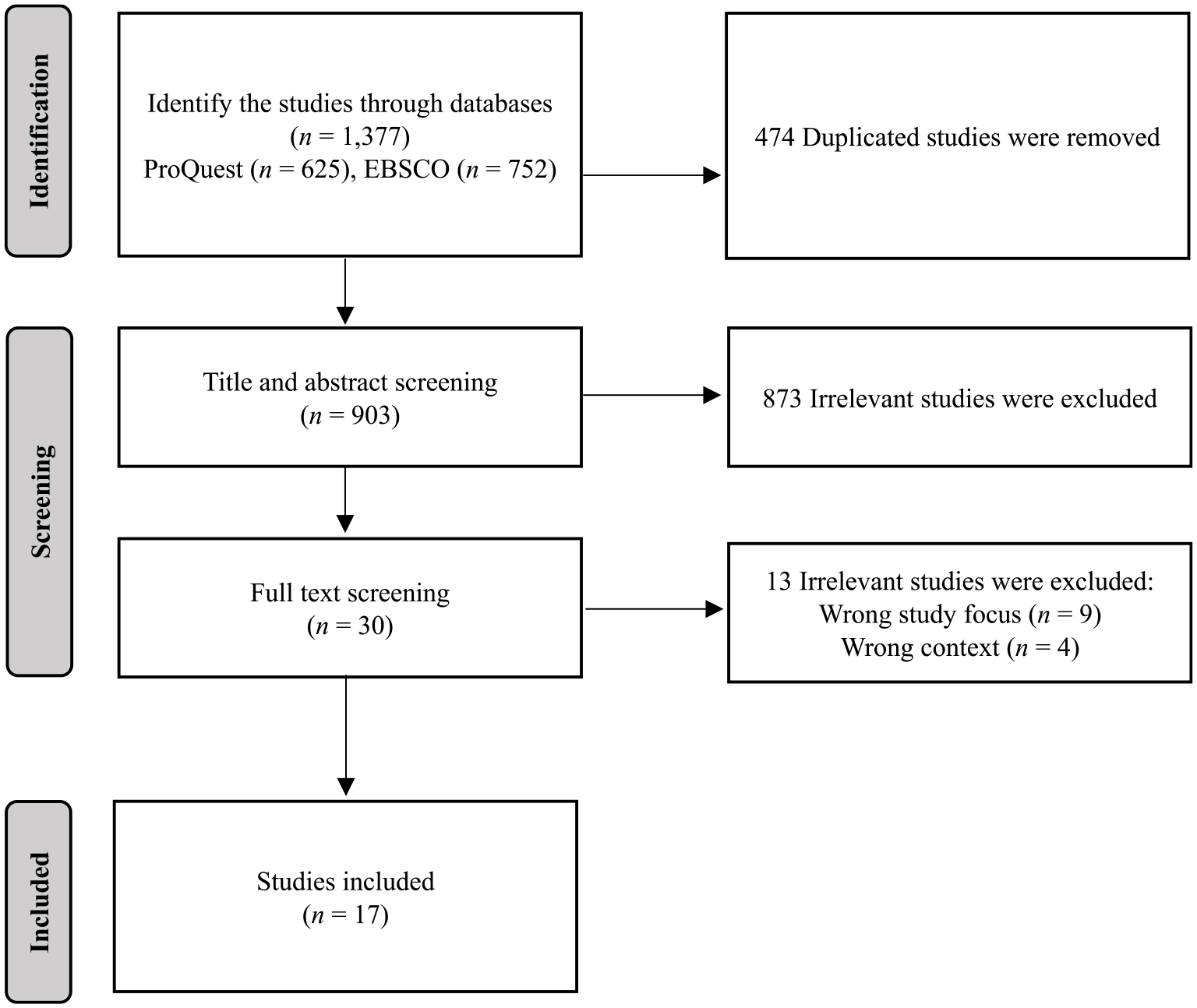
Flowchart of article selection.
Stage 4: Charting the data
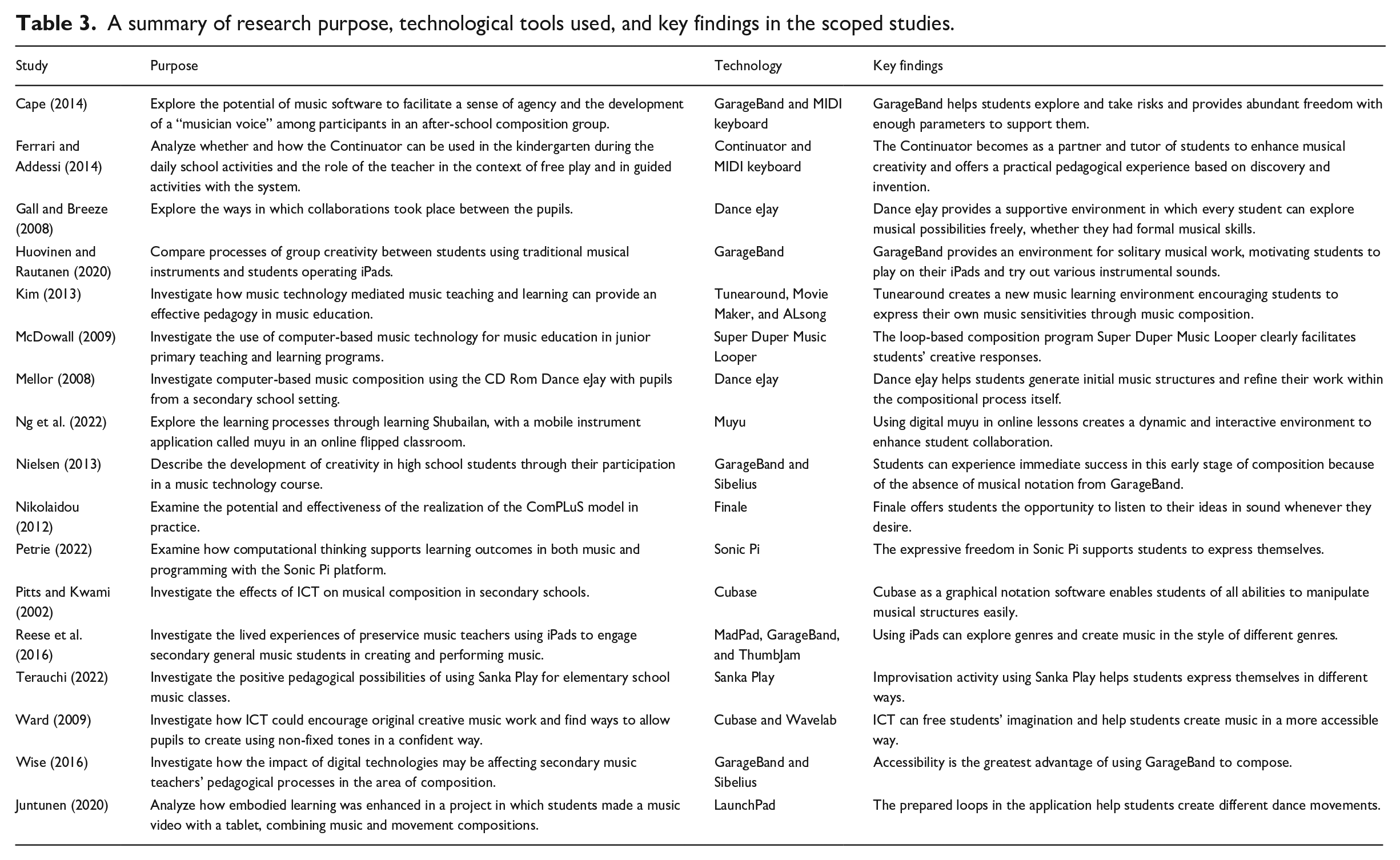
The generic information from the 17 articles was charted as listed in Table 2: the author, year of publication, research location, research participant, and research design. Table 3 shows the summary of the research purpose, technological tools used, and its key impact on students’ creativity noted in the scoped studies as an evidence map.
An overview of the scoped studies.
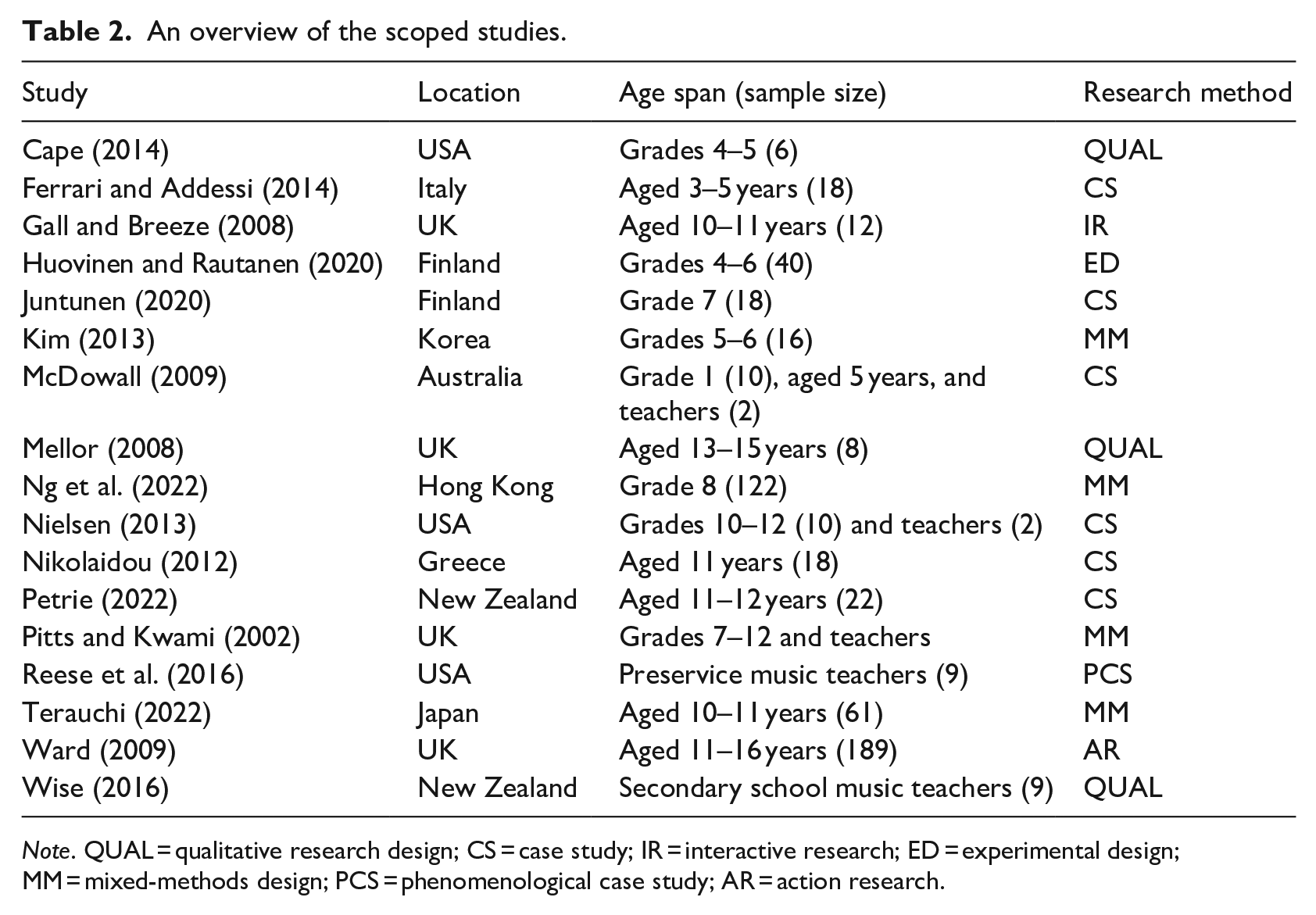
Note. QUAL = qualitative research design; CS = case study; IR = interactive research; ED = experimental design; MM = mixed-methods design; PCS = phenomenological case study; AR = action research.
A summary of research purpose, technological tools used, and key findings in the scoped studies.
Stage 5: Collating, Summarizing, and Reporting the Results
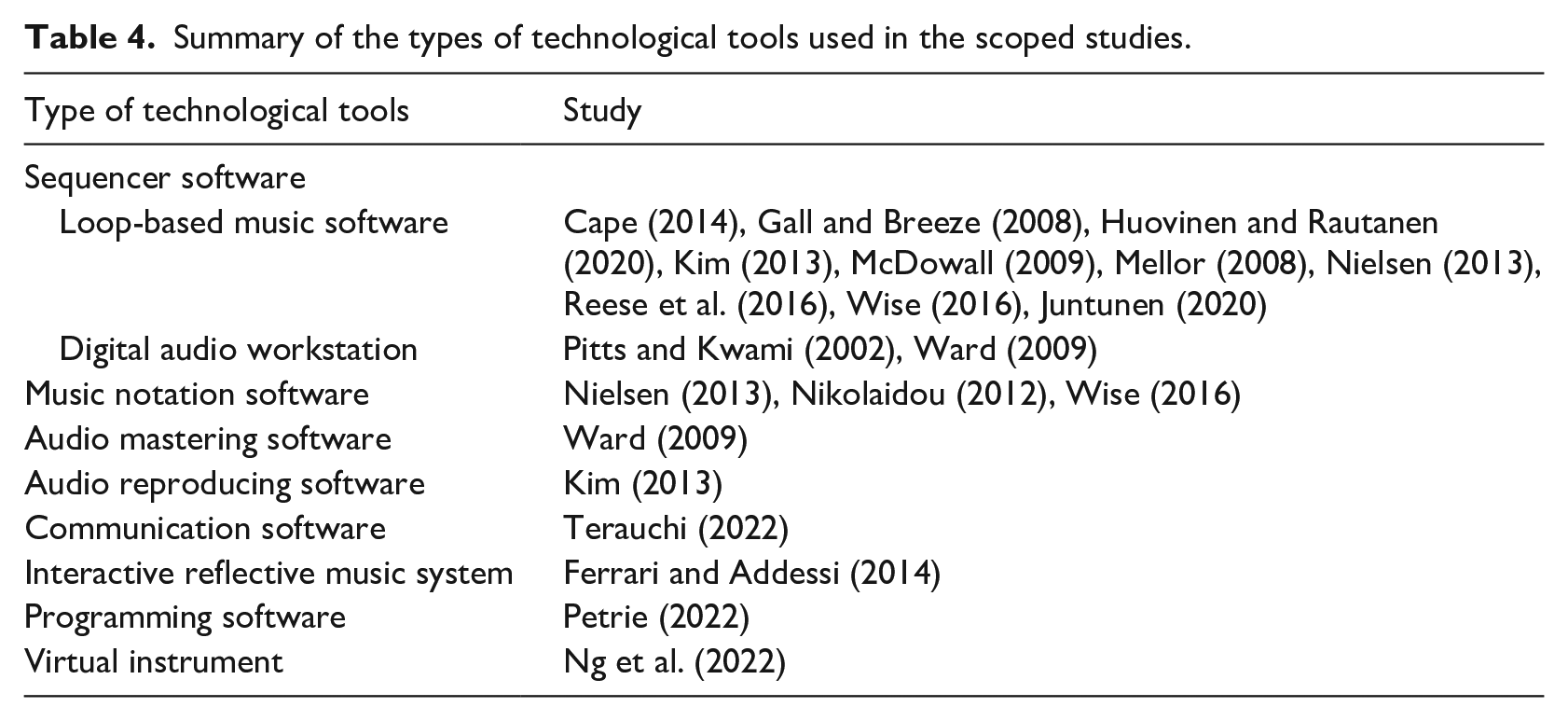
Data extraction and analysis were conducted in Covidence, an online screening and data extraction tool. Apart from the generic information of each scoped article charted in Table 2, data about the types of technological tools used was categorized into eight areas (see Table 4). Moreover, data showing the technology’s influence on creativity was divided into four categories proposed by Lubart (2005) as the social roles of computers: computer as nanny, computer as pen-pal, computer as coach, and computer as colleague. Glăveanu et al. (2019) also further explained how these four categories could potentially impact the development of creativity in a contemporary educational context. The detailed results will be discussed in the findings and discussion section.
Summary of the types of technological tools used in the scoped studies.
Findings and discussion
Overview of the scoped studies
The review examined the findings of 17 studies from 10 countries or cities, including 4 from the United Kingdom, 3 from the United States of America, 2 from each Finland and New Zealand, and 1 from each of the following places: Australia, Greece, Hong Kong, Italy, Japan, and Korea.
In terms of the research methodology, the majority of the selected studies employed a case-study design, followed by a mixed-methods approach. Some studies did not specify the type of qualitative research designs. Other methodologies used in the individual studies included interactive research experimental design, phenomenological case study, and action research (see Table 2). Categorized on the basis of Creswell and Creswell’s (2018) three approaches to research, 12 scoped studies utilized qualitative research methods, four studies adopted mixed methods, and only one study used quantitative methods to examine technology-enhanced creativity. With respect to data collection methods, a large majority of the studies used observation and interview to collect data, both of which were utilized in 13 studies. Additionally, the survey approach was only adopted in seven studies.
Regarding the number of participants, a notable portion of the studies included 11-20 participants (see Table 2). Pitts and Kwami (2002) did not indicate the number of responding students and teachers but specified that questionnaires from 18 schools were analyzed, and observations and interviews were conducted in 8 schools.
Types of technological tools in supporting creativity
Most of the scoped studies employed sequencer software to support students’ development of creativity in the music classroom. Other software and technological tools were also identified from the studies, such as music notation software, audio mastering software, audio reproducing software, communication software, interactive reflective music system, programming software, and virtual instrument. The types of technological tools used in the scoped studies were categorized in Table 4.
On the subject of loop-based music software, half of the studies employed GarageBand as a platform for students to compose music, and several studies used Dance eJay, Tunearound, Super Duper Music Looper, ThumbJam, and LaunchPad as the compositional tools (see Table 3). The reason for selecting loop-based music software among numerous kinds of music technology was suggested in six studies. Some studies (Cape, 2014; Huovinen & Rautanen, 2020; Nielsen, 2013; Wise, 2016) had the consensus for the main reason that the software which allows students to organize pre-recorded musical samples affords an easy approach for students to manipulate musical sounds and explore musical structures, regardless of their musical background. Another critical reason identified from the studies (Cape, 2014; Gall & Breeze, 2008; Huovinen & Rautanen, 2020; Reese et al., 2016) is that loop-based music software, especially GarageBand and Dace eJay, offers pre-recorded loops in a variety of styles and genres, providing students with miscellaneous combinations to explore.
The second most used type of technological tools among the 17 included studies is music notation software. Sibelius and Finale as the “two major notation tools” (Webster & Williams, 2018, p. 15) were chosen to become the software for composition in the studies (Nielsen, 2013; Nikolaidou, 2012; Wise, 2016). Although composing in Sibelius and Finale requires a basic understanding of music notation (Nielsen, 2013; Nikolaidou, 2012), one of the student participants in Nielsen’s (2013) study believed that music notation software surpasses loop-based music software as a compositional tool because students can learn about music faster with their own musical ideas than using pre-recorded materials.
Apart from loop-based music software and music notation software, the studies that employed other technological tools have different reasons for selecting other programs or systems as the compositional platform. For example, Terauchi (2022) explained that Sanka Play as the communication software could encourage interactive communication between students as performers and audiences. Ferrari and Addessi (2014) highlighted that the Continuator as an interactive reflective music system could produce music in the same style as a human playing the keyboard. Sonic Pi as a programming software provides a unique opportunity for beginners to learn programming through the activity of making music with code (Petrie, 2022). Muyu as a virtual instrument can facilitate student learning with pre-assigned online materials (Ng et al., 2022). Still, Ward (2009) and Kim (2013) did not mention the reason for the particular choice of technological tools in music making.
Roles of technology in supporting creativity
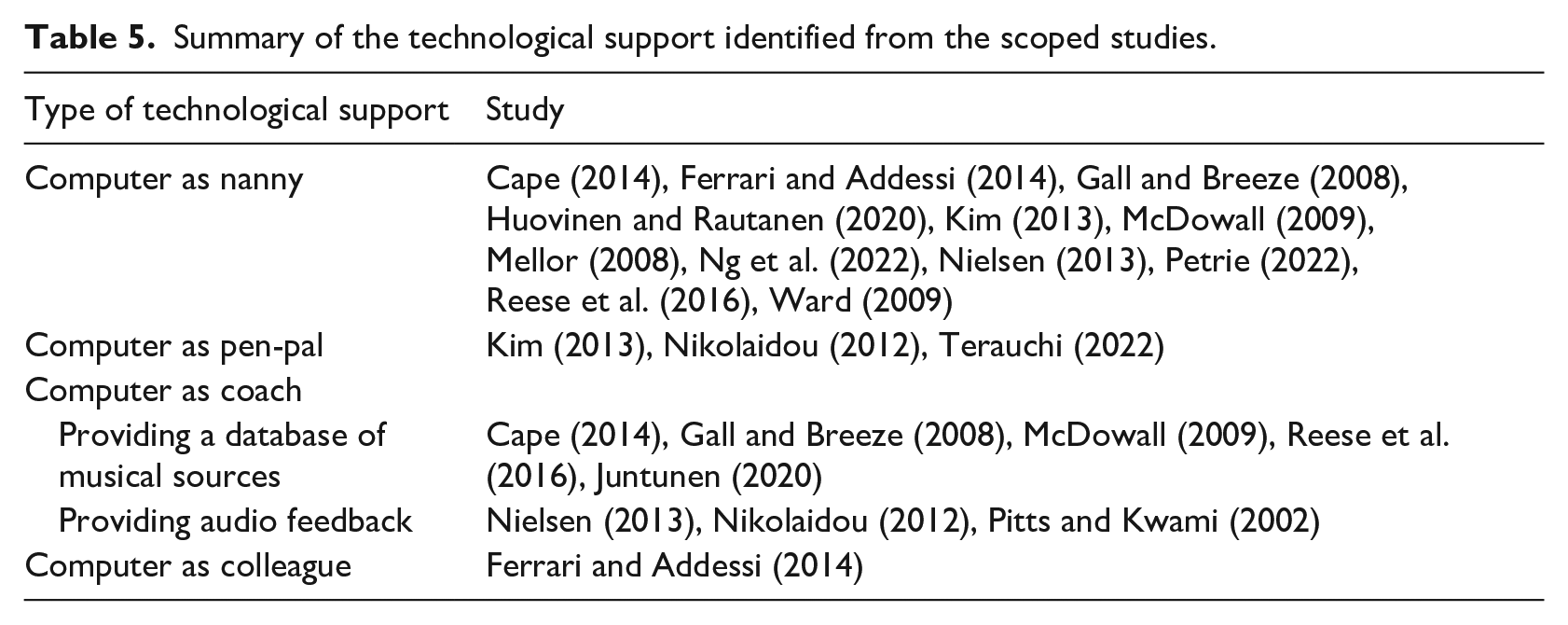
In a special issue of human-computer interaction, Lubart (2005) proposed four roles of computers to explain how computers can support people’s creativity: (a) computer as nanny, (b) computer as pen-pal, (c) computer as coach, and (d) computer as colleague. However, considering Lubart’s article was published 18 years ago, Glăveanu et al. (2019) contextualized Lubart’s ideas within a contemporary educational context to further include other technologies, such as communication technology and various software. As such, the computer described in this paper refers to not only computer technology but also other technological tools, such as iPads. The types of technological support for creativity identified from the scoped studies were categorized in Table 5.
Summary of the technological support identified from the scoped studies.
Computer as nanny
Computers in the role of a nanny fulfill various functions to support generative thinking, which involves learning and creativity (Glăveanu et al., 2019). They actively monitor the work process, ensuring learners maintain focus on their projects and objectives. Additionally, computers contribute to problem detection and recommend breaks, thereby facilitating a conducive environment for creative incubation. Beyond these functions, computers also afford working in environments, such as a beach or a café, offering engagement in creative work. Through these capabilities, computers assist students in breaking free from routine thinking, ultimately facilitating access to creative mindsets.
A majority of the scoped studies mentioned that the software or system used in the studies could offer a conducive environment that engage students in creative work. For example, Gall and Breeze (2008) reported that the sample sequencer Dance eJay provided a supportive environment enabling every student to explore musical possibilities freely, regardless of their acquired musical skills. The software employed a visual representation of musical samples, wherein each sample was represented by a colored block accompanied by its corresponding name. Samples sharing similar qualities were assigned the same color and grouped together. Gall and Breeze observed that the utilization of colored blocks in Dance eJay proved particularly advantageous in guiding students’ creation of the musical structure and texture, as they could refer to the color even in the absence of formal musical knowledge. Moreover, Huovinen and Rautanen (2020) asserted that the built-in smart instruments in GarageBand, which facilitate the convenient manipulation of accompaniment loop patterns through the utilization of eight vertical chord bars, highlight the affordance of the software in providing a whole action environment for coordinating music-making. Furthermore, Kim (2013) argued that ALSong and Tunearound take the full advantage of the internet to create a new learning environment which enhances students’ active engagement in the classroom and accordingly encourages them to express their own music sensitivities through music creating. In a similar vein, the use of digital muyu in online music performance creates a dynamic and engaging environment that enables students to collaboratively create varied rhythm patterns during synchronous online lessons (Ng et al., 2022). In summary, technology can establish a conducive environment that fosters or supports students’ creative thought, enabling them to unleash their creative potential and facilitating their development of creativity.
Computer as Pen-Pal
Computer as Pen-Pal denotes that computers may function “as a networker or facilitator” (Lubart, 2005, p. 367) between human beings, facilitating the communication between individuals collaborating on creative projects. Communication is pivotal to enhancing creativity since communicating ideas with audiences or collaborators can eventually integrate new creations (Lubart, 2005). Three scoped studies discussed that technological tools could facilitate the interactions between creators and audiences as well as the exchange of ideas between different individuals. For example, according to Kim’s (2013) empirical study, the participant students used ALSong and Tunearound, two internet-based music software platforms, to create music, and subsequently disseminated their musical compositions through online blogs. This reciprocal exchange and mutual appreciation of one another’s musical work on the internet not only allowed the students experience the roles of composer, audience, and critic, but also promoted their emotional exchanges. Hence, ALSong and Tunearound effectively harness the potential of the internet to create a two-way environment in which the students can share their experiences with other students and receive creative feedback. Furthermore, Terauchi (2022) developed a computer application known as Sanka Play, designed to facilitate active audience participation within improvisational performances. This innovative tool empowers audience members to engage in real-time interaction by submitting requests to performers. By using Sanka Play, audience members can transmit their desired requests to the application, subsequently enabling performers to view and incorporate these requests seamlessly into their improvisations. As a result, Sanka Play serves as a catalyst for performers to diversify their artistic expression in response to the diverse array of audience requests, contributing to the development of performers’ creativity. In a collaborative compositional task, Nikolaidou (2012) revealed that students’ involvement with a trial-and-error procedure within the Finale software led them to use exploratory and reflective talk during their joint work. This collaborative process propelled the collective development of novel solutions that bridge their creative ideas. Nevertheless, it is worth noting that the results from the study by Huovinen and Rautanen (2020) indicated that GarageBand is comparatively less conducive to fostering students’ creative musical interaction when compared to traditional musical instruments.
Computer as coach
The coach role of computers can offer information in various ways, enabling individuals to uncover creative ideas. This may include providing a database of potential sources of inspiration and existing techniques to stimulate creativity (Lubart, 2005). The studies reviewed discerned the former type of information, such as a database of musical sources and audio feedback. As for a database of musical sources, GarageBand, the most popular software for composition among the 17 scoped studies, affords abundant freedom with extensive musical samples to support students’ composition process (Cape, 2014; Reese et al., 2016). Cape suggested that GarageBand provides students with an expansive library of pre-recorded music loops, enabling them to have enough parameters to establish “workable space” (p. 16) for creation. Similarly, Reese et al. reported that GarageBand encompasses a rich assortment of sounds and effects, rendering it an invaluable tool for students to create music in a wide range of genres. Other loop-based music software, such as Dance eJay and Super Duper Music Looper, also affords assorted music sounds that students may not encounter in a school classroom environment (Gall & Breeze, 2008; McDowall, 2009). Further, with the use of the audio feedback function in Finale, students could immediately experience their compositions in sound and evaluate their musical ideas (Nikolaidou, 2012).
Computer as colleague
The colleague role of computers is a real partner who can contribute new ideas in a dialogue with humans (Lubart, 2005). In a creative team composed of a human-computer duo, human proposes an initial idea, which the computer collaboratively refines until the human deems the musical production as satisfactory. An example of the partner is artificial intelligence which can generate, evaluate, or refine humans’ creative ideas in a random or heuristic way (Glăveanu et al., 2019). Ferrari and Addessi’s (2014) research on the Continuator is the only scoped study that mentioned technology’s support of creativity in this perspective. They considered the Continuator as the students’ partner who can produce music in the same style as students playing the keyboard. Through listening to the Continuator’s answer and responding to it with new musical phrases, students can discover and invent new musical ideas, thereby fostering their creativity.
Limitations
This scoping review was limited by the small number of studies that met the inclusion criteria. As the included studies were restricted to those published in English, relevant studies written in other languages were not examined. Therefore, the coverage of the evidence was confined. The limited coverage could also be attributed to the finite search within seven major educational databases, and the studies included in other databases only were neglected in this review. Last, to ensure the quality of studies included in this paper, only articles published in peer-reviewed articles were examined. As such, other relevant studies, such as conference papers, dissertations, and chapters in an edited book, were excluded.
Conclusion and recommendations for future research
A total of 17 studies were analyzed, which revealed eight types of technological tools used to foster creativity in the music classroom and four types of technological support of creativity identified from the scoped studies. Sequencer software was found as the most often cited type of technological tools, in which GarageBand was the most popular software for composition among the included studies. Although technology supports the development of creativity in different ways, many studies reported that technology creates an engaging environment that enhances students’ creativity.
Considering that most of the studies employed qualitative methodologies, it is difficult to draw a general understanding of how technology can enhance students’ creativity in the music classroom because qualitative research cannot generalize findings to individuals outside of those under study (Creswell & Creswell, 2018). Therefore, additional research that adopts a quantitative or mixed-methods approach is necessary to achieve a comprehensive understanding of how technology can promote creativity in K-12 music education.
Further, with a large majority of the scoped studies examining the context of grades 4-12, there is a particular need for research on how technology can support K-3 students’ development of creativity. Potters et al. (2023) conducted a systematic literature review of 52 empirical studies on children’s development of creativity during primary education. The findings from their review underscore the facts that positive development of creativity can manifest as early as the preschool years and that open-ended fragmenting creativity begins to develop starting from grade 1.
Researchers in the scoped studies extensively focused on general students’ creativity, but there is little current research examining the creativity of students with special needs. Orsmond and Miller (1995) investigated creative behaviors of children with developmental disabilities, such as Autism, pervasive developmental disorder, and mental retardation, and concluded that children with special needs could also exhibit creativity. Further research on students with special needs is essential to address learning diversity in the music classroom and arouse the appropriate use of specific technological tools to foster certain students’ creativity.
Future research should also extend its focus beyond sequencer software and explore how other technological tools can foster students’ creativity as the findings of this review indicated that the influence yielded by other technological tools is under-researched. Giddings (2022) proposed a wide range of technological tools that can help students unleash their creativity, such as digital audio workstations (e.g. BandLab, Soundtrap, Audacity, and Soundation), online applications (e.g. Chrome Music Lab, Song Maker, Incredibox, Beepbox, ModBox, and Paint Composer), drum machines (e.g. GroovePizza and Drumbit), coding applications (e.g. Makey Makey and Micro:bit), and virtual instruments. By examining the potentials of these diverse technological tools in fostering students’ creativity, researchers can inform their pedagogical practices to optimize students’ development of creativity in music classrooms. Lastly, the dearth of research on the colleague role of computers is reasonable since artificial intelligence technology has not been well developed to be used in the music education context. However, with the rapid development of artificial intelligence, further research should focus on investigating how artificial intelligence or emerging technology can become students’ partners to help generate or refine their creative ideas.
Footnotes
Declaration of conflicting interests
The author declared no potential conflicts of interest with respect to the research, authorship, and/or publication of this article.
Funding
The author received no financial support for the research, authorship, and/or publication of this article.
