



Abstract
Admission procedures to elementary school in Music Conservatoires in Portugal consist in the assessment of aural aptitude. This investigation aims at assessing the power of aural aptitude at predicting future musical achievement as well as the assessment of two other variables for the same purpose: motivation and intentions of parental support. For that matter, our sample includes the cohort of the admitted candidates and their parents to the 2019 to 2020 academic year. We used a longitudinal approach that followed the musical achievement of the sample during the 2019 to 2020 and 2020 to 2021 academic years. Questionnaires were administered to both children and parents to collect information on motivation to learn a musical instrument and anticipation of parental support provision. Our results point that, after 2 years of music education, neither of the tested variables were able to predict the students’ musical achievement. These results suggest that the model of admission procedures to Music Conservatoires based on aural aptitude must be rethought and that this line of investigation could be revisited later when our sample enters middle school to assess again the predicting power of motivation and parental support.
Keywords
Introduction
Learning how to play a musical instrument is a long and demanding journey (Hargreaves, 1996; McPherson et al., 2012). The many challenges posed by mastering the instrument and by the music itself—both technical and artistic—require persistence and resilience (Bruser, 1999; Maynard, 2006; Neuhaus, 2008): it takes time to decipher a musical score, to understand the style and the language, to match the right action to the desired sound (e.g. breath control on woodwind or brass instruments, bow stroke on string instruments, or finger articulation on keyboards). The learning of the succession of movements leans on the formation of procedural memories, a process the human brain acquires by repetition, improving step by step (Duke & Davis, 2006; Simmons, 2012). Therefore, it is advised to start musical studies at an early age, depending on the instrument and the physical and cognitive maturation processes of the child, and profiting from the improved learning capacities human beings display at the commencement of school at the age of 6 years (McPherson et al., 2006).
Unlike general schooling, which provides broad knowledge in different subjects until the adolescence and only then students are required to take a vocational path, music schools and conservatoires offer vocational studies right from the start of musical studies.
In Portugal, the network of public music conservatoires includes seven schools based in Braga, Porto, Aveiro, Coimbra, Lisbon, and Loulé. Every academic year, the number of candidates far exceeds the offer of places on each school, leading to a selection process that takes place locally. Admission to elementary school is largely determined through a aural aptitude assessment that is based on the candidate’s aural skills. There are differences from one school to another, but exercises include repetition of given rhythmical short exercises (both on simple and compound meters) as well as short tunes (both in major and minor modes), singing a tune of their own choice, singing the tune taught in the welcome session, and submission of a video in which the candidate sings two tunes and claps the rhythm of one of them (exceptional procedure to avoid presential interactions due to the covid-19 pandemic). Candidates are invited to enroll according to their results (Conservatório de Música de Coimbra, 2021; Conservatório de Música de Loulé, 2021; Conservatório de Música do Porto, 2021; Escola Artística do Conservatório de Música Calouste Gulbenkian de Aveiro, 2021; Escola de Música do Conservatório Nacional, 2021; Instituto Gregoriano de Lisboa, 2021).
This admission procedure assesses one single dimension that plays in the learning process—capacities—and it is not clear whether these are innate or acquired capacities (Hallam, 2016). Some researchers advocate that natural capacities evident from birth are only possible to be assessed right after birth, before the environment starts influencing the individuals. One can conclude that the informal learning which starts happening immediately right after birth (i.e. the household stimulation, the earlier music experiences, just to cite a few) will influence a child’s capacities that can be observed later at any given moment. That is the main reason explaining why it is largely accepted that at the ages of elementary school students, human beings already possess an array of knowledge acquired through informal (or sometimes already formal) learning (Corrigall & Schellenberg, 2016). Therefore, 5- and 6-year-old candidates to a music conservatoire will display the knowledge previously acquired through exposition to their own environments. This reality represents an unequal access to music programs because the admission procedure based on aural aptitude is sensitive to the quality of the candidate’ social and economic environment with candidates from a favored social class possessing a richer cultural background and, therefore, are best placed to score high on the admission procedure (Miksza, 2007). This situation raises concerns on the fairness and equity of the admission procedure. Moreover, wealthier families have the chance to provide private lessons to prepare their children for the aural assessment, which can give them a distinct advantage.
On the other hand, it is arguable if aural aptitude on its own makes a good musician (Hallam, 2016; McPherson, 1995 [1996]). As mentioned, to master a musical instrument requires regular and intensive practicing, and a student lacking the persistence to endure the time to practice and learn the music score, although talented as the student may be, will fail to achieve the desired goals (Hallam et al., 2021).
The literature in the field highlights the importance of several factors that influence the learning process. Gagné (2009), in his Differentiated Model of Giftedness and Talent, asserts that catalysts have a stronger influence than natural abilities (skills or capacities) on the learning process. The author proposes two types of catalysts—environmental and intrapersonal—which exert a modeling influence on the learning path: environmental catalysts include items such as parental support, provision of programs, or social atmosphere; intrapersonal catalysts consider motivation, physical condition, or personality, to name a few.
Learning how to play a musical instrument requires individual organization and practice to meet the goals set by the teacher (Hallam et al., 2021; McPherson, 2000; Sloboda et al., 1996). Most of the learning is achieved by the student at home preparing the next music instrument lesson following the teacher’s guidelines and advise. However, considering the young ages of the beginners and the fact that they do not have the planning, structuring and self-regulation capabilities of an adult, they rely on external support to scaffold their practicing milieu and schedule (Creech 2010; McPherson, 2009). In other words, both intrinsic (or self-determined, coming from within the own student) and extrinsic (or controlled, coming from outside, in other words, from a teacher or the parents) types of motivations are essential to engage in a behavior, as in our case, learning how to play a musical instrument. A valuable and well-established theory that helped us to understand the assumption that all humans are motivated at times by both intrinsic and extrinsic motivation is the Self-Determination Theory of Motivation. In broad terms, the Self-Determination Theory of Motivation, initially proposed in the 1970s, was formally introduced in 1985 by the book Self-Determination and Intrinsic Motivation in Human Behavior (Deci & Ryan, 1985). The authors proposed that humans tend to satisfy three main psychological needs, namely autonomy (related to self-regulation), competence (related to self-efficacy), and relatedness (a sense of belonging). Together, these needs create a suitable environment for integrated extrinsic and intrinsic motivation to thrive. In terms of learning (specifically, a musical instrument), as proposed by the Self-Determination Theory, throughout the learning process occurs a transference of control from external regulation in the early stages, in which considerable planning and assistance are offered by parents or significant adults, to internal regulation in the most advanced stages, in which the student is able to autonomously organize his learning path (Deci & Ryan, 1985). The external support creates the ground where the interests and motivations of the child grow and flourish: parents set the optimal atmosphere and environment to children to excel, fulfilling the three basic psychologic needs of autonomy, competence, and relatedness. Deci and Ryan affirm that the level to which these needs are satisfied explain the type of the student’s motivation: from amotivated, when the psychological needs are not fully satisfied, to intrinsically motivated, when the needs are highly satisfied.
Parents’ involvement with the learning process signals to the child the importance music can have in their lives and how parents are committed with the child’ success (Küpers et al., 2014). It was observed that the expectations parents bring to the learning process impacts the quality of the student’s development (McPherson, 2009). For instance, the study of different prodigies revealed a common feature in mothers that was present from the very first stage of the instrument tuition, who sat in individual lessons, listened to the child’s home practice, took the child to public presentations or even took care of managerial decisions or adjusted the family routines around the needs of the young learner (McPherson & Lehmann, 2018). Comeau et al. (2015), in a study comparing American and Chinese students’ attitudes toward learning and practice, found that the Chinese students practiced their instrument more than their American counterparts, because of the assimilation of their family’s working ethics.
With the above as our context, this investigation assessed whether the information collected in the moment of the admission procedure about the intentions of parental support expressed by parents or other relatives predicts future musical achievement, considering that, nowadays, support regarding academic achievement and other dimensions of the children’s life is often offered by other members of the household other than parents.
Furthermore, the resilience and persistence to endure the long practicing sessions required to master the musical instrument have their roots on the instrumentalist’s motivation; a lack of this will, impedes regular practicing and thus thwarts improvement. Motivation, as the energy that the child puts into the learning of his musical instrument, affects the output achieved. There is a strong relation between the amount of practice and the students’ performance quality: although other factors exert a role in the process, it was observed that the more one practices, the better his playing (Hallam et al., 2021).
It was our aim to also assess motivation expressed by candidates in the moment of the admission procedure to determine how it can predict future musical achievement (Driscoll, 2009; Evans, 2015; Evans & McPherson, 2015).
This study investigates the relationship between the data on the student’s motivation and parental support collected on the admission procedure and the student’s musical achievement after 2 years of tuition. We collected grades achieved by students on each of the musical subjects (instrument, ear training, and chorus) at the end of each term (before Christmas, before Easter, and by the end of the academic year) during their first 2 years of tuition (2019/2020 and 2020/2021) and analyzed the relationship with the student’s motivation and parental support.
Based on the Self-Determination Theory, as discussed earlier, the aims of this research are (1) to investigate how much the aural aptitude results of this admission procedure impact on the student’s learning process (i.e. how much these results predict the student’s forthcoming musical achievement) and (2) to include two other variables—motivation and parental support—in order to explore if they exert a significant impact on the learning process. We hypothesized that data collected on motivation and parental support before the commencement of musical studies would predict students’ future musical achievement, whereas aural aptitude-based admission test would have a residual impact.
Method
Sample
A Music Conservatory in the Northern region of Portugal was contacted and accepted to stablish a partnership to allow us access to the sample of candidates and respective caretakers to the 2019/2020 academic year. Consequently, all the data collection moments were implemented within one single music institution. The opportunity to participate in this study was offered to all parents or other adults accompanying the candidates whenever they were members of the household with a significant role in the candidate’s life. All participants were informed that the present research observes the Ethical Letter of the Portuguese Society of Educational Sciences (2014) and the Ethics and Conduct Code of the Portuguese Catholic University. Written consents were signed by parents or accompanying adults. The Music School representatives reinforced that, as for the admission procedure to the institution, only the results in the aural aptitude assessment would be considered and the data collected in the present research could not be considered by any means or at any time for the admission procedure.
From the total candidates’ sample, 84 children (84%, in which 42 males; 42 females) and parents/accompanying relatives (24 males; 59 females; 1 did not declare sex) accepted to participate. The children’s mean age is 5.58 years (SD = .496); 42% of the sample was 5 years old, and 58% was 6 years old; the parents/accompanying relatives mean age is 40.82 years (SD = 4.303).
In the beginning of the following academic year, 55 students started musical studies and in the transition to the next academic year one student dropped out. Therefore, our sample comprises 54 students with complete information on grades awarded on the six terms (Christmas, Easter, and Summer evaluation moments over a period of two academic years).
The cohort of 54 students was composed by 63% of girls and 37% of boys (20 males; 34 females) and the mean age was 5.59 years (SD = 0.49); 40.7% of the sample was 5 years old, and 59.3% was 6 years old. Taking the total sample, 74.1% of the sample (n = 40) declared having previous musical experience and out of these, 34 participants (63% of the sample) reported already playing a musical instrument.
Regarding household, 34 participants (63%) reported having brothers or sisters, of which 20 are music players. Among siblings, piano (n = 3) was the most played instruments, followed by violin, trombone, French horn, and percussion (n = 2).
Considering sex differences, the male sample was composed by 5 five-year old and 15 six-year-old boys, while the female sample was composed by 17 five-year old and 17 six-year-old girls.
From the entire sample, 13 boys and 27 girls said having musical experience. Thirteen boys have brothers or sisters and out of these, six play a musical instrument; 21 girls have brothers or sisters from which 14 play an instrument.
As for the cohort of parents, it was comprised of 54 participants (16 males; 37 females; 1 adult did not declare sex) with a mean age of 40.92 years (SD = 4.25). As for the marital status, 33 were married, 11 were in de facto union, five were single, four were divorced, and one participant did not declare marital status. Concerning the professions of the adult sample, being a teacher was the most popular profession (n = 17), followed by specialists in law, social, artistic and cultural affairs, and health professionals (n = 6). As of education level, 87% of the sample declared to have tertiary level education: 27 adult respondents held an academic degree, 11 had master’s degree, and 9 had PhD; only six declared having high school education level. Concerning musical experience, 26 adults had studied music for 78.67 months on average. Regarding the 44 adults possessing musical instruments, the most popular single instruments were piano (n = 7) and guitar (n = 4). Upon enrollment in the conservatory, 49 adults expressed willingness to acquire an instrument for their children. Our data showed that 19 parents had other sons or daughters studying music, 12 at the Oporto Music Conservatory, and 7 at other music school. The most played instruments by other sons or daughters were piano (n = 4), and French horn (n = 3) (Table 1).
Parents’ musical background and household.

Instruments
For this study, two questionnaires were developed and named EXPERT, standing for Expectations, PERceptions and parental supporT: one to be administered by a researcher to the children, and another to be answered by the parents/accompanying adults.
The development of these questionnaires involved a three-step process, namely: (1) definition of the construct intended to be evaluated (through the discussion and literature review by the psychology and music experts within the research team); (2) selection and formulation of items; (3) design of the scoring system in batteries in the case of the parents’ questionnaire according to the measurement (frequency, agreement, quantities) with varying number of Likert points depending on the dimension (four or five points), and in the case of the students’ questionnaire, three batteries to measure motivation, expectations and perceptions, and household environment with three Likert points for the children’s questionnaire to prevent ambiguity in the part of the respondents (Bell, 2007).
Eight articles were screened and selected for further analysis after a search in the literature that was undertaken on May 21st, 2019 with the words “questionnaires on motivation to study music.” Considering that we adopted the Self-Determination Theory of Motivation, these articles were chosen for the potential adequacy of their questionnaires to our research questions and theoretical framework. The articles were by Freer and Evans (2018), Hallam et al. (2016), Hallam et al. (2020a, 2020b), Hallam et al. (2021), Martin (2008), McCormick and McPherson (2007), and Tai et al. (2018). Another article was added to this search for its relevance by McPherson (2000). From a first analysis of these articles’ questionnaires, three possible factors emerged for both the children’s and parents’ questionnaires: motivation, expectations/perceptions, and home environment for the children’s questionnaire; parental support, expectations/perceptions, and home environment for the parents’ questionnaire.
After a deeper inspection of the items of each questionnaire, four questionnaires were retained as references for the design of our children’s questionnaire: Hallam et al. (2016), Hallam et al. (2021), Tai et al. (2018), and McPherson (2000). For the parents’ questionnaire, one article was kept as reference: Tai et al. (2018).
From these questionnaires, we selected the items which allowed us to assess the fulfillment of the three psychological basic needs (competence, autonomy, and relatedness), as proposed by the Self-Determination Theory of Motivation. Some items on the questionnaires by Hallam et al. (2016) and Hallam et al. (2021) related to the experience students were having with performing their instruments and with instrumental lessons. These items did not serve our purposes because our sample was of candidates to a music school, thus children without formal musical experience. From these two articles we adapted items relating to motivation to study music in abstract terms (not about performance experience) (e.g., “I enjoy listen to music,” “I enjoy going to concerts to listen”) and to expectations/perceptions (e.g., “Playing an instrument is an important part of my social life,” “I think it is valuable to play a musical instrument,” “I have musical ability”).
From McPherson (2000) we selected the item “For how long do you want to play your instrument?” to assess the commitment the candidate brings to the instrument learning. Some items were taken from Tai et al. (2018) aiming to assess the musical digital resources available in the children’s household, for example, “Own classical music AV products (e.g. records, CDs, DVDs, Blue ray discs, etc.),” “Own home Hi Fi.” Two items were added to cover aspects not considered in these questionnaires (items 1 and 2).
For the parents’ questionnaire, items of the three factors were translated and adapted from the PIMTQ (Parental Involvement in Music Training Questionnaire by Tai et al. (2018), which in turn was taken and adapted from the PIHEM (Parental Involvement-Home Environment in Music) by Zdzinski (2013). For instance, for the factor parental support were borrowed the items “Listen to your child practice” or “Attend school concerts”; for the factor expectations/perceptions were adopted items like “I believe that music education should be in all schools” and “I expect my child to do his/her best in music”; and for the factor home environment, adding to the items used for the children’s questionnaire, were adapted items like “Do other members of your family play a musical instrument of sing?” and “Take music lessons yourself.” Like in the children’s questionnaires, original items were also written for the parents’ questionnaire (items 1, 8, 24, 25, and 26).
Taking into consideration concerns expressed by Bell (2007), it was decided that the items in the children’s questionnaire would have a 3-point Likert scale because young children do not have cognitive development allowing the understanding of the subtleties between four or more possible answers. Considering that the individuals of our sample are 5- and 6-years old, their questionnaire cannot be self-administered because the children cannot read. For that matter, it was decided that a researcher would read aloud the questions to the children, and they would give their answers on a little book by painting one of three different sized circles. For each question, the researcher would point to each of the answering circles and label the answer (e.g. to the question “Would you like to learn how to play a musical instrument?” the research would point to the small circle and say “no,” to the medium circle and say “maybe,” and to the big circle and say “yes”).
The parents’ version was a 33-item questionnaire organized in three batteries according to the answering dimension: (1) level of agreement (12 items on a 5-point Likert scale in which 1 stands for totally disagree and 5 for totally agree), (2) frequency (16 items on a 5-point Likert scale in which 1 stands for never and 5 for always), and (3) musical digital resources (5 items on a 4-point Likert scale in which 1 stands for none and 4 stands for many).
Sociodemographic information was also collected and included age, sex, profession, education level, marital status, former musical experience, and the existence of other sons or daughters playing or learning a musical instrument.
After translation of the selected items, a first draft of each of both questionnaires was analyzed by a team of specialists including two educational and clinical psychologists, and by two musicians. Some potential problems were identified with the items, namely phrasing and wording, especially in the children’s questionnaire. Thus, it was decided that all items in the children’s questionnaire were to be questions because items written as first person statements would be confusing to them as we predict children will have difficulties transposing a statement heard as a first person by the researcher to their own perspective.
In terms of wording, it was anticipated that children would have trouble understanding concepts such as potential and talent. For that matter, it was favored the term ability. On items addressing technology like “Do you watch music programs on TV with your parents?” or “Do you own Hi Fi?” it was favored a broader perspective of electronic devises since nowadays the interactions with them are very varied and diverse. So, the items were merged and rephrased as “Do you listen to music with your parents on TV, in the car, on smartphones, on tablets or on the computer?”. The answering labels for each question were debated and it was tried to use wording as simple and clear as possible. It was also observed that items sharing the same answering labeling possibilities should be put together to facilitate the understanding of the dimensions assessed: changing the answering labeling very often would add confusion and noise to a process that must be clean. Two items were added to this first draft: “Would you like to learn how to play a musical instrument?” and “Would you like to study at the Conservatory?”. Overall, the children’s questionnaire included 26 items after the analysis by the specialists.
Regarding the parents’ questionnaire, it was observed that many items have dichotomous answers of either yes or no. Thus, it was decided that some items should be moved to the sociodemographic questionnaire, and some others must be rephrased so to capture quantity. As a result, the parents’ questionnaire included 33 items divided into three batteries assessing frequency, agreement, and quantity after the analysis by the specialists.
The second version of the questionnaires was then pilot tested with a group of children aging from 5 until 7 and with a group of adults, all of them with children of about these ages. The first observation from the administration to the children was that coloring the circles was a very long process. Thus, in order to make the recording procedure faster and more appealing, children were requested to stamp their answers with a stamping match. To the question “Do your parents want you to play a musical instrument?” some gave double answers like “my dad yes, my mom no,” so it was decided to open a sub-answer for this situation. Some children revealed difficulties with the concept of importance such as in “To study music is important to you?” and so we decided that in the face of such difficulty, the researcher could help by giving a meaning to the concept like “something special to you.” To the questions “Do your parents own music DVDs and CDs” and “Do your parents own music books and magazine?” the possible answers were “none, some, many”; however, some children answered “I don’t know,” so it was decided that children wouldn’t stamp an answer in this situation.
As for the parents’ questionnaire, there were no changes required.
On July 1st, 2019, the questionnaires were administered to the candidates to the elementary level of a Music School in the Northern region of Portugal.
Data collection and analysis
Following the agreement with the Music School, candidates first did the aural aptitude assessment and afterwards, those wishing to participate in this research, were taken along with their parents or accompanying adults to a sector where a researcher administered the questionnaire to the candidates in a room whereas the parents/accompanying adults answered their questionnaire in a separate room to avoid persuasion from the latter over the former.
The results of the aural aptitude tests were collected when they were made public by the school. These tests rely on aural exercises. Before the test, children are welcomed by music teachers and gathered to perform relaxation exercises and to learn a tune that they will be asked to sing to the jury members. Then they are guided to a room where they will the assessed by a four-member jury comprised of three instrumental teachers and one ear training teacher. The test begins with the assessment of rhythmic skills: children are presented twice with two 4-measure simple-meter and two 4-measure compound-meter rhythmic exercises and, after the second presentation, they are asked to reproduce (jury members rate the accuracy of the performance); melodic skills follow and, likewise, children are present with two short tunes, one in major mode, the other in minor mode, and after the second presentation, children are asked to sing the tunes back (jury members rate the accuracy of the performance considering rhythm, intonation, and security). The remaining items included singing the beforehand learnt tune and another tune chosen by the children. Jury members rate the assessment on a 0 until 200 points, candidates are ordered according to their grades and invited to enroll starting on the higher grades.
For the data analysis protocol, initially we analyzed the sociodemographic data and then the questionnaires’ scores were summarized for each explored dimension (children: motivation, perceptions and expectations, household; parent: parental support, perceptions and expectations, household).
To assess musical achievement, we follow the learning paths of the students during two academic years (2019/2020 and 2020/2021) and collected the grades awarded to students in the three music subjects (instrument, ear training, and chorus) by the end of each academic term (first term before Christmas, second term before Easter, and third term by the end of the academic year). According to the Portuguese education system, grades awarded at the end of each term translate to the student’s achievement from the beginning of the academic year until the end of each term. Therefore, the third term grade expresses the achievement of the student on a given subject during an academic year. The scale of the grades awarded to students ranged from 0 until 100 points. We calculated the average of the three grades awarded every term to produce the mean grade of the music course.
For the purpose of our analyzes, we considered the grades of the musical instrument class and the calculated mean grade in music (we did not run analysis with the ear training and chorus grades because they are complementary to the music instrument subject). To probe our predictions, we ran linear regressions between every single dependent variable considered in our analysis (instrument and music mean awarded in each term) and the different independent variables isolated (aural aptitude assessment, children’s questionnaire score, parents questionnaire score), as well as subscales (children’s questionnaire motivation subscale and parents’ questionnaire parental support subscale) and combinations of these independent variables (aural aptitude assessment plus children’s questionnaire score plus parents’ questionnaire score; aural aptitude assessment plus children’s questionnaire score; aural aptitude assessment plus parents’ questionnaire score; children’s questionnaire score plus parents’ questionnaire score; parental support subscale plus perceptions and expectations subscale both from the parents’ questionnaire). Please see Figure 1 to have an overview of the different data collection points.
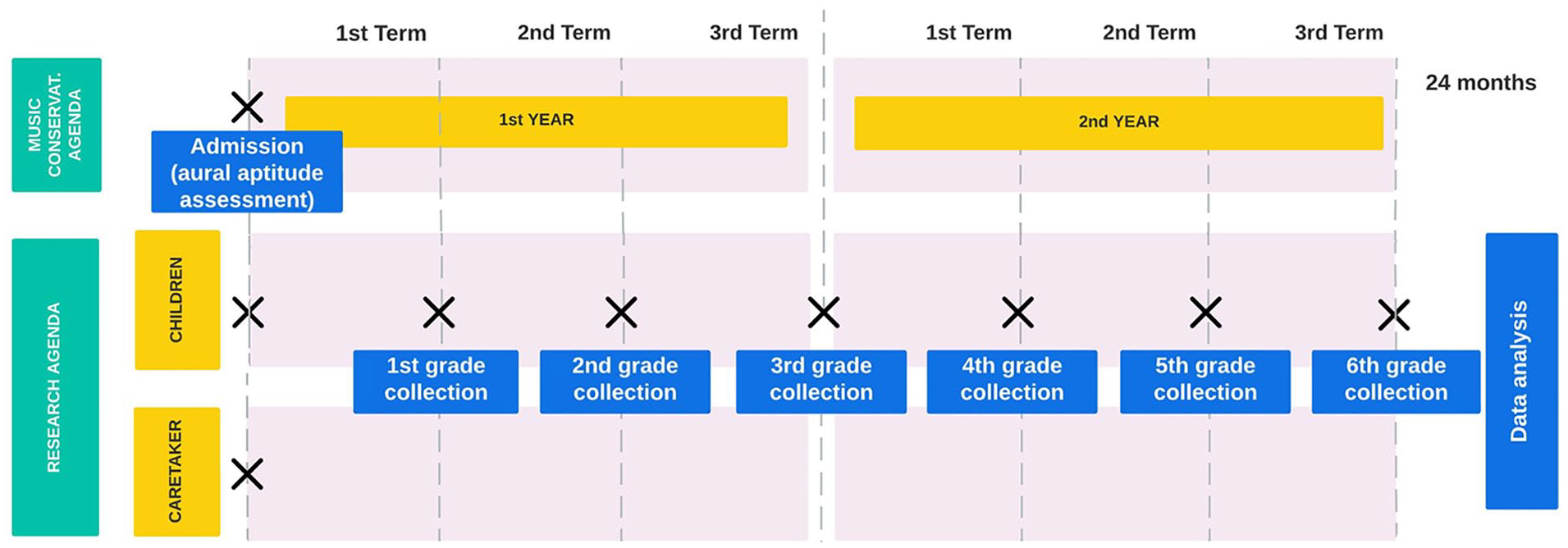
Overview of the different data collection points.
Results
The results of the children’s and parents’ questionnaires as well as the aural aptitude assessment are as follow (Table 2):
Results of the children’s and parents’ questionnaires and the aural aptitude assessment.
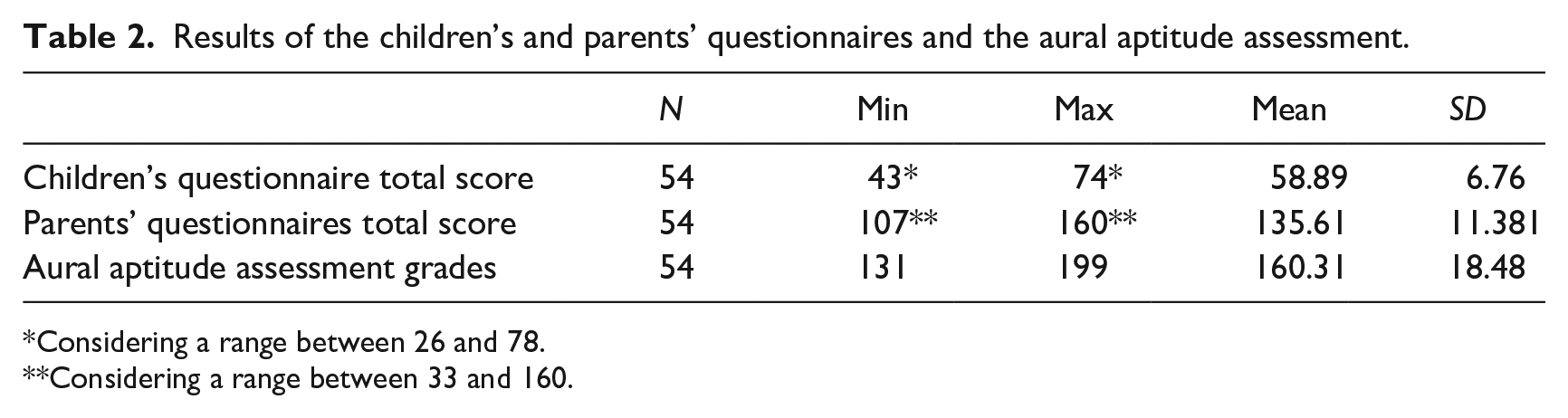
Considering a range between 26 and 78.
Considering a range between 33 and 160.
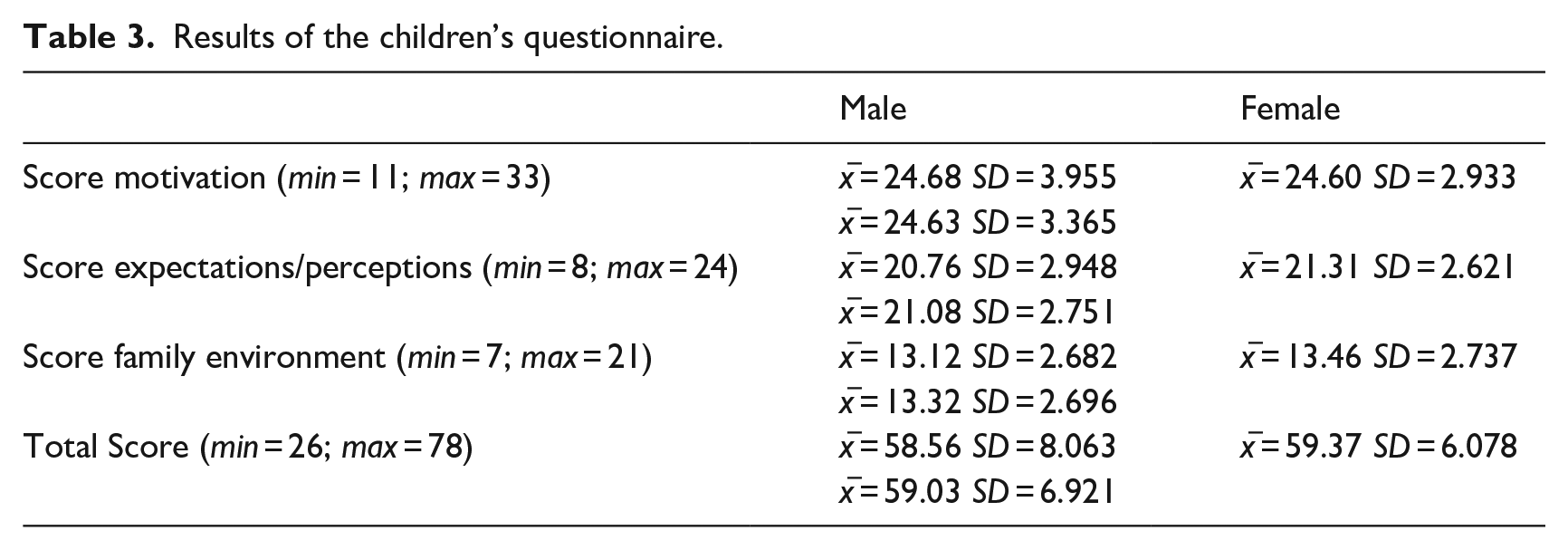
The scores of each subscale of the children’s questionnaire are shown in the following table. As can be seen, the samples’ average is higher than the median for all the subscales and the total score. When exploring the sub-scales separately, the highest average is found in the expectations/perceptions, and the lowest value for motivation, concerning the median (Table 3).
Results of the children’s questionnaire.
Also, the results of the parents’ questionnaire are higher than the median for all the subscales and the total score. The score for the sub-scale “parental support” was the highest, while the score for the sub-scale “family environment” was the lowest, concerning the median. As for the parents’ questionnaire, the calculated scores are as follows (Table 4):
Results of the parents’ questionnaire.

Regarding the internal consistency, the children’s questionnaire had a good Cronbach’s alpha of .680, whereas the parent’s questionnaire had a high level of internal consistency with an overall Cronbach’s alpha of .849.
The descriptives of the grades are as follow (Table 5):
Descriptive statistics of the students’ grades in music subjects.
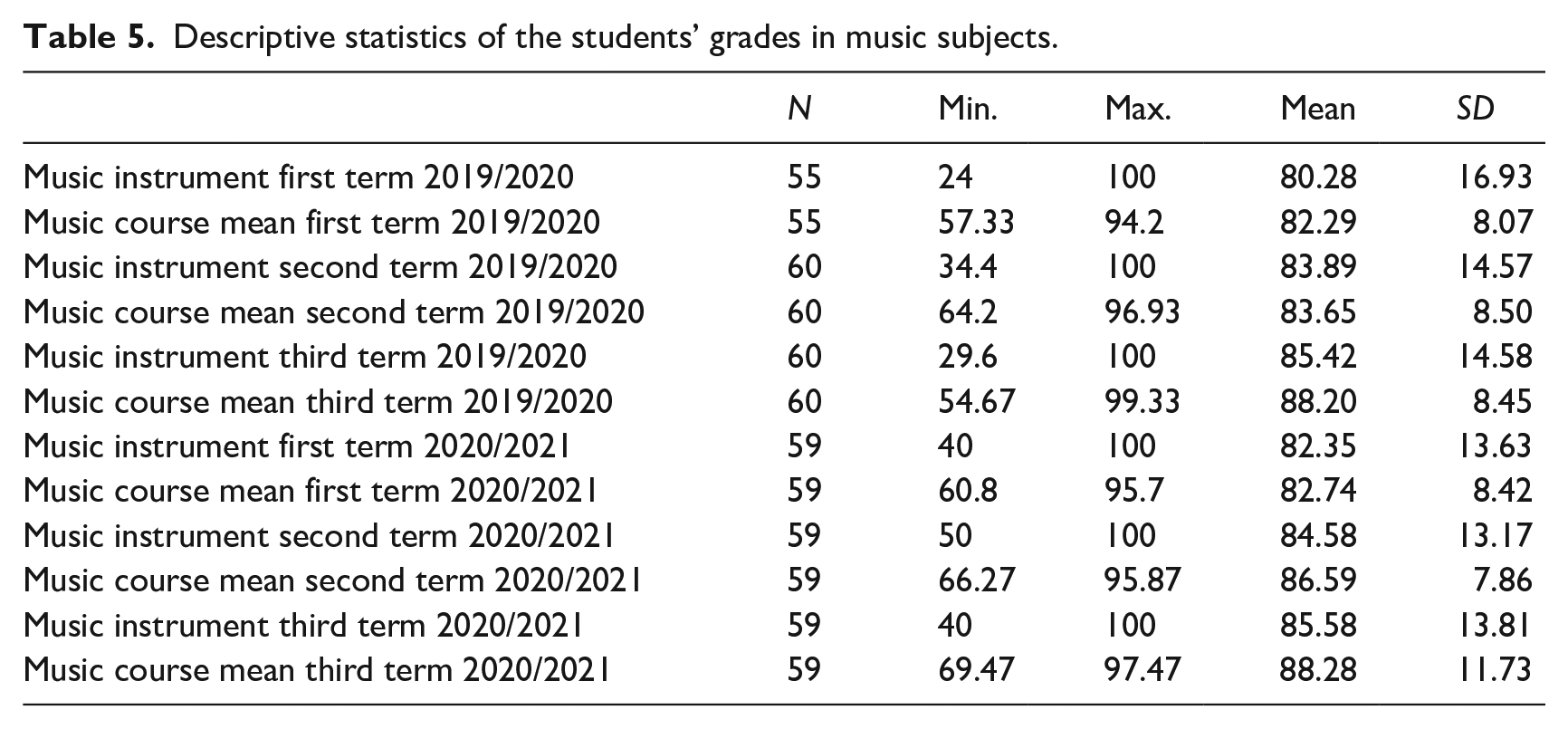
All regressions retrieved non-significant results but two: second term of 2019/2020 instrument grade exponentially transformed variable with children’s questionnaire score (p = .049) and second term of 2019/2020 instrument grade exponentially transformed variable with children’s questionnaire motivation subscale (p = .016). We deemed these results inconclusive because they were isolated and did not represent turning points from which results became significant onwards.
Discussion
The results found by this research team do not confirm the initial hypothesis formulated, namely, that information on motivation and parental support collected prior to the commencement of musical studies could predict subsequent musical achievement. One of the reasons that could explain these results is the fact that the answers given by the 5- and 6-year-old candidates to the elementary level of music conservatoires are unreliable. Traditional self-report instruments, the primary method of choice for assessing emotional and cognitive phenomena, have been discussed as a not well-suited strategy to collect data from children (Dang et al., 2020). Most concerns are related to misinterpretation of the questions being asked, or difficulty recalling memories, or even deliberately intention to hide information (less frequent in children). In general, the concerns to using self-report techniques in this field are related to children’s inability to report perceptions, feelings, or behavior patterns accurately. For this reason, hetero-report instruments (or reports by proxy), applied to parents and teachers, have routinely been preferred over self-reporting (Achenbach & Edelbrock, 1984). Considering this concern and agreeing that self-report instruments remain susceptible to respondents’ biases, this study tried to design and validate a more reliable instrument to be applied to both children and parents during the selection process for a music conservatory. In the same line, Bell (2007) has pointed out to the special care that must be put in the design of instruments to collect information from young respondents and signaled concerns about the quality of the data obtained through these means. An interesting finding of this study was that the information gathered from both the children’s questionnaire and the parents’ questionnaire’ sections on household conditions with items about the familiar musical resources of cultural objects such as books, discs or hi-fi devices did not match, which raised out attention to a situation in which answers were expected to be concordant (r = −.178, p = .174). Understanding this methodological limitation could lead to advances in the design of new instruments to assess children’s psychological aspects. Despite these drawbacks, these measures still have utility when applied to children through a pictorial response scale, especially when the items are presented orally to children, avoiding the impact of reading limitations.
As for the parents, social desirability may have influenced their answers. Although it was made clear that the data collected for this investigation would not be considered for the admission procedure, it may be that parents presented a positive view of themselves and declared intentions of provision of parental support that were not followed by attitudes once their child’s musical studies have commenced. It is important, however, to highlight the significant number of parents who owned their own musical instrument. There is a growing body of research suggesting that the parents’ personal attachment to music is an important factor modeling and influencing their children’s interest to learn how to play a musical instrument (Creech, 2010; Maxwell, 2020).
This investigation was conducted during an atypical moment of modern history: the covid-19 pandemic and the subsequent lockdowns decreed to prevent contagion changed the dynamics of the families. Being forced to stay at home, perhaps parents were able to provide more support than initially anticipated as they stated in the responses to the questionnaire we administered.
Future research could also administer the children’s questionnaire to other samples and probe the adequacy of the chosen solution: it may happen that our attempts to make the answering procedure more appealing to the children by stamping the chosen circle diverted their attention from the question itself and drove their focus to the playful side of the procedure. Future studies must adequately validate this pictorial approach before readministering the instrument introduced by this study.
Another possible reason that may explain our results is the reduced time span in analysis: it may happen that a 2-year time span is not sufficient to capture relationships between motivation and parental support, and musical achievement. It would be interesting to keep following the learning paths of these students and revisit the data after a longer period, for instance, in 6 years’ time, before the transition to secondary level and investigate if motivation and parental support is capable of explain part of their musical success or unsuccess.
Another element that could help understanding these results is the observed fact that music teachers tend to be generous when evaluating students on the elementary level: it was found that the grades awarded variables failed to meet a normal distribution, with a tendency to the higher grades of the scale. Again, it would be interesting to revisit the results when students move to middle school when the levels of demand on practice, exigence or artistic standards raise considerably with the more difficult repertoire students are expected to learn.
