



Abstract
Music, especially singing with others, is a highly emotive experience and has been a core of an early childhood education philosophy that has promoted a social image of the child, where children are portrayed as competent communicators, individuals with rights and members of a community. How children think and learn has been an on-going emphasis of educational research. By unpacking a specific project that centred around the development of a song and musical sharing we explore ideas of project-based learning in the 21st-century. We discuss aspects of child-centred activity and argue that the role of the adults is often prominent, especially in the early stages of designing a project. The context of this study was an early learning centre with arts-based paedagogical practices that included a combination of ideas from the past, children’s own experiences and more recent research. This contribution offers a nuanced look at a project involving a musician/composer, teachers with specialised knowledge and children accustomed to investigating challenging issues like climate change. Music offers a powerful language for adults and children to tackle ‘big’ ideas. It encompasses intellectual, social, cultural and emotional processes which are inherently political and the product of all participants.
Keywords
Introduction
This paper describes a music project conducted in an early learning centre across a 12-month period. Important concepts explored are the importance of the arts in the early childhood curriculum, the role of the adult artist and the pedagogy of project-based learning. Project-based learning has been an educational practice for over a century (Kilpatrick, 1918; Williams, 2017) children’s learning and collaborative investigative projects remains a relevant pedagogy to educational practice. The project described here is firmly grounded in 21st century ideas that have their antecedents in beliefs about children’s communicative competence, rights and the role of the arts in children’s learning.
How children think and learn has been an on-going emphasis of educational research (White, 2020; Wood, 1998) and the notion of ‘learning by doing’ has been practised in various guises across the centuries from Socrates and Confucius (You, 2020) to Dewey (1938), the scholars of Reggio Emilia (Chicken, 2022; Stone, 2012) and American researchers influenced by Dewey (Beneke et al., 2019). By unpacking a specific music project, conducted recently, we explore ideas of the prominence of music in early childhood and the potential of project-based learning. The aim of the paper is to provide a musical exemplar of children’s engagement with a range of musical activities based on shared experience with adults with musical expertise. Adults as more competent members of the culture can play a leading role in helping children use the language and tools of music. The children appropriate concepts and skills of music in order to engage and communicate with different elements of the medium (Nyland et al., 2015). We explore some aspects of beliefs about child-centred activity in order to argue the significance of the child/teacher relationship and that teacher centred guidance is crucial when assessing the roles that adults can play in children’s learning. In describing a project based on children’s interests and initially designed by the adults we are exploring the collaborative nature of learning in the context of a project which we differentiate from child-initiated play.
We situate the use of musical technologies in early childhood as significant symbolic languages and expressions of culture.
The centre where the research was conducted has a strong emphasis on the natural world in relation to the global context and the impact of human activity. Staff explore influences that strengthen children’s relationship with nature (Palmer, 1998). They are aware of recent post human research (Ritchie, 2015) and the challenges of the 21st century. Humans face different challenges, such as climate change, than previous generations and this has been a motivation in the choice of arts projects undertaken. Projects have included the children’s relationship with the Yarra River as well as responding to international themes like the Antarctic, Biodiversity and the International Year of Forests (Acker et al., 2022). To learn about how the world works is an important part of project-based learning (Beneke et al., 2019).
The director of the programme likes to talk of ‘lifeworthy learning’. Lifeworthy learning involves the examination of ‘big ideas’. For this project the focus of the black swan fell into this category of ‘big ideas’ (Deans, 2021). The bird is a native of Australia and has a special place in Aboriginal song lines, settler folklore, children’s literature and our present ecology. Such a contextual span gives children and adults, an opportunity to gain understandings of the past and positive attitudes to nature and sustainability. The rich topic of the black swan was encompassing and had the potential to be a theme that could highlight associations between existing knowledge and social relationships, as well as providing a link to a wider world of beauty, intercultural experience and responsibility for the future.
The paper is divided into four sections. In the literature review, we discuss the continuing relevance of the project approach, the importance of music as a human activity, a cultural artefact and a language that gives children and adults a tool to co-construct knowledge. Music is a language that lends itself to the exploration of ‘big ideas’ as it supports expression that is intuitive, conceptual and experimental (Acker et al., 2022). Methodology and methods are described. In the third section examples of adult and children’s musical thinking and experiences from the project are shared. The concluding discussion identifies the importance of music as a language of thinking, shared experience and a situation of rich cultural participation. The research addressed the following questions:
What were the benefits of adopting a project-based approach to the Black Swan project?
How did the children’s interest in the Black Swan project enhance this experience and influence practice?
How does the adult with specialist music knowledge incorporate their expertise in a project to enhance children’s learning?
Literature review
The role of music in early childhood education has always been recognised as an important part of the curriculum (Acker et al., 2022; Levinowitz, 1998; Niland, 2015). Music research in early childhood has started examining the value of in-depth musical projects to promote the language of music and to enhance children’s knowledge of other aspects of their lives as they engage in musical expression (Vidas et al., 2018). Music lends itself to emotional expression and in the project about a black swan, the focus of this paper, the children’s responses to the natural world have been observed and recorded (The Musikgarten, 2019). Within the project there is a layering of musical and associated languages as the children have an affective and cultural response to the subject. Reilly (2014), a visual artist provides a description of working with children across time through conversations and a layered process that gradually builds towards an outcome. The relationship between music expressed as symbolic languages and as a cultural artefact (Acker and Nyland, 2020; Mariotti, 2009) is significant to this project. The purpose of the Black Swan was to observe children’s expressed interests and for the adults to guide an instrumental activity where musical signs and symbols would be developed within social interactions within the group (Rogoff, 2003). This was an exercise in meaning-making where an invited musician/composer, teachers and children sought to explore their ideas of the swan by exploiting existing understandings that provided the flow of the moment (Ciksentmihalyi, 1990). Use of musical symbols and signs led to competence and new knowledge.
The swan is a cultural artefact while the use of musical languages (tools) within this culture became important for the collaborative co-construction of knowledge (Vygotsky, 1978). This sets up what Vygotsky (1962) termed a dialectical method and we can see an example played out in the range of expressive activities that shaped a collective aim and intentional action guided by the adult members of the culture (Nuttall, 2003). These elements of collective action are consistent to the concept of project-based learning (Williams, 2017).
A project is based on children’s interests and often, through intentional scaffolding, the adults will guide the children’s preferences, so the interest pursued is meaningful and has the potential for in-depth exploration and learning (Beneke et al., 2019; Nuttall, 2003). For this project, the children created narratives around a number of river birds and a nearby river using different art forms to express their ideas. The river birds were part of the central theme of sustainability and the importance of the natural world that the early learning centre adopted as part of its ongoing practice. The black swan became the focus of interest and the movement, music and poetry that ensued was an adventure for all.
With a project it is accepted that there will be an aim, or outcome (Williams, 2017). In this case, the musician intended to work with the children, share their interest in the swan and produce a song. This happened and the children’s embrace of the topic and the song led to many quality outcomes. Their images and stories about swans, the singing and interpreting of the song, a child’s dance of the swan song, led to the dance becoming a collective performance. These events indicated the excitement the swan evoked as a focus for a project (Acker et al., 2022). A collaborative learning cycle was established around a unifying element and the language of exploration was that of music and associated expression like the children’s drawings (Hanna, 2014).
The black swan falls into a special category for the focus of this project. We have labelled it a ‘big idea’ (Deans, 2021). The swan is a larger-than-life creature that captures the imagination. For children, the pre-school age is when imaginative play is at its peak (Vygotsky, 2004) and children can develop intense interests in particular topics. The interest in the black swan had cultural importance for the adults and children and is significant in Australian history, Aboriginal legends (Haworth, 2021), song lines (Fuller, 2020) and European Australian folklore (Paterson, 1893). The swan was a shared interest to both adults and children. his was not a child-centred endeavour to begin as it was an adult initiated project with adults taking both leading and guiding roles throughout. The stories of the swan and the children and adult’s awareness of the creature can be viewed as a tool of semiotic mediation (Mariotti, 2009), an artefact that can be exploited through tool use, in this case musical symbols to construct musical understanding.
Methodology
This research was qualitative with a variety of observation methods used. These included audio and visual recordings of group sessions, teaching notes that provide information on teacher intentions and discoveries as well as children’s comments and drawings that provided a picture of changing musical knowledge. The theoretical framework was a socio-cultural approach based on the work of Vygotsky (1978). We recorded the visiting musician/composer’s interactions with a group of children and interpreted them in terms of the social context for exploring and learning about music that was established. Hausfather (1996) identifies three themes for the creation of a social context where active learning can be observed. The context included the physical space, the familiarity of the gallery and interactions between the children and the musician. Haus father’s three themes relate to (1) observing children’s growing knowledge of musical concepts; (2) observing how the visiting artist creates social activity through collective discussion and (3) the way children’s understanding of music composition and performance is mediated by tools and signs that involve activities like writing music scores or have sound conversations without words. All of these occurred. Data were used to provide a view of the children’s experience of the black swan song. Through this lens we show the relationships with the music and the ideas that were constructed through this joint action (Rogoff, 2003).
The observations and most of the musical activities that were the focus of this research were conducted in two special spaces: one was a studio (Hanna, 2014) and the second an outdoor natural space where children encountered birdlife, native flora, fauna and a river. The project was conducted across a 12 month period. Protagonists were the musician/composer, specialist and generalist teachers and three-to-five-year-old children. We explicate the role of the adult, especially the musician/composer through his relationship with the children and the process by which expressions of the black swan were combined. There was a synergy that helped us assess the roles that adults and teachers can play in project-based learning (Donegan-Ritter et al., 2022). Music was the expressive, symbolic language that gave a voice to both adults and children. Data consisted of observations, video and audio recordings, children’s drawings and comments, teachers’ records and the song, The Black Swan, was composed by the visiting musician with lyrics by four of the children. A dance of the swan song was created by one child and choreographed for all the children.
Of particular usefulness in this research were video recordings that led to much revisiting and sharing across different audiences (Tobin et al., 1989, 2009). Video as a method of research has been used in sociology, anthropology, psychology and alike, where each discipline strives to analyse the theoretical and practical advantages of video as well as acknowledging limitations (Jewitt, 2012). In early childhood education and research, video has gained a prominent place as digital media has become increasingly accessible, easy to use and inexpensive. It is useful for supporting an exploratory research design that involves participants, observers and third-party commentary (i.e. Acker and Nyland, 2020; Acker et al., 2022; Beeli-Zimmermann et al., 2020). Video and audio recordings can re-awaken the memories and experiences of a researcher or participant (White, 2020). Various cycles of analysis, when revisiting such material can strengthen the likelihood of generating strong findings that are both reliable and valid (Jewitt, 2012). Video and audio recordings have been a privileged approach for noting our observations during this research and proved a practical method of data collection given the length of time of the project, the number of players and at least two physical settings. Other methods were also combined, and children’s comments and drawings have been important tools for theoretical reflection.
Using a variety of data collection techniques has allowed for multiple ways of viewing information. Videos have utility for revisiting and sharing with others, Audio is more concentrated on the sound itself and there are less distractions if it is used for self-assessment or revisiting. Paper-and-pencil has an immediacy that supports recollection. The musical emphasis the children choose when relating their experiences are invaluable. In this project the children sang, wrote music notation, played instruments, drew musical ideas or participants performing music and spoke of their impressions. We have explored the learning which takes place on two related levels – what and how individuals learn as they interact with each other over time; and the learning that occurs at the system level, that is, changes in how a group of viewers use and learn from joint experiences over time.
At the centre of the research was the notion of semiotic mediation (Vygotsky, 1978) which helped us interpret our data to observe the co-construction of musical knowledge through social interaction. Of significance was that the adult was a more competent member of this musical community and was able to share and even exploit, the musical artefacts and signs that are the basis of the social exchange described (Mariotti, 2009). In the next section we describe aspects of the project that outlines the adult’ role and the part this played in creating individual understanding of shared languages and created the potential for both individual and group action.
The Black Swan: An early childhood music project
This description of the Black Swan project is embedded in a frame that identifies the adults’ role in the learning process as one that promotes long term results and understandings which is a major aim of project-based learning and teaching. Starting with the composer/musician, we unpack the endeavour as a didactical cycle (Mariotti, 2009). The context is the children’s appreciation and knowledge of nearby river birds. The black swan is a cultural artefact in this context. The signs and symbols of music are the language/s used to co-construct knowledge through activity.
The cycle starts with collective discussion between centre staff and an invitation to the composer/musician to share his musical insights with the children in the context of the bird project. This collective discussion continued as Stephen Leek visited the children and they explored musical language and experimented with the swan as a cultural artefact that could be expressed in words, musical sounds, notation and drawings. The second part of the cycle was the composing of the song by the musician and the writing of the lyrics by the children. Vygotsky (1978) views such action as instrumental and in this case the activity indicated the strength of the swan as an artefact. The swan provided a meaning-making element that brought all participants together to create the shared activities of the project Figure 1. When one child performed a dance to the music and words of the song the adults choreographed the dance and it became a group action. The adults and the children had combined to explore the potential of the artefact for personal and musical meaning and these meanings were consolidated through words, drawings, movement, singing and a performance. The composing of the music and the choreographing of the performance were adult-guided shared activities. This project has implications for the role of artefacts in the construction of knowledge, the role of dialogue to establish collective purpose and the role of the adult in promoting the co-construction of knowledge in a social environment while also enhancing individual understanding.
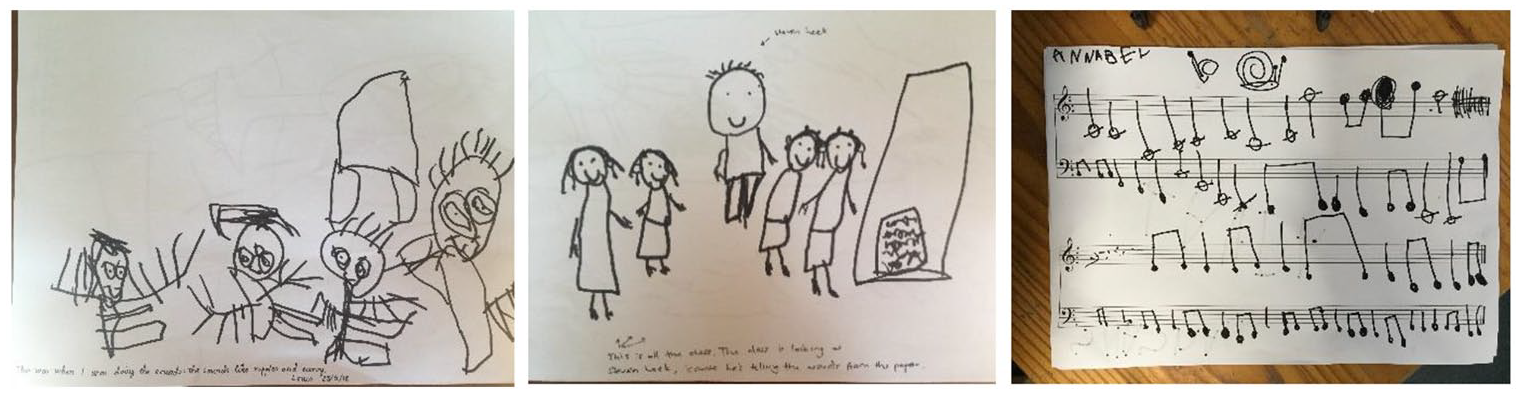
Examples of the group engaging with musical concepts with Stephen Leek.
The adults in the centre have a history of integrating signs and symbols into activities as tools. The centre employs artists with specific skills and there is an ongoing music programme conducted by a music specialist. Other staff members work with specialist staff to embed the arts programmes across daily activities. They are skilled in exploiting artefacts as semiotic mediation to encourage, through expressive languages, children’s participation, developing competence and understanding. The composer, Stephen Leek, was invited into the centre to spearhead a venture that would be musical in nature and would draw on previous explorations of the birdlife at a nearby river (Acker et al., 2022). This initial step meant the adults were guiding the children through intentional action.
Stephen Leek started the cycle by engaging in collective discussions with the children. He showed them musical notation; when children wrote their own musical notes, he asked if they wanted to play them on the piano. Stephen engaged in musical conversations that consisted of sounds without words. He set examples of inclusion by inviting children who seemed to have trouble participating to actively help him. Finally, the musical activities became more focussed on the birds. Bird sounds, wings, flight patterns and colours became a source of conversation and discovery.
Presentation of the data
In the children’s drawings above we can see their engagement with the musical ideas discussed. They made the sounds of birds, Stephen discussed the written form of music and Annabelle indicates she was a keen observer of the way notes and stave lines fit together. With Stephen, these children were developing a musical vocabulary as tools to use as they started to explore the black swan as a creature of nature and as an artefact.
The second part of the cycle consisted of the writing of the song of the black swan. In this collaboration, Stephen composed the music while a group of four children wrote the lyrics. The relationship between the lyrics and the music was a close fit as the symmetry in the words supported the symmetry in the music. Kempf (1996) comments on the importance of symmetry in music saying it relies on specific aspects of repetition as well as contrast through a mirror effect. Repetition is built into the song through the verse and chorus formation as well as within each part of the song.
Below (Figure 2) there are examples of selected drawings of the black swan. In these drawings we can see how the adults have guided the children’s interests into singing about the swan and the synergy that has been achieved with the words and music. The children have then incorporated their individual ideas.
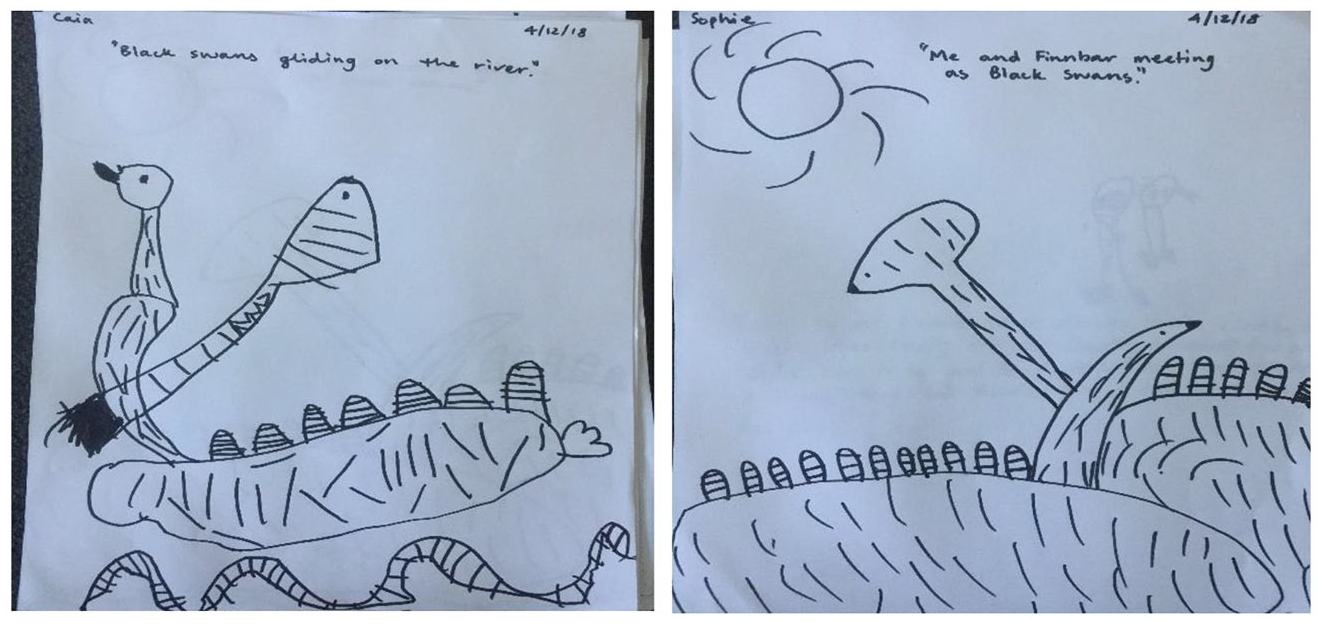
Children’s drawings of black swans.
The first picture emphasises the movement of the words of the music and the words, bringing the two systems together to celebrate the one idea. The second picture moves beyond this understanding of the relationship of the signs and symbols of the swan into the land of the imagination. Here the child, Sophie, has expressed the idea of her and a friend, Finbar, meeting as two black swans. This takes the project into the world of the mystical and surpasses the concept of collaboration. The purposeful actions of the adults have led to Sophie’s story making as she has constructed her own reality to share with the group. This is an example of higher-order sense-making (Vygotsky, 1978).
In the third part of the dialectical cycle the musical discourse reached another level. A child, Aria, decided to design a dance of the black swan (Acker et al., 2022). She practised the moves and performed for the children and staff. This was choreographed by staff and performed for parents at a concert. The initiative was undertaken by a child and adopted by adult’s and designed as a joint activity. Aria’s personal sense of the black swan was shared. The swan, as a semiotic mediator, has shown that the chosen topic had great potential; the role of participants enabled personal musical understandings to develop and musical meaning to be shared through a variety of external representations of the swan, music, words, written composition, instruments, singing, drawing and dance. These representations were captured through photographs, recordings (aural and visual), children’s drawings, performances and children’s play.
Technology, as a symbolic language, has been a significant method for enhancing observations, preserving musical moments and a source of music to widen existing ideas and use of musical devices for emotional expression and memory. Learning in this project was driven by both adults and the children, at different times, and grounded in cultural and community life experience. Since Williams (2017) published The Project Method in 1918 the possibilities that joint activity presents as a social and intellectual learning tool has been a focus of research (). This music project promoted children’s musical learning by providing an example of adults with specialist musical expertise who were able to work collaboratively with children in reciprocal exchange to enhance knowledge of musical languages at a personal and group level. We conclude the description of the project with two observations of the adults and children engaging in singing as a group activity.
These observations are an example of using different technologies for recording events. We present descriptions of group singing during this project. The first description is taken from a videorecording and the second of an audio recording. As this paper has highlighted the adult role in collaborative project activity, our comments focus on the role of the adults.
Observation 1 (Video recording)
A music session with the three-to-five-year-old group, music specialist and preschool teacher. The children and the educators are practicing the first Black Swan song. The children are standing in choir formation in two rows. The music specialist is singing and conducting. The preschool teacher is also singing along. Both adult voices are clear. Some of the children are moving to the beat of the music while others respond more to the rhythm of the words. All appear engaged, looking forward, some swaying, one imitating the conductor. The dynamic of the piece is guided by the music specialist who is encouraging the children to notice the contrast between the loud and soft parts. The first three lines are moderately loud, the chorus is loud and the ‘oohs’ are delicate. The children respond to this invitation as their unison voices alternate from quiet to louder. As the last phrase is repeated, one of the boys raises his voice to fortissimo and energetically joins in conducting. The music specialist is leading the song, the early childhood teacher is singing (an octave lower) and one can distinctly hear that some of the children’s singing is tuneful, others’ have oscillating pitch. All children are keeping up with the rhythm, tempo and the character of the song.
Observation 2 (Audio recording)
The recording starts with the piano introducing the piece. The music specialist conducts; she and the room teacher can be heard singing as the song starts. The children have waited quietly and now join in at the appropriate time, presumably when the conductor indicates. They are responsive to this direction. The initial singing is quiet and the piano dominates throughout the rendition of the first verse dictating timing, rhythm and phrasing. The adult voices can be clearly heard for the first verse. Some children are having rhythmic problems, indicated by stopping and starting and generally singing softly and there is a lack of confidence in the sound. When they reach the ‘oos’ in the chorus the singing is sweeter, and the tune held more confidently. The verse is repeated, and the singing becomes louder. The adults have indicated to the children that they should adjust the dynamics. This is achieved by the adults’ voices becoming very quiet and less dominant in this second rendition of the verse. Now the children can clearly be heard singing against the piano.
Comment
As to be expected there is different information to be gained from watching the video and listening to the audio recording. In observation 1 levels of engagement with adult guidance can be seen through body language, the line of regard and response to the conducting.
The second observation featuring piano means that the children’s musical interpretations cannot be easily heard. This is a soft song and the singing becomes harsher when the children are asked to sing loudly. This use of dynamics suggests the children are aware of the gentleness of the song and can respond to changes but are hampered by the accompaniment.
These observations indicate that the children are familiar with this music of Stephen Leek, having explored the songs in-depth throughout the project. Each group are competent performers for the preschool years. The variation in adult guidance, acapella singing with a conductor in the first instance and the piano in the second, provides different information about types of engagement and musical exploration. In both recordings the adults lead a group activity with different tools and levels of musical dominance. We hear the children singing, making mistakes and physically participating in the first observation. In the second we gain information on the children trying to match their singing to a dominant accompaniment. The video is more comprehensive as a record but observation 2 is indicative of the children’s group action with a difficult task.
Discussion
This paper contributes to early childhood discussions about project-based learning, children and music in three ways. We argue that the role of the adult changes during the project and does not always support child-centred exploration. Second, music as a language in early childhood plays a central role in semiotic mediation and third, the choice of the focus of projects is significant. We asked:
What were the benefits of adopting a project-based approach to the Black Swan project?
How did the children’s interest in the Black Swan project enhance this experience and influence practice?
How does the adult with specialist music knowledge incorporate their expertise in a project to enhance children’s learning?
To answer these questions, we have revisited the notion of project-based learning, have observed how the adults inspire the children’s interest in the black swan, which led to exciting outcomes. We have observed the role of the musician to illustrate how roles differed across the cycles of this project.
The first question we have addressed by arguing for music to have a more foundational role as a language in early childhood education. This emphasis is based on the idea that for learning to be a transformative experience, language, in this case music, is used to promote collaboration, communication and creativity. Vygotsky (1962) considered that language learning and other tool and sign systems were only part of higher mental processes like problem solving, logical memory and voluntary attention. He used language, spoken and written as an example. Such an approach is suitable for project-based learning and is evidenced by the outcomes documented. In this project the children were able to appropriate the language of music in multiple forms. They were introduced to concepts in the social setting and could internalise their experiences to give their musical activities both individual and group meaning. The music provided the adults and children with tools that could be transformed into reflective signs. Of music in the early years Trevarthen (1999) has said: Gestural mimesis and rhythmic narrative expression of purposes and images of awareness, regulated by, and regulating, dynamic emotional processes, form the foundations of human intersubjectivity, and of musicality. Acquired musical skill and the conventions of musical culture are animated from this core process in the human mind (p.155).
Our second question concerns the idea that the choice of projects that can be identified as lifeworthy. This is important in a time of climate change. Ritchie (2015) suggests that early childhood staff have an ethical responsibility to confront issues like climate change and environmental degradation with children and families. She sees this as critical pedagogy and argues that localised programmes can help children engage with their community. They have the opportunity to develop a connection with local history and the surrounding ecology. The commitment displayed by the adults and children in the Black Swan project is indicative of a group who have a sense of their space culturally, socially and politically. That over the years these children have explored the river meant that this familiarity added sophistication to their discoveries. This was an in-depth investigation into known territory with endless possibilities. The adults were able to exploit existing relationships to take turns in guiding children and observing the children’s competence when their strong interest and enthusiasm led to results like Aria’s dance. The adults could then move in and assist in this becoming a shared experience and a performance with all the rigour required. Such movements between adult expertise, adult-led and child centred actions refined the outcomes of this part of the project.
In relation to the third question we have described the role of the musician/composer and how he was able to mentor both children and staff through his own knowledge and history. Stephen Leek, as expert, initially assumed a didactic position although the strategies he used were child-friendly. He concentrated on meeting the children at a crossroad between their present interests and knowledge and providing tools to enhance their involvement in the project. Hence, Stephen conducted group games about musical conversations, introduced the idea of a musical score and shared enjoyment of participating in group singing. The staff at the centre were skilled in observational and reflective practices as well as having musical expertise. They were familiar with the history and the culture of the centre so were able to plan a long-term project. The children’s participation and construction of knowledge initially came from the instrumental activity of the adults. The use of the swan as a meaning-making device was originally chosen by the adults. The adult’s actions were collaborative, carefully designed and reflective. Their sense of purpose was an essential element of making the children’s contributions to the project competent and imaginative.
If early childhood programmes and activities can be transformative then the choice of focus for project-based learning is significant. The children can engage with ideas and activities that promote dispositions of taking an interest, being involved, persisting with difficult ideas, expressing a point of view, taking responsibility and empathy for self and others (Carr, 2001). Such an approach also encourages higher order thinking, including analysing, predicting and hypothesising (Beneke et al., 2019). The choice of the black swan was an act of advocacy and provided for meaningful musical expression in the children’s lives. The shared language of music made it possible for the adults and children in this project to collaborate, listen and influence each other.
Music is a human activity, a language, that can be a tool for semiotic mediation in the co-construction of knowledge (Vygotsky, 1978). Of significance is the idea that music is a meaning-making activity and a fundamental part of early learning. The cycle of the project gives direction to an appreciation of purposive knowledge growth. This project is an example of the importance of music in the early childhood curriculum and how project-based learning provides an environment where all participants benefit.
