




Abstract
Within an Orff-based program implemented in Israel, this mixed-methods study examined the effects of age on emerging rhythmic literacy in children. Participants (N = 132) were kindergarteners (n = 45) and first-graders (n = 87) aged 4 to 7.8 years. The participants performed a rhythm entitled “Rhythm-A” through the body and instrumental percussion and then were required to create a self-invented notation of the rhythm. A one-session literacy intervention program, based on teaching standard rhythm notation, followed with randomly selected first-graders (n = 44). Its purpose was to investigate the effect of standard notation instruction on children’s ability to notate Rhythm-A. Results indicated (1) a significant age effect on children’s emergent rhythmic literacy and (2) a significant effect of a one-session literacy intervention program on participants’ post-intervention notations. The study has relevance to research on Orff-based music education and music literacy.
Keywords
Within an Orff-based program for young children implemented in Israel, this study explored (1) the effect of age on children’s emergent rhythmic literacy and (2) the effect of a one-session intervention of standard notation instruction on children’s rhythmic symbolization.
This study of emergent literacy and standard notation instruction demonstrates the links between informal music development and formal music teaching by identifying the significance of each and incorporating them both into an educational program and research. Rather than treating informal rhythmic literacy development and formal literacy learning as distinct aspects, this study views them as milestones along a continuum. It is consistent with previous studies that advocate both informal learning opportunities and formal notation for young children’s music education (e.g. Andang’o, 2019; Folkestad, 2006; Hess, 2020).
Three topics pertinent to this investigation are discussed in the literature survey: (1) Defining Orff-Schulwerk; (2) Research studies on Orff-based education; (3) Studies on rhythm symbolization abilities.
Defining Orff-Schulwerk
Orff-Schulwerk (OS) was founded in Germany by Carl Orff (1895–1982) and his former student Gunild Keetman (1904–1990) and has been exemplified through their published volumes (Keetman, 1985; Orff & Keetman, 1982). There is, however, some difficulty in defining the term “Orff education.” According to some authors, adherence to the original materials and principles of the OS is strongly recommended (e.g. Sangiorgio, 2007), while many others prompt interpretations of the original materials, criticizing the standardization of the original OS (Benedict, 2009; Frazee, 2006; Locke, 2016; Lu, 2006; Nykrin, 2011; Shamrock, 1997; Thresher, 1964; Yue, 2018). It is Orff (2011) himself who encouraged flexibility and independence rather than adherence to his OS textbooks: “Every phase of the Schulwerk will provide stimulation for new independent growth; therefore it is never conclusive and settled, but always developing, always growing, always flowing” (p. 134). Using the widely-cited metaphor of the “wildflower,” Orff illustrated the diversity of adaptations. Writers employed additional descriptions and metaphors to convey diversity, such as seeds and flowers (De Quadros, 2000; Robbins, 1994), a big umbrella (Lu, 2006; Shamrock, 1997; Yue, 2018), an open pedagogy (Haselbach & Hartmann, 2013), an open model (Campbell & Scott-Kassner, 1995; Frazee, 2006; Shamrock, 1988; Siemens, 1969; Thresher, 1964) “an idea” (Shamrock, 1995, p. 32) and “a wide range of activities” (Wilson, 1956, p. 174). In this vein, the methodology used in this study can be described as a free-improvised Orff-based approach.
Research studies on Orff-based education
The impact of Orff-based programs on musical achievement and/or mental growth of young learners has attracted wide research attention. (e.g. Arslan, 2009; Hensley, 1981; Rohwer, 1998; Siemens, 1969; Yue, 2018; Yun & Kim, 2013). Data was often based on experimental Orff and non-Orff programs compared against each other. There is a discrepancy in the results. On the one hand, the Orff programs have been found to have positive effects on kindergarten children (Yue, 2018; Zachopoulou et al., 2003) and school-aged students (Arslan, 2009; Cunha & Carvalho, 2011; Hensley, 1981; Siemens, 1969; Yun & Kim, 2013). Hensley (1981), for example, indicated that fourth- and fifth-grade Orff learners improved melodic and instrumental recognition measured through the Music Achievement Test Series developed by Colwell (1970), Zachopoulou et al. (2003) demonstrated that kindergarten children’s rhythmic abilities improved through Orff lessons. On the other hand, studies indicated no significant differences between experimental Orff and control non-Orff groups, nor higher musical achievements through Orff teaching (e.g. Rohwer, 1998; Siemens, 1969). Siemens (1969), for example, found that a control group of fifth-graders performed better on Knuth Achievement Test in Music (Knuth, 1936) than Orff students.
There were also inconsistencies in the results of the trans-cultural studies conducted in many geographical regions: UK (Hensley, 1981), Canada (Hall, 1992), Japan, Taiwan, and Thailand (Shamrock, 1988, 1995), Japan (Takizawa, 2000), Turkey (Arslan, 2009), Portugal (Cunha & Carvalho, 2011), Australia (Southcott & Cosaitis, 2012), North America (Frazee & Wang, 2013), Latin America (Frega, 2013), South Korea (Yun & Kim, 2013), South Africa (Mason, 2013), New Zealand (Locke, 2016), and China (Lu, 2006; Yue, 2018). Some Orff programs have been found to have positive effects on children of various European and non-European cultures. For example, migrant preschoolers from suburban Shanghai, China, improved their social and emotional competencies (Yue, 2018); Children from low-income families in South Korea improved social skills and emotional regulation (Yun & Kim, 2013); Portuguese students displayed higher levels of happiness and satisfaction (Cunha & Carvalho, 2011). Some researchers, however, have argued that OS is inappropriate for their cultures, as evidenced by their respective studies (Frega, 2013; Thresher, 1964). Frega (2013), for example, was against the adaptation of OS in Latin America on the grounds of musical inappropriateness in terms of scales and the failure to include local instruments; Thresher (1964) questioned the advisability of restricting children from different cultures to the pentatonic scale that Orff found particularly well suited for children.
Studies on Orff training for professional music teachers (Locke, 2016; Robbins, 1994; Sogin & Wang, 2008) demonstrated both positive outcomes and drawbacks. Locke (2016), for example, indicated that professional Orff learning yielded significant sources of self-efficacy for music teachers in New Zealand. Yet several North American music teachers in Robbins’s (1994) study raised the issue of a lack of time for information processing and meaning building within the Orff program.
The question is what accounts for the discrepancy between studies concerning Orff-based education. One of the causes is the diversity and open-endedness of the Orff-based programs; different seeds yield different research programs and necessarily different research findings, as do different experimental settings and research methodologies. Since the results of Orff-based studies are inconsistent, one cannot draw inductive conclusions regarding the effectiveness of Orff-based education for children across cultures or music teachers.
The present study was conducted within the framework of an Orff-based program implemented in Israel, where primary schools are not obliged to include music in their curricula, nor is Orff music education widely practiced in primary schools (Elkoshi, 1996). As far as is known, this study explored for the first time the effect of age and literacy instruction on children’s rhythmic symbolization within an Orff-based program conducted in Israel.
Studies on rhythm symbolization abilities
The ability of young children to symbolize rhythm has attracted wide research attention (Adachi & Bradshaw, 1995; Elkoshi, 2002; Bamberger, 1980, 1991; Davidson & Colley, 1987; Goodnow, 1971; Hildebrandt, 1987; Smith, 1983).
Inspired by Piaget’s theory, developmental typologies were suggested indicating progressions from earliest scribbles of physical actions, through “symbolic” representations of rhythmic sounds, to mature stages of sophisticated notations, controlled by perspectives of Western Standard Notation (e.g. Bamberger, 1991; Hildebrandt, 1987). However, subsequent studies challenged the Piagetian approach, proving that (1) rhythmic literacy is the product of complex interactions rather than linear growth; (2) children move back and forth between notational strategies rather than progressively through stages (Smith et al., 1994); (3) notational strategies are accumulative rather than hierarchical; and (4) early notational strategies endure in children’s work during later years (Barrett, 1997).
Another direction of inquiry, though relatively scarce, focused on children’s rhythmic decoding, namely their ability to tap out rhythms from invented symbols generated by the researcher. In Stambak’s (1951) study, children tapped out sets of dots with various space intervals between them. The finding showed a developmental progression in children’s understanding of the correspondence between spatial and temporal intervals.
Other studies considered the effect of music training on rhythmic literacy (e.g. Elkoshi, 2004; Domer & Gromko, 1996). After 12 weeks of training, Domer and Gromko (1996) discovered qualitative changes in preschoolers’ invented notations. Children moved from scribbles, not yet associated with sound, to lines that accounted for regular pulsation and rhythmic durations, up to drawings that accounted for the rhythm and melodic contour of a musical stimulus.
A growing emphasis on multifaceted elicitation tasks is evident in recent studies (e.g. Elkoshi, 2002; Burton, 2017). To explore children’s development of rhythmic literacy, Burton (2017) involved children 5 to 8 years old in various activities, such as listening, singing, moving, chanting, and playing instruments. School children in Elkoshi’s (2002) study represented a rhythm that had been first introduced through drumming (fragmental task) and later through listening to a musical piece that contained that rhythm (contextual task). To enrich the children’s experience before the notational task, Burton (2017) told rhythmic stories to 5 to 8 year-olds with a puppet that functioned as a teaching assistant.
The children in this study were also engaged in multifaceted activities, including audiation-based activities, such as body percussion and drumming, and literacy activities of recording and decoding invented notations. This nexus of an Orff-based oral program with the literacy-based audio-graphic components aimed to enrich the children’s multi-sensory (auditory-kinesthetic and visual-tactile) experiences. An Orff-based program strengthens the skills of creating sounds and listening to sounds (e.g. Hall, 1960; Keetman, 1985; Orff & Keetman, 1982), while audio-graphic tasks enhance the ability to record and decode these sounds (e.g. Bamberger, 1991; Hildebrandt, 1987). In addition, the inclusion of audio-graphic activities in an Orff-based program exemplifies the possibilities inherent in a flexible implementation of Orff’s pedagogy.
Purpose of the study and research questions
The general purpose of this study was two-fold: (1) to investigate the effect of age on children’s emerging rhythmic literacy within an Orff-based program, and (2) to investigate the effect of teaching rhythm notation on first-graders ability to notate a rhythm. Two specific related research questions guided the research: (1) What is the effect of age on kindergarteners’ and first graders’ ability to notate a given rhythm named Rhythm-A? (2) What is the effect of one literacy intervention session on first-graders ability to notate Rhythm-A?
Method
Participants
The participants (N = 132) were of two age groups: preschoolers (n = 45, 18 boys; aged 4.0–6.5) from two kindergartens (n = 31, 14) in central and northern Israel, and first-graders (n = 87, 48 boys; aged 6.0–7.6) from three classes (n = 30, 28, 29) in one public school in central Israel.
Participant’s music learning
As the music teacher in the research sites, the author provided the only formal music education through the Orff-based program. As for “non-formal music education” (Andang’o, 2019), it turned out that only one first-grader started private organ lessons.
The researcher
The author, as the teacher-researcher, is a music educator trained in Orff pedagogy in the United States and Austria. Orff’s pedagogy has deeply influenced the author’s pedagogical practices. The researcher collected and analyzed the data.
Ethical considerations
The study has been approved by an institutional review committee affiliated with the Israeli Ministry of Education, Culture, and Sports. The kindergarten and school principals granted permission for the study and approved photographs and videos taken by the classroom teachers who attended the program. Using the drawings in this report was granted written consent by the children’s parents. Pseudonyms are used in this report to ensure children’s confidentiality.
Procedure
The study, designed as mixed-methods research (See “Type of the Study” below), consisted of two-phase experiments: phase one with kindergarteners and first-graders examined children’s emerging rhythmic literacy; phase two with a cohort of first-graders examined the effect of literacy intervention on rhythmic representation.
Phase one
Two kindergarten and three first-grade classes received a 50-minute Orff session each. (Five meetings in total.) Each session consisted of four segments: (1) introducing a rhythm through body percussion; (2) playing the rhythm on bongo drums and unpitched percussion instruments; (3) creating self-invented notations that represent the rhythm (audio-graphic activity) 1 and (4) decoding and reflection interviews with individual participants.
Introducing a rhythm through body percussion
The experimenter introduced a rhythm entitled Rhythm-A, which is a 4/4 bar composed of six quavers and one crotchet. Rhythm-A was demonstrated through quavers-knee-slamming (Patchen) and crochet-hand-clapping synchronized with the following chanting text: “pat-chen, pat-chen, pat-chen, clap” [Hebrew: Re-gel, Re-gel, Re-gel, Yad). (Figure 1, first system). The children were asked to replicate the experimenter’s demonstration.
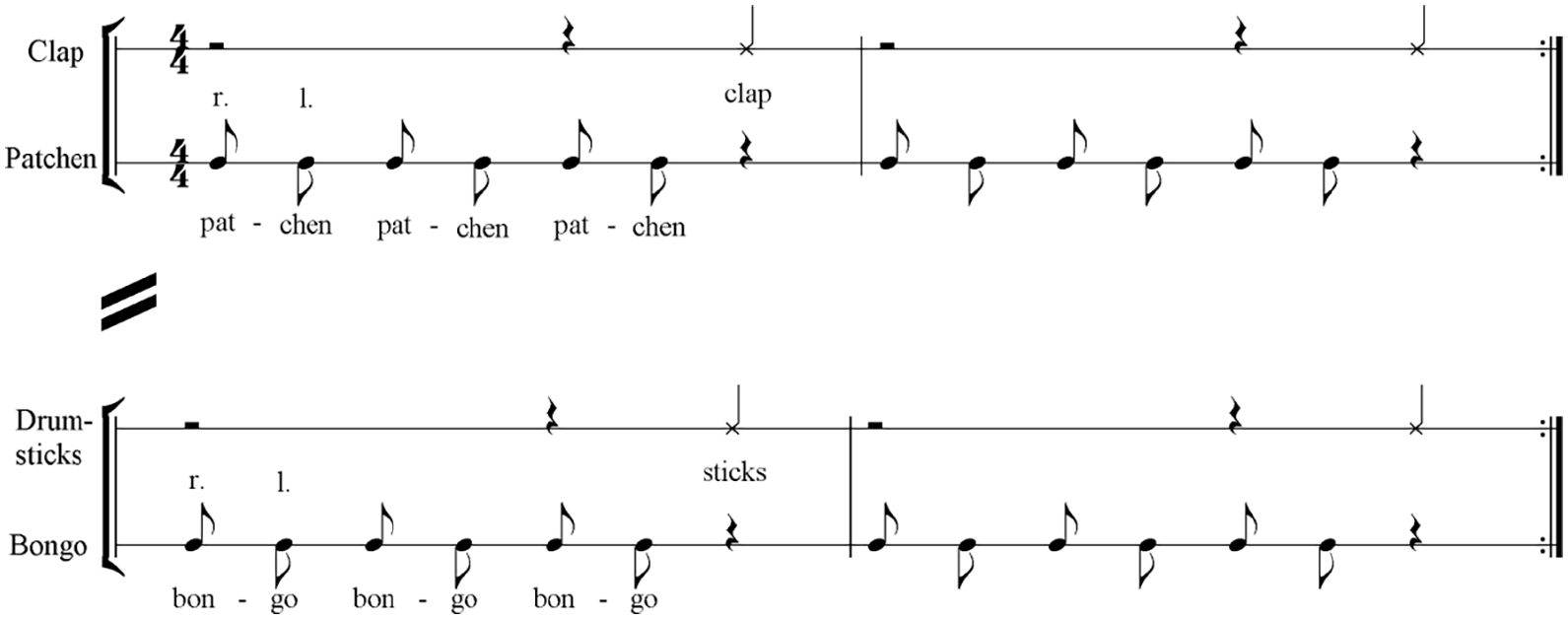
Rhythm-A.
Playing the rhythm on unpitched percussion instruments
The ensemble comprised five bongo drums with pairs of drum sticks (used as rhythm sticks), a large gong, and an assortment of unpitched percussion instruments: wooden blocks, triangles, maracas, and colorful belles. The experimenter played Rhythm-A with two drum sticks on a bongo drum while chanting, “bongo, bongo, bongo, sticks.” (Figure 1, Second system). Five children took turns playing the bongos. The entire class was actively involved in improvised sections using an array of unpitched percussion instruments. Miniature rondo structures were formed through free improvisation sections and repetitions of Rhythm-A as the refrain. The end of an improvisation section was marked by a vibrating sound of a large gong.
Completing an audio-graphic assignment
“Write down the rhythm on paper so that you can play it from your writing” was the instruction given to the children. The participants were reassured, “There is no right or wrong way to accomplish this task!” The researcher provided blank computer papers and writing tools: pencils, markers, and crayons. Each child created a self-invented notation of Rhythm-A.
Decoding and reflection interviews with individual participants
Afterward, there was an individual back-and-forth discussion in which the child decoded (read back) the notation and responded to unstructured questions, such as, “Tell me about your drawing. . . Where is the rhythm written. . .?”
Phase two: The literacy intervention session
First-grade teachers selected 44 students at random for the literacy intervention session. (Kindergarten children were not involved in the standard notation literacy program.) 2 The selected group of first-graders received an extra 50-minute lesson in which they learned the meaning and traditional symbols of crochet and two quavers.
Lesson plan
There were four parts to the standard notation lesson. (1) Practicing crochets and two quavers through various chants, such as “Twinkle, twinkle, little star.” (2) Learning to read and write the conventional rhythmic symbols of the corresponding chants. (3) Children were asked to clap back and write down Rhythm-A. (4) Following the completion of the notation writing, individual discussions followed.
Data examples
The first set of examples includes notations of Rhythm-A elicited by kindergarteners and first-graders during phase one. The second set of examples includes notations of Rhythm-A elicited by the experimental first-graders before and after the literacy Intervention.
Notations of Rhythm-A by kindergarteners (phase one)
Adina (a 4.1-year-old girl) traced her left palm with a blue marker and said: “This is my hand. . . I drew my foot in yellow” (Figure 2a). In response to the researchers’ question, “How would you read the rhythm?” Adina said, “I’d clap my hands and feet.”
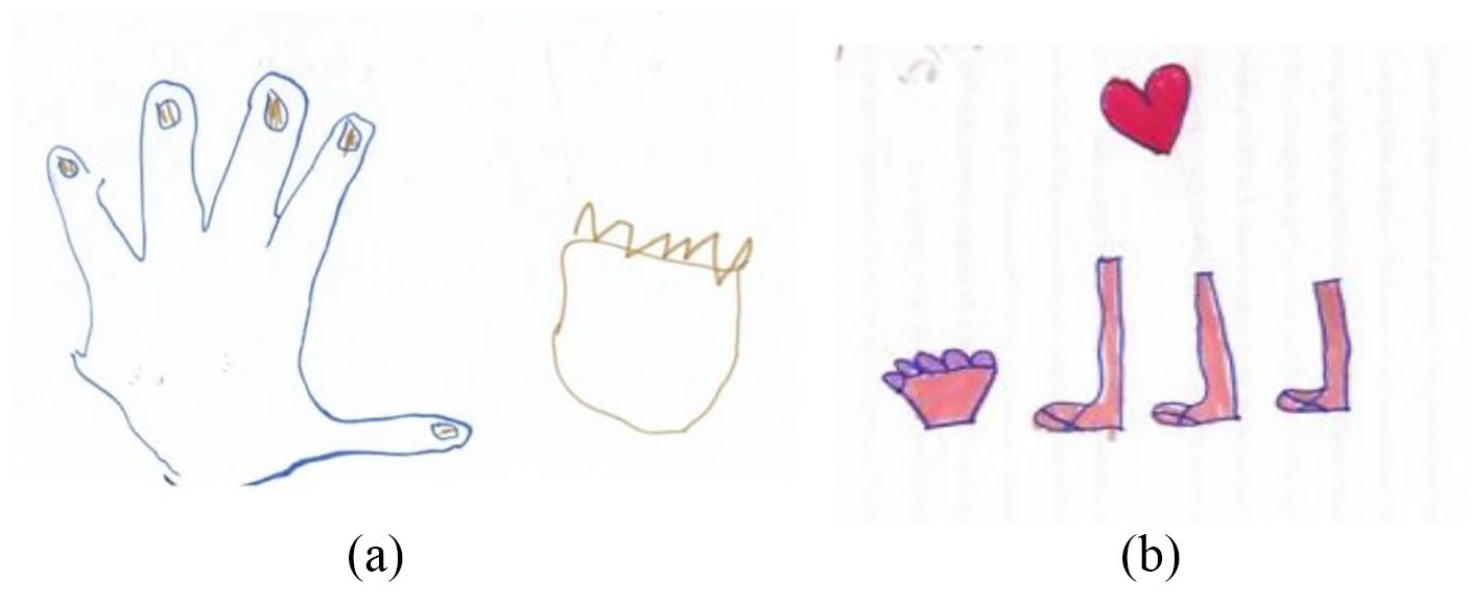
Notations of Rhythm-A by kindergarteners.
Alona (a 5.8-year-old girl) drew three legs (from right to left) and a hand. She added an icon of a red heart “because I love music” (Figure 2b). She accurately recited Rhythm-A while pointing at the respective images of the body parts.
Interpretation
Illustrations Figure 2a and b contain images of hands and feet involved in performing Rhythm-A through body percussion. While Figure 2a conveys no auditory information, Figure 2b represents four beats of Rhythm-A through four images and the respective body parts as the source of the sounds.
Notations of Rhythm-A by first-graders (phase one)
Jonathan (a 6.6-year-old boy) drew a complex picture of two horizontal lines: four drum-heads with pairs of drumsticks in the upper line (three big and one small drum-heads) and three legs and a palm in the lower line (Figure 3a). Jonathan said, “Drumming is too noisy. ‘Regel-Yad’ [body percussion] is more fun than drumming.”
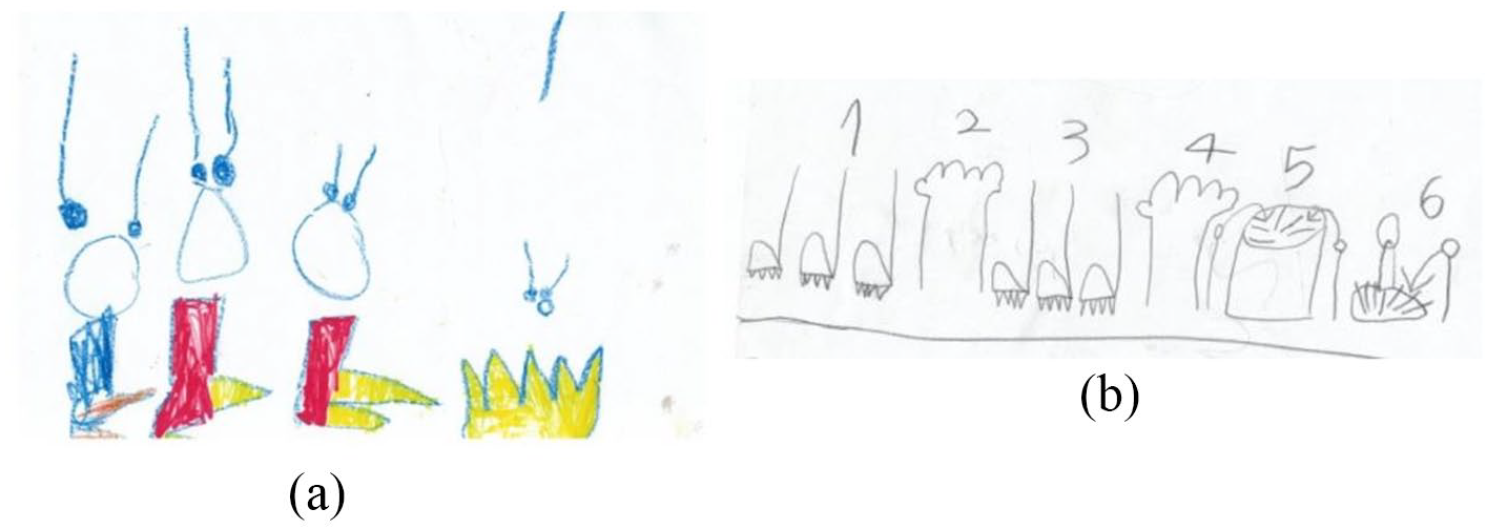
Notations of Rhythm-A by first-graders.
Levi (a 7.4-year-old boy) drew a row of images numbered 1 to 6 of body parts and instruments (Figure 3b). He said, “I drew the feet, hands, and drums.”
Interpretation
The drawings Figure 3a and b represent both pictures of sound makers (body organs and drums) and auditory information—four beats of Rhythm-A. In Figure 3a, the change of instrumentation is indicated by the size differentiation of the symbols (three big and one small drum-heads). It seems possible that with colored body parts versus monochromatic drum pictures, Jonathan expressed his preference for enjoyable body percussion versus “too noisy” drumming, respectively.
The sequence of numbers in Levi’s notation (Figure 3b) represent the chronological sequence of the auditory occurrences: two repetitions of Rhythm-A through body percussion numbered 1 to 4, the drumming section numbered 5, and a picture of a gong numbered 6 indicating a free improvisation period that ended with the sound of a gong.
Notations of Rhythm-A before and after the literacy intervention (phase two)
In his pre-literacy notation (Figure 4a), Ori (a 7.8-year-old boy) drew 10 staff lines and six semi-quaver symbols. He said, “It shows music.” The post-intervention representation (Figure 4b) includes a transcript of Rhythm-A notated conventionally although in the unconventional right to left direction (top page). Over the page, new rhythmic patterns are underlined, each accurately and enthusiastically decoded.
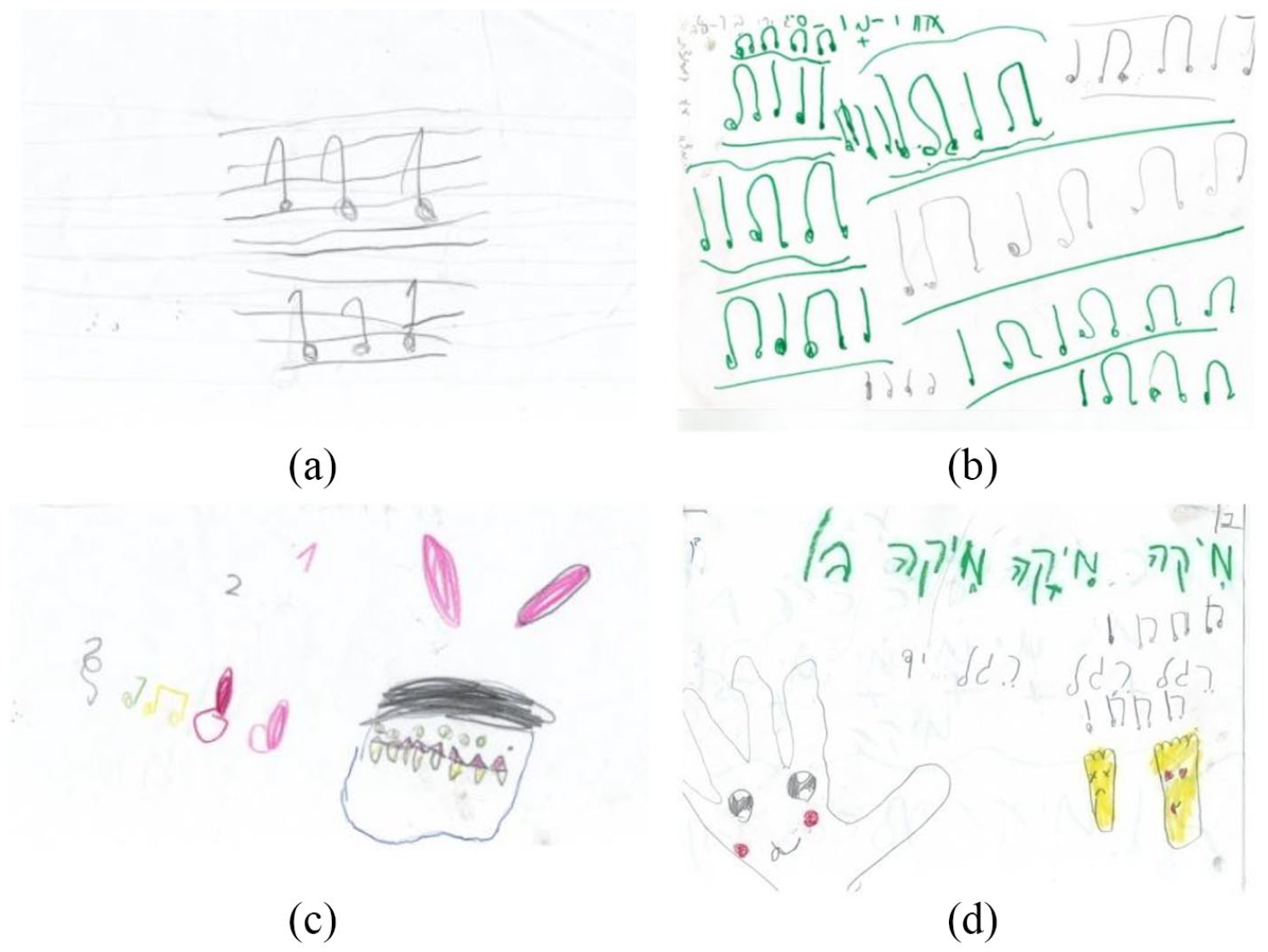
Notations of Rhythm-A before and after the literacy intervention.
In her pre-intervention representation (Figure 4c), Mina drew a drum and wrote four semi-musical symbols numbered 1 to 2. She said: “I drew an African drum because drumming reminds me of Africa.” The post-intervention notation (Figure 4d) includes two transcripts of Rhythm-A written in standard symbols, though from right to left, and a picture of a smiling palm and feet. In addition, Mina wrote down the learned “Regel-Yad” text and derived an original text for Rhythm-A: “Mika-Mika-Mika-Ben” [children’s names].
Interpretation
Unlike the pre-intervention drawings Figure 4a and c, which contained semi-musical symbols, the post-intervention illustrations Figure 4b and d contain both a conventional representation of Rhythm-A (although from right to left) and original spontaneous inventions, either rhythmic combinations of the acquired rhythmic durations (Figure 4b) or a text invention (Figure 4d).
Examples summarized
The summary of the above examples refers to three components of the audio-graphic data: Morphological, Structural, and Conceptual (abbreviated MSC) (Elkoshi, 2002, 2017). Morphological parameters (M) relate to the type of sign produced. Structural parameters (S) relate to the overall arrangement of the symbols. Conceptual parameters (C) relate to the conceptual meaning of the symbols.
Morphological parameters
Pre-literacy children used a variety of forms, including concrete pictures (Figures 2a, b, 3a, and b), icons (Figure 2b), semi-musical symbols (Figure 4a and c), and numbers (Figures 3b and 4c). The African drum in Figure 4c suggests that associative ideas could serve as a source of inspiration for some pictures. As for the use of color, illustrations were either monochromatic (Figures 3b and 4a), duo-chromatic (Figure 4b), or poly-chromatic (of three colors or more) (Figures 2a,b, and 3a). The first-graders drew body parts (Figures 3a,b, and 4d) in the same manner as kindergarteners (Figure 2a and b), implying that drawing schemes of kindergarten children do not disappear from drawings by older schoolchildren.
Structural parameters
Horizontal arrangements of discrete symbols prevailed throughout the examples. Linear directionalities were either from left to right (Figure 3a and b) or the opposite right to left (Figures 2b and 4b). Some children represented Rhythm-A twice (Figures 3b and 4d) and separated chronological audio occurrences into sections (Figure 3b).
Conceptual parameters
Drums and/or body parts are depicted in many illustrations (Figures 2a, b, 3a,b, 4c, and d) and maybe the only content of an illustration (Figure 2a), indicating that children in both age groups were greatly attentive to the sound makers. An exposition of spontaneous creativity was discernible in post-intervention productions either through rhythmic compositions (Figure 4b) or textual inventions (Figure 4d).
Many children indicated the four beats of Rhythmic-A by replicating the respective pictograms (pictures of three feet and a palm); however, they did not express the six discrete sounds nor the inner proportional durations of Rhythm-A (Figures 2b, 3a, b, and 4c). Post-literate children used standard notation to represent six discrete sounds and proportional durations, but did not explicitly express the four beats of Rhythm-A (Figure 4b and d). It follows that different types of writing (invented notations and standard notation) convey different auditory information about a rhythmic stimulus.
Type of the study
The study was designed as mixed-methods research (MMR) characterized by the combination of qualitative and quantitative components (Archibald et al., 2015; Teddlie & Tashakkori, 2009). The research design was sequential-dependent (Teddlie & Tashakkori, 2009) since the two strands—the audio-graphic experiences within the Orff-based program and the literacy intervention—occurred across chronological phases. Audio-graphic categories obtained firstly through QUAL measures were subsequently quantized through statistical assessments (QUAL → QUAN) (Teddlie & Tashakkori, 2009). In addition to visual and verbal data, the study was based on class observations assisted by video recordings and one-on-one discussions that captured the participants’ voices (Phillips, 2008) and audio-graphic meanings.
QUAL analysis of children’s notational artifacts
The analysis of the audio-graphic data was based on morphological, structural, and conceptual criteria (Elkoshi, 2002, 2017). The morphological categories that emerged from the complete set of data are scribbles, recognizable pictures of concrete referents, abstract shapes (lines and encapsulating frames), common icons (i.e. heart emojis and arrows), text, numbers, music symbols (unconventional and conventional), and colors (monochromes, duo-chromes, trio-chromes, and poly-chromes). Structural categories include horizontality (right-to-left/left-to-right) and verticality (top-to-bottom/bottom-to-top). Conceptual categories include associations, sound sources (body parts and/or drums), auditory information of pulsation (beats), discrete sounds and durations, periodic repetitions of Rhythm-A and the existence of original rhythmic and/or verbal inventions.
Statistical results
The MSC categories were quantified using statistical analyses. To examine differences between kindergarten children and first-grade students in representing Rhythm-A by the MSC components, χ2 (Chi-Squared) analyses, and Fisher statistical tests were conducted (Table 1).
Percentage of kindergarten and first-grade participants who represented Rhythm-A by MSC components.
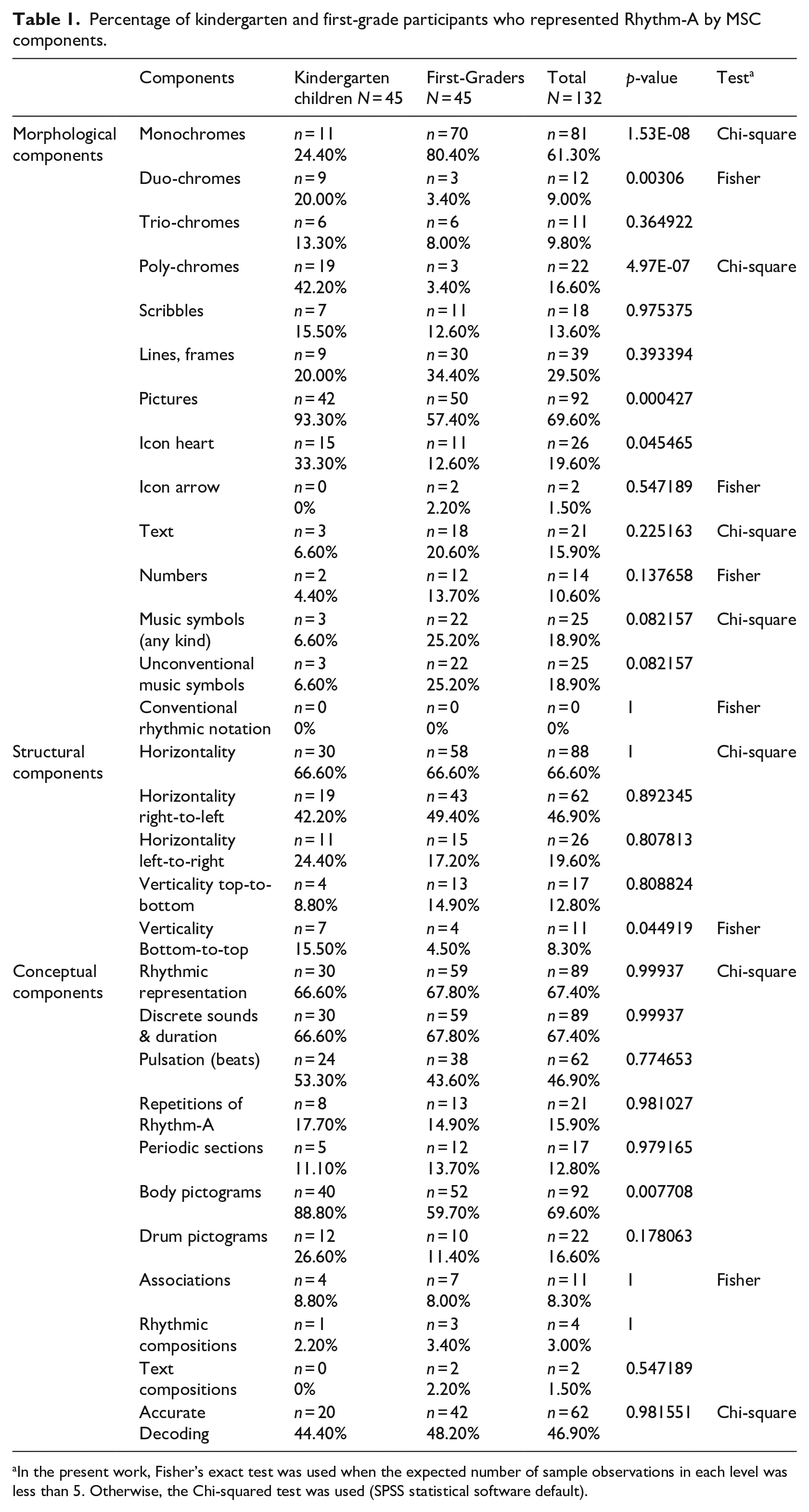
In the present work, Fisher’s exact test was used when the expected number of sample observations in each level was less than 5. Otherwise, the Chi-squared test was used (SPSS statistical software default).
Table 1 shows significant differences between kindergarten children and first-graders in four morphological components: colors, pictures, iconic heart, and music notation. Compared to kindergarten children, monochromes (one hue) significantly increased in first-graders (p-value = .53E-08), while poly-chromes, and duo-chromes decreased (p-value = 0.00306; 4.97E-07). Compared to kindergarten children, pictures and iconic hearts significantly decreased in first-graders (p-value = .000427; .045465). First-graders used unconventional musical symbols more frequently than kindergarteners. However, this result is statistically marginal (borderline) (p-value = .082157).
In terms of structural components, vertical arrangements in bottom-to-top directionality decreased significantly among first-graders compared to kindergarteners (p-value = .044919). In terms of conceptual components, the representation of body parts (as sound source pictograms) decreased significantly among first-graders compared to kindergarten children (p-value = .007708). No statistically significant differences in frequencies between the groups were observed for all other components measured.
To examine differences between the representations of Rhythm-A before and after the literacy intervention by MSC components, a McNemar statistical test was conducted (Table 2).
Percentage of participants who represented Rhythm-A before and after the literacy intervention.
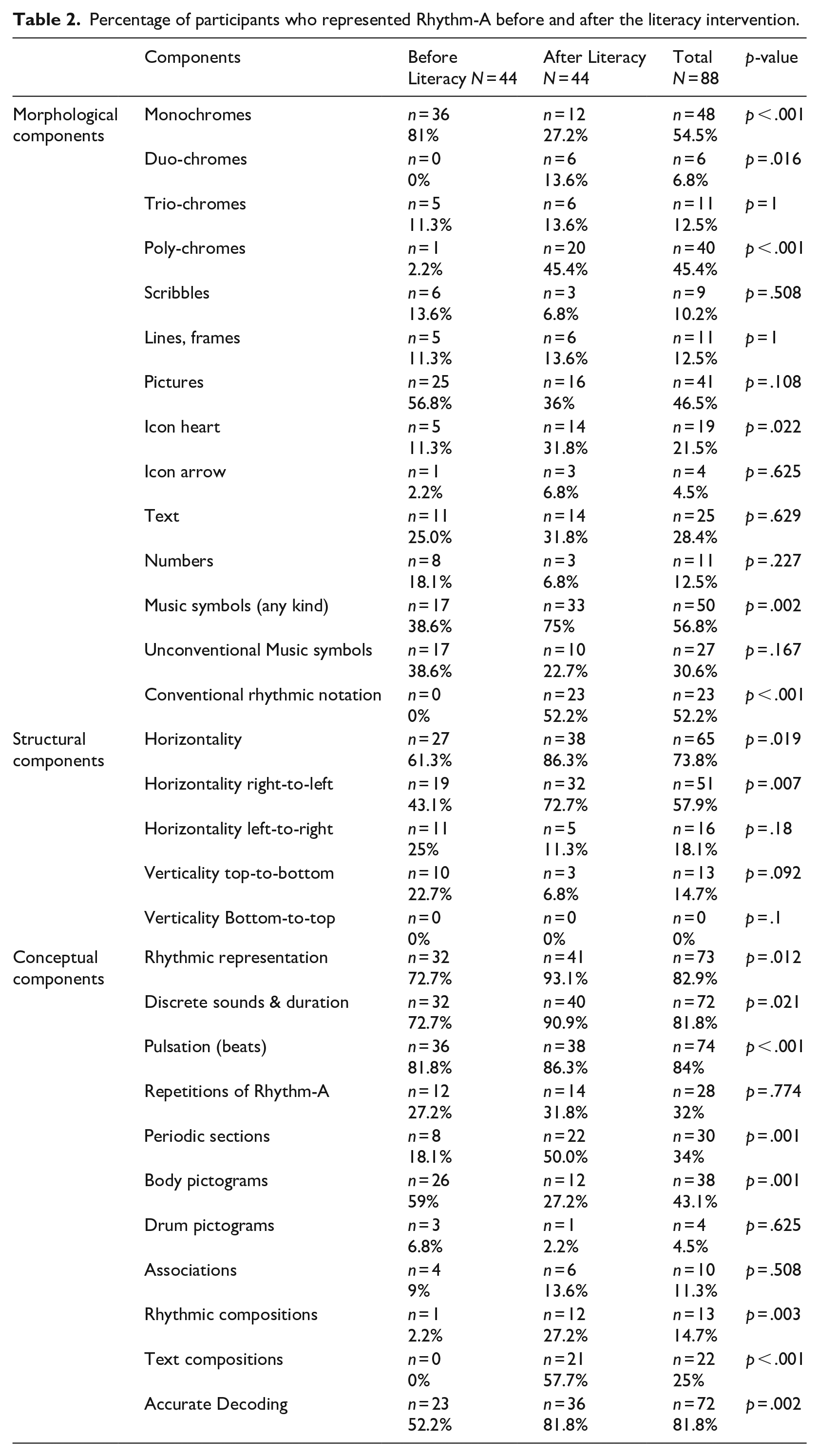
Table 2 shows significant differences between pre-and-post literacy representations in four morphological components: music symbols (of any kind), conventional rhythmic notations, colors, and icons of a heart. Music symbols (of any kind) increased significantly in post-literacy representations (p = .002) as well as conventional rhythmic notation (p < .001). Colors increased significantly in post-literacy representations, both poly-chromes (p < .001) and duo-chromes (p = .016), while monochromes decreased (p < .001). Iconic heart symbols increased significantly in post-literacy representations (p = .022).
As for structural components, horizontality and the right-to-left directionality increased significantly in post-literacy representations (p = .019; p = .007).
Significant differences between pre-and post- literacy representations are evident in six conceptual components: representation of body part pictograms (as a sound source), representation of individual rhythmic sounds, representation of pulse (beats), periodic sections, rhythmic composition, and text invention. After the literacy intervention, representations of body parts decreased significantly (p = .001) while representations of discrete sounds and duration (p = .021), rhythmic pulsation (p < .001), and periodic sections (p = .001) increased. A significant increase in spontaneous rhythmic composition (p = .003) and text inventions (p < .001) is evident after the literacy intervention.
Conclusions
This study indicates a significant effect of age on kindergarteners’ and first graders’ rhythm notations in some MSC components. In contrast to the kindergarten group, the first-graders decreased colors (poly-chromes and duo-chromes), pictures, and heart images, while increasing monochromes and semi-musical symbols (although only marginally).
There were significant differences between pre-intervention and post-intervention representations of Rhythm-A despite the short duration of the intervention program (only one session). Post-literacy first-graders increased their use of conventional rhythmic notation, iconic heart symbols, and horizontal arrangements of symbols, primarily in the right-to-left direction. Additionally, post-literacy first-graders created duo-chromes and poly-chromes instead of monochromes. In the post-literacy representations, pictures of body parts decreased while the exposition of discrete sounds, proportional durations, pulsation, periodic segmentation, rhythmic compositions, and text inventions increased.
Discussion
Within an Orff-based program implemented in Israeli kindergartens and first-grade classes, the present study examined the effects of age on emerging rhythmic literacy and the effects of one-session literacy intervention on first-graders rhythmic representations.
First-graders abandoned the use of colors in favor of monochromes and the drawing of pictures and icons in favor of semi-musical symbols. These morphological shifts are probably the result of the transition from kindergarten to primary school. As in most literacy-oriented cultures, Israel’s first-grade curriculum places a strong emphasis on conventional literacy (linguistics and mathematics) as well as abstract symbolism. 3 As a result of this emphasis on formal writing patterns, picture paintings and colorations may have declined. First-graders abandoned the relatively free vertical bottom-to-top arrangement, common in kindergarteners, in favor of horizontality. This structural shift can also be attributed to a strong emphasis on linear writing common in first-grade schooling. Although Orff’s pedagogy calls for improvisation (Keetman, 1985; Orff, 2011; Orff & Keetman, 1982; Shamrock, 1995) and the audio-graphic task prompts freedom of action (Elkoshi, 2002, 2004; Burton, 2017), the impact of formal schooling was stronger when it came to a literacy activity.
A significant change in first-graders is the abandonment of body part pictures in favor of audible information. Earlier studies concerning rhythmic invented notations have shown that as children grow, they shift their attention from sound sources to audible sounds (e.g. Bamberger, 1991; Hildebrandt, 1987). However, the types of symbols children used in this study do not show a linear developmental progression. First-graders sketched body parts in the same manner as kindergarteners. Both kindergarteners and first-graders drew note-like shapes (imitating staff lines, note-heads, stems, and clefs) with no relation between sound and symbol. This supports the notion that notational strategies are accumulative rather than progressive and endure as children grow (Barrett, 1997).
Significant differences were observed between pre and post-intervention audio-graphic data that is in line with former studies on the effect of music training on music literacy (Elkoshi, 2004; Domer & Gromko, 1996). Yet, compared to longer training interventions conducted in the previous studies, just one session provided in this study sufficed to bring about significant changes. Even after a brief literacy intervention, a rise in conventional rhythmic notation may be expected.
The rise in colors (duo-chrome and poly-chrome) and the increase in iconic heart symbols after the intervention are surprising. Why would a standard notation session prompt the spontaneous use of a broader palette of colors and heart icons? The use of multiple colors (i.e. rainbows) and heart symbols commonly conveyed love (see example Figure 2b) and enjoyment (see example Figure 3a). The significant increase of these symbols insinuates that children felt more at ease and joyful in the post-literacy audio-graphic situation. Based on the children’s general behavior (although not on explicit statements), it is speculated that knowing the “real” musical symbols reduced a sense of insecurity that was tied to having to design self-invented solutions to the notational task. Yet, further research is necessary to confirm this suggestion that familiarity with standard music notation functions as a mood repair in audio-graphic situations.
A key element of standard notation teaching is the horizontal arrangement of rhythmic symbols. Therefore, it is no surprise that the horizontal representation of the symbols increased following the intervention. Nevertheless, it was surprising to observe a significant increase in the unconventional right-to-left (R-L) direction, contrary to the learned rule. The R-L increase in post-literacy notations is probably due to the cultural practice of the Hebrew R-L writing and the strong emphasis that first-grade schooling in Israel places on teaching the Hebrew alphabet (Kadesh & Buckspan, 2014). This finding supports the idea that “children’s invented notations are cultural tools” (Barrett, 2004, p. 19). It may also suggest that culture’s writing conventions may influence the directionality of newly acquired semiotic systems. There might be merit in exploring this possibility further.
Last but not least, this study shows that a significant increase in spontaneous rhythmic composition and text inventions was evident after a short one-session literacy intervention. Thus it is suggested that the acquisition of Western rhythmic notation may enhance both rhythmic and text creativity. Further studies are required to confirm this suggestion.
Implications for music education
It is considered a difficult transition for young children from a child-centered kindergarten environment to a less flexible first-grade classroom (Sink et al., 2007). By inventing and decoding self-invented notations, kindergarten children internalize the fundamental relations between auditory sounds and visual symbols, a skill that may foster school readiness for linguistic literacy. Reflections upon audio-graphic actions lead to a mode of consciousness and active sense-making of written symbols. 4
Teachers can ease the transition from kindergarten to first grade by implementing free coloring and audio-graphic symbolization activities in the classroom. Note-like signs children informally imitate form an introduction to the teaching and learning of standard music notation.
Scholars agreed that music literacy should be approached from sounds before the symbol perspective (McPherson & Gabrielsson, 2002; Mills & McPherson, 2006). Orff also emphasized the importance of music experience before teaching abstract musical knowledge (Hall, 1960). In this study, one session of standard literacy that proceeded Orff-based activities sufficed to prompt the positive effects of musical and verbal creativity. The importance of promoting creativity within the classroom has been discussed and studied extensively (e.g. Nachmanovitch, 1990; Riveire, 2006). This study suggests that rhythmic literacy training that follows oral experiences within an Orff-based program promotes both musical knowledge and spontaneous musical and verbal creativity.
The need for further study
It would be beneficial to test experimental first-graders against a control group that does not receive notational instruction and instead receives some other non-notational lesson. Additionally, this study comprised one rhythmic stimulus tested on two age levels. Future studies may examine a broader range of rhythmic stimuli and ages.
Footnotes
Acknowledgements
My special gratitude to Prof. Carmit Levy and Mr. Nadav Elkoshi from Tel-Aviv University, Israel, for their assistance with the statistics and comments.
Funding
The author received no financial support for the research, authorship, and/or publication of this article.
