




Abstract
The agency of primary school students has been studied increasingly in recent years; yet, we know relatively little about student agency in music educational settings or how students experience their participation in joint musical action. This study explores sixth-grade students’ experiences of their agency in whole-class playing. Qualitative content analysis of 11 pair interviews identified vulnerability as an essential element of participating in whole-class playing, highlighting the intrinsically emotional nature of the process, the immediacy of the musically shared moment and the safe place of entrainment. This study elucidates the enactment of agency and the resources facilitating and limiting agency within the context of whole-class playing from the perspective of students themselves.
Introduction
Music education can support growth and well-being in a variety of developmental areas, such as identity construction and social connection mediated by the presence of music in shared experiences (Saarikallio, 2019) and joint musical action (Juntunen et al., 2014). The importance of children’s active participation and agency has become increasingly acknowledged in 21st-century education (Niemi et al., 2015), even though student agency in music education has received little attention to date. Furthermore, listening to the experiences of students themselves to gain a deeper understanding of the teaching and learning processes is seen as a significant factor in fostering student agency and transforming practices in the classroom (Cook-Sather, 2020). Therefore, the aim of this study was to explore sixth-grade students’ perspectives of their experiences of whole-class music playing to deepen the understanding of the concept of agency in whole-class playing. Whole-class playing is an important method and a part of the timetabled curriculum in the Finnish music education which aims at involving every student, despite their skill levels, to play music as a group (Stolp et al., 2022). Gaining a better understanding of students’ experiences could bring to light the demands made on students and the commitment they have to make when they participate in whole-class music playing (Boeskov, 2018; Juntunen et al., 2014; Kompridis, 2011) and support the further development of pedagogical practice in music education.
The study was conducted in Finland, where music is presented in the core curriculum as an opportunity for musical activities, such as whole-class playing, and cultural participation that promotes social skills, well-being, creativity, imagination and cultural understanding in addition to musical skills and the perception of music (Finnish National Agency for Education [EDUFI], 2016). While whole-class playing assumes that all students can be part of this activity, teachers cannot assume that all students are musically proficient as students come from a wide range of backgrounds. Whole-class playing is an important starting point as an environment with its resources, opportunities and limitations for the agency of a student when the teacher seeks to bring students together through music to experience entrainment in both its social and musical synchronisational dimensions (Clayton et al., 2020; Ilari, 2016), to explore new ways of being together collectively (Karlsen, 2011) and to gain a sense of themselves as music makers. While teachers can offer the opportunity, students must be willing agents to enter the exploration of ‘being the music’ (Juntunen et al., 2014), and little is known about students’ experiences as part of this process. Moreover, there is little empirical and theoretical knowledge on how agency is realised in a dynamic dialogue between the child and musical activity.
Subject-centred sociocultural approach to student agency
In recent years, there has been an increasing amount of research concerning primary-aged students’ agency in different learning environments (Kangas et al., 2017; Vaughn, 2020). Supporting the agency of students can advance the prospects of developing a responsible society that has the competence and motivation to advance equity, to make a difference and to be adaptable to changes (Adair, 2014; Vaughn, 2020). In this study, we draw on subject-centred sociocultural approach to agency (Eteläpelto et al., 2013) that considers the complex interplay between individual, social, cultural and material entities of agency. This approach sees subjects as individuals with not only their skills and competencies, but also their feelings and will, as subjects actively consider and choose what is worth pursuing. Hence, there is an accordance to socio-cognitive perspective where agency is often presented as an individual experience of motivation, determination, competence, self-esteem and self-management (Bandura, 1986). However, subject-centred sociocultural approach sees agency more like a process where agency is constantly evolving through social practices in environments and circumstances that constrain or resource agency. Furthermore, Eteläpelto et al. (2013) acknowledge the temporal dimension where agency in the present is argued to always be realised through past experiences, future orientation and the current context (Biesta & Tedder, 2007; Emirbayer & Mische, 1998). They also emphasise how agency should be analysed by focusing on both manifestations of agency and on subject’s interpretations, meanings and purposes as agency can manifest itself in various ways, like resisting or willing to maintain something that exists, and not for example only as events of actions.
Although there is a wealth of research on student agency, the prerequisites for and the development of primary school student agency have received little attention to date. In tertiary educational research, student agency is defined as the experience of being empowered to act through relational, individual and participatory resources and engage in learning situations (Jääskelä et al., 2020). Moreover, previous studies have indicated how college students’ agency is crucially dependent on the experiences of trust and how an emotionally safe climate facilitates student agency (Jääskelä et al., 2020; Juutilainen et al., 2018). In their work, Slaby and Wüschner (2014) argued that emotions are closely linked to our agency and to the sense of what we ‘can’ or ‘cannot’ do, what we are capable of and the active sense of potential doings and potential happenings. In a way, emotions might limit or facilitate our active participation in social action and play a crucial role in how we reconstitute our worlds (Ruud, 2020). Even though agency is generally seen as a positive orientation and educational goal, Skinnari (2014) argued that students’ expressions of resistance, which are agentic, should be considered significant as they are signs of avoiding meaningless activity.
Adair (2014) advocated education as an opportunity for children to have a broad set of learning experiences that expand what they have the potential to be and do, not only at the individual but also at the collective level. In this sense, teachers play a significant role in promoting students’ active roles, resulting in effective learning and an increased sense of agency (Niemi et al., 2014; Ruohotie-Lyhty & Moate, 2015). Nevertheless, while the appreciation of student agency is visible across research in education, it remains unclear how agency is constructed in different learning environments and how it can best be supported. Furthermore, it appears that current music education does not develop an understanding of how student agency can be conceptualised in the context of whole-class playing due to its multifaceted nature, where along with the various notions of agency, music itself is agentic and creates opportunities and new ways of relating to others (Ruud, 2020). Therefore, we chose to fill this gap by exploring students’ experiences and investigating how they reflect upon their own actions.
Approaching agency through musical activity
As participating and engaging in musical activities seem to play a significant role in understanding the nature of agency in the context of music education, it is important to focus on what characterises participatory music. The sociological approach to music (DeNora, 2000) considers music engagement as an act of emotional and aesthetic agency, and music education research recognises individual and social levels of musical agency in the context of musical learning (Karlsen, 2011). Juntunen et al. (2014) discussed the importance of building learning environments that would encourage students to participate, explore and experiment with music here and now to promote their personal agency, but also their social agency by emphasising the power of Small’s (1998) ideas of ‘musicking’ as a human encounter and its essence of exploring human relationships. However, Boeskov (2018) argues how social analyses of music educational practices many times overemphasise the positive effects and overlook their complex entanglement, neglecting the different experiences of those who are involved and thus, disregard the ambiguous effects and conflictual consequences of social music making.
Ruud (2020) emphasised how the participatory aspect needs to be considered in the moment among the participants, where the degree of success is measured in the contribution of individuals and democratic values in the musical interaction among the participants, instead of musical qualities. Turino (2008) described how a determined form of music, where learning the formulas through repetition opens the participatory musical forms that are favourable for the beginners, creates a sense of safety, the essence of which lies in the constant repetition and social synchrony. In the work of Clayton et al. (2020), interpersonal entrainment is understood as the interaction and coordination between human beings, and the ability to adapt one’s behaviour to social and musical entities by means of sound and movement. Musically spoken, this synchrony, or more precisely, interpersonal entrainment (Clayton et al., 2020), is the core focus for participatory forms of musicking, but it also involves the dense sounding musical texture, which makes it easier for participants to contribute at different skill levels without being obvious for playing ‘wrong’ (Ruud, 2020). The work of Ilari (2016) sheds the light to the prosocial behaviour and social competencies resulting from the rhythmic entrainment that has a potential to bond individuals and foster a sense of togetherness. In this sense, music itself carries a sort of agency as it creates possibilities for action and new ways of relating to others (Ruud, 2020). In this study, we use a subject-centred sociocultural approach (Eteläpelto et al., 2013) to explore the agency of students in relation to self, others and music in the context of whole-class playing.
Aim of the study
In the present study, we investigated students’ experiences of their agency in whole-class playing. Moreover, two sub-questions focused more specifically on (a) what kind of aspects of agency become highlighted in these experiences and (b) what kind of agency sixth-grade students demonstrate in whole-class playing.
Methodology
Participants and procedure
The participants in this study were one class of sixth-grade students (N = 23, age 12–13) in primary school located in Central Finland. The participants’ (11 males and 12 females) backgrounds in music varied greatly, which meant that there were students who had music as a hobby and those who only engaged with music as a compulsory school subject. In Finland, research with human participants must comply the guidelines of the Finnish National Board on Research Integrity TENK. Since the focus of the study was on minors, we consulted our university’s Human Science Ethics Committee to find out if our study needed an ethical review to be carried out. However, collecting consents from our participants’ parents or guardians prior to gathering data was enough to comply the guidelines of TENK and no ethical review was required. Before contacting the participants, permission was obtained from the municipal’s school authorities. Participants were recruited by first asking for the principal’s permission, determining the music teacher’s interest and finally asking if the students were interested in the study. Participants and their parents were informed about the purpose of the study and its methods and ethical commitments, after which students gave their oral consent; the informed consents were signed by their guardians prior to the data collection. The students were interviewed in April 2021.
Semi-structured interviews were conducted as they provide opportunities for understanding, reflection and elucidating subjectively lived experiences from the perspective of a respondent (Tracy, 2013). Interviews were guided by the subject-centred sociocultural approach to student agency (Jääskelä et al., 2020) and musical agency (Karlsen, 2011) outlined above, but they also provided space for the participants to share their perspectives and experiences of whole-class playing. Since our participants were sixth graders, we wanted to ask them very concrete and open questions about their relationship with music and instruments, whole-class playing processes and actions during whole-class playing, inviting them to describe their experiences in their own words, avoiding closed questions. For example, a typical question was as follows: When you begin to play a song with your class, what are the things leading you to participate? All the questions used in the interviews are presented in the Appendix.
The class teacher was asked to divide students into pairs and one triad prior to the interviews by allowing the students to freely choose their pairs. This free choice was evident in the data in the form of honest opinions and openly shared experiences, but also as inner circle humour and occasions where students began to stray from the topic. The interviews (lasting from 6 to 15 minutes) were conducted as a pair interview (with one triad) in a small room by the first author during the regular lessons of a class. The interviews were recorded, transcribed and anonymised. The final dataset included 103 pages of transcribed text (double-spaced, 12-point font).
Data analysis
An inductive approach was used in the qualitative content analysis of the transcribed interviews, adapting Vaismoradi et al.’s (2016) theory of theme development process (see Figure 1). The goal of the qualitative content analysis was to understand how the students described their experiences of agency in whole-class playing. The first analytical step was to familiarise ourselves with the data, search all the manifestations of agency in the transcribed text and utilise them as In Vivo codes, which results in rich data in research (Rogers, 2018; Vaismoradi et al., 2016). The second step was to work with the dataset and sort the In Vivo codes for conceptual codes, cluster the codes into categories that might become sub-themes and then further sort them into main themes (see Figure 2). Next, distancing from the data and discussions among the co-authors enabled self-correcting, after which all the codes were revisited throughout the dataset to ensure that all the participants were represented in the dataset (Vaismoradi et al., 2016). In the final phase of the analysis, the findings were linked to existing theories and literature, thus facilitating a deeper understanding of the phenomenon (Vaismoradi et al., 2016).
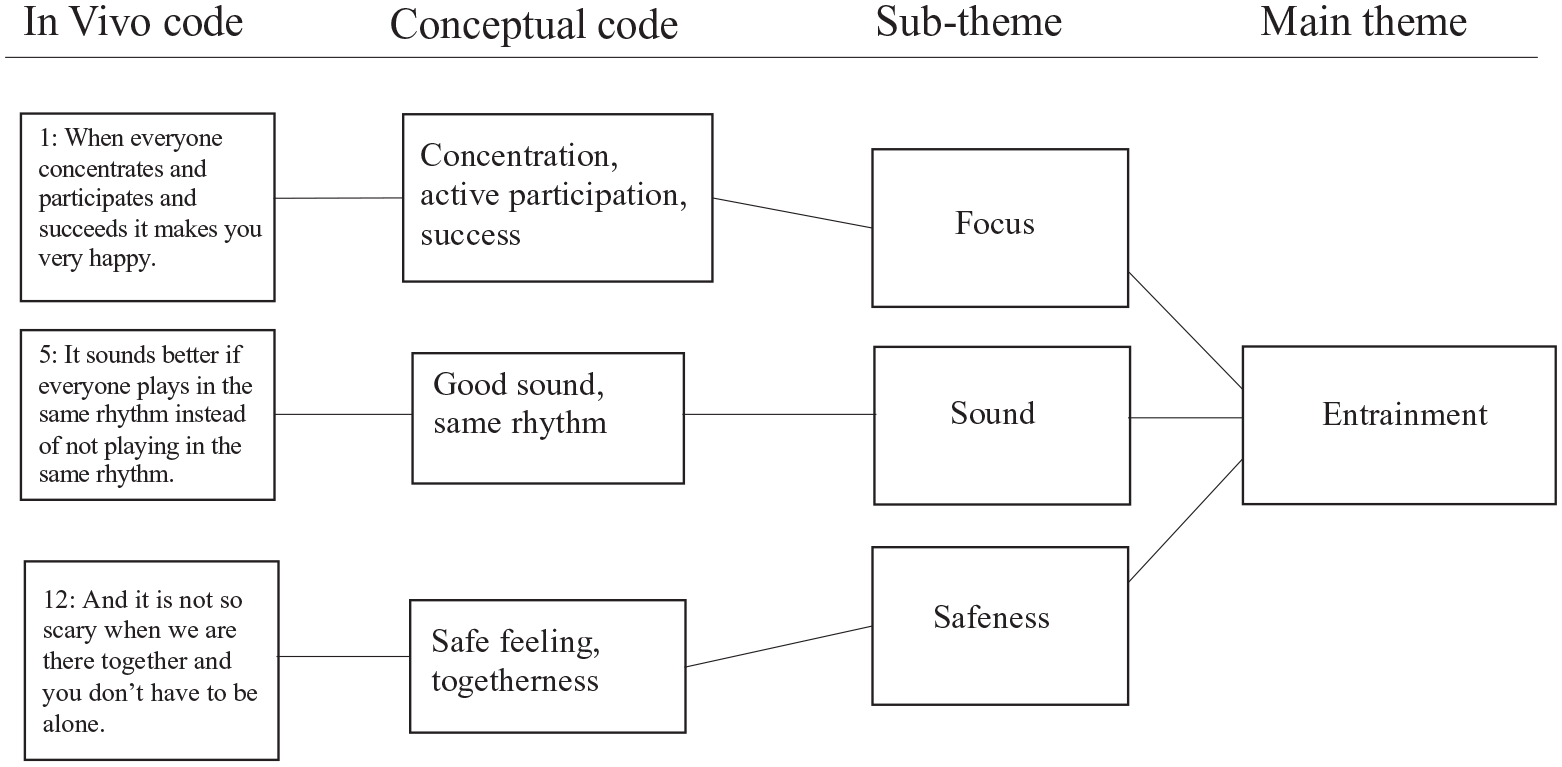
Phases of coding and theme development.
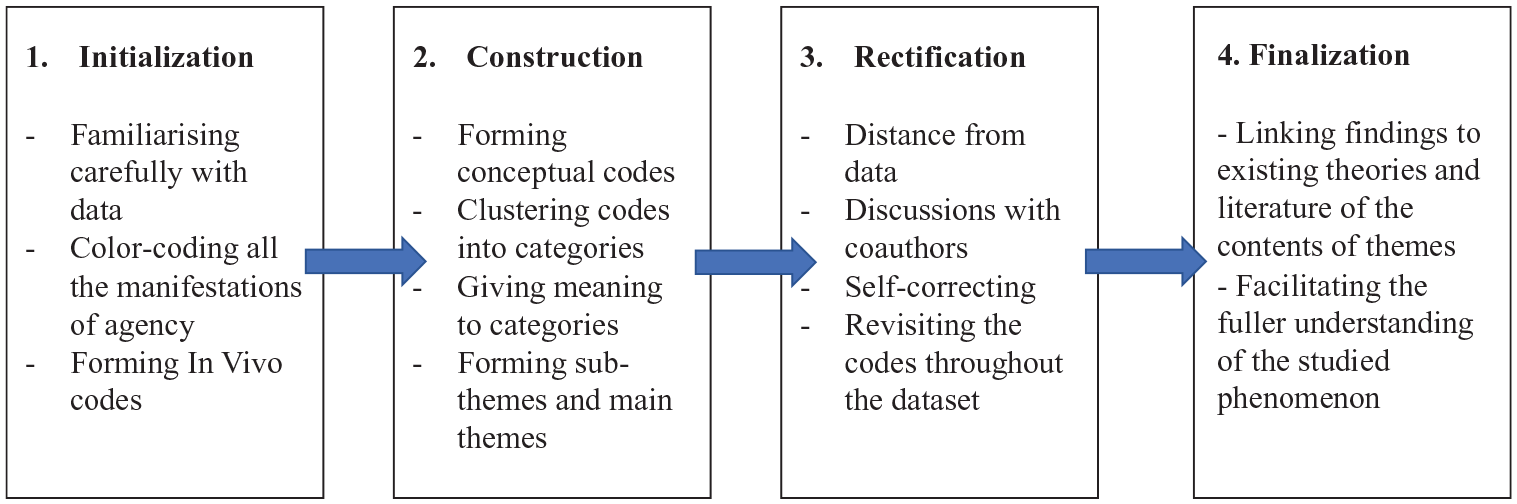
Theme development process adapted from Vaismoradi et al.’s (2016) theory.
Findings
The analysis led to the identification of three intermeshed main themes of the students’ experienced agency in the context of whole-class playing, which are presented in their own sections. Openness illustrates the very personal level of agency; Entrainment involves the understanding of the collective aspect and finally Relational and individual resources of agency points to the limitative or supportive resources or conditions in the here and now. Together, these themes provide insights into the rich and complex nature of student agency in the context of whole-class playing. The synthesis of the final themes and sub-themes is presented in Figure 3a. The relationship among the themes and the implications this has for how agency can be conceptualised are addressed in the Discussion section.
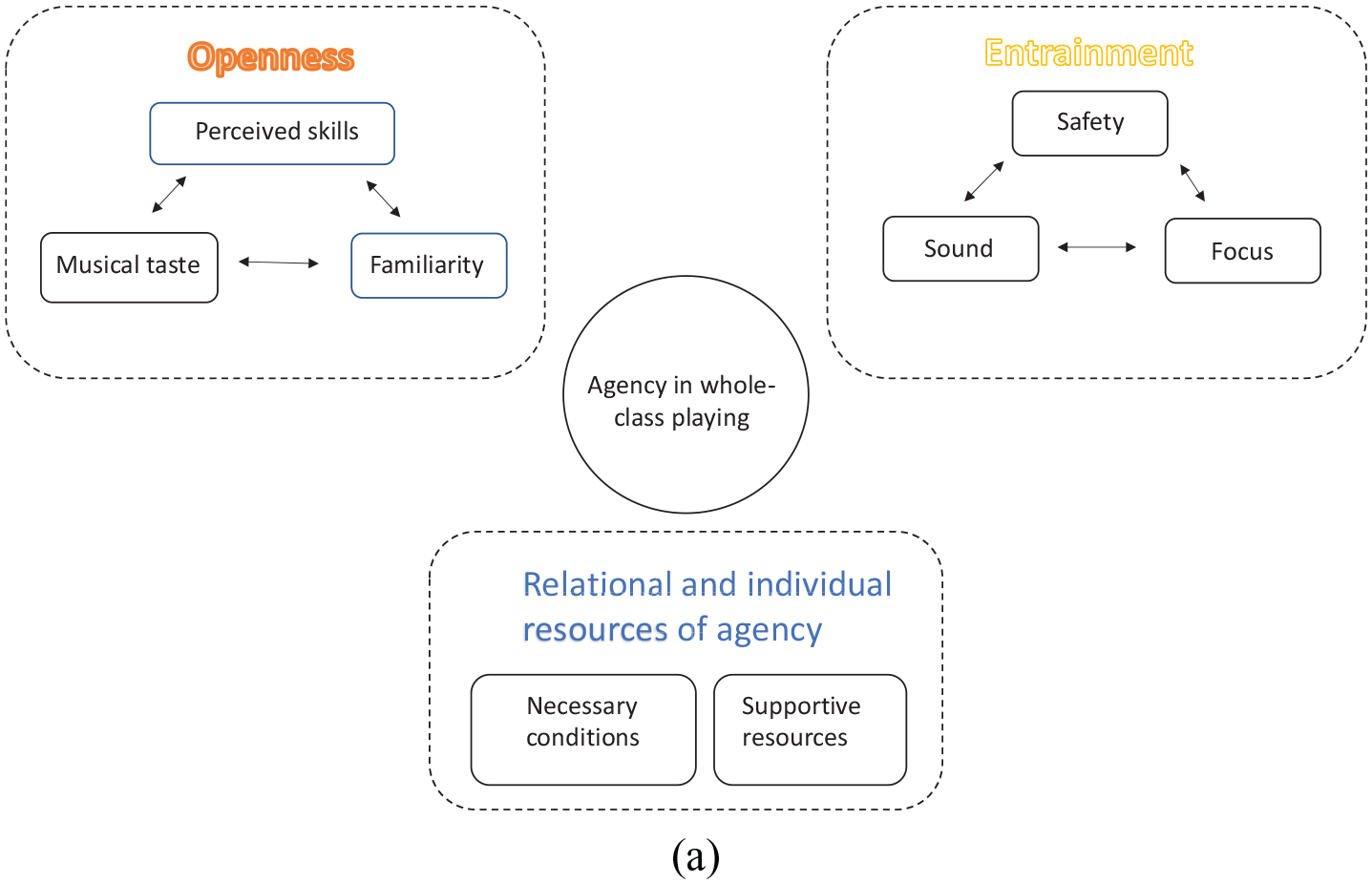
(a) Synthesis of the aspects of student agency in whole-class playing from the perspective of students.
Openness: Perceived skills, musical taste and familiarity
Openness in the interviews was connected to the interaction of aspects of perceived skills and musical taste and familiarity which seemed to some extent to determine individual relationships with music, willingness to engage in musical activity and resources to actively participate in joint musical action. The participants demonstrated that the sense of being competent seems to play a crucial role in whole-class playing and that the sense of one’s ability is connected to a strong emotional load. However, the findings indicate how competence alone is not enough to describe the phenomenon of what it means to be in the situation when you actually are the sound (or silence), the nature of which is in its immediacy, both to be shared and to be heard. In addition to perceived skills, openness includes not only individuals’ musical taste, that is, the experience of what instrument or music sounds good and what does not, but also the familiarity with the music or access to instruments and playing instruments as a hobby in free time.
Students described how whole-class playing is enjoyable as long as the song to be played is not too difficult and the goal is achievable for them. Students described numerous ways of increasing their competence during whole-class playing when it comes to perceiving the music and concrete ways of learning to play an instrument, demonstrating active determined agency to be able to reach a certain goal. Those aspects included memorising the structure and lyrics of the song, perceiving different musical elements such as rhythm or melody and exercising motoric performance when playing an actual instrument. According to the students, feelings of success, motivation, self-efficacy and satisfaction come from moments when one finds that their own capacity meets the demands of the task, such as learning to play something new correctly, or being able to perceive music. Also, music and the sound itself were mentioned, as Student 23 explained: It sounds good when you learn it, and sounding good is the nicest thing once you learn it.
There were students who emphasised that they would not take part in whole-class playing, demonstrating resistant agency as they actively withdrew from playing, if they felt it was too hard to play, if they did not know what the task was about or if they did not perceive the music easily. Feelings of disappointment, dislike and failure were present when students described experiencing low points. Students described how they hate an instrument because it is hard to play, how they lose their motivation if they cannot play and how it is possible to begin to ‘hate the song, like if there are difficult lyrics or rhythms’ (Student 11). There were students who ‘try to play but it never succeeds’ (Students 14 and 19), while Student 8 stated, ‘If I play something wrong, I notice it right away’. These aspects indicate how emotions are strongly linked to the perceived skills of an individual and how the music’s power is in its immediacy, the instant feedback of success or failure.
Familiarity was described as involving the aspects of using music (listening or playing) inside and outside the school environment as well as the emotions involved and motivation as a result of familiarity manifested through musicking. In the interviews, students described how they have access to instruments at home or have music as a hobby, which seemed to connect with the instruments they like to play the most. Music lessons in those cases were activities in which to learn something that could be taken outside the school environment. A song was described as nice and easy to play if ‘you have listened to it before’ (Student 14) or ‘you have played it before’ (Student 11). Student 2 stated how ‘motivation increases if I get to play an instrument I like and if the song is familiar’, and Student 1 emphasised ‘how good it felt when I got to play my favourite instrument’ and ‘you notice if we sing loudly or silently if the song is nice or if it is more boring and no one knows it’. What we found interesting was that there were students who considered musical action an opportunity to manifest their personal preference and enjoyment of the music, as Student 9 noted: I always vibe out when I play the music, because you enjoy more the music if you tap your feet or something like that.
In addition to perceived skills and familiarity, musical taste is the last aspect that relates to the theme of openness. It speaks to the power of music and the relationship between the music and an individual as to how the music itself calls one to participate, as the statements below illustrate:
If the song sounds nice, you feel more like singing it.
If the song sounds nice, then I start to work.
If the song sounds good and fits your musical taste, then it is easy to start to play it.
Interestingly, it seems that the amiable sound itself functions as a strong motive that contributes positively to the agentic participation of a student and makes one actually willing to participate. All these extracts point to the experiences, feelings, temporality and circumstances with resources or constrains (Eteläpelto et al., 2013) students are carrying with them when considering and choosing if entering into the musical action. The characteristics here suggest that student agency from a student’s point of view is temporally constructed ongoing negotiation between their perceived skills, familiarity and musical taste which together form their relationship with music and hence, create affordances for the practice of their agency.
Entrainment: Focus, sound and safety
Students described whole-class playing at its best as moments and an environment where everyone manages to aim at the same goal, concentrate and seriously take an active role in a group. Those moments were described as moments of intense focus, great team spirit and success, as Student 9 described: The moments when everyone is able to concentrate and is happy in what they do are precious moments. It feels like we have a good team spirit in those moments.
Our findings highlight how a safe atmosphere and the musical aspect of entrainment often intertwine. Many times, the students described the musical aspects of how in the moments of success the students in the class ‘have a very good rhythm’ (Student 10) and how ‘we sound like a real band together’ (Student 17). Students emphasised that the end result sounds very good when everyone plays together in the same rhythm as well as how nice it is to play together in the same rhythm. The power of entrainment and the dense musical texture are in creating places of safety, as can be seen from the following comments:
When we play together, it is not scary to play wrong because there is rhythm that continues, and you can hop on more easily.
You don’t have to be scared if you say lyrics wrong or play a wrong chord. You are not alone, because we are together in it.
These findings indicate how aiming for entrainment as well as the experience of entrainment can positively contribute to the agentic participation of students in whole-class playing, as the experience of entrainment seems to be a space that students are willing to actively maintain. Moreover, the findings provide insights into the ongoing interaction between subject and both social and material environments which can be analytically separate but constitute each other (Eteläpelto et al., 2013). As entrainment points to forming a collective whole, it is clear how dependent it is on everyone’s active contribution and, on the other hand, how delicate the entity is in respect to disruptions.
Relational and individual resources of agency: Necessary conditions and supportive resources
We found that the relational and individual resources of agency include the aspects of necessary conditions and supportive resources, meaning that the agency in whole-class playing might be either limited or facilitated by the conditions or the support received. The individual level encompassed the here and now sensations, expressed as ‘It hurts my fingers to play the guitar’ (Student 7) or ‘having a bad day and nothing succeeds’ (Student 17), which can be understood as necessary conditions that might strongly limit the possibility of being agentic. Students recognised how peers play an essential role in whole-class playing and how their behaviour and participation level determine the end result of whole-class playing. Peers seemed to be a supportive resource of learning and, on the other hand, the major challenge in endeavouring to reach goals also in a musical way, meaning that peers sitting next to a student might support or disturb their work by their social or musical impulses, as the following excerpts illustrate:
If you are playing the same thing with someone who is good at playing piano, then you can learn from them.
I go to ask help from my classmate because I don’t understand what the teacher is saying.
Once, I was the only girl in a group, and the others were boys, so I couldn’t ask help from them.
If we all play together, then it might lose the same pace if everyone plays in different tempos.
In the interviews, students described how peers determine the level of how they are able to concentrate and learn. This indicates that student agency is dependent on the conditions and the surrounding environment. Students acknowledged the importance of being able to focus on perceiving and learning the music, which is one of the necessary conditions for whole-class playing to succeed, and how they need to use their cognitive capacity to be able to actually play, as Students 1 and 16 described:
If you can’t concentrate, you start to play wrong chords and then it just doesn’t sound good anymore. It doesn’t sound right.
Can’t concentrate because someone is yelling.
The role of a teacher was considered to be a facilitator and supporter from the students’ perspective. The findings highlight how the students perceived the role and effort of the music teacher in supporting students’ skills in multimodal ways to help them perceive and play music with different instruments. Students mentioned how the teacher demonstrates how to play with different instruments, comes to help if needed, plays along with them, helps to perceive music by guiding how to listen and separate details in music, accompanies them until it is not needed anymore (entrainment), encourages, shows or tells which note to play and offers options if something feels too difficult. The teacher was also described as ‘increase the voice to get us to concentrate’ (Student 9). Students described the kind of support they get and how, little by little, their teacher constructs the path for them so that everyone can participate with their perceived skills. Three students noted this as follows:
First, we sing the song and only after that, the teacher accompanies us, and we sing. And only after that we take instruments along.
Teacher gives options of how to play more easily. ‘Try that one first’ and then ‘after that you can start to play more’, and it makes it much easier.
We always do it first in an easy way and we slowly quicken the tempo. So that everyone gets to come along.
Students also stated how they could sometimes influence the song to be played and how they were occasionally allowed to choose an instrument in a particular song to be able to master their favourite instrument. The students’ perspective on teacher support makes it obvious how the teacher directs support of not only the skills of an individual but also the musical taste, familiarity and entertainment as a whole. These insights from the students indicate their awareness of the teaching–learning situation as well as their active, that is, agentic, response to these conditions.
The meaning of the instructions given by the teacher was expressed as leading to very different experiences from success to failure. Instructions are an essential starting point for any kind of action in a school environment where there is a task with a goal. Instructions are therefore seen as a necessary condition for agency, as the excerpts below illustrate:
I don’t like the teacher because I never understand what the teacher is talking and explaining about. I always ask my classmate’s help (not the teacher), and if my classmate can’t help, then I won’t understand anything.
In my opinion, the teacher gives good instructions of how to get started.
These two very different comments on the perceptions of the same teacher illustrate how students within the same environment can experience the conditions in very different ways and the way in which students can be agentic in diverse ways in the same environment. These extracts above provide insights into the resources and constraints of the social and material environment (Eteläpelto et al., 2013) that create a platform for whole-class playing. The extracts point to the students’ awareness of how the teacher guides their participation and provides support, and the role of peers as resources or constraints. The findings indicate that there are clearly prerequisites for agency in whole-class playing that are above all relational, such as peers and teacher, as they can either facilitate or at worst preclude the chance to be agentic.
Discussion
Our study aimed to examine students’ experiences of their agency in whole-class playing from the subject-centred sociocultural perspective. The findings provide insights into how student agency takes shape and develops in whole-class playing and deepen our understanding of agency in the context of whole-class playing that goes beyond the existing theories to consider the multifaceted aspects involved: the merging in time, music as agentic, the emotions involved, the struggle of facing the unknown, our human vulnerability, making decisions about when to be open or when to answer the call of entrainment.
Our study indicates the multifaceted connection among aspects that are combinations of musical, individual, social, temporal and environmental factors, and suggests how they are intertwined tightly in the context of whole-class playing, as they all need to be regarded as agentic in order to understand the whole concept (Eteläpelto et al., 2013; Ruud, 2020). Openness involves an individual’s point of view that is an emotional and shared combination of perceived skills, musical taste and familiarity, which determines the way an individual resists or enters into the exploration and experience of whole-class playing. Entrainment is described as highly intensive, actively participated in and focused moments of success, musical satisfaction and places of safety that music itself facilitates in many ways but which is dependent on individuals investing in the collective whole and their will to maintain it. Finally, there are relational and individual resources of agency that involve the necessary conditions and supportive resources limiting or facilitating the agency of a student in whole-class playing. Our research points to the vulnerability that is required to be open to music, the immediacy of the moment in which music is shared and the struggle in the path from the individual level to the safe place of entrainment. Our findings emphasise how whole-class playing cannot be understood only by pointing out individual agency because it is a multifaceted entity and a combination of music as agentic, musical, individual, emotional and social agency.
Figure 3b depicts the dynamic interplay and the quality of connections among different themes, where the arrows indicate the directions of interaction and influence. There is a strong interplay between openness and entrainment as they overlap in whole-class playing, featuring emotions and the nature of these being shared. It is a matter of the in-time emotional experience of a being, one’s social and musical constantly evolving relationships that become shared, and finally, the will and vulnerability to explore and engage with the unknown. There are relational and individual resources of agency, involving both social and musical impulses, which are constantly affecting or drawn on at both the individual and collective levels in whole-class playing. These aspects provide insights into how delicate the interaction both socially and musically is in this context. Thus, the key contribution of this study is recognising the resonant quality of agency in whole-class playing, which highlights the intrinsic relationship between self and others mediated through music in whole-class playing.
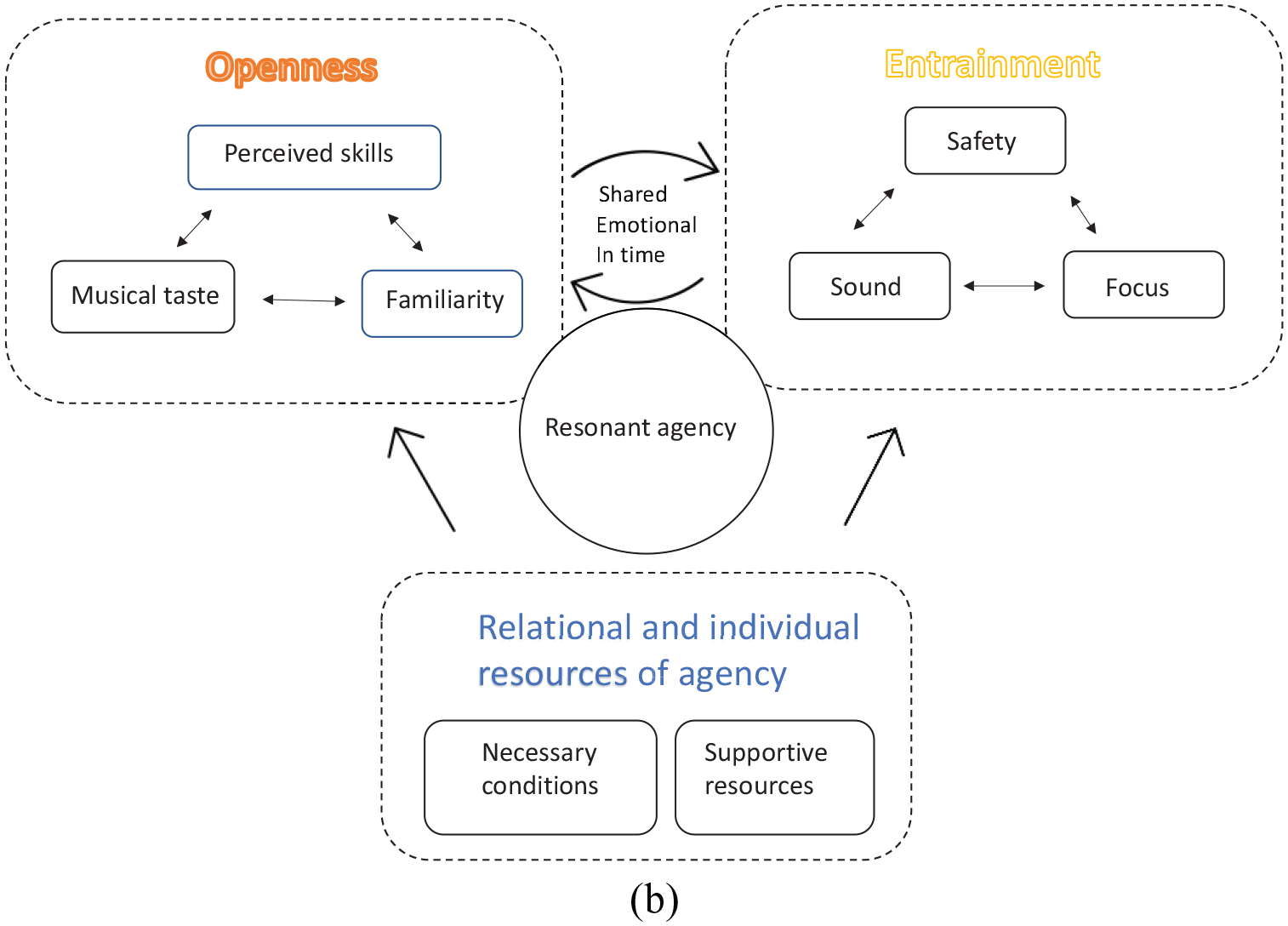
Interplay among themes of resonant quality of agency.
Our study shows how being competent seems to lead to experiences of success and satisfaction with increased motivation, but how this can also bring about experiences of failure that might distance a student from participating in whole-class playing and thus make students resist activity that does not serve as meaningful anymore (Boeskov, 2018; Skinnari, 2014). The findings support understanding how emotions are closely linked to our agency and how they reconstruct our worlds, resulting in either facilitating or limiting our agency (Eteläpelto et al., 2013; Ruud, 2020; Slaby & Wüschner, 2014). In music making, the sound and its immediacy mirror concretely the skills of an individual and the nature of sound being shared because it can be heard and can make it quite a scary and vulnerable space to enter for an individual. That is why in whole-class playing, the experiences of trust and emotionally safe climate are especially important aspects in fostering agency, as the studies in tertiary educational settings have found (Jääskelä et al., 2020; Juutilainen et al., 2018). The findings indicate how the quality of instruction, help and support from both the teacher and peers affect the perceived skills of a student. In other words, agency is inextricably affected by relational resources and is continuously developing in interaction with others. Therefore, it requires teachers to demonstrate a high level of pedagogical expertise and musical competence as they work to develop not only the musical understanding and abilities of children as individuals and as a group, but also to facilitate joint explorations and curiosity towards what is musically unknown (Juntunen et al., 2014). The findings are in line with the studies from tertiary settings emphasising not only the necessity of the teacher’s expertise, but also sensitivity in guiding the learning of students and planning the tasks that enable individuals to participate at their own level (Jääskelä et al., 2020; Niemi et al., 2014; Ruohotie-Lyhty & Moate, 2015).
Interpersonal entrainment (Clayton et al., 2020; Ilari, 2016) and the notions of participatory music (Ruud, 2020; Turino, 2008) may hold relevance for understanding not only how music as an agent may support the development of students’ social relations and social cohesion, but also how actively aiming to foster students’ experience of entrainment and the experience of being part of both a social and musical entity connects to the students’ agentic participation. This study highlights the role of musical aspects, such as experience of entrainment and repetitive, continuous and dense musical texture, that together create places of safety and possibilities to participate. This participatory element of the joint playing of music underlines the value of individual contribution, presence and in-time musical interaction that also supports the understanding of music as a ‘human encounter’ creating mutual commitment (Juntunen et al., 2014; Karlsen, 2011; Ruud, 2020; Small, 1998). However, as there is a sound in whole-class playing, a unique moment that is a little different every time and as it primarily depends on individuals’ contributions musically and socially, it is a new, unpredictable collective musical exploration that individuals have to be willing to enter. We believe that this study sheds light on the actual demands (Kompridis, 2011) made on students, the complexity of social music making (Boeskov, 2018) when asking them to play together and the vulnerability they feel when entering into an unexplored and active openness to make room for responding to the call of others and music itself. This study contributes to the discussion about agency in music educational environments by highlighting the intertwined nature of individual, social, emotional and musical aspects being present in joint music making.
There are some limitations to this study. First, there was only one class of sixth graders represented who had the same music teacher. It would be worthwhile to conduct a study with different classes from different music teachers to get an even richer understanding of the experiences of students. In the future, it would also be valuable to investigate how a teacher’s behaviour in the classroom and the quality of instruction affect the agency of students. Second, the study was conducted in a Finnish educational context of music which might differ from music education in other school systems and cultural contexts. Future research should include students in different countries to see whether the findings can be generalised. Nevertheless, our study contributes to understanding the complexity, richness and resonant quality of the notion of agency in whole-class playing, which also verifies the relevance of music as an essential school subject. Future research could also explore whether the resonance of agency is present in other contexts. Listening to the experiences of students is especially important in creating new pedagogical approaches to support student agency in whole-class playing and for teachers to be able to transform their classrooms into platforms that facilitate and enable students to be agentic.
Footnotes
Appendix
The questions used in the interviews were as follows:
Do you listen to music in your free time? What? Is there an instrument that you especially enjoy playing, and why? Is there an instrument that you don’t enjoy playing, and why? If you begin to play a new song with your class, what do you usually do, and how does the process go? When you begin to play a song with your class, what are the things leading you to participate? Are there things that make you not want to participate? In your opinion, what is the nicest thing when your whole class plays and sings together? Is there something that makes it not so nice? What does your teacher do when you start to play together as a class? How does your teacher teach you?
Declaration of interest statement
No potential conflict of interest was reported by the authors.
Funding
The authors received no financial support for the research, authorship, or publication of this article.
