




Abstract
Teachers’ confidence in navigating the complexities of ‘being a teacher’ influence their behaviour, how they are perceived, how they make sense of their environment and circumstances and their successes. A web-based survey was developed and distributed to music teachers via an online community of practice. This paper reports on the respondents’ self-reported confidence through the use of an Importance-Confidence Analysis. The responses of early career music teachers and experienced teachers are also compared to understand confidence over the career. Results show that both early career and later career teachers placed greater importance on pedagogical knowledge and skills relative to professional knowledge and skills and music knowledge and skills. Later career teachers reported greater confidence with respect to pedagogical knowledge and professional knowledge compared with teachers who were early in their career, whereas music knowledge and skills were viewed quite similarly by teachers across the career. The analysis highlights the need for ongoing support for experienced teachers alongside early career teachers. Recommendations are made for ongoing support of teachers throughout their careers.
Introduction
Teachers’ professional identities affect all aspects of their jobs, including their professional roles and their personal, social and cultural identities. Conceptions of ‘who I am as a teacher’ influence, and are influenced by, self-perceptions of agency and self-efficacy (Day & Kington, 2008; Skaalvik & Skaalvik, 2014). These self-perceptions shape the ways that teachers behave, the ways they are perceived, the ways they make sense of their environment and circumstances, and their successes and career longevity (Ballantyne et al., 2012; Ballantyne & Grootenboer, 2012; Ballantyne & Retell, 2020; Ballantyne & Zhukov, 2017; Beijaard et al., 2004; Russell, 2012; Sachs, 2005). The pace of change in the field and the level of teacher adaptability required have increased exponentially over recent years (Allen et al., 2020). In this paper, we focus on dimensions of importance (what teachers need to know to do their jobs) and confidence (how effective they feel in undertaking those tasks) to provide insight into broader issues of concern for the field, particularly related to teachers’ professional identity development and career longevity.
The importance of expectations, perceptions and reality
Music teachers of all career stages report struggling to balance work-related expectations with reality (Ballantyne & Retell, 2020). It is important for the field that we listen to teachers, especially in the areas that they think are important, and how confident they feel in those same areas. How teachers manage this balancing act has implications for their well-being, longevity (Ballantyne & Retell, 2020) and professional identities. Teacher success in this area also has implications for the field: in their study of 2,444 Australian teachers, Heffernan et al. (2019) found that a third of teachers were dissatisfied with their jobs, and that many felt key aspects of their work were undervalued. They further found that concerns relating to ‘workload, wellbeing and appreciation. . . are impacting teachers’ perceptions of being able to make the difference that they would like to’ (p. 4). It stands to reason, therefore, that we need to further explore teachers’ expectations and perceptions of their work.
Confidence is undoubtedly essential for teachers’ success. In their study of working teachers’ professional capacity, Nolan and Molla (2017) found that ‘professional learning, teacher professionalism, and teacher confidence’ (p. 11) were linked, and that this combination of learning, professionalism and confidence contributed to the development of professional capital. Nolan and Molla’s study focussed on how teacher confidence might be increased through (finite) mentoring programmes: in this study, we focussed on teachers’ self-reported perceptions of key aspects of their work. Specifically, we explored teacher confidence at different career stages as reflected in participants’ views of the skills and knowledge that were most important to them in their work, and how these perceptions intersected with their levels of confidence in other areas.
Understanding teacher challenges involves listening to what teachers think is important and what they think they do well. Previous research in this area (Ballantyne & Packer, 2004) identified that early career music teachers’ perceived work environment differed from their expectations, particularly in ‘pedagogical content knowledge and skills’ (p. 310). Ballantyne and Packer also considered ‘non-pedagogical professional knowledge and skills’ such as communication skills, to be areas where greater emphasis was needed during university studies. Such dissonances between university education and the profession reflect contrasting understandings of what is important, which has repercussions beyond teachers’ unmet expectations: these dissonances also influence teacher confidence. Teacher confidence, together with the perceived importance of both pedagogical and non-pedagogical skills, is therefore key to teachers’ experiences of the profession and their capacity to carry out their work.
Research that offers teachers the opportunity to convey what matters to them is needed as part of placing the ‘teacher voice’ (Heffernan et al., 2019, p. 14) at the heart of any reform to policy or practice that addresses teachers’ challenges. To do this, we developed a tool based on Martilla and James’ (1977) Importance Performance Analysis (IPA). IPA was developed to better understand consumer satisfaction in terms of attributes (importance) and how well they work (performance), which, in turn, allowed Martilla and James to suggest it could be used to assess the efficacy of marketing programmes. Modified for the purposes of this study, we adapted IPA to enable teachers to communicate the attributes that were most useful in their daily work (importance) and how they felt in the performance of those key areas (confidence). We wanted to understand how the tool could be applied to practising teachers reflecting on their current circumstances as opposed to previous use of IPA which was to evaluate external and previous experiences (e.g. Ballantyne & Packer, 2004). We felt that Importance–Confidence Analysis (ICA) could be a useful tool for highlighting particular areas of concern.
Tuning in to teachers’ confidence, self-efficacy and career development
The research highlighted above reflects teachers’ career development challenges in which maintaining a sense of professional identity is not a static undertaking (Hartung & Cadaret, 2017), and motivation is not the only issue (e.g. Eccles & Wigfield, 2020). More broadly, these challenges speak to teachers’ work-related adaptability.
Work-related adaptability is supported by a range of psychosocial resources, including confidence and self-efficacy (McLennan et al., 2017; see also Tschannen-Moran & Woolfolk Hoy, 2001). Previous work with music teachers has drawn upon the concept of self-efficacy to understand various aspects of teacher identity and adaptability. Cramer et al. (2009), drawing upon Bandura’s (2006) influential work, define self-efficacy as ‘one’s perceived ability to effectively accomplish or demonstrate a behavior or series of behaviors in a given situation’ (p. 320). McLennan et al. (2017) demonstrated links between pre-service teachers’ self-efficacy and the mediating role it had on both their career adaptability and the development of their professional identities. Ballantyne and Retell (2020) found that early career and more experienced music teachers seem to maintain similar levels of self-efficacy, though time in the profession did account for a slight increase in self-efficacy across the career. This finding concurs with large-scale studies such as the Organisation for Economic Co-operation and Development’s (OECD, 2014) TALIS surveys (see also OECD, 2005) which suggest that years in the profession contribute to teacher self-efficacy.
Teacher confidence has been described as being ‘akin to self-efficacy’ (Nolan & Molla, 2017, p. 12). Confidence, however, is distinct from self-efficacy (Cramer et al., 2009) in that it ‘functions as a degree of certainty about one’s judgment’ (p. 322). In this study, we aimed to highlight the impact of teachers’ self-reported judgements of their capacity to carry out the range of tasks associated with their roles to foreground teacher perceptions of both context and self, hence our focus on confidence and not just self-efficacy. At a time of rapid identity shift for many teachers due to the COVID-19 global pandemic (Nazari & Seyri, 2021), we argue that trusting one’s judgement (confidence) is just as necessary as being able to accommodate the presently ever-expanding range of behaviours and identities expected from teachers (self-efficacy).
For these reasons, we position matters of confidence, self-efficacy and importance as they are described in this paper within the larger theoretical framework of Savickas’ (2005) career construction theory. This framework offers a more refined focus than Bandura’s (2006) social cognitive theory or Eccles’ and Wigfield’s (2020) situated expectancy-value theory (SEVT) as career construction theory enables us to highlight the importance of confidence and importance as they relate to a person’s adaptability at work. Career construction theory is built around three pillars, which are vocational personality, adaptability and life themes. Sitting below adaptability are the components of career concern, control, curiosity and confidence (Savickas, 2005, pp. 52–55). Confidence, as a dimension of adaptability, is also concerned with notions of self-efficacy: the ability to do what is needed to take action (Savickas, 2005, p. 56). Through career construction theory, we may frame teachers’ perceptions of importance and confidence within a broader discourse of professional identity, adaptability and longevity.
Methodology
A web-based questionnaire was designed to explore the experiences of music teachers at different career stages. It was distributed, via snowball sampling, to music teachers through an online community of practice, advertisements in professional list-serves, social media and professional associations. The project received ethical clearance from the university board, and participants acknowledged their agreement to participate in the research before embarking on the questionnaire. An incentive was offered for participation, with participants able to opt into a random draw for a voucher in a separate area of the questionnaire. All responses were anonymously provided.
This paper reports the perceived importance of, and confidence in, various aspects of teaching music. Understanding the perceived confidence of music teachers enables a greater understanding of areas in which teachers feel successful, and those in which they need support. The findings of the paper compare the responses of early career music teachers with those of experienced teachers (>3 years of teaching service) to better understand the ways teachers’ perceived confidence is influenced by their career stage. The choice of dividing at the 3-year point was made following Caspersen and Raaen (2014) who argue that it is in the novice period (first 3 years of teaching) where praxis shock is most expected to occur, and therefore 3 years was a natural place to separate the data. In doing so, we aimed to investigate which elements of pedagogical and non-pedagogical skills and knowledge support teacher confidence. By exploring teachers’ perceptions at various points in their careers, we aimed to shed light on how years in the profession may impact teacher self-confidence and make recommendations for ongoing support for music teachers.
Participants and procedure
Of the 1,021 music teachers who attempted the questionnaire, 841 completed at least 50% (the threshold for a ‘completed’ questionnaire). If someone chose not to answer a question, their responses were excluded from the analyses of that item, which explains the varied number of responses in each item of analyses presented. Survey data were drawn from respondents in various parts of the world. All respondents self-identified as music teachers and this was the basis for inclusion in the analysis. Table 1 provides a summary of the respondents’ demographic information.
Participant demographic information.
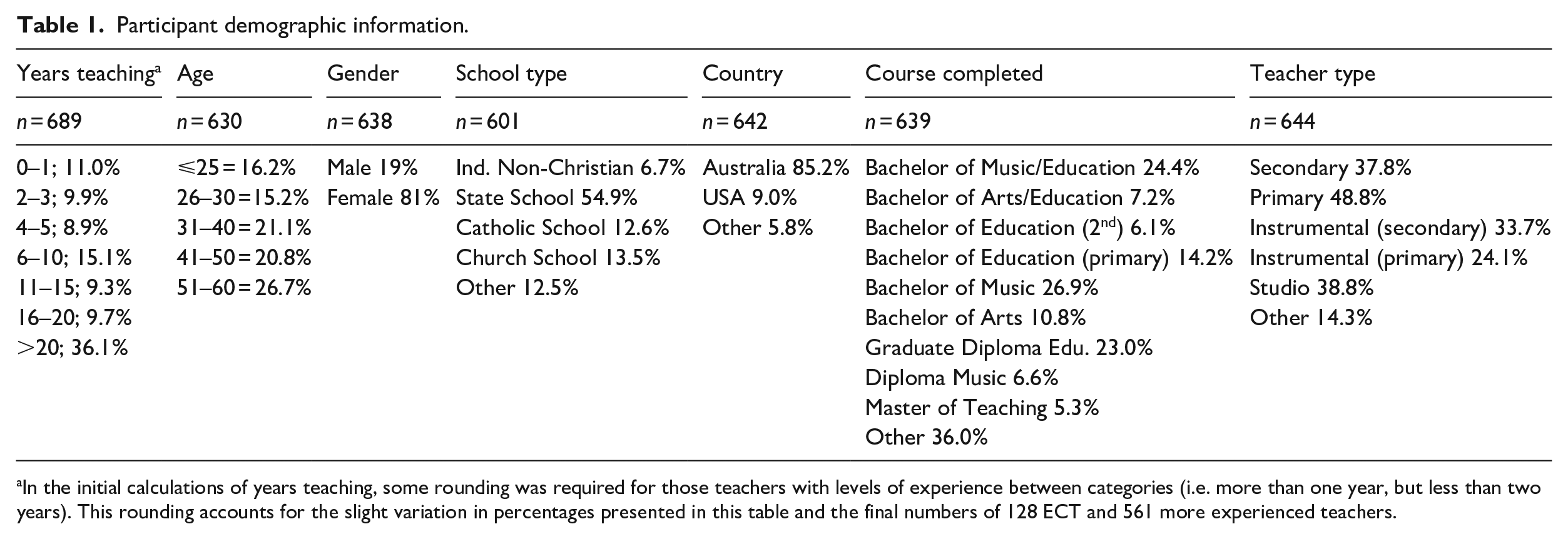
In the initial calculations of years teaching, some rounding was required for those teachers with levels of experience between categories (i.e. more than one year, but less than two years). This rounding accounts for the slight variation in percentages presented in this table and the final numbers of 128 ECT and 561 more experienced teachers.
Importance–Confidence Scale
The positioning of importance against confidence drew upon Cramer et al.’s (2009) definition of confidence, which extends the notion of self-efficacy beyond the ability to complete a given task to a person’s ‘degree of certainty about [their] judgment’ (p. 322). Drawing upon the work of Martilla and James (1977), we utilised 5-point Likert scales for importance and confidence, to compare the importance that music teachers ascribe to various aspects of the job to their level of confidence in these same aspects.
For the Importance–Confidence Analysis (ICA), teachers were asked: ‘How important are the following areas of knowledge/skills for music teachers?’, and they rated their responses from 1 (not important) to 5 (extremely important). Respondents were also asked to rate their confidence in each of the areas from 1 (not confident at all) to 5 (extremely confident). The areas of knowledge/skills (items) measured were drawn from the Ballantyne and Packer (2004) questionnaire. As recommended in that study, the item ‘musical creativity’, was not included for reliability reasons. Following Ballantyne and Packer, the areas of knowledge and skill in question were grouped according to:
Music knowledge and skills: performance skills, conducting skills, aural perception skills, composition skills and music history knowledge;
Pedagogical content knowledge and skills: knowledge of music teaching techniques, engaging students with music in a meaningful way, implementing the music curriculum effectively, assessing students’ abilities in the various aspects of music, and explaining and demonstrating musical concepts;
General pedagogical knowledge and skills: knowledge of learners and their characteristics, knowledge of education purposes and values, ability to cater for student needs, ability to plan for effective learning, ability to organise the learning environment, and ability to utilise various instructional strategies;
Non-pedagogical professional knowledge and skills: organisation of extra-curricular music activities, legal issues, managing the music budget, coordination of staff, communication with community, communication with colleagues, and communication with students and parents.
The wording of the question in the current study reflects the participants’ range of possible teaching situations, rather than referring to teacher education courses explicitly, allowing responses from teachers with any number of years of experience.
Results
Importance–Confidence Analysis
Importance–Confidence Analysis (ICA) was used to focus attention on areas that warrant further attention (adapted from Martilla & James, 1977) – in this case, when considering areas where support designed to build music teacher confidence should be focussed. In this style of analysis, the mean scores from the Importance and Confidence ratings are plotted on a grid, with four quadrants enabling the separation of items from least to greatest concern.
Descriptive statistics for participants’ ratings of importance and confidence in relation to the 23 items of music teacher knowledge and skills are reported in Table 2. Overall, participants considered all of the 23 items of music teacher knowledge and skills derived from the literature to be at least moderately important (all means >3 on the 5-point scale; see Table 3). Six items were perceived by the majority of music teachers to be extremely important (median rating of 5; means ranging from 4.4 to 4.68) and 12 as very important (median rating of 4; means ranging from 3.6 to 4.36). Only five items – conducting skills, composition skills, managing the music budget, legal issues and coordination of staff – received a median score of 3 (important; means ranging from 3.3 to 3.4) and no items were viewed as less than important.
Factor structure for the importance and confidence data.
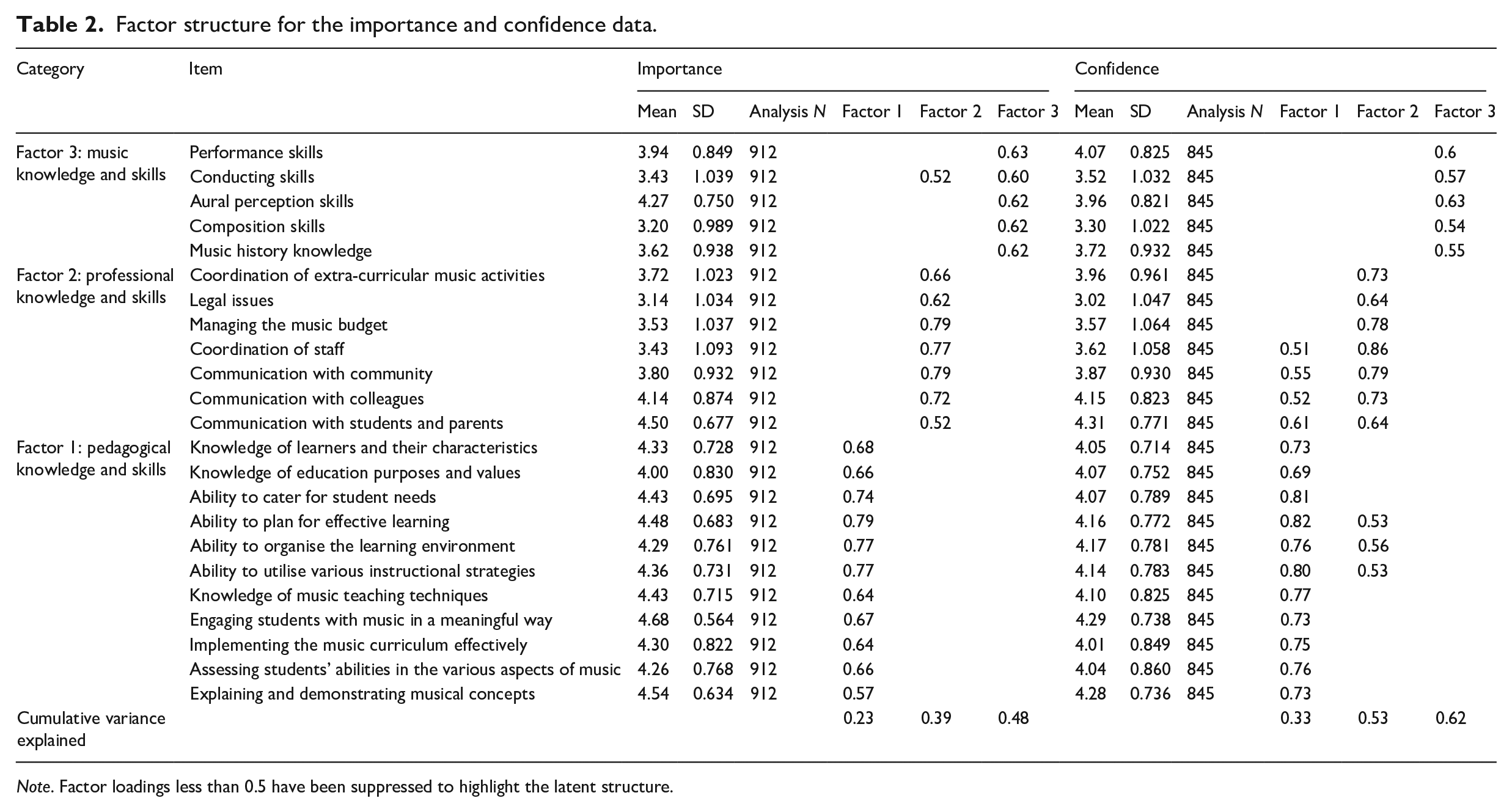
Note. Factor loadings less than 0.5 have been suppressed to highlight the latent structure.
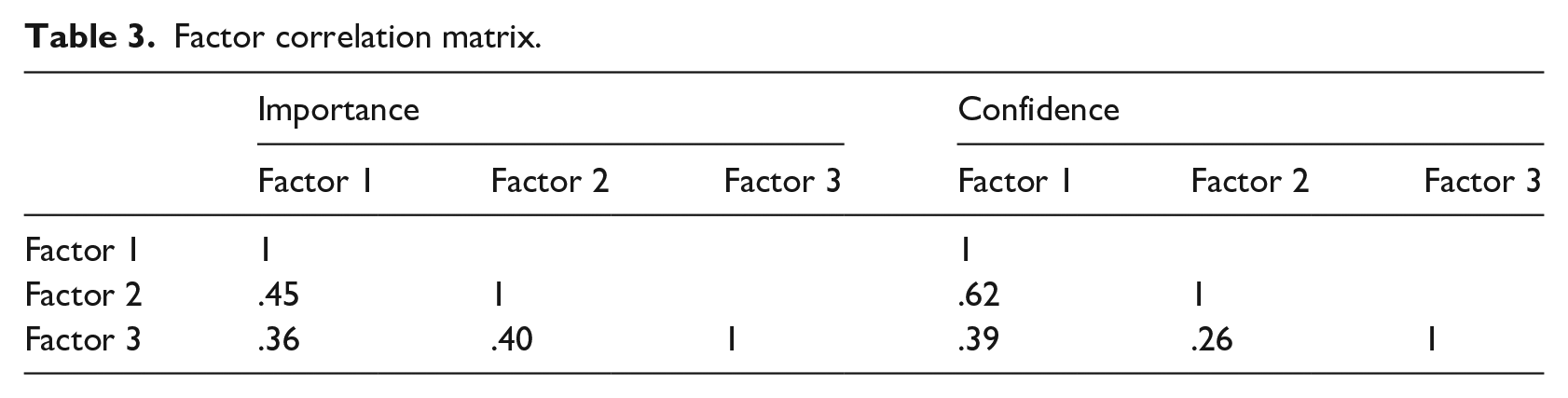
Factor correlation matrix.
The confidence that the music teachers reported across each of these items was, on average, adequately confident (means > 3; Table 3). The majority of teachers felt (on average) quite confident when considering 14 of the items (means 4.01–4.31). On average, none of the teachers were extremely confident in any of the items, and the teachers were adequately confident (means 3.02–3.96) in the remaining nine items.
Factor extraction
We used parallel analysis to identify the appropriate number of factors to extract from both the confidence and importance data (as recommended by Morton & Altschul, 2019). The factor scores were derived from the items that load highly on each factor. That is, the mean of the items that loaded onto each factor created composite scores. Using a principal factor solution, the parallel analyses identified a 3-factor solution for both the importance and confidence data. Inspection of the scree plots corroborated the 3-factor solutions.
Exploratory factor analysis
We conducted an exploratory factor analysis using principal axis factoring with an oblimin (oblique) rotation method to determine the factor structure. The 3-factor solutions and structures are shown in Table 2, and the relationships between factors are shown in Table 3.
Importance–confidence analysis
Importance–Confidence Analysis (ICA) was used to focus attention on areas that warrant further attention (adapted from Importance–Performance Analysis, see Martilla & James, 1977). In this style of analysis, the mean scores from the Importance and Confidence ratings are plotted on a grid, with four quadrants enabling the separation of items from least to greatest concern. IPA (or in this case ICA) enables the graphical representation of the combination of these two dimensions. Martilla and James (1977, p. 79) indicated that the positioning of axes in such analyses is considered a matter of judgement. In this case (see Figure 1), the horizontal axis has been positioned in such a way that items are divided into two equally sized groups – those with relatively higher importance (M > 4.1) and those with relatively lower importance (M < 4.1). Because of the generally high confidence ratings, the vertical axis was positioned in such a way that the items were divided into unequal groups – one-third representing relatively lower confidence (<3.90) and two-thirds being classified as having relatively higher confidence (>3.90). In this case, the graphical plotting shows areas where support designed to build music teacher confidence should be focussed.
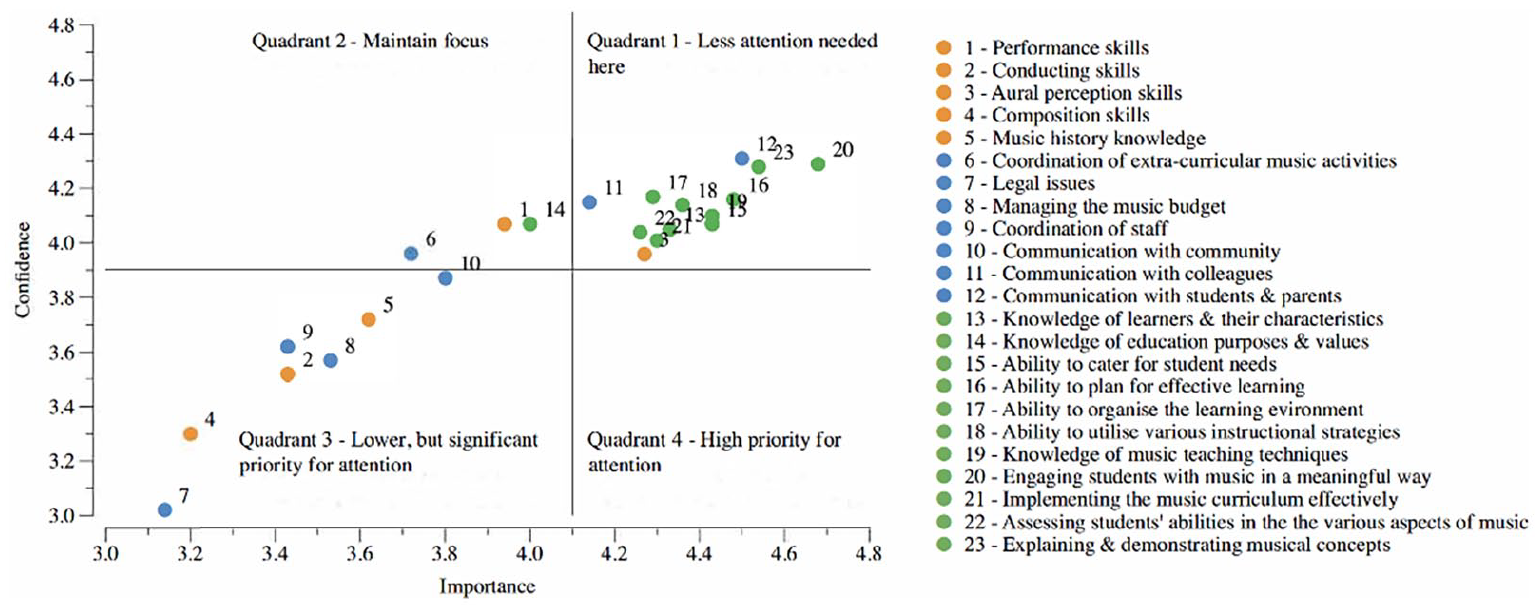
Mean scores of items comparing perceived importance to teachers versus confidence of teachers.
According to Importance–Performance Analysis (IPA) (Martilla & James, 1977; Nale et al., 2000; Rauch & Nale, 1995), items in Quadrant 1 (higher importance and higher confidence) are those which are already being adequately addressed and for which current efforts need to be maintained. Quadrant 2 (lower importance and higher confidence) may signal areas of possible ‘overkill’ where efforts could afford to be cut back. In the case of this analysis, however, we have labelled this quadrant as ‘maintain focus’, because of the relative importance of these items to the respondents. Items in Quadrant 3 (lower importance and lower confidence) are commonly considered to be of lower priority. Finally, in Quadrant 4 (higher importance and lower confidence) are those on which attention most needs to be concentrated. The results will be discussed in terms of the four quadrants into which items fall.
Comparing early career teachers and experienced teachers on importance–confidence constructs
To determine whether there was a difference between early career and experienced teachers’ perceptions of these scales, we used the same three factors that emerged from the factor analysis (reported above). To understand how teachers’ self-efficacy perceptions differ according to time in the profession, an analysis of variance on the means and standard deviations (ANOVA) of both the early career and experienced teacher groups’ responses were compared in terms of both the importance and confidence they attached to each item.
For the purpose of this analysis, Early Career Teachers (ECT) are defined as those teaching for 3 years or less (Caspersen & Raaen, 2014). In this sample, we had 128 ECT, and 561 more experienced teachers (i.e. a total of 689 teachers gave us information on the number of years they had been teaching).
Figure 2 shows the mean factor scores (composite scores, derived from the items that loaded highly on each factor) separately for importance and confidence as a function of teacher experience, and indicates that both experienced and inexperienced teachers place greater importance on pedagogical knowledge and skills relative to professional knowledge and skills and music knowledge and skills. Additionally, experienced teachers report greater confidence with respect to pedagogical knowledge and skills and professional knowledge and skills compared with early career teachers.
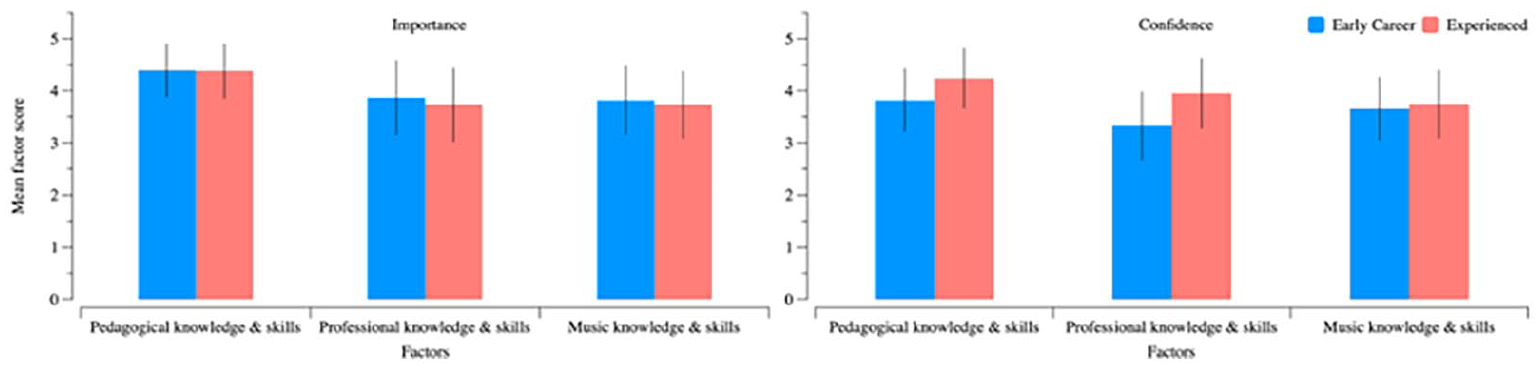
Comparative rating of factors by experienced and early career teachers.
Importance
A mixed-effects ANOVA revealed a significant main effect of factor, F(2, 687) = 240.0, p < .001. Figure 2 suggests that this effect is driven largely by Factor 1, pedagogical content knowledge & skills, where both early career and experienced teachers place greater importance on pedagogical knowledge and skills relative to Factors 2 and 3, professional knowledge and skills and music knowledge, respectively. Additionally, there is a main effect of experience, F(2, 687) = 5.38, p = .021. Figure 2 shows that the differences between experienced and early career teachers for Factors 2 and 3 are minimal – early career teachers placed slightly greater importance on Factors 2 and 3, professional knowledge and skills, and music knowledge and skills, relative to experienced teachers, t(687) = 2.91, p = .004 and t(687) = 1.99, p = .047, respectively. These differences are very small and likely artifacts of having a large sample size.
Confidence
A mixed-effects ANOVA revealed a significant main effect of factor, F(2, 675) = 93.60, p < .001, again driven by Factor 1 (pedagogical content knowledge and skills). A main effect of teaching experience, F(2, 678) = 55.23, p < .001, was qualified by a significant interaction term, F(2, 678) = 39.82, p < .001. Here, factor confidence varied as a function of teaching experience. Specifically, experienced teachers reported greater confidence along Factors 1 and 2 than early career teachers, t(675) = 7.51, p < .001 and t(678) = 9.52, p < .001, respectively. There was no real difference in reported confidence between early career and experienced teachers in relation to Factor 3 – Music knowledge and skills.
Discussion
Importance–Confidence Analysis
In terms of the importance that music teachers place on various aspects of their jobs, early career and experienced teachers all valued pedagogical content knowledge and skills alongside professional knowledge and skills over music knowledge and skills. Self-reported views on what teachers perceive to be important and what areas they are confident within, enable us to better understand the ways that they view their capacity in relation to the roles that they undertake in their jobs. These findings build upon previous work in the field indicating that early career music teachers require support, particularly in the areas of pedagogical knowledge and skills and professional knowledge and skills (Ballantyne, 2006). As highlighted in previous research, these are the areas that are important to them, and where they have reported the need for assistance. Similarly, the findings of this paper align with recent work investigating the nature of ‘praxis shock’ and experiences of socialisation in the early years suggesting that self-efficacy improves over the career (Ballantyne & Retell, 2020), which offers insights into some of the nuances of the music teaching profession as experienced across the career (Ballantyne & Zhukov, 2017).
Figure 1 provides a useful point of discussion in relation to the three quadrants into which items fall.
Quadrant 1: Less attention needed here (higher importance and higher confidence)
Items in this quadrant represent the areas that music teachers feel quite confident about, and which are also considered to be very important. On average, teachers were not extremely confident across any items in the questionnaire, so there is still a possibility for improvement in this quadrant.
Pedagogical content knowledge and skills: 13 Knowledge of learners and their characteristics 15 Ability to cater for student needs 16 Ability to plan for effective learning 17 Ability to organise the learning environment 18 Ability to utilise various instructional strategies 19 Knowledge of music teaching techniques 20 Engaging students with music in a meaningful way 21 Implementing the music curriculum effectively 22 Assessing students' abilities in the various aspects of music 23 Explaining and demonstrating musical concepts
Professional knowledge and skills: 11 Communication with colleagues 12 Communication with students and parents 3 Aural perception skills
Music knowledge and skills: 3 Aural perception skills
Items that fell into this quadrant (13–23) represent a combination of pedagogical content knowledge and skills and general pedagogical knowledge and skills. Respondents also felt that the support provided was matched with the need in relation to communication with colleagues, students and parents, as well as aural perception skills. When considering the average age/skill level of the teachers who responded to the questionnaire, it makes sense that these are areas of relative importance and confidence across the profession. This contrasts with the experiences reported by early career teachers in the Ballantyne and Packer (2004) study, who placed pedagogical content knowledge and skills in the area where respondents wanted much more support. Higher confidence in areas considered to be of high importance would seem to be a gold standard for the profession as teacher positivity and higher self-efficacy are associated with longevity in teaching and resilience to challenges. Placement in this quadrant does not mean that the profession can afford complacency; rather, it is an acknowledgement of work well done, and a reminder of areas most important to music teachers.
Quadrant 2: Maintain focus (lower importance and higher confidence)
The three items that fell in this quadrant are those aspects of teaching that are still somewhat important to teachers, and they feel quite confident in these areas. Therefore, the focus should be maintained on these areas, but the higher confidence of the teachers in these areas means that they are not areas needing urgent attention.
6 Coordination of extra-curricular music activities 1 Performance skills 14 Knowledge of education purposes and values
These three items reflect the varied nature of music teachers’ work. It is understandable that coordination of extra-curricular music activities would fall into this quadrant as it does not necessarily form part of every music teacher’s role; sometimes, it is managed by administrators. While different from each other, performance skills and knowledge of education purposes and values are both addressed in pre-service education. They are consistently present in the lives of practicing music teachers, who are frequently expected to perform, or demonstrate their performance skills – the majority of respondents were performance majors in their undergraduate degrees – and knowledge of education purposes and values tend to underpin any changes or developments in schools.
Quadrant 3: Lower, but significant priority for attention (lower importance and lower confidence)
This quadrant contains items considered somewhat important, in which respondents reported having relatively lower confidence. As no items fell into Quadrant 4, it would seem that this is the next area where some development may be needed, to increase the confidence of teachers. The two factors represented in this quadrant are professional knowledge and skills and music knowledge and skills.
Professional knowledge and skills: 7 Legal issues 8 Managing the music budget 9 Coordination of staff 10 Communication with community
Music knowledge and skills: 2 Conducting skills 4 Composition skills 5 Music history knowledge
Items 7, 8, 9 and 10 are items that may not have been emphasised in pre-service teacher education, and which gain immediate importance once teachers are faced with the realities of running a music department alone (music teachers are often isolated within schools). These items appear to be associated largely with procedural, administrative/management and communication skills. Generalised support in these areas by schools and school communities may significantly ameliorate any needs or discrepancies perceived by teachers.
Items 2, 4 and 5 warrant further discussion, because many (if not most) programmes in music education include courses in conducting, composition and music history; an area, perhaps, where professional development might enhance the confidence of practicing teachers. Provision for ongoing support in music knowledge and skills for teachers, perhaps through supported postgraduate training in music (rather than music education), may be beneficial to the majority of teachers.
Quadrant 4: High priority for attention (higher importance and lower confidence)
Any items falling into this quadrant would have indicated a discrepancy between importance and confidence. The fact that no items fall into this quadrant suggests that these respondents do not rate their confidence as low against items they consider especially important. This is an example of a ‘good news story’ for music education.
In sum, understanding what information is important for teachers – and why it contributes to their confidence – offers insight into teachers’ perceptions of what is required of them in their workplace. That experienced teachers are slightly more confident is unsurprising, but the relative similarities between early career and experienced teachers’ ratings of importance and confidence serve to highlight the need for ongoing support across the career. These insights can, in turn, shape the support provided to teachers during their university studies, and while they are teaching (Lent & Brown, 2013; Lent et al., 1994).
Limitations
It is important to note that the data reported here are self-reported. While self-report data are one of the main strategies to better understand teachers’ lives, there is no way to know from these data whether the confidence that teachers report aligns with the realities of their abilities in the areas researched. It may be that teachers feel less confident in a particular area, but objectively are performing at a very high level. The measurements here are therefore influenced by the ideas held by respondents regarding what constitutes ‘success’ in various areas of the profession.
When teachers are demonstrably excellent teachers, but they feel that their capacities as musicians are in some way lacking, they will perhaps be less likely to rate their confidence as highly in other areas (see Ballantyne & Grootenboer, 2012; Ballantyne & Zhukov, 2017).
Additionally, when asking whether the items were important, we did not equally ask whether they were a feature of teachers’ work. It was assumed that if something was not a feature of the work, that it would therefore be deemed unimportant, but future work could certainly distinguish between ‘importance’ and ‘relevance to the role’.
We recognise that the geographical spread of respondents may influence perceptions of the generalisability of our results. This study captures self-identified music teachers’ perceptions of the importance and confidence they feel at a point in time. Obviously, this is influenced by the particular context (e.g. location, school type, curriculum) that they may find themselves in and therefore this data is not generalisable.
A final consideration is that this study does not incorporate data from those who have left the profession. Previous work by Gallant and Riley (2014) has suggested that those who leave are often those who feel unsupported, and who experience arrested development, which is similar to the praxis shock described in previous research with music teachers (Ballantyne, 2007; Ballantyne & Retell, 2020). The paper provides a snapshot of the profession at a point in time and incorporates people who might be on the brink of quitting, as well as those who are very satisfied. More work should be done in this area following graduates through their various careers, over significant periods of time, as well as more in-depth investigations of those who do leave the profession.
Conclusions to be drawn from the Importance–Confidence Analysis
Analysis of the descriptive statistics reveals that music teachers, regardless of their number of years in the profession, feel that the most important knowledge and skills are pedagogical knowledge and skills, although they still value the other factors—professional knowledge and skills and music knowledge and skills. However, when we separate the responses for those teachers who are early in their career and those who are more experienced, teaching experience slightly influences ratings of importance in professional knowledge and skills and music knowledge and skills. The ratings of pedagogical content knowledge and skills, however, remain the same, regardless of years in the profession. These skills maintain their importance throughout the career. While we know that pedagogical content knowledge and skills are seen as important to early career teachers (Ballantyne, 2006), the demonstrable importance to more experienced teachers has not been fully established in prior work. Professional knowledge and skills may be seen as less important by more experienced music teachers, perhaps because these skills become automatic the longer that a teacher is in the workforce, or because they have less of a focus on students’ learning. However, these differences are so slight as to be unimportant.
In terms of confidence, experienced teachers reported greater confidence in pedagogical content knowledge and skills and professional knowledge and skills than their early career counterparts. This result is expected in a healthy workforce, where time spent teaching relates to increased confidence in the skills and knowledge needed to succeed. However, it highlights the importance of providing increased support for early career teachers in both pedagogical and professional knowledge and skills.
It is possible that the lack of difference between the confidence felt by the experienced and early career teachers in Factor 3 – music knowledge and skills – is because many early career teachers graduate with a keen sense of themselves as musicians and have corresponding confidence in their ability to perform as musicians. Musical ability and skills are also valued by more experienced music teachers who place the musician identity at the centre of their professional identity (Ballantyne & Grootenboer, 2012). It may be that music teachers’ skills and knowledge priorities are predictive of their self-efficacy beliefs, confidence and workplace behaviours, all of which contribute to their motivation, job satisfaction and well-being (Ballantyne & Grootenboer, 2012).
As can be seen in Figure 2, although the ICA analysis of the sample as a whole indicated that there was less need for support overall, the discrepancies observed between the early career teachers and experienced teachers in the sample suggest that support should be offered to early career teachers in the areas where they are less confident than their experienced counterparts – particularly in the areas of pedagogical content knowledge and skills and professional knowledge and skills. Relating this finding back to the broader discourse of teacher longevity and career construction theory, such skills development would likely enhance teachers’ work-related adaptability.
There seems to be general consensus among the music teachers in this study that pedagogical content knowledge and skills, professional knowledge and skills, and music knowledge and skills are relatively important, with the most important being pedagogical content knowledge and skills. The discrepancies in confidence in pedagogical content knowledge and skills and professional knowledge and skills (areas that all teachers valued highly) between early career versus established career respondents are to be expected. However, the Importance–Confidence Analysis indicates that there is more work to be done in these areas to ensure that teachers have opportunities across their careers to increase their confidence and abilities in these areas. This result aligns with the findings of Ballantyne and Retell (2020) that ongoing support is required to address burnout throughout the music teaching career.
Looking to the future
Teaching is an increasingly challenging profession in which teachers must balance wide-ranging views of their status, their efficacy, increased workloads and complex social issues (Heffernan et al., 2019). This paper reports on data collected before the pandemic, and therefore the perceptions of these teachers capture their views prior to needing to adapt to the needs of the pandemic. What we know, however, is that teachers at every stage of their career are under more stress now than before, and the pandemic has crystallised and sharpened the catastrophic staffing shortages ahead in education. Recent research from the United States indicates that although stress has consistently been a driver for teachers leaving the profession, the conditions that teachers find themselves in since March 2020 have produced a perfect storm driving burnout and early retirement for up to a third of currently employed teachers (Diliberti et al., 2021). A response to this situation might be found in the findings from this study, which argues that assisting teachers to feel more confident in areas that they feel are important to their jobs, is needed. Moving beyond the idea of individual agency and looking in greater detail at processes that support adaptation throughout the career (Canham, 2021, 2022) might also provide hope for the future of the profession (McLennan et al., 2017). It is increasingly incumbent upon universities to prepare students for futures that have not yet been experienced. Perhaps it is time for universities to employ pedagogies where lecturers are genuine learners/explorers alongside students – co-framing and solving problems, to develop the skills to solve unknowable/future problems. Stemming teacher attrition from music education also requires more research into the similarities and differences between agency and adaptability – particularly post-COVID (Canham, 2022).
And what does this mean for our understanding of music teachers’ professional identities? By examining the ways that teachers view various dimensions of their job and highlighting the areas where they need more attention/help, we can learn about both the areas that they value (the areas that are important to them) and also their perceived capacity to undertake those tasks that they find to be important. From this work, for example, we know that across the career, issues associated with teachers’ knowledge and flexibility in knowing how to teach (pedagogical knowledge and skills) and their ability to navigate rapidly changing teaching and learning environments (professional knowledge and skills) are areas to consider in designing any support for in-service teachers. Education and professional development resources could add new dimensions to the findings here, as could further research exploring emergent areas of need. As we exit the pandemic, areas such as mental health and wellness (Hill et al., 2020) will likely be more important than ever before.
Footnotes
Acknowledgements
We would like to gratefully acknowledge and thank James Retell who provided the statistical analysis of our data for this paper. Thanks also to the participant teachers, and to the reviewers of IJME for their helpful comments in shaping our work.
Funding
The author(s) disclosed receipt of the following financial support for the research, authorship, and/or publication of this article: This work was supported by The University of Queensland Foundation Research Excellence Awards.
