




Abstract
This study aims to analyze the distance guitar education provided by universities during the pandemic process based on the opinions of guitar educators. Twenty-six guitar instructors (academicians) who taught guitar in 24 universities participated in the study, and the data were collected through semi-structured interviews. Findings were interpreted under five categories, which were technical resources, functionality, motivation, guitar studies, and evaluation. It was found that technical problems, for example, audio delays, disconnection, and freezing were encountered. Although technical issues on the guitar can be overcome to a certain extent, it was reported that works such as musicality, and nuance were not reflected in the course. It was also emphasized that the technological possibilities are insufficient in reflecting the depths of the sound coming out of the guitar, and individual instrument guitar lessons must not be considered separately from face-to-face education. It was concluded that distance education leaves out the emotional aspects of music, and distance education can continue to support face-to-face education in the future.
Introduction
The global Covid-19 pandemic has directly affected sectors such as health, education, and finance (Telli Yamamoto & Altın, 2020). Many countries decided to continue with distance education after they had to interrupt face-to-face education. The first Covid19 case was reported in Turkey on March 11, 2020, and all the schools and educational institutions were temporarily closed from March 25 upon instructions by the Ministry of Health (Council of Higher Education (YÖK), 2020). The Council of Higher Education (YOK) took fast action and decided to provide distance education for spring 2020 (YÖK, 2020). The distance education method became dominant in education and instruction globally and in Turkey.
Distance education involves teachers and students in different locations working together through online platforms or physical materials exchanged through the postal service (Isman, 2011). Distance education means that the education reaches the students in a web-based way with the help of developing internet technologies and computers (Newby et al., 2006). Distance education can be applied in various ways depending on the content of the instruction schedule as well as the target audience and the state of the available technological systems. These are generally divided into three groups synchronous (time-dependent), asynchronous (time-independent), and mixed (semi-time independent) education models (Yungul & Can, 2018). The interaction of student and teacher at the same time is defined as simultaneous (synchronous) interaction, and the interaction of the same at different times is defined as nonsimultaneous (asynchronous) interaction (Kaba, 2019). The mixed education model refers to the combination of face-to-face education and internet-based education (Güler & Şahin, 2015).
Research on distance music education and learning has become a focus since the 2000s (Koutsoupidou, 2014). With the possibilities introduced by the internet, universities all around the world started to provide distance music education in this way (Herbert, 2007). Online instruction allows colleges and universities to provide online professional development to working teachers (Groulx & Hernly, 2010). The University of Boston, University of Duquesne, the University of Hawai’i at Manoa, Newcastle University, University of Ottawa, and the University of Sheffield are examples of the universities which already provided distance music education before the pandemic (Herbert, 2007; Sağer et al., 2014). Distance music education has become an important opportunity for music instructors and students from all over the world (Riley, 2009)
Instrumental education, a vital part of music education, can be provided effectively in distance education. World-renowned guitarists such as Gambale (1989), Gilbert (1993), and Martin (1990) presented videocassettes for the application of guitar techniques, exercises, and etudes in addition to the books they wrote. Web-based distance guitar lesson examples started to increase thanks to the developments in technology and the internet. Today, guitar lessons websites offer a wide range of opportunities through performance and educational videos, live Q&A sessions, blogs, and forums covering guitar topics for guitar students (Lee et al., 2018). Examples to guitar lessons websites such as onlineguitaracademy (2021), justinguitar (2020), classicalguitarcorner (2021), and thisisclassicalguitar (2020), are global platforms for courses can be taken in different guitar types and music genres. In addition to this, distance guitar training has also taken its place in universities. For example, Berklee Online, which is a subdivision of the Berklee College of Music in Boston, offers a variety of online guitar courses, including a full Bachelor’s Degree (Berklee College of Music, 2020). As in the rest of the world, VCDs and DVDs presented by guitarists along with their methods are early examples of distance guitar education in Turkey (Erim & Yöndem, 2009). For instance, in his guitar method named “Guitar and Art of Flamenco,” Yeprem (2004) presented a VCD in which flamenco guitar techniques, exercises, etudes, and works were explained with examples of practices. In terms of web-based distance guitar education, the website ( http://klasikgitarcalmakistermisiniz.com/index.php ), created by guitarist, composer, and guitar instructor Behzat Cem Gunenc in 2015 is one of the important examples in Turkey. Teachers provide lessons through social media and video-sharing platforms. Studies on distance guitar education are still developing in the world and Turkey.
Apczynskı (2008) explored the pros and cons of guitar education provided through websites. Before the expansion of the internet, many difficulties were experienced by students seeking guitar lessons. With the development of technology and the spread of the internet, websites for guitar education along with online study materials and audio-visual lesson possibilities with popular and famous guitar artists emerged. Brändström et al. (2012) focused on the masterclass and electric guitar education in “Vi r Music” project and investigated the differences between distance education and face-to-face teaching. They found that it is not possible to determine a difference between distance education and face-to-face lessons; however, thanks to distance education, students have the chance to work with the best instrumentalists at low costs. Yungul and Can (2018) developed a web-based experimental study to test the feasibility of the Web-Based Distance Education (WBDE) method in guitar education for Fine Arts High Schools within the scope of synchronous and asynchronous model for guitar education. It was concluded that the WBDE method is more effective than traditional education methods, being feasible, useful, functional, and effective in curriculum processing, and available for use as an alternative to traditional instrument education.
With the COVID-19 pandemic, a different perspective such as “distance education during the pandemic” has been added to the studies with regard to distance education (Hebebci et al., 2020). The number of studies on distance education practices in various parts of the world is increasing day by day during the pandemic. Studies can be classified as addressing transition to remote education methods for the countries during the pandemic (Durak et al., 2020; Rebukha & Polishchuk, 2020), the obstacles and deficiencies of distance education during the pandemic (Bickle & Rucker, 2020; Hoq, 2020; Katzman & Stanton, 2020; Kidd & Murray, Velle et al., 2020), teacher and student opinions on distance education during the pandemic (Hebebci et al., 2020; Keski̇n & Özer Kaya, 2020). Studies that focus on distance music education during the pandemic (Thornton, 2020) and the evaluation of student and instructor opinions on distance learning during the pandemic (Ozer & Ustun, 2020) examined the effects of the pandemic on music education. The focus of this research is the distance guitar education provided at universities during the pandemic.
Purpose of the research
In the pandemic period, which we are still living in, the courses at universities have to be continued as distance education in Turkey. It was reported by many healthcare authorities that we were caught unprepared by this outbreak, and it may bring various problems in the process. This study explored the current situation by interviewing the academicians who teach guitar as an individual instrument during the pandemic.
To that end, answers to the following questions were sought:
What are the technical resources of guitar instructors and the technical issues they face in distance education?
What are the opinions of guitar instructors on the functionality of the distance individual guitar lessons?
What are the opinions of guitar instructors regarding the consequences of distance education on guitar studies?
What are the motivations and evaluations of guitar instructors on conducting individual instrument lessons as distance education?
Method
This is a qualitative case study that provides descriptive details and increases understanding of a particular phenomenon (Brown, 2008). There are different aspects to case studies. We used multiple cases which are also called collective case studies. Multiple cases afford a deeper understanding and comparison of a topic (Creswell, 2002; Stake, 1995). In this study distance guitar education is the issue during the pandemic and 26 instructors’ opinions from different institutes are the case. In this context, technical facilities, course functionality, and motivations of the educators who provided distance education on guitar and the reflections of these on their technique and nuance were examined.
The participants
The participants were determined by criterion sampling, which is one of the purposeful sampling methods in qualitative studies (Büyüköztürk et al., 2013). According to the criterion sampling technique, individuals who meet the previously determined criteria must be included in a study (Christensen et al., 2015). The first criterion, being an instructor conducting distance guitar lessons at universities during the pandemic process was taken into account. It was estimated that the number of instructors who provided guitar lessons at the undergraduate level was close to 60 in Turkey. As a second criterion, teachers giving guitar lessons in music education faculties were added. By these criteria, the number of participants was 34. These instructors were contacted via e-mail. The research was carried out with 24 different music education departments and 26 instructors who agreed to participate in them voluntarily.
Data collection and analysis
The data were collected with semi-structured interviews, which are one of the qualitative data collection techniques in which the researcher asks participants a set of previously determined open-ended questions (Ayres, 2008). The semi-structured interview questions were created by the researcher by taking the opinions of experts in the field of guitar education and experts who had qualitative research experience. After the interview questions were completed, a pilot scheme was performed involving two participants to test the framework. Following this pilot study, interviews for the main study were conducted. They took place between 20 and 40 minutes and were made as video calls or phone calls depending on the requests of the participants.
The data that was obtained from the interviews were analyzed deductively. According to the deductive approach, researchers can analyze, classify and present data related to predetermined categories or patterns (Pearse, 2019). Developing the literature of categories provides analysis depending on information and it serves as the establishment of a strong relationship (Casula et al., 2021). When the categories were created, firstly, a literature review was made. Since the number of guitar studies in distance education was limited, music education studies were also included. We consulted with two experts who completed their Ph.D. in the area of guitar and music education and have published qualitative studies in internationally recognized journals and presented the first categories to experts in the study. Three forty-minute sessions were held on separate days. It was discussed whether there would be any categories other than the ones that measured the distance guitar education process during the pandemic process. The arguments were presented by brainstorming. As a result of the meetings held with experts and based on previous studies, it was concluded that these six categories would measure a qualified distance guitar teaching process (Figure 1).
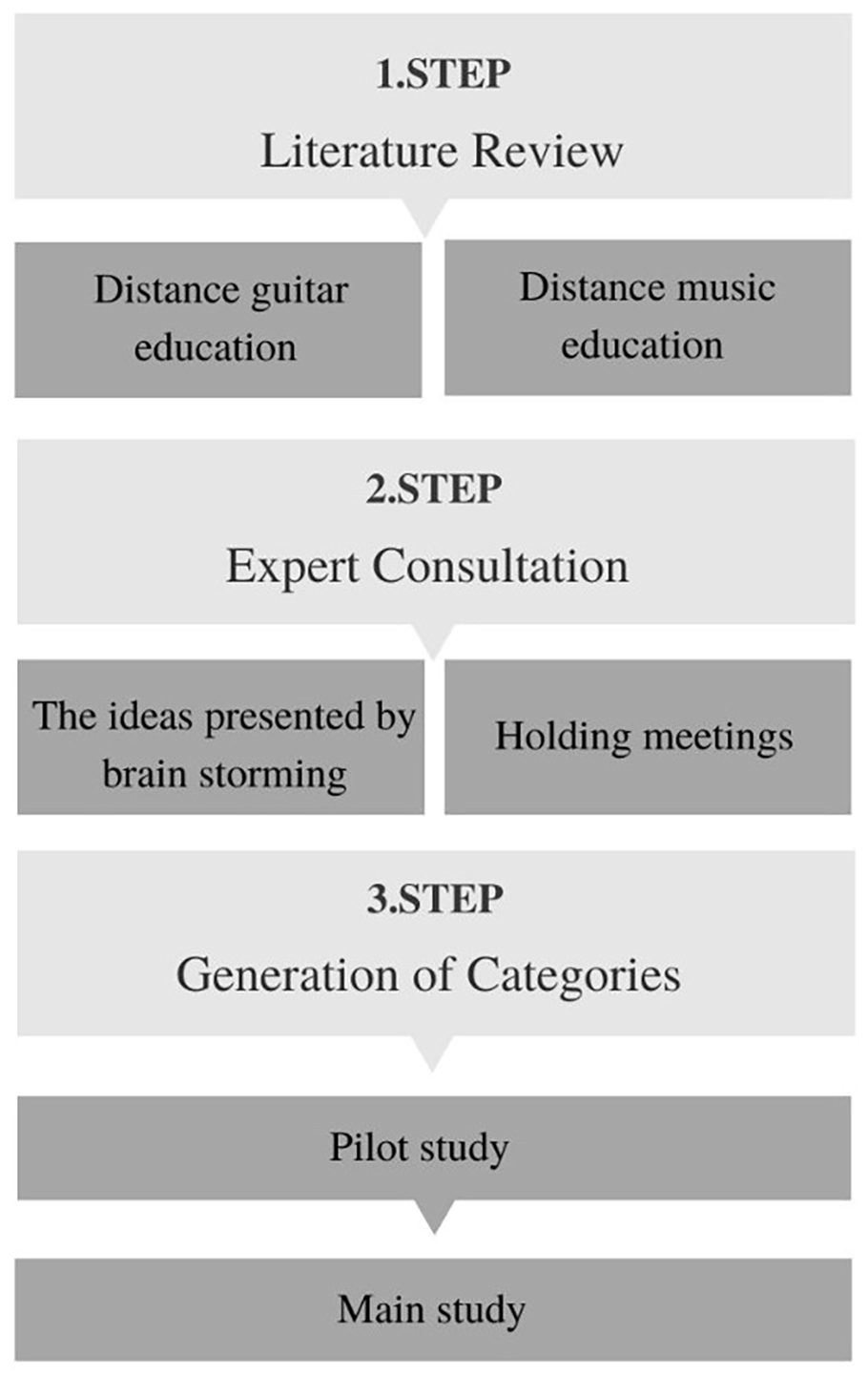
Categorizing process.
To ensure the credibility of the study, various methods such as expert reviews, pilot schemes, and ensuring agreement through joint discussions were used. The reliability of the study was calculated by using the formula “Reliability = Agreement / (Agreement + Disagreement) × 100” (Miles & Huberman, 1994). Five interviews were evaluated by two experts. The reliability rate among researchers was found to be 90%. During the evaluation of the interview questions, code names were used for each instructor to ensure the confidentiality of the participants. The participants were coded as P(1), P(2), P(3), . . ., and P(26).
Results
The results were analyzed under five categories, which were technical resources, professional experience, functionality, motivation, guitar studies, and evaluation.
Technical resources
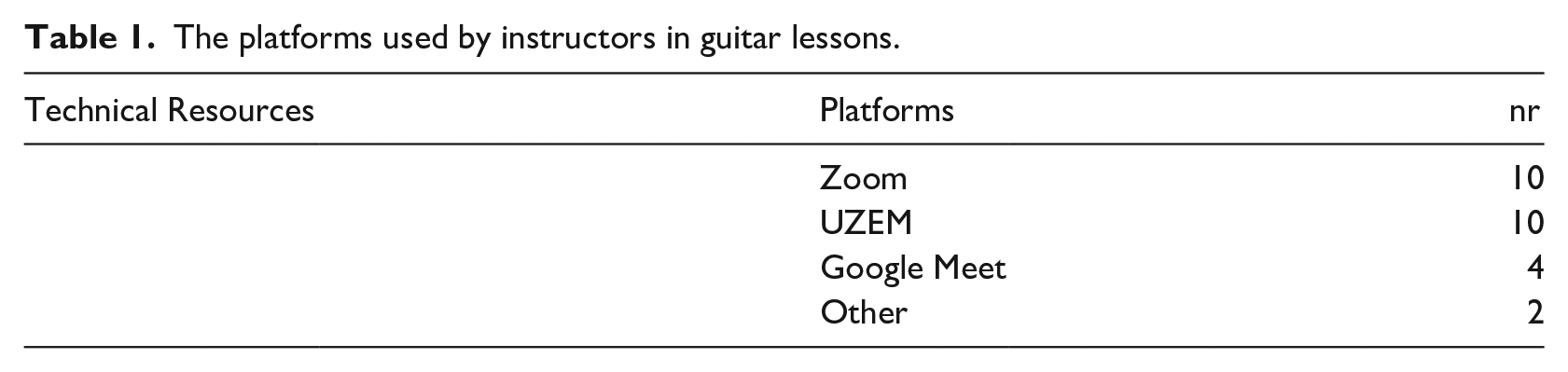
The platforms used by the instructors in guitar lessons are given below (Table 1):
The platforms used by instructors in guitar lessons.
Instructors stated that they experienced technical difficulties such as technical overload, occasional disconnections, freezes, and synchronous incompatibility. It was also stated that some students did not have sufficient technical means.
“Connection problems occur from time to time, but I have not encountered any problems that would affect our teaching.” P(4) “Internet connections of the students and microphone issues can be a problem.” P(5) “My students are well interested in technology and they have the necessary technological equipment. I do not experience serious technical issues, but sometimes there may be disconnections depending on the connection quality.” P(22)
The majority of the lecturers continued their lessons synchronously in the process. It was observed that a few teachers provided lessons asynchronously in line with the preference of the university.
Functionality
It was observed that functionality was classified in two as sufficient and insufficient depending on the perceptions of the instructors. It was stated that the functionality in distance guitar education is sufficient for this process not to interrupt the education during the pandemic period and to continue the usual course structure with the students in the same way.
“In the individual guitar lesson, if the students create a technical background beforehand and if they know about my style, I successfully conduct the lessons as if it was a face-to-face lesson.” P(20)
“I have not had any functionality issues. Especially with the students who have already reached some certain level, I have never had any problems.” P(19)
Besides all these positive opinions, instructors also stated that the functionality was affected negatively due to lack of student-teacher interaction along with problems in mastering the lesson and synchronization.
“I think the quality is low in terms of the functionality. Beginners have more troubles than others. I also have problems mastering or dominating the lesson. I cannot step in to show things by touching their hand. I cannot explain details such as techniques. At the same time, because of synchronization issues, we cannot talk about a quality flow.”P(5)
“The only functional part of distance learning might be the flexibility of course duration. However, about individual instruments, it is hard to communicate with students in distance learning comparing to face to face courses. I think, techniques, posture, and other details that students can learn by watching are not as effective as they are in face-to-face lessons. We try our best to use it in its most effective way if necessary.”P(24)
Motivation
Participants stated that distance education has positive and negative effects on motivation. Instructors mentioned its positive effects on motivation like being able to participate in the lessons at any place along with the flexibility in lesson length and being triggered by the pandemic to think in a novel and different way.
“Distance education has a positive effect on my motivation thanks to its features such as saving time and being able to take lessons in any location of our choice.” P(8)
“Its positive effect on my lesson motivation is that I can deliver the lesson as a whole without any interruption or interference (Synchronously and asynchronously). At first, talking to the camera lowered my motivation a bit. Once adapted, I conducted my lessons easily.” P(11)
“It has positive effects on my motivation. It is quite awesome for me to be able to conduct lessons at home without time restrictions. There is no other factor that interrupts the course and it is a good thing for the integrity of the lesson. Sometimes my lessons last up to two hours or three.” P(16)
Participants also stated they could not find the same warmth, sincerity, and interactions in distance lessons as they experienced in face-to-face lessons. Education professionals who thought they could not provide productive lessons stated that this issue lowered their motivation.
“It did not have any positive impact on my motivation. I would like these classes to be organized live as one-on-one lessons with kinesthetic bonds. Technically, trying to hear the tone of the instrument and playing together with the student both at the same time while trying to feel the energy and predict their psychology is challenging, so it did not bring me anything positive.” K(5)
“My motivation was negatively affected. Personally, I like to move during the lesson. Sitting in front of the camera without being able to touch or interfere was troublesome for me in the lessons. I fail to like distance education.” P(10)
Guitar studies
How the technique, nuance, and musicality are reflected in the lesson is believed to be related to technological resources used in the guitar lessons of academic personnel. It was mostly noted that during these lessons, the sound coming out from the guitar was thought to be “colorless,” without tone, and insufficient.
“Regardless of the communication tool used, there is no technology that can reach the privileges of the tones of the real guitar voice. In this respect, nuance may be incomplete but the lesson can be done anyway.” P(16)
“There are some problems with the tone of the sound coming out from the guitar along with its color and nuance and musicality. It cannot be reflected in the lesson in an efficient way. We can get the density of the volume somehow, but the sound comes out in a metallic manner, which affects the tone. Therefore, in this respect, it is not that effective.” P(25)
The education professionals also mentioned studies of chamber music, which is an important part of the guitar courses. The common opinion of music instruction professionals who conduct chamber music courses was that these lessons could be taught face-to-face. They stated that they had problems conducting distance lessons. As they generally studied with students on their partitions, there was no chance to play together, therefore, they worked on the history of chamber music or on combining partitions, which were played with various programs.
“As the synchronization cannot be achieved, we do our chamber music lessons mostly focused on theory. We work on topics like the history of the orchestra. Apart from this, I deliver orchestral pieces to the students and they work on their part.”P(3)
“Chamber music courses are the most problematic ones in this period. This lesson is meaningless if we cannot come together and perform. Each student plays his/her partition.” P(11)
Evaluation
When the general evaluations of the instructors were considered, it can be argued that instructors agree that lessons should not be conducted as distance lessons in the future. Although the idea that individual instrument lessons should be done in face-to-face format is at the forefront, it was stated that distance education can be used as a support to face-to-face education, and this mixed-method, in which these two are combined, will be quite effective.
“I think distance education might not be sociologically the best way for the lands we live in. Because we live in a society where people like to contact and touch. I believe education should be organized in line with the expectations of society and people. Maybe distance learning might be a good fit for western countries but I don’t think it would fit in a quiet social society like ours.” P(5)
“I think it will be useful if the digital world is used in a good way. Distance education will be developing with the new programs. I think its time-saving side is a positive aspect for us. However, I do not support distance education. Human beings are social creatures. Face-to-face training should definitely take place. I think that both types of education should be used in the process.” P(25)
“My approach to distance education is positive in general. I think it will get better with further technological developments. However, I believe the master-apprentice relationship in the traditional method cannot be ignored and we should not separate them considering the emotional aspects of the music. Online education can be used to its maximum extent if necessary.” P(15)
“Under these fast-changing circumstances in the world, I think people who can control themselves and to organize their own learning will be much more successful. Flexibility in terms of location and time is a very good asset. Combined models can be much more advantageous. Models can be formed in which both online and face-to-face lessons are done together. Face-to-face education is highly important in terms of getting the emotion. This kind of innovation should not be ignored in this era. We have to benefit from its good sides. I am planning to use online education always as support.” P(19)
“I think the Covid 19 outbreak forced education professionals to explore the possibilities of our age and adapt to its requirements accordingly. The process which we can name “individual learning” started thanks to improving communication means. Maybe we haven’t been in this process as education professionals. In this educational environment created due to the epidemic we’ve experienced, I had the opportunity to think more about the process we have been through and also about what can we do education-wise in the future. Therefore I can say that my motivation is quite high.” P(21)
Limitations and Suggestions
The research focused on the instrument learning part of music education in distance learning. However, the undergraduate level was taken as the criterion. A wider perspective on distance guitar education can be presented by adding studies on different levels of education. In this study, reviews were created according to the opinions of the educators only. In future research, the findings of this research can be expanded with student reviews as well.
In qualitative research, it is recommended to diversify data collection methods (triangulation) (Bogdan & Biklen, 2007). The data in this study were collected through interviews only. However, since the interviews were conducted with 26 educators, it is deemed that the findings of this research were satisfied. Yet, in future research, the findings can be expanded by using more than one data collection method.
The findings obtained in this research focus on distance guitar education conducted only in Turkey. More detailed results can be achieved by adding studies on distance guitar education also in different countries. Current data of the research sum experience of education professionals for one semester only. Considering the fast spread of distance education, it can be suggested to do similar studies combining it with the experiences earned after longer education processes.
Another important topic of discussion in the research is technological resources. The relationship between distance instrument learning and technological opportunities can be examined under a separate topic.
Discussion and Conclusion
Although there are differences between universities in terms of transition to distance education due to the current pandemic, in general, it was observed that universities offer sufficient resources to conduct lessons synchronously or asynchronously. Some technical issues such as sound delays, connection losses, or freezing were encountered in this regard. In their studies, Riley (2009) and Maki (2001) also underlined the technical issues caused by sound delays. In their research which examined piano lessons through Skype at the university, Kruse et al. (2013) stated that technological challenges obstruct lessons. It was noted that some features of the platform such as document sharing, scores mirroring, and taking notes on them were actively used during the lessons which were synchronously held. Even though some of the instructors were experienced in distance education, it appeared that most of them started distance education lessons during the current pandemic thus they experienced an educational environment created due to the pandemic. Instructors also stated that they knew about distance guitar education platforms and used them occasionally.
Some instructors said the functionality of the lessons was enough to continue the education and to keep students engaged in the process. However, the majority of the instructors expressed that quality was not enough due to technical issues such as lack of teacher-student interaction (contact), mastering difficulties, and synchronic issues. In this sense, it can be said that the quality of audio and visual interaction is important for success and quality in teaching (Dye, 2016). It was stated that sending works of students as video recordings not only contributed to their improvement but also helped the instructor to evaluate them so that useful and functional evaluations and feedbacks were possible.
One of the opinions, which is at the forefront, is that even if studies on guitar techniques have been achieved somehow, others like musicality and nuance could not be reflected in the lesson at an acceptable level. In this respect, technological possibilities are not sufficient to reflect the depth of the sound coming out of the guitar. It was observed that technology failed to transmit the emotions and musical dynamics during musical activities as well as it reflected the guitar sound in a metallic form. This finding of the research is in line with the conclusion of Orman and Whitaker (2010), in which it was stated they lacked the technology which was sufficient to transmit the quality of the sound during distance education.
Even if technological resources were tried to be used in chamber music for guitar lessons, it was stated that distance education was not sufficient to conduct this kind of lesson. Instructors said the distance education model was impracticable for chamber music lessons and they defended the idea that these lessons should be face-to-face education. In his research, Aldemir (2020) examined education during the pandemic based on the opinions of violin students and teachers and concluded that the video conference programs used in this respect were not designed for music works, and therefore, synchronic issues were experienced, which made impossible to study, rehearse, and play together in duet form. Brändström et al. (2012) stated that one of the biggest challenges in distance education was that the rhythm could not go simultaneously while playing together. The research of Riley (2009) that was conducted on music teaching through video conference emphasized that internet connections, sound and image quality should be improved and other factors such as time delays and echo should be minimized.
Some of the educators stated that they had some positive effects from distance education on their motivation thanks to its advantages such as being able to provide distance education in any location of their choice, time flexibility, and having control over some factors that could affect the integrity of the lesson. However, some of them stated that distance education lowered their motivation due to a lack of a warm environment, sincerity, and one-on-one interactions as they used to have in face-to-face lessons and also because of some technical issues encountered and unproductive lessons.
The general approach to distance education of the participants is positive. Although it is stated that there are shortcomings of individual instrument lessons with distance education, it is stated that it is important to continue education during the pandemic process. Clear opinions came forward on individual instrument lessons should not be considered independent from face-to-face education. Academic staff members agreed that distance education could be used as a support for face-to-face education in the future. In the research, in which the use of internet-based video conference platforms in instrument teaching was examined, Dammers (2009) concluded that video conferencing was functional but not equivalent to face-to-face learning. In their research on distance education in Turkey during the pandemic, Durak et al. (2020) stated that distance education applications could be used to support face-to-face education.
Another topic that stands out in the evaluations of the education professionals is their thoughts on what kind of education should be in the future. Some opinions became prominent concerning the fact that students who could organize their self-learning in education would be successful, emphasizing today’s music students and teachers should use music technologies unquestionably and those who use technology effectively would survive in the future. In the article on distance music education, Thornton (2020) predicted that education will change after the pandemic of 2020. Another perspective that the participants pointed out is the idea of human beings as social creatures and distance education was not sufficient in this respect, therefore it was not suitable for Turkish society which loves social interaction and sincerity. Furthermore, the importance of the master-apprentice relationship was emphasized and it was noted that it could not be reflected properly in distance education so it lacked emotional aspects of the music.
Footnotes
Declaration of conflicting interests
The author(s) declared no potential conflicts of interest concerning the research, authorship, and/or publication of this article.
Funding
The author(s) received no financial support for the research, authorship, and/or publication of this article.
