




Abstract
This article explored the relationships between the learning experiences and musical proficiencies of a formal and an informal popular musician in Malaysia. The presence and impact of formal popular music education within popular music culture is become increasingly harder to ignore, and while this phenomenon had been examined by numerous popular music scholars, there is a lack of attention towards the implications of learning experience on acquired musical proficiencies. In this study, participants took part in semi-structured interviews that enquired about their music learning histories and musical skills tests that examined their sight-reading, play by ear, and improvisation proficiencies. The aim was to compare and ascertain the disparities between both musicians’ learning histories and musical proficiencies, as well as to identify any potential relationships between learning methods and musical proficiencies. The findings showed that the musicians developed contrasting habitual music-making practices, attitudes and dispositions and musical proficiencies. Furthermore, the informal musician outdid the formal musician in almost all aspects examined in the musical skills tests. Implications from this article include the need for providers of formal popular music education to approach the study of popular music on its own terms, and develop methods of structured learning that enhances the development of virtuosity within the culture of popular music.
The examination presented in this article draws from a wider doctoral study exploring the impacts of music learning experiences on the musical proficiencies of popular music instrumentalists and singers who play Anglo-American popular music forms. The research employed an explanatory sequential mixed methods design (QUAN → QUAL) and collected data through questionnaires from 133 participants from numerous territories around the world, from which 8 participants from Malaysia were selected for interviews and musical skills tests. This article presents the findings that derived from the interviews and musical skills tests data from two popular musicians in Malaysia.
Introduction
The acquisition of musical skills and the experiences of learning to sing, or play an instrument, are intrinsically linked, and studies had been conducted to examine the correlation between pedagogies and musical proficiencies. 1 However, studies that examined this relationship within the context of popular music are lacking.
Popular music-learning and -making cultures
The music-learning and -making cultures of popular musicians, for a very long time, had been characterised as an aural tradition that operated in the informal realm. The process usually begins with the ambition to pick up an instrument to play after being inspired by a song, a musician or a friend who played instruments. From there, there would be attempts to privately ‘get songs’ they liked by listening to recordings and emulating identified sounds on musical instruments without guidance from a more experienced musician (H. S. Bennett, 1980, p.134). This method of ‘getting songs’ is what Green (2002) termed ‘listening and copying’ (p. 73). After achieving some proficiency on their instruments through individual endeavours, they continued developing additional skills in group music-making contexts and through peer-learning events. These activities were argued by Green (2002) to be central practices of popular music, which primarily took place without the use of notation, and predominantly involved self-learning, experimentation and repetition. Additionally, the musicians learnt whatever, when and in whichever way they wanted; enjoyment was an important aspect in the learning process. 2 Hence, the musicians had high levels of self-motivation towards achieving their musical goals.
While other literature documented such characterisations as well, a chronological review of those literature indicated that the learning cultures of popular musicians had gradually evolved into one where engagements with formal popular music education (FPME) had become increasingly common. H. S. Bennett’s (1980), Finnegan’s (1989) and Cohen’s (1991) accounts of the learning cultures before the 1990s corresponded the most to the above characterisations. From the 1990s onwards, nearly all the musicians examined were only partially ‘self-taught’ (Finnegan, 1989, p. 137), as their developments also comprised instrumental lessons and the use of notation (Bruford, 2019; Green, 2002; G. D. Smith, 2013). Furthermore, earlier studies indicated that musicians distanced themselves from formal learning. Even when they did attend lessons, they did not persist for long. Later studies, on the other hand, suggested that recent musicians were not only more willing to seek tuition, but also persisted with them for extensive periods. This meant that the learning cultures of popular musicians had expanded beyond the informal realm, and that those who engaged with FPME may develop music-making practices and attitudes that diverged from their non-FPME peers.
Contradictions and incompatibility issues in HPME
The FPME provision that is arguably the most significant to popular music-making cultures is higher popular music education (HPME), and studies revealed that HPME programmes usually placed emphasis on developing proficient music reading skills (Fleet, 2017), comprised of canonised repertoire that was to be ‘taught in a formal, transmission-style manner’ and accurately replicated (Parkinson & Smith, 2015, pp. 95, 108), had a disproportionate emphasis on pitch-based music skills (J. Bennett, 2017) and employed pedagogies that were more similar to classical music training (Lebler & Hodges, 2017). In doing so, HPME ‘may in many instances be ignoring vital elements of traditional ways of learning [popular music]’ (G. D. Smith, 2013, p. 31). There were reasons models of learning in HPME developed as such, and these were explored in numerous studies, 3 which also examined the incompatibilities of framing popular music into such pedagogical models.
In terms of canon-orientated pedagogy, Alper (2007) asserted that it operated in opposition to a characteristic of popular music: the development of a unique individual sound. Parkinson and Smith (2015) concurred that ‘rewarding “accurate replication”’ will ‘implicitly [discourage] transgression’ (p. 109). Furthermore, they argued that the presentation of popular music practices as ‘skills and knowledge that [were] to be taught and learned’ was utterly ‘antithetical to ideologies of authenticity rooted in natural expression’ (p. 95).
Regarding formal teaching, Alper (2007) argued that it might inhibit creativity. Many popular musicians did ‘unconventional things’ because ‘no one told them they can’t do those things’ (p. 160), so they experimented to discover unique methods to achieve their aims. Therefore, learning prescribed techniques and methods, in an organised learning event, might get in the way of some students’ creativity. There were also issues of self-motivation, for such pedagogic models conditioned students to cultivate a reliance on their teacher’s teachings, ‘possibly at the expense of the development of autonomy’ (Lebler & Hodges, 2017, p. 273).
Emphasis on notational skills was a clear distinction from the aural aspects of the cultures. However, there was an additional conflict. The conventions of Western music notation cannot adequately communicate the complexities in popular music (Alper, 2007), and this can contribute towards narrow understandings of the music.
Consequently, such contradicting models of music learning would result in tensions between popular musicians whose musical journeys primarily took place within institutional walls, and those that took the traditional informal route.
The Malaysian context
There is a lack of literature on the learning cultures of popular musicians in Malaysia, but the doctoral thesis by Choong (2021) discovered that the characterisations described above, based on the conditions in the UK, the US, Scandinavia and Hong Kong, were reflective of the situation in Malaysia as well; popular musical learning experiences across countries bore numerous similarities.
Aims
This article aims to enhance current understandings of the relationship between learning experiences and musical proficiencies within the context of popular music by:
Examining the tensions between the practices and attitudes of ‘formal’ and ‘informal’ popular musicians in Malaysia.
Investigating how those tensions are manifested through musical proficiencies.
Methods
The doctoral thesis categorised 133 participants, based on self-identification, 4 into ‘Formal’, ‘Informal’, ‘Formal to Informal’ and ‘Informal to Formal’ categories. From there, a profile of each category was determined based on the most selected answers to questions that enquired about learning contexts and practices. The two participants presented in this article were determined through calculations based on similarity index to be representative of the ‘Formal’ (formal training experiences only) and ‘Informal’ (informal learning experiences only) categories. 5 Pseudonyms that only retained the first letter of their actual names were given to protect their identities.
‘Formal’ and ‘informal’ have commonly been used (in various ways) to represent binary opposites of learning, but such dichotomous positionings are problematic as aspects of formal and informal learning ‘are in various degrees present and interacting’ in most learning situations, thus it would be more appropriate to view learning as a continuum with both terms situated at the extreme ends (Folkestad, 2006, p. 135). However, delineations were needed to facilitate comparisons between learning experiences. Thus, this article used these terms according to Folkestad’s ‘situation’ (p. 141) approach, in which they ‘strictly refer to the contexts in which the learning took place; within a lesson (formal) or outside of it (informal)’ (Choong, 2021, p. 80). They do not imply any other features of formal or informal learning: ‘learning to play by written music or by ear’, ‘didactic teaching versus open self-regulated learning’ or ‘within a pedagogical or musical framework’ (Folkestad, 2006, pp. 141, 142; Table 1).
Participants’ basic details.

Semi-structured interviews and musical skills tests were conducted between July to September 2019 and lasted between 90 and 120 minutes each. All interviews were audio recorded, and verbatim transcriptions and a summary of each participant’s accounts were imported into Nvivo for analysis. The interviews enquired into a wide range of aspects, but this article only concentrated on the participants’ engagements with formal/informal learning, musical practices and attitudes.
The musical skills tests examined sight-reading (SR), play by ear (PbE) and improvisation proficiencies. The improvisation test consisted of two sections of different natures: 4-bar call and response (C&R) and open improvisation over a backing accompaniment (BA). All tests consisted of one practise item and two test items. The practise items were for warm up purposes, while testing the same skill twice was for triangulation purposes. It should be noted that proficiencies necessary for popular music learning, performance practices and participation extend far beyond the skills tested here, and that the study only examined a narrow scope of proficiencies that though were arguably relevant to most music-making scenarios (such as rehearsals and gigs of all kinds), depending on the conventions of the unique music-making situation, some were less, or even not, necessary. 6
All test items were set at a Grade 8 (Rockschool and Trinity Rock and Pop) difficulty threshold. Each test item, composed by a professional musician, included a backing track for participants to play their responses. The assessment criteria (Table 2) were constructed with reference to the Grade 8 qualifications of the abovementioned examination boards, and the test responses were graded by the author. All test responses were video recorded and assessed only after all interviews and musical skills tests were completed. The test results were then analysed within the context of their learning histories.
Music skills tests assessment criteria.
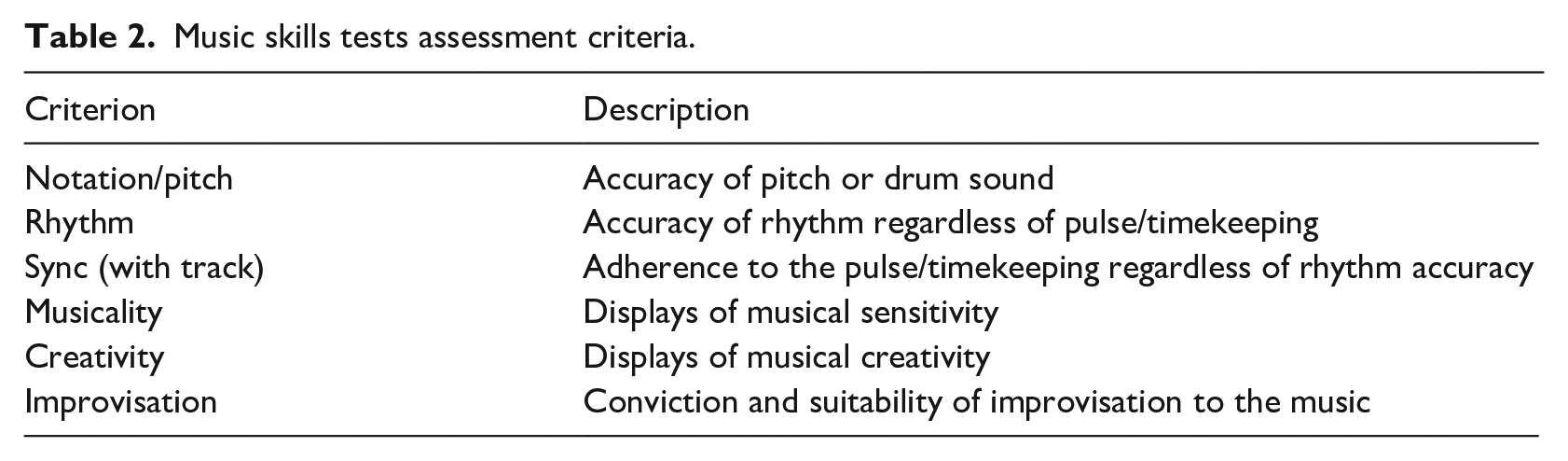
The conditions in which the proficiencies were tested are artificial, and it is unlikely that popular musicians would encounter these precise situations in their professional practices. However, the nature of this study required parameters to be controlled to ensure the validity of the test results.
Findings
Interviews
Haley (‘formal’ popular musician)
Haley is a drummer who had recently graduated from HPME, but her musical journal began with Western classical piano lessons during her teenage years. 7 After a few years of piano lessons, she became fascinated with drummers and chose to sign up for lessons as well and had since passed the Trinity Rock and Pop Grade 8 drum exams with distinction. She explained that she turned to lessons instinctively back then as ‘it was the only way’ of learning that she had known. Though she had been exposed to a range of learning modes since, she firmly believed in ‘getting proper lessons’. She acknowledged that her prior formal background contributed to this attitude but explained that it was primarily because she believed that the self-taught model was insufficient.
I still think getting proper lessons is important because if you learn by yourself, there’s some things you might think is good enough but it’s not. . .even if you [self-learn theory], maybe there’s something [you] don’t understand or misinterpret. So for me, I think classes are very important.
The HPME programme Haley undertook was described as one that placed extensive emphasis on music theory, favoured technical proficiencies over creativity and had an overall expectation that students learn songs by ear and through transcriptions. She further elaborated that theory when learnt was ‘something separated, it’s not linked to the playing’. Furthermore, the faculty favoured technically demanding musical performances.
Those that are not musically trained, they like grooves, those simple kind of things, and then some arrangements and surprises. But then when we do it in uni, as long as it’s not technical and not difficult enough. . .they still think it’s not good.
Haley learnt from numerous drum tutors whose pedagogic styles either resembled classical instrumental pedagogy or those that infused informal learning features. Thus, she encountered tutors that emphasised learning only from notation as well as those that propagated learning by ear and only used notation to introduce new materials. When asked which teaching styles she preferred, she admitted that she struggled with the ‘informal’ pedagogies, as she was used to more structured and systematic ways of learning.
I think it’s because most of them [teach] by feel as well, and I’m not that kind of person. For me it’s very important to be able to count and play at the same time, so you know where is it.
When it came to improvising, most tutors told her to ‘just play whatever comes into your mind’ without further instructions or guidance. Haley had only played as written and never attempted to improvise before, thus, this tutoring, or rather the lack of it, left her feeling unequipped to start improvising. Fortunately, one tutor provided her some form of structure that helped her to gradually ‘play without any form’:
He gave me a box, but it’s not everything, just the box, and I try to stick to the box first, then jump out a little bit from the box, then slowly the box changes to a different box.
However, Haley revealed that she was not interested in the art of improvisation and would not practise the skill unless it was part of an assignment or a performance examination.
Outside lessons, Haley only practised as instructed by her tutors but gradually began to self-engage additional materials after attending HPME. She also started learning by ear during her HPME years, but notation remained central to her process of learning and internalising music materials. Before HPME, Haley had 4 years of drums lessons with a tutor who only taught with notation and placed extreme emphasis on notational knowledge and understanding the theoretical aspects of music. Ear-based skills, on the other hand, were of secondary importance to him. Due to such experiences, she developed a strong reliance on notation, to a point where she ‘[doesn’t] even listen to the music’. Therefore, though she eventually employed her ears in her practice to some degree, her dependency on notation was already established and she noted that her over-reliance on notation had resulted in anxiety in its absence.
Sometimes when I don’t know the rhythm or I didn’t write it down, I feel. . .insecure when I have to play something I cannot note down and I don’t know what it is.
Zayne (‘informal’ popular musician)
Zayne is the bassist of a Malaysian band well-known for their diverse fusion of musical influences and cultural elements in the music they created. His musical journey began at age seven, when he was inspired to ‘mess around’ on his brother’s guitar after watching a video of Nirvana’s MTV unplugged in New York. His father wanted him to receive Western classical music lessons, but Zayne was reluctant. He revealed that he had ‘huge problems with being judged’ and ‘hated exams and tests’, and since classical music training generally involved progressing through graded examinations, it became an immediate deterrent to him. Furthermore, he enjoyed the attention and admiration he received from peers for the ability to learn a song by ear without instruction. After refusing lessons for many years, Zayne eventually gave in to his father’s wishes at age 12, but lessons lasted less than a month. Around this time, Zayne started his first band with friends, but was ‘relegated’ to play the bass as he was deemed to be the least accomplished guitarist among them.
Though Zayne had no bass lessons, he credited his education to the pub music scene where he began performing during his late teenage years. He learnt by doing and by being in the community of practice. At the pubs, he was constantly surrounded by seasoned musicians who were eager to impart lessons and advice, such as the understanding that musical proficiencies were subservient to the instrument being in pitch. Through his years as an active bassist in the pub music scene, he also learnt to constantly be alert and adaptable as it was common for the band to play spontaneous songs without notice.
Zayne taught himself to play the bass through the trial-and-error approach. He listened to songs he liked repeatedly and copied the lines by fiddling on the bass until he found the notes. This practice remained till this day, but he had become more proficient. He developed his own personalised notation system, but it functioned solely as a memory aid. Thus, notation, or rather some form of it, was secondary to his ears. Zayne also learnt to improvise through the trial-and-error approach. He explained:
So my process is basically to try to fill in the blanks my own way, and its trial and error basically. . .then I know that ok that doesn’t work maybe not in that context. So for me it’s a lot of trial and error. . .I’ll see shapes and patterns that I know if I do this, then this can work.
However, he noted that being an ‘informal’ musician did present some challenges, such as a lack of discipline to play strictly as requested as he was inclined to play as the music inspired.
Like cause I can’t play note by note so I’ll just come up with things as I feel it. . .I do that simply because I do not have the discipline to play what I’m supposed to play.
Furthermore, the lack of reading skills costed him many session opportunities.
I lost a lot of gigs because I couldn’t read, so especially backing up professional singers, when you have like one rehearsal and then straightaway. . .you’re expected to be able to pull it off, that kind of thing.
Zayne initially aspired to be a session musician, but he experienced an epiphany after working as a session musician himself. He realised that many musicians he respected, especially those that were products of HPME, did not have their own unique sound. Zayne perceived this to be the impact of formal learning, that institutions were producing generic sounding musicians.
If you want to be a performer and express your own music, [formal learning] may be a hinder, cause your outlook or how you approach music is the same as everyone else, so it’s really going to be doubly tough to find your own voice.
When discussing a friend who was one of the ‘craziest bassist’ he knew that went to Berklee College of Music and came back ‘playing single notes’, he said:
So that kind of like got me sad and scared to see all these people go to proper formal training and what they lost. They gained, they can make a living, they can be a sessionist, but that extra umph, that X factor, they lost it.
Zayne, on the other hand, was enthusiastic about experimenting, pushing boundaries and going against conventions, to create his own unique musical identity.
Again I have this thing against this, there’s a right way of doing things and a wrong way of doing things but if you happen to be doing things wrongly, then just go on further until it becomes the right thing and then it will become your own style.
Thus, he was unfulfilled as a session musician. Since then, he began working with like-minded musicians, and eventually formed his current band.
Musical skills tests result
Sight-reading (SR)
Given Zayne’s background, it was understandable that he performed poorly in this test. However, despite his lack of fluency in standard music notation, Zayne displayed willingness to try. Despite knowing he could not meet the requirements of the test, he improvised and produced responses that were adequately musical. Moreover, Zayne was very aware of the pulse and groove of the track, as seen in his ‘Sync’ and ‘Musicality’ scores (Figure 1).
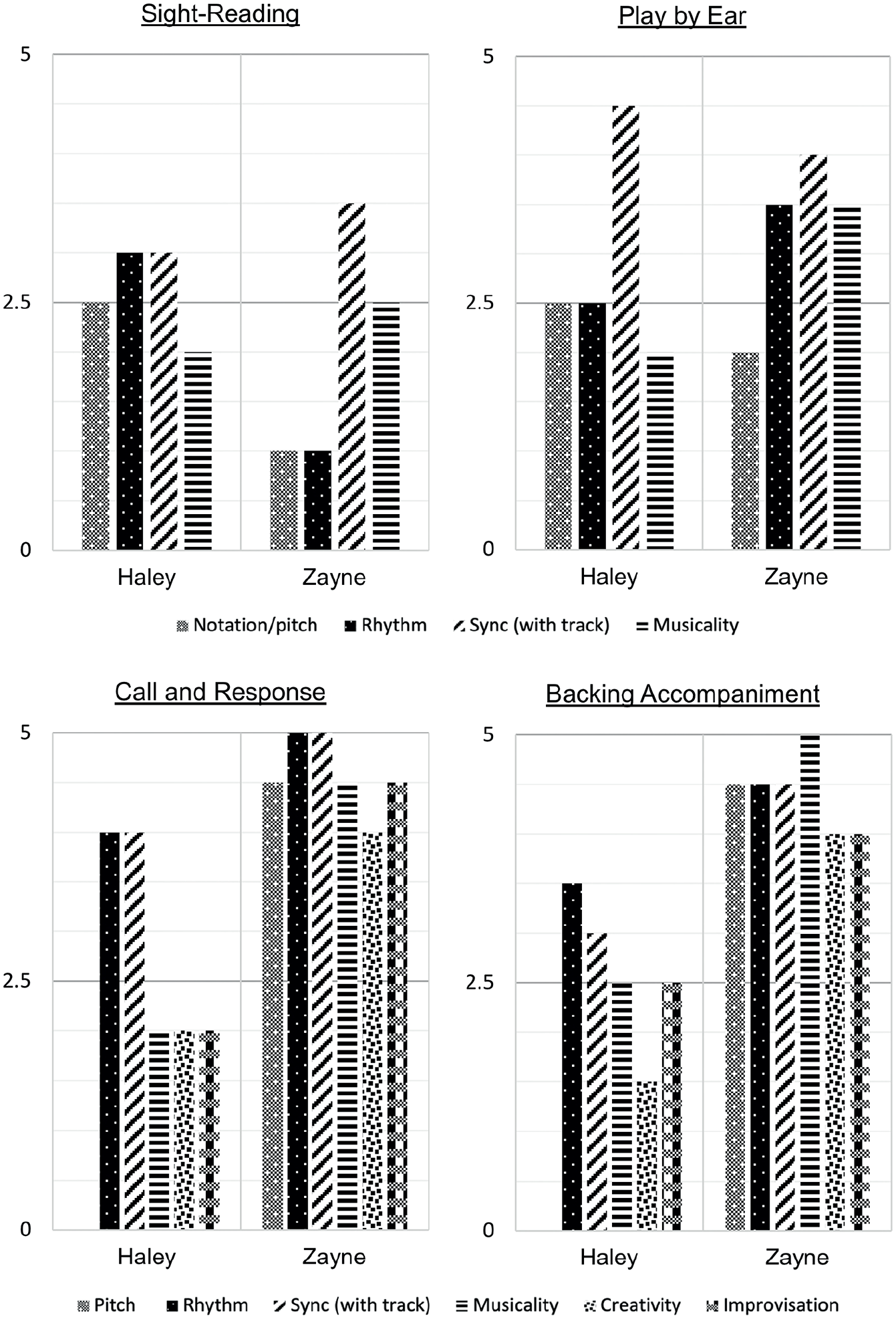
Results from the musical skills tests.
Unexpectedly, Haley did not fare too well in the SR test, and her responses revealed certain interesting characteristics. She displayed cautious behaviour, choosing to forgo notes that could not be learnt in time. It was observed that she focused on playing the hi-hats and snare as accurately as possible and took a laissez-faire approach with everything else. Furthermore, her responses to this test lacked a degree of musicality as sensitivity to tone was wanting.
Play by ear (PbE)
As ear-based practices were secondary to Haley’s practice, her responses barely met the test’s standards. The only exception was that, despite notational and rhythmic inaccuracies, her responses largely followed the pulse of the track (Figure 1). Her approach to the PbE test was akin to the SR test; she was careful to only reproduce notes and rhythms that were learnt in time.
Zayne, on the other hand, was primarily an ear-based musician, thus, it was expected that he attains favourable scores in this test. However, his results were comparable with Haley’s. Just like his SR test results, Zayne’s PbE test responses must be understood within the context of his learning history as well. The parameters of Zayne’s musical development were entirely self-determined, and he had no prior interactions with musical examinations. Thus, he was unfamiliar with the structured and constrained infrastructure of musical examinations, which was to accumulate maximum points in defined musical tasks with limited opportunities and within a restricted timeframe. However, it was observable that Zayne displayed no concern for accumulating points or accomplishing the specific task given. He instinctively improvised in parts that he could not (or possibly did not want to) learn in the given time limit.
Improvisation
As seen in Figure 1, the Improvisation tests were where Zayne thrived. In comparison to the SR and PbE tests, he performed significantly better in all areas of both Improvisation tests (C&R and BA). Furthermore, he produced his best performances in the test that afforded him the most freedom: BA. Nearly akin to how popular musicians in the past struggled with the constraints of formal training, this test result demonstrated that Zayne struggled similarly with restrictions (PbE) but was able to perform at ease when more freedom was afforded to him (C&R and BA).
Haley’s results were not comparable to Zayne’s. She struggled with non-technical aspects of both the C&R and BA tests. The rhythms she played were, for the most part, in sync with the pulse of the backing track and she was able to maintain the pulse generally. However, her responses not only lacked displays of musicality and creativity, but also lacked conviction and did not always suit the styles of the backing tracks.
Discussion
Tensions between practices and attitudes
Juxtaposing Haley’s and Zayne’s accounts highlighted some key tensions between the two popular musicians. The first notable difference was their attitudes towards formal learning. Haley was receptive, whereas Zayne was highly averse. Their early differences in attitudes here could be credited to their environments and learning preferences. Haley noted that she was unaware of alternative models of learning, thus it was instinctive for her to turn to the only model she knew. Furthermore, her extensive classical piano training was likely to have conditioned her to be more comfortable with structured, prescribed and guided forms of learning. Zayne, on the other hand, engaged with informal learning at a young age. By the time he attended his first music lesson, he had already enculturated the cultures of informal learning to some extent. As pointed out earlier, informal learning was at odds with formal training in many regards, and enjoyment, as a result of autonomy in the learning process, was an essential factor for Zayne; he knew he would not enjoy formal training because he struggled with external evaluations. As they developed, their attitudes towards formal learning became more pronounced. Haley believed that formal learning was crucial for a popular musician’s development, whereas Zayne perceived it to be the root cause for generic sounding musicians.
Going down different paths led to disparities in learning characteristics. Haley’s popular music learning history largely comprised of features that resembled the characterisations described by scholars of HPME, while Zayne’s learning history was consistent with the descriptions of popular music’s traditional learning cultures. Zayne taught himself to play the bass by ear through trial-and-errors and experimentations, and he was self-motivated to learn whatever he was interested in. Moreover, by situating himself within the community of practice, he absorbed anecdotal knowledge and gained experiences that facilitated his development as a popular musician. Contrarily, Haley learnt to play the drums in a ‘formal, transmission-style manner’ (Parkinson & Smith, 2015, p. 108), that not only emphasised the study of notation and theory, and technical proficiencies, but also presented aspects of music as isolated subject matters. With extensive engagements with classical-styled instrumental lessons, Haley was acclimatised to operate under a scaffolded environment with reduced autonomy in the learning and development process. Thus, she found it difficult when increased levels of autonomy were afforded, as exemplified by how she responded to the ways she was taught to improvise. Furthermore, she generally only practised what was instructed or required. These observations reaffirmed Lebler and Hodges’ (2017) assertions regarding formal learning and the development of autonomy. What this meant was that Haley, as a popular musician, developed dispositions that diverged from her ‘informal’ counterpart who immersed himself in the traditional learning cultures of popular music.
As a result of the differences in learning experiences, they developed contrasting habitual music-making practices as well. Haley’s practice was dominated by notational practices, and though she currently engages with ear-based practices, notation remained central to her music-making processes. Zayne’s practice was almost entirely ear-based, and his personalised notation system only served as a memory aid. Their accounts revealed further tensions in attitudes. Haley was disinterested in improvisations, nor did she enjoy experimentations. She preferred clear structures and instructions with no room for ambiguity. Meanwhile, Zayne disliked restrictions, and relished experimentations and pushing boundaries.
Manifestation of tensions in musical proficiencies
The tensions identified between the two popular musicians’ learning histories and attitudes were reflected in their displays of musical proficiencies. Although Haley barely met the threshold of the SR test’s standard, she still fared better than Zayne. This was due to their backgrounds, of which Haley had extensive engagements with music notation, while Zayne had close to none. In terms of the PbE test, Haley was arguably still developing her ear-based skills, hence, she struggled to learn all the elements by ear in the given time. Zayne, being an ear-centric musician, fared better than Haley in this test, but his results suggested that his unfamiliarity with the conditions of musical examinations was a factor worth examining.
Attributing Zayne’s PbE scores to the restrictions of the test parameters was not unsubstantiated, as ‘informal’ musicians who were well versed in play-by-ear and improvisation skills were found to struggle when attempting to display those skills within formal situations (Feichas, 2010). Furthermore, the Improvisation tests revealed that Zayne thrived in situations that allowed him more freedom. In contrast to the PbE test, which had pitch, rhythmic and time restrictions to be adhered to, and required Zayne to reorganise the way he usually played music, the Improvisation tests had considerably lesser constrictions.
There were also disparities in terms of their improvisation proficiencies; Zayne outdid Haley in all aspects examined. Their results in the Improvisation test correlated with assertions from McPherson and Gabrielsson (2002) and Woody (2012) that ear-abilities were crucial to improvising. However, their learning histories suggested that their attitudes and music-making inclinations were important factors as well. Haley, whose entire learning history only comprised of institutionalised learning, was accustomed to the conditions of structured, prescribed and organised frameworks. Thus, this acclimatisation to detailed external instruction, and possible enculturation of institutional values, arguably influenced her attitude towards ambiguity in music-making, and subsequently her inclination towards experimentation, which was an indispensable process to creativity and improvisation. This notion had been highlighted by Alper (2007) and was supported by the fact that she admitted to her aversion towards working on the art of improvisation. Zayne, on the other hand, had a passion for it. Being an ‘informal’ musician, he was used to having great amounts of autonomy in the music-making process, and rarely was he told what the right ways were of doing things. Therefore, he was inclined towards experimentation and playing without boundaries.
Furthermore, Zayne had better adherence to the pulse of the music and was more musical in his responses overall. This contrast pointed towards the disparities in their learning experiences and practices. According to Green (2002), musicians who learnt by ear (like Zayne) were more likely to have improved and developed creativity, technical understanding, musicality and individuality. Conversely, Woody and Lehmann’s (2010, p. 109) study suggested that in comparison, those that only had formal training (like Haley) tend to devote much of their conscious attention to the physical production of the music on their instruments.
Their musical skills tests’ results also revealed the tensions in how they approached a musical task. Haley valued accuracy of notes over the overall performance; conservatively playing as precisely as possible note-wise with little concern as to how those notes sounded in a musical context. Conversely, Zayne was more concern with playing a musical response over an accurate one. Haley was arguably a quintessential example of a ‘formal’ musician, whose musical progress was primarily measured by points earned in assessments. Therefore, it was common to strategically focus on areas that had potential to earn maximum points and sacrifice those that were predetermined to return poor results. For Haley, attention to note accuracy came at the expense of musicality. In contrast, Zayne’s development had never been measured by formal evaluations, instead it was validated by peers and respected musicians, and the feedback he received were more holistic in nature. Furthermore, he was predisposed to play as inspired by the music, rather than as requested. Therefore, it was arguable that Haley’s and Zayne’s approaches to the tests were partly rooted in the ways in which they enculturated the observation of music (compartmentalised or as a whole).
Conclusion and implications
The findings presented here demonstrated the ways in which formal and informal modes of music learning caused tensions between two popular musicians in Malaysia, in the form of conflicting practices, attitudes and dispositions, which were then translated into contrasting displays of musical proficiencies.
As demonstrated in this article, this difference in learning modes led to tensions in attitudes towards formal music learning. The ‘formal’ musician perceived it to be crucial to musical development, while the ‘informal’ musician identified it as the culprit for the loss of musical individuality. It similarly led to disparities in learning characteristics, dispositions and reliance on notation- and ear-based practices. The ‘informal’ musician learnt by doing and by situating himself within the community of practice, and he was predisposed to take charge of his development. On the other hand, the ‘formal’ musician learnt in transmission-style methods, where aspects of music were presented as isolated subject matters, and she developed a reliance on external instruction and guidance. This subsequently resulted in differences in self-motivation and passion for their crafts, as well as inclinations towards experimentation.
The impacts of these tensions were observable in their musical proficiencies as well as their approaches to musical tasks. The ‘informal’ musician outperformed the ‘formal’ musician in almost all aspects in each test except sight-reading. However, even so, the ‘formal’ musician barely met the standard threshold of the sight-reading task. When their approaches to the tests were examined within the context of their learning histories, it revealed that, in addition to their habitual practices, their dispositions and attitudes were contributing factors to their results as well. The ‘formal’ musician’s behaviour suggested that she was mindful that it was a test, and she utilised a conservative strategy to retain points by focusing on note accuracy at the expense of musicality. Contrastingly, the ‘informal’ musician was not at all concern that it was a test and only focused on playing musical responses.
This examination of the tensions between two popular musicians in Malaysia, in turn, asserts the relevance and legitimacy of alternative models of learning in popular music. As shown in this article, the routes through which competence and excellence are acquired are not the same as classical musician training. This is unsurprising considering the aspirations are different and require different ways of learning this craft and form of expression. Thus, achievement and virtuosity of popular music should be viewed in this light. The implication of this is that providers of popular music education (whether in Malaysia or elsewhere) need to approach popular music on its own terms, for this study has shown how the various methods of learning has influenced the development of a sample group.
Footnotes
Acknowledgements
The author wishes to thank all participants for their valuable contributions to the research as well as Dr. Jonathan Stockdale, Prof. Gregory Sporton, Prof. Shirley Thompson, Prof. Terry Lamb and Dr. Chris Kennett for their invaluable advice and support.
Funding
The author received no financial support for the research, authorship, and/or publication of this article.
