




Abstract
This article explores the ways in which popular musicians in Malaysia learn the craft of Western popular music-making in comparison to those in the United Kingdom. Literature that studied popular musicians and their practices had largely focused on communities within Anglosphere regions, and there are insufficient understandings of the journeys of non-Anglosphere popular musicians to determine if their experiences coincided with those from Anglosphere nations. In this mixed method study, popular musicians from Malaysia and the UK completed online questionnaires that enquired into their experiences with formal learning, as well as the practices they engaged in. Secondary data was also harvested from literature based on UK musicians for triangulation purposes. Though the findings indicated numerous overlaps in the experiences of popular musicians from both countries, there were areas of distinction. Malaysian popular musicians were more inclined than their counterparts in the UK, to engage with formal popular music learning, to cultivate a reliance on notation, and to experience instrumental lessons that comprised more features of informal learning. Implications from this article include the need to further investigate the factors behind the disparities, and to afford increased attention towards the learning cultures of non-Anglosphere popular musicians.
Keywords
Introduction
Ever since popular music entered institutional realms, literature that examined the practices of popular musicians had increased. Some of the most cited include Bennett (1980), Finnegan (1989), and Green (2002), of which Green (2002) was the most analytical as to accomplish the aim of identifying features of popular music’s informal learning practices that could be incorporated into formal classroom music learning.
Though the formal study of popular music had flourished since its emergence, and relatively recent literature on the formative journeys of popular musicians captured the presence of institutionalised learning of popular music, the notion that popular music primarily operates in the informal realm has generally remain unchallenged. A possible explanation was that examinations, such as Bennett (1980), Bruford (2019), Cohen (1991), Finnegan (1989), Lebler and Carey (2008), Mok (2014), Robinson (2010), and G. D. Smith (2013), aimed at documenting the learning histories of popular musicians in particular regions and periods, while the characterisations of the changes in how they learnt were not their prime concerns.
Popular music-learning and -making cultures
However, as demonstrated by Choong (2021), chronologically reviewing some of the literature cited above 1 allowed the examination of changes that took place over time, and it illustrated how learning cultures evolved as the world experienced various developments. What was initially a predominantly aural tradition that occurred beyond the confines of learning institutions, was gradually replaced with more diverse and unique learning experiences due to the formalisation of the field and technological advancements. In addition to self-taught popular musicians who do not require notation in their practices, there are now institutionally trained popular musicians, who are heavily notation-based. Furthermore, there are those that are predominantly ear-players despite undergoing formal training, and those who are completely self-taught and taught themselves to understand Western music notation. Regarding the use of technological music-learning and -making tools, the review of literature cited above indicted that its adoption into popular musicians’ practices increased gradually over time.
Be that as it may, the literature reviewed were based on demographies in the Anglosphere, and while the conclusions were informative, it must be acknowledged that it has limitations. Can these conclusions be applied to situations beyond the Anglosphere? Though the authors did not exaggerate the applicability of their conclusions beyond the localities in which their studies were undertaken, it does make the mind wonder if they could be more broadly applied. Do members of non-Anglosphere societies go through journeys of becoming popular musicians that align with, or stray from, the paths taken by those in the Anglosphere?
Similar examinations within an Asian context are scarce, and to the author’s knowledge, only comprised Choong (2021) and Mok (2014). Mok’s (2014) study examined the learning practices of popular musicians in Hong Kong and found that their experiences were mostly akin to their Anglosphere counterparts, but had differing perceptions of, and experiences with, formal learning. The doctoral thesis by Choong (2021) too identified numerous overlaps among the popular music learning cultures of Australia, China, Malaysia and the UK. However, there were evidence to suggest that some distinctions could be observed between Anglosphere and Asian regions, particularly regarding formal learning.
Formal learning, informal learning, notation-based practices, and ear-based practices
Informal learning is often associated with the practice of playing by ear. This is observable in the studies of popular musicians by Bennett (1980), Cohen (1991), Finnegan (1989), and Green (2002) and is most explicit in Green’s (2008, p. 10) assertion that ‘the main method of skill-acquisition in the informal realm involves copying recordings by ear’. However, Folkestad (2006, p. 142) argues that there is ‘a misconception and a prejudice’ that informal music learning is synonymous with popular music learnt by ear, while formal musical learning is confined to learning Western classical music from notation. He contends that binary observations of formal and informal learning are oversimplified as aspects of both are present and interacting in varying degrees in most learning situations; which extends to the presence of playing by ear in formal situations and learning with notation in informal situations. This notion is even substantiated by the later studies on popular musicians cited above, including Green (2002) who documented a guitarist who learnt to read standard notation without formal instruction (p. 70).
However, clear distinctions between ‘formal’ and ‘informal’ were needed to facilitate discussions. Thus, with additional reference to Green’s descriptions (2002, p. 16), this article draws from Folkestad’s (2006, pp. 141–142) ‘situation’, ‘ownership’, and ‘intentionality’ approaches to outline the definitions of ‘formal’ and ‘informal’. ‘Formal’ describes contexts in which learning takes place in institutional settings, such as classrooms or instrumental lessons, in the presence of a teacher, and that uses defined paedagogies. ‘Informal’ describes contexts in which learning takes place outside of institutional settings, is self-directed, and ‘holistic’ (Folkestad, 2006, p. 137) or ‘haphazard’ (Green, 2002, p. 207).
The learning practices engaged with during those situations are characterised under broad umbrella terms: ‘ear-based’ or ‘notation-based’ practices 2 . ‘Ear-based’ practices denote practices that engaged the use of ears without any forms of music notation, while ‘notation-based’ practices denote practices involving the translation of notational representations of music.
Malaysia
Malaysia is a Southeast Asian country with a long colonial past; from 1511 to 1957, the country was occupied by Portugal, Netherlands, Britain, and Japan (MyGovernment, 2022). As such, the influences of over 400 years of continuous foreign rule can be observed in Malaysia’s architecture, laws and policies, social structure, politics, ethnic makeup, food, culture, and language. However, foreign influences did not eliminate local culture and characteristics. Take language for example. While the national language of Malaysia is Malay, English, a ‘legacy’ left behind by British colonialists (Lee et al., 2010, p. 88), is still widely spoken. However, the language has been localised and fused with words, expressions, and idioms from multiple local languages and resulted in what is now known as Manglish, ‘the basilect of Malaysian English with features of an English-based creole’ (Leo & David, 2021, pp. 1–2).
With Western popular music being an imported form of music culture in Malaysia, agents within the field of Malaysian music arguably interacted with this foreign music culture with habitus distinct from those belonging to said music culture. While mass communication and information technology advancements blurred the geographical/social/cultural lines originally associated with various forms of popular music, and essentially broke down boundaries between communities (Silver et al., 2016, pp. 3–4), it would be a stretch to claim it eradicated the discrepancies between cultures. The world may have gotten smaller, but diversity is resilient. This raises questions of the ways in which popular musicians in Malaysia became who they are, and the extent in which their experiences differ from their Anglosphere counterparts.
As portrayed above, literature that examined the learning cultures of popular musicians were largely confined to regions in the Anglosphere, and there are insufficient studies on popular music learning cultures in non-Anglosphere regions 3 to determine the applicability of characterisations of the former on the latter. While Choong’s (2021) findings suggested distinctions exist between the regions, the study did not examine the discrepancies. Meanwhile, Mok (2014) did conduct such an investigation, and it provided rich insights into the cultures of the ‘East’ in comparison to the ‘West’ (p. 179), but her study was qualitative in nature and built on the data of six popular musicians in Hong Kong. The findings of which Mok (2014) acknowledged ‘cannot be generalised beyond the six musicians interviewed’ (p. 192). Therefore, this article aims to further the examinations of Choong (2021) and Mok (2014) by expanding research on non-Anglosphere popular musicians and explore those distinctions with a larger sample size.
Purpose and research questions
The purpose of this article is to determine the discrepancies between the learning cultures of Anglosphere and non-Anglosphere popular musicians by juxtaposing quantitative data of the learning cultures of popular musicians from Malaysia and the UK. The investigation is guided by the following research question and sub-questions:
To what extent can discrepancies be observed between the learning cultures of popular musicians in Malaysia and the UK?
Are there disparities in experiences with formal and informal popular music learning?
Are there disparities in engagements with music-making tools and practices?
Are there disparities in reliance on notation- and ear-based practices?
Materials and methods
The author’s doctoral study, that aimed to characterise the relationships between learning experiences and musical proficiencies of popular musicians, employed an explanatory sequential mixed methods design which collected data through questionnaires, interviews, and musical skills tests. The questionnaires enquired into how current popular musicians learnt, and data acquired allowed an examination of learning histories between a Malaysian and an Anglosphere (United Kingdom) demography. It should be clarified that this article conducted an analysis that is independent from the doctoral study.
As the article aimed to extend the qualitative findings of Mok (2014) as well as examine the discrepancies between two cultures, of which one comprised limited literature, a convergent parallel mixed method design was employed to elicit primary quantitative data of the cultures in Malaysia and the UK, and qualitative data of the UK from literature. This design facilitated the establishments of characterisations of the cultures in both countries to enable comparisons.
Data collection
Primary data
Data was collected from June to September 2019 through an online questionnaire. The questions, based on the theory of social and contextualised learning (Albatrosov, 2023) and informed by the characterisations found in literature discussed above 4 , enquired into many areas of the participants’ learning histories, but this article only focused on experiences with formal and informal learning and the practices engaged with during those learning contexts. The questions were determined to have face validity by the researcher, who is a popular musician and educator, and the thesis supervisory committee. Reliability was subsequently established with a pilot test.
Using purposive sampling, participants were recruited from both physical and online efforts. Physical efforts involved the author entering university lecture halls to invite students of higher popular music education to participate in the study. Online efforts comprised invitations sent out to popular musicians from the author’s network as well as online musician and popular music scholar network groups.
Secondary data
Characterisations of the learning culture in the UK was also informed by the findings of works that captured the presence of formal learning among popular musicians who played musical instruments commonly associated with Anglo-American popular music forms; Green (2002), Robinson (2010), and G. D. Smith (2013). The rationale for selecting these three literatures was that formal popular music education flourished in the UK during the 1990s. University of Liverpool, University of Salford, Leeds University, and University of Westminster all launched Higher Education programmes in popular music in the 1990s, and the Scottish Qualifications Authority rolled out modules in Rock Music Performance as well (McLaughlin, 2017; Warner, 2017). Furthermore, the Guildhall music examination board introduced exams for drum kit, which was followed swiftly by Rockschool in the same decade (G. D. Smith, 2013). Thus, it was appropriate to only survey studies that were conducted in the UK since the 1990s 5 .
Participants
The sample in this article includes 83 and 19 participants representing Malaysia and the UK respectively, where the majority in both samples were between the ages of 18 and 34. While both samples primarily comprised acoustic/electric guitarist, pianists/keyboardists, bass guitarist, drummers, and singers, the Malaysian sample was dominated by pianists/keyboardists (50.6%), while ‘vocals’ was the most reported instrument the UK sample (42.1%).
Procedure and analysis
The quantitative data was analysed on SPSS using descriptive analysis methods, as the study collected nominal, dichotomous, and ordinal data, and only required the frequency distribution of variables studied. From there, the statistics between the Malaysian and UK samples were juxtaposed and examined against the characterisations from UK-based literature.
Ethical clearance and informed consent
All participants participated voluntarily and received no compensation. The participants provided their written informed consent to participate in the doctoral study which received ethical clearance from University of Westminster’s University Research Ethics Committee (Reference: ETH1819-1381) 6 .
Results
Characterisations from UK-based literature
Self-directed learning
The analysis of Green (2002), Robinson (2010), and G. D. Smith (2013) revealed that, despite the formalisation of the field, listening to and copying from recordings, and peer or group learning remained core learning practices in popular music. Green (2002) described the practice of ‘listening and copying’ (p. 60) as one that was almost always done in solitude and aided the development of creativity, technical understanding, musicality, and individuality (pp. 73–76). Peer or group learning activities (PLAs), on the other hand, generally took place as part of a band (Robinson, 2010, p. 86), but can occur inside and outside of music-making activities (Green, 2002, pp. 76–77; G. D. Smith, 2013, pp. 35–37).
Notation and instructional books were often used in the learning process but in a capacity that is secondary to learning by ear (Green, 2002, p. 96). Notational knowledge was primarily acquired through lessons, though there were instances of self-teaching (Green, 2002, pp. 70). This was supported by Robinson’s (2010, pp. 133–139) investigation into how popular musicians taught and it revealed that while some do not use notation at all, others used notation in various ways and degrees, and some taught with notation right from the start. Instructional books were presumed to be used by those who had been taught to read notation (G. D. Smith, 2013, p. 41), and only in the early learning stages and abandoned ‘quite quickly after a certain stage was reached’ (Green, 2002, p. 72).
There was increasing use of learning resources made possible by technological advancements, such as instructional videos and the internet. Green’s (2002) book had some mentions of such resources, and Robinson, in his 2010 thesis, suggested that,
“The use of demonstration videos and subscription websites offer audio-visual models which may be replacing (or at least supplementing) purely audio recordings as ‘texts’ for popular music learners, with social networking sites and discussion forums acting as ways of exchanging information and passing on advice”. (pp. 263–264)
Robinson’s postulation in 2010 was confirmed by G. D. Smith’s (2013) sample of drummers who reported turning to YouTube to watch ‘drumming videos’, drum kit lessons, as well as to learn songs (pp. 28, 41) 7 . However, the most frequently cited means of learning was film footage (online or DVD) of other drummers (p. 44), as it ‘[helped] drummers understand what it is to be drummers, beyond how merely to play the instrument’ (p. 46).
Lessons
Instrumental tuition could be characterised into ‘classical lessons’, and ‘popular music instrumental lessons’ (Green, 2002, pp. 18, 129) or lessons on their ‘chosen instrument’ (Robinson, 2010, p. 89). Majority abandoned their classical lessons after a brief period as they found it ‘boring, the progress slow, the music difficult to relate to’ (Green, 2002, p. 148), and disassociated with ‘the passion for sound which drove their practice on their chosen instruments’ (Robinson, 2010, p. 92).
As Robinson (2010) sought to examine how popular musicians taught, his thesis provided detailed accounts of popular music instrumental lessons (PMIL). Despite incorporating informal practices that emphasised the priority of listening (p. 149), lessons generally resembled classical instrumental training, which included ‘studying music theory, acquiring ‘correct’ technique, and taking grade exams’ (p. 139). Most of his sample’s students were registered for graded examinations (if available), the understanding of chords and scales were emphasised as part of regular lessons (p. 148), and as noted above, the study of, and emphasis on, notation was common, though to varying degrees (pp. 133–139). While there were diverse descriptions of PMIL in all three literature, they generally comprised a ‘mixture of formal and informal practices’ (G. D. Smith, 2013, p. 39), that have many overlaps with Robinson’s (2010) descriptions.
Therefore, experiences with PMIL were not always positive (Robinson, 2010, p. 95), and many chose to end lessons after a year or less (Green, 2002, p. 175), or outright rejected lesson for they found ‘little inspiration’ from them (G. D. Smith, 2013, p. 42). Some even perceived lessons as unnecessary for they found it ‘relatively easy to learn to play’ and that lessons prevented the development of individual styles (pp. 42–43).
Experiences with formal and informal contexts
The analysis of Green’s (2002), Robinson’s (2010), and G. D. Smith’s (2013) samples revealed that many popular musicians had taken lessons. Some journeys only comprised taking lessons or being self-taught, but a majority had a combination of both formal popular music learning (FPML) and informal popular music learning (IPML) experiences. Some began with FPML, while others with IPML. Hence, their samples could be broken down into four categories based on learning contexts (Table 1).
Categories of learning contexts.

Five participants in Green’s (2002, p. 220) sample only had IPML experiences (I), and the remaining nine had a combination of FPML and IPML experiences (F-I, and I-F). On the other hand, all in Robinson’s (2010, pp. 90–91) sample had a combination of experiences (F-I and I-F). G. D. Smith’s (2013, p. 28) sample of 100 drummers could be broken down into 22 with only informal experiences (I), 27 with only formal experiences (F), and 51 with a combination of formal and informal experiences (F-I and I-F).
Findings from primary data
Disparities in experiences with formal and informal popular music learning
Examination of data in Figure 1 showed most participants in Malaysia and the UK had a combination of experiences (F-I and I-F) and showed similar percentages (75.9% and 68.4% respectively). However, there were disparities in the engagement sequence with both learning contexts. 47.0% of the Malaysian sample began with formal experiences (F-I), and 28.9% began in the informal realm (I-F). In the UK sample, those figures were somewhat inversed, 26.3% (F-I) and 42.1% (I-F).
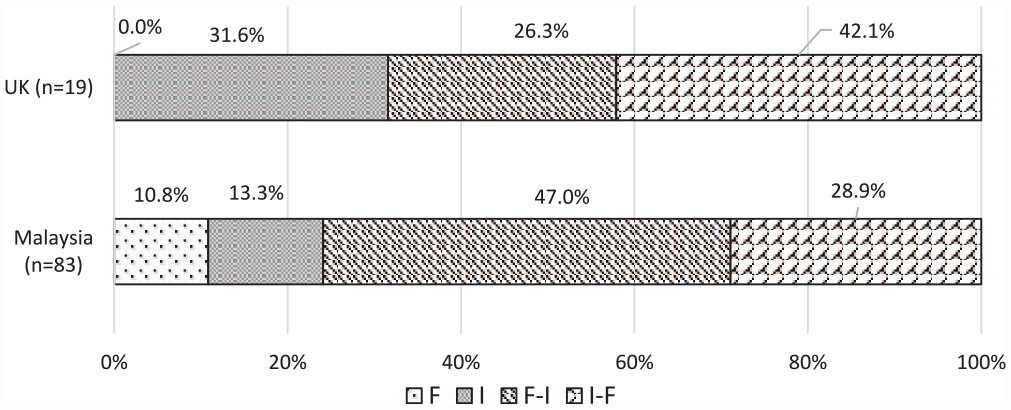
Distribution of participants according to the four context categories.
The data also indicated that 86.7% (Malaysia) and 68.4% (UK) of participants had experienced some form of formal training (F, F-I, and I-F). However, deeper examinations revealed that 57.8% in the Malaysian sample either only learnt (F) or began learning (F-I) with FPML, while the UK sample had less than half that figure (26.3%, F-I). In terms of IPML experiences, 89.2% (Malaysia) and 100% (UK) had engaged with informal modes of learning (I, F-I, and I-F), but only 42.2% of the Malaysian sample solely had (I) or began with (I-F) informal learning, while the figure was nearly doubled at 73.7% in the UK sample.
The most glaring disparity between the Malaysian and UK sample was found in the ‘F’ category; 10.8% (Malaysia) versus 0% (UK). Furthermore, while only 13.3% of Malaysians reported being entirely self-taught (I), this category comprised 31.6% in the UK sample.
The data in Figure 2 showed that of all the participants that had engagements with FPML, 98.6% (Malaysia) 8 and 100% (UK) of participants had engaged with FPML for a minimum of 1 year. However, the more intriguing finding was that only 11.1% (Malaysia) and 7.7% (UK) of participants had engagement durations that lasted between 1 and 2 years, while most participants had extensive engagement durations with FPML. 34.7% (Malaysia) and 23.1% (UK) had between 5 and 10 years of engagements, and more than one-third from both samples had over 10 years of engagements (36.1% and 46.2% respectively). This meant that 70.8% (Malaysia) and 69.3% (UK) had lessons for a minimum of 5 years.
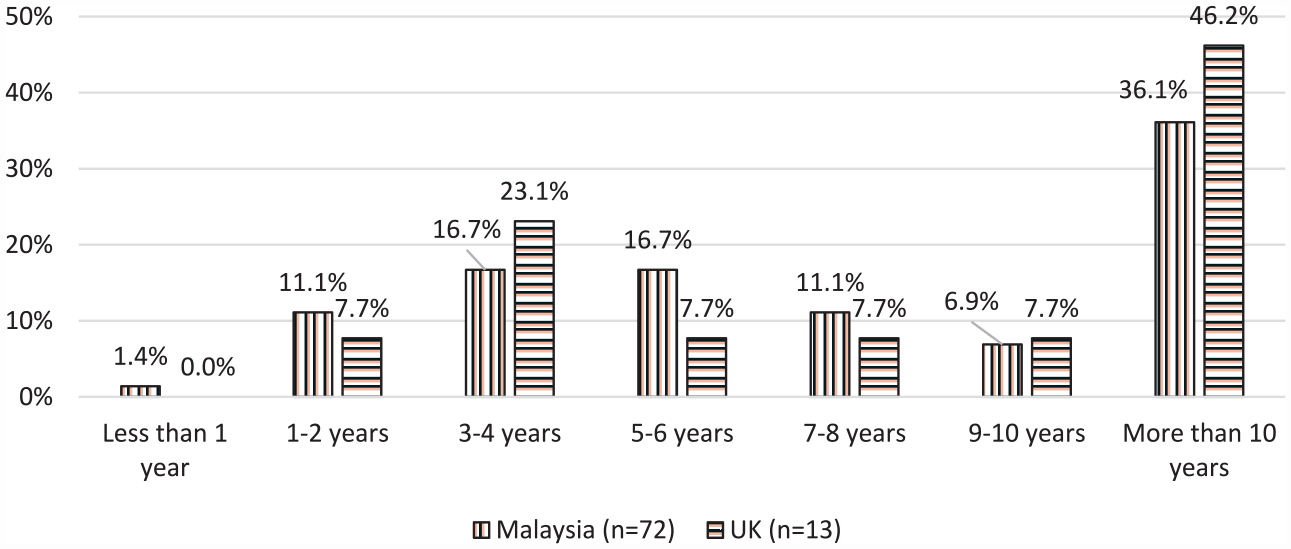
Duration of engagements with FPML.
Scrutinising the data in Figure 3 revealed that the PMIL Malaysian and UK participants experienced were relatively dissimilar. In the UK, PMIL was characterised as extremely structured and organised (92.3%), where learners were required to follow instructions rigorously (84.6%), had experienced a greater emphasis on learning by reading notation (76.9%), and were not always taught to play by ear (46.2%), improvise (38.5%), or engage with graded exam materials (53.8%). Contrastingly, lessons in Malaysia were described as moderately structured and organised (66.7%), where learners were not always required to subscribe to their instructor’s pedagogy (47.2%) or experienced much emphasis on learning by reading notation (56.9%), and generally were taught to play by ear (63.9%) and improvise (68.1%). However, a majority were taught using graded exam materials (90.3%).
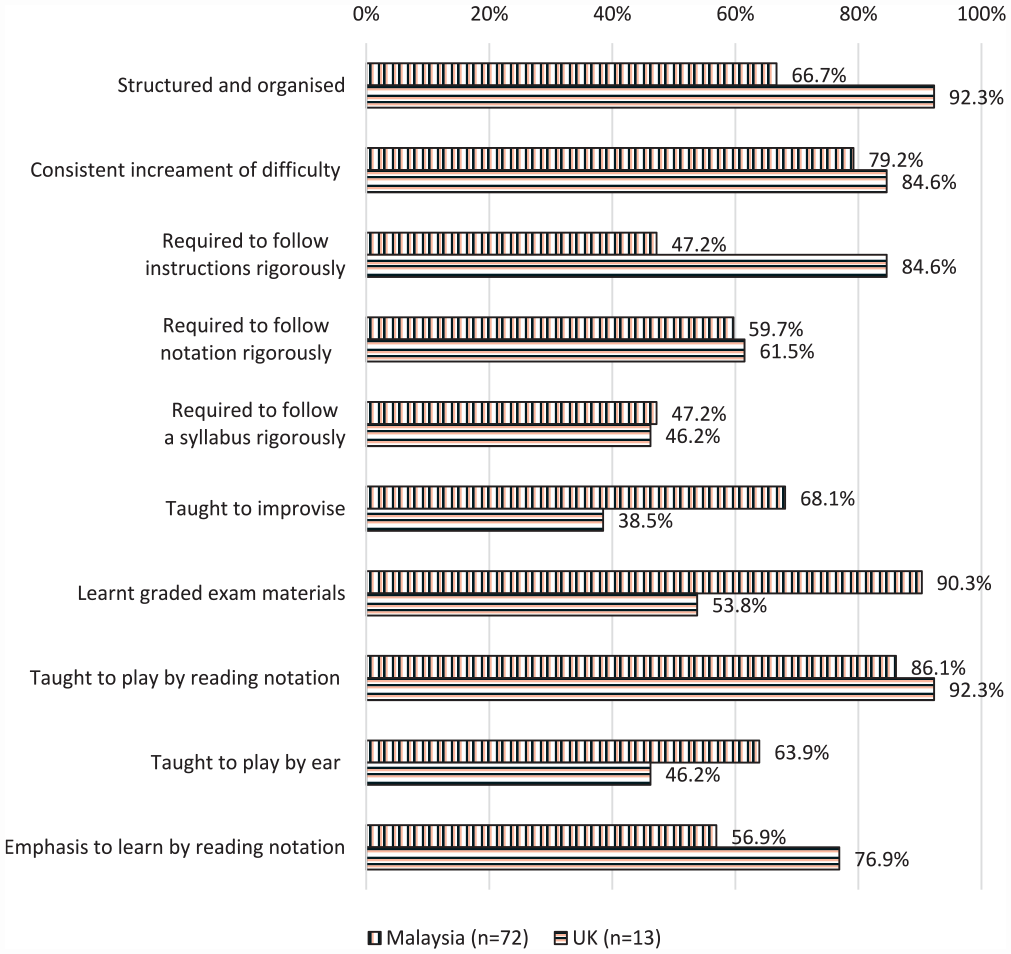
Characterisation of lessons.
While there were distinctions in the characterisations, there were commonalities as well. Participants in both countries reported experiencing consistent increments of difficulty overall (79.2%vs. 84.6%) and were almost always taught to play by reading notation (86.1%vs. 92.3%). Furthermore, they were not expected to strictly follow a syllabus (47.2%vs. 46.2%), or to always play as written (59.7%vs. 61.5%).
Disparities in engagements with music-making tools and practices
In terms of tools and practices participants engaged with during periods of self-learning or outside of lessons, Malaysia and the UK shared numerous similarities (Figure 4). Participants from both countries were highly engaged in listening and copying (96.4%vs. 84.2%), and to a lesser extent, PLAs (68.7%vs. 72.2%) and instructional/tutorial videos (67.5%vs. 63.2%). They also had similarly low engagement levels with tablature (22.9%vs. 31.6%), and personalised notational systems (38.6%vs. 26.3%).
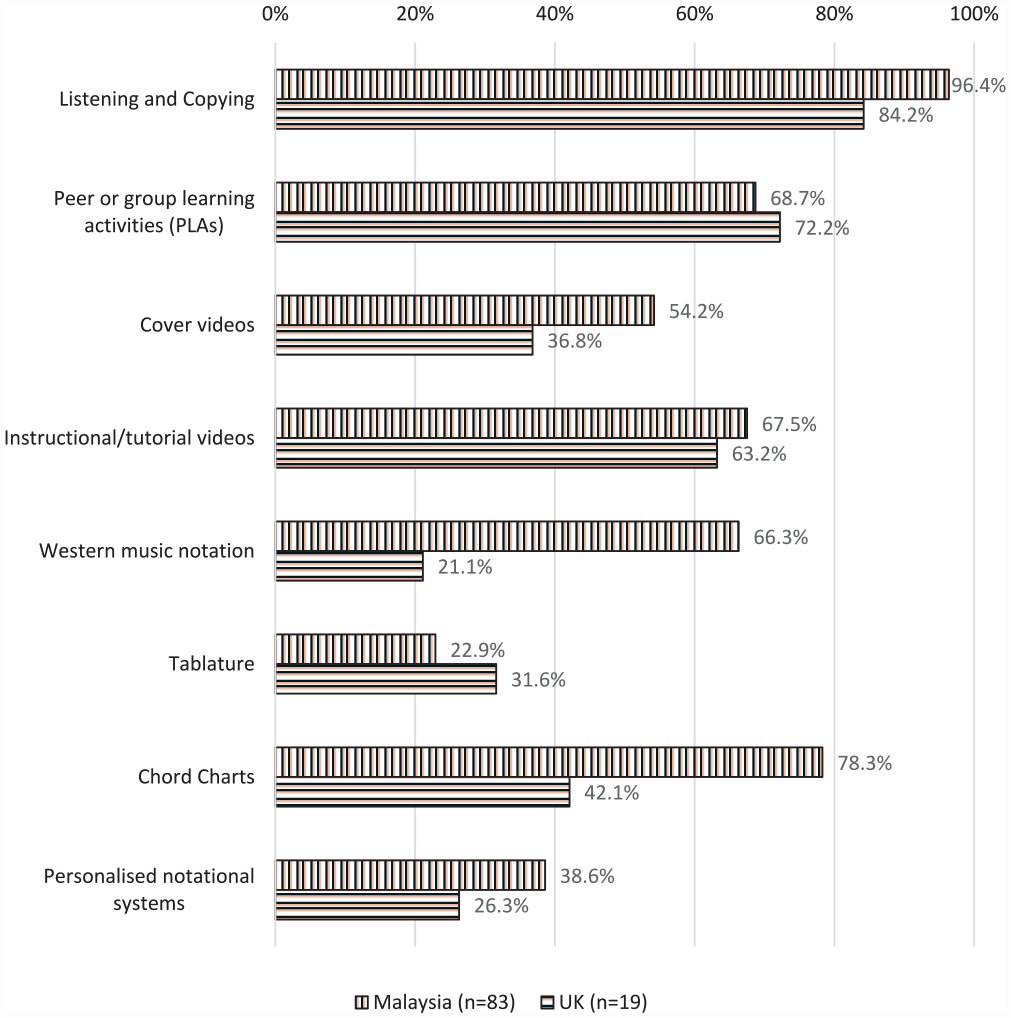
Engagement with tools and practices during self-learning or outside of lessons.
However, there were discrepancies in their engagements with other forms of notation and technological tools. Malaysian participants had greater engagements with Western music notation (66.3%), chord charts (78.3%), and cover videos (54.2%) than their UK counterparts (21.1%, 42.1% and 36.8% respectively).
Disparities in reliance on notation- and ear-based practices
Superficial examination of the data regarding reliance on notation and ear in Figure 5 indicated that the levels were nearly identical between both countries. 26.4% (Malaysia) and 26.3% (UK) of participants reported being more notation-reliant, while 73.6% (Malaysia) and 73.7% (UK) were more ear-reliant. Furthermore, the majority were situated in the middle of spectrum (70% Notation–80% Ear).
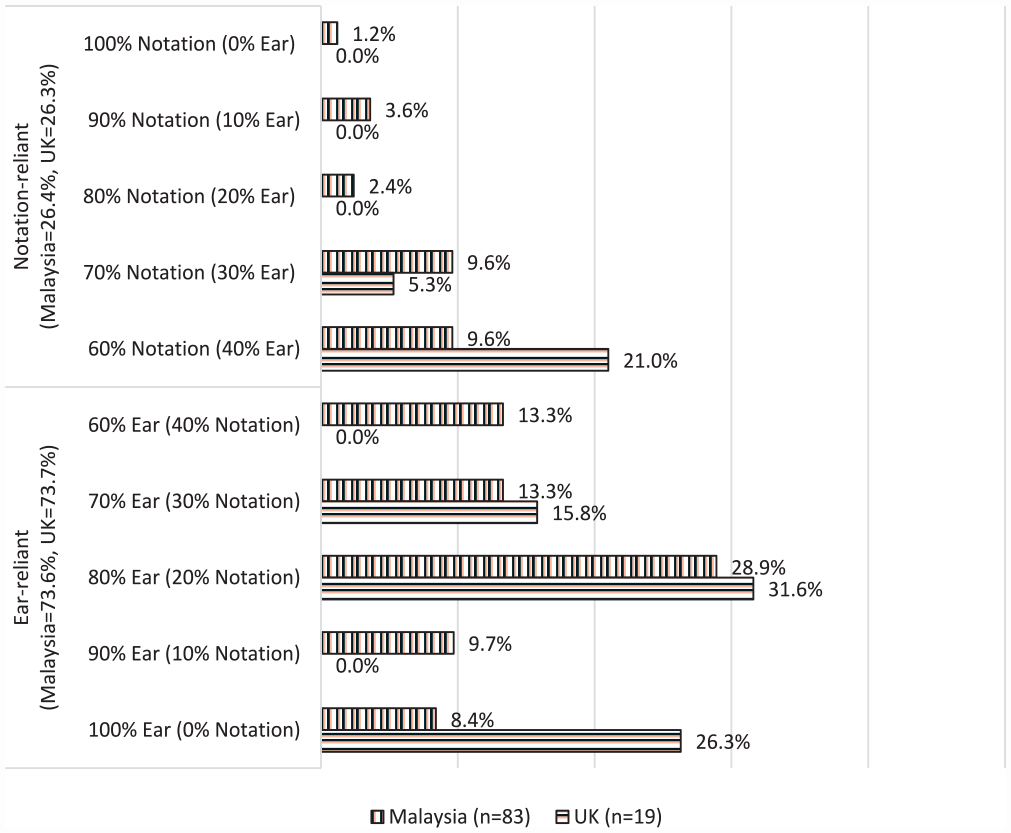
Reliance on notation and ear.
However, further scrutiny of the data revealed that the 26.3% of UK participants who reported being more notation-reliant were all situated towards the centre on the spectrum (60-70% notation), whereas the extreme end (80-100% notation) was only populated by Malaysian participants, which made up nearly one-third of the 26.4%. On the opposite side of the spectrum, 57.9% of UK participants (80-100% Ear) were situated at or towards the extreme end of the spectrum, whereas 55.5% of Malaysian participants (60-80% Ear) were located closer towards the centre.
Discussion
Most popular musicians from both countries had encountered both FPML and IPML. This finding corresponded with the learning histories of Green’s (2002), Robinson’s (2010) and G. D. Smith’s (2013) samples. While the findings indicated that most popular musicians in both countries had experiences with FPML, it suggested that Malaysian popular musicians were not only more likely to engage with FPML, but were also likely to begin with it, or had journeys that only comprised it. Contrastingly, UK musicians were more likely to engage, and begin, with IPML.
The duration in which both samples engaged with FPML contradicted descriptions in literature, where lessons were either rejected outright or lasted a few months; only one of the musicians in this study had lessons that lasted less than one year. Even when considering a slightly longer duration (1–2 years), the figures remained minute in both samples. The remaining musicians in this study all had at least 3 to 4 years of lessons, with the majority having a minimum of 5-10 years and some even lasting more than 10 years. This suggested that popular musicians in both countries were not just turning to FPML to learn the craft of popular music-making but may have also had positive experiences with them, which contrasted literature’s reports of popular musicians feeling uninspired by lessons and not perceiving a need for them. This finding led the study to wonder if disparities in engagement periods with FPML were due to perception changes of FPML or to activities within FPML, and the characterisations of lessons suggested there to be some truth in both the former and the latter.
The characterisations of UK lessons concurred with literature and revealed more intricate details; lessons were structured and organised, had consistent increments of difficulty, and instructors expected their students to meticulously follow their instructions. Furthermore, lessons generally comprised the study of notation, and an emphasis to learn from notation rather than by ear. In fact, informal practices such as playing by ear or learning to improvise were not common occurrences in lessons. However, students were not required to treat notation like holy scripture, nor follow a syllabus religiously, and many did not learn graded exam materials. These characterisations concurred with Robinson’s (2010, p. 139) findings, as they indicated that though informal practices were making their way into formal realms, FPML in the UK was still dominated by features of classical music training. They also coincided with Green’s (2008) descriptions of formal learning, where the teacher decides what the student learns, rarely employs ‘aural copying from a recording’ as an approach to learning, emphasises on reproduction more than creativity, and ‘[tends] to follow a planned progression from simple to complex, often involving specially composed music, exercises, a curriculum or a graded syllabus’ (p. 10).
The depictions from the Malaysian sample painted a relatively different picture. Though the difficulty levels of the materials increased in a consistent manner, and the learning of graded exam materials were staple occurrences, lessons were haphazard at times, and instructors allowed students certain levels of autonomy in deciding what and how to learn without much regard for the prescribed syllabus. Even though instructors required students to study notation, they did not always place significant emphasis on learning by reading notation, nor expected students to play as written. Furthermore, instructors generally taught their students to play by ear and improvise. In contrast to the descriptions from UK-based literature and the UK sample in this study, FPML in Malaysia appeared to have positioned itself further away from the classical music model, is more student-centred, and is relatively successful at incorporating popular music’s informal music learning features: playing by ear, improvising, autonomy, and haphazardness in the learning process (Green, 2008, p. 10).
Meaning, popular musicians who engaged with FPML in Malaysia had experiences that were different from their UK counterparts, and it suggested that the extended durations were due to lesson activities and instructors’ pedagogic styles. However, the same could not be said of the UK, where FPML was described similarly to that reported in literature, yet the majority had more than 5 years of lessons. Therefore, a plausible explanation would be changes in perception, where young learners now ascribe ‘pedagogic authority’ (Bourdieu and Passeron 1977, as cited in G. D. Smith, 2013) to FPML, and may perceive it as a form of “‘apprenticeship training’ whereby young musicians are introduced, and explicitly trained or just generally helped by an individual adult or ‘community of expertise’. . .most importantly, the older musicians act as expert musical models whom learners can talk to, listen to, watch and imitate” (Green, 2008, p. 6).
Though it was argued that the case in Malaysia was due to lesson activities and pedagogic styles, the fact that a significant majority signed up for lessons do point towards them ascribing pedagogic authority to FPML as well; if they did not believe lessons were beneficial, they would not have signed up for them in the first place. Therefore, it led to more positive experiences, and beliefs that such modes of learning can facilitate their acquisition of popular music-making skills, which subsequently resulted in longer engagement durations.
Findings regarding self-learning from the UK sample corresponded with those from Green (2002), Robinson (2010), and G. D. Smith (2013). Listening and copying and PLAs were core practices, technologically-induced learning tools were commonly used, and engagements with various types of notation were low.
Though the situation in Malaysia was akin to that in the UK, there were areas of divergence. Similarly, listening and copying and PLAs were central practices, technologically-induced learning tools were often used, and some forms of notation such as tablature and PNS were seldom utilised as well. However, the use of technology in the learning process was greater in Malaysia, in terms of both cover videos and instructional/tutorial videos, of which the latter was almost equal to the level of engagements with PLAs. There were also significantly greater engagements with the remaining forms of notation. The use of chord charts eclipsed engagements with PLAs, and Western music notation was not too far behind, suggesting that these forms of notation, and instructional/tutorial videos could arguably be deemed core tools/practices, especially chord charts which dethroned PLAs as the second most engaged with tool/practice.
The findings on their reliance on notation/ear supported this assertion. Despite having nearly identical levels of reliance in a general sense, the musicians in the UK were clearly more ear-reliant and used notation as a supplement to their practice. This drew attention to Green’s (2002) assertion that the use of notation was always secondary to learning by ear. There were musicians who were notation-reliant and used their ears in supplementary roles, but they were not overly reliant on notation.
Malaysian musicians on the other hand, had a different relationship with notational practices. While Malaysian musicians can range from entirely reliant on notation, to being completely ear-based, the majority were ear-reliant. However, it was not to the same extent as their UK contemporaries, and notation played relatively bigger roles in their practices. Furthermore, there were some who were completely, or almost completely, reliant on notation in their practices.
Conclusion
In the attempt to explore the extent in which discrepancies can be observed between the learning cultures of popular musicians in Malaysia and the UK, this article examined disparities in experiences with formal and informal popular music learning, engagements with music-making tools and practices, as well as reliance on notation- and ear-based practices. The findings from the examination illustrated similarities and disparities in the learning cultures of popular musicians between Malaysia and the UK.
Generally, in terms of learning histories, the findings from both countries concurred with literature in that most popular musicians in both countries had a combination of FPML and IPML experiences. While that may be so, the findings also indicated that Malaysians were more likely to turn to formal modes to learn the craft of popular music-making, while musicians in the UK were more likely to operate within the traditions of the learning culture: informal learning. The one area that drastically diverged from descriptions in literature was the durations of FPML. Both Malaysian and UK popular musicians had extensive engagements with FPML, which suggested that current popular musicians perceived FPML as a legitimate and effective route to accomplish their popular music aspirations.
However, the FPML experienced in both countries were quite different. Lessons in the UK bore striking resemblance to classical music training, and despite incorporating some informal practices, they sat quite firmly within the descriptions of formal learning, which corresponded with portrayals in literature. Malaysian lessons shared similarities to those in the UK and retained some characteristics of formal learning, but they contained more features of informal, and student-centred, learning.
The tools and practices engaged by UK musicians during periods of self-learning did not diverge from assertions in literature as well; listening and copying together with PLAs remained central, resources made available by technology were frequently used, and engagements with, and reliance on, notation were low. Though Malaysia shared similarities, there was greater use of technology and notation, to a point where notation could arguably be considered a central practice. The fact that a notable number of musicians were completely, or nearly completely, reliant on notation supported this argument.
In conclusion, while the findings from this study reinforced the notion of relative uniformity between Malaysia and the UK, it identified some key areas of divergence between the popular music learning cultures of both regions. Though musicians in both countries generally had a combination of FPML and IPML experiences, and extensive engagements with FPML, popular musicians in the UK were more inclined towards IPML, whereas Malaysian musicians were more inclined towards FPML. Furthermore, the lessons encountered by both sets of musicians were different in nature, and they had different engagement levels with the same tools and practices. It was evident that listening and copying, and PLAs were core practices in both Malaysia and the UK, and tools made available by technological advancements were gaining ground in both countries. However, Malaysian musicians had greater usage of, and reliance on, notation, to a point that it could be considered a central practice in their culture. As the findings from the UK sample coincided with the descriptions in the literature examined, it brings into question the extent in which characterisations from Anglosphere regions may be applied to a Malaysian context.
Contributions to knowledge
The key contribution of this article is the characterisation of popular music learning cultures in Malaysia in terms of engagements with formal and informal music learning, music-learning and -making tools and practices, and reliance on notation- and ear-based practices, and the demonstration of its divergence from characterisations of the UK. Another contribution is the introduction of quantitative data to expand the knowledge of a field that is largely dominated by qualitative inquiries.
Limitations
The findings from this article are arguably contestable, as the examinations were conducted with disproportionate sample sizes between Malaysia and the UK. Additionally, a sample of 19 participants is insufficient for a quantitative study, and the sample size for Malaysia though relatively larger, is arguably representative of only some popular musicians as well. These limitations were the consequence of borrowing the sample from a doctoral study that did not seek to conduct comparisons between regions. Furthermore, the study only conducted a descriptive analysis of data that derived from a methodology that falls short of the standards required for a quantitative study. For these reasons, the research does not intend for the findings to be treated as robustly objective of, nor generalisable to, the populations being studied, but rather to be viewed as potential indications that discrepancies between popular music learning cultures of differing regions may be observed, and thus, demonstrating the need for more extensive and rigorous examinations into the subject matter.
Implications and recommendations
The conclusions from this study highlighted numerous potential areas of research that could contribute towards the understanding of popular music learning cultures, and the developments in music education, as the findings raised more questions than it answered. There were glaring disparities between the Malaysian and UK populations, but this study did not seek to enquire why there were such distinctions, thus future research should be conducted to examine the factors behind these disparities.
Another area that deserved attention, that this study did not afford, was the instruments that participants played. There were notable imbalances between the samples, whereby the Malaysian sample was dominated by pianists/keyboardists, while the UK sample had more vocalists. Thus, further scrutiny of this discrepancy is warranted. Lastly, and more importantly, this study demonstrated the need for increased attention towards examinations on non-Anglosphere regions within the subject matter of popular music learning cultures.
Research Data
sj-xlsx-1-ijm-10.1177_02557614231179221 – Supplemental material for The applicability of Anglosphere-based popular music learning culture characterisations to a Malaysian context
Supplemental material, sj-xlsx-1-ijm-10.1177_02557614231179221 for The applicability of Anglosphere-based popular music learning culture characterisations to a Malaysian context by Hueyuen Choong in International Journal of Music Education
Footnotes
Acknowledgements
The author wishes to thank all participants for their valuable contributions to the research as well as Dr. Jonathan Stockdale, Prof. Gregory Sporton, Prof. Shirley Thompson, Prof. Terry Lamb, and Dr. Chris Kennett for their invaluable advice and support.
Declaration of conflicting interests
The author(s) declared no potential conflicts of interest with respect to the research, authorship, and/or publication of this article.
Funding
The author(s) received no financial support for the research, authorship, and/or publication of this article.

Notes
References
Supplementary Material
Please find the following supplemental material available below.
For Open Access articles published under a Creative Commons License, all supplemental material carries the same license as the article it is associated with.
For non-Open Access articles published, all supplemental material carries a non-exclusive license, and permission requests for re-use of supplemental material or any part of supplemental material shall be sent directly to the copyright owner as specified in the copyright notice associated with the article.
