




Abstract
There is a considerable literature concerning divided societies and the role of education in such societies. In the case of Northern Ireland, education is characterised by a largely separate system of education for its two main communities. There is also a considerably smaller integrated schools sector, where the two communities learn together. A more recent intervention is that of shared education where separate schools are retained but shared classes and other opportunities for sharing are offered. Politically, there has never been extensive support for integrated education, particularly from the two largest parties in the Assembly and power-sharing Executive: The Democratic Unionist Party and Sinn Féin. While not active proponents of integrated education the two parties have embraced shared education and with their own interpretation of its implementation. The introduction of shared education can be seen as a triumph as the two main parties in the coalition have agreed on a policy designed to bridge the gap in education. An alternative view is that shared education is the least-worst option for these two parties but may do little to advance reconciliation.
Keywords
Introduction
Guelke (2012: 30) has described divided societies as places where ‘conflict exists along a well-entrenched fault line that is recurrent and endemic and that contains the potential for violence between the segments’. One manifestation is where there might be a difference of faith or as what Guelke (2012: 18) refers to as ‘branches of the same faith … The most obvious case of a society divided along sectarian lines is Northern Ireland’. Northern Ireland, a largely divided society, is geographically part of the island of Ireland but politically part of the UK. The main social cleavage is ethno-sectarian which can crudely, and which misses many of the nuances, be characterised as between Catholic, Irish-oriented, Republican Nationalists and Protestant, British-oriented, Loyalist Unionists. Periodically, these divisions have escalated into violence. Most recently, in a 30-year period from 1968, there were more than 3600 deaths and 30,000 injuries in a period of ethno-sectarian conflict known colloquially as ‘the Troubles’; over half of those killed were civilians (Worden and Smith, 2017).
The division in society is also reflected in education and schooling. As Duffy and Gallagher (2017: 108) write Northern Ireland is a society divided by religious, national and political identities. These divisions are reflected in education as there are parallel school systems for Protestant and Catholic communities, tempered by the presence of a small religiously integrated sector of schools.
Main school sectors in Northern Ireland (excluding special schools) 2019–2020.
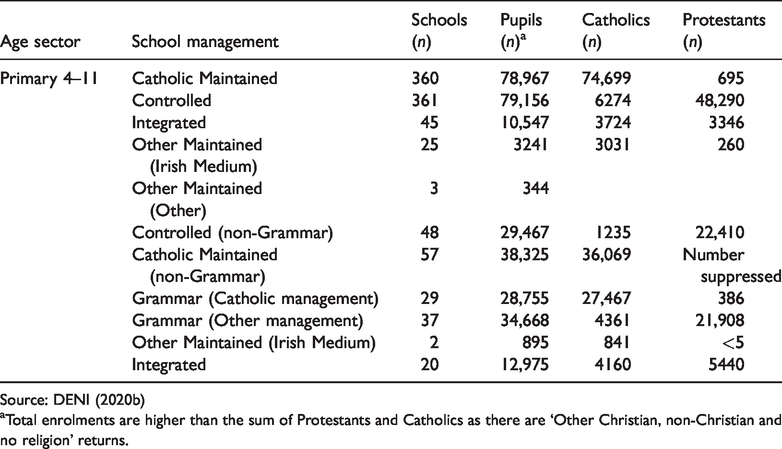
Source: DENI (2020b)
aTotal enrolments are higher than the sum of Protestants and Catholics as there are ‘Other Christian, non-Christian and no religion’ returns.
A number of initiatives have been attempted to redress the segregated nature of the education system. In broad terms, these represent interventions in the process of education through increased contact between Catholic and Protestant pupils and/or through curriculum reforms. One of the earliest emerged from the Education Reform (Northern Ireland) Order 1989, which introduced Education for Mutual Understanding (EMU) and Cultural Heritage into the curriculum (DENI, 1990). These curriculum developments centred on self-respect, and respect for others, and the improvement of relationships between people of differing cultural traditions. Despite considerable work by many schools and individual teachers, these creative approaches often deteriorated into partial and tokenistic delivery limiting opportunities for proper integration between pupils from diverse backgrounds (O’Connor et al., 2009; Wardlow, 2003).
This was followed by a parent-led initiative: the introduction of integrated schools, characterised as providing ‘constitutional and structural safeguards to encourage joint ownership by the two main traditions in Northern Ireland’ (Kilpatrick and Leitch, 2004: 564). The Northern Ireland Council for Integrated Education (NICIE, 2012) refer to Integrated schools as places where children from diverse backgrounds are educated together daily in the same classrooms and, under the 1989 Education Reform (Northern Ireland) Order, the Department of Education Northern Ireland (DENI, 1990) has a statutory duty to ‘encourage and facilitate the development of integrated education that is to say the education together at school of Protestant and Roman Catholic pupils’ (DENI, 1990). There were 65 grant-aided integrated schools in Northern Ireland in 2019–2020 with a total enrolment of almost 24,000, an increase of over 1500 pupils from 2016/2017, and comprising over 7% of the school population (DENI, 2020b). Social attitudes and public opinion data in Northern Ireland have shown that public support for formally integrated schools remains high (see Hansson et al., 2013). However, although opinion polls and surveys have highlighted parental preference for integrated education, this has never been matched by the pattern of school choice. While integrated schools continue to grow in numbers of schools and overall enrolment, recent growth has slowed and their efforts to promote reconciliation have been largely superseded by shared education, viewed by some a ‘new way’ to deliver reconciliation (Borooah and Knox, 2013). This represents a change in policy and [a] decisive swing away from integrated education. The idea of shared education, which accepts the reality of the dual system but works to increase cooperation, has eclipsed integrated schooling as an ideal for the Northern Ireland Executive. (Nolan, 2013: 114)
The initiative is quite open about foregrounding educational benefits in order to give the initiative a chance of traction for schools and parents who often rejected previous initiatives which were openly focused on reconciliation (Hughes and Loader, 2015) and it has been shown to improve intergroup attitudes and, through increased contact between Catholics and Protestants, to reduce intergroup anxiety (Hughes et al., 2012).
However, research has also highlighted the possible ‘tension’ between educational and reconciliation benefits, as discussed by, amongst others, Loader et al. who write: As long as securing market advantage through improved academic performance is the main imperative for schools, reconciliation will remain a marginal concern and the ‘especially important condition’ ( Pettigrew and Tropp, 2006 : 77) of institutional support will be unfulfilled. (Loader et al., 2020:17)
A range of reasons have been discussed and presented with regards to the slow progression of integrated education, such as the area planning process (Northern Ireland Assembly, 2015) and the lack of integrated provision in the vicinity for families who would otherwise have used these schools (ARK, 1999). It is, however, also pertinent to draw attention to what Knox (2010) refers to as the ‘lukewarm’ attitude towards integrated education of most political parties in Northern Ireland; he comments that ‘the will, it seems, to move to a post-conflict or reconciled society is not yet present because it threatens the electoral base of the two key partners in a power-sharing devolved government’ (2010: 230). (The exception is the relatively small Alliance Party which has consistently placed integrated education at the centre of its policy platforms; see for example, their 2016 Manifesto (Alliance Party of Northern Ireland, 2016).)
This certainly rings true for the largest parties in Northern Ireland: The Democratic Unionist Party (DUP) and Sinn Féin. The DUP are the archetypal Unionist, British and Loyalist party in Northern Ireland, and would widely be perceived as representing the ‘Protestant’ community. Sinn Féin are equally clearly perceived as a Nationalist, Irish and Republican party, widely viewed as representing ‘Catholic’ interests. After the 2007, 2011 and 2016 elections, these two parties emerged as the largest in the five-party coalition, thus claiming the majority of Ministries in the Executive, Northern Ireland’s governing body. Although a coalition of all-elected parties, the consensus rules meant that the two largest parties dominated decisions. Birrell and Heenan (2013), however, found that that the power-sharing arrangements had led to impasses and stalling rather than consensus, particularly in the field of education. In this paper, however, the emphasis is on how there has been a ‘convergence’ between the DUP and Sinn Féin concerning integrated education and the introduction of shared education.
The two parties have also held the post of education minister and ‘shared’ the chairmanship of the Education Committee following all Assembly elections since the Northern Ireland Assembly was first established in 1999 and up until the last Assembly election in 2017. This reflects well the ‘tradition’ of having the ‘opposite party’ of the Minister of Education being the Committee chair of the Education Committee. The focus of this paper is set on the DUP’s and Sinn Féin’s election manifestos between 2001 and 2016. The importance of parties’ policy programmes and manifestos are reflected in the attention political science has given to them. Indeed, electoral manifestos have become ubiquitous in political science analyses (see, for example, Rose 1980 and McDonald, et al. 2004). Statements from debates in the Northern Ireland Assembly supplement the analysis of manifestos.
Debates selected have been those in which the concepts of integrated and shared education have featured. However, it is not by any means an exhaustive list of debates between 2010 and 2017.
Thematically the article identifies three areas/foci in which the two parties’ approach to education is laid bare. In the first instance, the focus is on the two parties’ overall perception and understanding of integrated education and in particular its place in relation to other sectors. The second section focuses on the parties’ vision for education in Northern Ireland and in particular the DUP’s vision of a ‘single education system’. The final section highlights the convergence of the parties with the embracing of shared education and the coming together of formerly implacably opposed political parties to support shared education.
Perception of integrated being favoured: other sectors losing out
The DUP was established in 1971 with strong links to the founder, the Reverend Ian Paisley’s Free Presbyterian Church. Throughout the 1970s and 1980s, the party was critical of the Ulster Unionist Party and any move interpreted as compromise on constitutional matters. The party was adept at mobilising support from the Protestant working class around issues such as the Irish Republican Army’s (IRA) reluctance to decommission their weapons (the IRA were a Republican paramilitary group in Northern Ireland’s conflict). The DUP also categorically rejected the Good Friday Agreement (and arguably accounted for most of Northern Ireland's 29% ‘No’ vote in the 1998 referendum). With regards to Sinn Féin, originally formed in 1905, the party reinvented itself many times. It re-emerged in the 1970s closely linked with the Provisional IRA and its campaign to unite Northern Ireland and the Republic of Ireland through a mixture of violence and political activism. In the 1990s, Sinn Féin ended its support for violence and joined the new Northern Irish Executive (Government) set up under the Good Friday/Belfast Agreement of 1998. Since then, Sinn Féin has become the second largest party in Northern Ireland. The signing of an Agreement in 1998, and its ratification by plebiscite on both sides of the Irish border, promised an end to a 30-year period of violence and the beginning of a new era in Northern Ireland. However, even the name of the agreement is contested. Nationalists tend to refer to it as the ‘Good Friday Agreement’, while Unionists prefer the ‘Belfast Agreement’ or the ‘Stormont Agreement’ (Morgan 2009: 85). However, despite considerable criticism, there is a widespread political ‘belief that power sharing is the most viable means of accommodating the conflicting political aspirations of the two national communities’ (O’Flynn, 2003: 129).
The DUP has actively and vigorously defended the controlled sector and ‘Protestant’ schools. Following lobbying by the party, a body representing the needs of that sector was established in 2016, and the DUP celebrated that it had ‘ended the under-representation of the Controlled Sector… part of the DUP’s broader equality agenda in education’ (DUP, 2016b: 14).
However, more critically, the DUP has not supported integrated education and, almost from their inception, saw integrated education as detrimental to Protestant schools (Collins, 1992). Collins also found two aspects of education that particularly concerned the DUP: the funding of integrated schools and the curriculum for all schools (1992). The DUP perceived a ‘preferential treatment of Integrated schools’ as they received 100% funding from the state, something which they felt led ‘inevitably to financial disadvantage to other schools’ (Collins, 1992: 108). This was also exemplified by references made to schools in the controlled sector having been forced to close ‘because they are said to be surplus to requirement’ and as such ‘an imposition on parents rather than, as is often claimed on its behalf, a widening of their choice’ (1992: 109). With regards to the curriculum, references were made to the introduction of EMU and Cultural Heritage into the curriculum, changes seen as being ‘blatant manipulation of children’ done without parent’s knowledge. Similarly, Richardson (in Richardson and Gallagher, 2011) referred to the DUP being extremely critical of initiatives such as EMU. Collins summarises the DUP stance: The only circumstances under which Mr Paisley might be seen to countenance a form of integrated education would be in a state system of education, with Catholic children being educated alongside Protestant children, but presumably without any notion of joint cultural heritage such as the Common Curriculum presently requires by law in all schools. (Collins, 1992: 110) is commissioned to promote Christian Education within the Free Presbyterian Church of Ulster whilst supervising and regulating the seven existing schools. The Board endeavours to highlight those issues within the state education system that are a threat to the spiritual and moral well-being of our children. (Free Presbyterian Church of Ulster, 2014) work towards creating a single education system…[and] establish a Commission harnessing international expertise to advise on a strategy for enhancing sharing and integration within our education system. (DUP 2011: 12) However, we believe it would be mistaken to confuse these norms with how the British government handles integrated education in the Six Counties [the Nationalist term often used to describe Northern Ireland]. We have no quarrel whatever with those parents who choose to send their children to these schools, nor with those teachers who teach in them. They do so for the best of reasons. We can see some advantages and we are in favour of their being there as an option for parents. (Sinn Féin, 1995) no school sector or ethos should be afforded extra statutory protection within the law. All types of schools are grant-aided within our system and should be afforded the same rights and privileges. (DUP 2015a: 6)
Sinn Féin’s official party policy on integrated education has been to endorse multi-denominational schools while pushing for a change in the school curriculum as well as increased collaboration between schools (see for example Sinn Féin, 1995, 2011). The main thrust of their education policy seems to stem from the commonly-held conviction that the educational system, in its current form, is unnaturally enforcing a sense of ‘Britishness’ onto Northern Ireland's youth (Sinn Fein, 2017).
The DUP, Sinn Féin and Integrated Education: a single education system – the vision of education in Northern Ireland
The DUP have repeatedly referred to the need to work towards ‘a single education system’ but without much elaboration on what such a system would resemble. It appears not to be a vision of integrated schools such as those which exist today. One DUP education spokesperson was clear that we do not mean the current system of integrated education, because that was the creation of another sector. We mean a genuine, single system that respects rights, privileges and having a Christian ethos in schools, and we need to continue to work towards that. (Northern Ireland Assembly, 2010: Storey) We must accept that we cannot keep schools open while losing money on expensive administrative structures. Nowhere else in the United Kingdom or anywhere in the world can match the number of different school-management types in Northern Ireland. (Northern Ireland Assembly, 2007: Spratt) their door is open, whatever religious denomination or persuasion children are. There is no sign across the door of a controlled school that says that Catholics need not apply. In the voluntary sector and in the controlled sector, there is a mix of children from different religious persuasions. (Northern Ireland Assembly, 2013: Storey) that the government should stop funding Catholic schools…was unlikely to find favour with many people beyond [the] party faithful. (2016: 352)
For Sinn Féin, a single education system is a challenging prospect, as highlighted in various debates such as in 2014 and where the party expressed ‘concern’ over such an approach and where the party were critical of what it perceived to be ‘one size fits all’ and where the points was made that: The Catholic maintained sector is outperforming every other sector at the minute on educational outcomes. Why on earth would it agree to go into a single education system? Why would the Irish-medium sector do so? Why would people who want to play Gaelic sports go into a system in which they might not be catered for? All those issues have to be teased out. (Northern Ireland Assembly, 2014: Sheehan)
Embracing shared education
Research such as Hansson et al. (2013) and Fontana (2017) has highlighted how integrated education, despite being a feature of the Good Friday/Belfast Agreement, fared badly in subsequent policies. Instead, in much public policy the emphasis is placed on shared education, which allows schools to maintain their distinct and separate identities whilst entering into an interdependent, collaborative relationship (Duffy and Gallagher, 2014). Shared education, its proponents say, does not replace integrated education and involves all sectors, including integrated schools, and as a policy aims to allow for further collaboration and co-operation (Brown et. al. 2020), making the existing boundaries between sectors and schools more porous (Borooah and Knox, 2015). The Department of Education (DENI, 2015: 4) referred to an all-encompassing vision for Vibrant, self-improving Shared Education partnerships delivering educational benefits to learners, encouraging the efficient and effective use of resources, and promoting equality of opportunity, good relations, equality of identity, respect for diversity and community cohesion.
While integration is mentioned by Robinson (Belfast Telegraph, 2010), the party advocated that school development proposals should ‘demonstrate that options for sharing have been fully explored’ (DUP, 2010: 12) and the emphasis has been on ‘sharing’. The party also referred to schools to be established as ‘shared spaces’ with the sharing of resources and assets. Also emphasised was cross-sectoral work and further exploration of sharing between and across sectors. The lack of appetite for a unified system of education was clear when the DUP in its 2015 manifesto referred to what it saw as a limited appetite for a single type of school … that purports to meet the needs of all children … Our diverse schooling system reflects the wishes of our society. (DUP, 2015b: 4) Educating our children together is the key to transforming society for generations to come. Parents and communities tell us that whilst they want greater sharing they still wish to retain their distinctive school ethos and identity. This is a reality that we have to accept and we believe that piloting greater sharing within our system will do much to build confidence within communities to break down barriers. (DUP, 2015b: 7) Sharing provides clear community benefits, not only from an educational point of view, but socially and economically. Sharing with pupils from different religious and socio-economic backgrounds will increase understanding and appreciation of our varied culture. Sharing can foster respect, tolerance and understanding in our young people. (DUP, 2016a: 8)
As with other parties, in its manifesto for the UK General Election in 2010, Sinn Féin refers to the Lisanelly educational village, a proposed shared education campus at the former British military base in Omagh (Sinn Fein, 2010: 23), and in its Assembly Election Manifesto in 2011 to the promotion of ‘collaborative schools’ (Sinn Féin, 2011: 16). Sinn Féin (2016) in its assembly election manifesto stated that the party would Continue to encourage and facilitate the growth of Irish Medium; Integrated; and Shared Education. Greater sharing of resources and greater co-operation is clearly desirable, but that should not be misrepresented as integrated education. No one seems to be arguing against parental preference – rightly so. When we give such importance to parental preference, we will always end up with a diverse school sector. (Northern Ireland Assembly, 2013: Sheehan)
The DUP has also put forward the need for the streamlining and management of resources, and in the light of shared education referred to in 2011, when the party referred to the promotion ‘sharing of resources and assets between schools’ (DUP, 2011:12). A connecting thought here has been the criticism of the ‘multiple sectors’ and ‘administrative structures’. In the context of shared education, this has manifested itself by referring to the need for sharing of resources, such as in 2015 when a DUP politician stated: resources – or the lack of resources, if we are being honest about it – will drive us down that route no matter what … If there is not enough finance there to provide two separate schools and there is only enough finance to provide one single building, and you have a maintained school and a controlled school, the answer is staring us in the face. That is where shared education is driving this. The resources may well bring about the shared educational experience that we are talking about.
Conclusion
Birrell and Heenan refer to impasse after impasse in education policy due to the lack of a consensual policy style, which has worked to block the implementation of policies in education. They identify three determinants or contextual factors that influence educational policy in Northern Ireland: the salience of communalism, the significance of the ideological policy positions of the parties and the nature of policy communities and networks. The salience of communalism is particularly influential as political parties reflect the ethnic and religious divisions in society, and as a result, policies are ‘interpreted within a calculation of sectarian interests or crude views of which community might benefit or be disadvantaged’ (Birrell and Heenan, 2013: 777). They note that this is pertinent in the context of education policies where, rather than a consensual policy, the decision-making process has been characterised by a culture of top-down unilateral decisions by minsters and policies characterised by political stalemate and often based on the communal divisions of Northern Ireland. This ‘salience of communalism’ may have influenced the DUP’s and Sinn Féin’s stance on integrated education and shared education.
This short paper has attempted to show a shift by Sinn Féin and the DUP from criticising integrated education to welcoming shared education, leading to a situation where the result has been – in the context of impasses – a successful implementation of a shared education policy. It is possible to trace this development through the policies and statements of the political parties and, as Knox (2010) so correctly identifies, a lukewarm attitude towards integrated education as parties protect their own sectoral interests. There has been an agreement and consensus between the two largest parties through the introduction of, for example, the Shared Education Bill. However, it is clear that the ‘salience of communalism’ remains; despite the rhetoric, the DUP has advocated and emphasised separate education, and fought the corner of the controlled sector while Sinn Féin have done little to promote integration in education. It is not entirely clear what the end-goal of such policies are, and it is hard to envisage Sinn Féin – as the party currently stands – agreeing with the DUP that shared education is a route towards a single state education system, albeit not using an integrated model. While the DUP has been critical of the state funding of Catholic schools, this policy is unlikely to receive wide support (Gardner, 2016). Rather, the emphasis for the DUP has been the protection of the Controlled Sector, addressing its perceived mistreatment. The espousal of shared education might be a response to the need for the challenges of duplication to be addressed. The DUP has also advocated the role played by the controlled de facto Protestant sector as a sector with schools ‘open to everyone’, thereby failing to acknowledge the perceptions amongst the Nationalist and Republican communities that state schools have a British and anti-Irish agenda.
For many of them, even integrated schools emphasise a Unionist narrative and thereby act as a hindrance for any form of integration and inter-group contact (McDaid, 2015). The implementation of the shared education policy also plays well with the DUP’s ‘governmental counterpart’, Sinn Féin, which as a party has tended to emphasise parental choice and, in the case of shared education, aspects of socio-economic mixing rather than addressing the divide between Protestants and Catholics.
The UK Government’s New Decade, New Approach document (2020) was designed to get politicians in the devolved assembly back to work after a three-year hiatus. It explicitly committed the Executive to establishing an external, independent review of education provision, with a focus on securing greater efficiency in delivery costs, raising standards, access to the curriculum for all pupils, and the prospects of moving towards a single education system. To help build a shared and integrated society, the Executive will support educating children and young people of different backgrounds together in the classroom. (UK Government, 2020: 7)
Footnotes
Declaration of conflicting interests
The author(s) declared no potential conflicts of interest with respect to the research, authorship, and/orpublication of this article.
Funding
The author(s) received no financial support for the research, authorship, and/or publication of this article.
