




Abstract
The purpose of this study is to examine the applicability of an applied music notation system, Figurenotes, by using the concept of educational method as theoretical lens. Figurenotes is examined through this lens at two levels: the micro level of music educational practice and the macro level of advancement of educational policies. The study is based on semi-structured interviews with experts in music education, special and general education, educational policy, music therapy, voluntary work, and music business as well as with students, clients, parents, and the developers of Figurenotes. The findings emphasise that the application of Figurenotes lowers the threshold for learning and teaching music, and is especially applicable in educational situations where the student’s cognitive load needs to be lessened. It is concluded that Figurenotes can be seen both as a pedagogical approach and as a method for advancing educational equity.
Keywords
Introduction
In recent decades, music education for students with significant support needs 1 has drawn increased interest (Adamek & Darrow, 2010; Darrow, 2003; Dobbs, 2012; Laes, 2017; Ockelford, 2012). In Finland, this interest can be attributed to two developments. First, general awareness of the diversity of students has increased at the level of legislation and curriculum development (Zilliacus, Holm, & Sahlström, 2017; see also BEAA, 1998/633, §1; FNBE, 2014, 2017). Second, it has been acknowledged that the perspective of significant support needs may deepen understanding of educational phenomena as pedagogical innovations developed with such students often have broader general applicability (Laes, 2017; see also Vaughn & Swanson, 2015).
The aim of this study is to analyse the applicability of Figurenotes, an applied music notation system developed at the Resonaari Music Centre in Helsinki, Finland, in the 1990s to provide access to music for students who have significant support needs. The Figurenotes approach to learning and teaching musical skills uses notation based on different colours and shapes that indicate pitch levels and are duplicated on the keyboard or fretboard of musical instruments. This system was originally designed for use in popular music pedagogy, particularly for pitched instruments such as electronic guitars and keyboards.
So far, research has indicated that Figurenotes has strengthened the teaching and learning of students with significant support needs (Kivijärvi & Poutiainen, forthcoming), yet its wider applicability and educational policy meanings have been virtually unstudied at the academic level. The only study on the system demonstrated its applicability in early childhood piano teaching (Vikman, 2001). Figurenotes has also allowed students with significant support needs to attend music lessons in Basic Education in the Arts (BEA), a Finnish system of extracurricular arts instruction that follows goals and guidelines stipulated by the National Board of Education (BEAA, 1998/633, §1; FNBE, 2017). Some students who have studied with Figurenotes have also launched professional music careers. 2
This study examines Figurenotes at two levels: the micro level of educational practice and the macro level of advancement of educational policies. The research question guiding this case study was: What are the aspects of applicability of Figurenotes?
The application of Figurenotes in various educational and therapeutic situations and environments makes its definition ambiguous. To answer the research question, therefore, this study also examines the definition of Figurenotes. The research question thus addresses the wider social, cultural and policy meanings connected with the application of Figurenotes. For this case study, semi-structured interviews were conducted with experts in the fields of music education, special and general education, educational policy, music therapy, voluntary work and music business, as well as with students, clients, parents and the developers of Figurenotes. In the following sections, the contextual and conceptual background of the study is described. The methodological choices are then presented, followed by the findings and conclusions.
Figurenotes and music education in Finland
Finland has two publicly funded music education systems. Within general education, all children and adolescents receive basic music education in comprehensive and upper secondary school. The aim of general music education is to ensure that all students can participate actively in music making and are introduced to a wide variety of musical activities (FNBE, 2014). Parallel to general music education, BEA institutions offer extracurricular music education targeted primarily at minors. The Finnish National Board of Education sets the BEA’s educational goals in the national core curriculum: to provide students with self-expression skills and the competencies needed to study in secondary-level music institutions (BEAA, 1998/633, §1; FNBE, 2017). Whereas equity is the point of departure for Finnish general education (Sahlberg, 2015), BEA has been criticised as promoting inequity. For instance, it has low accessibility for people with disabilities (Juntunen & Kivijärvi, forthcoming).
The development and application of Figurenotes is directly linked to the establishment of the Resonaari Music Centre (henceforth, Resonaari) in 1995. Resonaari has widened perspectives within BEA by providing opportunities for students with cognitive and developmental disabilities to receive goal-oriented music instruction. At the time of writing (2018), more than 300 students of all ages were enrolled in the Resonaari music school, attending one-to-one and group lessons once or twice a week. This music school frequently draws its teaching repertoire from popular music, unlike the many other BEA music institutions that emphasise classical music repertoire (Väkevä & Kurkela, 2012). At Resonaari, almost all students begin their studies with Figurenotes and later may switch to the Western standard music notation or continue with playing by ear. Figurenotes is also applied in early childhood music education, comprehensive schools, universities and applied sciences universities in Finland. 3
Figurenotes and the pedagogical applicability of notation systems
Teaching and learning with notation is widely debated within popular music education (e.g., Green, 2001; Powell, Krikun, & Pignato, 2015), and whether students should be taught using notation or by ear has emerged as a core issue (Björnberg, 1993; Lilliestam, 1996). Learning strategies that are not notation driven, such as copying recordings by ear, have been suggested to be essential to learning popular music repertoire (Green, 2001). Learning processes focused on improvisation, arrangement and composition are also commonly utilised (Cohen, 1991).
One explanation for the infrequent use of popular music pedagogy is the different principles of structuration in popular and classical music. A seminal work in this argumentation is by Chester (1970), who suggested that standard Western classical music represents an extensional form of musical construction that takes basic musical ideas and builds up complex structures of their combinations. Chester (1970) argued that popular music, in contrast, largely follows intensional development in which the basis of musical structuration is variations in existing parameters, such as subtle modulations of pitch and slight deviations from the beat in rhythmic patterns. Meyer (1989), moreover, distinguished between primary musical parameters, or syntax-based, discrete relational categories of pitch and duration, and statistical secondary parameters, including tempo, dynamics and timbre.
Following this rationale, standard Western notation might not serve the needs of popular music pedagogy as it focuses more on symbolic representation of the primary musical parameters used as the basis of extensional musical structuration. This might explain why, in learning popular music, standard Western notation often is either never or rarely used (Lilliestam, 1996). Even when applied in this context, notation is often reduced to lyrics, melody lines and chord progressions. Instead of staff notation, chords can be represented by letters and pictograms of guitar fingerings. 4 Examples of specialised notation conventions in popular music derived from the Western musical tradition are percussion notation and chord charts. Notation systems based on numbers, colours, shapes and letters are also commonly used (Kuo & Chuang, 2013). Some examples of such notation systems are graphic notation by Murray Schafer, Nashville Number Notation, Braille music notation, and the shape note system (Kuo & Chuang, 2011; Rutherford, 2014). There is also a variety of colour-based notation systems that have been developed for the purposes of general and instrumental music education (e.g., Hoffman, 1996; Holcombe, 2006; Mencher, 1996). In Finland, a well-known colour-based notation system is Colourstrings (Szilvay & Szilvay, 2011), which is used in some BEA music institutes.
Based on these considerations, the exclusive use of standard Western music notation may limit the musical learning of students who encounter challenges perceiving the syntactic relationships between pitch levels and rhythmic patterns or between wider musical forms and patterns. Students with cognitive disabilities, for instance, may have difficulties with such high-level musical perception, especially when working with symbolic representations in written form. One way to support more equal opportunities in music learning could be to learn repertoire by ear with the aid of a simplified or cursory notation system, such as Figurenotes (see Figure 1).
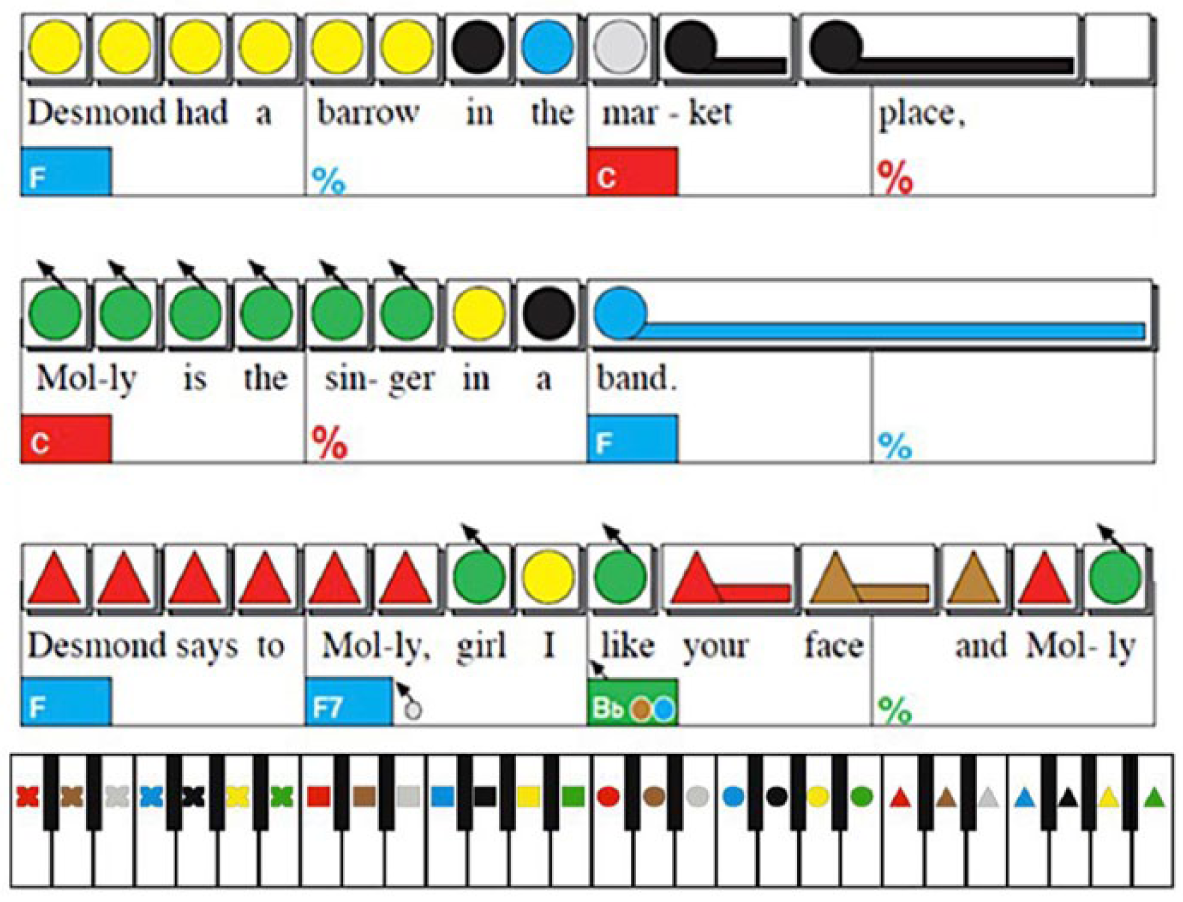
Figurenotes notation: An example with “Ob-La-Di-Ob-La-Da” by John Lennon and Paul McCartney, Kaikkonen & Uusitalo (2014).
In Figurenotes, each note has a corresponding coloured symbol. The symbols are usually illustrated in stickers placed on the corresponding keys or frets of an instrument. The player does not need to name the colours or shapes but instead connects the symbols to the keys or frets. Different octaves are indicated by a diagonal cross, triangle, square, circle and diamond. Rhythmic patterns are depicted by the size of the symbols, and rests are depicted as empty bars whose size represents the duration. Sharps and flats are marked with arrows over notes. An arrow pointing to the right depicts a sharp, while an arrow pointing to the left depicts a flat.
In Figurenotes, the colour of the chord is the same as that of the root note of the chord. The sharps and flats that are a part of the chord are marked in the bar. The sharpened or flattened root note is based outside the bar. More complex chords are marked so that an extra tone is marked outside the bar. Chords with turnarounds are marked so that the root note is in the right corner of the bar, and the other tones are played in line with it. In melody playing, the shapes, colours and arrows are used together. All of them are positioned on the same static line, which is a clear difference of this system compared with Western music notation. However, chords are positioned underneath the melody line, similar to Western music notation.
Alternative notation systems and the concept of “method” in music education
In music education, “the underpinnings of pedagogical practice are often explained through teaching method[s]”, especially the so-called “grand methods” (e.g., Kodàly, Orff, Suzuki and Dalcroze) (Huhtinen-Hildén & Pitt, 2018, p. 55). Several music education scholars, though, have warned against narrowly understanding methods as technical devices to aid teachers’ work and have suggested that the methods’ philosophical rationales should be examined, and that they should be always related to the teaching contexts (e.g., Benedict, 2010; Juntunen & Westerlund, 2011; Regelski, 2002).
From a philosophical perspective, the choice of method can be linked to the conception of the relationship between pedagogical means and ends. For instance, the ends may be pre-determined by a tradition with strict curricular definitions, whereas another view might hold that teaching should address the dynamism of students’ experiences within their cultural context (Juntunen & Westerlund, 2011; Väkevä & Westerlund, 2007). According to Regelski (2002), music teachers are often trained in methods classes that do not inculcate a critical approach to teaching and learning. Regelski (2002, 2004) referred to such modes of action as “methodolatry” and argued that methods are often applied in music education simply as they have been previously used. Such education typically emphasises one particular method and excludes others, so that the method applied restricts the use of other possible approaches that question musical engagements (Benedict, 2010). Consequently, educators might adopt teaching strategies without reflectivity, enacting indoctrination rather than education (Bowman, 2002). Instead of designing teaching towards fixed ends then, educators should focus on the actual learning processes based on situational needs where the relationship between the means and ends is subjected to ethical deliberation (Väkevä, 2007).
A music notation system, therefore, perhaps should be understood not as a method but as a system of representation meant to support musical practice. However, standard Western notation certainly has had a central role in traditional music education methods, even in approaches that highlight ear training and performing by heart. Many applied notation systems seem to be developed as intermediate steps to learning Western notation, which has taken-for-granted pedagogical value as the standard way of representing musical works.
A central motivation for inventing alternative notation systems may be to advance music making and learning by those who cannot or find no need to learn standard Western notation. If we accept that music education should be aimed at opening new creative possibilities in learning situations for all, teachers should be equipped with a range of pedagogical knowledge and capabilities, including the capability to apply alternative notation systems. However, many alternative approaches of notation may be superficially understood as methods that are targeted at limited groups of students. From the standpoint proposed here, notation systems should not be seen as applied ways of representing musical events. Instead, notation systems may be understood as pedagogical tools that can be adapted flexibly, acknowledging the possibility that they might not be needed at all. At the same time, alternative notation systems seem to transgress the traditional methodological use of standard Western notation in pedagogical practice, suggesting new ways to meet the diverse pedagogical needs of learners.
Research process and methodological approach
The data for this case study were constructed through semi-structured, thematic interviews (Creswell, 2014). There were 25 interviews: 15 of the interviews were conducted with experts, four with students, two with clients, two with parents, and two with the developers of Figurenotes. In this data-driven study, the analysis focuses on interviews with the Figurenotes developers (2) and other experts (15). The student, client and parent interviews were utilised to deepen the examination. Kaarlo Uusitalo and Markku Kaikkonen, the two experts who had developed Figurenotes, were interviewed. The 15 experts represented the fields of music education, special and general education, educational policy, music therapy, voluntary work, and music business. In choosing the experts, their familiarity with Figurenotes was emphasised. The experts were recruited using snowball sampling (Check & Schutt, 2012). Two music education students from comprehensive schools, one student from the Resonaari Music Centre, and another student from another BEA music school, as well as two music therapy clients, were also interviewed. In addition, two parents of students who were studying music using the system were interviewed.
The individual interviews were conducted by the author between February 2014 and July 2014. The interview data consisted of approximately 30 hours of audio recordings. The interviews were thematically divided into the following sections: (1) the interviewee’s background, (2) the applicability of Figurenotes, (3) the history and development of Figurenotes and (4) the implications of Figurenotes. The student and client interviews focused on the interviewees’ personal experiences and their individual trajectories within the Finnish education and therapy systems. The results based on this data will be reported in two articles with different research questions in each.
The author transcribed the audio-taped interviews into text. Specific words, phrases, and concepts were then recognised and encoded with the best possible heading in line with the research focus (e.g., Figurenotes in instrument teaching, composing, or Vapaa säestys [free accompaniment]). 5 The codes were combined into three categories.
The interviewer briefed the interviewees about the timetable and purposes of the research and emphasised that all informants would remain anonymous throughout the study, and that they were free to withdraw from the study at will (Check & Schutt, 2012). This information was also provided in simple language for children and interviewees with significant support needs.
Findings
The data analysis identified the following main categories: definition of Figurenotes, pedagogical applicability of Figurenotes and Figurenotes as a method for educational and social change. All the interviews were conducted in Finnish. The English translations of the quotations have been made by the author. The developers of Figurenotes gave permission to use their names publicly. The following abbreviations refer to the other interviewees: E1–E15 (expert 1–expert 15), S1–S4 (student 1–student 4), C1 and C2 (client 1 and client 2) and P1 and P2 (parent 1 and parent 2).
Definition of Figurenotes
Several experts described Figurenotes as either an independent or an alternative notation system. One expert (E12) summarised, “I would define Figurenotes as a music notation that is simplified, easy to understand, linear and based on colours and shapes”. Another expert (E1) expressed similar views: “Figurenotes is a music notation [system] but somehow an alternative one, as it is so easy to adopt”.
Students, clients and parents shared similar sentiments. A parent (P1) said, “Figurenotes is clear, and it is also a highly exceptional system to learn how to play”. A student (S1) stated, “Figurenotes is a music notation, … just simpler and easier than conventional standard Western music notation”. A music therapy client (C1) expressed, “I don’t think there is that much difference between [the standard Western music notation and Figurenotes]. … I know both systems. It is just faster to learn Figurenotes”. The youngest students and clients described Figurenotes more concretely, naming the colours and shapes used and the instruments and contexts in which they were applied.
Almost all the interviewees reflected on whether Figurenotes could be understood as a method in the sense of consisting of the strategies and materials teachers use to facilitate students’ learning and to build their ability to follow a similar, stepwise process (Benedict, 2010; Juntunen & Westerlund, 2011). One expert (E4) stated, “I would say that Figurenotes is a method but not similar to the Dalcroze method, for instance”. Another expert (E9) proposed, “One can teach in various ways with Figurenotes. That is why I would define Figurenotes as a system instead of a method”. The interviewees’ accounts seem to reflect the view that a pedagogical method is a controlled, systematic process connected to an underlying philosophy or ideology.
Unlike most interviewees, the developers were clear on the issue of Figurenotes in relation to methodolatry (Regelski, 2002). Kaarlo Uusitalo expressed, “Figurenotes is not a method. It is a notation system”. Similarly, Markku Kaikkonen stated: “People tend to think that Figurenotes is a method, perhaps because some other colour-based systems, such as Colourstrings, are methods. Figurenotes is not. It is only a way of notating music”. An expert (E11) followed this line of thinking: I would define a method as a system that has a clear copyright and that is somehow canonised. Usually, there is some kind of imperative on how to use a system or whatever it is. … In my view, any of these features are not found in Figurenotes.
These three statements align with the international critique of the use of established methods in music education. They may also reflect the changes in the Finnish curricula since the 1990s intended to avoid the use of the grand methods and to instead emphasise teachers’ autonomy and flexible educational practices in the context of changing situations (Juntunen & Westerlund, 2011).
Pedagogical applicability of Figurenotes
The interviewees first analysed the applicability of Figurenotes in different areas of Finnish music education. Uusitalo elaborated on the system’s applicability: Figurenotes is suited for all individuals, especially those who have not used standard Western music notation. We [the Resonaari staff] have tested Figurenotes with learners who have highly different backgrounds and challenges. For students who have visual impairments, we developed a Braille version of Figurenotes. For students who are colour blind, the teacher can mark the first letter of the colour on the sheet note. In my opinion, Figurenotes is applicable at all levels of our [Finnish] music education system.
Kaikkonen explained: Figurenotes is applicable to all situations in which a music notation system is required. However, when a person has already learned standard Western music notation, the utilisation of Figurenotes is often not beneficial. This is more a pedagogical question.
The applicability of Figurenotes, therefore, depends on the learning and teaching situation. In several learning and teaching situations and pedagogical approaches, music notation is required, but in other situations, it is not justified. As discussed, such situations may be learning popular music repertoire (Green, 2001) and cases when students have difficulties perceiving the syntactic relationships between pitch levels and rhythmic patterns or wider musical forms and patterns (Chester, 1970; Meyer, 1989). By reducing the cognitive burden related to music reading, the application of Figurenotes can be especially applicable with students who have cognitive disabilities and novice students in general.
The majority of the interviewees said that Figurenotes is applicable to a wide range of learners. One expert (E3) mentioned the environments in which the system can be utilised: “Figurenotes is applicable in comprehensive schools, high schools, [BEA] music institutes, universities of applied sciences and other universities”. An expert (E10) summarised, “Figurenotes is suited to individuals of all ages and target groups”. The interviewed parents, students and clients expressed similar views. A parent (P1) stated, “I think Figurenotes is for all; it is designed for all”. Both developers expressed similar sentiments. Kaikkonen stressed a key idea in Figurenotes: “The key principle in the system is to find the minimum common denominator that is required for a person to start playing”. He elaborated on the realisation of this idea in the application of Figurenotes: “The bottom line of Figurenotes is that one can start playing without a teacher. The information is in such a simple form that you do not need anyone to guide you. Just start playing”. He also addressed the limitations of the system: If the musical texture is complex or dense, Figurenotes is not the best way to present it visually. In theory, it is possible, but in practice, it is not worth the effort. Figurenotes rather loses its point: it is a tool presenting the basic principles of music in a straightforward way.
Kaikkonen argued that Figurenotes’ low threshold accessibility as a notational system should be recognised, especially for students who are not capable of learning complex musical pieces with standard Western notation. Likewise, the experts discussed the strengths and limitations of the Figurenotes system in relation to other notation systems and different musical genres. The interviewees gave particular attention to the system’s applicability in instrument teaching in the context of popular music pedagogy. One expert (E12) emphasised Figurenotes’ high applicability to teaching accompaniment and band playing: “I think Figurenotes is best for teaching free accompaniment [vapaa säestys] or for use in the rock band context”. The interviewed students enrolled in comprehensive schools described their music activities and reported that they found Figurenotes to be suitable for these classes when learning popular music.
The interviewees also emphasised the applicability of Figurenotes in ensemble pedagogy. One expert (E11) made the following observation: One opportunity is that one can make digressions to other instruments [from playing the main instrument]. In band playing, it is highly important that the player can also play instruments other than his or her main instrument and understand the special characteristics of instruments—their limitations and how they fit together. In these kinds of educational situations, it is highly useful if you have an application that allows one to put in minimal effort on the basics, … like what key should I press in this instrument? I’d say that in these situations, it is much faster to deploy some things with Figurenotes. I think it is quite a big issue.
Another expert (E14) followed this line of thought, suggesting, “Well, it is an approach through which you learn very easily to play in a band. Like immediately and not after five years, which is typical”. Regarding the challenges in playing with Figurenotes, an expert (E6) stressed that … especially in band playing, they work very well, and make melody playing in bands possible. I feel like the challenge is that if the notation is dense, then it becomes difficult to read. I sometimes simplify the version if that’s the case.
Another expert (E12) elaborated: Figurenotes is at its best when you have to make chord sheets for players. This means that some players are typically playing the basic pulse, and the rest are improvising, you know, like playing riffs and patterns and so on. I think Figurenotes can definitely better work in this kind of playing than traditional notation.
Following these considerations, some experts described Figurenotes as an application of standard Western music notation. They suggested that the basic idea of the system imitates staff notation, so it can be used for learning standard Western music notation, though it was not originally designed for doing so. An expert (E1) explained: I think Figurenotes offers a way to learn differently. If it is too challenging to start with the traditional notation, one can begin with Figurenotes. And then slowly … I begin to think Piano soikoon [a Figurenotes piano instruction book] is great; it makes the shift easy. First, Figurenotes, then colours on the staff, and then one can stop using the colours. My students have learned to play with Figurenotes and also with the standard Western music notation.
Thus, the information conveyed by Figurenotes may also provide the first steps to learning standard Western music notation. This process can take place, for instance, through Colournotes, an application of Figurenotes in which the noteheads are marked with the same colours as in Figurenotes. However, in the context of popular music pedagogy, the use of Figurenotes varies considerably, and in many cases, it is not considered to be necessary.
Figurenotes as a method for educational and social change
The experts also expressed macro-level perspectives on the matter of Figurenotes and equity. One (E12) elaborated that whether Figurenotes can be defined as a method “depends on the definition of a method. I would consider Figurenotes as a method for advancing equity and inclusion in education”. Another expert (E4) followed this line of thinking, addressing how educational systems and schooling structures generate inequities and exclusive policies: Of course, exclusion happens all the time in music or art culture, likewise in education. The educational mechanisms legitimate certain things. That’s why I think it [Figurenotes] is or can be a way to let people’s voices be heard—those voices that would not be there otherwise. I think that this is the value [of Figurenotes], but it has also applicability in general music education and perhaps in music didactics.
Another expert (E11) examined Figurenotes from a macro-level perspective connecting it to equity and accessibility policies in Finnish music education: It [Figurenotes] is an open system that can be adapted to various kinds of uses. Maybe the applicability [of Figurenotes] is the primary thing that comes to my mind rather than a simple description of what it is … rather the process of what happens when it is applied. It is an approach through which the threshold for music making can be lowered. This way, it [music making] is accessible to so many [people]; that is, it [Figurenotes] makes music and musicianship more equal. It is very significant that music making is made available for those people who haven’t had the opportunity … to make music because the [educational] system has not worked in a right manner; it has not had the means.
One expert (E8) elaborated these considerations on the applicability of Figurenotes: For this group [learners with significant support needs], it offers opportunities for self-expression and to be part of art and musical … musical experiences and what they engender. It [Figurenotes] provides all these [opportunities] to society as well, makes it more pluralistic. Who has access to music? Who has access to performing? Who has access to develop his or her potential?
Kaikkonen highlighted effects of the application of Figurenotes on Finnish society: Figurenotes has been an opening. … It enables playing for people who haven’t previously had such opportunities. And if Figurenotes allows people to engage with music culture and their own relationship with music starts to deepen and develop, above all, Figurenotes enables people to engage with the cultural field as musicians and artists. Here, I’m talking about musicians who have cognitive disabilities. … It is an extraordinary thing. For example, this band on my T-shirt [Pertti Kurikan Nimipäivät], they would not be there without Figurenotes. We can talk about a societal phenomenon.
These considerations relate to wider changes initiated by the application of Figurenotes, including music education policies focused on the social roles of students with disabilities. Based on the interviewees’ statements, the application of Figurenotes has contributed to advancing equity in music education in Finland. They thus support the view that music education practice can be understood as a method that alters social order rather than merely a practice of transmitting musical traditions to students (Väkevä & Westerlund, 2007).
Conclusions
This study aimed to examine the aspects of applicability of Figurenotes using the concept of educational method as a theoretical lens. The findings make clear that, unlike standard Western notation, Figurenotes should not be seen as a standard as it can be altered depending on situational needs. Figurenotes seems to be more flexible than standard Western music notation: it is not restricted to a staff, so it can be used within several approaches in music education. For instance, in early childhood education, when colours and shapes are often used as symbols in teaching other subjects, it may be beneficial to also build pedagogical approaches in music education on colours and shapes. This adaptation of Figurenotes may be a fluent way to teach music to children in general education. However, based on the study results, it can also be concluded that Figurenotes is applicable in educational situations where students’ cognitive load needs to be reduced. Moreover, the application of Figurenotes may be beneficial in cases when the repertoire is not structured following the extensional rationale as described by Chester (1970) or when complex figurations of syntactic patterns do not form the basis of musical structuring (Meyer, 1989). Finally, avoiding the often time-consuming reading of staff music notation may allow for more fluent interactions with other players and more time for practicing technical skills in playing instruments.
Based on the interviews, it seems that wider application of Figurenotes could contribute to a growing trend in Finnish music education as the system may enable students to find their individual paths to learn music as a lifelong pursuit (see FNBE, 2014, 2017). The national core curricula for general and BEA music education permit more flexibility than in the past and grant teachers a great deal of autonomy in deciding how to teach students. Teachers are free to decide in what learning and teaching situations they want to use Figurenotes and other notation systems. The curricula for general and BEA music education also encourage teachers to take the initiative to advance accessible pedagogy.
Critical reflection on the use of available music notation systems may also prompt broader analysis of teachers’ preconceptions, expectations, goal setting and pedagogical practices. Instead of being conceptualised as methods for documenting music, musical notation systems can be applied as pedagogical tools that can be evaluated from the standpoint of equity. Considering equity from the perception of participation (Ainscow, 2016), it is important to note that Figurenotes can also help students to play repertoire traditionally learned using standard Western music notation. In general, this inclusivity leads to broader consideration of the pedagogical and educational aspects of Figurenotes. As Kaikkonen stated in his interview: If we think of a country where we talk about an equal education system and learning democracy, it means that we have to make it happen. Those words need to mean something and have to be true. When we create something like this, and it is taken seriously, it influences the entire educational field.
Based on this study, future studies focused on the learning processes with Figurenotes and their transfer effects beyond specific learning situations could be highly beneficial. In particular, research on how music can be analysed or understood theoretically with Figurenotes could be useful. In a subsequent study, this author will provide a more detailed description of the influence of Figurenotes in education and music therapy in Finland.
Footnotes
Declaration of conflicting interests
The author declares no potential conflicts of interest with respect to the research, authorship, and/or publication of this article.
Funding
This research has been undertaken as part of the ArtsEqual project funded by the Academy of Finland / Strategic Research Council. Programme: Equality in Society, project no. 293199.
