




Abstract
Entitlement in biomedical publishing manifests through attempts to bypass peer review, requests for expedited handling, and non-compliance with submission requirements. These practices increase editorial burden, threaten fairness, and may compromise scientific standards. Accelerated editorial workflows may be associated with higher correction and retraction rates. Entitlement reflects structural weaknesses in biomedical publishing systems rather than merely isolated instances of individual misconduct. To address this, journals need clear standards, transparent fast-track rules, mandatory reporting checklists, regular audits, and incentives that reward rigor over speed.
Biomedical journals rely on fair and consistent peer review and submission standards to ensure quality, transparency, and trust. Editors increasingly receive manuscripts in incorrect formats, lacking required disclosures, or accompanied by requests for preferential handling. These practices can undermine procedural fairness and editorial independence. 1 Authors sometimes cite deadlines or career pressures when requesting special treatment, effectively treating publication as a transactional service. This article identifies common manifestations of entitlement, including attempts to avoid peer review, requests for expedited processing, and non-compliance with submission guidelines, and offers certain recommendations.
Manifestations of Author Entitlement
These manifestations illustrate how entitlement surfaces in diverse forms, from fast-tracking requests to pre-submission inquiries, each compromising editorial integrity in distinct ways.
Peer Review: A Courtesy, Not a Requirement
When “Urgency” Is Used to Bypass Scrutiny
Peer review, though imperfect, remains the primary mechanism for assessing research validity, originality, and reliability. 2 Attempts to circumvent independent review, such as requesting internal handling, suggesting fabricated reviewers, or unduly influencing reviewer selection, raise risks of error and fraud. High-profile cases of peer-review manipulation and retractions illustrate these dangers. 2 The Committee on Publication Ethics (COPE) guidelines, 3 support independent peer review and recommend regular editorial audits to preserve fairness and trust.
Fast-tracking and the Inflation of Urgency
When Personal Timelines Are Framed as Public Need
Fast-track review should be reserved for clearly justified cases that benefit public health or policy. Authors may cite personal deadlines or career pressures; however, such reasons do not confer scientific urgency. Evidence from the COVID-19 pandemic indicates that accelerated editorial processes were associated with higher correction and retraction rates;4,5 however, causality is complex and context dependent. Expedited handling of manuscripts should therefore be rare, well-justified, and demonstrably beneficial to the community rather than to individuals.
Submission Guidelines: The Normalization of Non-compliance
Optional for Authors, Mandatory for Editors
Reporting checklists, ethical approvals, trial registration, and author declarations are essential for transparency and reproducibility, not mere paperwork. Despite available frameworks (e.g., CONSORT, PRISMA), editors frequently receive submissions missing required elements. Systematic reviews suggest that interventions that require checklists at submission are associated with improved completeness of reporting. 6 Requiring checklists at submission and implementing automated pre-screening reduces editorial workload and improves the quality of peer review.
Seniority, Power, and Publication Entitlement
Status as a Shortcut
Seniority and institutional prestige can create expectations of preferential treatment and flexibility. When evaluation systems, such as promotions and grants, emphasize publication quantity and speed, biased or questionable practices increase. Empirical work links publication pressure to increased bias; 7 large analyses indicate many retractions stem from misconduct rather than honest error. 8 Some researchers have even pressured editors, a practice known as editorial bullying. 9 These actions undermine procedural fairness, weaken decision-making neutrality, and erode trust in scholarly publishing. Journals should record exceptions, audit decisions, and apply policies uniformly to protect editorial independence.
Editorial Governance and Conflict-of-Interest Management
Perceived entitlement among editors, journal board members, and editorial board members is a concern in scholarly publishing. Some members may challenge editorial decisions or seek preferential treatment for their submissions.10,11 Such practices can undermine editorial independence, erode trust in peer review, and create conflicts of interest, highlighting the need for transparent policies and careful handling of such submissions.10,12
Pre-submission Inquiries
Seeking Approval Without the Effort
Authors may face pressure from promotions, exams, financial rewards, citation targets, or institutional performance metrics. That pressure can prompt some to seek shortcuts, such as asking for pre-submission assurances of acceptance rather than going through the formal process. Whether driven by convenience, avoiding the time and effort of formal manuscript submission, concerns about rejection, or a sense of entitlement, such requests for likely acceptance or preferential treatment place undue pressure on editors and undermine editorial freedom.
Rather than relying on pre-submission inquiries, authors should consult the journal’s website for scope and submission requirements, then submit formally. Manuscripts should be considered only after formal submission and evaluated through a consistent editorial screening and peer review process that ensures fairness, transparency, and equal opportunity for all authors. This is crucial to safeguard editorial autonomy, uphold scientific integrity, and avoid favoritism stemming from rank, influence, or informal connections.
Overall, the patterns of entitlement discussed above reflect systemic weaknesses in publishing incentives and editorial capacity, demonstrating that entitlement is not merely individual misconduct but a manifestation of deeper structural shortcomings within biomedical publishing. These entitlement practices add further strain to editorial systems already burdened by high submission volumes and reviewer fatigue, 13 a challenge that is compounded in low- and middle-income countries (LMICs) where institutional support and resources are limited. Any meaningful response should therefore address not only individual behavior, but also the structural inequalities and resource constraints that shape publishing choices across different settings.
Equity and Inclusion
When Limited Resources Shape Publishing Choices
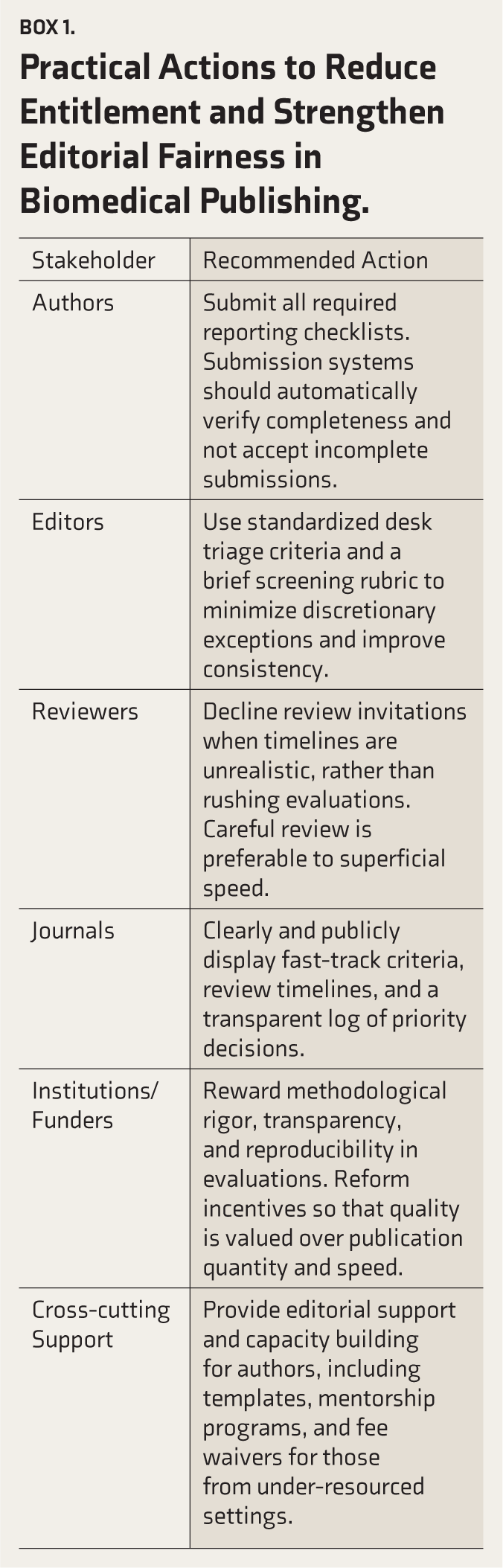
Privilege can foster entitlement, while persistent inequity further marginalizes those already at a disadvantage. Authors in LMICs often face limited institutional support, scarce funding, heavy workloads, and intense publication pressures. Under these constraints, rapid publication routes or predatory journals may appear attractive. The need for speed, lack of mentorship, and fewer resources shape publishing decisions.14,15 To create fair opportunities, we need real capacity building. This means offering helpful mentorship, ongoing editorial support, fee waivers for those facing financial barriers, and equal access to publishing resources. Publishing should not be a privilege only for those with more resources. Solving these problems requires the joint effort of everyone involved. Box 1) illustrates some practical steps.
Practical Actions to Reduce Entitlement and Strengthen Editorial Fairness in Biomedical Publishing.
Restoring Editorial Balance
Restoring editorial balance is a shared responsibility. Everyone involved plays a part in creating these pressures, so everyone also has a role in fixing them. Authors, editors, reviewers, journals, and institutions can all help prevent shortcuts. Box 1 lists practical steps for each group.
Limitations and Future Directions
This article synthesizes published research and editorial experience rather than presenting new data. The relationship among expedited review, errors, and retractions is multifaceted and varies across disciplines. Further research is essential to clarify the impact of editorial interventions on these outcomes. Journals should implement the proposed measures, monitor the outcomes, and report the findings to uphold the integrity of scientific publishing.
Conclusions
When authors skip peer review, request expedited reviews, or ignore guidelines, they foster entitlement and undermine trust in biomedical publishing. Journals should enforce transparent, measurable policies, require reporting checklists, publish fast-track criteria and logs, standardize triage, and support under- resourced authors to ensure rigor and equity are prioritized over speed. Institutions and funders must align incentives to reward careful, reproducible research rather than rapid publication. Scientific publication should remain a system grounded in rigor, accountability, and independent scrutiny, not a transactional service shaped by hierarchy, urgency, or expectations of preferential treatment.
Note
This editorial confirms the journal’s commitment to diversity, equity, and inclusion. Research and publishing should be guided by merit, fairness, integrity, inclusiveness, equity, and equal opportunity for everyone, not limited by hierarchy, access, or entitlement.
Footnotes
Acknowledgements
Nil.
Declaration of Conflicting Interests
The author declared no potential conflicts of interest with respect to the research, authorship, and/or publication of this article.
Declaration Regarding the Use of Generative AI
The author used the AI tools (ChatGPT and Microsoft Copilot) only for language editing and formatting. Grammarly was also used to improve grammar and language. The author reviewed all content and takes full responsibility for the final manuscript.
Funding
The author received no financial support for the research, authorship, and/or publication of this article.
Citation Diversity Statement
The author is committed to equitable citation practices and has made conscious efforts to include work from authors of diverse genders, geographic regions (including the Global South), career stages, and historically marginalized groups. The aim is to support a more inclusive and representative scholarly record.