




Abstract
Background:
A proportion of manuscripts submitted to scientific journals get rejected, for varied reasons. A systematic analysis of the reasons for rejection will be relevant to editors, reviewers, and prospective authors. We aimed to analyze the reasons for rejection of manuscripts submitted to the Indian Journal of Psychological Medicine, the flagship journal of Indian Psychiatric Society South Zonal Branch.
Methods:
We performed a content analysis of the rejection reports of all the articles submitted to the journal between January 1, 2018, and May 15, 2020. Rejection reports were extracted from the manuscript management website and divided into three types: desk rejections, post-peer-review rejections, and post-editorial-re-review rejections. They were analyzed separately for the rejection reasons, using a predefined coding frame.
Results:
A total of 898 rejection reports were available for content analysis. Rejection was a common fate for manuscripts across the types of submission; figures ranged from 26.7% for viewpoint articles to 72.1% for review articles. The median time to desk rejection was 3 days, while the median time to post-peer-review rejection and post-editorial-re-review rejection was 42 days and 96 days, respectively. The most common reasons for desk rejection were lack of novelty or being out of the journal’s scope. Inappropriate study designs, poor methodological descriptions, poor quality of writing, and weak study rationale were the most common rejection reasons mentioned by both peer reviewers and editorial re-reviewers.
Conclusions:
Common reasons for rejection included poor methodology and poorly written manuscripts. Prospective authors should pay adequate attention to conceptualization, design, and presentation of their study, apart from selecting an appropriate journal, to avoid rejection and enhance their manuscript’s chances of publication.
Manuscripts most commonly got desk-rejected either because they were out of scope or lacked sufficient novelty. The most common reasons for rejection at the peer review or editorial re-review stages were similar and included shortcomings in design of and rationale for the study and writing and presentation of the manuscripts.Key Messages:
Admittedly, every author commits a lot of resources and efforts to conduct research, write up the manuscript for possible publication, and choose a journal to place their work. Despite all these, every academic will agree that manuscript rejections are a common occurrence. At high impact journals such as the New England Journal of Medicine, the rejection rates are as high as 90%. 4 Given that close to two million research papers are published in science every year, this means that many millions of manuscripts meet with rejection and, consequently, end up in the rejection–resubmission cycle.
Several sequential processes, some of them journal-specific, are followed when a journal receives an academic manuscript. Those manuscripts not fulfilling the initial quality check are desk-rejected, and the most common reasons are being out of scope and lack of novelty, originality, or scientific rigor.5–7 Those that survive this initial phase are sent out for peer review, the time-tested quality control mechanism available in scientific publishing today. Subsequently, in most journals, guided by the peer reviewers’ comments, the editor-in-chief makes a decision to reject, accept, or request a revision. For a few journals, after the peer review and before acceptance, there is an additional layer of editorial re-review. However, independent editorial re-review following acceptance of a manuscript after peer review has also been described. 8
Knowing the usual reasons for manuscript rejection can alert prospective authors to common errors and flaws in conducting research. It will also inform them about what the editors and peer reviewers look for in a manuscript, so that they can plan their research better and increase its chances of getting published. For reviewers, such an analysis can provide an awareness of common lapses in scientific papers, thus improving the quality of their reviews.
Despite these obvious benefits, no systematic analysis of reasons for manuscript rejection is available from major Indian journals in psychiatry. In a previous report, 9 we published our nonsystematic observations on the common reasons for editorial (desk) rejection in the Indian Journal of Psychological Medicine (IJPM) over one year. Here, our objective was to systematically analyze the reasons for manuscript rejection at IJPM. Additionally, we also aimed to examine the time taken for various editorial decisions on the manuscripts; this would inform prospective authors about journal decision times across all possible stages of article processing and serve as an index of journal efficiency. Finally, we performed a content analysis of postpublication peer reviews received in the form of letters on various article types published during the study period; this would indirectly assess the efficiency of the review process and provide an idea about the kind of errors missed during the reviews.
Materials and Methods
Journal Workflow
The journal accepts the following submission types: original article, review, brief communication, case report letter, non-case report letter, commentary, viewpoint, practical psychotherapy, and editorial. All submissions are subjected to the mandatory brief initial screening and quality check using a checklist comprising of a mix of scientific and technical aspects; those not meeting the scientific criteria are desk-rejected, while those that do not fully comply with the submission guidelines are sent back for technical modification and resubmission. Manuscripts that clear this initial screening are sent out for double blind peer review; usually, two or three reviewers are solicited per manuscript and the choice of reviewers is at the editor’s discretion.
Once the peer reviewers send in their comments, the editor-in-charge makes a guided decision. Wherever the reviewers’ comments are concordant and suggest rejection, the manuscript is rejected. Mixed reviews necessitate a discussion amongst the Editor-in-Chief and Chief Associate Editors (i.e., the editorial team) to arrive at a decision or another tie-breaker review, following which a revise/reject decision is made. If the editorial team feels that the quality of the available peer reviews is inadequate, they internally evaluate the manuscript or commission another external review.
After the necessary revisions are done to the satisfaction of the peer reviewers, all manuscripts receive a further two rounds of editorial re-review by two members of the editorial team, who are qualified psychiatrists competent in research methodology. This stage is single blind and has two objectives: to identify any flaws that may have been missed in the peer review stage and to further improve the intellectual content and language of the manuscript. Occasionally, this re-review has also led to the rejection of manuscripts that survived the preceding stages. Thus, at the IJPM, there are three possible types of manuscript rejection, namely editorial rejection (or desk rejection), post-peer-review rejection, and post-editorial-re-review rejection.
Study Retrieval and Eligibility Criteria
We carried out a descriptive content analysis of all manuscript rejection reports from the period between January 1, 2018, and May 15, 2020. The reports were obtained from the journal’s online manuscript management system of that time (
All manuscripts rejected during the period of study were included for analysis, barring three types of articles that were not rejected but, nevertheless, featured in the rejection reports database; those that were withdrawn at the author’s request (n = 168), those that were long pending in the system (as the authors had not responded to editorial queries, n = 40), and articles processed for the Mental Healthcare Act supplement (n = 32), which underwent initial processing and peer review at the IJPM but were later withdrawn and published in a thematic supplement of the Indian Journal of Psychiatry. These three types of articles were also excluded from the analysis of time to editorial decisions. We also excluded the withdrawn articles while calculating the proportion of articles rejected in each submission category.
Reasons for rejection were analyzed and tabulated separately for different types of reject decisions, that is, desk rejection, post-peer-review rejection, and post-editorial-re-review rejection. In addition, we analyzed the rejection reasons separately for original articles, review articles, and case report letters. We use the term “case report letters” to refer to case reports because such articles were only processed as letters to the editor for the majority of the study period.
Data Extraction and Coding
The online journal system archives all types of rejection reports in one place. All the reports were downloaded, and for content analysis, the following variables were extracted: manuscript identification number, type of manuscript, originating from India or abroad, whether standard reporting guidelines were followed, field of the first author (psychiatrist/nonpsychiatrist), the zone of origin of work (North/South/East/West/Central, as per the categorization by Indian Psychiatric Society), number of authors, statistician as co-author (yes/no), prior conference presentations (yes/no), part of a manuscript published earlier (yes/no), time to desk rejection (days), reasons for desk rejection, technical modifications requested or not, time to send for peer review (days), number of peer reviewers solicited, time to post-peer-review rejection (days), reasons for post-peer-review rejection, time to post-editorial-re-review rejection (days), and reasons for post-editorial-re-review rejection.
“Time to desk rejection” was defined as the time elapsed from initial receipt of manuscript submission at the journal website to the dispatch of a desk reject email to the authors. “Time to post-peer-review rejection” was defined as the time taken from the initial receipt of the manuscript to dispatch of rejection notification email to the authors, following receipt of the completed peer review reports. Likewise, for “time to post-editorial-re-review rejection,” we considered the time taken from the initial receipt of the manuscript to the dispatch of the rejection decision email to the authors, after receipt of the editorial re-review reports. Time to post-peer-review rejection and time to post-editorial-re-review rejection were also similarly computed from the date of the initial receipt of the manuscript to the time taken to send the decision email to the authors.
A coding frame to code the common reasons for manuscript rejection was prepared a priori by one of the investigators (VM) and refined through discussion and consensus. This coding frame was also modified by adding any new reasons identified during the course of the study (online supplementary file). Initially, all the documented rejection reasons were recorded word for word, and following content analysis, the reasons for rejection were coded according to this coding frame. Multiple reasons for rejection, if mentioned, were coded separately, to get maximum information. Thus, one manuscript could contribute more than one reason for rejection. Data extraction and coding of rejection reasons were done by a single investigator (NV). In case of any ambiguity, the opinion of two senior investigators was sought, and a consensus was arrived at before coding. The same coding frame was used for postpublication peer review letters too.
To minimize bias in coding, we adopted the following measures; first, the selected data coder was a qualified psychiatrist with experience in publishing and reviewing articles for the journal; next, the coder was given a session of orientation to the predesigned coding frame by a senior author, and finally, a WhatsApp group comprising of all the authors was created, and any doubts that emerged during the coding process were promptly shared to facilitate clarification; as such, on the grey areas, the coding represented expert consensus opinion. Further, one of the authors conducted random checks on the data file with the saved manuscript identification numbers, to check the fidelity of the coding.
No approval was sought from an Institutional Ethics Committee for this work as the study involved secondary data analysis only.
Statistical Analysis
Simple descriptive statistics were used to represent the data. Reasons for manuscript rejection were summarized as frequencies and percentages. Time to various editorial decisions was summarized using median with interquartile range (IQR) and total range. Association between manuscript characteristics and types of errors noted were evaluated using chi-square test or Fisher’s exact test as appropriate. Data analysis was done using Statistical Package for the Social Sciences (SPSS) Statistics for Windows, Version 20.0 (Armonk, NY: IBM Corp).
Results
Characteristics of Rejected Manuscripts
A total of 1,138 articles were available in the rejection reports database for the period of study. Of these, 898 articles were included in the final analysis after applying the eligibility criteria.
The year-wise break-up of rejection reports was as follows; 2018 (n = 332/898, 37.0%), 2019 (n = 337/898, 37.5%) and 2020 (n = 229/898, 25.5%). Majority of the manuscripts (n = 627/898, 69.8%) were desk-rejected, followed by post-peer-review rejections (n = 217/898, 24.2%), and only a small proportion was rejected post-editorial-re-review (n = 54/898, 6.0%).
Original articles (n = 627/898, 69.8%) constituted more than two-thirds of the papers rejected during the period of study.
Final Disposition of Different Types of Manuscripts Submitted to the Journal
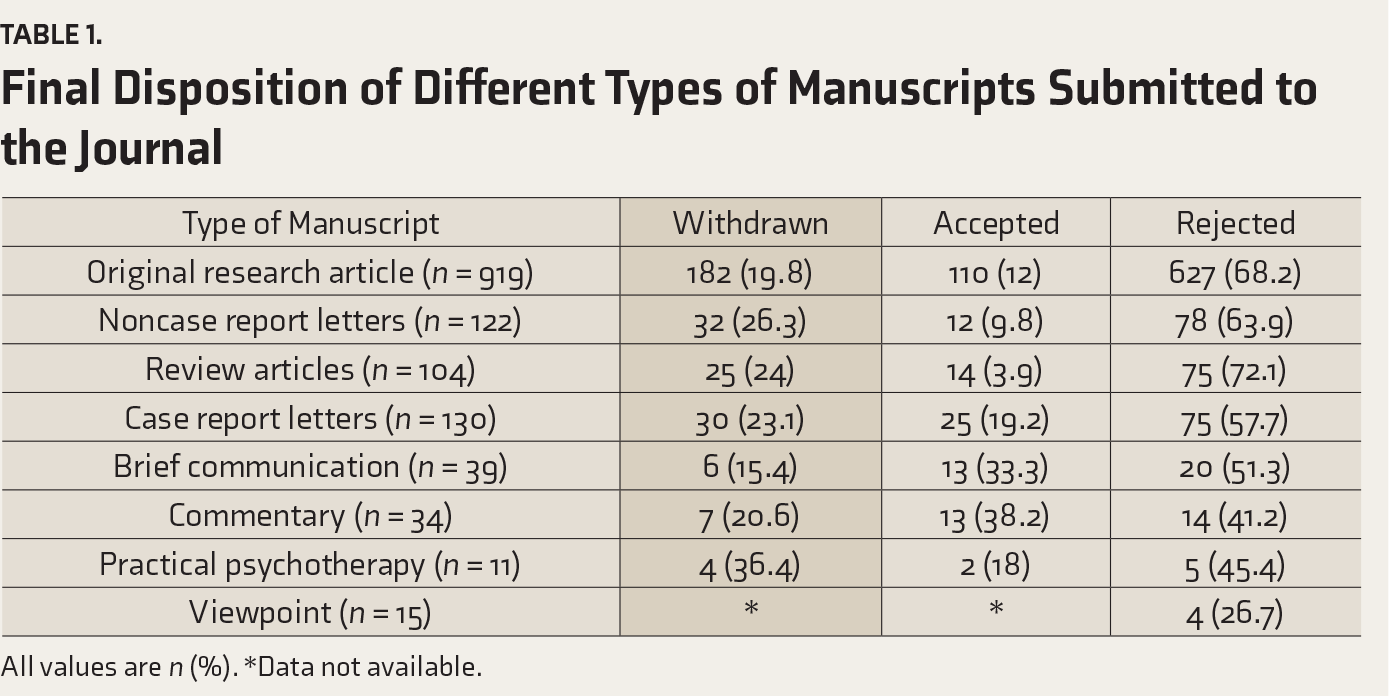
All values are n (%). *Data not available.
Compared to manuscripts where the first and lead author was a psychiatrist (n = 388/898, 43.2%), those where the lead author was a nonpsychiatrist (n = 510/898, 56.8%) faced rejection in higher proportion. Manuscripts with a psychiatrist as the first author were significantly less likely to be out of scope (χ2 = 44.45, P < 0.001), though not associated with significant differences in novelty/originality (χ2 = 1.69, P = 0.19).
Zone-wise analysis showed that the proportion of rejection to total submissions was largest for papers submitted from the Central Zone (n = 20/21, 95.2% of the submissions received from the zone) followed by West Zone (n = 67/76, 88.2%), East Zone (n = 84/101, 83.2%), North Zone (n = 250/305, 82.0%), and South Zone (n = 313/399, 78.4%), respectively.
Most of the rejected manuscripts had either two (n = 220/898, 24.5%), three (n = 226/898, 25.2%), or four (n = 174/898, 19.4%) authors. Single author submissions (n = 92/898, 10.2%) and submissions with more than four co-authors (n = 186/898, 20.7%) together constituted a little under one-third of the rejection pool. Bulk of the rejected articles originated from India (n = 734/898, 81.7%), and the rest (n = 164/898, 18.3%) were from abroad.
The majority of rejected papers were not presented in any previous conference (n = 813/898, 90.5%), did not belong to a series of papers from the same dataset (n = 895/898, 99.7%), and did not have a co-author from the discipline of statistics (n = 884/898, 98.4%). Presence of a statistical co-author was not associated with reduced likelihood of statistical errors such as errors in data analysis (Fisher’s exact P > 0.99), sample size calculation (Fisher’s exact P > 0.99), and poor control of confounding factors (χ2 = 0.97, P = 0.32).
No technical modifications were requested for the majority (n = 664/898, 73.9%) of rejected manuscripts; of the others which underwent technical modification (n = 234/898, 26.1%), 33/234 (14.1%) were rejected without peer review, while the remaining (n = 201/234, 85.9%) were rejected after peer review or editorial re-review.
Time to Editorial Decisions on Rejected Manuscripts
The median time to desk rejection was 3 days (IQR 1–5 days, range 0–80 days). The median time for manuscripts to move to peer review was seven days (IQR 3–17 days, range 0–86 days); more than half of the manuscripts (n = 144, 53.1%) were sent to peer review within the first week of receipt of the manuscript.
The median number of peer reviewers for manuscripts was 2 (range 1–4). The median time to post-peer-review rejection was 42 days (IQR 28–61 days, range 2–154 days). The median time to send manuscripts to editorial re-review was 66 days (IQR 53–92 days, range 16–370 days). The median time to post-editorial-re-review rejection was 96 days (IQR 73–142 days, range 16–417 days).
Reasons for Manuscript Rejection
The frequency of the recorded reasons for desk rejection, post-peer-review rejection, and post-editorial-re-review rejection is depicted in
Common Reasons for Rejection
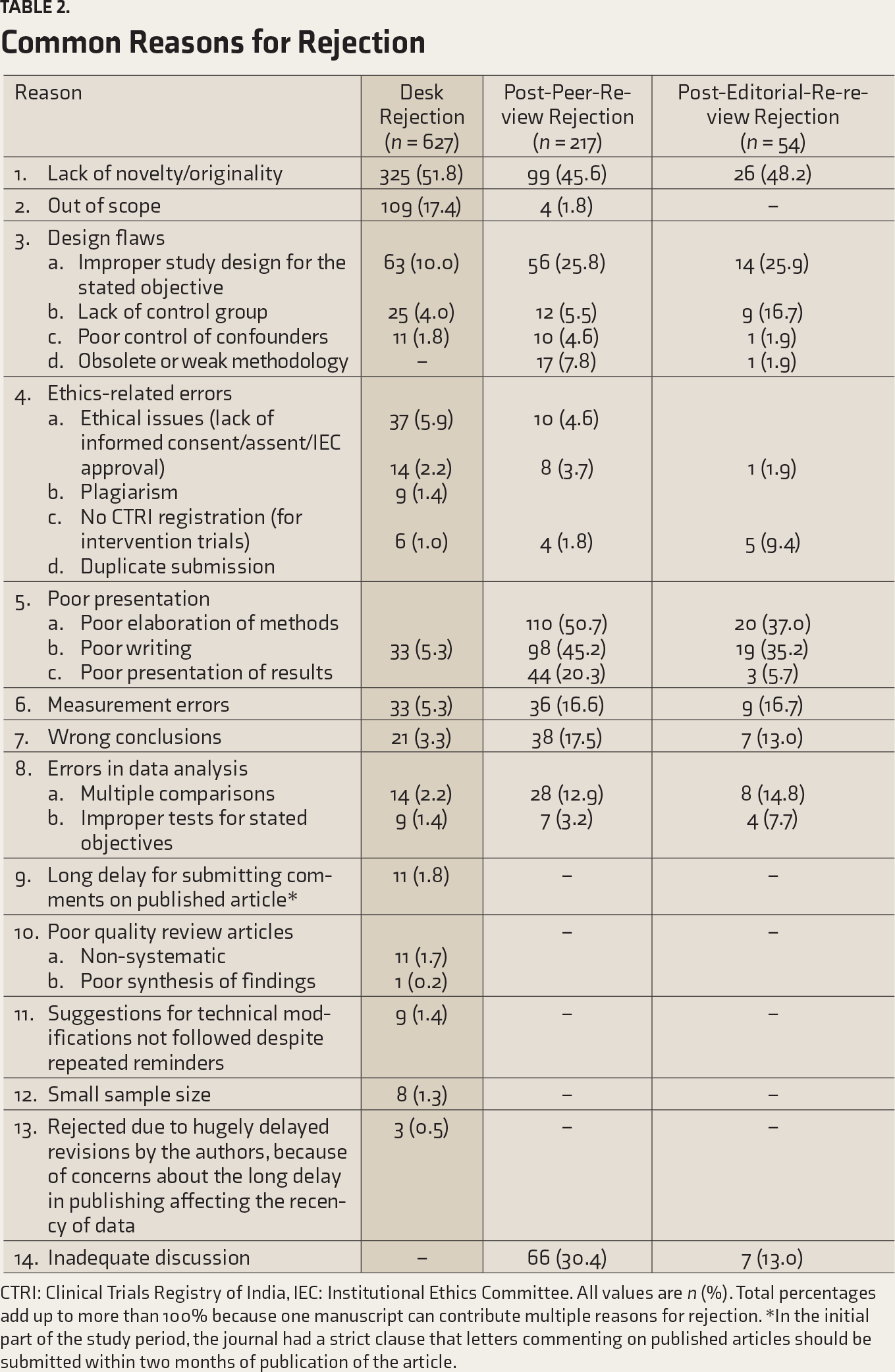
CTRI: Clinical Trials Registry of India, IEC: Institutional Ethics Committee. All values are n (%). Total percentages add up to more than 100% because one manuscript can contribute multiple reasons for rejection. *In the initial part of the study period, the journal had a strict clause that letters commenting on published articles should be submitted within two months of publication of the article.
The most common reasons for desk rejection were lack of novelty/originality of the topic (46.3%), and being out of the journal’s scope (17.4%). Other common reasons included improper study design (e.g., using cross-sectional designs to make causal inferences, 8.9%), lack of approval from ethics committee (5.9%), poor/unintelligible language (5.3%), and use of improper tools/measures (5.3%).
The most commonly pointed out reasons for rejection following peer review were inadequate elaboration of the methodology (50.7%), poor or unscientific writing (45.2%), inappropriate (repetition of results) or inadequate (recent articles/evidence are not covered) discussion (30.4%), weak study rationale (28.1%), and fatal methodological flaws related to the study design (25.8%).
The most common reasons for rejection following editorial re-review were similar to those for post-peer-review rejection and included inadequate elaboration of the methodology (37.0%), poor writing style (35.2%), weak study rationale (31.5%), flaws in study design (25.9%), lack of study novelty (16.7%), and incorrect choice of study instruments or measures (16.7%).
Reasons for Rejection by Manuscript Types
Desk rejection was the most common type of rejection for original articles (n = 446, 71.1%), review articles (n = 60, 80.0%), and case report letters (n = 44, 58.7%). This was followed by post-peer-review (n = 148, 23.6%; n = 14, 18.7%; n = 21, 28.0%) and post-editorial-re-review rejections (n = 33, 5.3%; n = 1, 1.3%; n = 10, 13.3%) for original articles, review articles, and case report letters, respectively.
Common Reasons for Rejection Across Article Types and Rejection Types
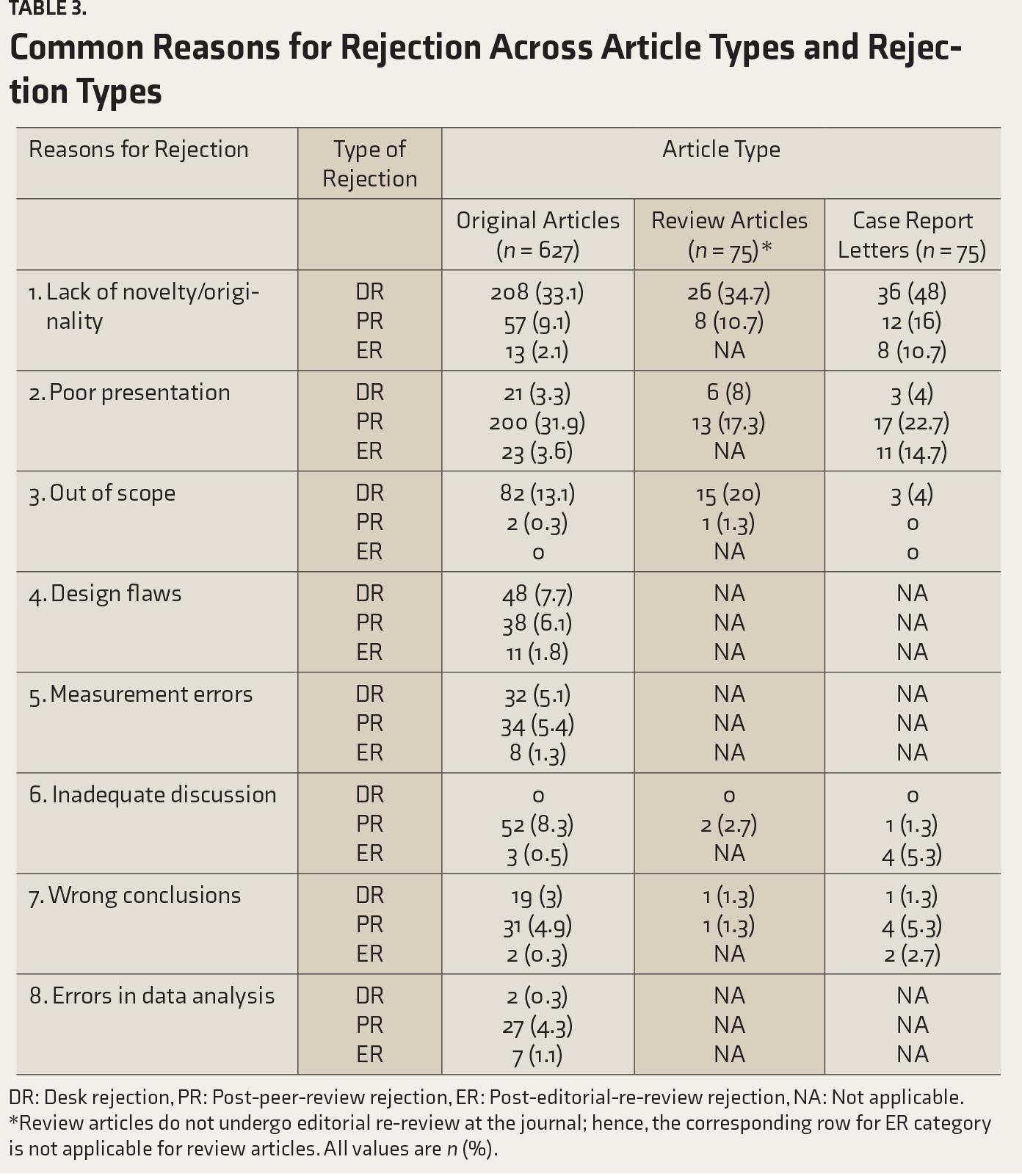
DR: Desk rejection, PR: Post-peer-review rejection, ER: Post-editorial-re-review rejection, NA: Not applicable. *Review articles do not undergo editorial re-review at the journal; hence, the corresponding row for ER category is not applicable for review articles. All values are n (%).
For review articles, lack of novelty (n = 26, 34.7%), being out of scope (n = 16, 21.3%), deficiencies in manuscript presentation (n = 16, 21.3%), and weak rationale (n =8, 10.7%) constituted the majority of rejection reasons. Likewise, lack of novelty (n = 47, 62.7%), deficiencies in manuscript presentation (n = 27, 36.0%), and weak rationale (n = 9, 12.0%) constituted the majority of rejection reasons for case report letters.
In addition, for review articles, there were three other reasons for rejection; submitted as a narrative review when the topic is more suitable for a systematic review (n = 8, 10.7%); inadequate literature survey (n = 2, 2.7%), and lack of a critical synthesis of the findings from the literature (n = 2, 2.7%).
Content Analysis of Postpublication Peer Review Letters
A total of 13 letters commenting on published original articles were retrieved during the search. The distribution of errors mentioned in these manuscripts is summarized in
Content Analysis of Post-publication Peer Review Letters
(n = 13) Published by the Journal
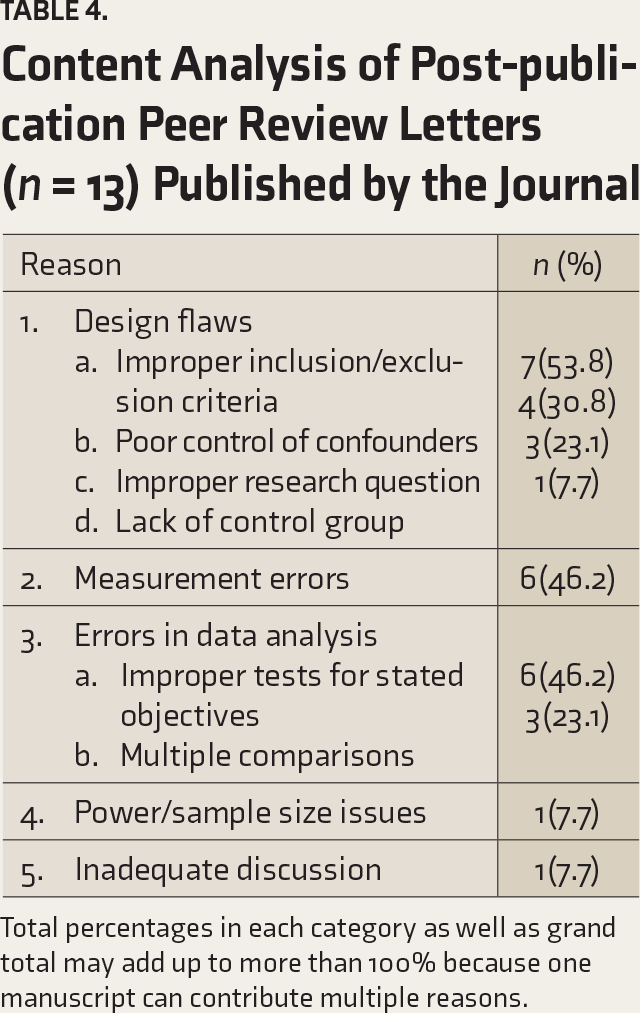
Total percentages in each category as well as grand total may add up to more than 100% because one manuscript can contribute multiple reasons.
Discussion
The main findings of the study were that the reasons for manuscript rejection differed depending on the stage in the article cycle. While lack of study novelty and being out of scope were the most common reasons for desk rejection, at the peer review level, poor presentation of the manuscript and its findings, weak study rationale, fatal flaws in the methodology, and erroneous conclusions were the most common errors. A few of the reasons for rejection following editorial re-review, such as poor presentation/organization of the manuscript and weak study rationale, were similar to post-peer-review reasons. Further, desk rejection was the most common type of rejection across manuscript types; more than two-thirds of original articles and review articles and more than half of case report letters were desk-rejected.
In this context, prospective authors need to differentiate between “fatal” and “not-so-fatal” study flaws. Fatal flaws are those involving aspects central to a study such as errors in framing the research question and errors in study design such as improper study design, choice of instruments, or lack of control group10, 11; clearly, all of these are aspects that cannot be corrected once the study is completed. In contrast, flaws such as overstating the results, applying inappropriate statistical tests, not correcting for multiple comparisons, and improper or inadequate comparisons with extant studies represent errors that can be fixed at the review stage.
Common fatal flaws noted in our study included lack of novelty/originality in research question, errors in study design, lack of ethical approval, and wrong choice of study measures. Previous online surveys of psychiatry journal editors, 12 as well as editors and peer reviewers of a general interest journal, 13 have also noted that flaws related to study design such as inadequate data on confounding variables, small sample size, and results which did not sufficiently advance science were the most common reasons for desk rejection. Additionally, being out of the journal’s scope was also a common reason for desk rejection. This may be partly explained by the journal’s name—“Indian Journal of Psychological Medicine,” which creates an impression that core psychology articles are within its scope.
The most common fatal flaw leading to manuscript rejection was perceived lack of novelty/originality in the research question. The process of judging novelty/originality of the manuscript by editors and peer reviewers has a definite element of subjectivity involved. Nevertheless, there are also significant opportunities for authors to plan and present their study in a way that convinces reviewers about its potential value. A simple way to do this would be to take a published paper on the topic that the author intends to study. Next, go to the limitations section of that paper and find one or two limitations that can be addressed in the subsequent study. Plan the study incorporating these modifications and present these arguments coherently in the final paper to convince the reviewers why your study is an improvement over previous papers in the field. 14 This also makes sense because research is most often incremental than transformative and reviewers are then unlikely to reject the manuscript for reasons of lack of novelty.
Common nonfatal flaws noted for manuscript rejection were poor presentation or writing, errors in data analysis, and drawing improper conclusions. Our findings broadly concur with the results of a survey of editors and peer reviewers carried out more than two decades ago. 13 Findings from other specialty journals too suggest that weak writing15, 16 and improper conclusions 17 are common reasons for rejection. First time authors may take assistance from experienced senior colleagues in improving the presentation of the manuscript; there are also excellent resources available to help authors with their writing skills.18, 19 Crisp presentation and precision writing are important skills that young, budding authors must not ignore as it creates a good impression on editors and peer reviewers. We did not find significant associations between the presence of a statistical co-author in the manuscript and reduced likelihood of statistical errors in the manuscript but our findings were limited by the small sample size of manuscripts with statistical co-author.
Just under 15% of the submitted original articles saw the light of the day in this journal. More than two-thirds of case report letters, non-case report letters, commentaries, and review articles also faced rejections. It is important to note that the high manuscript rejection rates observed in this study would not change dramatically even if all the reasons of rejection were addressed satisfactorily; this is due to constraints of journal space and because editors may raise the bar for acceptance when there are sufficient number of good quality manuscripts. Therefore, rather than classifying these findings as journal-specific, readers must view the reasons for manuscript rejection against the larger research landscape and make efforts to avoid these pitfalls when submitting their manuscript to any journal.
The manuscript processing times at the journal returned reassuring trends; more than half of the submitted manuscripts were either rejected or moved to peer review within the first week of submission, and the median time to desk rejection was three days. An early desk-reject decision is relevant in scholarly publishing as it saves the authors undue delay, saves the journal referees the effort of peer review, and facilitates early resubmission of the manuscript elsewhere. Median times to post-peer-review and post-editorial-re-review rejections were 42 days and 96 days, respectively; however, there were outlier articles in both, and this was due to multiple rounds of reviews and revisions. The quality of the peer review and editorial re-review at the journal are, to some extent, validated by the relatively low numbers of post-publication peer review letters received during the study period.
Our study has certain limitations. First, this was an analysis of rejection reasons for articles submitted to a single journal. Every journal has its own workflow, and hence, the results may not extend to other journals, particularly those with a niche focus. Second, the reasons for rejection were coded based on a coding frame prepared a priori for the study; while this may have local relevance, it may need to be adapted for use by other journals. Third, a single investigator was involved in coding reasons for rejection. This may have led to some bias or classification errors in coding, though, as elaborated in the methods, several steps were taken to minimize this possibility. Fourth, at the time of submitting this piece, we were only able to include postpublication peer review letters that appeared in two subsequent journal issues following the end of the study period; it is possible that the future issues may carry more letters highlighting shortcomings of articles processed and accepted during the study period. Fifth, though we coded all the reasons for rejection mentioned by the peer reviewers, it is possible that the rejected manuscripts had other shortcomings too that are not reported here.
Notwithstanding the mentioned limitations, our study may be a useful addition to the literature. It should inform editors, prospective authors, as well as reviewers about the common reasons for manuscript rejection in a specialty psychiatry journal. Given the high proportion of rejections across article types, it should also alert authors to common flaws in conducting and publishing research.
Conclusions
Majority of the submitted manuscripts, across the spectrum of article types, face rejection at the IJPM. While the reasons for rejection differed between desk, post-peer-review, and post-editorial-re-review rejections, many of the reasons noted could be eminently avoided by spending sufficient time in planning and conceptualizing the work. Indeed, the adage “Well begun is half done” appears appropriate in this context. It behooves authors to pay adequate attention to reasons mentioned here, particularly the “fatal” flaws, so that rejection can be avoided. We also hope that experts can use these results when conducting capacity-building research workshops to build awareness and assist researchers in planning and writing research papers that have better chances of acceptance, yet are easy to assimilate for the average reader and truly advance science.
Supplemental Material
Supplemental material for this article is available online.
Footnotes
Declaration of Conflicting Interests
SA serves as Editor-in-Chief of the Indian Journal of Psychological Medicine (IJPM). VM and SKP serve as the Chief Associate Editors of IJPM. NV serves as an ad-hoc invited peer reviewer for the journal.
Funding
The authors received no financial support for the research, authorship, and/or publication of this article.