




Abstract
Background:
Genetic factors contribute to the development of opioid dependence syndrome (ODS), with evidence suggesting that the neuropeptide galanin, which plays a role in the stress response, may influence addiction risk through its receptor galanin receptor 1 (GALR1). However, this area is largely unexplored in the Indian context.
Methods:
This case-control study included 85 opioid-dependent patients and 85 healthy controls, all males, recruited from a tertiary care hospital in North India. All participants were assessed using a socio-demographic proforma, a case record form for substance use parameters, and the World Health Organization Alcohol, Smoking and Substance Involvement Screening Test (WHO-ASSIST) to assess harmful use of other substances. Participants were genotyped for polymorphisms in the galanin gene (GAL rs948854, rs3136541) and its receptor gene (GALR1 rs9807208).
Results:
The GAL rs3136541 and GALR1 rs9807208 polymorphisms showed significant differences in the genotypic distribution between cases and controls. The GALR1 rs9807208 minor allele (G) was associated with a 2.27-fold increased risk of opioid dependence (95% CI = 1.17–4.41; p = .01). However, no association was found between these polymorphisms and substance use patterns or related clinical parameters.
Conclusions:
This study provides preliminary evidence of an association between GALR1 rs9807208 polymorphism and opioid dependence in an Indian population, suggesting a potential genetic basis for addiction risk. Further studies with larger samples could be considered to confirm these findings and also to explore gene–environment interactions in opioid dependence.
Genotype distributions at GAL rs3136541 and GALR1 rs9807208 differed significantly between cases (opioid-dependent patients) and controls. The minor allele (G) of GALR1 rs9807208 significantly increased the risk of opioid dependence (OR = 2.27; 95% CI = 1.17–4.41; p = .01). The study findings provide preliminary evidence for a potential role of the galanin receptor gene in opioid addiction risk among the Indian population.Key Messages:
Opioid dependence poses a significant social and health burden globally due to high prevalence and associated complications. According to the World Drug Report 2024, the number of past-year opioid users was estimated at 60 million, accounting for 1.2% of the global population. 1 Approximately half of the disability adjusted life years attributed to drug use are linked to opioids. Opioid use accounts for around 66% of the 167,000 drug-related deaths worldwide. In India, approximately 2.26 crore of the population consumes opioids in some form, with heroin use being the highest. It is estimated that nearly 7.7 million people require intervention for opioid-related problems. 2
Both environmental and genetic factors are implicated in the development of opioid dependence syndrome (ODS). 1 A high prevalence of co-morbid anxiety and mood disorders has been documented among individuals with ODS.2,3 Stress and anxiety are well-established contributors to both the initiation and relapse of addictive behaviors. 4 Stress initiates addictive disorders by promoting drug seeking and excessive drug intake. 5 Galanin, a stress-inducible neuropeptide, is widely expressed in the central and peripheral nervous systems and plays a significant role in modulating physiological and pathological processes through its receptors galanin receptor 1 (GALR1), GALR2, and GALR3.6,7 GALR1 has been shown to influence serotonergic and noradrenergic pathways, which are central to mood regulation and stress reactivity. 8
Emerging evidence suggests that neural circuits involving galanin may influence drug reward mechanisms. 9 Genetic variations in galanin and its receptors are associated with susceptibility to anxiety and depression, particularly in persons exposed to any recent psychosocial stressors or childhood adversity. 6 While galaninergic modulation has shown a protective effect against opioid and cannabis addiction in some studies, it has also been found to enhance the rewarding effects of ethanol and stimulate dopamine release in the hypothalamus. 10 Prior research reported associations between polymorphisms in the GAL and GALR1 genes and heroin or cocaine addiction.11,12
In neurons co-expressing GALR1 and the mu-opioid receptor, activation by either galanin or morphine appears to produce comparable effects on the Cyclic adenosine monophosphate (cAMP) signaling pathway, leading to reduced cAMP levels and decreased neuronal firing. This mechanism may underlie the ability of galanin to attenuate opioid-induced reward and withdrawal. Also, supports the observation that small-molecule GALR agonists can lessen both opioid reward and withdrawal symptoms. Genetic polymorphisms in galanin or its receptor genes may therefore influence susceptibility or resilience to opioid addiction. Experimental evidence further shows that galanin agonists reduce opioid reward and withdrawal manifestations. In contrast, the absence of galanin among knockout mice is associated with heightened opioid reward and withdrawal response. 13 A significant association has been found for three single-nucleotide polymorphism (SNP) pairs among galanin and its receptor through interaction effects with heroin dependence. 1 However, findings remain inconsistent across studies, and the research on non-Western populations is limited.
Despite the potential implications of galanin-related genetic markers in addiction neurobiology, the association between GAL/GALR1 polymorphisms and ODS remains underexplored in the Indian population. To the best of our knowledge, no prior published Indian studies have investigated the role of galanin or GALR1 polymorphisms in patients with ODS. Given the variability in genetic architecture across ethnicities, it is crucial to examine whether associations observed in Western cohorts are also applicable in India. Furthermore, previous studies have not consistently examined associations with substance use patterns or clinical characteristics of addiction.
The current study aims to investigate the association between the specific galanin gene polymorphisms (rs948854, rs3136541) and their receptor (rs9807208) with ODS males in a North Indian population. The objective of the study was to compare the frequency of these genes between ODS and healthy controls. The study also assessed the association of these polymorphisms with clinical features and substance use parameters. The study is novel in its attempt to replicate and validate previously reported associations in a new ethnic and geographic population. By examining genotype distributions and their associations with clinical parameters, this research contributes to a deeper understanding of the genetic vulnerability to opioid addiction.
Methods
Ethical Considerations
The Institutional Ethics Committee has approved the current study protocol. Written informed consent was obtained from all participants. All participants were aged 18 years or older; therefore, assent and parental consent were not required. The study adhered to the ethical principles of the Declaration of Helsinki. We used the Strengthening the Reporting of Genetic Association Studies checklist as a reporting guideline.
Study Design and Participants
This was an exploratory, observational case-control study conducted between February and September 2023 at a tertiary care treatment facility for drug dependence in North India. The formula 4PQ/L 2 was used to determine the sample size, where P is the minor allele frequency (MAF) among ODS patients, Q = 1 − P, and L is the permissible error level (5%). 14 The MAF was calculated as 8.5 (MAF of rs948854). 15 The sample size for each arm was calculated to be 136. Due to logistical issues and being an exploratory study, we recruited only 85 participants in each group, with a total study sample of 170.
The study recruited 85 opioid-dependent male patients and 85 age-matched unrelated healthy controls using non-random purposive sampling. Inclusion criteria for cases included: (a) Diagnosis of opioid dependence as per ICD-11 16 and (b) males aged between 18 and 60 years. Exclusion criteria were: (a) Inability to comprehend or respond to study tools, (b) presence of any psychiatric comorbidity, (c) co-morbid substance use disorder (except nicotine), or (d) ethnicity other than North Indian. Healthy controls were screened to rule out any lifetime history of substance use disorders or mental illness using a brief clinical interview.
Socio-demographic and Clinical Assessments
Socio-demographic data were collected using a semi-structured interview schedule. This included details on age, education, employment status, marital status, family type, monthly income, and current living arrangement. Clinical information was collected using a case record form that included lifetime and recent (past one-year) substance use, and details of opioid use: Age at onset of opioid use, cumulative duration (in months), route of use (e.g., inhalation), and history of abstinence lasting more than one month.
Mean daily dose of opioids was recorded in “standard units” (e.g., number of pudiya per day, each equivalent to approximately 300 mg of street heroin). Wherever possible, the total quantity was converted into milligrams per day for uniformity. The World Health Organization Alcohol, Smoking and Substance Involvement Screening Test (WHO-ASSIST) was used to assess harmful use of other substances. 17 Details on the psychometric properties and standardization of the instruments in the Indian population are cited in the references. The semi-structured interview guide used to collect this information has been uploaded as supplementary online material.
Genetic Assessment
A total of 2 mL of blood (venous) was drawn from an individual participant using aseptic technique. Samples were collected in Ethylenediaminetetraacetic acid (EDTA) vials and stored at –20 °C for further analysis. The QIAamp Deoxyribonucleic Acid (DNA) Blood Mini Kit (Qiagen) is used for DNA extraction. Genotyping for the selected SNPs in the galanin gene (GAL rs948854 and rs3136541) and its receptor gene (GALR1 rs9807208) was conducted using real-time polymerase chain reaction on a QuantStudio 12K Flex system (Thermo Fisher Scientific, India). Specific TaqMan genotyping assays (Assay ID: C_8760681_10, C_1514993_10, and C_29681436_10, respectively) were used for allelic discrimination. All laboratory personnel were blinded to participants’ clinical status.
Statistical Analysis
The participant’s socio-demographic characteristics were analyzed using descriptive statistics. The mean and standard deviation (SD) or the median with interquartile range of continuous data were summarized based on the data distribution. The frequencies and percentages of categorical variables were presented. Substance use parameters were recorded as either continuous or categorical variables, as appropriate. Participants were categorized based on their genetic profiles for the polymorphisms GAL rs948854, GAL rs3136541, and GALR1 rs9807208 into respective genotype groups (e.g., homozygous major allele, heterozygous, homozygous minor allele). Genotypic and allelic frequencies were compared between cases and controls using the chi-square (χ²) test. Associations between GAL and GALR1 polymorphisms and clinical variables—such as duration of opioid use, quantity used, abstinence history, and psychiatric parameters (depression, anxiety, and stress)—were assessed using Mann–Whitney U tests or χ² tests, where appropriate. A p-value of less than .05 was considered statistically significant. All statistical analyses were done using IBM Statistical Package for Social Sciences (SPSS) Statistics, version 26.0 (IBM Corp., Armonk, NY). 18
Results
Socio-demographic Profile
The age of cases (mean age) (SD) was 28.30 (7.39) years, while that of controls was 30.54 (8.00) years; a statistically significant difference was not found. The majority of the cases were unmarried or widowed (58.8%), unskilled workers or unemployed (54%), educated up to the eighth standard, residing in nuclear families, and had an average monthly income of INR 20,000.
Substance Use Characteristics of Cases
All individuals with ODS reported daily opioid use for at least the past three months, primarily heroin through the chasing route. The mean duration of opioid use was approximately 67 months. The average daily consumption was three pudiya (approximately 900 mg/day).
A significant abstinence period of more than one month was reported by 70% of the cases during their lifetime opioid use history. In addition to opioids, all participants had tobacco dependence; 45.9% used cannabis, and 10% used alcohol. As per the WHO-ASSIST scores, none of the participants’ cannabis or alcohol use was in the high-risk zone.
Galanin Gene and Receptor Polymorphism
Details of the selected SNPs are presented in Table 1, and their genotypic and allelic distribution among cases and controls is provided in Table 2. For the GAL rs3136541 polymorphism, the genotypic distribution differed significantly between cases and controls (χ² = 7.98, p = .01). However, the overall allelic frequencies did not differ significantly. For GAL rs948854, both genotypic and allelic distributions showed no significant difference between groups (p = .54). The GALR1 rs9807208 polymorphism showed a significant difference in genotypic distribution between cases and controls (χ² = 9.53, p = .01). The GG genotype was present in 23.52% of cases and 28.23% of controls. The AA genotype was observed in 23.52% of cases and 41.17% of controls. The AG genotype was reported in 52.94% of cases and 30.58% of controls. Regarding allele frequency, the minor allele G was significantly more prevalent in cases (76.47%) than in controls (58.82%), whereas the major allele A was more frequent in controls (41.17%) than in cases (23.52%) (p = .01). A dominant genetic model was applied to further evaluate the association of GALR1 rs9807208 with opioid dependence. When comparing carriers of the minor allele (G) to those with the major allele (A), a significant association was found. Individuals carrying the minor allele had a 2.27-fold increased risk of developing opioid dependence (OR = 2.27; 95% CI = 1.17–4.41; p = .01), indicating a potential genetic susceptibility conferred by the GALR1 rs9807208 variant.
Selected Single-nucleotide Polymorphisms (SNPs) for the Study.
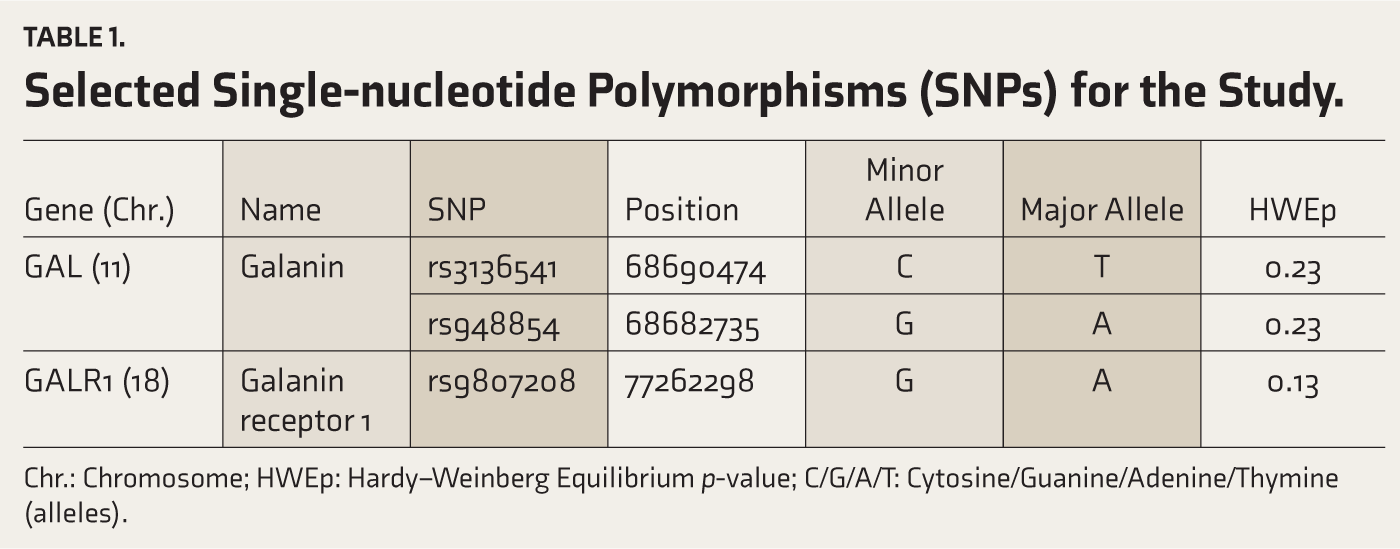
Chr.: Chromosome; HWEp: Hardy–Weinberg Equilibrium p-value; C/G/A/T: Cytosine/Guanine/Adenine/Thymine (alleles).
Frequency of Galanin Gene and Its Receptor Polymorphism in Cases (n = 85) and Controls (n = 85).
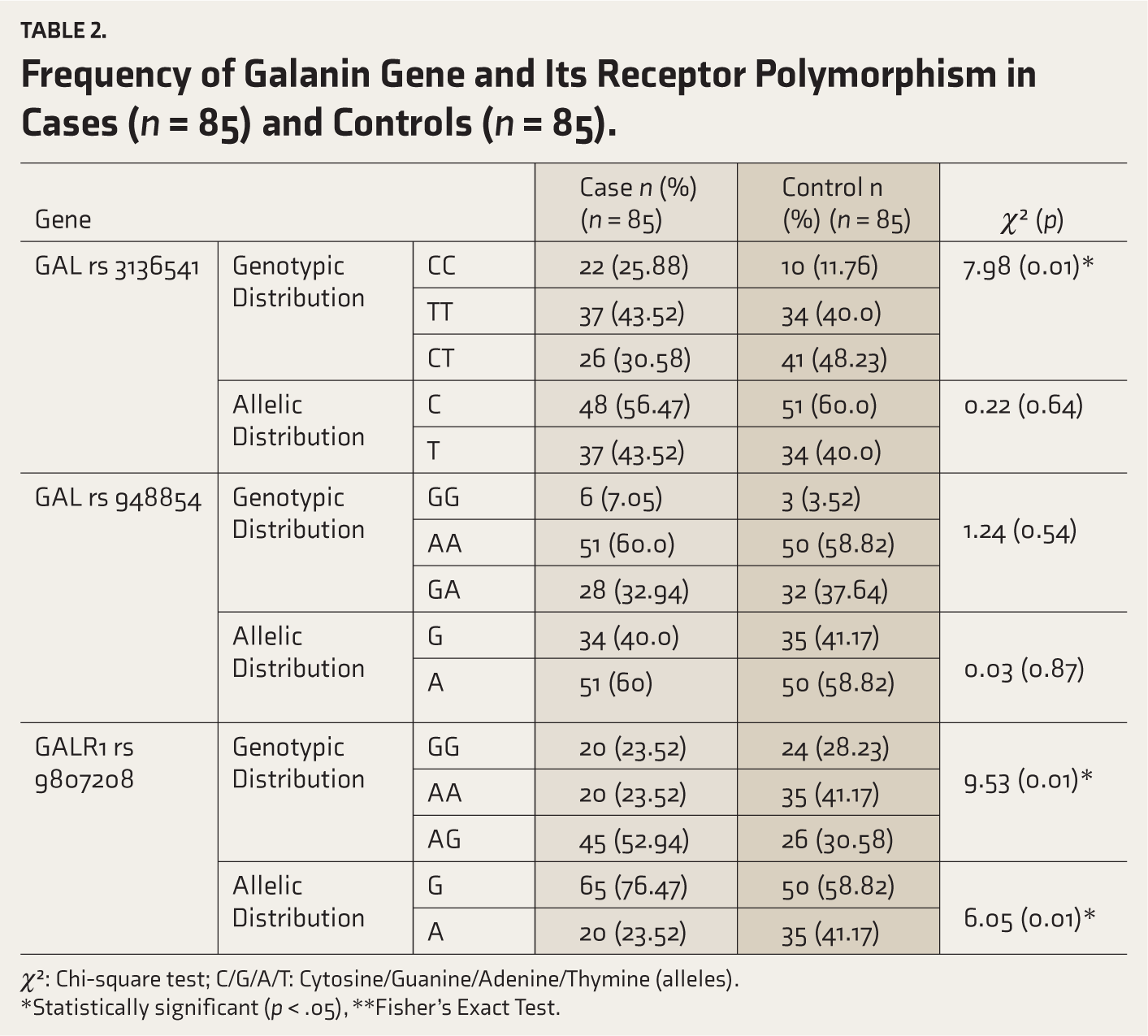
χ²: Chi-square test; C/G/A/T: Cytosine/Guanine/Adenine/Thymine (alleles).
*Statistically significant (p < .05), **Fisher’s Exact Test.
Association with Substance Use Parameters
Associations between galanin gene (GAL rs3136541 and rs948854) and its receptor gene (GALR1 rs9807208) polymorphisms and clinical parameters of opioid use (duration, amount of opioid use, route of administration, and abstinence history) were assessed among cases (n = 85). Participants carrying the minor allele were compared to those with the major allele. Statistically significant differences were not found between allele groups for any of the substance use parameters assessed, including duration of opioid use, daily dose (in pudiya), route of use, or history of abstinence exceeding one month (Table 3).
Association of Galanin and Its Receptor Gene Polymorphism with Substance Use Parameters in Cases (n = 85).
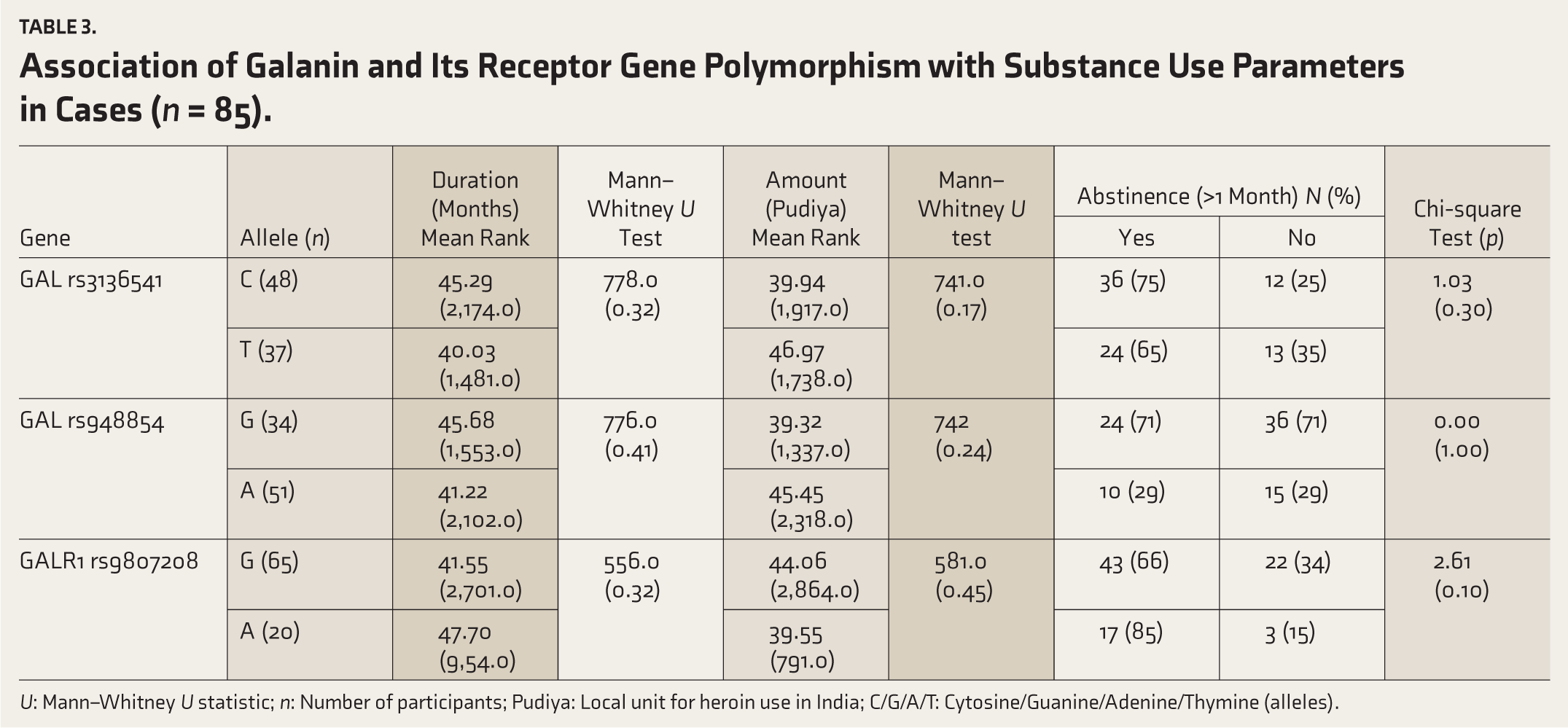
U: Mann–Whitney U statistic; n: Number of participants; Pudiya: Local unit for heroin use in India; C/G/A/T: Cytosine/Guanine/Adenine/Thymine (alleles).
Discussion
This study evaluated the association of polymorphisms in the galanin gene (GAL rs3136541 and rs948854) and its receptor gene (GALR1 rs9807208) with ODS in the North Indian male population. To the best of our knowledge, this was the first published case-control study in this population to investigate genetic variants for association with ODS.
Among the studied polymorphisms, GAL rs3136541 demonstrated a significant genotypic association with opioid dependence, with the TT genotype being more frequent in ODS cases. These findings are consistent with earlier research conducted on Dutch populations, where the T allele was found to be more prevalent among opioid-dependent individuals. 3 Some of the previous studies found a similar association between heroin addiction and the dominant allele of the GAL rs3136541 polymorphism, suggesting its role in modulating vulnerability to opioid addiction.19,20
In contrast, GAL rs948854 did not show significant differences in allelic or genotypic frequencies between cases and controls. This aligns with prior findings that report no definitive association of this variant with opioid dependence or other substance use disorders.3,12 The neuropeptide galanin counters the behavioral effects of the systemic administration of the µ-opioid receptor agonists. 21 The GALR1 rs9807208 polymorphism emerged as a strong candidate gene variant in this study. Both genotypic and allelic distributions differed significantly between opioid-dependent individuals and healthy controls. The minor allele G was associated with a 2.27-fold increased risk of developing ODS, suggesting a possible genetic predisposition conferred by this variant. The underlying neurobiological mechanism may involve heteromerization of the GALR1 with the µ-opioid receptor, thereby modulating the activity of dopaminergic neurons in the ventral tegmental area. 22 Animal and molecular studies have suggested that this heteromer formation influences the reward-related effects of opioids and may contribute to individual differences in addiction vulnerability. The major allele (A) may exert a protective effect through reduced heteromer potency. 23 This effect was observed in the present study findings with a higher prevalence of the A allele among controls. Interestingly, the wild-type G allele was more prevalent among cases, suggesting a protective effect of the major allele (A).
No statistically significant associations were found between the studied polymorphisms and clinical measures of addiction severity, route of administration, daily dose, abstinence history, or co-morbid substance use and psychological parameters such as depression, anxiety, stress, and perceived social support. This finding suggests that while these genetic variants may influence susceptibility to developing opioid dependence, they may not have a direct impact on the clinical manifestation or progression of the disorder but rather play a modulatory role in the initial rewarding effects of opioid use. This finding aligns with the biopsychosocial model for ODS etiology. The type of opioid used, its frequency, and route of use will be affected by socio-economic factors and environmental factors that determine drug availability.
This study adds novel evidence to the limited body of research on how galaninergic genetic mechanisms associate with ODS in the Indian context. However, several limitations should be noted, including the relatively small sample size, which might have significantly reduced the statistical power to detect subtle genetic effects or interactions. Also, the current study design did not account for environmental factors or gene–environment interactions, which are critical in the multifactorial etiology of substance use disorders. Furthermore, the study’s cross-sectional design precludes causal inferences. As the vast majority of ODS patients at our center were male, the sample for this study was restricted to male participants. Participants were limited to those of North Indian ethnicity to minimize potential confounding due to population heterogeneity. Future studies are warranted to focus on longitudinal, multicentric, diverse populations and larger sample sizes to validate these findings. Exploring interactions among genetic, environmental, and psychosocial factors may yield a comprehensive understanding of the risk architecture of ODS. Functional studies to elucidate the mechanisms by which these polymorphisms affect opioid-related behaviors would be valuable.
Conclusions
The present study provides preliminary evidence that polymorphisms in the galanin (GAL rs3136541) and its receptor gene (GALR1 rs9807208) may be associated with increased susceptibility to opioid dependence among Indian males. In particular, the GALR1 rs9807208 minor allele (G) significantly increased the risk of opioid dependence. These findings substantiate the role of galaninergic pathways in the neurobiological areas of opioid addiction. While the results are promising, further studies with larger and more diverse cohorts are essential to confirm these associations and explore their potential clinical implications.
Footnotes
Acknowledgements
The authors would like to acknowledge the staff of the biochemistry laboratory, NDDTC, AIIMS, for their contribution to completing this study.
Consent for Publication
Informed assent and consent were obtained from all participants, including permission to publish anonymized data in research reports.
Declaration of Conflicting Interests
The authors declared no potential conflicts of interest with respect to the research, authorship, and/or publication of this article.
Declaration Regarding the Use of Generative AI
None used.
Ethics Committee Details
The study is cleared from the Institute Ethical Committee for Post Graduate Research, All India Institute of Medical Sciences, New Delhi (Ref No. IECPG-699/29.09.2022, RT-02/27.10.2022, dated 28.10.2022).
Funding
The authors received no financial support for the research, authorship, and/or publication of this article.
Prior Presentation
The study results in partial were presented at the Annual National Conference of the Addiction Psychiatry Society of India (APSI) 2024 and won first prize in the Dr Sadgi Jagawat Award category for women residents in addiction psychiatry.
Simultaneous Presentation to Another Journal or Resource
None.