




Abstract
Background:
Suicide attempts are one of the important causes of end of life in middle- and low-socioeconomic countries. A considerable number of suicide attempts are due to impulsive behavior. Non-planning, decreased attention, decreased cognition, and risky behavior constitute important reasons for suicide attempts. The study aimed to understand the proportion and patterns of attempts at suicide and the assessment of impulsivity in individuals with suicide attempts.
Methods:
In this cross-sectional study, the proportion of suicide attempts among the total number of cases admitted to the emergency department was calculated. The sample size of this study was 104. Informed consent was obtained from the individuals who risked their lives. Sociodemographic details were collected using a semi-structured pro forma. Later, information related to the method used for suicide, age groups, and gender indicating the pattern of suicide was collected using a semi-structured pro forma, and levels of impulsivity in individuals attempting to end their lives were assessed using the Barratt Impulsiveness Scale 11.
Results:
Of total patients admitted to the emergency department, 8.8% had a history of suicide attempts. Most individuals were young (50%); males and females constituted an equal proportion, and the most common method used was insecticide poisoning (35.6%). Impulsivity was seen in 47% of individuals who presented with a suicide attempt. High impulsivity was seen in individuals using insecticide poisoning and other poisons.
Conclusion:
A person’s intention to end life even once increases the risk of multiple suicide attempts and even loss of life. The role of impulsivity in suicide attempts, especially in youth, is significantly high. Hence, one has to be vigilant enough to identify and provide necessary psychiatric help to individuals who come with suicide attempts.
Suicide attempts are strong predictors of completed suicide. Impulsivity is a key factor that contributes to individuals attempting to take their own lives. Adolescents and young adults are particularly vulnerable to engaging in risky behaviors, including suicidal actions.Key Messages:
Suicide is one of the most important, common, and under-recognized epidemics in middle- and low-socioeconomic countries. 1 According to the National Crime Records Bureau (NCRB) 2022, the prevalence of suicide rates increased from 9.9 per lakh population in 2017 to 12.4 per lakh population in 2022. 2 As per the World Health Organization, the prevalence of suicide in India was 16.7 per 1,00,000 population in 2023. 3 A suicide attempt is a behavior that the individual has undertaken with at least some intent to die. This behavior might or might not lead to serious medical consequences. Several factors that influence the medical consequences of suicide attempts include lack of knowledge about the lethality of the method chosen, intentionality, or chance intervention by others after the behavior is initiated. 4 A large number of attempts to end life end in completed suicide; hence, one has to consider each suicide attempt as high risk for the individual ending his or her life. 5
High impulsivity is also one of the characteristics seen in people with self-harm. Impulsivity is an important risk factor for suicide attempts. 6 It is characterized by unplanned, risky behavior. People with high impulsivity perform activities quickly without thinking. Action without thinking, quick cognitive decision-making, and non-planning are the components of impulsivity. 7 The main components of impulsivity are improper planning, lack of self-control, and novelty seeking. Behavioral problems such as impulsivity are said to be the cause of suicide attempts in the majority of individuals, as per a few studies. 8
In a general hospital setting, patients with suicide attempts are seen in the emergency department. Immediate measures to save lives are provided in the emergency department. Once the patient is stable, they are interviewed by the psychiatrist, and psychiatric help is provided. 9 In this study, we assessed the proportion of individuals with suicide attempts attending and being admitted to the emergency department, patterns of suicide attempts, and also impulsivity in individuals having suicide attempts. Since suicide attempts are considered to be a risk factor for completed suicide in the future, the use of psychoeducation and psychiatric help could prevent the same. There are only a few studies done in India assessing impulsivity in patients with suicide attempts presenting to the emergency department. Hence, there is a need for the study to be done.
Aim
This study aimed to determine the proportion and patterns of suicide attempts and the assessment of impulsivity in individuals with suicide attempts.
Objectives
The objectives of the study were as follows:
To assess the proportion of suicide attempts among patients getting admitted to the emergency department. To evaluate the patterns of suicide attempts. To assess impulsivity in patients with a history of suicide attempts.
Methods
Study Design
A cross-sectional study was conducted from August 15, 2024 to November 15, 2024.
Settings
The sample was recruited from a general hospital in South India. The emergency department admits an average of 20–25 patients daily, has a casualty medical officer, and four nursing staff. Institutional ethical committee clearance was obtained before the study began.
Participants
All patients visiting the general hospital with an alleged history of suicide attempts were included in the study. After explaining the study’s objectives and purpose, a detailed information sheet was provided to each participant, and written informed consent was obtained. In the case of a minor, informed assent was obtained from the minor, and informed consent was obtained from their guardian. In the case of illiterate participants, a witness’s signature was also taken. The study sample size was 104.
Operational definition
Suicide Attempt
A suicide attempt is a behavior in which the individual has undertaken, with at least some intent, to die. 4
Impulsivity
Impulsivity is defined as a tendency to act without forethought or consideration of consequences. 4
Method of Collection of Data
The proportion of suicide attempts among the total number of cases admitted to casualty was calculated. Patients were provided immediate medical and surgical care whenever required. Informed consent was taken from the individuals who attempted to end their lives. Sociodemographic details were collected using a semi-structured pro forma. Later, information related to the method used for the suicide attempt, the age group, and the gender indicating the pattern of suicide was collected using a semi-structured pro forma, and levels of impulsivity in individuals attempting suicide were assessed using Barratt Impulsiveness Scale 11 (BIS-11). All this information was collected confidentially once the patient was medically stabilized. During the interview, the patient was psycho-educated and provided with psychiatric help if found necessary.
Tools
BIS-11
A total score of 72 or above on BIS-11 should be used to classify an individual as highly impulsive. BIS-11 total scores between 52 and 71 should be considered within normal limits for impulsiveness. Scores lower than 52 usually represent an individual who is extremely over-controlled. This scale measures impulsivity in terms of inattention, cognitive instability, motor impulsiveness, poor perseverance, self-control, and cognitive complexity (first-order factors), and attentional impulsiveness, motor impulsiveness, and non-planning impulsiveness (second-order factors). 10
Statistical Analysis
Statistical examination and data analysis were done using SPSS software (20.0). 11 The frequency of methods used to attempt suicide was calculated. In addition, impulsivity among patients attempting suicide was assessed. Impulsivity among various methods of suicide was also assessed using SPSS software. 11
Results
Out of 1,270 patients admitted to the casualty of the general hospital from August 15, 2024, to November 15, 2024, there were 104 patients admitted with self-harm attempts. Of these, 50% were males and 50% were females; 94% belonged to the Hindu religion, 6% belonged to the Muslim religion, 61.5% were single, 30.8% were married, 3.8% were divorced, and 3.8% were widows. Fifty-eight percent of patients had studied up to intermediate/diploma. Most were either unemployed or farmers and belonged to middle socioeconomic class families. The methods used to end life are described in Table 1. Organophosphorus compound poisoning accounted for 35.6%; other poisons, drug overdose, drowning, hanging, self-immolation, and other means accounted for 28.8%, 23.1%, 5.6%, 3.8%, and 1%, respectively, of the total population trying to end their lives. Individuals belonging to the age group of 19–30 years constituted most of those who had tried to end their lives (50%), followed by the age group of 31–45 years (27.0%). Individuals trying to harm themselves belonging to the age groups of 46–60 and 12–18 years constituted 13.5% and 9.61%, respectively. Males and females had equal preponderance.
Impulsivity was assessed among the individuals attempting suicide as per BIS-11. It was found that impulsivity was high in a reasonably large number of individuals, accounting for 47.1% of all cases. The rest were at a normal level of impulsivity, as shown in Figure 1. Impulsivity among different methods used for an alleged history of suicide is shown in Table 2.
Methods Used for Suicide Attempt.

The highest number of individuals tried to end their lives by consuming insecticides (35.6%), followed by consumption of other poisons (28.8%), and drug overdose was seen in 22.1% of individuals.
Methods Used for Suicide Attempt.
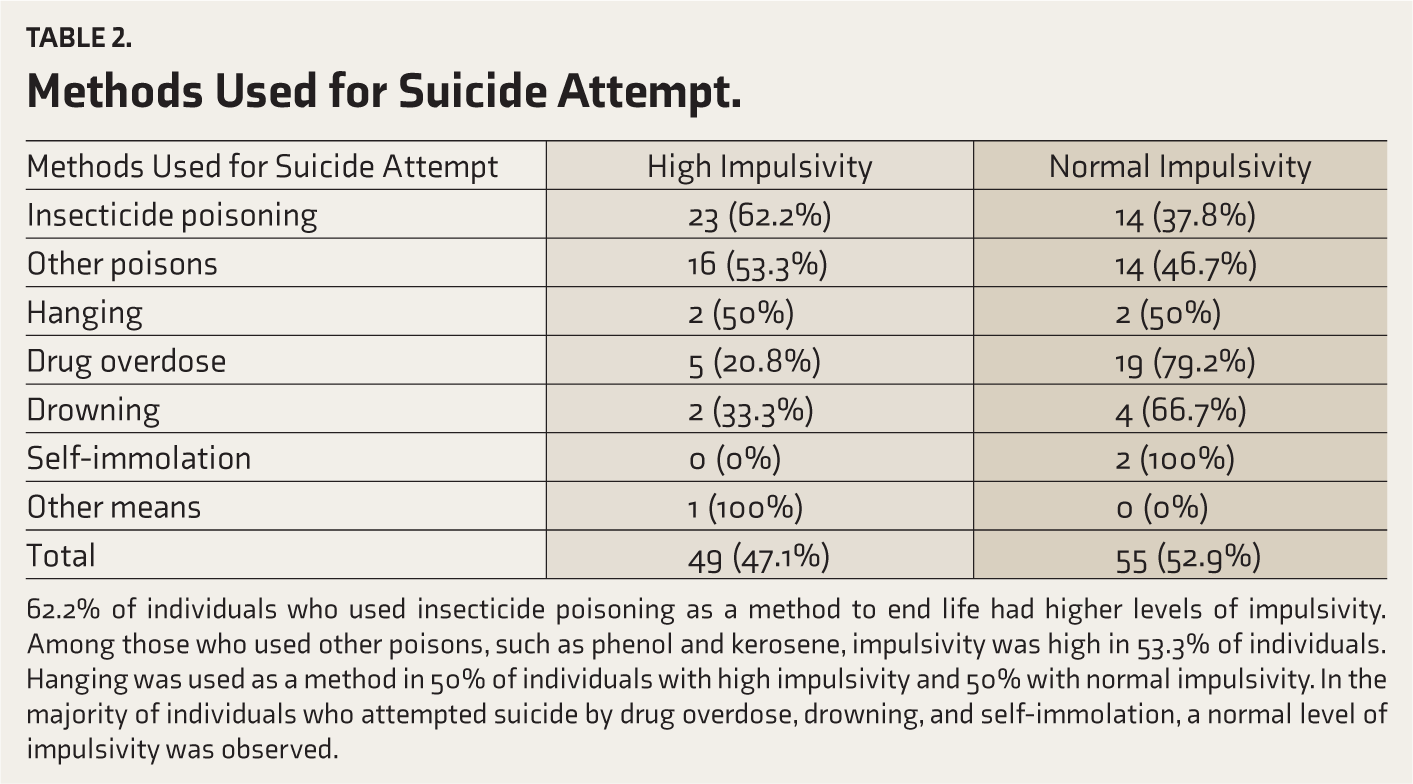
62.2% of individuals who used insecticide poisoning as a method to end life had higher levels of impulsivity. Among those who used other poisons, such as phenol and kerosene, impulsivity was high in 53.3% of individuals. Hanging was used as a method in 50% of individuals with high impulsivity and 50% with normal impulsivity. In the majority of individuals who attempted suicide by drug overdose, drowning, and self-immolation, a normal level of impulsivity was observed.

Amongst the individuals who had tried to end lives, 47.1% of them had impulsivity and 52.9% did not have impulsivity.
Discussion
In our study, the proportion of patients with an alleged history of trying to end their life among the total admissions in the emergency department during the period from August 15, 2024, to November 15, 2024, was 8.89%. Organophosphorus compound poisoning accounted for 35.6% of total suicide attempts. The majority of the participants had tried to end their lives by consuming organophosphorus compounds, followed by consumption of other poisons, drug overdose, and drowning. This was at par with a study done at a tertiary care hospital attached to a medical institute in Karnataka, 12 and a multicenter retrospective study done in Southern Nepal. 13 A cross-sectional study done in Bangalore showed a higher number of suicide attempts by drug overdose and not organophosphorus compound poisoning. 14 This could be due to easier access to medication than to organophosphorus compounds in Bangalore.
Youths are more prone to suicide attempts. The most widely observed causes for the same include many psychological risk factors, such as affective processes (worthlessness and decreased self-esteem), social processes (decreased interpersonal connectedness due to work pressure), and cognitive processes (impulsivity). Various environmental factors, including child maltreatment, bullying, and peer and media influences, also play an important role in this. 15 However, impulsivity is an important reason for suicide attempts among youths. The maximum number (50%) in our study were youths. This was consistent with studies in Southern Nepal, 13 tertiary care hospitals in Bangalore, 14 and Western Nepal. 16
Impulsivity plays an important role in patients with self-harm. People with impulsivity usually cannot focus, plan, or organize and are found to have increased self-destructive behavior along with aggression. 7 In our study, high impulsive behavior was a cause of self-harm in 47% of individuals assessed as per the BIS-11. 10 Impulsivity accounts for a significant number of suicide attempts. 17 In this study, impulsivity among people attempting suicide using insecticide poisoning was more prevalent, followed by other poisons such as phenol and kerosene oil. The attempt to hang showed 50% impulsivity each. The other methods used for suicide showed that people with normal impulsivity accounted for more than those with abnormal impulsivity. Our study is similar to a cross-sectional study done by Nazeer et al. 18 They found that higher impulsivity was seen in patients with poisoning. This study shows high impulsivity among people attempting suicide using insecticides, other poisons, and hanging. However, the study done by Lim et al. 19 showed high impulsivity with drug overdose, and very few had insecticide poisoning in their study. This difference could be because our study was done in a setting where insecticides are more easily available. The proportion of suicide attempts among individuals admitted to the emergency department is higher in our study. Also, the individuals who used hanging as a method did so impulsively, as per our study.
Creating awareness about warning signs of self-harm, which include often talking or writing about death, dying, or suicide; making comments about being hopeless, helpless, or worthless when people say that there is no reason for living or no purpose in living; saying things like “It would be better if I were not here,” increased alcohol and/or drug use, withdrawal from friends, family, and community; reckless behavior or engaging in more risky activities seemingly without thinking; dramatic mood changes; and talking about feeling trapped or being a burden to others among the general population is important. 20 Insisting that individuals with any of the above symptoms seek professional health care is another important step because they follow evidence-based interventions. 21 Encouraging people to increase their interaction with friends and family, seek psychiatric help in terms of medication and psychotherapies through talks on various platforms, and also providing a 24/7 helpline would drastically decrease the number of people ending their precious lives. Psychiatrists can also begin medications for individuals who have attempted suicide and have other psychiatric comorbidities. 22 Hence, both pharmacotherapy and psychotherapy play an important role in preventing people from ending their valuable lives and in maintaining mental health.
Limitations
The sample size is small, and it was collected only from one place. Hence, we cannot generalize the result to the entire population.
Conclusions
Impulsive behavior is seen in a significant population trying to end their lives. Impulsive behavior is most commonly seen in late adolescence and early adulthood; hence, a large number of individuals trying to harm themselves belong to this population. A person’s intention to end life even once increases the risk of multiple suicide attempts and even loss of life. Hence, one has to be vigilant enough to identify and provide necessary psychiatric help to these individuals.
Supplemental Material
Supplemental material for this article available online.
Footnotes
Declaration of Conflicting Interests
The authors declared no potential conflicts of interest with respect to the research, authorship, and/or publication of this article.
Ethical Statement
The ethical committee clearance was provided by the institution (IEC-SUIMS/15/2024-25).
Declaration Regarding the Use of Generative AI
None used.
Funding
The authors received no financial support for the research, authorship, and/or publication of this article.
References
Supplementary Material
Please find the following supplemental material available below.
For Open Access articles published under a Creative Commons License, all supplemental material carries the same license as the article it is associated with.
For non-Open Access articles published, all supplemental material carries a non-exclusive license, and permission requests for re-use of supplemental material or any part of supplemental material shall be sent directly to the copyright owner as specified in the copyright notice associated with the article.
