




Abstract
Compulsive buying (CB) presents itself with uncontrollable or excessive urges and preoccupations with behaviors related to spending money that have detrimental consequences. Compulsive buying disorder (CBD) can result in remorse and regret over purchases, guilt, shame, issues with finances, and interpersonal difficulties. Despite the growing understanding of the phenomenology of CBD, only some evidence-based therapies have been developed that cater to the concerns within a limited time frame. This study aimed to assess the effectiveness of solution-focused brief therapy for CBD. This study explored compulsive buying behavior (CBB) and evaluated the clinical effectiveness of a single case intervention study of a 21-year-old male with a CBD. The patient was assessed using the Yale-Brown Obsessive Compulsive Scale for Compulsive Buying (Y-BOCS). The data were collected at baseline, treatment termination, and follow-up. The intervention was initiated in October 2022 and continued for two weeks. The intervention was conducted in three phases: psychoeducation, goal setting, solution-building, and relapse prevention. There was a decrease in scores on CB between baseline (24), treatment termination (8), and one-year follow-up (4), indicating a significant reduction in the symptoms. This case study suggested the clinical relevance of solution-focused brief therapy for the treatment of CB in obsessive compulsive disorder (OCD). Future studies are needed to develop therapy guidelines for solution-focused brief therapy as a medium of intervention for treating OCD. It is important to establish the effectiveness of a larger sample or case series on a clinically adequate sample size.
In the present world, buying behavior is widespread. People indulge in such behavior to fulfill their needs, unwind, or treat themselves. However, when turned excessive and uncontrollable, it can turn destructive, adversely impact one’s life, and result in “compulsive buying” (CB). Compulsive buying disorder (CBD) involves uncontrollable or excessive preoccupations, urges, or behaviors related to shopping and spending that have detrimental consequences. 1 Compulsive shoppers purchase items to manage stress, boost their mood, seek attention from others, and enhance their self-image.2, 3
Over the past decades, compulsive buying behavior (CBB) has become increasingly prevalent worldwide. Recent studies have observed a prevalence of 4.9% for CBB, with higher ratios for individuals of noncommunity origin, university students, and shoppers. 4 CBB has two components: obsessive-compulsive disorders (OCD) and impulsive control disorders (ICD). 5 Literature studies have attempted to define CBB based on its similarities with disorders, which include substance use disorder, 6 OCD, 7 eating disorders, 8 and behavioral addictions. 9
Prior studies have also highlighted that compulsive shoppers exhibit anxiety disorders by engaging in compulsive behaviors and having obsessive thoughts, which can be distressing and disrupt their daily lives. 10 Although prolonged CBB can result in feelings of remorse and regret over purchases, guilt, shame, and issues with finances, as well as interpersonal difficulties, people with CBB are unable to stop their compulsive purchasing. 11 A range of therapeutic interventions are used in treating CBD, like individual therapy,12, 13 family therapy, 14 and experiential therapy. 15 Cognitive-behavioral therapy (CBT) can be given both individually and in groups and used a manualized approach in the latter, which is the most tried-and-true method of treating CBD. Literature studies have shown the effectiveness of CBT for CBD.16, 17
Despite the growing understanding of the phenomenology of CBD, only some evidence-based therapies have been developed that cater to the concerns within a limited time frame. Most therapeutic modalities focus on the cause of the problem, which often leads to dissatisfaction from the client, who is eager for a solution. In the context of problematic buying behavior, mental health practitioners have traditionally focused on their client’s financial difficulties and the problematic behavior that contributes to them. 18 They have focused on the client’s past, particularly how that individual acquired financial issues and undesirable behavior. The existing therapeutic approaches seldom highlight a client’s favorable attributes to develop self-identified solutions to these problems. Solution-focused therapy is a short therapeutic technique providing a perspective through which practitioners think clients can and are motivated to change by leveraging their strengths. Comparing solution-focused therapy to other therapeutic techniques, outcome studies have repeatedly demonstrated that the methodology creates more autonomy in clients, leading to beneficial behavior changes in less time. 19 A study by Corcoran and Pillai found that solution-focused therapy had a 50% efficacy rate compared to no treatment or alternative conditions. These studies show that solution-focused therapy may be effective in working with clients. 19
The fundamental principle of solution-focused brief therapy (SFBT) lies in finding solutions to problems. SFBT offers the development of a solution that is not necessarily related to the problem. The client is considered an expert working on the issue. SFBT works on the premise of trying to work out solutions to problems. In this regard, SFBT seeks to address problematic buying by addressing the following domains: the wants of the client, the needs of the client, the present way of dealing with finances, the new budget, and a new financial lifestyle. Compulsive buyers tend to become trapped in this vicious cycle, and any moderation or cessation requires the adoption of a different lifestyle. In this regard, SFBT as a therapeutic approach would help understand the client’s readiness for change and help specify positive exceptions in the client’s experiences in contrast to the established patterns of problematic buying behavior, reduce the present distress, and emphasize the preferred future goals. To date, there have not been studies that have utilized this therapeutic approach in the context of CBD and related issues.
This case study assessed the effectiveness of SFBT in CBD.
Case Description
Mr. SP is a 21-year-old single male born into a Hindu family of middle socioeconomic status. He is currently employed at a call center. As a child, he had a slow-to-warm-up and anxious temperament. He was shy and sensitive to comments and opinions from people. In 2017, when he was in 12th grade, he lost his father to medical conditions. To support his family, he started working as a part-time typist. He would go to the college in the morning and work part-time in the evening, for which he was paid ₹2500 monthly. He would use the money to buy groceries for the house. As he felt lonely after his father’s death, he would cry out to his work friends, who introduced him to alcohol to cope with his loneliness. He would consume occasionally. However, after two to three months, he started spending a considerable amount of his salary on buying alcohol. Most times, he would not consume alcohol himself but would insist on paying for his friends as well, as he felt they were kind to him. He enjoyed buying alcohol for his friends. Though he would join them for drinking once or twice a month, he would spend about ₹1600 to 1800 of his salary buying alcohol for his friends. He would join them most days and feel happy spending time with them. He reported that once his salary was credited, he would be urged to withdraw and spend it to purchase items from local vendors. He would feel uneasy keeping money with him and immediately buy food items, expensive clothing, and accessories, after which he would feel relaxed. He would buy expensive gifts for his friends even when the spending resulted in a financial crunch. He reported being unable to resist the urge even though his income was less. He would exhaust his earnings within a week and demand money from his mother to buy food items. In 2019, his friends introduced him to online money apps that loan small amounts to college students. He would borrow money but return it once his salary was credited. At the end of 2019, he started borrowing huge amounts of money from apps like M Pocket and Dhani Freedom Credit. He regularly ordered food online and spent about ₹750 to 1000 daily as he would order two to three dishes. He would feel distressed if he had any money and would feel the urge to spend it immediately. In 2020, after graduating, he changed his job and started working at a call center. He would receive a salary of ₹10,000. He would use all the money to buy expensive gifts for his friends and extended relatives. As the pay was insufficient, he started working as a night security guard, earning ₹6000. As he was allowed to take his salary in advance over here, he barely had any salary credited to his account by the end of the month. He reported that even though he earned ₹16000 monthly, he would exhaust it within 10 to 15 days and borrow money from money-lending apps. He reported feeling guilty for spending money on trivial things like expensive clothing and food but could not control his urges. He also mentioned lying to his friends to borrow money from them. He recalled how his debt from money apps and money borrowed from friends kept increasing, amounting to ₹1 lakh. Over time, he could not take a loan due to poor credit scores, and his friends stopped lending him money, claiming he never returned it. He reported feeling guilty for the amount spent, but he still manipulated his mother into lending him money and used the money to buy gifts for others.
There is no history of active suicidal ideations or attempts to harm self and substance use disorder.
Family History
There is a history of death due to medical condition and depression with completed suicide in elder sister.
He shares a close relationship with his mother. He mentions that she is anxious and adopts a permissive approach to parenting.
Upon examination of his mental status, he was well-kempt and cooperative during the interview. He was attentive, and rapport could be established. He was anxious about the huge debt and felt guilty due to his excessive expenditure. He worried that he would never be able to overcome his illness and that it would be better if he died, indicating hopelessness and passive suicidal ideations. There was no presence of perceptual abnormalities.
Treatment History
He was on clomipramine 250 mg and propranolol 40 mg for two months. However, he did not report any change in symptoms. The medications were stabilized during therapy.
Diagnostic Considerations
An objective evaluation used Yale-Brown Obsessive-Compulsive Scale for Compulsive Buying (Y-BOCS). He scored 24, indicating severe OCD. Becks Depression Inventory (BDI) was administered to assess the severity of depressive symptoms. The score was 24, indicating moderate depression. He recognized these thoughts and impulses as his own, which he tried to resist multiple times but could not do so. The impulse to spend money was repetitive, and he mentioned feeling a sense of relief and being free from distress once he had spent it all. Subsequent to the patient meeting ICD-10 diagnostic criteria, a provisional diagnosis of OCD-predominantly compulsive was considered.
Intervention
SFBT was used to conceptualize and deliver the treatment. The core principles and processes of SFBT were delivered in a 5-session format. The therapy sessions commenced in October 2022. Two sessions were taken in the first week and three in the second week. Each session lasted 60 minutes.
Session 1: The first session emphasized building rapport, normalizing the patient’s difficulties, psychoeducation on the disorder, and the therapy process. The presession changes were evaluated. He reported not spending money buying chaat for himself and his peers the previous day. The therapist stressed the importance of working with a goal, taking responsibility for change, and eliciting his expectations from therapy. The miracle question was used to elicit the goals. He stated, “I will be thrilled as I will have repaid all the loans, and I will not have feelings of guilt and will be able to concentrate and complete my master’s degree.”
The goals were formulated as solutions. The patient expressed that he wants to (a) save 40% of his income and (b) get into a master’s program. Though hopeful, he did not know how to go about the goals.
Session 2: The session was focused on developing solutions using the technique of exception question: “If there were days in the past when he was able to save money?” He recalled two to three days in the previous month when he could save money. He reported giving it to his friend for safekeeping to avoid spending it. However, after three days, he took back the money to buy an expensive dinner. The therapist and client came up with the solution of setting aside the money in the bank or giving it to his mother, as accessing it would be more challenging. He also remarked that his friends pitch in an amount to contribute to the gift on occasions like someone’s birthday, and he would join them instead of giving his gift separately. He reported feeling cheerful and willing to try out solutions.
Session 3: The patient appeared cheerful in the third session. He reported being able to use the solutions and stop himself from buying food at an expensive restaurant. He noted an improvement in symptoms as he stopped using the money at a costly restaurant. He rated himself at five on a scale of 1 to 10. The therapist elicited details on how he managed to keep up with the change and what he did differently, which led to the change positively. He mentioned that he kept about 40% of his income when credited with his mother and changed the wallpaper of his phone to a picture of him having a master’s degree with the help of artificial intelligence (AI) tools, which motivated him to save money.
The efforts of the patient were acknowledged. Coping questions on “What would it take for him to keep doing what he had been doing” were introduced to enhance insight and measure the progress towards goals. He mentioned that the wallpaper motivated him; he also said he would try limiting ordering to weekends and setting a limit to the amount.
Session 4: The session focused on maintaining the goals as achieved. The possible challenges were anticipated, and necessary solutions for the challenges were discussed. He reported that though he felt confident about controlling spending on himself, rating himself as 7, he occasionally felt like ordering gifts for his friends online. Although positive, he was finding it difficult to control the urge. He was motivated and assigned himself some homework on setting a limit on the amount of online transactions. He was also encouraged to maintain a journal to notice changes in himself.
Session 5: The therapist reviewed the progress in the fifth session and evaluated the outcome. He rated himself at nine on the scaling question. He reported being able to control the urges to a greater level. It was suggested that he visit the hospital for a follow-up session. Relapse prevention emphasized reviewing the gains in therapy. The gains in therapy were summarized, and the importance of follow-up was explained. Feedback was taken from the patient.
Follow-up
Six months post-treatment, the patient reported that he was continuing his job as a security guard and had resumed his education. He was saving about 50% of his salary, which he used for his education. He revealed improvement clinically as well as in his self-report (Table 1). He reported feeling the urge to buy something expensive for the therapist but controlled by writing a personal thank you note on the challenges and how he overcame them. At the 12-month follow-up, he reported doing better as he no longer engaged in CB. He mentioned opening a savings bank account, where he saved about 40 to 45% of his monthly income. He kept track of his expenditures and set a limit to his expenses. He reported carrying minimal cash with him whenever he eats street food. However, he noted the presence of mild sexual obsessions, which resulted in mild mood disturbances. He was referred to teleconsultation for online sessions as he could not attend offline sessions regularly.
Scores on Measures of Compulsive Buying and Depression from Baseline to 1 Year (12 Month) Follow up.
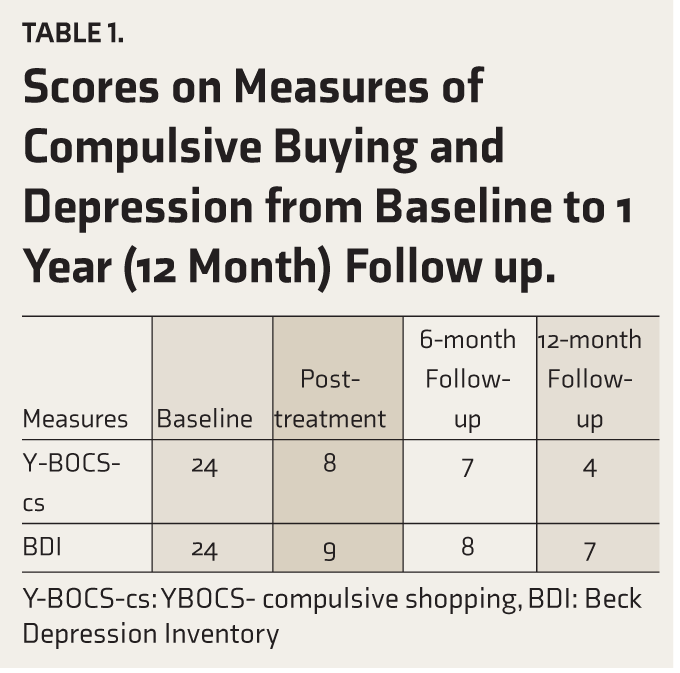
Y-BOCS-cs: YBOCS- compulsive shopping, BDI: Beck Depression Inventory
Discussion
This case study presents the application of solution-focused brief psychotherapy in an adult with compulsive buying behaviors (CBBs). Literature on CB includes impulsivity, worry, and pessimism in anticipation of upcoming challenges. 20 Although CBB is followed by guilt, regret, and financial and interpersonal problems, people with CBB are not able to stop their behavior. 11 This case presented the clinical manifestation of CBB leading to functional impairment and outlined how such cases can be approached in intervention. The therapeutic process provided the patient with a safe place to help him express his emotions and reach for solutions using his strengths. The techniques that brought about the change were miracle questions, which helped him visualize his life without those problems. The exception technique was also beneficial as it led the patient to devise techniques to control excess expenditure. Using techniques and therapeutic compliments to appreciate the client’s efforts contributed to better rapport and engagement of the client in the therapeutic process, increased acceptance and motivation for change, and considerable improvement in self-perception. Considering the favorable clinical results maintained at the six-month and one-year follow-up, this case successfully illustrates how components from solution-focused brief psychotherapy could be helpful in the treatment of problematic buying behaviors in developing countries.
Conclusion
The findings of this study imply that SFBT should be evaluated for its effectiveness as a further therapeutic modality that may be used for clients with problematic buying behaviors and for future exploration in more extensive trials. However, at this early stage, the authors are careful about the clinical application of the study findings by suggesting that the components of SFBT could be useful in treating CBD.
Footnotes
Declaration of Conflicting Interests
The authors declared no potential conflicts of interest with respect to the research, authorship, and/or publication of this article.
Declaration Regarding the Use of Generative AI
None used.
Funding
The authors received no financial support for the research, authorship, and/or publication of this article.
Informed Consent
Written informed consent was obtained from the patient for publication of this case report.