




Abstract
Background:
Contrary to traditional notions of emerging adulthood as a period free from parental pressures, the prolonged transition to adulthood in contemporary society implies that parental influence remains a significant factor in the lives of emerging adults. This presents a potential challenge to emerging adults, as navigating independence while managing parental expectations can result in adverse psychological outcomes. The present study examined the relationship between perceived parental expectations and fear of negative evaluation (FNE) and the mediating role of maladaptive perfectionism.
Method:
This cross-sectional study was conducted on 466 emerging adults from India between 18 and 25 years old. They responded to the Perception of Parental Expectations Inventory, the Frost Multidimensional Perfectionism-Brief Scale, and the Brief Fear of Negative Evaluation–Straightforward Items Scale.
Results:
Correlation analyses revealed significant, positive associations between perceived parental expectations, maladaptive perfectionism, and FNE. Findings from regression analyses indicated that increased perceptions of parental expectations and maladaptive perfectionism predicted increased levels of FNE. The relationship between perceived parental expectations and FNE was fully mediated by maladaptive perfectionism.
Conclusion:
A key reason for heightened perceptions of parental expectations associated with increased FNE is that emerging adults tend to adopt unrealistic perfectionistic standards. Maladaptive perfectionism represents a vital intervention target for individuals who perceive elevated parental expectations and are at risk for FNE, offering promising avenues for promoting well-being in emerging adults.
Keywords
Perceived parental expectations and maladaptive perfectionism are positively associated with FNE in emerging adults. Maladaptive perfectionism fully mediates the relationship between perceived parental expectations and FNE, highlighting its importance as an intervention target to promote functioning.Key Messages:
Over the past few decades, literature points to a worrying trend that parental self-worth has become increasingly contingent on their children’s success. 1 As modern society thrives on the ideals of meritocracy, parents believe that their children’s success reflects positively on their competence as caregivers. Consequently, they promote extreme expectations, such as pressuring children toward specific careers irrespective of their interests, unintentionally linking self-worth to grades, or engaging in constant comparisons.1,2 Emerging adulthood, marked by identity exploration, independence-seeking, and heightened self-awareness, is particularly vulnerable to such pressures. 3 When these perceived escalating expectations exceed realistic boundaries, emerging adults may internalize them, developing perfectionism. Perfectionism, defined as striving for flawlessness and setting excessively high standards for oneself, manifests in two distinct facets. 4 Adaptive perfectionism, characterized by a healthy drive for self-improvement, facilitates personal achievements and growth. However, this study focuses on maladaptive perfectionism, a relentless pursuit of unattainable standards. This can create a high-stress environment where emerging adults feel compelled to validate their parents’ worth as caregivers. 2 The crippling self-scrutiny associated with maladaptive perfectionism fosters a hyperawareness of perceived failure and a dread of disappointing oneself and others, known as a fear of negative evaluation (FNE). 5
Despite the widespread recognition of the impact of maladaptive perfectionism, its intricate relationship with heightened parental expectations and FNE in this age group has largely been unexplored. Unlike adolescents, emerging adults navigate an awkward middle ground—possessing greater cognitive and emotional maturity while confronting life-altering decisions about careers and relationships and forging independent identities. The psychological patterns established during this phase can resonate throughout life as anxiety, depression, burnout, and physical health problems, such as chronic fatigue syndrome, gastrointestinal disorders, and immune system dysfunction.6,7 These chronic issues impact personal well-being, professional growth, and future relationships. The present study delves into this critical juncture, examining whether perceived parental expectations catalyze maladaptive perfectionism, which in turn contributes to FNE in emerging adults, potentially shaping their emotional and social trajectories.
Culture, Parental Control, and Maladaptive Perfectionism
Family and parental influences emerge as prominent drivers of maladaptive perfectionism among all developmental domains. Children of demanding, perfectionistic parents exhibit maladaptive perfectionism, as explained by the social learning and social expectations models. 8 Observing parental perfectionism and seeking contingent parental approval by meeting unreasonably high expectations contribute to this risk. 9 Paradoxically, children’s attempts to meet well-intentioned but perfectionistic parental expectations become counterproductive and exacerbate maladaptive perfectionism.
Maladaptive perfectionism thrives in family environments marked by control, stifled autonomy, and suppressed expression. Emerging adults experiencing high parental psychological control and authoritarian parenting tend to exhibit maladaptive perfectionism, while parental warmth and responsiveness are negatively related to this trait. 10 Turner and Turner 11 identified parental autonomy and high behavioral inhibition system sensitivity as predictors of maladaptive perfectionism. There is also evidence that children who perceive their parents as excessively worried about their mistakes tend to report higher levels of perfectionism, 12 possibly due to increased parental intervention that inadvertently promotes perfectionistic tendencies. These detrimental tendencies translate into tangible consequences, with studies linking maladaptive perfectionism to lower life satisfaction, 13 increased internalizing problems such as depression and anxiety, 14 and lower academic achievement, 15 among emerging adults.
Arnett, 3 defines emerging adulthood as a period marked by the need for independence, which clashes with Indian cultural expectations of fulfilling familial responsibilities while remaining financially and emotionally dependent on parents. Strong intergenerational dependence and high parental expectations characterize Indian family dynamics. 16 Asian parents, driven by their children’s success aspirations, often make significant sacrifices and invest heavily in quality education. Thus, Asian cultural values such as family recognition through achievement can fuel maladaptive perfectionism, as filial duty compels children to internalize parental expectations and pursue impossible standards in service of familial honor. 17 However, these continual choices can hinder an emerging adult’s ability to become independent. Therefore, understanding how Indian parental expectations influence emerging adults’ inner world and self-worth is crucial, especially considering the potential threat to their well-being.
Maladaptive Perfectionism and Fear of Negative Evaluation
Maladaptive perfectionism is deeply rooted in cognitive distortions related to achievement, self-worth, and failure. Driven by a fear of being negatively evaluated, these individuals pursue goals compulsively and hold inflexible notions of success. 18 Heightened anxiety and dysfunctional emotion regulation further characterize this trait. Thus, FNE is central to social phobia, defined as anxiety arising from the anticipation of harsh judgment.19,20 Nonclinical studies support a positive correlation between maladaptive perfectionism and FNE,5,21 and clinical studies reveal greater perfectionism in individuals with social phobia than in controls.22,23 The literature also highlights this interplay’s detrimental impact on emerging adults’ academic well-being. For instance, increased FNE stemming from maladaptive perfectionism elevates perceived stress and academic perfectionism in university students. 5,21 Gender nuances also appear in the interplay between maladaptive perfectionism and its consequences. Lasota and Kearney, 24 identified self-esteem as the critical factor linking maladaptive perfectionism (stemming from parental criticism) to trait anxiety in men only. Conversely, Dobos et al. 25 found FNE to mediate between maladaptive perfectionism and lower life satisfaction in women. These findings align with Heimberg et al.’s, 26 cognitive-behavioral model of social anxiety, suggesting that maladaptive perfectionism intensifies the perceived discrepancy between self-evaluation and social norms, driving FNE.
However, Levinson et al., 27 found a surprising dissociation between maladaptive perfectionism and FNE, with only FNE strongly predicting social anxiety and eating disorders. This finding challenges their simplistic link and warrants further investigation to refine our understanding of whether the effect of maladaptive perfectionism on FNE might be less direct than previously assumed. Our study also aligns with Momeñe et al.’s, 28 findings by demonstrating how external pressures, such as parental expectations in our case and emotional dependence in abusive relationships in theirs, can converge on maladaptive perfectionism as a central mechanism for amplifying FNE. By offering distinct cultural and situational lenses, our study aimed to underscore the generalizability of this dynamic.
Conditional Love, Parental Pressure, and Fear of Negative Evaluation
Fear of failure fostered by FNE is often rooted in parental control and conditional love. According to the internal working model (IWM) of attachment theory, 29 insecure attachment styles, characterized by inconsistent or overly demanding parenting, can lead to feelings of rejection and a sense of inadequacy in emerging adults. They may develop a cognitive schema emphasizing negative self-evaluation, excessive rumination on perceived shortcomings, and a heightened awareness of potential rejection. 19 This leads individuals to develop FNE, which stems not from performance itself but from the perceived scrutiny of others. Furthermore, the self-determination theory 30 suggests that overly critical parenting practices with heightened expectations undermine children’s autonomy, competence, and relatedness, resulting in FNE. Parents imposing their notion of success over their children’s interests creates conflict with the child’s natural drive for self-direction and mastery. 31 When these basic needs are unfulfilled, individuals crave external validation, leading to FNE. Helicopter parenting is a prominent exam- ple of reducing autonomy and increasing FNE among college students.31,32 Additionally, in a collectivistic cultural milieu such as India, conditional positive regard may be perceived as implicit parental rejection, as affection hinges on meeting parental expectations, particularly in academic pursuits. 17 Such ingrained views, wherein parents instill the core belief that perfect equals loved, contribute to FNE. 33
Research highlights the link between harmful parenting practices and FNE. Deneault et al. 34 reported that parental psychological control predicts fear of failure and hinders academic adjustment in undergraduates. This link is stronger in gifted students than in typical students due to their tendency to internalize and strive for unrealistic expectations. 35 Perceived authoritarian and supervisory parental attitudes have also been associated with increased FNE and decreased self-efficacy among college students. 36 Notably, de Vente et al. 37 indicated that parents’ FNE extends to their children’s environment, explicitly manifesting as fear of negative child evaluation (FNCE) or fear about the negative evaluation of their child. Parents who experienced high levels of criticism or conditional love during their upbringing are more likely to view the world as a generally critical place. They project their anxieties onto their children, acting as social conduits. 1 Therefore, such parents might worry excessively that their children will face negative evaluations and be judged for their behavior. The consequences of this intergenerational transmission often encompass internalizing problems, such as anxiety and depressive symptoms, in both youth and their mothers. 38 Fredrick and Luebbe’s 39 longitudinal study further highlights this phenomenon, demonstrating that both adolescent and parent-reported FNE significantly predict increased social anxiety symptoms over time.
Present Study
Despite the consensus underscoring the influence of harmful parenting practices on FNE, empirical evidence struggles to pinpoint heightened parental expectations as the driving force behind this association and maladaptive perfectionism as the mediator. This is particularly critical in the Indian context, wherein familial expectations of achievement impact emerging adults’ self-discovery and emotional well- being. Consequently, those with average achievements fear negative evaluations within the Indian community, where success is not just aspired to but also expected. This necessitates a psychologically adaptive mindset prioritizing healthy personal standards without worrying about parental expectations. The focus must shift from external pressure to an intrinsic motivation for continuous growth. Examining this dynamic tapestry through a non-Western lens paves the way for interventions promoting self-compassion and breaking the cycle of self-inflicted pressure. Therefore, this study hypothesized that (a) among emerging adults, there is no significant relationship between perceived parental expectations, maladaptive perfectionism, and FNE; (b) perceived parental expectations and maladaptive perfectionism do not predict FNE; and (c) maladaptive perfectionism does not mediate the relationship between perceived parental expectations and FNE.
Methods
Participants
The study included 466 Indian emerging adults aged between 18 and 25 (M = 22, SD = 2.07). There were 346 women (74.2%), 108 men (23.2%), and 12 non-binary (2.6%) individuals in the sample. The highest educational qualifications of the participants ranged from high school (10.9%, n = 51), bachelor’s degree (48.7%, n = 227), master’s degree (38.2%, n = 178), to PhD (2.15%, n = 10). To control for potential influences from factors such as parent–child or marital relationships, we ensured that all participants had no children and were unmarried. Individuals with a history of psychiatric illness were excluded.
Most participants hailed from intact families (n = 408, 87.6%), while the rest came from non-intact families (n = 58, 12.4%), characterized by deceased parents, single parents, divorces, or step-parents. Approximately 54.4% (n = 253) of the sample resided at home, while the remaining 45.6% (n = 212) stayed away from home. In terms of perceived parental influence, 42.5% (n = 198) reported influence from both parents, 31.1% (n = 145) from their mothers, and the remaining 26.4% (n = 123) from their fathers. Regarding parental discipline, 30.5% (n = 142) perceived discipline from both parents, 43.6% (n = 203) from their mothers, and 26% (n = 121) from their fathers.
Procedure
The research commenced after ethical approval was obtained from the institutional review board of a reputable autonomous university in Bengaluru, India. Data was collected through an online survey and distributed on social networking sites from May 5, 2023, to July 25, 2023. No monetary compensation was given.
Before responding to the questionnaires, participants were informed about the study’s objectives and implications. They provided voluntary, informed consent and were briefed on their right to withdraw from the research at any point. Assurances were given regarding the confidentiality of their responses. Participants were also informed that there were no right or wrong answers, recognizing individual differences in feelings and behaviors across diverse situations. The investigator addressed any further inquiries participants had about the study. After providing consent, participants completed a questionnaire that included a sociodemographic response sheet, followed by measures of perceived parental expectations, maladaptive perfectionism, and FNE. Upon completion of the questionnaire, the participants were thanked for their participation. A total of 471 responses were received, five of which were excluded because they did not meet the inclusion criteria, resulting in a final sample size of 466. Following the data collection, the participants’ initials on the response sheets were substituted with codes. The investigators inputted item-wise responses into an Excel sheet and securely stored them on a password-protected computer.
Measures
Sociodemographic Information
A sociodemographic response sheet was created to collect information about age, sex, highest educational qualification, type of family (intact vs. nonintact), parental influence in terms of achievement and discipline (mother, father, or both), and place of residence (at home vs. away from home).
Perceived Parental Expectations
The Perception of Parental Expectations Inventory (PPEI), 16 a 30-item self-report scale exclusively developed for Indian emerging adults, was used to measure perceived parental expectations. It measures four related factors, namely, personal expectation (PE), academic expectation (AE), career expectation (CE), and parental ambition (PA). An example item is “My parents expect me to be financially secure in the future.” All the responses were recorded on a 5-point severity scale ranging from 1 (not at all) to 5 (all the time). The responses were added to obtain a composite score of the overall perception of parental expectations. High PPEI scores indicated a perception of a high level of parental expectations. According to the scale’s authors, 16 PPEI has adequate reliability (α = 0.90). In the present sample, the scale showed excellent internal consistency (α = 0.92).
Maladaptive Perfectionism
Maladaptive perfectionism was measured using the 8-item Frost Multidimensional Perfectionism Scale-Brief (FMPS-Brief) 40 that assessed the bidimensional model of perfectionism using two shortened subscales: evaluative concerns or maladaptive perfectionism (EC; four items; e.g., “If I fail at work/school, I am a failure as a person”) and striving or adaptive perfectionism (S; four items; e.g., “I have extremely high goals”). Items are scored on a 5-point Likert-type scale, with higher scores indicating higher levels of perfectionism. Only the EC subscale was utilized since the current study required a measure of maladaptive perfectionism. According to the scale’s authors, 40 the FMPS-Brief is reliable (α = 0.81) and positively correlated (r = 0.723) with other perfectionism measures such as the Almost Perfect Scale-Revised. In the present sample, the EC subscale showed adequate overall internal consistency (α = 0.81).
Fear of Negative Evaluation
Developed by Carleton et al., 19 the Brief Fear of Negative Evaluation-Straightforward (BFNE-S) consists of eight items to measure an individual’s fear and distress arising from negative evaluation (e.g., “I often worry that I will say or do wrong things”). Each item is rated on a 5-point Likert scale ranging from 0 (not at all characteristic of me) to 4 (extremely characteristic of me). The total score is calculated by summing the client’s rating on the eight straightforward (-S) BFNE items. According to the scale’s authors, 19 BFNE-S had good internal consistency (α > 0.92), factorial validity, and construct validity in undergraduate and clinical samples. In the current sample, the internal consistency was excellent (α = 0.95).
Data Analysis
The study was analyzed using IBM SPSS 26.0 and the open-source software Jamovi 2.3. 41 Descriptive analyses of the variables were examined, represented as means (standard deviations) and frequencies (percentages). Pearson’s correlation was used to assess the association between perceived parental expectations, maladaptive perfectionism, and FNE. Hierarchical regression was performed to examine whether perceived parental expectations and maladaptive perfectionism predicted FNE. Using the advanced mediation modeling package in Jamovi, the mediation effect of maladaptive perfectionism in the relationship between perceived parental expectations and FNE was examined.
Results
Table 1 presents the descriptive statistics and bivariate analysis of the sample’s perceived parental expectations, maladaptive perfectionism, and FNE levels. Correlation analysis revealed that perceived parental expectations had a moderate but significant positive correlation with maladaptive perfectionism (r = 0.32, p < .01). Perceived parental expectations also had a weak but significant positive correlation with FNE (r = 0.24, p < .01). On the other hand, FNE had a moderate but significant positive correlation with maladaptive perfectionism (r = 0.64, p < .01). Thus, Hypothesis 1 was rejected.
Descriptive Statistics and Correlations for all Measures.
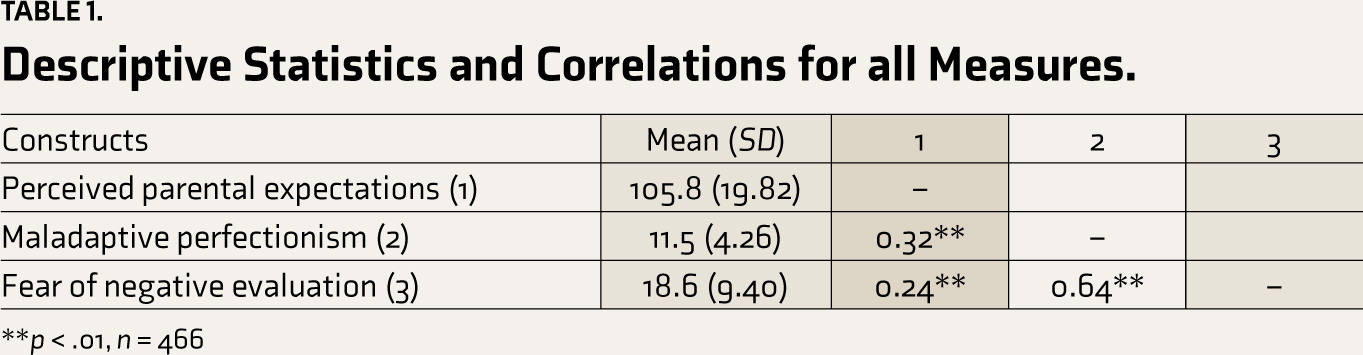
**p < .01, n = 466
Predicting Fear of Negative Evaluation
Hierarchical regression analysis showed that perceived parental expectation was a significant direct predictor (β = 0.24, p < .01; Table 2) of FNE in model 1. The model was of adequate fit (F = 28.60, p < .01) and explained 6% (R2 = 0.06) of the variance in the dependent variable that was predicted from the independent variable. In model 2, the entry of maladaptive perfectionism, which was a significant direct predictor (β = 0.63, p < .01) of FNE, reduced the strength of the slope between perceived parental expectations and FNE (β = 0.04, p > .05). The model was of adequate fit (F = 159.87, p < .01) and explained 41% (R2 = 0.41) of the variance in the dependent variable that was predicted from the independent variable. Hence, Hypothesis 2 was rejected. This finding indicated the possibility of a mediating effect of maladaptive perfectionism in the relationship between perceived parental expectations and FNE.
Hierarchical Regression of Perceived Parental Expectations and Maladaptive Perfectionism in Fear of Negative Evaluation.
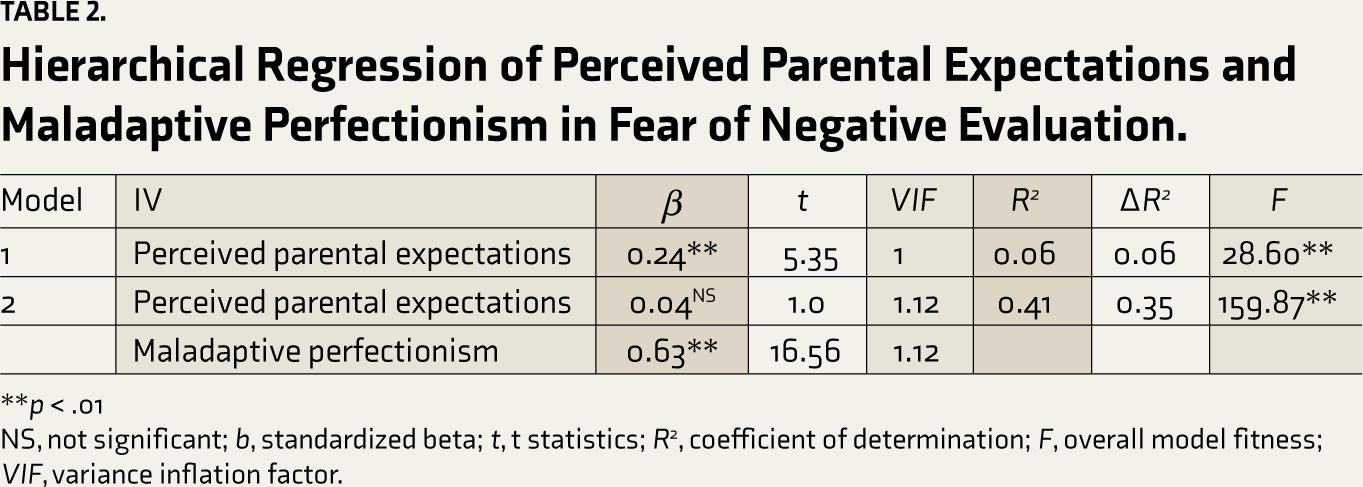
**p < .01
NS, not significant; b, standardized beta; t, t statistics; R2, coefficient of determination; F, overall model fitness; VIF, variance inflation factor.
The Mediating Role of Maladaptive Perfectionism
Mediation analysis was used to test whether maladaptive perfectionism mediated the relationship between perceived parental expectations and FNE (see Table 3). Perceived parental expectation was entered as the independent variable, maladaptive perfectionism as the mediating variable, and FNE as the dependent variable. The findings revealed that the path from perceived parental expectations to maladaptive perfectionism (β = 0.32, p < .01; Table 3) and the path from maladaptive perfectionism to FNE were significant (β = 0.63, p < .01). Additionally, the total effect of perceived parental expectations on FNE was significant (β = 0.24, p < .01). With the inclusion of the mediating variable, the direct effect of parental expectations on FNE was not significant (β = 0.04, p >.05). However, the indirect effect of parental expectations on FNE through maladaptive perfectionism was significant (β = 0.20, p < .01). Hence, the effect of perceived parental expectations on FNE was fully mediated by maladaptive perfectionism. In other words, high levels of perceived parental expectation increase FNE by increasing emerging adults’ maladaptive perfectionism (see Figure 1). Hypothesis 3 was thus rejected.
Mediation analysis revealed that maladaptive perfectionism is a full mediator.
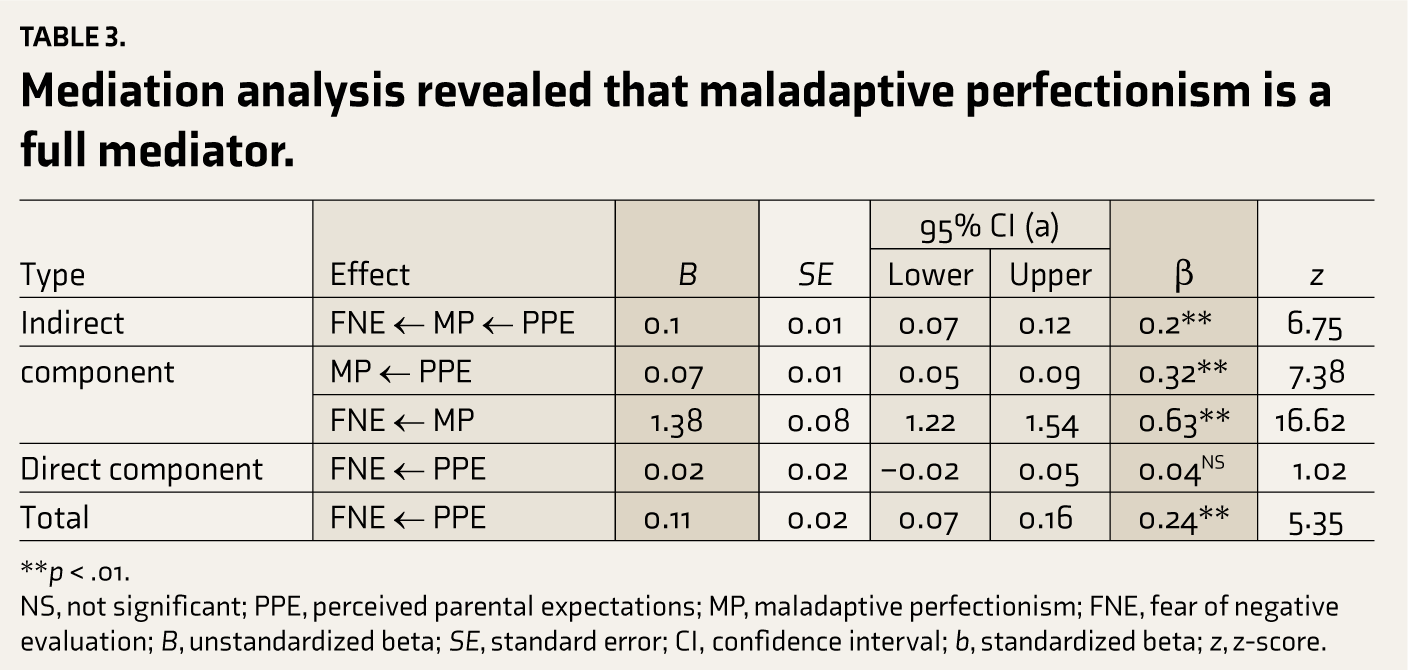
**p < .01.
NS, not significant; PPE, perceived parental expectations; MP, maladaptive perfectionism; FNE, fear of negative evaluation; B, unstandardized beta; SE, standard error; CI, confidence interval; b, standardized beta; z, z-score.
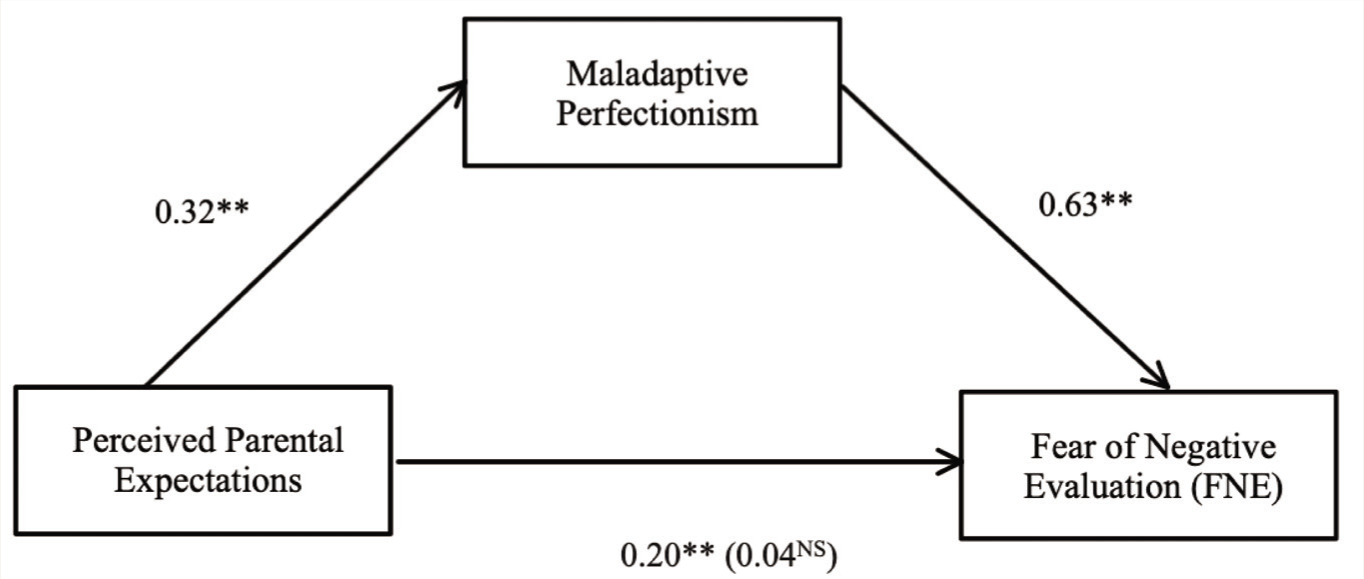
**p < .01.
Discussion
The present investigation examined the relationship between perceived parental expectations, maladaptive perfectionism, and FNE among emerging adults. Correlation and regression analyses revealed that emerging adults with higher levels of maladaptive perfectionism perceived higher parental expectations. Previous research has demonstrated that the family environment, with parents as influential role models, is crucial in developing perfectionistic tendencies.4,8 In collectivistic cultures such as India, with a pronounced emphasis on academic and career success, heightened parental expectations prevail. 16 Thus, children often internalize their parents’ high standards, adopting them as benchmarks and persistently striving for maladaptive perfectionism into emerging adulthood. Individuals who perceive perfectionistic parental expectations are also prone to generalizing such expectations to others outside the familial realm and seek acceptance only upon meeting those standards. 9 Speculatively, this correlation could reinforce itself over time, as emerging adults with maladaptive perfectionism may align their behavior with perceived parental expectations, creating a self-fulfilling prophecy where their behavior reinforces the belief that expectations are high. In this way, the feedback parents and children give to one another likely creates a destructive cycle that maintains maladaptive perfectionism. 4
Consistent with previous research,5,25 our study revealed a positive association between maladaptive perfectionism and FNE. Driven by the need for favorable self-presentation, maladaptive perfectionists use social comparison and external validation to bolster their contingent self-worth. They frequently fear being ostracized if their shortcomings become known, giving rise to FNE stemming from a focus on perceived flaws.19,20 This elevated sensitivity to negative evaluation poses a significant risk for various psychopathologies, including social anxiety, 23 depression, 42 and eating disorders. 43 For example, Bardone-Cone et al. 44 identified maladaptive perfectionism and contingent self-worth tied to performance as contributors to FNE, potentially fueling eating disorders. These findings suggest a synergistic relationship between maladaptive perfectionism and FNE. Maladaptive perfectionists also experience cognitive distortions, such as overgeneralizing or catastrophizing adverse outcomes that contribute to an increased FNE, as they exaggerate the potential consequences of perceived failure. 18 Hence, the relationship between maladaptive perfectionism and FNE creates a probable vicious cycle in which an increase in maladaptive perfectionism intensifies FNE and vice versa, establishing a feedback loop that sustains and amplifies these adverse cognitive and emotional patterns. This aligns with Heimberg et al.’s 26 model of social anxiety, where the discrepancy between self-evaluation and perceived social expectations, exacerbated by maladaptive perfectionism, fuels FNE and maintains social anxiety.
Perceptions of increased parental expectations were positively associated with a high FNE. This finding fits well with developmental research,3,29 showing how early experiences shape an IWM, influencing how emerging adults approach future relationships. Thus, insecure IWMs, formed through parental rejection, can lead to a negative cognitive schema characterized by self-doubt and preoccupation with potential shortcomings, leading to FNE. Additionally, the FNCE exhibited by parents, reflecting their concern that their children will be negatively evaluated by others, plays a pivotal role in the intergenerational transmission of FNE. 37 Parents with high FNCE are prone to imposing stringent expectations, signaling to their children that broader societal evaluation is inherently critical and increasing the likelihood of FNE. Despite cultural differences, our Indian study echoes Western findings, which could be attributed to the universality of the self-determination theory. 30 Parents who set high expectations often leave their children unequipped with adequate autonomy and competency to cope with hardships, exacerbating their FNE.31,32 Not every instance of high parental expectations leads to FNE, underscoring the need to differentiate between maladaptive and adaptive forms of perfectionism. Specifically, when parental expectations become intertwined with maladaptive perfectionism, individuals may be preoccupied with FNE.
Maladaptive perfectionism mediated the relationship between parental expectations and FNE among emerging adults. Individuals who perceive high parental expectations tend to have an unhealthy focus on achieving flawlessness and, in turn, fear being negatively evaluated. When perceptions of high parental expectations are coupled with rejection following unmet expectations, it reinforces the belief that parental acceptance is contingent upon achieving perfection. Additionally, overprotective parents with high expectations may instill a fear of imperfection in their children. 15 This confluence of parental rejection and overprotection creates an environment wherein maladaptive perfection emerges as a coping mechanism propelled by a distorted belief system that achieving perfection is essential for approval. 45 Excessive parental expectations can also prompt a transition from intrinsic to extrinsic motivation, as individuals prioritize external validation over personal fulfillment, which is implicated in the development of maladaptive perfectionism. 46 Extremely high expectations imposed on such maladaptive perfectionists can diminish the use of meta-cognition and induce FNE. 18 Instead of reflecting on and adjusting their cognitive strategies, these individuals may become hyper focused on avoiding errors and seeking external validation, reducing their ability to think critically about their thought processes. The unmet need for relatedness in such individuals can drive a continual search for affirmation, reinforcing a strong FNE and potentially hindering the formation of social connections. 32 Consequently, the cognitive dissonance arising from the perceived incongruence between one’s self-concept and unattainable standards exacerbates this fear, creating a persistent cycle of anxiety and performance-driven behavior.
Maladaptive perfectionism emerged as a stronger predictor of FNE than perceived parental expectations, speculatively because maladaptive perfectionism is a more stable and enduring characteristic than perceived parental expectations. 47 Parental expectations can change over time, depending on the child’s age, development, and performance. However, maladaptive perfectionism is a more ingrained cognitive pattern likely to persist even if parental expectations change. As a result, maladaptive perfectionism may have a more cumulative effect on FNE over time. For example, an individual who develops maladaptive perfectionism in early childhood will likely experience FNE throughout life, even if their parents’ expectations change. Another explanation could lie in the differing nature of these pressures. While maladaptive perfectionism represents an internalized striving for unrealistic standards, perceived parental expectations are external pressures that may not always align with emerging adults’ self-defined standards. 4 While significant for some individuals, this external influence might be overshadowed by internal struggles and the increasing importance of peer group interactions during this developmental stage of identity exploration and independence.
The Indian population’s cultural background could have contributed to the current findings. The literature has shown that, compared with their European counterparts, emerging Asian adults perceive high expectations from others as more maladaptive and demonstrate reduced responsiveness to interventions to adapt those expectations. This can be traced back to Asian parents’ child-contingent self-esteem, evident in the rise of parental expectations, which psychologists have noted is cause for concern. 1 Asian culture emphasizes filial piety, academic achievement, and family hierarchy, translating into parental behaviors that closely monitor and intervene in their children’s lives, often projecting their aspirations onto them and placing significant pressure on academic performance. 16 Moreover, an emphasis on values such as humility and family recognition through achievements (or the concept of dharma) in the Asian culture provides a possible explanation for maladaptive perfectionism among emerging adults in India. For instance, Methikalam et al., 17 with a sample of 174 Indians in the United States, identified that those who perceived their families as perfectionistic tended to value family honor tied to their accomplishments and exhibited traits of maladaptive perfectionism.
Limitations and Future Research
From this study, it remains uncertain which aspects of increased parental expectations contribute to maladaptive perfectionism. The impact of high parental expectations on maladaptive perfectionism and FNE might be weaker when intervention in emerging adults’ lives is minimal and perceived as supportive. Future research should explore individual differences in perceptions of parental expectations and how closely these perceptions align with actual parental expectations. The current study also examined parental expectations based on the emerging adults’ self-perceptions of their parents. Further research should examine the perspectives of both parents and children for a more holistic understanding.
Our female-heavy sample hinders a thorough exploration of potential gender differences, considering the influence of traditional gender roles on parental expectations. Consequently, future research should aim for a more equitable representation to portray parental expectations in the Indian context accurately. Furthermore, all the data collected in our study relied on self-report surveys, which are susceptible to the influence of social desirability and response biases. Future research should supplement self-reported survey data with multiple-source reporting (e.g., surveying parents themselves) and qualitative methods, such as interviews or observational techniques.
Although this mediational study explored potential relationships and mechanisms between variables, our cross-sectional analysis limits our understanding of cause-and-effect relationships. Perceptions of parental expectations may change throughout development, with subsequent maladaptive perfectionism and FNE levels. Moreover, other confounding variables may have affected parental expectations and FNE in this study. Therefore, future research could examine resilience factors that neutralize the adverse effects of high perceived parental expectations on FNE, such as obtainable self-expectations, social support, emotion regulation, and coping strategies. A longitudinal study could provide parents with valuable insights to guide their parenting decisions and help them draw more confident conclusions about causality. Notwithstanding these limitations, this study serves as a useful beginning for providing direction for future research examining the impact of perceived parental expectations on emerging adult development, particularly in a collectivistic cultural setting.
Implications for Practice
Recognizing the potential adverse impact of high parental expectations on FNE, it is imperative to collaborate with parents to formulate strategies for mitigating FNE in emerging adults. Practical measures include organizing local parenting workshops and emphasizing exchanging ideas and techniques to reduce maladaptive perfectionism. Promoting practices such as unconditional positive regard and fostering effective parent–child communication could be integral to these workshops. Furthermore, when designing counseling or remedial education programs for emerging adults struggling with FNE, parents must understand how their expectations affect their relationship with emerging adult children. This means delving into family dynamics, particularly those characterized by enmeshment and the imposition of high standards, and educating parents on establishing healthy boundaries in parenting behavior. Cognitive restructuring can help reshape how clients perceive parental expectations by, for instance, reframing high parental expectations in India as culturally typical expressions of optimism and encouragement. This way, we can empower emerging adults to navigate their families and develop healthier coping mechanisms.
University student support services could conduct parent-oriented programs that equip parents to foster emerging adults’ autonomy and offer support constructively without overinvolvement. This should involve a thoughtful assessment of the potential ramifications of promoting high parental expectations, particularly in collectivistic contexts where such heightened expectations are prevalent. University administrators can also organize targeted initiatives, such as student development programs, to cultivate positive self-perceptions and enhance social resources to reduce emerging adults’ maladaptive perfectionism and promote low FNE.
Conclusion
This study contributes to the literature on the mechanism of FNE among emerging adults and is one of the few studies conducted with an Asian Indian sample. A significant, positive correlation was found between perceived parental expectations, maladaptive perfectionism, and FNE among Indian emerging adults. Additionally, perceived parental expectations were found to predict FNE, and maladaptive perfectionism explained why perceptions of heightened parental expectations resulted in increased levels of FNE. Thus, from a theoretical standpoint, reducing maladaptive perfectionism, particularly in emerging adults, could alleviate FNE in hopes of attaining enhanced overall functioning.
Footnotes
Acknowledgements
We extend my heartfelt gratitude to Dr. Aiswarya and Dr. Santhosh for their unwavering support and guidance during this research. Special thanks to Dr. Sanjay, and Ms Jasmine Joseph as well as our research participants, whose invaluable contributions made this study possible.
Declaration of Conflicting Interests
The authors declared no potential conflicts of interest with respect to the research, authorship, and/or publication of this article.
Declaration Regarding the Use of Generative AI
None used.
Ethical Approval
The study was approved by the Institutional Review Board of CHRIST (Deemed to be University), Bengaluru, India.
Funding
The authors received no financial support for the research, authorship, and/or publication of this article.
Informed Consent
All the participants provided informed consent to participate.