




Abstract
Background:
The COVID-19 pandemic and its associated psychological distress led people to engage in attributing several health-related behaviors and consequences at the community and international levels. A scoping review was conducted to explore the existing literature on the use of attribution theory in understanding the psychological phenomena underlying health-related behavior and consequences during the pandemic.
Methods:
We conducted the literature review using Arksey and O’Malley’s methodological framework for scoping review. Studies were identified through a comprehensive search of the following six databases: MEDLINE through PubMed, ProQuest, JSTOR, Scopus, ScienceDirect, and Google Scholar. All databases were searched for entries in English from September 2019 to September 2021 to correspond to the advent of the pandemic.
Results:
Several elements influence attributions and the influences of the attributions on people’s responses to information and the consequences of attributions in influencing people’s responses to information and behavior changes in the context of the COVID-19 pandemic. The importance of attribution errors leading to stigmatization and responsibility framing, both crucial for implementing pandemic control measures and enhancing psychological well-being, were also highlighted.
Conclusion:
More research is needed in this field to inform people-centered policies and pandemic preparedness plans to mitigate the potentially devastating psychosocial consequence of the pandemic or other public health emergencies.
COVID-19 has emerged as a worldwide catastrophe with severe physiological, psychological, and social implications. Self-isolation, quarantines, social distancing, work-from-home, online schooling, and constant apprehension about contracting the illness and recovering from it—all these factors have contributed to adverse mental health consequences across people from all walks of life. Several studies have recorded a steep increase in loneliness, depression, anxiety, insomnia, self-harm, and suicidal behavior in the past year and a half, across the whole world.1, 2 It is estimated that these concerns will grow even further in the coming years.3, 4 The pandemic has also adversely affected a plethora of livelihoods, careers, and financial conditions. This has further fostered frustration, anger, and resentment—especially among the members of the East Asian community across the world, culminating in hate crimes, blame games, and the overarching desire to identify and single out a culprit to hold responsible.5, 6
In this context, the cognitions that people use to comprehend the pandemic and their health-related behaviors would be crucial to make meaning out of the pandemic. Attribution theory would hence facilitate a deeper understanding of the psychosocial implications of COVID-19. Attribution is a concept and phenomenon integral to 20th-century social psychology. Several prominent figures have contributed to its development, such as Fritz Heider, Harold Kelley, Jones and Davis, and Nisbett. In the classical definition, attribution theory deals with “how the social perceiver uses the information to arrive at causal explanations for events.” It examines what information is gathered and how it is combined to form a causal judgment. 7 Attribution theory, therefore, would provide a deeper understanding of the locus of control perceived by individuals—whether they perceive something as beyond their capacity to control or more internal. Several biases arise from misattribution, and these have helped explain blame, prejudice, stigma, and discrimination across judicial, legislative, medical, and socioeconomic settings.8, 9
As mentioned earlier, with the advent of the COVID-19 pandemic and the subsequent distress, loss, frustration, and uncertainty, people at the community and international levels have begun attributing several health-related behaviors and consequences. We, therefore, conducted a scoping review to explore the existing literature on the use of attribution theory in understanding the psychological phenomena underlying health-related behavior and consequences during the COVID-19 pandemic. The current review is anticipated to map evidence, synthesize knowledge, and identify gaps in the literature to inform interventions for tackling adverse psychosocial consequences associated with pandemics like COVID-19.
Methods
We conducted the literature review using Arksey and O’Malley’s methodological framework for scoping review, further enhanced by Levac and Daudt.10–12 Accordingly, the literature search and analysis were conducted in five stages: (a) identifying the research question, (b) identifying relevant studies, (c) study selection, (d) charting the data, and (e) collating, summarizing, and reporting the results.
Identifying the Research Question
The research question for this review, developed through discussions, pilot searching, and consensus, was: “What is known from the existing literature on the use of attribution theory in understanding the psychological phenomena during the COVID-19 pandemic?” We used this broad question to facilitate the inclusion of different constructs relating to our topic of interest.
Identifying Relevant Studies
The research question was then transformed into searchable queries or key terms for the literature search. Exploratory searches were done in Google Scholar and PubMed to refine our key terms. The final key terms included “COVID-19,” “attribution,” “attribution theory,” “pandemic,” “blame,” “psychosocial,” mental health,” and “psychological.” Studies were identified through a comprehensive search using a combination of the above key terms from the following six databases: MEDLINE through PubMed, ProQuest, JSTOR, Scopus, ScienceDirect, and Google Scholar. All databases were searched for entries in English from September 2019 to September 2021 to correspond to the advent of the pandemic. No country or study design restrictions were applied.
Study Selection
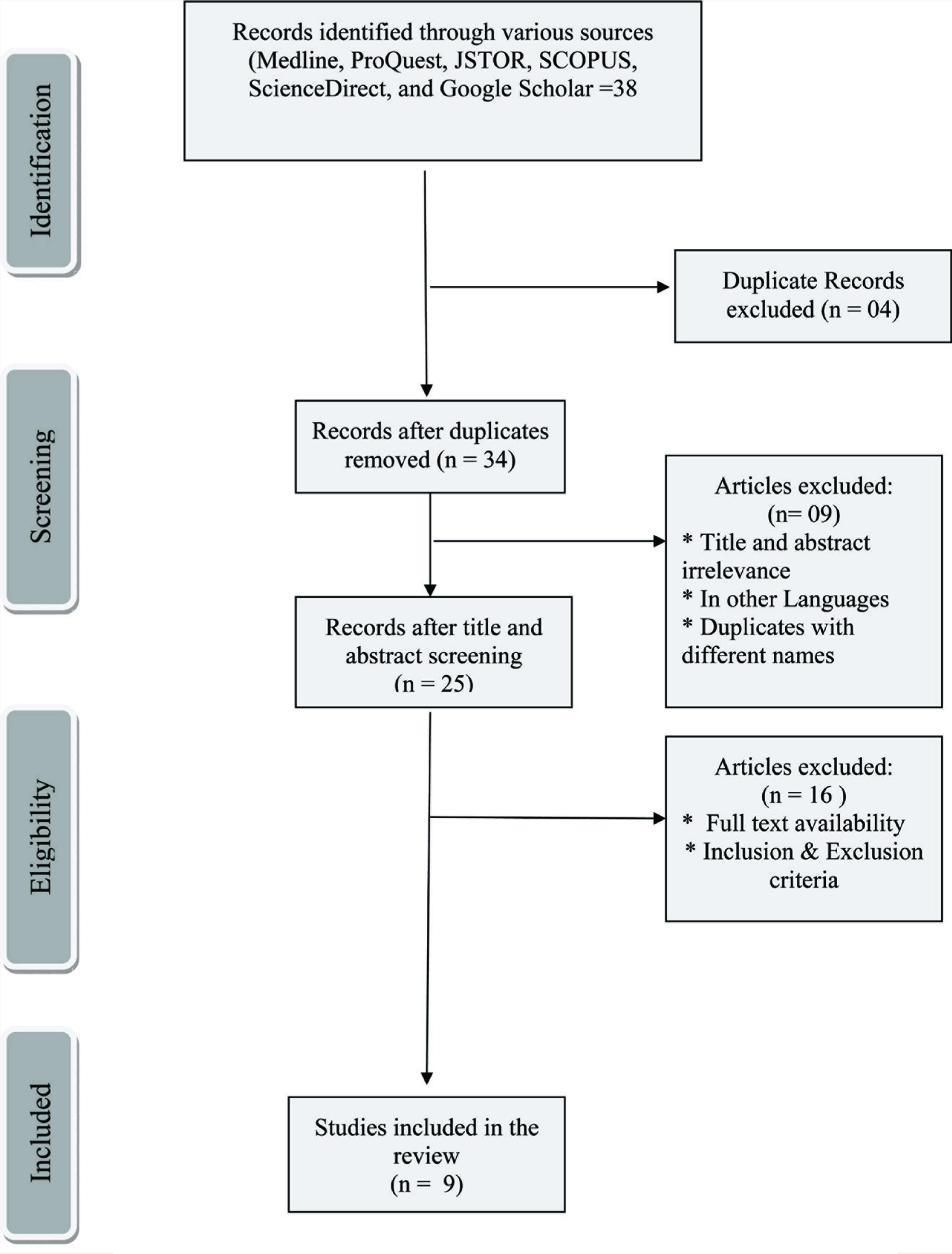
Studies were selected based on the use of attribution or attribution theory in the title, abstract, or body of the paper. They were used theoretically to analyze the psychosocial or mental health issues associated with the COVID-19 pandemic. The selection of relevant studies is shown in preferred reporting items for systematic reviews and meta-analysis (PRISMA) flowchart (Figure 1). Peer-reviewed studies (original articles, narrative, and systematic reviews) were included. Because of the severe dearth of literature in this specific domain of viewing the pandemic from the lens of attribution theory, any studies identified to utilize variants of attribution theory were also selected that included nonpeer-reviewed published research papers (including preprints), unpublished theses, and credible blog posts/newspaper editorials by scientists and professionals. COVID-19 articles not related to attribution theory or human subjects were excluded. Two authors independently screened the article titles and abstracts initially; for those whose relevance could not be determined by title and abstract, the full text was read for further information. The reference list of primary retrieved articles was also examined to locate any relevant articles missed in the database search.
PRISMA flow diagram of the study selection for the review
Charting the Data
The full text of the selected articles was read in detail. The authors were contacted for those articles where full text was not available. Data from the articles were charted using a data extraction form that included the author, year of publication, and key findings relevant to the topic of our review. Guided by the research question, the extracted data were synthesized using a descriptive-analytical framework to provide a meaningful narrative account.
Results
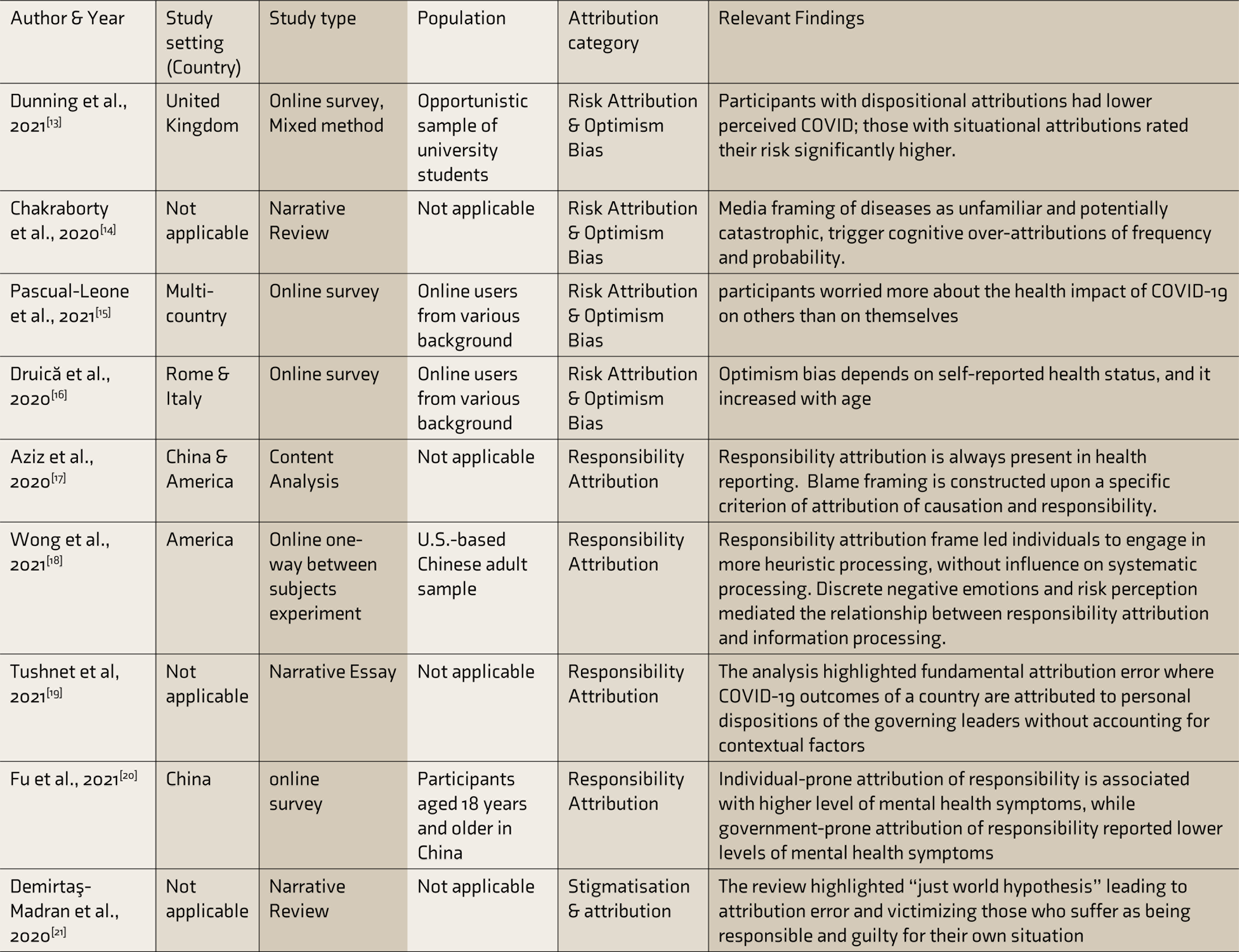
A total of 38 studies were retrieved through the initial database search. Four duplicates were excluded. Titles and abstracts were screened for the remaining 34 studies. After the exclusion of studies that do not meet inclusion criteria and following a full-text review, a total of nine studies were included in this scoping review. Using a thematic synthesis approach, three themes were developed from coding the meaning and content of each study, followed by conceptual translation and critical interpretation that are relevant to the stated objective. Table 1 summarizes and categorizes the nine studies under the three themes: risk attribution and optimism bias, responsibility attribution, and stigmatization.
Summary of Included Studies
Risk Attribution and Optimism Bias
Risk attributions and the attribution style explain decisions about relevant health outcomes or behaviors. One of the studies examined the risk perceptions of contracting COVID-19 through the lens of Heider’s Attribution Theory, 1958. 13 According to this theory, people are considered naive psychologists motivated to attribute meaningful causes to action and behavior. 13 The study was conducted on an online survey platform using an opportunistic sample of 114 university students from the United Kingdom. Content analysis using a conceptual framework (attribution theory) indicated that participants with more dispositional attributions (attributing their risk to factors such as age and own personal hygiene) had perceived their COVID risk to be significantly lower. In contrast, participants with more situational attributions (attributing COVID-19 risk to government decision-making and other people’s cleanliness) perceived their risk to be significantly higher. The findings helped gain insight into how risk perception and attribution may help target noncompliant risky behavior, such as not wearing masks, during the pandemic.
Another study looked at risk perception and attribution slightly differently, with the author claiming that perceived risk is often amplified by “social amplification stations” like news outlets and social media. This can often result in an overestimation and attribution of a high frequency of positive cases and a higher likelihood of contracting the virus—a reverse of optimism bias, which, in a vicious cycle, can exacerbate perceiving risk. 14
Another research has looked into the effect of optimism bias, a type of attribution error that results in biased risk assessment. 15 Optimism bias is the mistaken belief that negative things or events are less likely to happen to oneself than to others. Although such optimism can be advantageous in reducing stress and anxiety, it can be detrimental while dealing with the pandemic. This is because excessive optimism bias with low perceived risk can pose a severe threat to adhering to strict precautionary protocols, difficult behavioral adjustments, and practices required for pandemic control. This endangers not only the individuals but also everyone around them. A recent cross-cultural study from Romania and Italy highlighted the association of optimism bias with self-reported health status and rising age, with conflicting findings for gender and education. The study also noted an association of objective fragility (poor health state) with lower levels of optimism. 16
Responsibility Attribution
A content analysis of two popular newspapers—The Washington Post in the USA and The China Daily in China—highlighted how news content is framed to attribute either responsibility or blame. The analysis indicated that when a high positivity rate was present, the reporting would target or hold the government responsible for poor governance. When positivity rates were low, individual communities or people would be urged to be more careful and take responsibility for the spread. 17
A study from the United States examined the influence of responsibility attribution on heuristic and systematic information processing by exposing the participants to a news article that blames China (n = 445) or does not blame China (n = 498) for the pandemic. 18 It found that exposure to a responsibility attribution frame (a way of attributing blame for a cause or solution to either the government or an individual or group) led to more heuristic (fast, intuitive, emotional, and nonanalytical, using mental shortcuts) processing without much influence on systematic (slow, rational, effortful, and analytical using cogent evaluation of the information) processing. Furthermore, an analysis of the mediating effect of discrete negative emotions and risk perception revealed that responsibility attribution framing might serve as a heuristic cue to influence the people’s way of dealing with information about the COVID-19 pandemic.
The success or failure of governance in the COVID-19 pandemic was attributed to the dispositions of the leaders, without taking into consideration the relatively more difficult contextual/situational factors. Such responsibility framing supports the fundamental attribution error by Ross (an obvious tendency to explain bad behavior with an individual’s personality through contextual explanations is plausible). 19 Taking mental health into account, a study from China examined pandemic-related post-traumatic stress symptoms (PTSS) and post-traumatic growth (PTG) from the perspective of responsibility attribution. 20 Using an online survey conducted among 2441 Chinese adults during the COVID-19 lockdown, it examined the mental health outcomes by exploring their association with responsibility attribution and the consequent cognitive dissonance. The study found that attributing responsibilities to individuals was associated with more PTSS and PTG, while individuals attributing more responsibilities to the government reported fewer symptoms. In addition, both positive and negative coping styles were associated with higher reported PTG and lower PTSS. Furthermore, attribution of responsibilities was found to modify the relationships between coping styles and PTSS.
Stigmatization and Attribution
Pandemics can also trigger violent xenophobic reactions when people attribute blame to both personal and contextual factors. A systematic review examined COVID-19 from social psychological perspectives and indicated that associating the virus to a sociodemographic group—namely, East Asians, creates a false illusionary correlation, leading to stigmatization and discrimination. 21 The review highlighted that the “just-world hypothesis” in attribution theory (in a just world, everyone gets what they deserve and deserve what they get: bad things happen to bad people and good things happen to good people) is frequently turned into an attribution error by victimizing those who suffer from the virus as being somehow responsible and guilty for their own situation (internal attribution), rather than the disease being interpreted as uncontrollable (external attribution).
Discussion
In this scoping review, existing pieces of evidence that examined attribution theory in the context of the COVID-19 pandemic were mapped and synthesized. Although the review indicated a narrow pool of literature available in this domain, each of the included studies has immensely contributed to a better understanding of the pandemic’s psychosocial implications and how the phenomenon of attribution operated as a mediating factor. Several elements influence attributions and the influences of the attributions on people’s responses to information and the consequences of attributions in influencing people’s responses to information and behavior changes in the context of the COVID-19 pandemic. The importance of attribution errors leading to stigmatization and responsibility framing, both crucial in the context of implementing COVID-19 pandemic control measures, was also highlighted. Several of the included studies adopted a qualitative or mixed-methods approach for obtaining rich data on motives underlying pandemic health reactions and behaviors. However, the review found only one study that looked into COVID-19-associated mental health issues from the attribution perspective to help guide mental health interventions in a pandemic context. Overall, this scoping review framework has allowed us to examine how research on this area is conducted, identify current knowledge gaps, and better understand the psychosocial consequences of the COVID-19 pandemic.
In this review, the included studies were charted into three broad categories: risk attribution and optimism bias, responsibility attribution, and stigmatization. Several of the studies in this review found that an individual’s risk perception and optimism bias are closely related to whether or not they engage in particular health behaviors like wearing a mask or social distancing. Individual preparedness is crucial for successfully implementing pandemic prevention and control measures. Thus, understanding an individual’s risk perception in the context of dispositional and situational attribution will be helpful to support the efforts toward enhancing “health literacy” in COVID-19 and beyond. 22 Simultaneously, future research should extend from these initial inquiries to more structural and overarching frameworks on how bigger groups attribute their risks and modify their behavior in response. This will address various social, cultural, and personal factors at play to improve compliance with health recommendations in the context of the global pandemic. 23
The review highlighted the association of risk perceptions and attributions with optimism bias. Optimism bias is basically a cognitive error that several people make when they realize their danger of catching the virus is rising, but they also see that other people’s risk is rising.24, 25 Although this optimism bias can help people avoid negative emotions, it can also lead them to underestimate their chances of contracting a disease, disregard public health recommendations and warnings, and fail to adopt personal hygiene practices and precautions that could be critical to overall protection.15, 25, 26 It has to be recognized that there is a difference between people understanding that something is risky and admitting that they are personally at risk. Therefore, health communication campaigns should be adapted to balance this optimism bias without inducing excessive anxiety and fear. 23 Further, the review found differences in the population’s subjective characteristics and objective conditions that influence optimism bias and differentiated behaviors. Communication strategies must be calibrated and optimized to various target audiences to address these elements that influence optimism bias. More research is needed to improve our understanding of cultural differences and optimism bias, particularly during health crises.
Blame or responsibility framing usually involves the attribution of causation. Deficiencies of individuals or faults in social conditions are generally attributed to being responsible for the cause of a social problem. People have been proven to be more vulnerable to heuristic cues and processing at times of uncertainty, such as during a pandemic. 27 In the evaluated studies, exposure to a responsibility attribution frame acted as heuristic cues, leading to increased heuristic processing, with discrete negative emotions and risk perception acting as mediators. 16 As a result, communication professionals such as journalists, media people, and legislators should pay close attention to how the public processes and perceives pandemic information from various media while establishing the agenda for disaster response measures.
Sometimes over attributions occur, especially in circumstances like COVID-19 where first-hand knowledge is unavailable and the public must rely on the media’s framing of the disease to assess and attribute the risk. 28 Such attributions generally use metaphors with blame terms. Media blame and responsibility framing were more widespread during COVID-19. 12 This is because it appeals easily to the public, who tends to blame the government and incompetent leaders, because of the fundamental attribution error and self-serving bias. Also, the media frequently portrayed COVID-19 negatively, focusing on the number of those affected and those who died, rather than those who recovered or had just mild symptoms. This may elicit negative feelings and exacerbate the blame game. Although this framing of responsibility may put pressure on governments and leaders to do better, it may also excuse and prevent individuals from engaging in COVID-safe behaviors, which could be a factor contributing to the growth of “anti-vaxxers” and “anti-maskers” in many nations. It is also possible that this is a sort of psychological reactivity. 29 Future research could build on this study by systematically examining the critical role of risk attribution and optimism bias in vaccination intentions and uptake. Furthermore, one of the studies emphasized the media’s glaring exclusion of risk or behavioral science expertise. 14 Also, the role of media and government agencies in fear-mongering and creating a stigma around the disease through fake news, rumors, and vilification of certain communities have been documented in India. 30 This psychosocial investigation had highlighted how media and government agencies could manipulate attribution biases and aggravate the pandemic by stigmatizing communities and ensuring fear about COVID-19. 30 Given the media’s importance in molding public perceptions and risk attributions, future risk-communication studies should include psychosociological frameworks within their agenda-setting and risk context. This will enhance the media’s ability to shape risk perceptions and attributions and positively influence the psychology behind the participation of the public in tackling the pandemic.
Interestingly, our review could find only one study that explored mental health symptoms during COVID-19 from a responsibility attribution perspective. 20 Although this study gave some light on mental health therapies in a pandemic setting, more research is needed to develop evidence-based interventions to mitigate the psychosocial consequences of the pandemic. Highlighting the mediational role of emotions in the attribution-emotion-action process, a recent study had explained the responses to problematic behaviors associated with COVID-19 using Weiner’s framework. 31 Weiner’s framework focuses on the following crucial antecedents: perceived responsibility (the extent to which the person is held accountable for the outcomes of their actions), perceived controllability (the extent to which a cause is volitionally alterable), and intentionality (inference about whether an action is intended and compatible with the individual’s goals). Thus, future attribution research should explore the potential benefit of investigating Weiner’s framework to understand and mitigate social conflicts in the context of COVID-19 transmission. This would provide a comprehensive way of conceptualizing the pandemic. Lastly, attribution biases contributing to hate crimes and discrimination were noticed during COVID-19. To avoid and combat discrimination associated with the pandemic, a better understanding of the sociopsychological processes behind coronavirus-related xenophobia using a mix of Integrated Threat Theory and Attribution Theory would be critical.
Overall, this review provided a useful insight into attributions and the complex process involved in influencing people’s behavior during the COVID-19 pandemic. In the pandemic, those with situational attributions had higher risk perception, and “social amplification stations” like news outlets and social media augmented the perceived risk through over attributions. On the other hand, optimism bias attenuated the perceived risk and posed a serious threat to adhering to COVID-appropriate behaviors. Certain characteristics (age and gender) and objective conditions (health status) of the population had differentially influenced the risk attribution and subsequent behaviors. Attributions also influenced the public’s response to COVID-19-related information through information processing and responsibility framing. Further, errors in attribution were associated with blaming, adverse mental health consequences, and stigmatization, all of which have a detrimental effect on public participation and support in controlling the pandemic.
Strengths and Limitations
The unique contribution of this review is its scope and focus, which allowed for an open, broader perspective and a better understanding of the possible antecedents and effects of psychosocial attributions to influence various control measures in the context of the COVID-19 pandemic. To the best of our knowledge, no prior review was conducted systematically to synthesize the psychosocial causes and consequences of COVID-19 pandemic behaviors from an attribution perspective. Therefore, the present scoping review would help guide the development of future research on psychosocial strategies to inform pandemic response measures and enhance public cooperation. The quality of the included articles could not be assessed as scoping reviews are not designed to assess the quality of the included studies. Diverse types of articles were included. Further, the review included articles in only English. Given the cross-cultural variations, this could have introduced bias as relevant studies in other languages may not have been included. Because of the domain being rather a niche, there is scarce literature available, and grey literature could not be used. Nonetheless, the review used a broad question to facilitate the inclusion of different constructs relating to our topic of interest and found several research gaps in these areas that need to be addressed.
Conclusion
This scoping review revealed a scarcity of research on this subject. From an attribution perspective, the review highlighted several psychosocial causes and consequences of various health-related behaviors during the COVID-19 pandemic. More research is needed in this field to inform people-centered policies and pandemic preparedness plans to mitigate the potentially devastating psychosocial consequence of this pandemic or other similar public health emergencies. To successfully implement public health policies to limit the consequences of the pandemic, those who do health-risk communications should realize the importance of psychology and cognitive neuroscience in educational campaigns.
Footnotes
Declaration of Conflicting Interests
The authors have no potential conflicts of interest to declare with respect to the research, authorship, and/or publication of this article.
Funding
The authors received no financial support for the research, authorship, and/or publication of this article.