




Abstract
Background:
Problematic use of the internet (PUI) is a growing concern, particularly in the young population. Family factors influence internet use among children in negative ways. This study examined the existing literature on familial or parental factors related to PUI in children.
Methods:
A scoping review was conducted in EBSCOhost, PubMed, ScienceDirect, JSTOR, Biomed Central, VHL Regional Portal, Cochrane Library, Emerald Insight, and Oxford Academic Journal databases. Studies reporting data on family factors associated with PUI in children, published in English in the 10 years to July 2020 were included. The following data were extracted from each paper by two independent reviewers: methodology and demographic, familial, psychiatric, and behavioral correlates of PUI in children.
Results:
Sixty-nine studies fulfilled the eligibility criteria. Three themes emerged: parenting, parental mental health, and intrafamilial demographic correlates of PUI in children. Parenting styles, parental mediation, and parent–child attachment were the major parenting correlates.
Conclusion:
Literature on significant familial and parental factors associated with PUI in children is scarce. More research is required to identify the interactions of familial and parental factors with PUI in children, to develop informed management strategies to address this issue.
Keywords
Digitalization has changed the world, and the global statistics highlight the enormous reach and penetrance of the internet among the general population. 1 Worldwide, one in three internet users are children, and they start using it at an early age. 2 Although the internet and digital entertainment help children fulfill their potential by promoting creativity and bringing opportunities for learning and education, we cannot ignore its adverse effects like behavioral addiction; manifestations are similar to the addiction to substance and gambling disorders. 3 Increased internet use and the development of internet dependency is a matter of public concern because of its long-term adverse health and social outcomes.4, 5
There is only a thin line between internet use and problematic internet use (PIU). The terms “internet addiction,” “problematic internet use,” “compulsive internet use,” and “pathological internet use” have been used to refer internet-use-associated problematic behavior patterns. Global concern on the potential harm of internet overuse is on the rise regardless of the terminologies used to refer to the behavior.6, 7 These terms cover the range of impulse-control problems and behaviors involving the internet, desktop/laptop computers, and mobile technology. 8 Young 9 had used the term “internet addiction” to describe various types of excessive internet use, which has now been replaced with more specific definitions. 9 However, the definition and diagnostic criteria of problematic internet use or addiction lack consensus. 10
Research identified that real addiction is related to specific online activities such as gaming, social networking/use of social media applications, gambling, shopping, trading, cybersex/online pornography, entertainment sites, and information sites. Particular patterns of maladaptive behaviors characterize each addiction. 11 However, they share some common features of addiction, such as impulsivity, addictive personality, and psychosocial dysfunction.12, 13 Studies indicate that the problems associated with internet overuse are getting worse because of the increase in the number of internet users preoccupied with various online activities, resulting from the increased access to devices like computers and smartphones. 8
Problematic use of internet (PUI) is an addictive behavior that includes excessive or poorly controlled preoccupations, urges, or behaviors regarding internet access and use of computers that lead to impairment or distress. 14 PUI does not have a widely accepted diagnostic criterion; the term “problematic use” is used as a neutral alternative for “addiction” to the internet, online gaming, social media, or smartphone, as it does not inherently imply the presence of psychopathology. 15 The diagnostic criteria of PUI do not appear even in the latest official diagnostic systems, including the International Classification of Diseases (ICD-11) and the Diagnostic and Statistical Manual of Mental Disorders (DSM-5), because of insufficient evidence to determine whether this condition is a unique mental disorder.16, 17 However, DSM-5 recognized internet gaming disorder (IGD) in the section recommending conditions for further research as a nonsubstance-related addictive disorder. 17 In 2018, the World Health Organization introduced gaming disorder in its ICD-11 revision and described IGD as an addictive behavior similar to the description and classification by Young 9 and adapted the diagnostic criteria for addiction. 16 Like PUI, increasing frequency of social media use results in problematic social media use (PSMU) characterized by excessive indulgence in internet social networking, adversely affecting academic and co-curricular activities and social and interpersonal behavior. 18
Smartphones have become an indispensable part of individuals’ lives because of easy accessibility to internet-based applications for obtaining information, communication, social networking, gaming, shopping, trading, and entertainment. The facilities like touch screens, easy internet access via Wi-Fi, easy installation and use of smartphone applications, presence of media players, digital cameras, and GPS-based navigation, and easy portability and affordability have made smartphones popular and readily available. Smartphones can be problematic when used excessively. Problematic smartphone use (PSU) is defined as smartphone use associated with at least some element of dysfunctional addictive behavior patterns. 19 Internet fuels smartphone addiction by providing a wide range of functions apart from making phone calls. Indeed, internet addiction is rooted in addiction to social media, online gaming, and smartphones. These are interconnected and interrelated behavioral issues. Studies have conceptualized PUI as one’s inability to control the use of the internet that leads to negative consequences in their daily life. 7 PUI impacts physical, psychological, and social domains and manifests as social withdrawal, low motivation, poor academic performance, and loneliness. 20 Psychological factors like depression,20–22 anxiety, 22 aggression, 23 poor self-esteem, 24 and impulsivity 25 and interpersonal factors related to families and schools26, 27 are a few significant aspects to mention. Children are often attracted to the internet’s desirable and gratifying properties and, moreover, the opportunities it provides for self- presentation, diversion, relationship building, and feeling of being part of the virtual community.28–30 Environmental variables such as exposure to advertisements, accessibility,31, 32 availability, and exposure to alcohol 33 are also associated with internet addiction.
However, a few children exposed to the internet are more vulnerable to PUI because of their developmental characteristics.34, 35 The quality of family relationships is the primary factor influencing adolescent adjustment. 36 Parents are the most influential agents of a child’s development, and parenting practices have a significant role in promoting or preventing internet-related problems in children. 37 Children having problems in one or more familial and parental variables are likely to get addicted to the internet.38–44
This scoping review examines the significant familial and parenting factors associated with PUI in children. It also detects the gaps in existing literature, informing themes to design further interventions. The existing reviews in this area focused on understanding family factors associated with problematic internet use (PIU) or internet addiction and problematic online gaming (POG) or gaming addiction.36–38, 43, 44 In this review, all kinds of problematic uses of the internet and internet-accessing devices that share common characteristics are put together under the umbrella term “Problematic Use of Internet” (PUI). They include problematic internet use (PIU), problematic online gaming (POG), problematic social media use (PSMU) and problematic smartphone use (PSU).We examined the interaction of diverse family factors contributing to PUI in children. A set of demographic, psychiatric, and behavioral correlates were also explored to gain insight into modifiable factors to develop an evidence-informed care plan for children with PUI.
Materials and Methods
Scope
This review addressed the following question:
“What are the family factors associated with the PUI in children?”
The scoping review was conducted to ascertain the extent and strength of evidence in familial and parental correlations in children with PUI. An established framework for scoping reviews 45 was used. The methods summary is presented based on the Preferred Reporting Items for Systematic Reviews and Meta- Analyses guidelines: Extension for Scoping Reviews (PRISMA-ScR). 46
Search Strategy
A comprehensive literature search was conducted using electronic databases of PubMed, EBSCOhost, ScienceDirect, JSTOR, BioMed Central, VHL Regional Portal, Cochrane Library, Emarald Insight and Oxford Academic Journals. We used the same search terms for all the databases. Sufficient care was taken to ensure complete coverage and minimize the likelihood of missing papers fulfilling our inclusion criteria.47, 48 The search string we used was:
(“family factors” OR “parenting factors” OR parenting) AND (“problematic use” OR abuse OR addiction OR overuse) AND (internet OR “online gaming” OR “social media” OR “social networking”) AND (adolescents OR students OR children).
We included quantitative, qualitative, and mixed-method studies published in the 10 years from 2010 to 2020. Following inclusion criteria were used: (a) published in English, (b) during the period from July 2010 to July 2020, and (c) on children or adolescents with PUI or parents of adolescents with PUI.
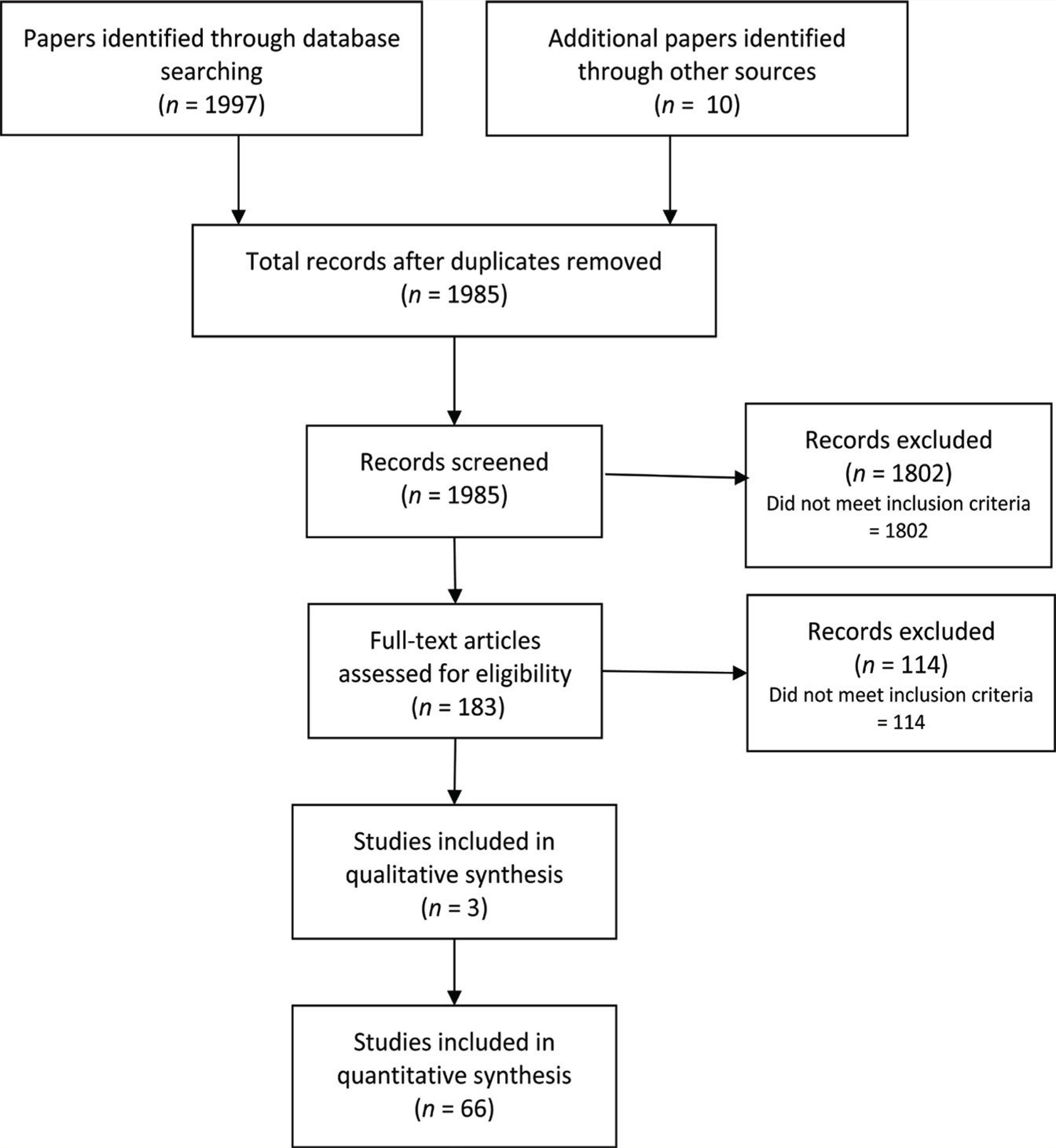
We used a 10-year time frame for two reasons: (a) this is the time frame usually used in similar reviews 43 and (b) the PIU became a critical concern around the globe in this period. A total of 1997 papers were identified from the initial search, 10 additional papers were identified by reference list search, and 22 duplicates were removed. Title and abstract screening were conducted for relevance and excluded 1802 papers. The team scrutinized the papers for quality based on the COPE guidelines on quality publication, 49 and 69 papers that fulfilled the quality criteria were selected for data extraction (Figure 1). One of the team members (AN) extracted data using a standardized checklist, and the second author did the second-level scrutiny for accuracy (NMT). The disagreements were resolved by consensus or discussion with other authors.
Preferred Reporting Items for Systematic Reviews and Meta-Analyses Flowchart.
Data Extraction and Synthesis
The extracted data were entered into a Microsoft Excel file, including the details of authors, journal, aims, methods, study design, sample size, sample description, relevant outcome data, and main findings (e.g., PUI measurement, family factors). The emerging themes were coded and organized under global themes to conclude the overarching themes across various papers.
Results
Characteristics of Included Studies
Among the 183 reviewed papers, 69 papers50–118 aligned with the set eligibility criteria (Figure 1). Fifty-nine were cross-sectional studies,52–57, 59, 60, 62–74,77–83,85,87–91,93–106,108–118 eight were longitudinal studies,50, 58, 61, 76, 84, 86, 92, 107 and two were prospective cohort studies.51, 75 Sixty-four were quantitative,50–83, 85–102,104–113 three were qualitative,116–118 and two were mixed-method84, 103 studies. The majority of the studies were conducted in Asian countries such as China,56, 65, 68–70, 78, 85, 86, 87–90,91,93–94,97,98,105,109 Hong Kong,50, 52, 61, 66,74,82,84 South Korea,57, 71, 75, 80, 83, 96, 106, 113 Taiwan,51, 55, 76, 79, 104, 112 Malaysia, 59 India,101, 111 and Singapore. 92 Other studies were conducted in countries such as the United States,100, 108 Italy,64, 72, 77 France, 73 Germany, 81 Poland, 115 Belgium,116, 118 Czech Republic, 117 Turkey,63, 67, 99, 103 Netherlands, 58 Spain,95, 110 Greece,54, 62, 72, 114 Portugal, 102 and Slovakia. 60 Two were multi-country studies.53, 95 The extracted data are summarized in online-only supplementary tables (Table S1: Summary of the characteristics of the studies on PIU; Table S2: Summary of the characteristics of the studies on POG; Table S3: Summary of the characteristics of the studies on PSMU; Table S4: Summary of the characteristics of the studies on PSU).
Fifty studies reported data about PIU,50–57, 59–63,65–70,72,74,76–80,82,83,85,87–89,91,94,95,97–104,109–112,114,116,117 12 studies about POG,58, 73, 75, 81,84,86,90,92,98,106,107,115 three about PSMU,58, 64, 118 and seven about PSU.57, 71, 93, 96, 105, 108, 113 Fifty-four studies were conducted among children with PUI,50–52, 55, 56, 58–70,72,73,75,11–80,83,85–99,101,102,104–107,109–115,117,118 three among parents of children with PUI,57, 108, 116 and 12 among parent–child dyads.53, 54, 74, 76, 81, 82, 84, 100,103 Study sites were schools, households, communities, clinics, and social media sites, and one study failed to mention the study site. Data were collected in different modes such as self-administered questionnaires in paper and pencil method, online survey, computer-based survey, face-to-face interviewing, observation, case study, and focused group discussion.
The thematic analysis of our findings revealed that family factors are closely associated with PUI in children and adolescents, along with the demographic and psychosocial correlates. The results, however, were heterogeneous (Tables S1–S4).
Family Factors Associated with PUI in Children
The family factors associated with PUI in children were classified as: parenting correlates, parental mental health correlates, and intrafamilial demographic correlates.
Parenting Correlates
These include parenting styles/parental rearing styles, parenting patterns, parental attitudes, internet parenting styles, parental mediation, parental bonding, parent–child relationship, parent–child attachment, parental control, parent–child communication, interparental conflict and parent–child conflict, parental monitoring, family functioning, parental norms, parental supervision, parental involvement with child computer use, parental neglect, child maltreatment, and family dysfunction. Studies have identified positive association of PUI in children with parenting factors such as parenting styles with poor warmth and excessive control,52, 55, 57, 76, 85, 94, 98, 103, 104, 110 poor parent–child communication, 60 poor parent–child attachment,50, 55, 59, 61, 63–65, 70, 72, 76, 77, 79, 86, 90,92,93,97,100,106,109,115 restrictive mediation of internet use,53, 58, 66, 79, 95, 100, 105, 108, 113, 116–118 poor parent–child bonding,54, 59, 62, 84, 101, 114 higher/poor parental control,50, 56, 61, 102 paternal behavioral control,56, 102 maternal psychological control,56, 61 increased interparental conflict,51, 66, 73, 75, 78, 91, 97 excessive/poor parental monitoring,59, 60, 67, 69, 100,106 family dysfunction,51, 66, 71, 73, 76, 88, 89 absurd parental norms,95, 116, 118 parental neglect, 96 inadequate parental supervision,59, 67, 69, 100, 106 perceived poor father–adolescent relationship poor family support,86, 87 overprotection, 60 and child maltreatment. 112
Parental Mental Health Correlates
These include the status of parental mental health or the presence of mental illness in parents. Studies have identified a positive association of PUI in children with parental mental health issues like depression 80 and anxiety,81, 83 addictive behaviors such as alcoholism,51, 83 smoking, 51 PUI,57, 75 and parental phubbing. 105 Parental access to internet51, 111 and parental online security practices 54 have been found to be inversely related to PUI in children. Parental respect for children’s privacy 59 and parental internet literacy 107 were also significant predictors of PUI in children.
Intrafamilial Demographic Correlates
These include major demographic characteristics related to family or parents such as parental education, parent marital status or family intactness, parental occupation and working status, family composition, single-child status, household income, family socioeconomic status, parental economic activities, parental gender, and parental internet literacy. Poor parental literacy, 80 single parenting,51, 66, 89 fragmented family,51, 66, 71 both parents working,59, 67, 101 poor or increased household income,7, 63, 66, 68, 6, 71, 80, 96, 100 and poor parental internet literacy 79 are positively associated with PUI in children. Being a single child66, 73, 111 and having poor paternal parenting 68 are also positively associated with PUI in children.
Psychosocial Correlates
The psychosocial factors in the selected studies as mediators and moderators of relationship between family factors and PUI in children are self-control56, 71, 87, 96; emotion regulation65, 67, 72; stressful life events 65 ; friendship quality71, 111; callous-unemotional traits 72 ; life satisfaction 74 ; self-esteem75, 79, 83, 88; social function76, 109; cyberbullying victimization or perpetrations 79 ; academic achievement stress 81 ; well-being 102 ; social sensitivity 89 ; adverse childhood experiences90, 115; emotional insecurity 91 ; personality traits91, 98; conscientiousness 94 ; social problems 80 ; peer attachment77, 78, 107; school connectedness 86 ; deviant peer affiliation86, 89; teacher support 94 ; relational maladjustment at school 96 ; sensation seeking 100 ; psychological disorders like alexithymia,63, 67 mood disorders,67, 106 depression,78, 79, 80, 83, 96 anxiety,78, 80, 83, 11 substance abuse, 79 schizophrenia, 67 hyperactivity-impulsivity, 70 post-traumatic stress disorder (PTSD), 112 and stress74, 85; psychological symptoms like attention-deficit/hyperactivity disorder (ADHD) symptoms,76, 80 dissociation symptoms,90, 115 autistic traits, 76 aggression,80, 83 delinquency, 80 impulsivity, 100 sadness, 114 loneliness,88, 132 escape from self, 106 and real-ideal self-discrepancy 106 ; and child health behaviors such as sleeping time 102 and lifestyle habits. 102
Demographic Correlates
Demographic correlates of PUI in children in the selected studies are gender, age, urban living, and school grade. Male gender,55, 58, 64, 76, 80, 81, 99 adolescent age group,50–115 and urban living52, 71, 74, 79, 82, 100, 115 were found positively associated with PUI. Majority of the studies have been conducted among students in Grades 7 to 12.61, 64, 67, 68, 70, 79, 83, 85, 88, 96, 103, 106, 109, 110, 111, 115
Further Findings from Studies
Other factors identified in the studies as associated with PUI in children are poor academic and non-academic school performance and goals,54, 62, 79, 83, 109, 113 poor academic achievement,71, 96 the prior participation in preventive education for smartphone use disorder, 71 negative behavioral attitude, and poor intention toward self-control of mobile phone use 106 and motives for participating in social networks 62 such as lesser real-life friendships, interest in virtual friendship, narcissistic involvement, and escapism.
Discussion
To our knowledge, this is the first review addressing family factors associated with PUI in children that covered all types of PUI and internet-accessing devices such as PIU, POG, PSMU, and PSU. We found 69 papers that documented family factors associated with PUI in children across the globe. A consistent finding of the review was that problems in one or more familial and parental variables are associated with increased severity of PUI in children. The majority of the studies emphasized the roles of parenting styles, parent–child attachment, parental mediation, parental bonding, family functioning, and the parent–child relationship in child and adolescent PUI.
This review shows that problems in parenting can increase the risk of PUI in multiple ways. Familial and parental variables, such as inadequate family functioning,51, 66, 71, 73, 76, 83, 88, 89 poor parent–child relationship,55, 65, 68, 86, 101, 106 high parental control,50, 51 more parent–child conflict,51, 65, 66 higher/poor parental restriction,51, 54, 57, 58 lack of parental monitoring of media use,60, 69, 100, 109 and parents’ marital issues51, 75, 78, 91, 97 were positively associated with PUI in children. Parental monitoring, interparental conflicts, and parental behavioral addictions were documented only infrequently in these papers. This review found that bidirectional linkages also exist between parenting factors and PUI, keeping with data from other reviews in this area. The importance of family factors like parenting correlates, parental mental health correlates, and intrafamilial demographic correlates and the demographic, psychosocial, and behavioral correlates of PUI in children have been highlighted in this review. The current review findings are congruent with the results of previously published reviews that focused on the family factors related to adolescent internet addiction, problematic online gaming, and problematic online screen use.36–38, 43, 44
The evidence base from this scoping review on the family factors associated with PUI in children is predominantly based on East Asian experiences,50–53, 55–57,61,65,66,68–71,74–76,78–80,82–89,91, 93,94,96–98,104–106,109,112,113 and it is likely that the family dynamics and the parental responses to PUI in children vary across regions. This review highlights the need for further research in the study area in different cultural contexts around the globe. It also underlines the need for families to be involved in interventions for adolescents having symptoms of PUI. Overall, this review found a dearth of in-depth research on family factors associated with PUI in children, especially the newly emerging problems such as problematic online gaming, problematic use of social media, and smartphones. Further research is needed to confirm the tentative findings of this review that family factors are etiologically linked to PUI in children. In particular, studies exploring the clustering of significant family factors occurring within individuals, families, and communities are required to understand the barriers of effective management of PUI in children. This understanding will assist the development and targeting of interventions in population subgroups which may help manage PUI risks more effectively and reduce morbidity.
Strengths and Limitations
This scoping review is the first to examine significant family factors associated with all types of PUI, such as PIU, POG, PSMU, and PSU in children. This review was conducted according to the PRISMA-ScR guidelines, and the eligibility criteria were rigorously applied. Two researchers independently used the inclusion criteria, and the research team made the final decision about the included papers. The family factors documented in this review associated with PUI in children may provide a useful reference for further empirical research.
This review also has some limitations that warrant acknowledgment. We have extracted papers from nine major databases and possibly missed a few significant pieces of information from other databases. Another limitation of our study was the focus on only peer-reviewed studies and the exclusion of research reported in the grey literature. Studies not published in English were also excluded. This study is a scoping review rather than a full systematic review of the empirical findings, though the extent of the literature would make the latter rather difficult. However, this evidence would guide the future researchers to decide on customizing the individual and family-based services for PUI in children.
Conclusion
This review found significant family factors that are associated with PUI in children. These include parenting correlates, parental mental health correlates, and intrafamilial demographic correlates. This review found that the majority of the studies on family factors associated with PUI in children did not collect data from parents but relied on children’s perception of family dynamics and their internet usage. Most of the evidence collected was from cross- sectional studies, which cannot establish causal relationships. The review findings suggest the need for more prospective studies among both parents and children to understand the causality between these familial factors and PUI in children. Such studies will further throw insight into the development of more effective intervention strategies in addressing PUI in children.
Supplemental Material
Supplemental material for this article is available online.
Footnotes
Declaration of Conflicting Interests
All authors have completed the ICMJE uniform disclosure form at
Funding
This scoping review is part of the first author’s ongoing PhD research, which is being supported by the Junior Research Fellowship scheme of University Grants Commission of India (UGC-JRF).
References
Supplementary Material
Please find the following supplemental material available below.
For Open Access articles published under a Creative Commons License, all supplemental material carries the same license as the article it is associated with.
For non-Open Access articles published, all supplemental material carries a non-exclusive license, and permission requests for re-use of supplemental material or any part of supplemental material shall be sent directly to the copyright owner as specified in the copyright notice associated with the article.
