



Abstract
Background:
A community participation initiative of stitching personal protective equipment (PPE), masks, and face shields for healthcare professionals working in the hospital during the COVID-19 pandemic was conducted using a case study design.
Methods:
The hospital tailoring unit was used to cater to the in-house demand for stitching safety gear kits for healthcare professionals. A transect walk was conducted to survey hospitals for selecting material for stitching the safety gears and to draw up a plan to meet future demand. The psychiatric social worker induced a community participatory initiative using the method of social work of community organization. A flyer was prepared to invite participants with prior experience in tailoring for this initiative. All participants were trained by the master trainers of the tailoring unit. The participants were also interviewed about their views on this initiative in an informal interview.
Results:
A total of 83 participants, including 26 individuals (8 volunteers and 18 who received an honorarium), 2 boutiques (n = 12), and 1 government organization, participated in the activity (n = 45). A total of 1700 complete PPE kits and 13,000 masks were stitched during this period. The participants reported that the benefit of being a part of this initiative was reduced boredom, sense of purpose and satisfaction, and improved mental health due to structured activity.
Conclusions:
A community participation initiative using the principles of community organization, a method of social work, can help produce desired outputs and improve the well-being of the participants.
A community participation initiative can help produce desired outputs (in products or services) during COVID-19 pandemic. A community participation initiative can help improve the economic and psychological well-being of the participants during COVID-19 pandemic. Volunteering for a larger social cause (i.e., stitching PPE) during the pandemic helps regain one’s lost personal value and inspires others to continue to make an impact.Key Messages:
The COVID-19 pandemic has had a huge economic fallout for the working class, entrepreneurs, industries, and commerce.1,2 The Centre for Monitoring Indian Economy 3 data show that the unemployment rate rose from 7.76% in February, a month before the Indian government implemented lockdown, to 23.5% during March 26, 2020–May 31, 2020 (period of national lockdown in India). Data have shown that job loss was more considerable in occupations that require more interpersonal contact and that cannot be performed remotely.2,4 Especially, the informal employment sector, such as tailors, merchants, and migrant workers, faced challenges in earning a living and maintaining their livelihood. Loss of job was also attached to significant psychological distress about the present situation and the stress of the job search process in the future. 5
Apart from the economic burden of job loss, the working class also had to come to terms with boredom and lack of daily routine due to job loss. 6 One of the purposes of everyday life, of going for a job to earn a living and occupying oneself, was lost in the pandemic. Volunteerism helped regain this lost personal value “by enabling one to inspire others to continue to make an impact.”7-9 The Chinese model provides insight into the important role of volunteerism and coproduction in China’s response to the pandemic. 8
The National Institute of Mental Health and Neurosciences (NIMHANS) is a tertiary care hospital providing mental health, neurological, and neurosurgical care to clients across the country. Being a Government hospital, it caters to mostly the middle and lower sections of society who could afford the subsidized-but-quality treatment provided at the hospital. The Psychiatric Rehabilitation Services (PRS) of NIMHANS has a dedicated tailoring section as part of its vocational rehabilitation program for clients with mental health disorders. As the day-boarder services were closed due to the COVID lockdown, the tailoring section was used to meet the growing demand for stitching personal protective equipment (PPE), masks, and face shields for healthcare professionals working in the hospital. The current article is a case study of a community participation initiative started in the tailoring section of NIMHANS and the positive impact it had in producing the desired output and in the psychosocial rehabilitation of those who participated in this service.
Materials and Methods
Process of the study
As the Government of India consignment of safety gear for healthcare professionals working at NIMHANS could not be delivered due to total lockdown and lack of transportation facilities from March 26, 2020 to May 31, 2020, the internal resource of the hospital—a Tailoring Unit with 14 tailoring machines—was metamorphized from being a vocational rehabilitation unit for clients with mental disorders to a full-scale tailoring unit to cater to the demands of stitching safety gear kits (PPE, masks, and face-shields) for the healthcare professionals of the hospital. Furthermore, due to the surge in COVID-19 positive cases in India and depletion of state supplies of safety gear kits, this in-house initiative was considered to be of utmost importance for the safety of the healthcare professionals working in the hospital during the COVID-19 pandemic.
Keeping in mind the emergency nature of this need (time factor) and the inherent growing demand at NIMHANS, which could not be met from the market (shops closed) or state due to the lockdown, the psychiatric social worker working with the PRS induced a community participation initiative using the social work method of community participation. 9 A transect walk (a method of community development in social work) 10 was conducted, where the social worker systematically walked (followed up) along a defined path (transect), surveying hospitals across the community (Bengaluru), together with the local people, to explore where the material for stitching the safety gears could be procured in the pandemic condition and to draw up a plan (transect diagram) for a continuous supply of material to meet future demand. Post the survey, a neighborhood hospital was contacted to finalize the material quality and vendor (who was close to the hospital and could supply during lockdown) and procure training on stitching the safety gear kits. Two staff members from the PRS tailoring section were provided training by the neighborhood hospital in stitching the safety gears (cutting, tapping, and double stitching). These two staff members were then used as master trainers to train others who participated in this initiative.
A flyer was prepared to invite participants of all age groups, with prior experience in tailoring, to volunteer for this initiative, via social media and word of mouth. As there was no employment during the lockdown, the administration of NIMHANS agreed to pay an honorarium of 30 Indian Rupees (INR) per piece of PPE, 10 INR per piece of mask, and 15 INR per piece of hood stitched to tailors who were interested in participating in this initiative to support their families financially.
Study Design
All participants were divided into batches and trained for three days by the master trainers of the tailoring unit of PRS. The training was carried out with norms such as social distancing, safety measures, and prevention strategies. The authors facilitated honorarium, tea/snacks, and travel pass during the lockdown, for the participants, in liaison with hospital administration. The participants were also interviewed about their views about this initiative in an informal interview.
Ethical Consideration
Informed consent was taken from all the participants to be a part of this activity and for the publication of their views about this initiative in the form of an article in a scientific journal. This case study was exempted from ethical review retrospectively by the Institute Ethics Committee of NIMHANS because it was a service program, a case study with healthy participants that elicited only informal feedback from the participants.
Results
A total of 83 participants, including 26 individuals (8 volunteers and 18 who received an honorarium), 2 boutiques (n = 12), and 1 government organization participated in the activity (n = 45) from March 28, 2020 for 74 days. Four participants worked at PRS tailoring section and the remaining worked from their homes/organizations, with all the safety measures. The mean (SD) age of the participants was 39.92 (8.22) years, with a mean education level of 12.11 (3.22) years, and 42 (50.61%) of them were females. The majority of them, i.e., 77 (92.8%), were tailors by profession, 3 (3.6%) were medical professionals, and 3 (3.6%) of them were homemakers. One-third of the participants belonged to the below poverty line [31 (37.35%)] category.
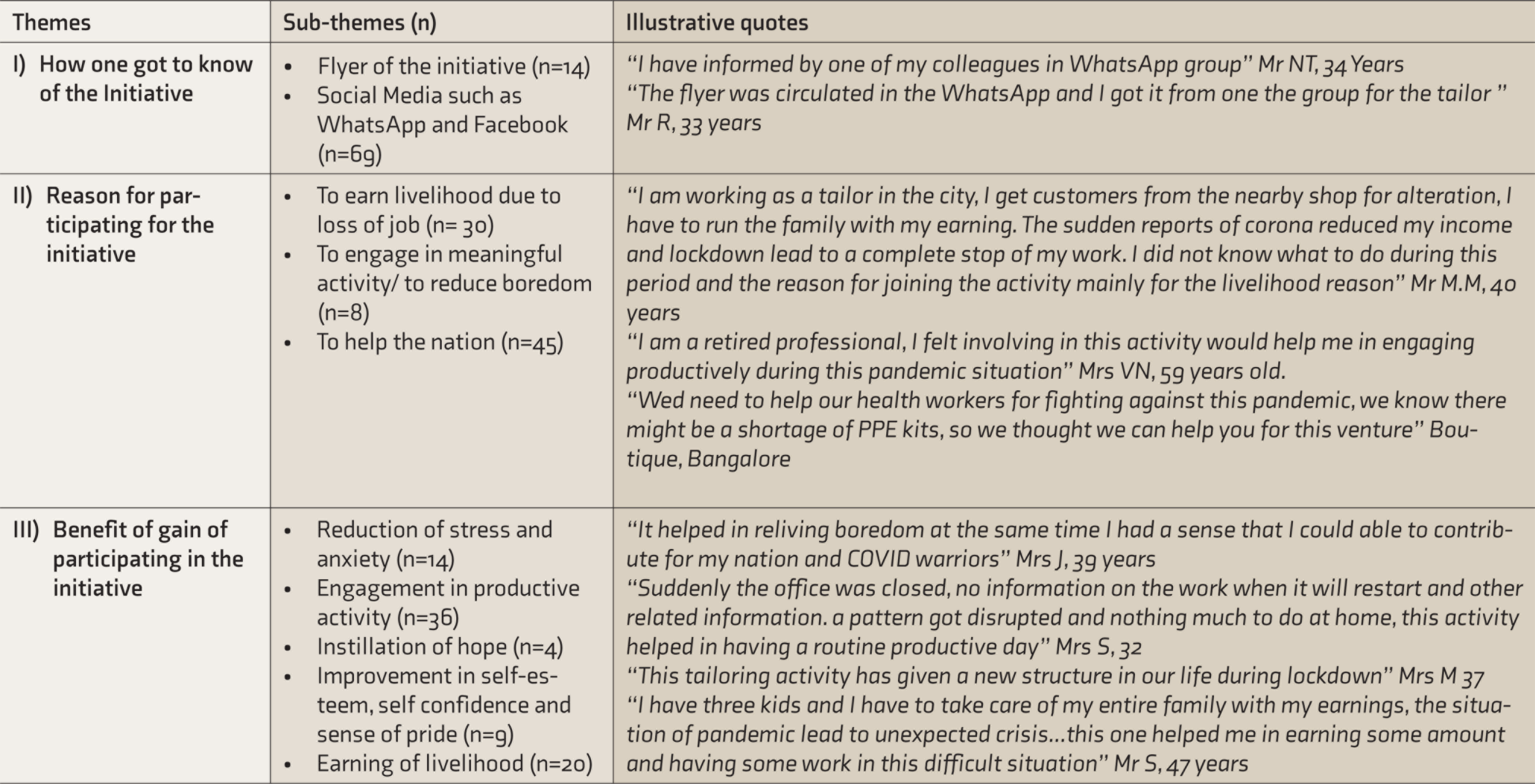
A total of 1700 complete PPE kits (suits and hoods separately) and 13,000 masks were stitched during this period. The finished PPE kits were sanitized and stored with the help of administration. The participants reported that (a) they received information to participate in this initiative via social media; (b) some participated because they wanted to contribute to a social cause during the pandemic and others looked at this initiative as an opportunity to earn the honorarium to sustain their household expenses; and (c) outcomes of participating in this initiative were reduced boredom, a sense of purpose and satisfaction, and improved mental health due to structured activity. The participants’ quotes and the themes that were elicited during the interviews are tabulated in Table 1.
Qualitative data (Themes, sub-themes and quotes; n=83)
Discussion
One of the main reasons for the success of this initiative was “Community participation.” Participants came out in large numbers to contribute their skills to a cause— some with self-less attitude to serve and others with a need to earn. However, the underlying principles of community participation, such as planning and preparation (through initial training), inclusion and demographic diversity (as observed in the socio-demographic details of the volunteers), collaboration and shared purpose (of stitching healthcare kits), openness and learning (by the volunteers), transparency and trust (among the participants and trainers), and sustained engagement and participatory culture (working together for one goal) helped lead to desired action (of successfully running the tailoring unit even on holidays during the lockdown period) and impact (producing desired number of health kits in limited period). 11
The other important characteristic of this initiative was the aspect of ‘volunteerism.’ Although some of the participants were provided an honorarium, the initiation was from their side to participate in this initiative. Data have shown that volunteering is a legitimate way to participate in the activities of society 7 —for a social cause, common goal, etc. The common goal in this initiative was stitching of PPE, and it addressed a social cause of helping healthcare professionals who were providing their services during the pandemic. The participants’ qualitative feedback also reiterated that engaging in this initiative helped improve their self-esteem, self-confidence, and sense of pride—of contributing to a larger good (social cause). The PRS’ past experience of engaging volunteers had shown that they are enthusiastic about getting enrolled in volunteering activities and that they come up with varied ideas on how they can be utilized, i.e., for marketing products, helping clients write up resumes for job interviews, and conducting social events, recreation activities, etc. 12 This initiative’s success shows that volunteers can be mobilized as effective resources with prior training, even in crisis situations, especially in teams where there is a paucity of skilled rehabilitation professionals.
The dual outcomes of (a) gaining a sense of purpose and (b) earning a small honorarium to support the family in the event of job loss and lockdown seemed to be the attractive aspect for the success and sustenance of this initiative. Various studies had stated the relationship between vocation and positive mental health. 13 Besides, studies have also found a positive correlation between vocational activity and reduction in burnout, stress, and boredom.14,15
Conclusion
This initiative has shown that a community participation initiative using the principles of community organization, a method of social work, can help produce desired outputs and improve the well-being of the participants. The success of such models in a pandemic situation gives us hope that it can be translated successfully even in post-COVID era if weaved in with a shared sense of purpose.
Footnotes
Declaration of Conflicting Interests
The authors declared no potential conflicts of interest with respect to the research, authorship, and/or publication of this article.
Funding
The authors received no financial support for the research, authorship, and/or publication of this article.