




Abstract
Background:
COVID-19 has a profound impact on people with existing mental disorders, augmenting the prevailing inequalities in mental health.
Methods:
In order to understand the status of telepsychiatry in India and the role of artificial intelligence (AI) in mental health and its potential applications, a scoping review was done between March 2020 and May 2020. The literature review revealed 253 papers, which were used to derive the primary framework for analysis. The information was then reviewed for ideas and concepts, which were integrated with evidence from gray literature and categorized under broader themes based on the insights derived. Finally, a thematic framework was developed for discussion to tailor scientific information for decision-makers’ needs.
Results:
Review findings are summarized under the following headings: changing patterns of health-seeking behavior, origin and evolution of telepsychiatry, possible applications of telepsychiatry and AI, technological features, and AI models in mental health.
Conclusions:
Though there are several potential opportunities, the time is not yet ripe for telepsychiatry and AI to be adopted fully in the field of mental health care. But it is time that we develop indigenous proprietary technology and test and validate it. With many solutions offered by telepsychiatry and AI, psychiatrists must choose an appropriate tool based on their requirements, availability of resources, and feasibility of deployment. Harmony between conventional care and technology-based care must be reached gradually.
Telepsychiatry equipped with artificial intelligence can be effectively deployed to address the shortage of psychiatrists and the urban–rural gap in providing mental health services. The technology must be indigenous and validated for use in India.Key Messages:
COVID-19 has a profound impact on people with existing mental disorders, augmenting the prevailing inequalities in mental health. 4 Studies show that pandemics cause stress disorders, as seen in SARS. 5 COVID-19 is, therefore, expected to cause an increased incidence of mental disorders of varying severities in the future. 6 Isolation and quarantine for longer periods, due to COVID-19, are known to precipitate depression and anxiety.7, 8 Also, social distancing leading to an alteration in routine and livelihood results in frustration, stress, boredom, low mood, and depression, while fear of contagion leads to anxiety.9, 10 There might also be a cancelation of psychiatry services, deeming them as nonessential. 11 All these factors related to COVID-19 may exacerbate the existing barriers and challenges posed by stigma, traditional and religious beliefs, sociocultural factors, low literacy, unavailability of services, and discrimination associated with mental illness.12, 13 These factors can aggravate the existing mental illness and also increase the incidence of mental disorders. There is a possibility of a higher incidence of post-traumatic stress disorder (PTSD) during and after the pandemic.14–16 The voluminous burden of mental health issues makes it practically difficult to address this singularly at the level of psychiatrists alone or to use the traditional approaches. 17
These challenges pose several questions; how can these issues be handled with the existing infrastructure and mental health care spending? Can we look forward to any technology to help bridge the supply–demand gap? Will technology help in enhancing psychiatry clinical practice, ensuring the standards of clinical care and social distancing? Can we experiment with artificial intelligence (AI) enabled telepsychiatry when social distancing, isolation, lockdown, and quarantine are in place? If the model is successful, can it be used for future interventions? What is the common ground where psychiatrists collaborate with technology experts? What is the information that a psychiatrist needs in order to collaborate with a technology expert and vice versa?
We may be already having the answers to these questions. Most of the time, the necessary technology is present in a form unfamiliar to a psychiatrist, one of the reasons being the lack of an interdisciplinary approach to problem-solving in medicine. Technology experts too find it hard to understand the gaps from a psychiatrist’s perspective. They find it hard to identify the issues (to create solutions), whereas psychiatrists find it hard to understand what type of technology exists.18–22 Another potential challenge is that technology-related information is mostly present in gray literature and nonmedical academic literature more than the medical academic sources, which further increases the information gap. 23 Any psychiatrist who wants to use technology to address problems in psychiatry must rely on nonacademic sources of knowledge. Therefore, a traditional systematic review of literature cannot be attempted.
An alternate approach to synthesize evidence for policy and practice is to perform a scoping review. 24 In order to synthesize knowledge on telepsychiatry in India, the role of AI in mental health, and its potential applications in psychiatry clinical practice, the following scoping review was done.
Materials and Methods
Between March 2020 and May 2020, a scoping review, using the PRISMA-ScR (Preferred Reporting Items for Systematic reviews and Meta-Analyses extension for Scoping Reviews) guidelines, was done by the two authors in the published literature (Medline, PsycINFO, and Web of Science; for academic knowledge) and gray literature (for nonacademic knowledge and evidence).25–27 Many research questions were framed for the study ( How has technology in telepsychiatry evolved in India in the last two decades? What are the various ways to use artificial intelligence (AI) in psychiatry? What are the various technological features that can be used in telepsychiatry with AI? What are the possible applications of AI-enabled telepsychiatry in India? How can AI be integrated with telepsychiatry? What is the must-have knowledge for a psychiatrist who wishes to use technology to address problems in psychiatry or to collaborate with technology experts? What are the solutions that can be developed indigenously for having AI-enabled telepsychiatry in India? How does the current pandemic offer a situational advantage to design, develop, and deploy such technology? (situational perspective)Research Questions That Were Used to Guide the Review
Initially, two reviewers independently identified peer-reviewed articles published in English between 2000 and 2020. Articles on telepsychiatry were chosen only from Indian studies, which primarily discussed the design of the telepsychiatry model. On the other hand, peer-reviewed articles on AI in mental health were chosen primarily from western literature, to understand the growth and potential of the technology. Articles that did not give any new insight were removed for the sake of conciseness.
After the removal of duplicates, 253 papers were analyzed using the grounded theory approach and the constant comparative method.
28
Knowledge was retrieved from these articles as concepts. The concepts were categorized under different preexisting themes (origin and evolution of telepsychiatry in India from a design perspective, possible applications of telepsychiatry and AI, and technological features of AI-enabled telepsychiatry). Secondary qualitative analysis of the retrieved information yielded new themes (changing patterns of health-seeking behavior and AI/machine learning/deep learning models in mental health). A thematic framework was developed, which was used to integrate evidence and knowledge from gray literature.
29
The final synthesis of knowledge from the themes was done.
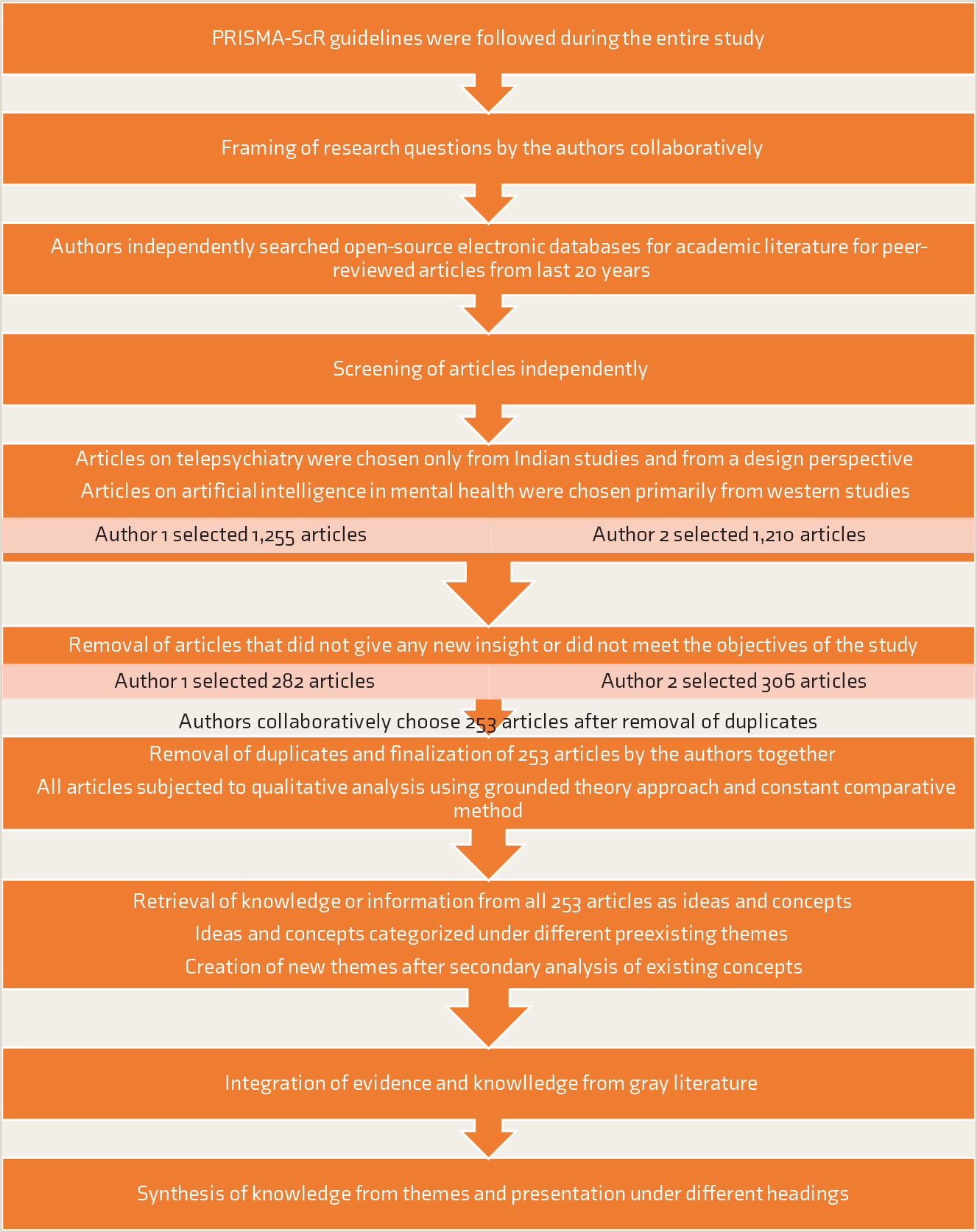
PRISMA-ScR: Preferred Reporting Items for Systematic reviews and Meta-Analyses extension for Scoping Reviews.
Results
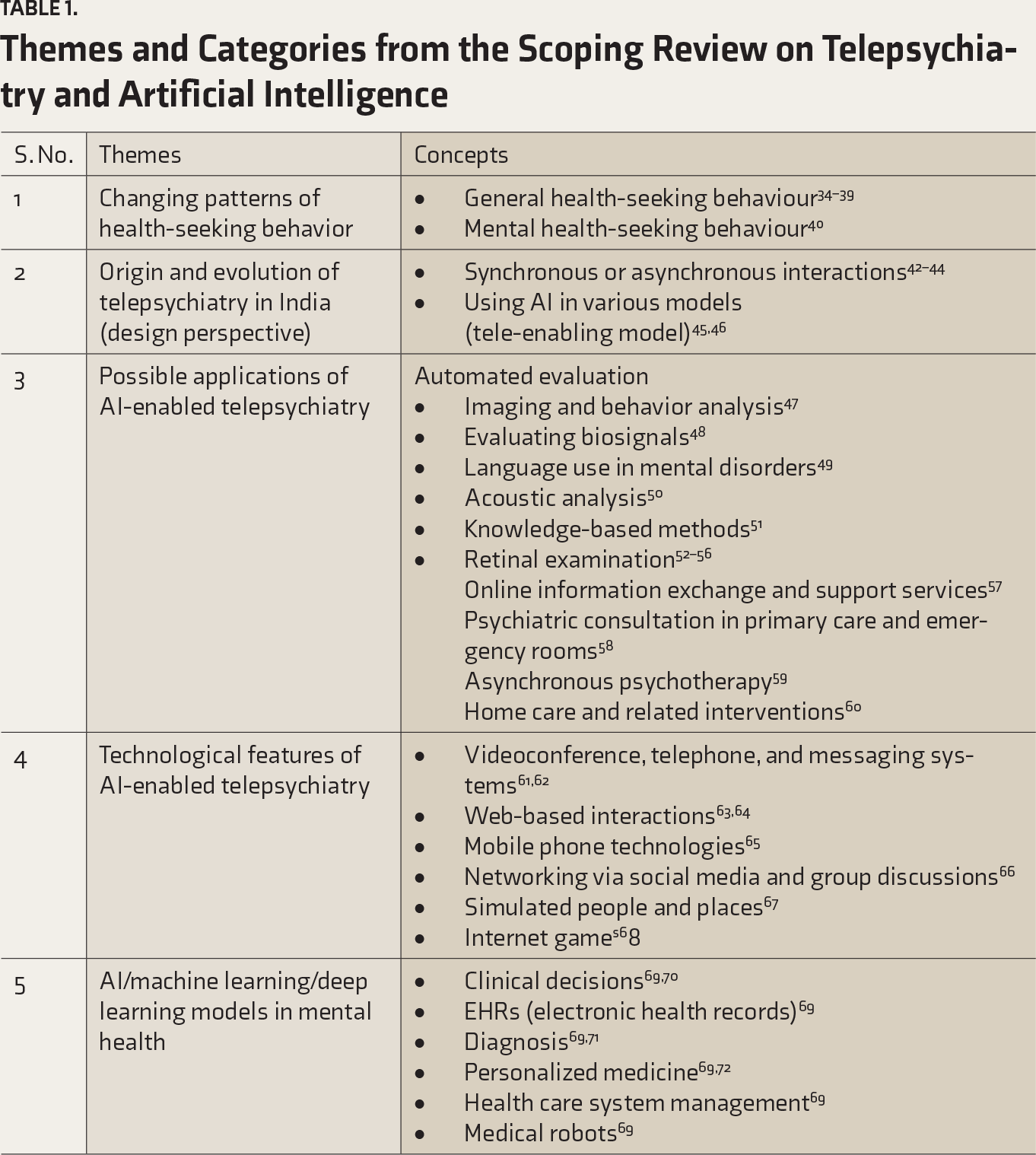
Themes and Categories from the Scoping Review on Telepsychiatry and Artificial Intelligence
Discussion
The pandemic COVID-19 has put an extraordinary burden on the existing health care resources. 30 For psychiatry, this has widened the already existing gap between the mental health seekers and providers. 31 Considering the fact that it will take a while for the pandemic to reduce or a cure to be found, we must find alternate strategies for providing mental health care. 32 AI-enabled telepsychiatry, therefore, may be an option at present and in the future. 33
The technology used in telepsychiatry in India has evolved from a simple synchronous teleconsultation model using video conferencing, telephone, online chatrooms, etc., to the deployment of asynchronous models using AI-enabled telepsychiatry. AI in mental health has enabled automated evaluation of various clinical parameters. There are several ways the potential of AI can be leveraged in telepsychiatry, ranging from web-based interactions to internet games. The following section explains the must-have knowledge for a psychiatrist to work with a technology expert and vice versa. The current pandemic is the best time to collaborate, design, develop, deploy, and validate AI-based telepsychiatry models. These models can be used during the COVID-19 situation as well as repurposed for routine primary care post COVID-19. Therefore, the following section discusses the key findings with potential applications in COVID-19 times and beyond.
Changing Patterns of Health-Seeking Behavior
Initially found as a secondary insight from the review, changing patterns of health-seeking behavior is an important factor that determines the uptake and scaling of telemental health: Studies show that people are increasingly using the internet for seeking help for various health-related issues, which enable the users to gain more knowledge on any health condition.34–36 There are several benefits, like being free of cost, 37 better privacy, 38 and the potential for anonymity. 39 This is especially true for mental health-seeking behavior where people are turning to online social platforms and other resources for mental health and are more comfortable seeking mental health-related information online than in person. 40 The present generation is increasingly seeking online help for health issues than the previous generation, though disparities exist in the quality of care sought. 41 The current generation of millennials, which will be the youth of the next decade, is known to be digitally active and friendly. The uptake of online services will, therefore, increase in the coming decades, thereby leading to a large number of people turning to e-mental health than conventional care. In the extraordinary times of the pandemic, where social distancing and no contact interactions are encouraged, this behavior should be understood and encouraged by the practicing psychiatrists. At present, urban people are favorably positioned to access this type of service than the rural population. But considering the increasing digital and technology penetration, the percentage of people using online mental health services will increase substantially even in rural areas. Developing countries like India would benefit more from such initiatives than the developed nations that already have a good doctor to patient ratio. Therefore, a practicing psychiatrist should look for ways to accommodate this online health-seeking behavior of their patients in their regular practice, beginning from the current pandemic, into the future.
Origin and Evolution of Telepsychiatry (Design Perspective)
In India, along with the changing patterns of health-seeking behavior, the technology associated with health has also gradually evolved from being a simple teleconsultation model using video conferencing, telephone, online chatrooms, etc., to the deployment of asynchronous models using AI. 42 Synchronous telepsychiatry models were successfully implemented in India during the tsunami of 2004 from fixed establishments, which later evolved into mobile telepsychiatry units.27, 28 Asynchronous models were known to have limited feasibility, 43 but with improved access, lower costs, and as a supplement to the existing care. 44 Studies globally show that digital technology coupled with AI, known as the “tele-enabling model,” can be used to leverage the potential of medical informatics in conventional telepsychiatry. 45 AI is being effectively utilized for patient monitoring, health care information technology, intelligent assistance diagnosis, and information analysis collaboration. 46 With the current growth trajectory, the technology associated with telemedicine is bound to increase and also service uptake will improve with better penetration of technology. The current model will evolve to become stable enough for large-scale deployment. Therefore, it is essential to develop a model that is based on telepsychiatry integrated with features of AI with better ease of use. Psychiatrists must become familiar with such models. During COVID-19, psychiatrists, with the help of technology experts, can try developing such models for communicating with their existing and new clientele. In the future, the models might migrate toward augmented reality/virtual reality (AR/VR). There are also various telepsychiatry services for academic purposes in India, which is beyond the scope of this article.
Possible Applications of Telepsychiatry and AI
Studies show that telepsychiatry and AI can be effectively deployed for automated evaluation, namely imaging and behavior analysis, 47 evaluating biosignals, 48 assessing language use in mental disorders, 49 acoustic analysis, 50 knowledge-based methods, 51 and retinal examination.52–56 Other potential uses include online information exchange and support services using social media and networking, 57 psychiatric consultation in primary care and emergency rooms, 58 and asynchronous psychotherapy. 59 Home care and related interventions for the geriatric population are also possible using technology. 60 All these possible applications help in collecting as much data as possible for making effective clinical decisions by the psychiatrist. The availability of temporal data that has been effectively summarized using AI can be a potential tool for psychiatrists in clinical decision making. Any psychiatrist relies on data for making clinical decisions. This type of big data with temporal characteristics analyzed using AI will be an effective tool for diagnosis, follow-up, and monitoring of patients. Psychiatrists will have meaningful data to enhance their clinical decisions. But, with no uniform data collection pattern, this type of automated evaluation is not possible immediately or in the near future. Yet, it is time that ethical guidelines on alternate data collection practices are encouraged in psychiatry.
Technological Attributes of Telepsychiatry and AI
Technological features include videoconference, telephone, and messaging systems,61, 62 web-based interactions,63, 64 mobile phone technologies, 65 networking via social media and group discussions, 66 simulated people and places, 67 and internet games. 68 The technology aspect of telepsychiatry has been experimented on a small scale in different cultural settings.63, 64, 67, 68 Any large-scale implementation requires more validation studies. Institutions that focus on mental health should encourage experimenting with these technologies during this pandemic. Personal interactions with patients revealed that patients are also willing to experiment with telepsychiatry, due to the social distancing norms during this pandemic. The learning from these experiments should inform future decisions in AI-enabled telepsychiatry.
Specific AI/Machine Learning/Deep Learning Models in Mental Health 69
Specific models of AI in mental health can be used for clinical decisions, electronic health records (EHR), diagnosis, personalized medicine, health care system management, and medical robots. These models can help reduce the need for human resources, reduce costs, and improve the efficiency of time. A large number of patients can be seen in a shorter duration. In addition, a single psychiatrist can consult a large number of patients by using triaging models for prioritizing patients and effectively reduce the time needed for history taking. This will enable the psychiatrist to spend more time talking to the patient than collecting data. However, the models have to be robust enough with high sensitivity and specificity.
Machine learning models using natural language processing techniques can read and review EHRs in addition to comparing the EHR with the published literature. With the ever-increasing medical literature, this will be an effective tool in the hands of a psychiatrist. A chatbot built to specifically review published literature will be effective for senior practitioners who have less time for updating themselves. Advanced algorithms can help make clinical decisions through their clinical decision support systems (CDSS). 70 Studies show that AI can improve the quality of medical diagnosis. 71 Also, precision medicine models are completely dependent on AI for accuracy where an individual patient is considered as one unit and is evaluated from different perspectives of genetics, lifestyle, sociobehavior, environment, ethnicity, etc. 72 Technology experts, in collaboration with psychiatrists, can develop specific AI-models focusing on the mental illness during COVID-19. Since technology people do not completely understand how clinical decision making in psychiatry works, psychiatrists and psychiatric institutions must take initiatives to give specific requirements to technology experts for developing such products. This will be resource-efficient than the technology experts trying to figure out themselves what needs to be done.
Challenges in Implementing Technology in Mental Health Care73–75
Along with the many opportunities that technology offers, there are also unique challenges. The challenges in implementing technology in providing mental health care are many and beyond the scope of this article. However, it is essential to understand that there are issues related to validation, privacy, security, biases, urban/rural gaps, language barriers, financial constraints, technical issues, training and professional issues, professionalism issues, and problems related to patient–provider relationships.
Conclusion
Though there are many potential opportunities, the time is not yet ripe for telepsychiatry and AI to be adopted fully in the field of mental health care. But it is time that we develop indigenous proprietary technology and test and validate it. With many solutions offered by telepsychiatry and AI, psychiatrists must choose an appropriate tool based on their requirements, availability of resources, and feasibility of deployment. Any institution, public or private, that pioneer this process must establish a clinical and technology research and development team that continuously fuels the process of innovation at the grassroots level. A platform should be developed and validated with robust clinical trials. The final platform and technology can be deployed and scaled up in India in a decade or two, to reach the WHO goal of universal health coverage for mental health. Simultaneously, awareness among the public regarding the importance of mental health care should be done along with the training of mental health care professionals to handle the technology. Harmony between conventional care and technology-based care must be reached gradually.
Footnotes
Declaration of Conflicting Interests
The authors declared no potential conflicts of interest with respect to the research, authorship, and/or publication of this article.
Funding
The authors received no financial support for the research, authorship, and/or publication of this article.