




Abstract
This study tested the Vulnerability-Stress-Adaptation (VSA) model of change in relationship satisfaction in a highly stressful context (i.e., the pandemic lockdown). We examined whether conflict resolution strategies (i.e., own situational withdrawal, perceived partner demands and perceived partner use of positive problem-solving strategies), confinement-specific variables (i.e., space for oneself, changes in sleep, social life routines and sport habits) and partner’s perceived support may act as adaptive processes through which avoidance attachment influences relationship satisfaction. Data were collected via an online survey from 236 individuals confined at home with their partners in Spain during April 2020. Structural equation modelling was employed. Avoidant attachment orientation along with own withdrawal was negatively linked with relationship satisfaction. Stressors during confinement, own withdrawal, perceived partner’s use of positive problem-solving strategy and perceived partner support mediated the link between avoidant attachment orientation and relationship satisfaction. These results underscore the importance of adaptive processes in mitigating the negative effects of avoidant attachment orientation and stressors, offering valuable insights into relationship dynamics under stress as well as expanding the applicability of the VSA model to extreme and contextualized stress environments.
The COVID-19 pandemic, with virus containment measures such as home confinement, has significantly influenced couples’ lives by leading to substantial changes in their routines (Wang et al., 2020). Understanding how this period of confinement has affected partners is crucial (e.g., Pietromonaco & Overall, 2021; Schokkenbroek et al., 2021) not only for addressing the immediate impact on relationship dynamics but also for informing future strategies to support couples in times of crisis.
In order to examine relationship satisfaction in stressful contexts, research studies have applied the Vulnerability-Stress-Adaptation (VSA) model (Karney & Bradbury, 1995) across various challenging life situations. Specifically, the VSA model has been used to analyse how relationship satisfaction is impacted across various individual stressful contexts, such as dealing with cancer (Clabburn, 2023) or infertility (Péloquin et al., 2023), within the family, including parenting (Karantzas et al., 2024), or raising a child with a neurodevelopmental disorder (Schiltz & Van Hecke, 2021), and in interpersonal relationships such as intimate partner violence (Brunton & Dryer, 2024). Yet, most of these studies focus on individual or interpersonal stressors, such as illness or family dynamics, and do not address the impact of external, contextual factors like widespread uncertainty and stress (cf., Overall et al., 2022; Pietromonaco & Overall, 2024). This is a crucial issue because perceived stress and its impact on interactions may differ when the situation is highly uncertain, potentially limiting the availability of support resources (Randall et al., 2021). To address this gap, in the present research, we applied the VSA model within the context of COVID-19 and explored the relationship between attachment orientation, adaptive processes (i.e., one’s own and perceived partner’s conflict resolution strategies), specific stressors and relationship satisfaction.
The VSA model and COVID-19
According to the VSA model, individual vulnerabilities, stressful events and adaptive processes together explain variations in relationship satisfaction (Karney & Bradbury, 1995). In this model, how couples manage stress and their vulnerabilities through coping mechanisms (e.g., communication and conflict resolution skills) plays a crucial role in determining the success, stability and quality of their relationship. Vulnerabilities typically involve individual characteristics, with the attachment orientation of avoidance being acknowledged as one factor highly relevant for relationship satisfaction (see meta-analyses: Candel & Turliuc, 2019; Li & Chan, 2012). These vulnerabilities can influence how a person perceives stressful events, thereby affecting their response to stress and interactions within their relationship. In turn, the way in which individuals cope with these stressors not only impacts relationship satisfaction but also shapes the effectiveness of adaptive processes within the relationship, which in turn are highly relevant for maintaining and enhancing relationship satisfaction. These adaptive processes refer to conflict resolution strategies — both those employed by the individual and those perceived in their partner — as well as the perceived partner support provided by the partner.
A few studies have applied the VSA model to explain how a stressful situation such as the one generated by COVID-19 could affect relationship satisfaction (e.g., Pietromonaco et al., 2024; Randall et al., 2021; for a review, see Pietromonaco & Overall, 2024). Pietromonaco and Overall (2021) theorized about the key predictors of couple satisfaction during COVID-19, highlighting attachment orientations, external stressors, communication, conflict resolution skills and lack of partner support as potential negative influences. Yet, their approach was not empirical. In a later study, Overall et al. (2022) explored the relation between attachment orientations and stressors, examining their effect on relationship functioning, but did not assess the role of adaptive processes in relationship satisfaction and their link to attachment and relationship satisfaction. This is a notable absence; in fact, the original VSA model concluded that the stressful events that couples encounter, the enduring vulnerabilities that spouses bring to the relationship and the adaptive processes through which couples cope with their difficulties were equally important. The ability of couples to cope with stress and relationship difficulties is closely linked to their individual vulnerabilities and adaptability.
Specifically, in the present study, we tested the VSA model (see Figure 1) that incorporates avoidance (of intimacy) attachment — an insecure attachment orientation — as one of the individual’s vulnerability factors most closely associated with relationship dissatisfaction (for meta-analyses, see Candel & Turliuc, 2019; Hadden et al., 2014) and likely to exert a particularly high impact under stressful circumstances. Aside from perceived stressors during lockdown, regarding adaptive processes, we included couples’ conflict resolution strategies. Next, drawing from Ridley et al.’s (2001) framework, we consider three conflict resolution strategies as adaptive processes in the model: low use of own withdrawal, low use of perceived partner demand and high level of perceived partner positive behaviours. Additionally, we include perceived partner support as an adaptive process, recognizing its crucial role in couples’ management of conflicts and stress.
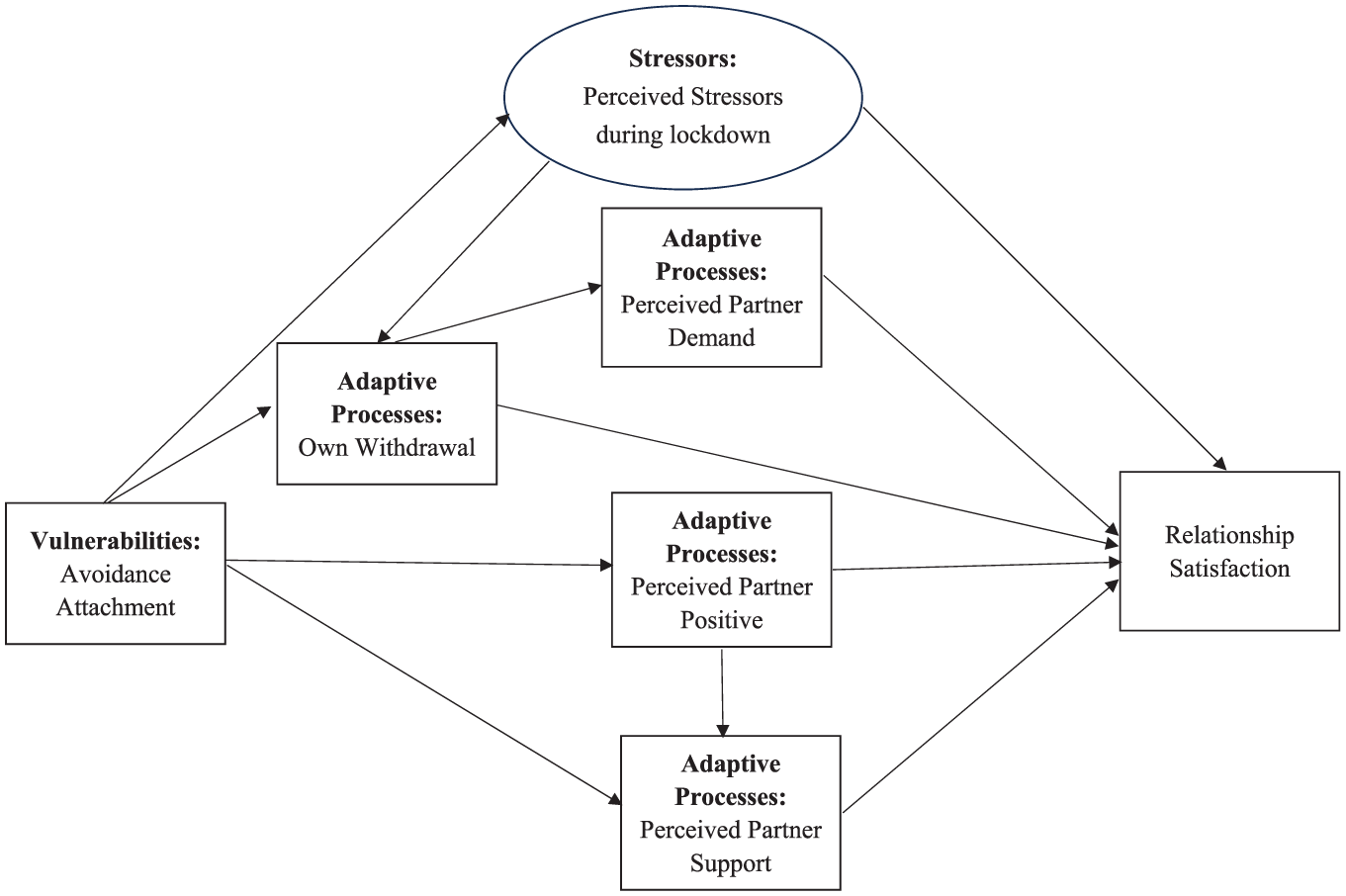
Adjustment of the present study variables in the VSA model.
Previous research by Bretaña et al. (2023) demonstrated that the association between avoidance attachment orientation and relationship satisfaction was mediated by these adaptive processes. Their findings revealed that avoidance attachment orientation was associated with both own and perceived partner conflict strategies, specifically own withdrawal and perceived partner positive behaviours. Moreover, own withdrawal and perceived partner positive behaviours mediated the link between avoidance attachment orientation and relationship satisfaction. Their research also showed that perceived partner demand mediated the relationship between own withdrawal and relationship satisfaction (Bretaña et al., 2020, 2023). Individuals with higher levels of avoidance attachment typically avoid conflicts by withdrawing, which leads them to perceive their partners as more demanding and less likely to use positive problem-solving strategies. These three conflict resolution strategies — own withdrawal, perceived partner demand and perceived partner positive behaviours — contribute significantly to relationship satisfaction, warranting their inclusion in our current model.
In addition to adaptive processes, stress could add to how vulnerabilities affect relationship satisfaction. For instance, McNulty et al. (2021) analysed how qualities (i.e., the reverse concept of vulnerabilities) affect marital satisfaction taking into account stress. Nevertheless, these authors focused on the association between qualities, stress and relationship rather than examining a more comprehensive model with interrelated variables that would allow knowing the value of each to account for the variation in relationship satisfaction.
In stressful conditions, attachment system gets activated (Mikulincer & Shaver, 2016). Individuals with a stronger avoidant attachment orientation tend to have more negative mental schemas of others, making them more likely to perceive daily stressors as particularly prominent or negative (Overall et al., 2014; Simpson et al., 1996). Consequently, the way individuals perceive stressors or stressful events related to COVID-19 can significantly impact their relationship satisfaction (Işık & Kaya, 2022). Therefore, it is relevant to carry out an analysis that addresses these intra-individual (avoidance attachment orientation), interpersonal (conflict resolution strategies and partner support) and contextual (stressors and changes in the habits) variables that jointly could exert an effect on the levels of relationship satisfaction.
Furthermore, and to complete the description of examined elements in the VSA model, we should acknowledge an important link between stressors and adaptive processes. Specifically, we refer to the fact that conflict resolution strategies deployed by individuals may be influenced by stress perception, with ‘stressors’ acting as a key mediating variable between avoidant attachment orientation and individuals’ own conflict resolution strategies (Pietromonaco & Overall, 2021). Yet, the significance of stressors may extend beyond a general approach. Likewise, in the face of unprecedented stressful events filled in with uncertainty, the perceived social support in the partner may hold relevance. In the context of COVID-19, and specifically in the confinement, partner support appeared as a relevant issue in both individuals’ and couples’ well-being (Soares et al., 2023), being an important factor that mitigates the negative effect of stress in relationship satisfaction (Bar-Shachar et al., 2023). Next, we outline the elements of the proposed model extension: specific concrete stressors within a framework of a pervasive abstract stressor (Taylor, 2022a) and social support perceived in the partner.
The role of perceived stressors during lockdown
Extensively documented through meta-analytic research, changes during the COVID-19 quarantine in sleeping habits (e.g., Limongi et al., 2023), in social contact habits (e.g., Knox et al., 2022), in sports and physical activity (e.g., Stockwell et al., 2021) and in life routines (e.g., Liu et al., 2024) have been identified as main stressors in daily lives. These stressors have been associated with increased anxiety levels (Chen et al., 2022) and reduced emotional well-being (Chouchou et al., 2021) that could ultimately affect negatively the relationship functioning (Escobar-Córdoba et al., 2021). Additionally, lacking space or privacy at home is among the most often studied socio-environmental stressors (Gatersleben & Griffin, 2017), whose impact on relationship satisfaction has also been observed in the pandemic lockdown. For instance, in a study conducted during the lockdown in Lombardy — one of Italy’s geographical regions most affected by the pandemic — living in small-sized homes was associated with a higher likelihood of experiencing depressive symptoms (Amerio et al., 2020).
The value of small houses is particularly relevant for couple dynamics. Home centrality was dramatically emphasized during COVID-19 lockdowns. During the lockdown, the home became a multifunctional space where all daily activities (e.g., work/study, socializing, physical exercise) would take place (Fornara et al., 2022). The experiences around the home in pandemic times might have brought a negative connotation, the home symbolically representing a place of isolation, threat, oppression and imprisonment (Devine-Wright et al., 2020). This situation and the need to share the available space throughout the day sometimes brought family conflicts and tensions (Prime et al., 2020), and in turn affected the quality of the relationships (Pietromonaco & Overall, 2021).
Overall, we propose that perceived stressors during lockdown would mediate the association between attachment avoidance orientation and relationship satisfaction. This hypothesized scheme builds on established research demonstrating that attachment avoidance orientation influences how individuals perceive stressors (Overall et al., 2022), while their ability to cope with COVID-19-related stressors directly affects their relationship satisfaction (Simpson & Rholes, 2017). This integration of stressors into our previously outlined model provides a more comprehensive understanding of the mechanisms through which attachment patterns influence relationship outcomes during periods of heightened stress.
The role of perceived partner support
In the COVID-19 pandemic context, the protective role of social support to cope with highly stressful situations has been noticed (e.g., Rahal & Singh, 2024). In general, social support provided by the partner has been identified as one of the most important factors contributing to relationship satisfaction (e.g., Cunningham & Barbee, 2000). During the uncertain times of the pandemic, the need to feel safe and secure increased and attachment figures’ support (i.e., partners in adult relationships) became more important than ever to successfully adapt to the pandemic changes and stressors (Vowels et al., 2021) and a more relevant support source to explain relationship satisfaction (Karantzas et al., 2022; Lawrence et al., 2008). Yet, as Vowels et al. (2021) observed, individuals higher in attachment avoidance were significantly less likely to perceive their partner as providing support.
While social support is a key factor in situations of uncertainty and stress, own conflict coping strategies, and their relation with perceived partner support, are essential to understand stress management in couples (Lavee, 2014; Pietromonaco & Overall, 2021). Although often framed in the affective domain, the greater perception of social support is closely linked to perceived partner positive conflict resolution strategy (Kaur, 2017). When individuals perceive their partners as closer, more available, willing to listen and sharing positive emotions, their sense of support increases (Rusu et al., 2023). Moreover, the interaction between perceived partner support and conflict resolution strategies is influenced by individuals’ proximity-distance regulation patterns (Pietromonaco & Overall, 2021). These proximity-distance patterns — as forms of emotion regulation — often manifest in withdrawal and demand behaviours (Story & Bradbury, 2004), which tend to become more pronounced in stressful situations, especially when the attachment system is activated in both partners (Mikulincer & Shaver, 2016). Therefore, it is crucial to examine the impact of both perceived partner support and conflict resolution strategies on relationship satisfaction within the proposed model in a contextually stressful environment.
The present study
This research was conducted in Spain, a country where strict home confinement measures during COVID-19 were imposed. Therefore, the study site provides an ideal context to empirically test the VSA theoretical model in a highly stressful context of uncertainty (Taylor, 2022a, 2022b). Specifically, we examined the link between avoidance attachment orientation and relationship satisfaction and the mediating role of three conflict resolution strategies as adaptive processes in the model (i.e., own withdrawal, perceived partner demand and perceived partner positive), the role of perceived partner support and stressors during confinement in that link (see Figure 1).
Methods
Participants
We conducted a Monte Carlo simulation with the calculation of indirect effects (Schoemann et al., 2017) to determine the sample size. Considering an anticipated effect size of .1, a desired statistical power level of .8 and a probability level of .05, with one latent variable (‘stressor during lockdown’) and six observed variables in the model, we determined that a minimum sample of 200 individuals would be necessary (Soper, 2024). The final sample consisted of 236 adult Spanish individuals who were confined at home with their partners (76.7% women; Mage = 36.9 years, SDage = 10.8; 57.2% were not parents; Mrelationship length = 11.4 years, SDrelationship length = 9.9). Regarding COVID-19, 11.4% of the sample had tested positive or experienced compatible symptoms, and 20.8% of the sample reported having a family member who had tested positive for COVID-19. As for working status during the confinement, 55.9% teleworked from home, 14.4% were dismissed due to company closure and 22% did not work for various reasons, such as unemployment or sick leave (7.6% of the sample did not provide information on this question).
Procedure
After approval was granted by the Ethics Committees of the authors’ universities, the questionnaire was hosted on the Qualtrics platform. The questionnaire link was distributed via email and various social media platforms such as Instagram, Facebook and WhatsApp between 10 and 20 April 2020. At the time, individuals had been home-confined for approximately one month due to the pandemic, which began on 15 March. A non-random sampling method was used; participants were recruited using a combination of convenience sampling, standard snowball sampling and purposive sampling procedures, as other studies during the confinement did (e.g., Amerio et al., 2020; Fornara et al., 2022; Pizarro et al., 2024). Participants did not receive any form of compensation for their participation.
Measures
The time frame of scales assessing some variables (i.e., conflict resolution strategies, relationship satisfaction, perceived partner support and stressors) referred to the last two weeks. Specifically, it refers to the time in which Spaniards had been immersed in strict confinement since the COVID-19 pandemic began. In the case of attachment variables, more stable over time (e.g., Waters et al., 2000), not time frame, was specified.
Avoidant attachment
This variable was measured using the Experiences in Close Relationships scale (ECR; Brennan et al., 1998; Spanish adaptation by Alonso-Arbiol et al., 2007). The scale is composed of 18 items on a Likert scale from 1 (‘Strongly disagree’) to 7 (‘Strongly agree’), addressing lack of comfort with closeness with the partner and preference for emotional distance (e.g., ‘I prefer not to show a partner how I feel deep down‘; α = .85).
Relationship satisfaction
This variable was measured using the Relationship Assessment Scale (RAS; Hendrick, 1988; Spanish adaptation by Molero et al., 2016). It assesses the general satisfaction with the partner through seven items (e.g., ‘Overall, I am satisfied with this relationship’) measured with a Likert-7 scale (1 = ‘Not satisfied at all’; 7 = ‘Very satisfied’) (α = .87).
Conflict resolution strategies
These were measured with the Conflict Inventory Revised Scale (CI-R; Ridley et al., 2001; Spanish version adapted by Bretaña et al., 2019). It consists of 13 items rated on a seven-point scale ranging from 1 (‘Never’) to 7 (‘Always’) and grouped into three coping strategies: Positive (four items: e.g., ‘Listening attentively’), Withdrawal (five items: e.g., ‘Leaving the room’) and Demand (four items: e.g., ‘Insults’). Participants indicated how frequently they have used these strategies (CI-Own) and have perceived their partners to have used them (CI-Partner) in the last two weeks. In the present study, only strategies relevant to the theoretical model to be tested were examined: own withdrawal (α = .75), the perception that the partner uses demand strategy (α = .74) and the perception of the partner using positive problem strategies (α = .78).
Perceived partner support
This was measured using the Multidimensional Scale of Perceived Social Support (MSPSS; Zimet et al., 1988; Spanish adaptation by Landeta & Calvete, 2002). This tool assesses perceived social support levels. In this study, only the support perceived in the partner was examined (Likert-7 scale, four items: 1 = ‘Strongly disagree’; 7 = ‘Strongly agree’). A sample item is as follows: ‘There is a special person with whom I can share joys and sorrows’ (α = .88).
Stressors during lockdown
These were measured using the COVID-19 Confinement Stressors Scale (CCSS; ad hoc). An adaptation of Holmes and Rahe’s (1967) scale of life stressors was made to assess the frequency of stressors associated with pandemic confinement. Four items rated on a Likert-7 scale (1 = ‘Never’; 7 = ‘Always’) measured changes due to the pandemic in social contact habits, sleep patterns, sport or physical activity patterns and life routines (α = .80). A fifth stressor was included as a contextual one: ‘Do you have enough private space for yourself to be quiet without other people’s interruptions in the house where you are confined with your partner?’ Since this stressor seems inadequate for a Likert-7 scale, a dichotomous (i.e., 1 = ‘Yes’ and 0 = ‘No’) format was used for this item.
Analyses
Data analyses were conducted using SPSS 28.0. First, we examined missing data. To make sure that missing values were not hiding any theoretical interpretation associated with any of the variables, Little’s (1988) Missing Completely at Random (MCAR) test was performed, X 2(739, N = 230) = 715.925, p = .722, indicating that our missing data were completely at random. Upon closer inspection, it was found that the two items with the highest number of missing values (four each, 1.70%) belonged to the avoidance attachment scale and that two missing values were identified in one item of the conflict scale. Missing data were handled by averaging scores (Little & Rubin, 2002). Since total scores were used for subsequent analyses, the total N remained unchanged.
We carried out descriptive analyses and zero-order correlation analyses between all variables. Path analysis was used to test hypotheses regarding pathways between study variables. Maximum likelihood with AMOS 28.0 (Arbuckle, 2021) was used to estimate the overall model fit. All stressors during lockdown were analysed as clustered into one latent variable (a confirmatory factor analysis yielded a good model fit: χ2/df = 2.01, df = 2, p = .12, TLI = .97, CFI = .99, RMSEA = .07). We analysed the mediator role of conflict resolution strategies (i.e., withdrawal, demand and positive) and partner support between avoidant attachment and relationship satisfaction; the bootstrap method (Cheung & Lau, 2008; 5,000 resamples) with 95% bias-corrected confidence interval separately with each mediator was used. If zero was not included in the interval between the lower and the upper bounds, the effect was statistically significant at p ⩽ .05.
Results
The tested model (Figure 2) showed a good fit (χ2/df = 1.05, df = 31, p = .39, TLI = .95, CFI = .99, RMSEA = .02). All the direct relationships between the variables proposed in the VSA model (avoidance attachment, conflict resolution strategies and relationship satisfaction) were significant and of the expected valence — except perceived partner demand, which was not associated with relationship satisfaction. Avoidant attachment orientation was negatively related to perceived partner support. The perception of partners as having positive conflict resolution strategies was positively related to perceived partner support and to relationship satisfaction. The perception of partners as supportive was also positively related to relationship satisfaction. Stressors were negatively associated with the relationship satisfaction.
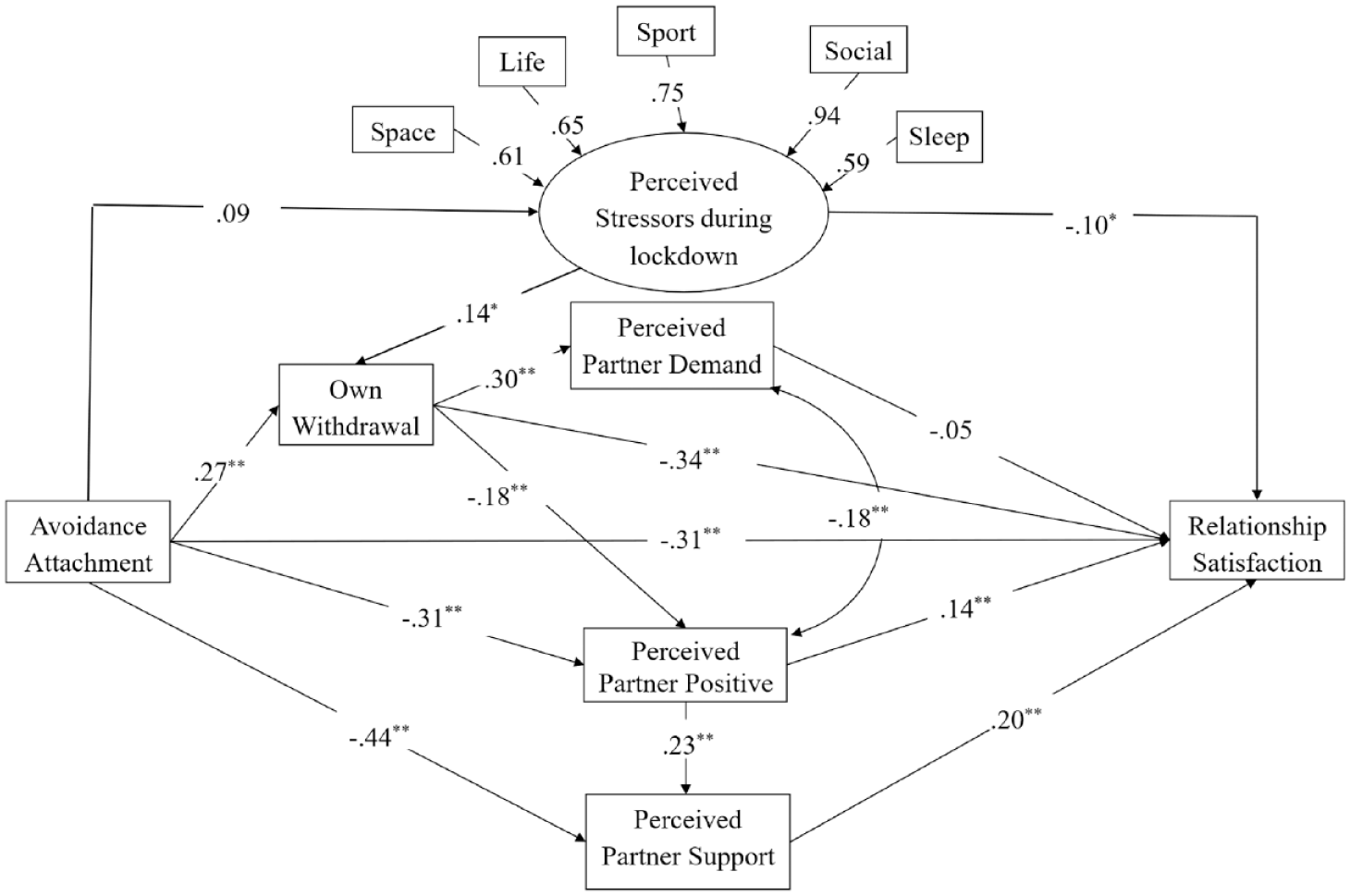
Path model of relationship satisfaction during the COVID-19 lockdown.
Finally, when examining mediating effects (see Table 1), the results showed statistically significant indirect effects of avoidance attachment on relationship satisfaction through own withdrawal and perceived partner positive. However, although a significant indirect effect of avoidant attachment was found on perceived partner demand through own withdrawal, perceived partner demand was not linked to relationship satisfaction. Upon testing the effects of added variables in the extended VSA model, we found that perceived partner support mediated between (a) the avoidance dimension of attachment and relationship satisfaction and (b) the perceived partner positive and relationship satisfaction. When we analysed the specific association among avoidant attachment, relationship satisfaction and stressors during lockdown, stressors during lockdown mediated the link between avoidant attachment and relationship satisfaction. Finally, stressors during lockdown mediated the association between the avoidance dimension of attachment and own withdrawal; in turn, own withdrawal acted as a mediator in the link between stressors during lockdown and relationship satisfaction.
Specific indirect effects of avoidance attachment on relationship satisfaction.
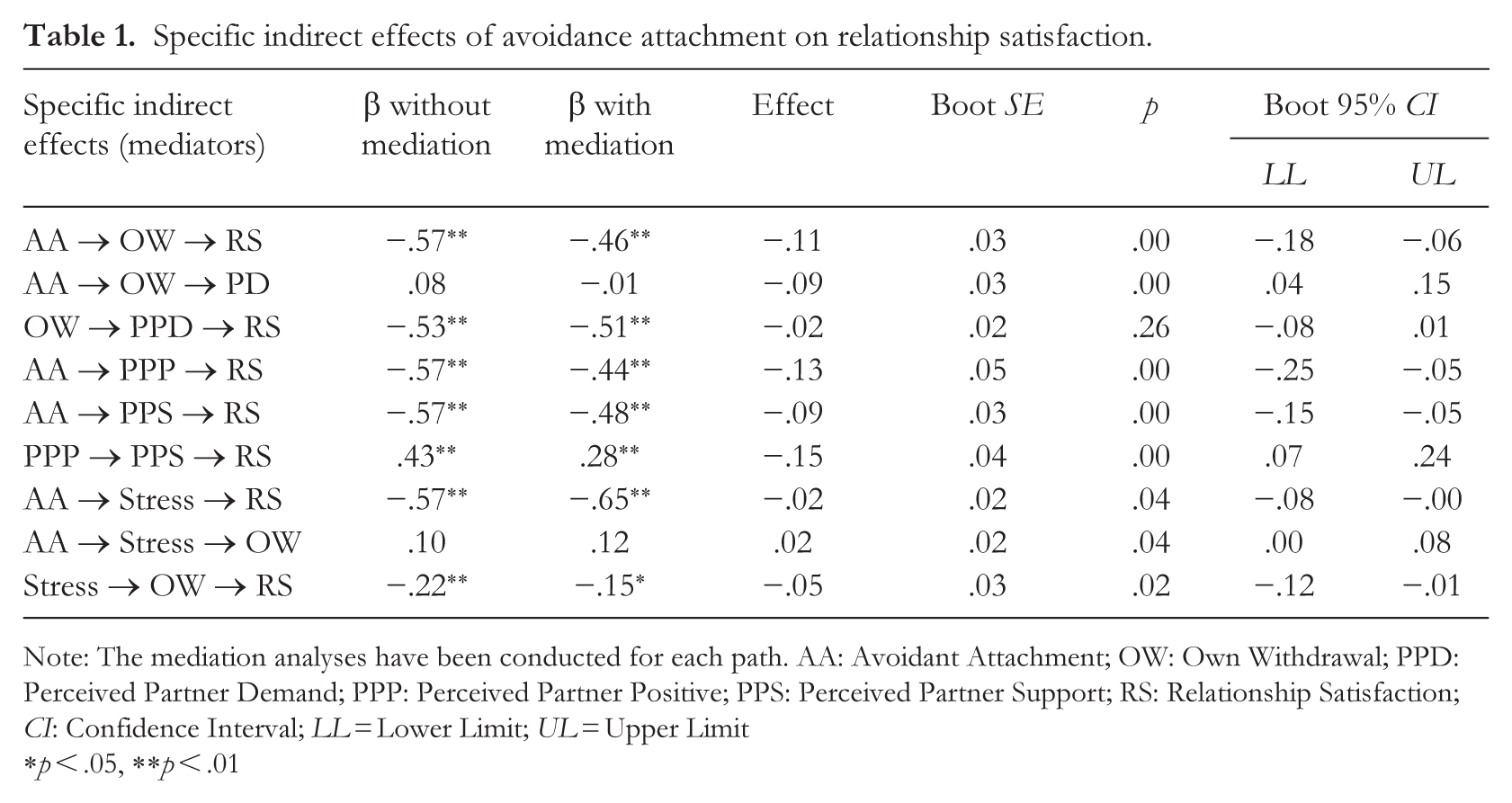
Note: The mediation analyses have been conducted for each path. AA: Avoidant Attachment; OW: Own Withdrawal; PPD: Perceived Partner Demand; PPP: Perceived Partner Positive; PPS: Perceived Partner Support; RS: Relationship Satisfaction; CI: Confidence Interval; LL = Lower Limit; UL = Upper Limit
p < .05, **p < .01
Discussion
Our study confirms central tenets of the VSA model — i.e., avoidance of intimacy is associated with lower relationship satisfaction directly and through one’s own problem-solving strategies and those perceived in the partner — in a new, untested context where stressful situations are caused by external factors, specifically the COVID-19 situation. By incorporating conditions unique to this context, such as confinement-specific stressors (e.g., changes in social habits, sleep habits, exercise habits) and perceived partner’s support, we demonstrated the necessity of considering both interpersonal and contextual factors when applying the VSA model to real-world crises, providing a more comprehensive framework for studying relationship dynamics in similar contexts.
The application of the VSA model in the context of COVID-19 offers a critical opportunity to expand its theoretical and practical scope. Traditionally used to examine how individual vulnerabilities and adaptive processes shape relationship satisfaction, the model had not been thoroughly tested in situations defined by external, contextual challenges like those posed by the pandemic. By applying the VSA model to such a context, this study provides valuable insights into how couples navigate such unique scenarios. It highlights the importance of integrating context-specific factors — such as changes in daily routines, lack of space and disruptions in privacy — to fully understand relationship dynamics. This work extends the model’s applicability to new, untested contexts, emphasizing the need to account for both individual and external influences when studying relationship satisfaction.
Our results further revealed that stress plays a key role in understanding the quality of relationship satisfaction, as extensive research has shown (e.g., Randall & Bodenmann, 2009; also during the COVID-19 pandemic: Schokkenbroek et al., 2021). Building on this foundation and targeting the exceptional context of home confinement to extend the VSA model, we incorporated stressors that are particularly relevant to this scenario (Taylor, 2022a, 2022b). To address the unique challenges posed by home confinement during the COVID-19 pandemic, we extended the VSA model by incorporating confinement-specific stressors that had profound impacts on daily routines and lifestyles (Wang et al., 2020). Our findings showed that individuals with an avoidant attachment orientation — characterized by a tendency to distance themselves emotionally and a mistrust of others — were particularly affected by this situation. Specifically, their attachment orientation was associated with a heightened perception of stressors, likely because avoidant individuals are more inclined to view their environment through a negative lens, amplifying the prominence of daily disruptions. This perception of stressors was further related to the lower relationship satisfaction levels.
Notwithstanding, the way these stressors are related to couple dynamics may differ. Our findings indicate that stressors affected relational dynamics through two channels to impact relationship satisfaction. First, sharing spaced in confinement introduced specific couple stressors, whereas conflict within the couple relationship required different types of emotional management. Confinement in a limited space caused individuals to feel more frustrated with their partners, leading to worsened communication (Vowels et al., 2021). This stressor is directly linked to couple dynamics. Second, stress seems to be associated with relationship satisfaction indirectly through own withdrawal. Specifically, changes in certain habits such as physical activity (Stockwell et al., 2021) or sleep patterns (Allen et al., 2022; Limongi et al., 2023) were broadly related to how individuals regulated their emotions and managed stress (Bernstein & McNally, 2017). These changes applied to both everyday emotion self-regulation and relational dynamics (Karamitrou et al., 2017).
Finally, perceived partner support acted as a mediating variable between avoidance and low relationship satisfaction (Meyers & Landsberger, 2002). Our study complements the previous findings that highlighted the positive association between perceived partner support and relationship satisfaction (Bretaña et al., 2020). Perceived partner support enhances the model’s ability to explain the processes underlying partner satisfaction associated with the avoidant attachment orientation under highly stressful circumstances. This is especially intriguing, since individuals with higher levels of avoidant attachment are typically less likely to perceive support from their partner (Vowels et al., 2021). The generalized stress and uncertainty of the confinement may account for this result. In situations of prolonged stress, conflict resolution strategies can be influenced by the support received from partners (Rusu et al., 2020). Therefore, as our results suggest, when one’s strategies are compromised by stress, the partner’s ability to offer compensatory support may positively impact relationship satisfaction. In turn, the support partners provide during stressful times can serve as a protective factor against vulnerabilities, such as an avoidant attachment orientation.
Limitations and future directions
A few limitations should be noted. First, the cross-sectional nature of the study prevents us from making causal claims. Given that ‘natural laboratory scenarios’ like the pandemic lockdown are difficult to predict, designing longitudinal designs becomes more challenging. Second, the study did not use random sampling, which may limit the generalizability of the results.
Future research designs that incorporate specific individual vulnerabilities — both those related to couple dynamics (e.g., attachment orientations) and broader personality traits (e.g., the Big Five or other traits) — could provide a more comprehensive understanding of how the VSA model explains relationship satisfaction in highly stressful contexts. This includes other individual variables that seem related to the response or adaptability to stressors in general (Taylor, 2022a), such as intolerance of uncertainty (Shihata et al., 2016) or trait optimism (Puig-Perez et al., 2024).
Practical implications
Some noteworthy implications may derive from our investigation. First, the perception of stressors can be influenced by enduring vulnerabilities, leading to more (mal)adaptive processes that affect relationship satisfaction. Identifying which aspects of confinement could increase stress levels, as well as understanding couples’ coping mechanisms, is essential for therapists to develop programmes that help manage conflict in stressful situations. Working with both partners is key in stress management (Bodenmann et al., 2016), especially when one partner’s resources may be depleted during confinement (Kozakiewicz et al., 2023), making the other partner’s support critical. Therapists should consider the impact of certain stressors on individual emotion regulation and the couple’s capacity to manage everyday difficulties.
Second, it is important to work with couples on stress management and how it influences emotional expression and regulation during conflicts. Emotion-focused interventions, such as Emotion Focused Therapy (EFT; Johnson, 2004), have proved effective in couples: EFT has been successful in changing relationship-specific avoidant attachment (Burgess Moser et al., 2016). This therapeutic approach aims to understand the emotions that individuals are experiencing in specific situations to address unmet needs in the relationships, often stemming from vulnerabilities (e.g., insecure attachment orientations). It focuses on identifying negative interaction patterns that may worsen under stress. The goal is to help couples recognize and understand the emotions triggered by stress, making it easier to address underlying needs and employ strategies that benefit both partners.
In a nutshell, this study provides new insights for developing theoretical models to deepen the understanding of relationship dynamics (Overall et al., 2022). On the applied side, and in anticipation of future confinements, our findings enable us to make recommendations for practitioners and government stakeholders. In the event of a new pandemic, therapists can equip couples with specific tools to enhance their management of conflict, while governments can consider incorporating short breaks from confinement in future protocols for virus containment.