



Abstract
This Special Issue examines the concept of ‘double standards’ in ethnicity, migration and intercultural relations, focusing on the uneven application of principles or expectations to similar groups or situations. Amid growing discussions on its relevance to intergroup conflicts and humanitarian crises on a global scale, the issue explores how double standards emerge in diverse socio-historical and political contexts, legitimizing unequal treatment of ethnocultural and migrant communities. It investigates the psychological mechanisms and boundary conditions underlying these biases and their impact on marginalized groups. Contributions analyse how double standards both perpetuate injustice and fuel collective resistance, emphasizing the need for social and political psychologists to address these disparities. By integrating empirical research with diverse theoretical frameworks, this issue advances our understanding of double standards and their implications for intergroup relations and justice in an era of rising nationalism and populism, while paving the way for future research on this critical topic.
With the term ‘double standard’, we refer to the practice of applying different sets of principles, rules, criteria of judgement or expectations to similar situations, individuals or groups. A judgement of double standards presumes a degree of equivalence between the situations, individuals or groups being treated differently, and it carries an accusation of bias. Initially used in the early 2000s to describe gender disparities in judgements of sexual behaviour (for a review, see Sagebin Bordini & Sperb, 2013), the term has only recently been applied to the differential treatment of ethno-cultural and immigrant groups (Dangubić et al., 2020, but see Foschi, 2000). Historically, scholars primarily focused on related concepts such as racism and discrimination, which were rooted in the North American tradition and centred on discriminatory treatment of racialized minorities by the White Majority, betraying double standards (Adams et al., 2008). In this context, racism was defined as a systemic structure that reinforced group-based hierarchy and White Majority privilege, while discrimination was understood as its behavioural manifestation, leading to the unfair treatment of racialized minorities based on group membership (Dovidio & Gaertner, 1986).
Even as racial disparities continued to grow over the years (Bhopal, 2023), significant political and institutional transformations in the late twentieth century shifted racism and discrimination to more subtle and ambivalent forms, which were more difficult to recognize and challenge (Berard, 2008). Desegregation policies made intergroup boundaries more permeable and facilitated social mobility (Durrheim & Dixon, 2005), while international human rights declarations promoted the ideal of equality across national, racial and religious lines (Doise, 2002). These principles fostered a broader sense of shared humanity, challenging ethnocentric and parochial views that favour one group over another without valid justification (McFarland et al., 2013). Accordingly, universalism became increasingly positioned as a hallmark of psychological maturity and moral development (Kohlberg, 1981; Schwartz, 2007).
These structural transformations fuelled the rise of colourblind narratives of universal peace and harmony (Perez & Salter, 2019; Pettigrew, 1991), making ethnic and cultural discrimination increasingly anti-normative and less overtly expressed (Berard, 2008; Dovidio & Gaertner, 2004). Western liberal democracies institutionalized this ideal through constitutional protections of individual rights and a strong emphasis on personal autonomy and self-development (Berlin, 1958; Shklar, 1989). While this new approach aimed to promote fairness by freeing individuals from oppression and evaluating them based on their merits (Gale & Staerklé, 2019), it has also obscured enduring patterns of discrimination, oppression and misrecognition along lines of class, gender, race, ethnicity, age and ability (Isin & Wood, 2012; Opotow, 1990). Because discrimination was no longer overt or explicitly institutionalized, marginalized groups became increasingly disenfranchised in their claims for justice, since their exclusion was rendered less visible and therefore harder to challenge (Dixon et al., 2010; Politi et al., 2025).
The emergence of the term ‘double standard’ in everyday language
Colourblind narratives of universal peace and harmony have recently been challenged by rising populism and the resurgence of nationalist discourses in many Western liberal democracies (Brubaker, 2020; Staerklé et al., 2024). Within this evolving landscape, the term ‘double standard’ has gained new prominence, and it has since broadened to encompass the uneven responses to intergroup conflicts and humanitarian crises on a global scale. Two key events have been particularly emblematic of this semantic shift (Figure 1):
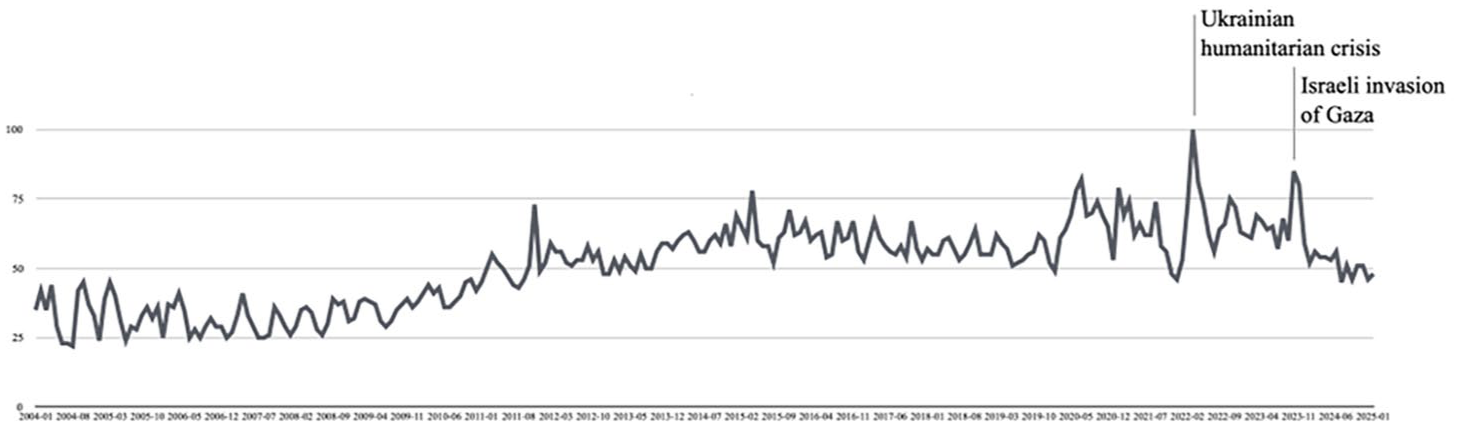
Trends in the use of the term ‘double standard’ over the past 20 years, as observed through Google search data.
The Russian invasion of Ukraine revived Cold War–era tensions and triggered a new paradigm in how the international community managed the migratory flows of Ukrainian nationals fleeing the war (Politi et al., 2023). Concurrently, African students fleeing the same conflict faced harassment and racism (Kingston & Ekakitie, 2024), and displaced Ukrainians were subject to different legislation than other asylum seekers — such as those from the Middle East and North Africa —despite facing similar circumstances (see Zubareva & Minescu, 2024). This legal disparity sparked widespread use of the term ‘double standards’ to describe the differential application of regulations, from local to supranational institutions, extending to individual practices of selective solidarity and humanitarian assistance (De Coninck, 2023; Uhr et al., 2025).
Double standards have also been prominently evoked in the response of the international community to the military invasion of Gaza and the associated genocide against the Palestinian population. The positions adopted by Western institutions and mainstream media revealed selective condemnation of violence alongside the justification of civilian massacres, marked by dehumanizing language and silencing (Khan & Tinua, 2024). Critical voices have raised concerns about how the lack of accountability for Israeli military actions contrasts sharply with prior responses to similar cases, exposing the unequal implementation of international criminal law (Goldston, 2024).
On the one hand, these appeals to double standards highlight glaring anomalies in the application of universal principles of distributive and retributive justice (Miller, 1999). Indeed, they reveal a troubling reliance on discretionary decisions based on group membership rather than formalized standards for allocating rights and enforcing punishment for wrongdoing (Staerklé & Clémence, 2004). By undermining commitments to fair and impartial procedures, double standards compromise the integrity of individual justice and the universality of its principles (Gale & Staerklé, 2019). They deviate from the core idea that similar cases should be treated equally under impartial norms or rules (Opotow, 1990).
On the other hand, the condemnation of double standards acts as visible manifestations of injustice, offering a shared language to express and communicate it (Durrheim, 2012). By exposing the unequal treatment of certain groups over others on biased or discretionary criteria, they can unite segments of society in advocating for social change to restore justice (Tyler & Smith, 1995; van Zomeren et al., 2012). Furthermore, such exceptions provide concrete examples of better treatment, allowing those disadvantaged by the same standard to demand equality (Smith & Pettigrew, 2015). They also encourage those in privileged positions to recognize their relative advantage and join efforts to improve conditions for all (Leach et al., 2002).
Unpacking double standards: a societal psychology perspective
Balancing the boundary between the social and the political, a societal psychology perspective is well positioned to investigate politically relevant and polarizing cases of double standards in contemporary societies (Doise & Staerklé, 2002). Contributing to this perspective, the Special Issue wants to bridge individual-level explanations with analyses of the broader social dynamics embedded in diverse socio-historical and political contexts that shape and give meaning to political behaviour (Howarth et al., 2013). Adopting a complex and systemic perspective, we invited contributors to consider the psychological mechanisms that drive or mitigate double standards, not simply as products of individual thinking but as deeply embedded within social structures and norms that shape and influence individuals’ actions (Bou Zeineddine & Leach, 2021). After all, accusations of double standards involve judgements both of biased treatment and equivalence of situations, which are subject to personal, social and ideological influence.
What is more, analysing double standards compels us to move beyond a binary framework of social relationships — such as Majority vs. Minority or Black vs. White (Dixon et al., 2020). Accusations of double standards inherently involve a third-party perspective, where two comparable situations are evaluated, with preference given to one over the other. This means that categories like ‘refugees’ and ‘migrants’ should not be treated as homogeneous groups. Instead, it is essential to account for the social stratification that shapes power dynamics both between and within these categories (Caricati, 2018). In other words, examining double standards necessitates an intersectional approach — one that not only considers multiple comparisons and ethnic hierarchies within societies but also acknowledges the cumulative and intersecting disadvantages that define lived experiences of injustice (Bowleg, 2017; Cole, 2009)
Aim and scope of the Special Issue
The primary aim of the Special Issue is to provide empirical evidence for the presence of double standards while encouraging diverse theoretical approaches to investigate them within varied socio-historical and political contexts. These disparities in treatment are intended to include variations in individual attitudes and behaviours, ranging from overt hostility towards one group to solidarity with another (Esses, 2021; Subašić et al., 2008), as well as the differential application of retributive and restorative justice principles across groups (Abrams et al., 2015; Passini, 2010). The issue also seeks to explore how double standards might manifest in the conceptual and discursive framing of resistance — both violent and non-violent — in interethnic conflicts (Nilsson, 2020; Vollhardt et al., 2020), as well as in the varying levels of third-party support for normative and non-normative forms of collective action (Bruneau et al., 2017; Orazani et al., 2021; Ünal et al., 2024).
A second aim of the Special Issue is to encourage investigations into the psychological mechanisms driving the emergence of double standards, as well as the boundary conditions and contextual factors that might exacerbate or mitigate them. These factors include the malleability of stereotypes and ideologies (Blair, 2002; Roebroeck & Guimond, 2018), which can be strategically used to legitimize existing inequalities (Jost & Banaji, 1994; Knowles et al., 2009). Political ideologies and shared representations linked to cultural affiliations and national identities are also emphasized as key areas of focus, given their potential to generate divergent moral judgements and to allow selective permeability towards different ethno-cultural and immigrant groups (Eger & Valdez, 2015; Federico et al., 2013). From a critical perspective, the Special Issue also creates space for analysing dominant discourses surrounding contemporary interethnic conflicts and the role of language in constructing exceptions and particularized representations of victimhood (Billig, 1985). These representations, in turn, are likely to be disseminated to influence public opinion and legitimize double standards in crisis responses (Augoustinos & Every, 2007; Reisigl & Wodak, 2000).
The third objective is to encourage a focus on the potential impacts of differential treatment on those groups who experience it. Responses to such treatment are expected to range from justification and acquiescence to condemnation and grievance (Bahamondes et al., 2022; Jost et al., 2012). Particular attention is drawn to how differential treatment can be differently framed by different parties (Elcheroth et al., 2019), potentially contributing to heightened intergroup violence, feelings of relative deprivation and a sense of competitive victimhood (Craig & Richeson, 2012; Noor et al., 2012). The call for contributions sought to consider how double standards can also inspire efforts towards restitution, foster a shared group consciousness and promote collaborative actions aimed at driving social change (Cortland et al., 2017; Macías Mejía, 2024).
Summary of the individual contributions to the Special Issue
The opening article of this Special Issue, authored by Diab (2025), sets the stage by using critical race theory and framing theory to scrutinize the contrasting responses to refugees within the European Union. Diab’s position paper reveals the systemic racism underpinning the differential treatment of Ukrainian refugees compared to those from the Middle East and North Africa (MENA) region (Bhopal, 2023). This foundational critique is empirically supported by Stefaniak et al. (2025), who, through experiments in Germany, document systematic differences in the willingness to host displaced Ukrainians versus Eritrean and Syrian refugees. The latter are perceived as less similar and more threatening, largely due to their association with Islam (Landmann et al., 2019). These contributions shed light on the interplay between social structures and institutional arrangements, on the one hand, and individual psychology and public opinion on the other.
Building on this exploration of religion’s role in shaping public attitudes, Anderson et al. (2025) demonstrate in an Australian context that explicit and implicit biases favour Christian refugees over Muslim ones, with the disparity in explicit attitudes being particularly pronounced among Christian participants (Deslandes & Anderson, 2019). However, this explanation based on shared religious affiliations is nuanced by Türkırkı et al. (2025), who analyse social media sentiment in Turkey, a predominantly Muslim country. They find Afghans to be the most negatively perceived group, followed by Syrians, whereas posts about Ukrainians exhibit overwhelmingly positive sentiment and minimal perceived threat (Uluğ et al., 2023). Unilateral favouritism for White Christian refugee groups suggests a shared ethnic hierarchy in humanitarian assistance that transcends national and cultural borders, reflecting enduring colonial legacies and the influence of Western cultural dominance.
Beyond these general patterns, several contributions highlight the nuanced conditions and motivated reasoning that influence the emergence or reduction of double standards, emphasizing that they are not inevitable or deterministic. Lantos et al. (2025) investigate the motivations underlying long-term support for refugees in Poland, Slovakia and Hungary, emphasizing how these motivations shape the conditionality of assistance. They explore the role of paternalistic and stereotypical expectations, where refugees are perceived as helpless yet grateful recipients of aid. Their findings reveal that such expectations are associated with volunteers’ personal and humanitarian motivations but are not influenced by politicized motivations. Similarly, a study by Altamura and La Barbera (2025) reveals that Italians who strongly identify with Europe adopt a more egalitarian stance towards helping refugees, although favourability towards Ukrainians intensifies when participants anticipate Ukraine’s integration into the EU (Politi et al., 2023). Extending these findings, Perényi-Harka and Martinović (2025) investigate ingroup favouritism in the Netherlands, showing that identification with the nation, place attachment and perceived ownership influence disparity in attitudes towards Dutch emigrants and immigrants.
Political orientation emerges as a key moderating factor across several studies. In Germany, Eckerle et al. (2025) demonstrate that selective solidarity with Ukrainians is predominantly observed among conservatives and those who glorify the nation (Kende et al., 2019). However, as the political landscape shifts, liberals become more sympathetic to Ukrainians than to other refugee groups. Complementing these findings, experiments in Switzerland and France by Vétois et al. (2025) show that media framing of immigration as a major societal issue increases prejudice and far-right support among conservatives, but not when participants recalled news about Ukraine (Dennison & Geddes, 2019). In a related vein, Al-Amine and Çakmak (2025) explore the political implications of Israel’s invasion of Gaza, illustrating how liberal and conservative participants in the US and UK exhibit opposing reactions to pro-Israel and pro-Palestinian demonstrations, with each group justifying police repression selectively (Van Assche et al., 2020). This selective allocation of distributive and retributive justice contributes to the broader discussion over double standards, raising the question of whether such disparities arise from relative moral frameworks or from absolute moral inconsistencies in judgement (Jost, 2017).
Furthermore, the instrumental and strategic nature of acceptance is explored by Komisarof et al. (2025), who demonstrate how social markers are differentially applied to evaluate migrant groups. Their study shows that Japanese participants adjust these markers based on perceived threat and contribution, revealing how acceptance criteria can shift and potentially reflect underlying double standards (Leong, 2014). De Coninck (2025) deepens this exploration by linking personality traits to double standards across seven European countries. Narcissists prioritize migrants’ societal contributions over their motives, Machiavellians pragmatically acknowledge humanitarian needs, and psychopaths exhibit broad indifference to migrants’ circumstances (Jonason et al., 2020). Finally, Szebeni et al. (2025) show that while the collective feeling of ownership among Finnish people leads them to open their borders more to Ukrainians threatened by the same Russian imperialist power than to other asylum seekers, their chauvinistic attitude towards their social welfare drives them to demand more stringent border regulations for all potential beneficiaries for international protection (Careja & Harris, 2022). These contributions highlight the role of pragmatism in impression formation and the motivated cognition that shapes the differential treatment of various categories of valued and devalued immigrant groups (Gale & Staerklé, 2020).
Intersectionality, both as a framework and an analytical lens, informs several contributions and enhances our understanding of the varying responses to double standards. Lou et al. (2025) explore how ethnicity and migration status intersect to shape stereotypes in Canada, revealing that the compensatory stereotype of competence applies only to native Canadian Asians (Fiske et al., 2002). Mancini et al. (2025) examine the intersection of gender and migration, showing that Ukrainian and Russian women in Italy experience less gendered racism compared to African-Black women, with racism affecting the psycho-social adjustment of the two groups in distinct ways (Bowleg, 2012). Ramachandran (2025) expands this intersectional analysis by demonstrating how legal status and socio-cultural differences contribute to feelings of exclusion, competitive victimhood and moral entitlements among migrants in the UK (De Guissmé & Licata, 2017). Finally, Vollhardt et al. (2025) critically examine traditional approaches to collective victimhood that neglect the sociopolitical and historical context of intergroup relations, often reinforcing double standards. By exploring how power imbalances and structural inequalities shape perceptions of historical victimization, their contribution reveals how these dynamics influence solidarity, betrayal and shared suffering among historically oppressed groups (see also Noor et al., 2017).
Future directions
Recognizing the complexity of double standards, we present this Special Issue as an initial step in a broader effort to deepen our understanding of the differential treatments that shape contemporary societies. The articles in this issue underscore the challenge of developing a shared operationalization of the concept of double standards, highlighting its polysemic nature and its potential for analysis from multiple perspectives and across various levels of analysis. To advance this understanding, more systematic approaches are needed to synthesize how double standards have been approached and operationalized in diverse contexts and scholarly traditions.
Limiting the scope of our analytical endeavour, we acknowledge the underrepresentation of perspectives from non-Western, Educated, Industrialized, Rich and Democratic (WEIRD) contexts (Henrich et al., 2010), as well as from settler societies, post-colonial and neo-colonial regions and areas affected by armed conflict (Bou Zeineddine & Vollhardt, 2024). This gap underscores the need to further explore less visible and underexplored cases of double standards that remain largely absent from mainstream media and academic discourse.
A societal approach to double standards should also go beyond examining how categories like ‘refugee’ or ‘migrant’ are socially constructed to influence biased perceptions and unequal treatment. Future research should explore how the term ‘double standard’ is pragmatically used or circumvented as a rhetorical device to justify or challenge social hierarchies, shaping the political discourse around (in)equality and (in)justice (Durrheim et al., 2005; Verkuyten, 2005).
While this article collection cannot fully capture the complexity of these multifaceted and rapidly evolving global dynamics, it provides a rich and thought-provoking exploration of double standards in contemporary societies marked by increased populism and rising nationalism. By examining the differential treatment of ethnicity, migration and intercultural relations, these contributions shed light on some of the most pressing challenges of our time, while laying the groundwork for continued research, dialogue and critical reflection. Together, the contributions in this Special Issue highlight the power asymmetries and forms of domination that shape current international responses to political conflicts and humanitarian crises.
This collection of articles and diverse perspectives demonstrates that complex societal phenomena cannot be analysed solely through the lens of individual cognition and intra-psychological processes; instead, they require a systemic perspective that seriously considers the socio-historical conditions and political contexts that construct psychological realities (Bou Zeineddine & Leach, 2021). They also underscore the importance of making intersectional approaches to social justice more central across the various subfields and areas of social and political psychology (Rosenthal, 2016).
Whether the term ‘double standard’ becomes a lasting part of the common lexicon in public debate or fades from prominence over time remains an open question. Regardless of its trajectory, we hope this Special Issue underscores the importance of studying double standards empirically and highlights their complexity as a subject of rigorous analysis.