



Abstract
This research examined whether highlighting immigration as a major societal issue increases anti-immigrant prejudice and far-right support, particularly among social conservatives. We also explored whether this effect would be weaker when salience involves immigrant groups that are normatively protected, such as Ukrainian refugees, compared to other groups. Across two studies conducted in Switzerland (N = 439) and France (N = 382), participants were randomly assigned to either a control or a salience condition in which immigration was framed as a major societal issue. Participants then recalled immigration-related news, allowing for a comparison between salience attributed to Ukrainian refugees versus other immigrant groups. Results showed that immigration salience did not increase prejudice or far-right support when focused on Ukrainian refugees. However, when salience was associated with other immigrant groups, it significantly increased anti-immigrant prejudice and far-right support, especially among social conservatives. These findings suggest that immigration salience can increase double standards in attitudes towards immigrants, with negative effects mitigated when attention is directed towards normatively protected groups.
In recent decades, immigration has frequently dominated headlines and become a major societal concern, coinciding with the rise of far-right parties that promote anti-immigration agendas (Mudde & Kaltwasser, 2017). According to issue salience theory (Dennison & Geddes, 2019) such heightened visibility and concern are expected to increase anti-immigrant prejudice and far-right support. However, findings remain mixed. Some studies linked higher immigration salience to increased anti-immigrant prejudice (Fuochi et al., 2019) and far-right support (Burscher et al., 2015), while others reported null (Vétois et al., 2025) or inconsistent results (Meltzer et al., 2021). These mixed findings suggest that the effect of immigration salience on anti-immigration attitudes may depend on moderating factors.
One such factor is individuals’ ideological orientation. Immigration often evokes polarized social narratives, with conservatives likely to adopt exclusionary views, while liberals favour more inclusive perspectives (de Rosa et al., 2021). Accordingly, previous studies have examined whether ideological orientation moderates the effect of immigration salience on anti-immigrant attitudes. Yet here too, findings remain inconclusive. Some studies suggest asymmetrical polarization, where heightened salience increases far-right support, especially among conservatives (Burscher et al., 2015). Conversely, other research points to symmetrical polarization, with salience intensifying both pro- and anti-immigrant views (Schneider-Strawczynski & Valette, 2025).
Thus, the evidence linking heightened immigration salience to increases in anti-immigrant prejudice and far-right support remains inconclusive, and the role of ideological differences in this process is uncertain. This research addresses these gaps by proposing that these inconsistent findings may stem from the double standards national group members apply to different immigrant groups.
From a social psychological perspective, double standards manifest in a differential treatment of immigrant outgroups, with these disparities influenced by societal norms regarding the acceptability of prejudice (Crandall et al., 2002). These norms are influenced by perceptions of immigrant groups: those deemed more deserving, less threatening, and culturally closer receive more solidarity, while those viewed as less deserving and more threatening face greater prejudice (Montreuil & Bourhis, 2001; Xuereb, 2023).
A notable example of these double standards is the contrasting reception of Ukrainian refugees in 2022 compared to refugees from non-European regions such as Syria, Iraq, and Afghanistan in 2015 (Xuereb, 2023). Despite both events being highly salient, widely covered by the media and eliciting significant public concern, Ukrainian refugees were generally met with solidarity (Paul, 2022). In contrast, the arrival of Syrian, Afghan, and Iraqi refugees contributed to societal polarization and the rise of far-right parties (Schneider-Strawczynski & Valette, 2025).
These differences suggest that the impact of immigration salience on anti-immigrant prejudice and far-right support may vary depending on the immigrant group in focus, reflecting the double standards applied by national majority members. However, the extent to which these double standards moderate the deleterious impact of immigration salience remains unclear.
The present research
We conducted two experiments in Switzerland and France in early 2022 to examine how immigration salience affects anti-immigrant prejudice (Experiments 1 and 2) and far-right support (Experiment 2), considering ideological differences and double standards towards different immigrant groups. In both countries, immigration was highly salient, with clear evidence of double standards: in Switzerland, Ukrainian refugees were granted special status, while Afghan refugees faced criticism and negative incidents (State Secretariat for Migration, 2022; Swissinfo, 2022). In France, Ukrainian refugees were granted permits, while anti-immigrant rhetoric targeted non-European immigrants during the presidential elections. Additionally, the COVID-19 period further fuelled controversy and polarization over immigration, dividing public opinion between inclusive and exclusionary views (Giacomozzi et al., 2023).
We hypothesized that high immigration salience would increase anti-immigrant prejudice and far-right support (H1), with these effects being more pronounced among social conservatives (H2). However, we also hypothesized that salience involving Ukrainian refugees — a normatively protected group — would not increase anti-immigrant prejudice or far-right support (H3). Furthermore, we also anticipated that social conservatives would not report increased prejudice or far-right support when Ukrainian refugees were the focus of the salience (H4).
All measures, manipulations and exclusions are reported. Results and materials are available on the OSF project page. H1 and H2 were pre-registered along with the analysis plan, inclusion criteria and sample size determinations on https://aspredicted.org/swzc-wvjk.pdf. 1 H3 and H4 were not preregistered. Both experiments were conducted in French and received approval from the University of Geneva’s Commission for Ethical Research. Participants in both experiments remained anonymous and were not involved in recruiting other participants.
Experiment 1
Method
Participants
Sample size determination followed Fuochi et al. (2019). Four hundred and forty-one participants were required to detect a small effect size (f = .025) with 80% power and a 5% error margin in a linear multiple regression model. Undergraduate students, as part of a research seminar, recruited participants via word of mouth and social media, presenting the study as research on public perceptions of contemporary political issues. Interested individuals received a link to the online experiment hosted on Qualtrics (2022).
Of the 959 participants who completed the experiment, 21 were excluded for not providing consent, nine for being under 18 and 204 for not being Swiss nationals. An additional 286 were excluded for misunderstanding the experimental instructions (see the Materials and Procedure section for details). The final sample consisted of 439 Swiss adults (261 women, 174 men, three other gender identities and one not specified), aged 18 to 94 years (Mage = 28.97; SDage = 12.07).
Materials and procedure
Participants completed all measures in the order listed below (see Note 1). Demographic information was collected at the beginning of the questionnaire. At the end, participants were thanked and fully debriefed.
Social conservatism
We used an adapted version of the Social and Economic Conservatism Scale (SECS; Everett, 2013), which includes four items measuring economic conservatism and four items assessing social conservatism. This study focuses on social conservatism due to its correlation with anti-immigrant prejudice (Everett, 2013). 2 Participants rated their attitudes towards restricting abortion, gay marriage (reverse-coded), military security and patriotism on a scale ranging from 1 (‘very negative’) to 5 (‘very positive’). Responses were averaged to compute a mean social conservatism score (M = 2.32, SD = .69, α = .66).
Experimental manipulation of immigration salience
Participants were randomly assigned to either a control or salience condition using Qualtrics (2022)’ randomization function. In the control condition, participants viewed a fictitious report from a statistics institute, highlighting population concerns on various issues unrelated to immigration, along with a table showing media coverage of different political topics — excluding immigration. In the salience condition, the report indicated that immigration was the top concern of the population, and the table showed that it was one of the most covered topics in the media.
Salience of Ukrainian refugees, other immigrant groups and control
Participants in both conditions were asked to recall a recent news article. In the salience condition, participants were instructed to recall news specifically about immigration, while those in the control condition recalled news about any other salient issue listed in the fictitious report and table — none of which involved immigration. Within the salience condition, we distinguished between participants who associated immigration salience with Ukrainian refugees and those who focused on subjects related to other immigrant groups. This distinction was made by the first author after reviewing each participant’s recalled news.
We excluded 286 participants based on the following criteria: participants in the immigration salience condition who recalled news about both Ukrainian refugees and other immigrant groups (compromising salience attribution) and those who recalled news unrelated to immigration or no news at all. Additionally, we excluded participants in the control condition who recalled immigration news or no news.
After applying these criteria, three distinct groups emerged: participants in the salience condition who linked immigration salience to the Ukrainian refugee crisis (n = 151), those who linked it to other immigrant groups (n = 55) and those in the control condition who recalled topics unrelated to immigration (n = 233).
Dependent variables
The anti-immigrant prejudice scale (Urbanska & Guimond, 2018) comprised eight items such as ‘Because of the number of immigrants, I sometimes have the impression of being a foreigner in Switzerland’. Responses were collected on a five-point scale ranging from 1 (‘completely disagree’) to 5 (‘completely agree’) and were averaged to compute the mean score of anti-immigrant prejudice (M = 2.27, SD = .77, α = .84).
At the experiment’s end, participants completed manipulation checks that confirmed the effectiveness of the salience manipulation. For details, please refer to the online supporting information.
Results and discussion
We conducted a series of multiple regression analyses using R (R Core Team, 2024) to test H1 to H4. To assess whether high immigration salience increased anti-immigrant prejudice (H1), especially among social conservatives (H2), a first analysis included the experimental manipulation (control = −1 and salience = +1), standardized social conservatism and their interaction, with anti-immigrant prejudice as the dependent variable. For H3 and H4, a second analysis was conducted using two orthogonal contrasts. The first contrast compared the salience of non-Ukrainian immigrant groups (+2) with both Ukrainian refugees and the control condition (both coded −1). The second contrast compared the salience of Ukrainian refugees (+1) with the control condition (−1), controlling for other immigrant groups (0). Support for H3 required a significant effect for the first contrast but not for the second. To test H4, we also included interactions between each contrast and social conservatism. Detailed results are presented in Tables S1 and S2 in the online supporting information.
We found no support for H1 and H2: the experimental manipulation had no significant effect on anti-immigrant prejudice (b = .06, SE = .03, p = .058) and did not interact with social conservatism (b = .03, SE = .03, p = .292). Supporting H3, the first contrast indicated that salience involving other immigrant groups increased anti-immigrant prejudice compared to salience involving Ukrainian refugees or the control condition (b = .07, SE = .03, p = .018). The second contrast showed no significant difference between salience involving Ukrainian refugees and the control condition (b = .03, SE = .03, p = .291) (Figure 1). Thus, high immigration salience increased anti-immigrant prejudice, except when it involved Ukrainian refugees. Contrary to H4, there was no significant interaction between the first contrast and social conservatism on anti-immigrant prejudice (b = .04, SE = .03, p = .097).
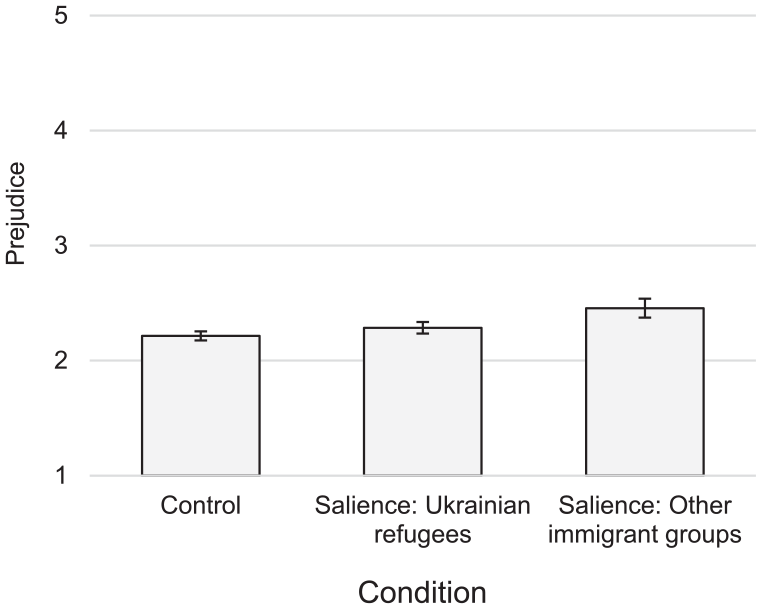
Anti-immigrant prejudice (ranging from 1 = ‘low’ to 5 = ‘high’) depending on experimental condition (Experiment 1).
Experiment 2
Method
Participants and procedure
Sample size determination followed the criteria of Experiment 1. Participants were recruited through FouleFactory and Prolific for a study on contemporary political issues in exchange for compensation. Interested individuals were redirected to Qualtrics (2022) for the online experiment. Of the 462 participants who completed the experiment, exclusions were made for the following reasons: lack of consent (n = 7), being under 18 (n = 1), not being French nationals (n = 2), failing an attention check (n = 3), not understanding or following the experimental instructions (n = 67). The final sample consisted of 382 participants (186 women, 192 men, four other gender identities), aged between 19 and 80 years old (Mage = 37.70; SDage = 12.95).
As in Experiment 1, participants first completed demographic questions and the adapted SECS (Everett, 2013), with four items measuring social conservatism (M = 2.54, SD = .77, α = .67) (see Note 2). They were then randomly assigned to either an immigration salience or control condition using Qualtrics (2022)’ randomization function. The materials were the same as in Experiment 1 but adapted to the French context. 3
Participants were asked to recall a news item, allowing us to distinguish those who associated immigration salience with the Ukrainian refugee crisis (n = 70) from those recalling other immigrant groups (n = 122). We kept participants in the control condition who recalled news on unrelated topics (n = 190). We excluded participants from the immigration salience condition who recalled news on both Ukrainian refugees and other immigrant groups, those who recalled unrelated or no news and control participants who recalled immigration news or no news (n = 67).
Participants then completed the anti-immigrant prejudice scale (Urbanska & Guimond, 2018; M = 2.61, SD = .94, α = .90) and also rated their support for far-right presidential candidate Marine Le Pen’s immigration policies on a scale from 1 (‘not at all’) to 5 (‘completely’) as well as their voting intentions for her, with options ranging from 1 (‘no’) to 5 (‘yes’). These responses were averaged to create a continuous measure of far-right support (M = 1.98, SD = 1.32, r = .78, p < .001).
At the end, participants completed manipulation checks to evaluate the experimental procedure. Detailed information is available in the online supporting information.
Results and discussion
The analyses, conducted in R (R Core Team, 2024), were identical to Experiment 1 but were each run twice: once with anti-immigrant prejudice and once with far-right support as the dependent variable. We focus on hypothesis-testing, with full details in online Tables S6 and S7.
Partially supporting H1, immigration salience increased anti-immigrant prejudice (B = .08, SE = .04, p = .036) but did not significantly increase far-right support (B = .10, SE = .06, p = .065). H2 was not supported, since no significant interactions between the salience condition and social conservatism were found for either anti-immigrant prejudice (B = .04, SE = .04, p = .251) or far-right support (B = .10, SE = .06, p = .078).
Supporting H3, the first contrast indicated that salience involving other immigrant groups increased anti-immigrant prejudice (B = .06, SE = .03, p = .020) and far-right support (B = .13, SE = .04, p = .002) compared to salience involving Ukrainian refugees or the control condition (Figure 2). The second contrast showed no significant difference between Ukrainian refugee salience and the control condition for either outcome (p ⩾ .508). This result is consistent with Experiment 1 and indicates that high salience of immigration increases both anti-immigrant prejudice and far-right support, except when it involves Ukrainian refugees.
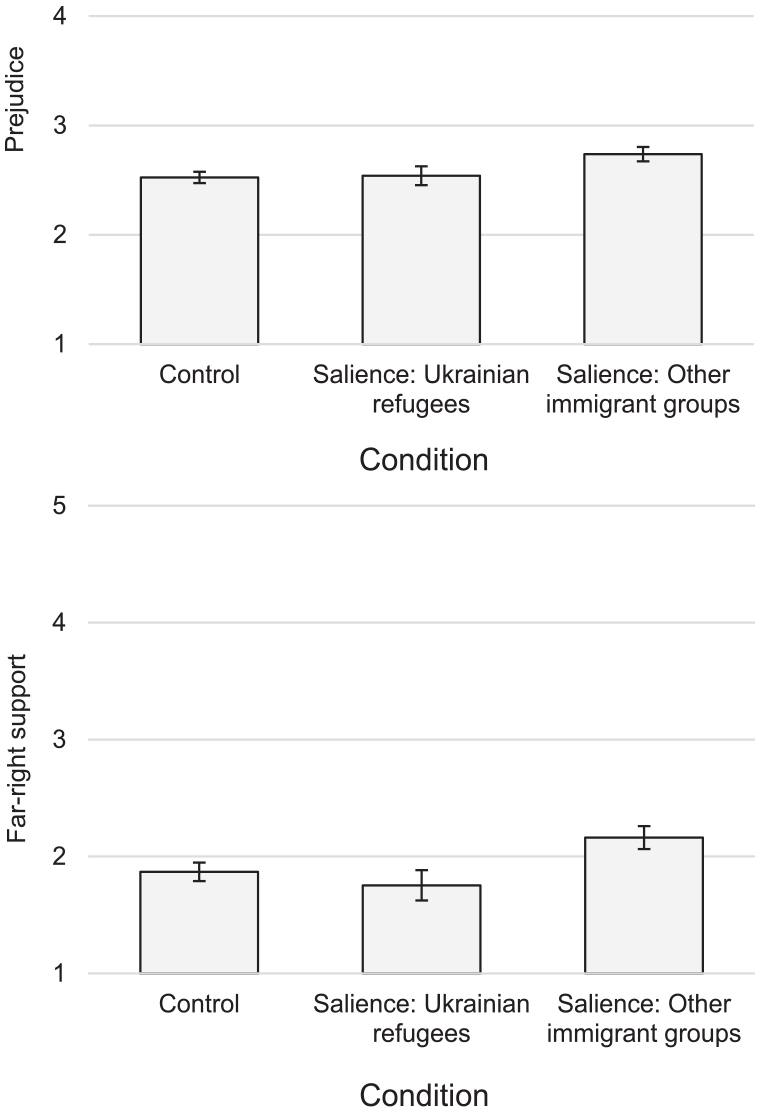
Anti-immigrant prejudice and far-right support (1 = ‘low’; 5 = ‘high’) depending on experimental condition (Experiment 2).
Regarding H4, there was no significant interaction between the first contrast and social conservatism on anti-immigrant prejudice (B = .04, SE = .03, p = .133). However, a significant interaction was found on far-right support (B = .14, SE = .04, p < .001) (Figure 3). For highly social conservative participants, salience of Ukrainian refugees did not increase far-right support compared to the control condition (B = −.19, SE = .11, p = .101), while salience related to other immigrant groups significantly increased far-right support (B = .29, SE = .06, p < .001).
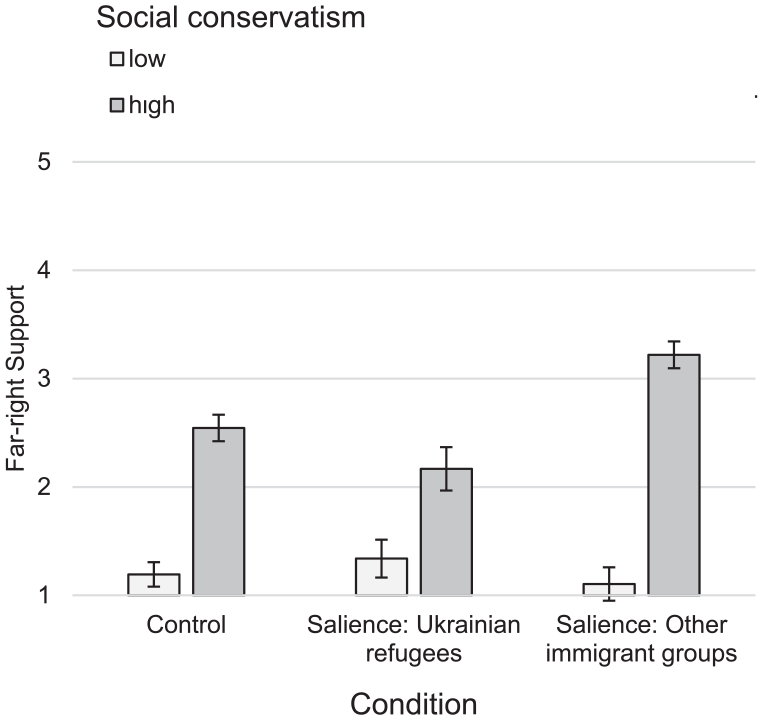
Far-right support (1 = ‘low’; 5 = ‘high’) as a function of experimental condition and social conservatism (Experiment 2).
General discussion
This research examined the impact of immigration salience on anti-immigrant prejudice in Switzerland and France, and on far-right support in France, considering ideological differences as a moderator and introducing double standards towards Ukrainian refugees versus other immigrant groups as a potential explanation for inconsistent effects.
Partially supporting H1, immigration salience had inconsistent effects when double standards were not considered. In Switzerland, salience did not significantly influence anti-immigrant prejudice, while in France, it increased anti-immigrant prejudice but not far-right support. However, when considering double standards (H3), the findings were consistent across both experiments: salience concerning Ukrainian refugees did not significantly impact prejudice or far-right support, while salience involving other immigrant groups did.
Building on research linking prejudice expression to societal norms (Crandall et al., 2002), our findings suggest that issue salience theory (Dennison & Geddes, 2019) does not hold for immigrant groups that are normatively protected from prejudice, such as Ukrainian refugees. These results help explain previous inconsistencies regarding the relationship between immigration salience, anti-immigrant prejudice and far-right support (Burscher et al., 2015; Fuochi et al., 2019; Meltzer et al., 2021; Vétois et al., 2025). They also highlight that double standards in responses to different immigrant groups can influence the negative impact of immigration salience on prejudice and far-right support.
We also examined whether high immigration salience polarizes attitudes by testing the moderating role of ideological differences in social conservatism on anti-immigrant prejudice and far-right support (H2). Contrary to expectations, ideological differences did not moderate the effect of salience on these outcomes. However, partially supporting H4, social conservatives were more likely to support far-right parties when salience involved other immigrant groups than Ukrainian refugees. This interaction was not found for anti-immigrant prejudice. The findings suggest that the effect of immigration salience on far-right support is moderated by ideological differences and further shaped by double standards towards different immigrant groups. Social conservatives appear more responsive to high immigration salience, except when it concerns Ukrainian refugees, underscoring an asymmetric polarization process (Burscher et al., 2015; Jost et al., 2022).
Limitations and future directions
Our results suggest that heightened salience of Ukrainian refugees did not increase prejudice or far-right support, likely due to perceptions of their deservingness and minimal threat (Xuereb, 2023), which may be a reflection of this group’s normative protection. However, these explanations were not tested in our study, highlighting the need for further research to explore these mechanisms.
Additionally, relying on participants’ recall of news articles to distinguish between Ukrainian refugees and other immigrant groups, while useful, has limitations. The broad ‘other immigrant groups’ category lacks precision, making it difficult to identify factors driving the observed effects, such as differences between refugee and migrant status or ethnic backgrounds. Some participants also recalled general immigration topics without specifying a group. While we assumed that these participants did not refer to Ukrainian refugees, this cannot be confirmed. Future studies should use more targeted manipulations of immigrant group salience and consider social norms surrounding different immigrant groups.
Despite these limitations, our findings underscore the importance of media portrayals of migration, especially for vulnerable populations. Media coverage of immigration issues may inadvertently reinforce prejudice or far-right support if it fails to critically address the double standards held by the national majorities towards different immigrant groups.
Footnotes
Notes
Supplementary Material
Please find the following supplemental material available below.
For Open Access articles published under a Creative Commons License, all supplemental material carries the same license as the article it is associated with.
For non-Open Access articles published, all supplemental material carries a non-exclusive license, and permission requests for re-use of supplemental material or any part of supplemental material shall be sent directly to the copyright owner as specified in the copyright notice associated with the article.
