



Abstract
This research aimed to analyse the social representations of the Spanish Civil War and the dictatorship among young people from different autonomous communities in Spain. A free-association exercise elicited by the words ‘Civil War’ and ‘Francoism’ was completed by 477 university students of the Basque Country, Catalonia, Galicia and Madrid. Participants were also asked about their national identity and ideological orientation. Lexical analysis was used to analyse their responses, and the results revealed that there is no shared narrative among participants. The results show that most of the discourses constructed for these times go hand in hand with the discourses of the current political parties in Spain, which seek to satisfy the basic needs of the groups and justify their decisions and goals. However, the intergenerational voice also appears in the results showing alternatives to the political and hegemonic narratives of the state. This has significant implications for future research and memory policies.
The Civil War and the subsequent dictatorship are historical events that are central to the collective memory of the Spanish (Faber et al., 2011) and are still the subject of debate within the public sphere (Yusta, 2014). This debate has determined how the diverse national identities and political ideologies that coexist within the Spanish state construct their narratives about what happened from different voices (e.g., politicians, citizens, scientists from different disciplines) (Faber et al., 2011; Retamozo, 2011) and positions.
Regarding the scientific literature that studies this phenomenon, it should be noted that despite having been widely used in the social sciences, there are few studies on the current narratives of young people about what happened (e.g., Basabe & Herranz, 1999; Busse et al., 2017; Sampedro & Baer, 2003). Moreover — and as is well known — past events are transmitted from generation to generation and represented in different ways over time (Halbwachs, 1992; Rimé et al., 2015). Given this context, we considered it appropriate to delve into establishing the processes of constructing the collective memory of the Civil War and Francoism within a nation, observing how these are constructed dialogically and represented by youngsters. Indeed, in the future, it will be the new generations and their perceptions of the past that will determine the course of the debate and the construction of the collective memory of what happened in Spain.
The present study therefore aims to explore how young people represent those epochs. Moreover, this research aims to analyse the differences in the collective memory of Civil War and dictatorship among the youths of four different Spanish regions and ideological positions. Therefore, in the first part of this section, the Spanish collective memory about the Civil War and dictatorship is briefly explained. The following two sections will delve into the conceptualization of collective memory as social representations of the past and how these representations are constructed based on ideology and national identity.
A summary of the collective memory of civil war and dictatorship in Spain
On 12 April 1931, while Spain was a constitutional monarchy, the Second Republic was proclaimed through municipal elections. During this regime, significant reforms were implemented, such as the reorganization of the military, the separation of Church and State, improved wages for the working class, the establishment of public education and the granting of women's suffrage (Casanova, 2009, p. 16). All these socio-political changes resulted in a division among different strata of society, accompanied by political instability arising from both the lower classes and the social elites.
These tensions culminated in a failed military coup on 17 July 1936 in Ferrol (Galicia), which sparked a civil war where the Spanish population became embroiled in conflict with one another, ultimately resulting in the Spanish Civil War. While there are no precise data on the deaths resulting from the conflict, it is estimated that the war claimed the lives of 350,000 people, with half a million exiled. Subsequently, it is estimated that during the post-war period, the number of deaths related to repression, hunger, disease and imprisonment was 215,000 (Preston, 2012). This means that directly and indirectly, the death toll attributed to the conflict amounted to 565,000 (Richards, 2002/2015).
Aside from deaths and exiles, it should be noted that the winning side had the opportunity to elaborate, dignify and praise their losses, while the defeated side could not express their pain publicly, making it impossible to give an account of the war (Fouce, 2006; Gómez & Hernández, 2011). Also noteworthy is the repression and control — both linguistic and ideological — to which the regime subjected the population. Punishments and deprivation of basic and social needs were imposed on the defeated (Díaz Gandasegui et al., 2018). Using a language other than Spanish (e.g., Catalan, Galician or Basque) in public life was also punished and repressed (Colmeiro, 2011).
Although these conditions were attenuated throughout the regime's evolution, a change was generated when the dictator Francisco Franco died and democratization within the country began (i.e., the transition). During this period, two significant processes occurred that are crucial for understanding the current discourses related to the Spanish Civil War and Francoism.
Firstly, it is important to highlight that the political elites of that time constructed a new hegemonic narrative of what happened during the war, although not regarding Francoism. This narrative, as described by Izquierdo (2014), is known as the ‘redemptive narrative’. In this, the war was described as fratricidal, an epoch of collective madness in which both sides were guilty and left a gap in what Francoism meant in Spain. This led to a ‘pact of forgetting’ imposed by these political elites on the population (Mateo Leivas & de Kerangat, 2020), which, like any other institutional memory, carried a political decision. A clear example is the Amnesty Law (Ley 46/1977, 1977), which absolved any individual or organization of criminal responsibility for human rights violations that occurred during the dictatorship. This law acted as a barrier to investigating and pursuing legal action against these crimes (Fernández, 2023). While individuals initially drove the application of this law from the ‘losing side‘ towards those who had been or were being repressed, it was, in fact, applied to the ‘winning side‘ as well. This meant that public officials and military personnel who had violated human rights during the dictatorship were exempted from criminal responsibility, diverging from the law’s initial demands (Boyd, 2008).
Secondly, and in parallel, during this period, a citizens' social movement began to emerge. This movement sought to unravel what happened in the past and acknowledge the victims of the recent past by engaging in various activities to uncover and raise awareness about it. These activities included exhumations, talks, commemorative events and more (Yusta, 2008). These initiatives had little resonance in the Spanish public sphere until the arrival of the new millennium, when what the historian Boyd (2008) refers to as the ‘memory wars’ began.
In this way, recent history started to find a place on the political agendas of Spanish political parties. Progressive and peripheral nationalist parties adopted these demands, while conservative and right-wing parties positioned themselves against this historical revisionism. We have clear examples when observing the trajectories of laws that refer to the recent past. Certainly, in 2007 the progressive government of the Spanish Socialist Workers Party (PSOE, for its acronym in Spanish), launched the Historical Memory Law, which, among other things, aimed to establish a Truth Commission on what happened during this time. However, during the government of the Popular Party (PP, for its acronym in Spanish) in 2008, the law was not abolished, but no effort or funding was allocated for its implementation (Yusta, 2008). At the same time, discussions in the mass media and public sphere began to allocate space for discussions about the recent past. However, these spaces are dominated by experts, historians and politicians, leaving aside civic activism. This has resulted in the construction of collective memory in Spain being largely controlled by a few rather than being a more inclusive and participatory process (Retamozo, 2011).
Collective memory as social representations of past
For several authors, social representations theory is a good starting point from which to study collective memory (de Saint-Laurent & Obradović, 2019; Hirschberger, 2018; Paez & Liu, 2011). Certainly, according to Kansteiner (2002), collective memory is a social representation of the past, which is remembered by members of a society as the history of the group. Thus, under this definition, collective memory is a social representation (Bar-Tal, 2014). Indeed, social representations are social objects elaborated by a community (Moscovici, 1984) in a concrete space-time (i.e., context) (Jovchelovitch, 2007), so this definition fits the concept of collective memory introduced by Halbwachs (1992). For its part, the elaboration of the social object in a specific context results in the content of the social representations of the past. Considering the nature of the construction of sense and meaning, we can conclude that social representations are polyphonic; that is, they are constructed by diverse voices of different social positions, identities, etc. (Renedo, 2010). Furthermore, social representations are dialogic objects, the product of tensions and negotiations between various parties (Marková, 2003). In this way, social representations of the past can alter over time, showing themselves to be subject to social change (Psaltis, 2016; Psaltis et al., 2014).
However, these representations are often not constructed from historiographical sources, but rather consist of a collective construction of the past by a group using their own symbolic resources and significant events, which are part of the culture of the group (Bar-Tal, 2014). Although the groups that construct these representations consider them functional and relevant, they are biased and selective because they must fulfill certain psychosocial functions (e.g., Bilewicz et al., 2017; Sibley et al., 2008; Techio et al., 2010). Regarding psychosocial functions, social representations of the past primarily aim to establish a connection between the ancestors, contemporaries and successors of a group throughout the course of time (Schutz, 1967). Thus, social representations of the past serve as a source of socio-symbolic resources used to provide continuity to the groups that construct them (Andreouli & Chryssochoou, 2015). They also contain significant events that are vital to the collective social life and are used as a guide to decide present actions and future goals (Hirschberger, 2018; Jovchelovitch & Priego-Hernández, 2015).
Regarding the generation of continuity, representations of violent events (such as the Spanish Civil War or the repression occurred on Francoism) typically serve to maintain the group's continuity and the memory of losses (Hirschberger, 2018). These representations, being painful, are strongly anchored in emotions, putting the groups in existential crises but giving meaning to these losses. In this way, groups construct a number of symbolic elements related to these events, which have significant emotional weight and are transmitted to future generations. These can include works of art, monuments, fictional narratives set in the event and more (Bar-Tal, 2014). The treatment of the recent past in Spain demonstrates that while those who won the war had their public space and events to remember their losses, the losing side did not have such an opportunity. This changed when the regime transformed into a democratic one, and efforts were made to address this imbalance (Fouce, 2006; Gómez & Hernández, 2011).
Regarding the justification of actions in the present and the construction of goals for the future, social representations of the past are used to build political visions of societies (Bar-Tal, 2014), serving to rationalize the socio-political decisions of the moment (Langenbacher, 2010). In this way, the redemptive narrative imposed by the political elites during the Spanish transition justifies the Amnesty Law of 1977 (Ley 46/1977, 1977). This is because the discourse blames all of society for the war and does not condemn Francoism, while the law pardons any politically motivated crimes that occurred during the dictatorship. However, social representations of the past can also serve the opposite purpose: to discredit political decisions and the current socio-political structure of present societies (Kus et al., 2013). This is also observed in the case of Spain, where citizen movements born during the transition period continue to this day, seeking the truth of what happened and working towards dignifying the losses during the war and dictatorship (Ryan, 2017).
The citizen demands, embraced by left-wing and/or peripheral nationalist political groups (i.e., the losing side), while Spanish and conservative-leaning parties (i.e., the winning side) opt for inaction, lead us to hypothesize that the social representations of the recent past in Spain, being a subject of debate, are strongly anchored by ideological positioning and/or national identities (Spanish vs. peripherals). Therefore, it seems necessary to explain how social representations of the past are anchored based on these two variables, which we will do in the following section.
Anchoring through ideology and national identity
The primary process of constructing social representations is anchoring (see Moscovici, 1984). Regarding these processes, people internalize the new common knowledge with already known concepts (Hoijer, 2011). However, social representations of the past or history do not have the same meaning for everyone; that is why Doise et al. (1993, p. 56) postulate that the social representations of the past are anchored in the shared knowledge and values of different groups (e.g., the political left and right wing, or different national identities). This can be observed in social representations of coups d'état and dictatorships in Latin America, where right-winged people understand those dictatorships were necessary to avoid chaos in the country, while left-wing people understand it as a breaking of democracy and even of human rights development (Arnoso et al., 2012; Manzi et al., 2004). We believe that we will find similar results in our study. On the one hand, people on the left and/or with a peripheral national identity will represent the Civil War as an attack on democracy (see Retamozo, 2011; Ryan, 2017). Along the same lines, people identified with peripheral identities (especially Catalans and Basques) saw their identity and linguistic rights reduced during the Civil War and Francoism (Aguilar & Humlebaek, 2002). On the other hand, individuals with a Spanish national identity and right-wing affiliations, based on the redemptive narrative (see Izquierdo, 2014), will depict the war as a fratricidal conflict, assigning blame to all individuals involved in the conflict. Although it is true that research also shows that the Spanish identities, and also the peripheral ones among themselves, have a differentiated understanding among themselves of the Spanish Civil War and Francoism (Payne, 2000).
In the case of national identities, as representations of the past are the social construction they rely on to build these identities, the social representations of these times will seek to satisfy the basic needs of the groups (see Tajfel & Turner, 1986). Thus, the different narratives that we will find throughout our results could be constructed based on the principle of maintaining a positive image of the group. As a result, on the one hand, people with right-wing ideologies, selectively choosing events to construct social representations of the past (Bar-Tal, 2014), will build an image of the dictatorship that does not question the regime. Similarly, on the other hand, people with left-wing ideologies and a peripheral national identity will construct both the era of the war and the dictatorship using alternative sources to the hegemonic one, such as oral history. In this way, these groups could maintain the continuity of the groups they feel they belong to (Andreouli & Chryssochoou, 2015) and generate a positive image of the group by recounting the losses and hardships their group has endured in the past (Hirschberger, 2018).
Method
Sample
The sample was composed of 477 young university students recruited from the Basque Country, Catalonia, Galicia and Madrid regions. The first four territories were selected because they have a significant national identity. Specifically, these territories display social movements or, even, representative political parties that they express a nationalist sentiment centred on the specific region rather than a broader Spanish identity. In contrast, Madrid was selected because it is the country's capital, having great heterogeneity in terms of origins within its population. However, when recruiting the sample, we looked for a numerical balance among the participants regarding national identity. These characteristics of the sample can be observed in Table 1.
Birthplace and residence of the sample.
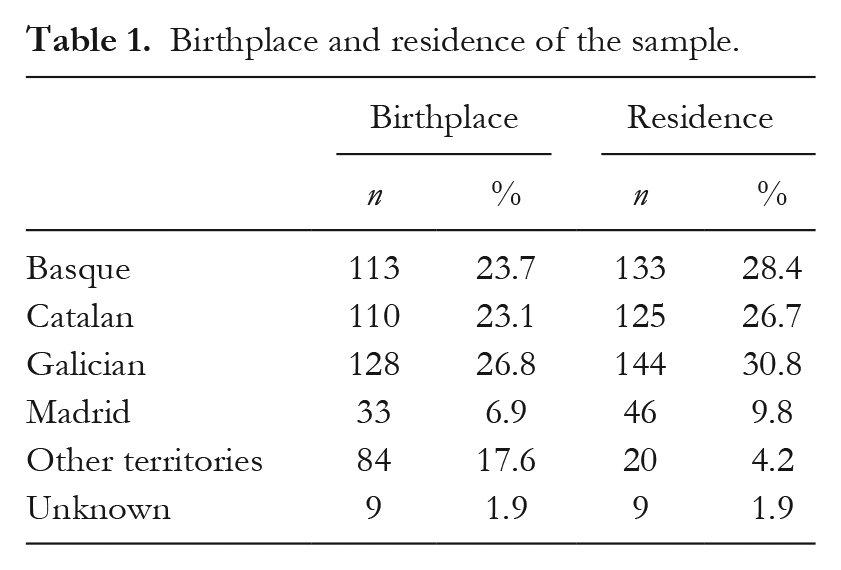
The sample was composed of 339 women (72.6%), 121 men (25.9%) and seven people of non-binary gender (1.5%). The mean age was 24.74 years (SD = 9.54). Participants were also asked which national identity they most identified with, to which 110 (23.1%) participants responded that they considered themselves to be mostly Basque, 99 Catalan (20.8%), 113 Galician (23.7%) and 137 Spanish (28.7%). Nevertheless, in the case of political orientation, we observed an overrepresentation of left ideology (M = 8.08, SD = 1.79). That is why we had to conduct an ad hoc distribution of our sample to better facilitate ideological comparisons. Using a scale of ideological positioning 0 (‘right wing’) to 10 (‘left wing’), those scoring 0 to 7 (n = 120, 25.1%) were regarded as having a centre-right ideology, a score of 7 to 9 (n = 219, 45.9%) indicated a left ideology and, finally, a score of 10 (n = 112, 23.5%) was taken to indicate a far-leftist ideology.
Procedure
To access youths in territories with a national identity, the universities were asked to disseminate our research (online) among their students. The administration of faculties and university rectorships shared an email among students to do so. We presented our research, and we attached the link to access the questionnaire for those who wished to participate. Sampling began in September 2020 and ended in February 2021. This research has obtained the approval of the Ethics Committee of the University of the Basque Country (UPV/EHU).
Data collection
To analyse the participants’ social representations of the Civil War and Francoism, the Grid Elaboration Method (GEM) for free association was used. This technique is commonly used in research on social representations (Joffe & Elsey, 2014) and social representations of history (Bouchat et al., 2019). This method consists of providing participants with instructions and four boxes. In the instructions used here, participants were asked twice to write any ideas that came to mind when they thought first about ‘Civil War’ and then ‘Francoism’. Afterward, the participants were asked to explain why they had chosen those words for each epoch. This final explanation of the words obtained was used as the textual corpus in the analyses.
Once this procedure had been completed, the participants had to state which of the four national identities (Spanish, Basque, Catalonian or Galician) they felt they belonged to. They could choose only one. Finally, they were asked to tell us their ideological orientation on a scale from 0 (‘right’) to 10 (‘left’), in addition to information about their birthplace, residence, age and gender.
Data analysis
The Reinert method using Iramuteq software for lexical analysis (Reinert, 1996) was employed to analyse the text corpus. This method — together with the GEM — has frequently been used to study social representations (Idoiaga & Belasko, 2019), confirming that the results obtained agree with those of other methods used in this field of research (Lahlou, 1996). This method is based on the premise that words are not independent of each other but reflect underlying themes. Reinert’s (1990, 1996) main thesis is that all discourse is expressed from a set of words that constitute units of meaning independently of their syntactic construction.
The redundancy of successions of words, or the concatenation of words that comprise a given discourse, makes it possible to locate the lexical worlds evoked by the enunciators (Molina-Neira, 2017). Iramuteq is a software that eliminates problems of reliability and validity in text analysis by using the Reinert method (Idoiaga & Belasko, 2019; Reinert, 1996). Specifically, the software creates a dictionary of ‘whole words’ (nouns, verbs, adjectives and adverbs). The initial text corpus is then broken down into segments of a sentence or two (40 words). Next, the corpus is analysed in terms of the presence of whole words in the segments. The segments and reduced forms create a contingency table that displays the vocabulary distribution per segment. Next, the program generates a squared distance matrix from this contingency table, indicating that two segments are close if they share some of the words analysed (Reinert, 1996). Subsequently, following the Reinert method, the software runs a descending hierarchical cluster analysis on this table, which yields segments that best differentiate the vocabulary. In so doing, this software assists in the interpretation of texts. It extracts sets of words, referred to as classes, which co-occur and are best able to distinguish between such classes. Specifically, the software identifies the words and text segments with the highest chi-square values, that is, those words and text segments that best identify each class or idea that the participants have repeatedly mentioned.
In accord with previous research using the Reinert method, the raw data were entered into the Iramuteq software. The most significant items of vocabulary in each class were selected based on the following three criteria: (1) an expected value of the word greater than 3; (2) evidence of the chi-square association, tested against the class [χ2 (1) ⩾ 3.89, p > .05]; and (3) the word appears mainly in that class, with a frequency of 50% or more. The Iramuteq software determines which text segments are associated with each class or group of words and classifies them according to their chi-square value. In this study, the text segments with the most significant chi-squares of each class were recorded.
Once these lexical universes have been identified, they are associated with passive variables (i.e., independent variables). In the present case, these passive variables were national identity (participants’ autocategorization) and ideological orientation. Thus, Reinert method operations are statistical, transparent and reproducible until the final stage of interpretation. First, the analyst assigns a label to each specific vocabulary set that the software had identified as a lexical world based on co-occurrences and distribution patterns (Schonhardt-Bailey, 2013). Then, in the final phase, to create the labels or titles of each class, a systematic process was used in which one of the researchers named each class based on the words. Finally, three researchers approved all labels.
Results
Civil War
The corpus was made up of 20,217 words, of which 3,265 are unique. The descending hierarchical analysis divided the corpus into 608 segments and five classes (see Figure 1).
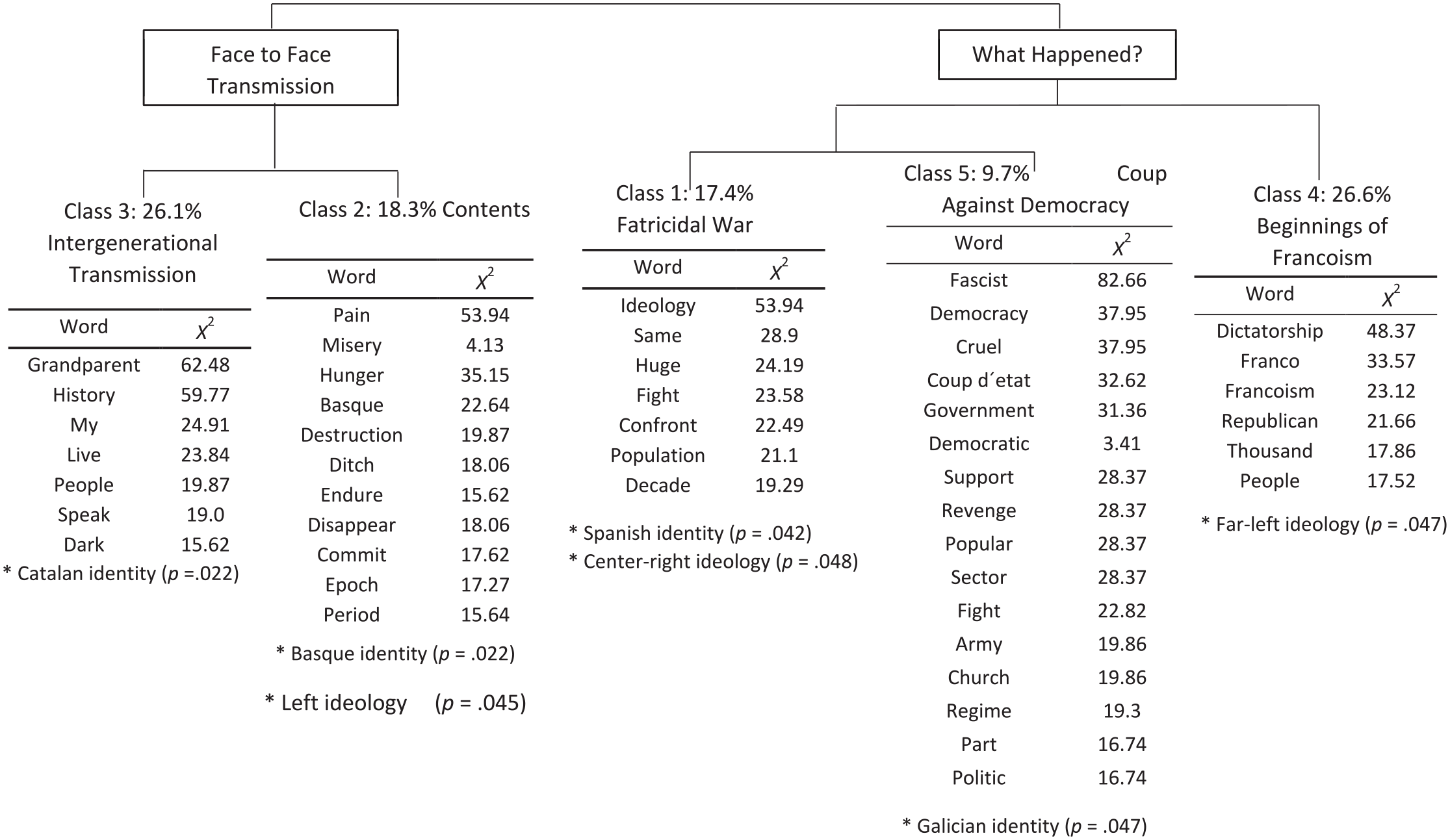
Hierarchical clustering dendrogram of the free association exercise of the Civil War: most frequent words and words with the greatest association, as well as association with ideology and national identity (*).
The main ideas that participants expressed about the Civil War through free association were observed. First, the analysis showed a division of the corpus into two branches. The first branch, starting from the left, was called ‘Face-to-face transmission’, which housed two classes (Class 3, ‘Intergenerational transmission’, and Class 2, ‘Contents’), while the second was called ‘What happened?’, from which three classes emerged (Class 1, ‘Fratricidal war’, Class 5, ‘Coup against democracy’, and Class 1, ‘Beginning of Francoism’).
First, in the branch of ‘Face-to-face transmission’, the third class emerged with a weight of 26.1%, named ‘Intergenerational Transmission’, since this class includes segments in which it is indicated that relatives have transmitted the information. Some of the most characteristic segments of the class were the following: I still currently associate the figure of the Civil Guard with a stale institution, but they are adjectives that make me think of the figure of the past, I know stories from my parents and my grandparents of torture, abuse and humiliations carried out by the Civil Guard, exercising the typical abuse of the one represented by fascism. (χ2 = 184.76, Galician, left ideology) The word ‘grandparents’ comes to me because the grandparents of my generation are the last who will be able to bring lived experiences of the Civil War and we have fewer and fewer victims who are alive, to finish, it has always been said that where there are bombs, there are wars, cartoons, news, stories or tales. (χ2 = 154.69, Catalan, centre-right ideology)
This class was associated with a Catalan national identity (p = .022). As was observed both in the significant words and in the most representative segments of the class, the intergenerational content transmitted is substantially negative (e.g., hunger, aggression).
Class 2 is also in the ‘Face-to-face transmission’ branch, with a weight of 18.3%. This class was labelled as ‘Contents’ because, unlike ‘Intergenerational transmission’, content and events derived from the Civil War appear (e.g., pain, misery, destruction and disappearances). Some of the most characteristic segments of this class were: ‘The Civil War was a horrible historical time, people went hungry and had horrible experiences; death and cruelty were everywhere, there was a great cultural destruction that was barely visible’ (χ2 = 144.34, Catalan, left ideology), and: It was one of misery in which everyone who was not in favour of Franco was shot; in my family, there were many deaths, and that is why they have always told us about it as a bad and cold one in which all those who were not Franco's were hungry, and they had a hard time surviving. (χ2 = 114.81, Basque, left ideology)
In addition, this class was associated with a Basque national identity (p = .048) and a left ideology (p = .045).
In the ‘What happened?’ branch, Class 1 first emerges with a weight of 17.4%. This class was named ‘Fratricidal war’ because within this class the war is represented as an intra-community and even intrafamily conflict. This assumption can be observed more clearly in the characteristic segments of this class: ‘These are the first words that come to mind, and the Spanish Civil War caused a great separation between the population since each one had a different thought and they fought for different sides’ (χ2 = 101.60, Spanish, centre-right ideology); ‘The Civil War divided Spain into two sides that fought to the death during the war, killing enemies but, at the same time, brothers were part of the same country and still deliberately killed each other’ (χ2 = 91.00, Catalan, centre-right ideology). This class was associated with a Spanish national identity (p = .042) and a centre-right ideology (p = .048).
Second, in this same branch, Class 5 emerges with a weight of 9.7%. This class was labelled ‘Coup against Democracy’ because within it appears those segments that accuse the national side and its coup for aggression against the regime of the Second Republic, considering the latter as democratic. Some of the most characteristics segments of the class were ‘a war that arises out of hatred and that is provoked and supported by fascists’ (χ2 = 111.03, Galician, left ideology), and: The coup d'état of the fascist army was the culmination of years of a conspiracy by the Falangist fascists, the Catholic Church, the Legion and more ultraconservative groups against a legitimate and progressive democratic system and government, from here on, cruelly murdered on both sides. (χ2 = 284.83, Spanish, left ideology)
This class was associated with a Galician national identity (p = .047).
Finally, with a weight of 26.6%, Class 4 appeared in this ‘What happened?’ branch. This class was labelled as ‘Beginning of Francoism’ since it is in this class where the segments that link the Civil War with the beginning of the Francoist dictatorship are mainly found. The most characteristics segments of the class are the following: After the Second Republic, these two coalitions end up facing each other, and that is where Franco makes himself known; it is after three years when, after thousands of misfortunes and deaths, Franco and the national front proclaim themselves winners, beginning a horrible dictatorship (χ2 = 163.68, Basque, left ideology). After the conflict between the two rebellious and republican sides there were hundreds of thousands of executions that multiplied when a fascist dictatorship was established that lasted 40 years and it seems that its symbols are still in force on some occasions (χ2 = 157.72, Galician, far-left ideology).
This class was associated with far-left ideology (p = .047).
Francoism
In the same way as the social representations of the Civil War, social representations of Francoism among the youths were analysed using the Reinert method. In this case, the corpus was composed of 20,592 words, of which 3,265 were unique. The analysis divided the corpus into 608 segments, creating five classes (see Figure 2).
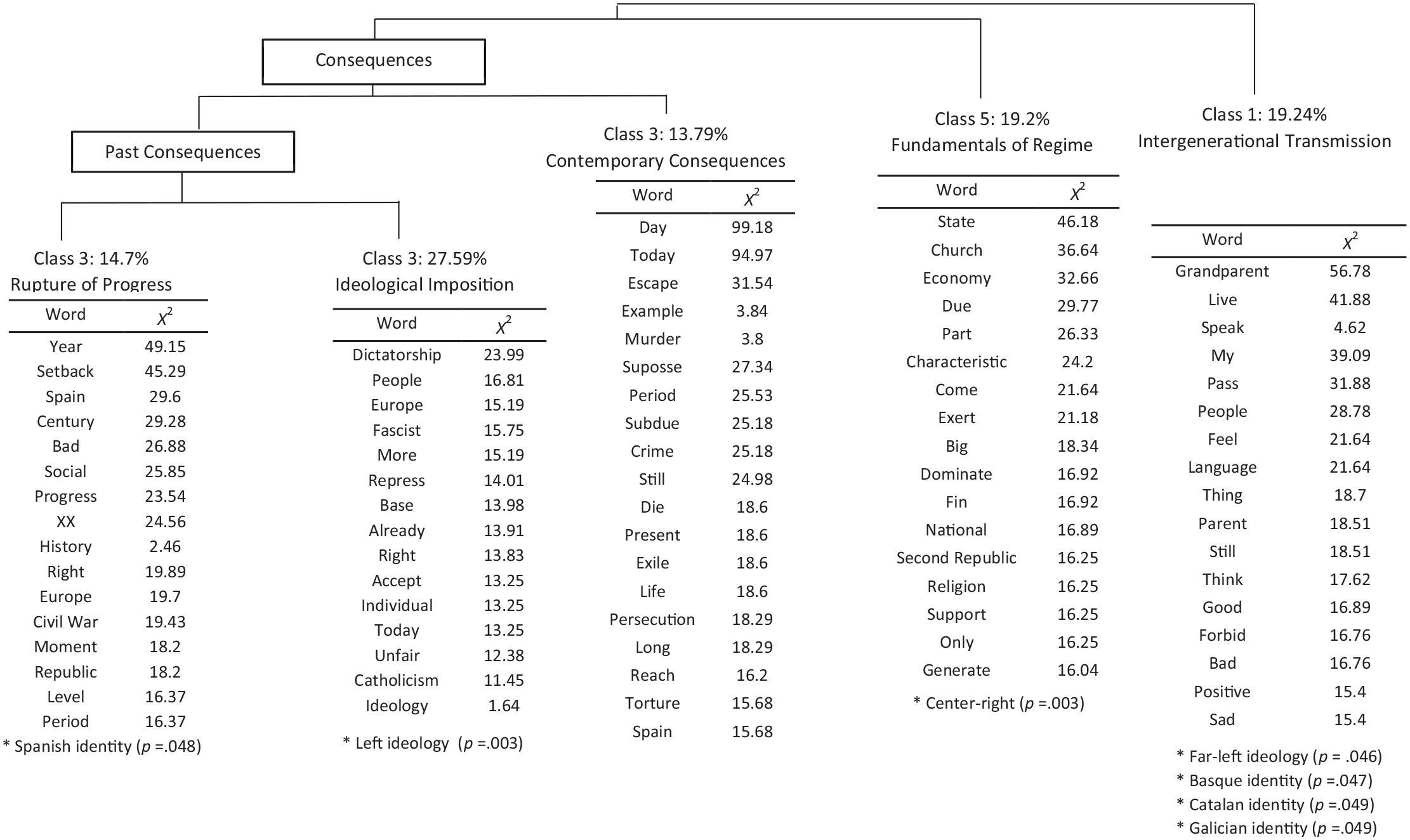
Hierarchical clustering dendrogram of the free association exercise of Francoism: most frequent words and words with the greatest association, as well as association with ideology and national identity (*).
As shown in the figure, the hierarchical descending analysis generated different branches following its analyses. Two branches were identified; the first refers to all those classes identified as consequences of Francoism (Class 3, ‘Breakdown of progress’, Class 2, ‘Ideological imposition’, and Class 4, ‘Contemporary consequences’). A second division was observed within this branch, referring to past consequences of Francoism (i.e., settled in its own time; Class 3, ‘Breakdown progress’, and Class 2 ‘Ideological imposition’) along with another class concerning the consequences in the present.
First, within the ‘Past consequences’ branch, Class 3 appeared with a weight of 14.79%. This class was labelled as ‘Rupture of progress’ since Francoism is referred to as a regime that stopped the social advances of the time, and the precursor of setback could be observed. This detention of progress seemed to be based on a comparison with the previous regime (i.e., the Second Republic) or the advances in the rest of Europe. The most characteristics segments of the class are as follows: ‘Misery because the standard of living during the first 20 years was very bad with an autarky that condemned Spain to several decades of unnecessary economic backwardness in addition to hunger and ration cards’ (χ2 = 181.41, Spanish, left ideology), and: Setback with respect to the great social, cultural and civic and material advances initiated during the progressive years of the Second Republic, finally, the chronification of the culture of the martial, machoism, the reactionary and the conservative, the cancellation of the questioning of reason and the critical thinking (χ2 = 173.62, Spanish, far-left ideology).
This class is associated with a Spanish national identity (p = .048).
Second, in the same ‘Past consequences’ branch, Class 2 appeared with a weight of 14.7%. This class was labelled as ‘Ideological imposition’ because it refers to the ideological imposition of the regime’s foundations through the oppression and repression of the population or towards any thoughts outside the institutionalized regime. The following were the most characteristic segments of this class: A fascist dictatorship that has done nothing more than literally eliminate the vast majority of people with progressive ideology, class consciousness and feminist consciousness, to leave a legacy of reactionary and neoliberal fascist ideology that prevents us from developing (χ2 = 92.78, Catalan, far-left ideology). Because it was a fascist regime in which a dictatorship ruled, it caused a lot of repression since it only accepted one way of thinking, this fascist dictatorship was characterized by a national Catholic ideology, and that was the only accepted form (χ2 = 92.08, Basque, left ideology).
Outside the ‘Past consequences’ branch, but within the ‘Consequences’ branch, Class 4 emerged with a weight of 27.59%. In this class, labelled ‘Contemporary consequences’, segments that referred to the present legacy or effects of that epoch were observed. In this regard, we observed a certain internalization of the narratives about Francoism within the sample. This narrative of Francoism as something continuous up to the present made us consider that a certain proportion of the participants question the democratic transition in Spain. The most characteristic segments of this class were as follows: Basically in opposition to the republic, the three years became more than 40 of the fascist regime, which makes it long, oppressive and deadly for many people and also today many Francoist estates are still present in our lives (χ2 = 295.19 Catalan, left ideology). In addition, the Franco family even today is not willing to compensate to the Spanish people for all the damage they did, they still have much of what they stole, and it is seen that they have no intention of making up for their crimes or asking for forgiveness (χ2 = 277.51, Galician, left ideology).
This class was associated with a left ideology (p = .003).
The next class was the fifth one situated outside the ‘Consequences’ branch, and with a weight of 19.2%. This class was labelled as ‘Institutional features of the regime’ because it refers to the ideological principles of Francoism. This could be seen in the most characteristic segments of the class: ‘The injustice is also given by the fact that Franco proclaimed himself governor without allowing the citizens to choose who, after all, were people who were part of Spanish society like him’ (χ2 = 110.24, Catalan, centre-right ideology), and: Poverty after a war, there is usually poverty due to the destruction generated, in addition, given the characteristics of dictatorships, a lot of control, little freedom, etc., economic recovery is slow, due to the control they exercise over all economic and social spheres (χ2 = 152.01, Galician, centre-right ideology).
This class was associated with a centre-right ideology (p = .003).
Finally, isolated in another branch, Class 1 emerged with a weight of 19.24%. This class was labelled as ‘Intergenerational transmission’ because, as in the case of the Civil War, it refers to the experiences transmitted by the family about this issue. As can be seen in the characteristic segments of the class, these experiences are negative, with hunger and the repression of the language, among others, being the aspects that are most referred to in this class: ‘Francoism causes me many negative feelings when I see something about it or listen to my grandparents and my parents talk about it, it affects me negatively’ (χ2 = 203.42, Galician, left ideology), and: Clear repression, executions, imprisonment, torture, censorship, etc., of any movement contrary to Franco's doctrine, extreme poverty, as seen in images and told by my grandmothers, corruption and resistance from what has been read in articles and interviews with people who lived through it (χ2 = 157.40, Catalan, extreme-left ideology).
This class was associated with Galician (p = .049), Basque (p = .047) and Catalan national identity (p = .049) and far-left ideology (p = .046).
Discussion and implications
The main objective of this research was to analyse the social representations of the Civil War and Francoism among the youth. Our results show that in Spain, social representations of the past are strongly anchored by ideological positions (despite not having a representative sample of right-wing individuals) and the various national identities present in the country. Thus, our findings provide new information, which should be considered both in future research and in social policies when addressing the issue.
On the one hand, the Reinert analyses show the presence of the redemptive narrative in individuals with a centre-right ideology and a Spanish national identity, in the case of the Civil War, and a non-judgemental description of the dictatorship only in the case of those who identify with a centre-right ideology. First, in the case of this representation of the war, this narrative aims to justify the political decisions made in the formation of the current regime (Bar-Tal et al., 2009; Kus et al., 2013) and shows the opposition to historical revisionism adopted by right-wing parties (Yusta, 2014). In this way, it also maintains a positive image of the group (Tajfel & Turner, 1986), by blaming both sides equally for the war. Following this principle of maintaining a positive image and considering that the social representations of the past constructed by these groups are selective, the narrative of Francoism is built. Indeed, similarly to the redemptive narrative, Francoism is not questioned in the centre ideological class, and the repressive events and violations of human rights are not used to construct the representation of the dictatorship.
On the other hand, Reinert analyses also showed the existence of different narratives constructed by individuals on the left and far left, as well as from peripheral national identities that seem to be in dialogue with each other. First, in the case of the Civil War, we can observe how individuals on the left and Basque and Catalan nationalisms construct their social representations of the war through intergenerational voices, creating a narrative of suffering about what happened. This narrative maintains a positive image of the groups (Tajfel & Turner, 1986) and gives meaning to the losses of a group that, thanks to the construction of these narratives, continues to exist today (Hirschberger, 2018). The absence of the construction of the social representation of the war in the Galician national identity, adopting a discourse commonly seen in left-wing individuals (see Arnoso et al., 2012; Manzi et al., 2004), could be due to a contextual factor. Indeed, since the coup d'état took place in Galician territory, there was no war in that region, but rather direct repression by the insurgent side (Rodríguez Gallardo, 2018). To conclude the discussion on the Civil War, the far-left ideology was associated with a class that portrayed the beginning of Francoism because of the war. This, combined with their interpretation of the Franco era, constructs a discourse that implies the continuity of Francoism to the present day. However, when examining how people with this ideological stance construct their representations of Francoism, we can observe that, as well as peripheral national identities, the far left represents this era through the voices of their family members. In this way, similarly to the case of the war with peripheral nationalisms, the ideological position within this spectrum could be considered a social identity, perpetuating the ideological group and highlighting the suffering they experienced, something that Busse et al. (2017) already observed in their interviews with young people. Finally, it should be noted that the Spanish identity was associated with narratives from left-wing parties about the disruption of progress due to Francoism. However, it is worth remembering that not all people who identified as Spanish supported Francoism.
In summary, the results seem to indicate the presence of institutional and political voices, contrasting with the emergence of intergenerational voices, leading to discrepancies between cultural and communicative memory. Cultural memory refers to the institutional mediated narrative of what happened (e.g., commemoration or public education). For its part, communicative memory refers to the oral transmission of what happened, which is subject to the group dynamics of forgetting and remembering, this being a semantic knowledge that culture provides (Paez & Liu, 2011). Thus, as indicated by the theory of social representations, the representations of the Spanish Civil War and Francoism in Spain are in dialogue and negotiation, with some having more negotiation than others, due to dialogical and ideological tensions (see Markova, 2003). However, this study only collects the social representations of a youth population with a strong left-leaning tendency and a specific educational background. Therefore, the results could substantially differ, and it would be pertinent to conduct a study on the social representations of these historical periods, focusing on the meaning-making processes, in a more heterogeneous and larger sample, aiming for equity in terms of ideology and gender among participants.
This study has several limitations that should be considered, especially when generalizing these results to the entire Spanish society. First, the ideological position of the sample tends to be left-wing. Although this influences our findings, it's important to note that this is a common limitation in samples of university students. However, it should be considered that for future studies, a more diverse and representative sample should be obtained in terms of ideological positioning to provide a more comprehensive understanding of the topic. Second, extending the sample to the entire population of the chosen territories could considerably improve the external validity of our results. Third, the sample collected in Madrid could be biased when externalizing the results to the Spanish identity in general. Fourth, the sample in this research is overrepresented by women, so gender should be controlled for in future research studies. Finally, even though Madrid has a significant degree of heterogeneity in terms of the origin of the population, according to the epistemology of the theory of social representations, the context of the capital compared to other areas of Spain (where there is no peripheral national identity) may have influenced the data obtained. To address this issue, this study should be replicated, seeking to obtain samples from different areas of the state.