



Abstract
Previous research shows that animalistically dehumanizing low-socioeconomic-status (SES) groups, compared to high, favours maintaining socioeconomic differences. Less is known about the variables that trigger the (de)humanization of these groups. We rely on previous literature about the causes of dehumanization to perform an extended analysis of the variables that potentially predict the attribution of humanity to these groups. In a large study (N = 765), we included several steps using hierarchical regression analysis to identify the contribution of each psychosocial process. Results highlight that low-SES (de)humanization was predicted by unrest and security towards the poor along with social dominance and hostile classic attitudes, while high-SES (de)humanization was predicted by individuals’ sex, admiration and (lack of) shame towards the rich. This double path of ascribing humanity to groups based on their status is discussed and practical interventions to narrow the perceived humanity gap between low and high SES are highlighted.
Groups at the bottom of the social ladder are considered less human (animal-like) than those who are at the top of the socioeconomic standing. This perceived humanity gap has been found in several studies in which low-socioeconomic-status (SES) groups (i.e., poor people and disadvantaged groups) are viewed as less evolved, with fewer human uniqueness traits, and closer to certain animals than high-socioeconomic-status groups, who are seen as more evolved, cultured and rational (Loughnan et al., 2014; Sainz, Martínez, Moya, & Rodríguez-Bailón, 2019). The consequences of this (de)humanized perception of both extremes of the social ladder are severe: dehumanizing low-SES and humanizing high-SES individuals seems to trigger the rejection of public redistribution policies or social spending, which serves to reinforce the income gap within society (Sainz, Martínez, Rodríguez-Bailón, & Moya, 2019; Sainz, Martínez, et al., 2020). Nevertheless, even when previous research has addressed the consequences of this process, it has not properly acknowledged the specific reasons behind the different attributions of human uniqueness (HU) traits to low- and high-SES groups. Thus, the present project aims to perform an extended exploratory analysis of the variables that predict the attribution of humanity to low- and high-SES groups to highlight possible practical interventions for its reduction.
(De)humanization of low- and high-SES groups
Dehumanizing individuals and groups — perceiving them as less human or with fewer human traits compared to oneself or their own groups — has detrimental consequences on interpersonal and intergroup relationships (for a review, see Haslam & Loughnan, 2014; Haslam & Stratemeyer, 2016; Vaes et al., 2012). The consequences of this process range from reducing prosocial behaviours towards dehumanized people (Andrighetto et al., 2014), reinforcing existing conflicts (Bruneau & Kteily, 2017; Leidner et al., 2013), favouring discrimination against minorities (Goff et al., 2008; N. S. Kteily & Bruneau, 2017) or even legitimizing socioeconomic inequality (Sainz, Loughnan, et al., 2020; Sainz, Martínez, et al., 2020).
Furthermore, the dehumanization process can manifest in different ways based on the human traits or characteristics that are denied. In this sense, Haslam (2006) proposed that individuals or groups can be perceived as machines (i.e., mechanistic dehumanization) when they are considered to be lacking human nature (HN) traits, such as their emotionality, warmth or cognitive flexibility. This type of dehumanization allows individuals to avoid emotional contagion, experience less disruptive emotional states or allow deny others’ needs (e.g., patients, workers; Vaes & Muratore, 2013). Further, Haslam’s (2006) model also proposed that individuals or groups can be equated to animals (i.e., animalistic dehumanization) when they are considered to lack HU traits, such as civility or rationality. This dehumanization form is associated mainly with socially disadvantaged groups, such as immigrants, refugees, ethnic minorities or groups lacking socioeconomic status (Esses et al., 2008; Goff et al., 2008; Loughnan et al., 2014). Due to this, animalistic dehumanization has been considered a hierarchical-based dehumanization that triggers the perception that socioeconomic differences or unequal access to resources is a natural outcome within societies: those who have more (resources or higher standing) are considered more human or more evolved and deserving of their privileged position compared to those who lack humanity and, thus, are worthy to occupy the lowest standing within the social ladder (Loughnan et al., 2014; Sainz, Martínez, Moya, & Rodríguez-Bailón, 2019).
This hierarchical-based attribution of HU traits to individuals and groups is especially relevant in the socioeconomic domain. Within this context, low-SES groups (i.e., poor people) are considered as lacking HU traits and being less evolved compared to high-SES groups (i.e., rich people). This perceived humanity gap has been found in several studies in which low-SES people are perceived closer to animals or considered as having fewer HU traits than high-SES people (Loughnan et al., 2014; Sainz, Martínez, Moya, & Rodríguez-Bailón, 2019). The perceived humanity gap between both extremes of the socioeconomic ladder has detrimental consequences. For instance, dehumanizing low-SES groups leads people to blame the poor for their plight, making internal attributions about poverty (Sainz, Martínez, et al., 2020) or considering the group as having inadequate consumption practices that make them waste their income and, thus, less deserving of help (Sainz, Loughnan, et al., 2020). In addition, perceiving high-SES individuals as more human in terms of HN reduces an individual’s willingness to implement progressive taxation systems or redistribution policies as a consequence of considering that rich groups earn their wealth by their means (i.e., internal attributions about wealth; Sainz, Martínez, Rodríguez-Bailón, & Moya, 2019). This leads to the conclusion that the perceived humanity gap between both extremes of the socioeconomic ladder contributes to justifying socioeconomic differences. However, less is known about the specific antecedents that lead people to (de)humanize low- and high-SES groups.
Antecedents of intergroup processes: the case of humanity attributions
Research has made efforts to understand the causes of intergroups’ attitudes (Hodson & Dhont, 2015) as well as others’ dehumanization (see Haslam & Loughnan, 2014; Vaes et al., 2012). Particularly, the variables that can act as antecedents or precursors of humanity attributions overcome a wide range of processes that go from individual differences to contextual perceptions, or ideological positionings. In this project, we rely on previous antecedents of prejudice and dehumanization research to perform an extended analysis of the variables that predict the (de)humanization of low- and high-SES groups. In the following pages, we review some of the possible antecedents from the ones that are expected to have the least predictive power to the ones that are expected to have higher predictive capacity (Table 1).
Summary of the predictors included in the analyses and the expected outcomes regarding the attribution of humanity to low- and high-SES groups.
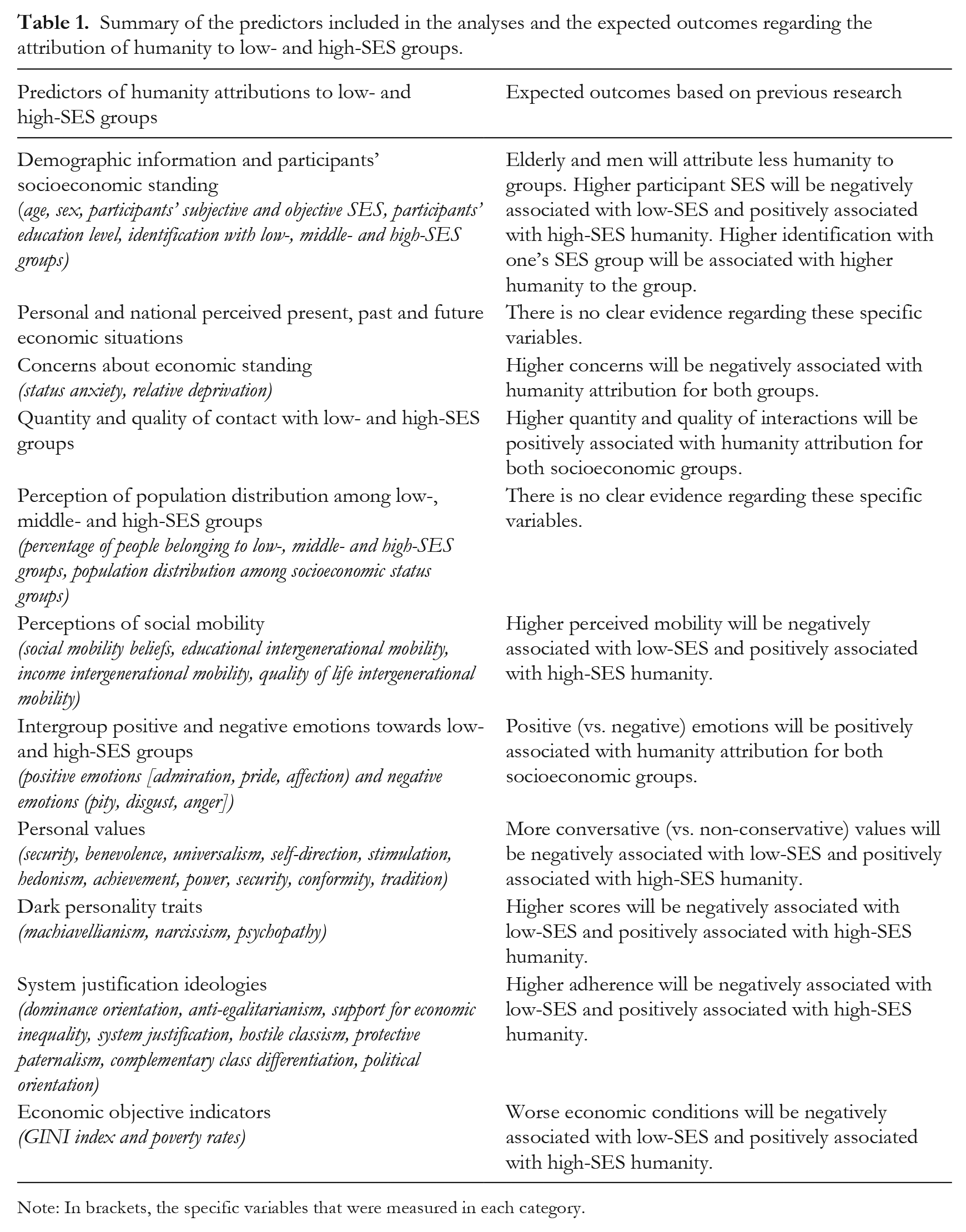
Note: In brackets, the specific variables that were measured in each category.
Demographic information and individuals’ socioeconomic standing
Individuals’ socio-demographic features are important triggers of several psychological processes (Hodson & Dhont, 2015). Some of the demographic variables are related to prejudice tendencies such as individuals’ age (i.e., elderly people exhibit more prejudice than younger people; Cornelis et al., 2009), sex (men expressed significantly more prejudice against various outgroups; Dozo et al., 2014; Kudrnáč, 2017) or socioeconomic status (e.g., the working class is more prejudiced towards certain groups such as immigrants; Lipset, 1959). Nevertheless, evidence is not so clear regarding (de)humanization processes: even when some studies have shown that children tend to dehumanize outgroups (Costello & Hodson, 2014) or their peers in the context of abusive relationships (Pozzoli et al., 2012; van Noorden et al., 2014), less is known about the role that individuals’ age might play in the tendency to dehumanize others. This lack of evidence can also be applied to men’s and women’s dehumanization tendencies with a lack of evidence about one sex with higher prevalence of others’ dehumanization than the other sex (Vaes et al., 2011). Finally, in the dehumanization field, there is also a lack of consistency of individual SES on predicting humanity towards others, especially regarding poor and rich groups (Sainz, Martínez, Moya, & Rodríguez-Bailón, 2019). Therefore, further research is needed to clarify these sociodemographics’ roles on the (de)humanization processes — specifically on the socioeconomic realm. This should also be addressed along with an analysis of how self-identification as a member of low-, middle- or high-SES groups might play a role in predicting dehumanization even above an individual’s own social class (Kaiser & Wilkins, 2010).
Perceptions and concerns about individuals’ socioeconomic standing
Perceptions of personal economic downturns trigger negative attitudes towards disadvantaged groups as a consequence of the increased competition and perceived realistic conflict (Burns & Gimpel, 2000; Riek et al., 2006). However, recent work has also highlighted how economic prosperity can favour the hardening of anti-immigration policies (Anier et al., 2016; Jetten et al., 2015), showing that not only hard times but also prosperous times increase the derogation of disadvantaged groups (the wealth paradox; Jetten, 2019). Furthermore, past conditions and future estimations trigger what individuals feel and how they behave about others (Jetten et al., 2015; Postmes & Smith, 2009). Finally, regarding dehumanization tendencies, previous research has explored the role of current economic crises perceptions in the appearance of mutual dehumanization between agents involved in economic conflicts (e.g., Germany vs. Greece; Sainz, Loughnan, et al., 2021).
In addition to these perceptions, individuals’ concerns about their own economic standing play a role. In this sense, status anxiety (i.e., the psychological tendency to worry about losing one’s SES and lacking socioeconomic success in the view of society; De Botton, 2004; Melita et al., 2020), along with perceptions of relative deprivation (i.e., perceived lack of resources compared to others), shapes individuals’ emotions, behaviours and cognitions (Carrillo et al., 2011; Delhey & Dragolov, 2014; Melita et al., 2021; Smith et al., 2012). Further, relative deprivation is related to negative attitudes (Jetten et al., 2015; Pettigrew et al., 2008) and dehumanization. Research shows how higher relative deprivation seems to be related to higher levels of prejudice and dehumanization of low- (but not high-) status immigrant groups (Gheorghiu et al., 2022). Finally, even when there is not much evidence about the role that status anxiety has on developing attitudes and attribution of humanity, it can be expected that, to a certain extent, the need for gaining or keeping status might be related to a dehumanized vision of poverty as well as to a humanized perception of the rich.
Perceptions and interactions with low- and high-SES groups
Individuals’ perceptions and interactions with low- and high-SES groups can also trigger intergroup attitudes and (de)humanization. In this sense, the role of quantity and quality of contact interactions must be acknowledged: under the optimal conditions (Allport, 1954), (quality of) contact with others might lead to reduced prejudice against a set of outgroups (Pettigrew & Tropp, 2000). This pattern of results has been found in longitudinal analyses that show how contact causes a reduction not only in intergroup attitudes but also on infrahumanization perceptions (i.e., the attribution of fewer uniquely human emotions to outgroups than to ingroups, Brown et al., 2007). In this line, previous correlational (Drury et al., 2017), longitudinal (Bruneau et al., 2021) and experimental research (Capozza et al., 2017) has shown that increasing direct or indirect contact (extended, imagined, etc; Capozza et al., 2014; Falvo et al., 2014; Vezzali et al., 2014) can favour outgroup humanization. Therefore, it can be expected that positive (vs. negative) experiences of contact with low- or high-SES groups might play a role in attributing humanity to them.
In addition to contact and interactions, individuals’ perceptions of population distribution among socioeconomic classes can also be important attitude triggers. The estimation of the population distribution captures specific details of how inequality is framed in the individual’s mind by focusing on the number of individuals that are perceived as low, middle or high SES within a society. On this point, previous research addressed similar issues by exploring how the perceived group size of immigrant groups related to perceptions of the immigrant’s right to stay in the host country (Zagefka et al., 2020). Similarly, research on dehumanization also shows that numeral minorities are more likely to be judged as less human (Prazienkova et al., 2017). Despite the differences between this previous work and the present study, there are grounds to believe that the perceived group size of poor (vs. rich) groups might have an influence on humanity attributions.
Apart from the population estimations, people’s judgments about social mobility are relevant when judging low- and high-SES group stranding. The perceived individual capability to move up or down in social standing, compared with their peers or family members, is an important frame that people use to judge SES differences or existing levels of economic inequality (Davidai & Wienk, 2021; Day & Fiske, 2019; Gugushvili, 2016). However, less is known about how this variable might relate specifically to negative attitudes towards other groups. In this regard, certain studies highlight that objective social mobility does not lead to more negative or hostile attitudes towards immigration compared to other socially related variables (e.g., individual social class; Stawarz & Müller; 2020; Tolsma et al., 2009). However, others pointed out that, in general, people living in high (vs. low) downward mobility contexts show more hostile attitudes towards immigrants (Paskov et al., 2021). Concerning the tendency to dehumanize others, to the best of our knowledge, no attempts have been made to link poor and rich people’s attributions of humanity as a function of the intergenerational or societal social mobility. On this issue, it can be expected that higher social mobility perceptions will be correlated with people’s tendency to perceive a wider humanity gap between the poor and the rich. The more opportunities to improve one’s life conditions, the more people will think that the ones who are stuck in poverty are in that circumstance because they lack certain traits (i.e., are less human) and the ones who succeed in life are more personally skilled (i.e., are more human).
Finally, intergroup emotions play a role in the appearance of dehumanization tendencies. For instance, different facets of disgust are related to dehumanization especially towards disadvantaged groups (Buckels & Trapnell, 2013; Harris & Fiske, 2007; Hodson & Costello, 2007; Valtorta et al., 2021), but also, guilt-related processes seem to favour dehumanization in the context of intergroup violence or reparation policies (Castano & Giner-Sorolla, 2006). Further, research also shows that fear and anger (Giner-Sorolla & Russel, 2019) and contempt and (lack of) admiration (Esses et al., 2008) play a role in the tendency to dehumanize various groups and their surrounding consequences.
Individuals’ traits and personal characteristics
Some of the traits and individual characteristics considered relatively stable play a role in developing attitudes and dehumanization tendencies. For instance, personal values that serve as guiding principles in each individual’s life are related to the perceptions of others (Schwartz, 1994; Smith & Schwartz, 1997). In the Australian context, adhering to certain personal values, such as self-enhancement and conservative values, is positively related to prejudice towards Australia’s aboriginals (Feather & McKee, 2008). Self-transcendence is also negatively related to prejudice against asylum seekers in Australia (Hill & Murray, 2020) and national strength values are positively related to prejudice towards Middle Eastern people (Heaven et al., 2006). Further, personal values can also relate to the attribution of humanity to others: Greenhalgh and Watt (2015) identified that perceived value dissimilarities, especially in self-transcendence and self-enhancement, between ingroup members and outgroups, such as asylum seekers, led to greater dehumanization and prejudice towards this group.
In addition, previous research has addressed how personality traits are relevant to the appearance and development of prejudice against others (Sibley & Duckitt, 2008). For instance, research has examined the role of socially aversive or subclinical personality traits (Paulhus & Williams, 2002) on the development of prejudice. Among these ‘dark traits’, research distinguishes between Machiavellianism (i.e., tendency to manipulate others and a lack of sincerity or ethical concern), narcissism (i.e., perceptions of superiority over others, exaggeration of self-worth) and psychopathy (i.e., antisocial behaviours, low empathy and lack of remorse; Lee & Ashton, 2005; Vernon et al., 2008). All of these factors are related to not only prejudice but also the dehumanization process. This is the case, for instance, of people with high psychopathy who showed a tendency to dehumanize women (Methot-Jones et al., 2019), or the case of narcissistic individuals who are willing to see others as less human than themselves (Locke, 2009). Moreover, other evidence highlights how outgroup dehumanization mediates the relationship between the dark personalities and outgroup avoidance tendencies (Capozza et al., 2019), or that Machiavellianism and psychopathy partially mediated the associations between childhood maltreatment and outgroup dehumanization (Jiang et al., 2021).
Finally, individuals’ preferences for social dominance (i.e., individuals’ support or preferences for social hierarchies; social dominance theory; Sidanius & Pratto, 1999), adherence to system justification beliefs (i.e., individuals justifying beliefs about the current unequal economic system; system justification theory, Jost & Banaji, 1994) and political conservatism (i.e., the adherence to traditional values in opposition to social change; Jost et al., 2003) can trigger the tendency to dehumanize others (for a review, see Haslam & Loughnan, 2014; Vaes et al., 2012). In this sense, individuals scoring higher on social dominance or legitimization beliefs or who are politically conservative are more prone to dehumanizing disadvantaged groups, such as immigrants, refugees or ethnic minorities (Banton et al., 2020; DeLuca-McLean & Castano, 2009; Esses et al., 2008; Hodson & Costello, 2007; Russo & Mosso, 2019).
Related to this, both tolerance to inequality (Wiwad et al., 2019) and the different components of the classism attitudes, from the more hostile to the more paternalistic manifestations of this process (Jordan et al., 2020), can also reinforce the status quo. However, less is known about how attributions of humanity can be related to both preferences of inequality and ambivalent classism attitudes. Preliminary evidence shows that preference for inequality is related positively to the humanity ascribed to the rich and related negatively to the humanity ascribed to the poor (see study 3a–b; Sainz, Martínez, Matamoros-Lima, et al., 2021). Further, in a Spanish sample, hostile classism (not paternalistic attitudes) is strongly related to the attribution of humanity to the poor (Sainz, Lobato, & Jiménez-Moya, 2021).
Economic objective indicators
In recent years, psychosocial research has used a variety of country-level indicators, such as the country level of gender equality (Kosakowska-Berezecka et al., 2020), the GINI index or the gross domestic product per capita (García-Sánchez et al., 2019), to predict a series of interpersonal or intergroup outcomes. This procedure allows research to analyse how the relationship between certain variables can be predicted by societal or national standing or to address how certain national-level variables can shape psychological processes. In the present project, it is possible that attitudes and perceptions about extremes of the social ladder (i.e., low- and high-SES groups) are shaped by the current economic country-level conditions, such as the objective level of economic inequality (SEMARNAT, 2019) or the country level of poverty rates (CONEVAL, 2020).
The present research
This work aimed to explore the role of several variables as antecedents of the humanity attributions of low- and high-SES groups. Specifically, based on the psychosocial literature relating to the antecedents of negative attitudes and dehumanization of individuals and groups, we performed an extended exploratory analysis of the variables that trigger (a) the humanity ascribed to the low- as well as (b) the high-SES groups’ humanity (see preregistration: https://osf.io/vsn83). To do so, we carried out a study with participants from the general Mexican population. Data and materials can be found online: https://osf.io/c2et3/
Method
Participants and procedure
Participants were recruited from the general Mexican population by using Prolific Academic’s services. They received compensation for participating in the study (£1). To estimate the sample size, an a priori analysis was carried out using G*power software (Faul et al., 2009) for a linear multiple regression function (fixed model, R2 increase). However, as stated in the preregistration plan, we aimed uniquely to include in the regression analysis those variables that were significantly related to the rated humanity of low- and high-SES groups. Because we did not know the number of variables that would be correlated, we considered a total of 20 variables, an f2 = .03, 80% power and an alpha of .05. The results yielded a minimum of 715 participants 1 . Thus, we collected a sample of 765 participants, 22 of which were excluded because they did not meet the registered inclusion criteria (Spanish speakers with Mexican nationality and answering the full questionnaire). The final sample included a total of 743 (307 women, 431 men and five others; Mage = 26.19; SD = 7.42)2.
Measures
Participants answered the following measures.
Demographic information and participants’ socioeconomic standing
Participants provided their age, sex, subjective SES (10-step MacArthur ladder from 1: ‘low-SES’ to 10: ‘high-SES’; Adler et al., 2000), objective socioeconomic status (monthly household income per person; Kraus & Keltner, 2009), education level (from 1: ‘no formal education’ to 10: ‘postgraduate studies’) and finally, SES identification as a member of the low-, middle- and high-SES groups (from 1: ‘not at all’ to 7: ‘completely’).
Personal and national perceived present, past and future economic situations
We included three indicators measuring perceptions of the present (‘How would you describe your current economic personal situation?’; from 1: ‘very bad’ to 7: ‘very good’), past and future personal economic situation (‘Now, please think about your personal economic situation three years ago/in the next three years. To what extent would you describe your personal economic situation three years ago/in the next three years to be worse, the same or better than it is now?’; from 1: ‘a lot worse’ to 7: ‘a lot better’). Further, participants answered the same three questions applied to the national perception of the present, past and future economic situation (e.g., ‘How would you describe the current national economic situation?’; from 1: ‘very bad’ to 7: ‘very good’). Questions were adapted from Jetten et al. (2015).
Concerns about economic standing
To measure participants’ concerns about their economic standing, we included a measure of status anxiety (five items, e.g., ‘I am concerned that my social status will not improve’; α = .85; Melita et al., 2020) and a measure of relative deprivation (five items, e.g., ‘I feel deprived when I think about what I have compared to what other people similar to me have’; α = .69; Carrillo et al., 2011). Answers ranged from 1: ‘not at all’ to 7: ‘completely’.
Quantity and quality of contact interactions
We measured the quantity of contact with low-, middle- and high-SES groups with two items (e.g., ‘Think of all the people you know. What percentage of the people you know belong to the following social classes: low, middle and high SES (the total sum must be 100)?’; r = .74, p < .001). Answers ranged from 0 to 100. Additionally, quality of contact was measured with two items (e.g., ‘When you interact with people of low/middle/high SES, to what extent is the contact friendly?’; r = .49, p < .001). Both measures were adapted from Hässler et al. (2020). Answers ranged from 1: ‘not at all’ to 7: ‘completely’.
Perception of population distribution among socioeconomic classes
Participants were asked to provide a first estimation of the percentage of people belonging to low-, middle- and high-SES groups in Mexico. Moreover, a second question displayed five diagrams showing different population distributions along with social classes (e.g., a distribution of most of the population at the bottom of the pyramid and a small amount at the top). Participants were asked to choose the diagram that better suited the population distribution in Mexico (Castillo et al., 2012).
Perceptions of social mobility
To measure participants’ perception of social mobility within their context, we included the first measure of social mobility beliefs (six items, e.g., ‘No matter who you are, you can significantly change your status a lot’, α = .88; Browman et al., 2022). Answers ranged from 1: ‘completely disagree’ to 7: ‘completely agree’. Further, we included a second measure with indicators of perceived intergenerational mobility (three items, e.g., ‘Your educational level/income level/quality of life is . . . compared to your parents’ at your age’; Reynolds et al., 2019). Answers ranged from 1: ‘lower/worse’ to 7: ‘better/higher’.
Intergroup emotions towards low- and high-SES groups
Participants rated the extent to which they experienced 24 emotions (positive and negative; e.g., anger, admiration) when interacting or thinking about low- and high-SES groups. These emotions were originally included in Fiske et al. (2002), and Cuadrado et al. (2016) used them with Spanish speakers. Answers ranged from 1: ‘never’ to 7: ‘constantly’.
Personal values
Participants rated their adherence to the 40 statements of the Schwartz values scale (Schwartz, 1992) by using the version of the scale adapted to the Spanish context (García del Junco et al., 2010). The scale differentiated between benevolence (four items, e.g., ‘Help the people around me’, α = .77), universalism (six items, e.g., ‘May every person in the world be treated equally and fairly’, α = .90), self-direction (four items, e.g., ‘Be independent’, α = .76), stimulation (three items, e.g., ‘Always look for adventures’, α = .86), hedonism (three items, e.g., ‘Have fun whenever I can’, α = .88), achievement (four items, e.g., ‘Be better than others’, α = .78), power (three items, e.g., ‘Be in charge and tell other people what to do’, α = .82), security (five items, e.g., ‘Live in safe places’, α = .79), conformity (four items, e.g., ‘Be satisfied with what I have’, α = .67) and tradition (four items, e.g., ‘Follow customs and traditions’, α = .67). Answers ranged from 1: ‘not at all important for me’ to 7: ‘very important for me’.
Dark personality traits
Participants answered the 24 items of the Spanish adaptation of Salessi and Omar’s (2018) Dark Triad Scale. This scale differentiated among the following sub-factors: Machiavellianism (nine items, e.g., ‘You have to know how to wait for the right moment to take revenge’, α = .78), narcissism (nine items, e.g., ‘People see me as a natural leader’, α = .68) and psychopathy (six items, e.g., ‘I like to make fun of losers’, α = .65). Answers ranged from 1: ‘completely disagree’ to 7: ‘completely agree’.
System justification ideologies
To measure participants’ ideological positioning, we included several scales. The Social Dominance Orientation Scale (SDO, eight items, subfactors: dominance orientation, e.g., ‘Some groups of people are simply inferior to other groups’, α = .67; antiegalitarianism, e.g., ‘Group equality should not be our ideal’ [reverse coded], α = .72; Ho et al., 2015). The Support for Economic Inequality Scale (five items, e.g., ‘Economic inequality is causing many of the world’s problems’, α = .74; Wiwad et al., 2019). The System Justification Scale (seven items, e.g., ‘If people work hard, they almost always get what they deserve’, α = .85; Jaume et al., 2012). The Spanish adaptation of the Ambivalent Classism Inventory (20 items, subfactors: hostile classism, e.g., ‘Many poor people cannot be trusted to make important life decisions for themselves’, α = .94; protective paternalism, e.g., ‘Charitable organizations should help poor people use their food stamps wisely’, α = .90; and complementary class differentiation, e.g., ‘Poor people are often more humble than nonpoor people’, α = .82; Sainz, Lobato, & Jiménez-Moya, 2021). Answers from these scales ranged from 1: ‘completely disagree’ to 7: ‘completely agree’. Finally, participants reported their political orientation by answering a single item from 1 (‘extreme left’) to 7 (‘extreme right’).
Economic objective indicators
We included two economic indicators that could affect individuals’ perceptions of low- and high-SES groups: the GINI index (SEMARNAT, 2019) and the poverty rates (CONEVAL, 2020) of the states in which the participants lived.
Attribution of humanity to low- and high-SES groups
Participants rated the extent to which they considered that low- (i.e., poor) and high-SES (i.e., rich) groups were less evolved (animal-like) or more evolved (human-like). They rated each group using a slider that went from 0 (‘least evolved’) to 100 (‘most evolved’). Further, as in the original procedure in which this blatant measure of dehumanization was previously used (N. S. Kteily et al., 2015), some filler groups were included (e.g., politicians, indigenous people) to conceal the aim of the study.
Results
We first computed descriptive statistics and bivariate correlations among the measures included in the study. Due to the number of variables, we decided to uniquely include in Table 2 the variables that significantly correlated with one of the possible outcomes (i.e., low- or high-SES humanity). Full disclosure of descriptive statistics and correlations can be found in the supplemental materials 2 . In general terms, results highlight that variables correlated in an expected direction, based on previous research, with respect to the attribution of humanity to low- and high-SES groups. Further, this exploratory analysis showed some patterns among the correlations. Variables that were positively related to the humanity of poor people were usually negatively related to the humanity of rich people, while other variables seemed to be uniquely related to the humanity of one group but not to the other.
Descriptive statistics and bivariate correlations of the antecedents’ variables with the attribution of humanity to low- and high-SES group scores.
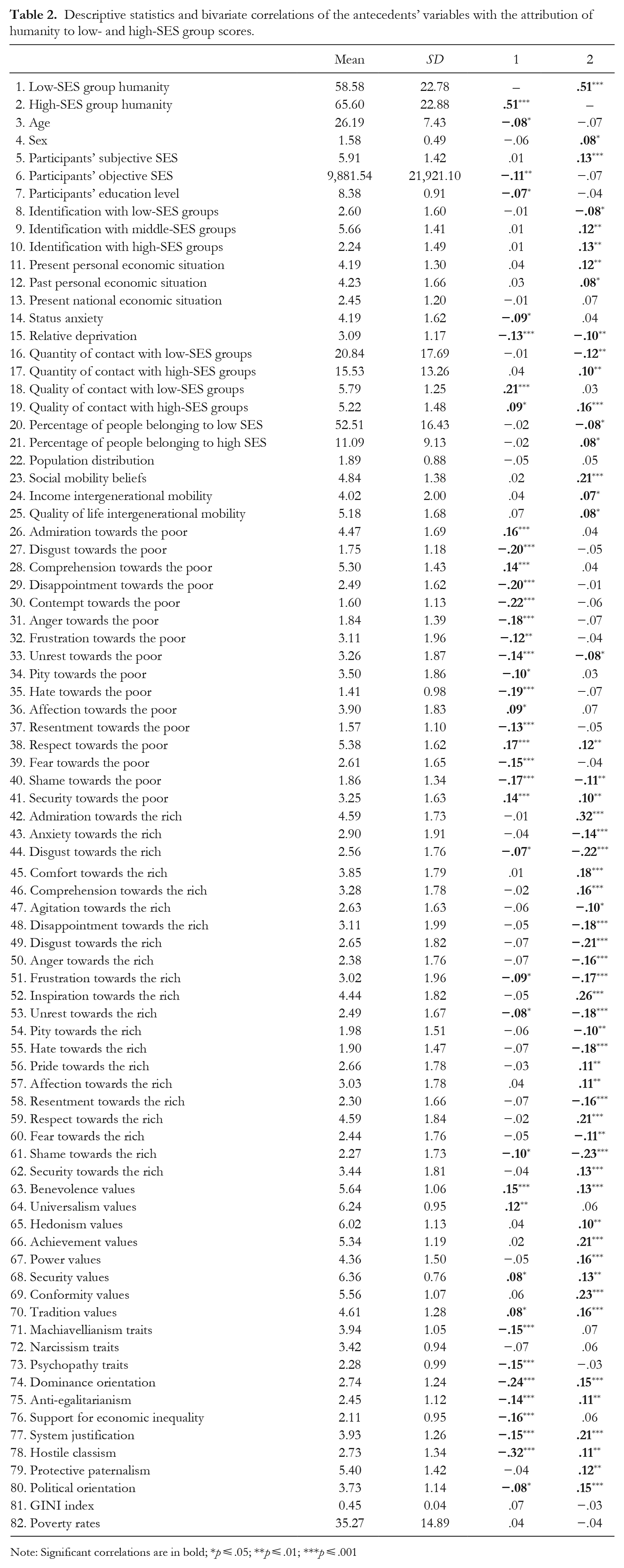
Note: Significant correlations are in bold; *p ⩽ .05; **p ⩽ .01; ***p ⩽ .001
At a second instance, we performed two hierarchical multiple regressions by using low- and high-SES groups’ humanity as the criterion variables. For this purpose, different steps were created using as predictor variables only those that were significantly correlated with the corresponding criterion variable (see Table 2). In all three cases, the first step included the expected variables, based on previous research and similarity between variables, to have the least predictive power (demographic information), and subsequent steps included the groupings of variables that potentially could have a higher predictive capacity, up to a total of 11 steps in some analyses. However, the number of steps varied in each regression because in some cases, no variables in the grouping were significantly correlated. All independent variables were standardized for regression.
Results for the regression analysis regarding the attribution of humanity to low-SES groups can be found in Table 3. These analyses showed that in the first steps (1–3), participants’ objective SES negatively predicted this group’s humanity, their feelings of relative deprivation perceptions negatively predicted it, and their contact with low-SES individuals positively predicted this group’s humanity. However, the inclusion in further steps of certain emotional experiences (lack of unrest or security) to a higher extent predicted the low-SES group’s humanity. In these further steps, holding universalism personal values negatively predicted the humanity of low SES. This pattern of results is inconsistent with not only our theoretical expectations but also the positive correlation between this variable and the attribution of humanity to low SES that we identified in the correlations (Table 2). In addition, including the ideological variables in the final step took some effect from previous significant predictor variables. Specifically, ideologies associated with hierarchical-based orientations and hostile derogation of low SES were significant negative predictors. Finally, the latest steps indicated that the main variables that predict low-SES humanity were lack of unrest, feeling of security, lack of adherence to social dominance orientation and lack of hostile classism attitudes. Among these variables, hostile classism, to a higher extent, positively predicted the dehumanization of low SES.
Hierarchical regression analysis including the different models as predictors of the humanity ascribed to low-SES groups.
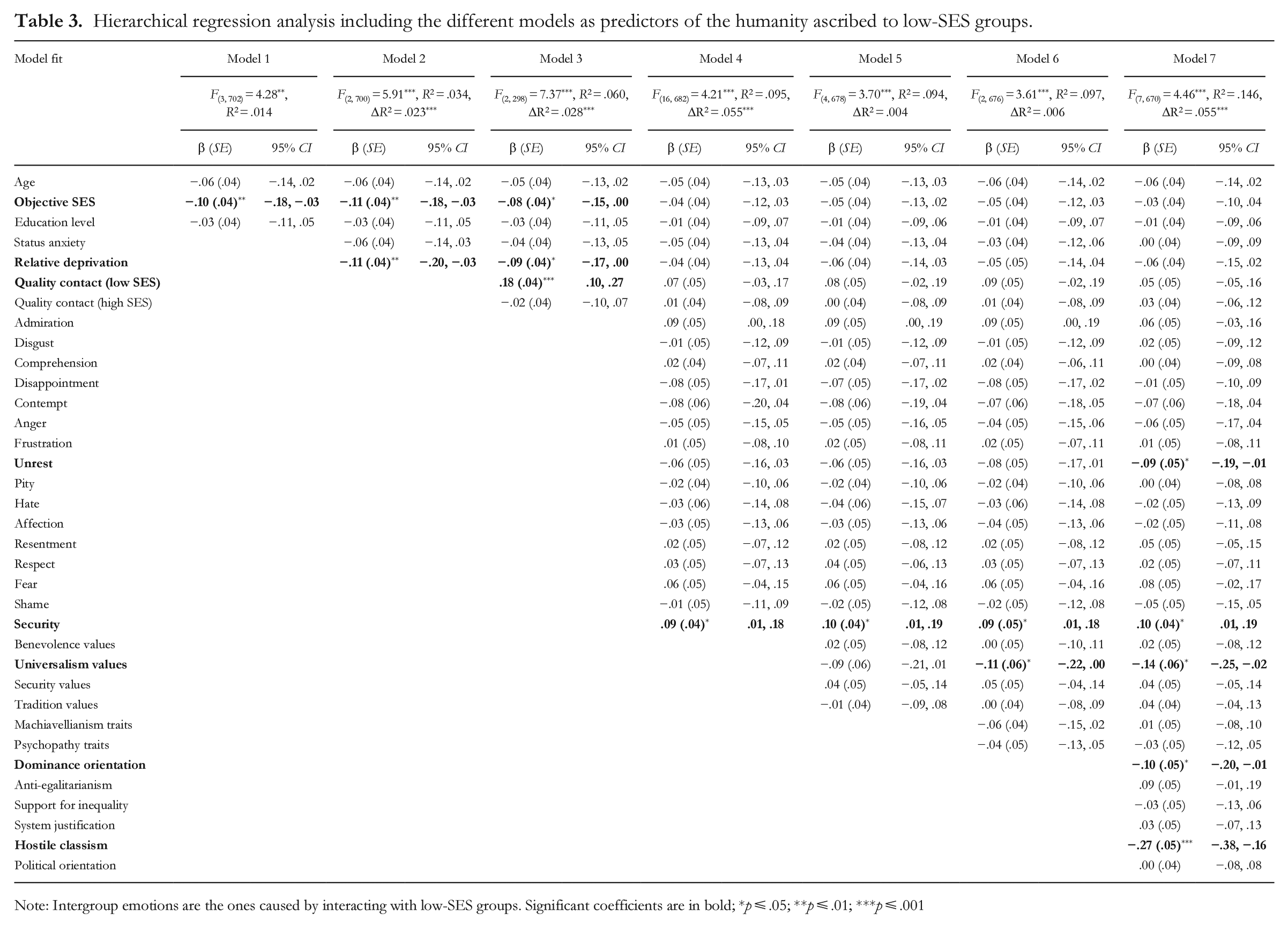
Note: Intergroup emotions are the ones caused by interacting with low-SES groups. Significant coefficients are in bold; *p ⩽ .05; **p ⩽ .01; ***p ⩽ .001
Results for the regression analysis regarding the attribution of humanity to high-SES groups can be found in Table 4. These results indicated that in the first steps (1–3), participants’ sex and individual identification as a middle- or high-SES member positively predicted the tendency to humanize the rich. Further, individual identification did not predict humanity when the quality of contact with high-SES individuals or social mobility beliefs were included in the steps (4–6). Further, the emotional experience towards the rich predicted the attributions of humanity to a higher extent compared with the previous variables (making previous variables nonsignificant). Especially admiration but also the lack of shame predicted the humanity ascribed to this group in further steps (7 and 8). Finally, including individual values and individuals’ ideology did not significantly increase the model’s explained variance, leading to a final step in which admiration, lack of shame and, surprisingly, participants’ sex (being male) were significant predictors of the attribution of humanity to high-SES groups.
Hierarchical regression analysis including the different models as predictor of the humanity ascribed to high-SES groups.
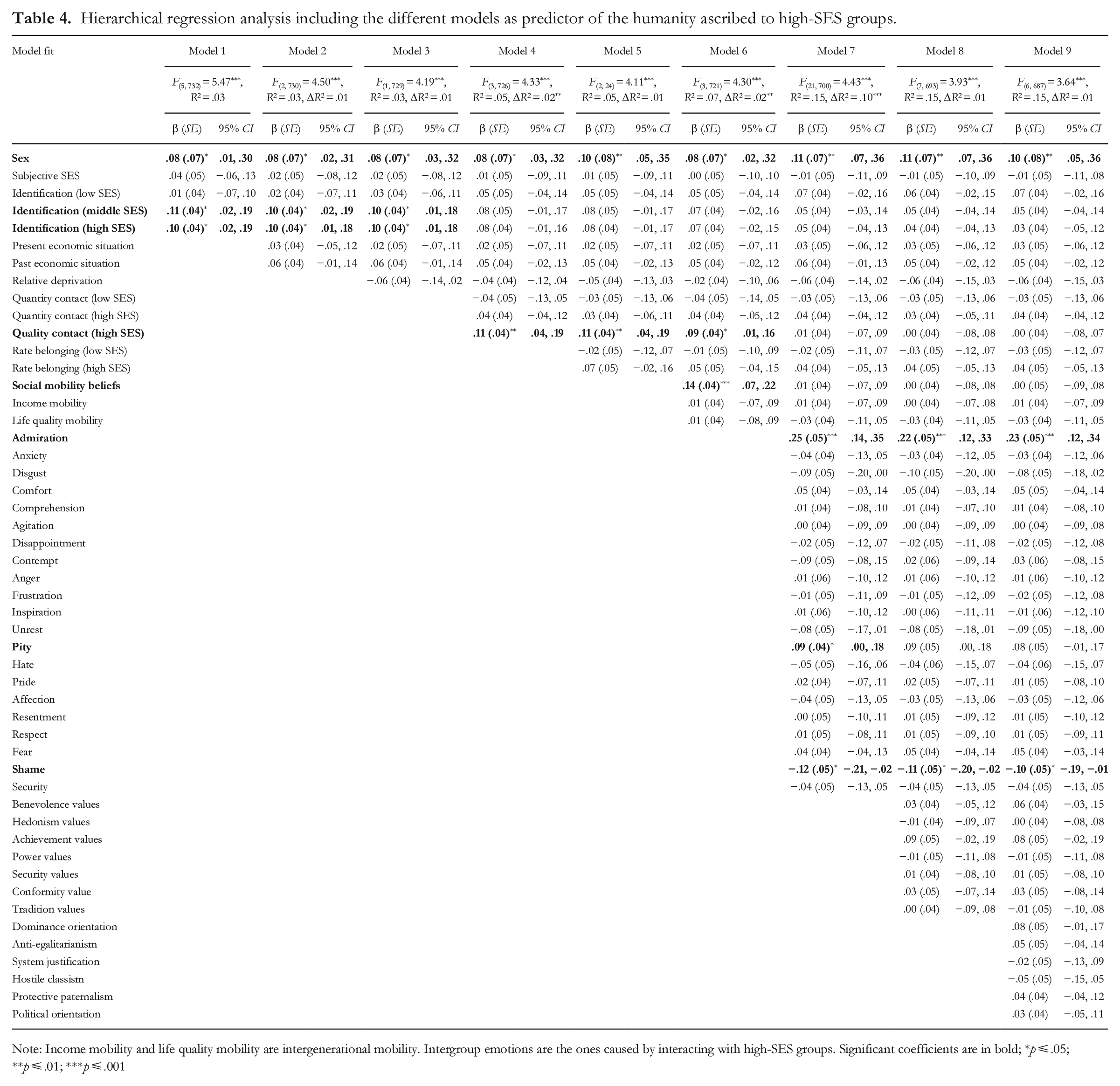
Note: Income mobility and life quality mobility are intergenerational mobility. Intergroup emotions are the ones caused by interacting with high-SES groups. Significant coefficients are in bold; *p ⩽ .05; **p ⩽ .01; ***p ⩽ .001
Discussion
The present project provides evidence of the variables that predict the tendency to attribute humanity to low- and high-SES groups. This extended analysis using the individual variables that trigger intergroup hostility and group-level dehumanization allows us to identify the double path associated with the (de)humanized perception of those who have less (predicted mainly by hostile beliefs about the poor) and those who have more (predicted to a higher extent by admiration) within society, as well as establishing communalities and differences in the variables that correlate with the humanity ascribed to one socioeconomic group or the other.
In general terms, results regarding the attribution of humanity to low-SES groups showed that many of the variables previously considered as triggers of dehumanization processes (e.g., dark personality traits) were less relevant when evaluating this group, while other variables that were originally related to the group’s humanity, such as an individual’s SES or the positive contact with low-SES groups, lost relevance in favour of other psychological processes in further steps we tested. Final steps including all the predictors that were originally correlated with the groups’ humanity indicated that low-SES groups’ dehumanization was mainly related to certain emotional experiences that the group elicited: feelings of restlessness/unrest and insecurity when interacting with the group. It is also interesting to note that these emotions found to be relevant predictors of low-SES dehumanization were also caused by, or at least related to (see Cuddy et al., 2007), the derogatory stereotypes and prejudice that affects low-SES groups. This points out a possible common emotional origin or triggering point between the attribution of humanity and these other social processes. Further, as anticipated, the role of individuals’ ideological standing was predominant when (de)humanizing low-SES groups. In this regard, we evaluated the most common forms of hierarchy-based ideologies from the well-established SDO to less-studied forms such as the support for inequality or the ambivalent classism attitudes. Results were clear on this matter: dominance-oriented individuals and those who blatantly despised low-SES groups were the ones who dehumanized them to a higher extent, while other variables such as system justification or the paternalistic view of low-SES groups did not have a relation with the dehumanization of this group. These variables’ unexpected lack of relation could be due to different reasons, such as the overlap among ideological factors (e.g., between system justification and social dominance) or the blatant nature of the outcome variable (e.g., protective paternalism could be related to subtler forms of dehumanization).
Additionally, results regarding the attribution of humanity to high-SES groups showed how certain individual variables, such as identification as middle or high SES, that were significant predictors in the initial steps lost their effect as new variables were included in the analysis, such as contact with low-SES people and social mobility perceptions. This also applied to social mobility beliefs, which were expected to be related to the social perception of high-SES groups but whose relationship became nonsignificant after including the intergroup emotions. The final step also showed that, on the difference with the step predicting the humanity of low-SES groups, ideology played a minor role when people ascribed humanity to high-SES groups. Instead, emotional experiences, such as admiring high-SES groups and not feeling shame about them, were the most relevant variables that predicted the humanity of high-SES groups. Based on these findings, note that individuals’ ideological standing was more closely related to the dehumanization of low-SES groups. Further, high-SES groups elicited emotional experiences closely related to ingroup members or close allies, following previous research on the stereotype content model (Cuddy et al., 2007).
Moreover, an unexpected result showed that individual sex had a consistent correlation along the analysis. This was unexpected because previous research on dehumanization did not highlight sex differences on the tendency to dehumanize others. However, our data indicated that in our study’s context, men were more willing to ascribe humanity to high-SES groups than women. This effect is consistent along with the models we tested and uniquely applies to perceptions of high-SES groups. Thus, it seems that differences between men’s and women’s dehumanization attitudes emerge when it comes to certain groups. Previous research highlights that in the specific context of sexual relations and the objectification of women, the motivation behind dehumanization varies between men and women even when they dehumanize both genders to the same extent (Vaes et al., 2011). In our study’s context, it might be possible that men and women also had different motives to ascribe humanity to high-SES groups. Specifically, according to traditional gender roles, men (compared to women) desire to a higher extent to acquire wealth and status (see Ellemers, 2018). The expected competence and wealth preference among men might, to some extent, relate to a humanized perception of wealthy individuals and groups that could be considered a role model for them. However, further research of the psychosocial mechanisms that link sex and attribution of humanity to high-SES groups is necessary to fully understand this result.
These results have implications on how the causes of (de)humanization based on group SES are understood. In the first place, results are clear regarding the specific role of certain variables that predict the humanity of low- versus high-SES groups. While low-SES dehumanization is predicted by hierarchy-enhancing variables (classism and dominance orientation), high-SES humanity is strongly related to positive emotions (or the lack of negative ones) towards this group. In this sense, previous authors have hypothesized a similar dual mechanism regarding how inequality might affect low- and high-SES individuals and groups through different psychological processes (relative deprivation in the case of low SES and status anxiety in the case of high SES; Jetten et al., 2017). This dual process can be applied not only to how economic inequality affects individuals but to how people justify groups’ socioeconomic standings as a function of the humanity that is ascribed to them: ideology plays a more prominent role in terms of dehumanizing disadvantaged groups than in terms of praising wealthy individuals and groups. Further, it seems that humanizing those who hoard wealth is related more closely to the pleasurable contemplation of the groups at the top of society. Bearing in mind the consequences of (de)humanizing social classes in the maintenance of socioeconomic difference (e.g., Sainz, Martínez, et al., 2020; Sainz, Martínez, Rodríguez-Bailón, & Moya, 2019), future studies should more deeply explore the different psychosocial roots of the (de)humanization of low- and high-SES groups to reach a better understanding of these processes.
Practical interventions can be highlighted from the present results: interventions designed to reduce dehumanization of those in need and, thus, preferring attitudes in favour of economic equality should acknowledge the different psychological mechanisms behind attributing humanity to low- and high-SES groups. Reducing low-SES dehumanization is widely related to modifying derogatory attitudes towards the poor and poverty, even when dehumanization and negative attitudes are considered separate processes (Bruneau et al., 2018; Wilde et al., 2014). Well-known strategies to decrease dehumanization among disadvantaged groups (Vezzali et al., 2022) might also be suitable procedures to reduce hostile classist attitudes. On this point, reducing hostile and derogatory perceptions of the poor as vermin individuals who take advantage of the social system (Jones, 2011; Sainz, Loughnan, et al., 2020) might alternatively favour the desire to reduce economic inequality and promote social change.
Further, we should recognize that the increasing poverty rates cause economic inequality, as much as by the hoarding of wealth in the hands of the few. On this issue, we also know that humanizing (vs. dehumanizing) high-SES groups (in terms of higher/lower ascription of HN traits) promotes rejection of taxing the rich or implementing redistribution policies (Sainz, Martínez, Rodríguez-Bailón, & Moya, 2019). These previous results are complemented with the present findings of how positive emotions lead to humanizing the group. Therefore, wealthy individuals are praised within society, which to some extent drives the maintenance of the status quo or the lack of recognition of the wealthy’s hoarding as a social problem. Bearing this in mind, should we promote dehumanization of high-SES groups to prevent the rising support of economic inequality? Undoubtedly, high-SES individuals are less vulnerable to dehumanization and they do not perceive that others dehumanize them, compared with more disadvantaged socioeconomic groups (Sainz, Martínez, Moya, et al., 2021). However, we are aware that outgroup dehumanization leads to a vicious cycle of metadehumanization between groups that erodes social cohesion (N. Kteily et al., 2016). Therefore, alternative strategies need to be implemented. One possibility is to reduce the perceived humanity differences by focusing on the facets that create this perceived humanity differentiation. In general terms, poor people are considered as having deviant behaviours or traits that lead them to be deprived, and people consider that uniquely hard-working individuals are prone to success (Bullock et al., 2003; Cozzarelli et al., 2001). This understanding of the social outcomes as a naturally prone process could be reduced by highlighting external barriers to economically succeeding (e.g., Piff et al., 2020). By focusing on how social standing is not tied to individual traits (including the perceived evolveness of the individuals or groups), one can also potentially reduce the perceived humanity differences between groups and increase awareness of the need to support redistribution policies aimed to create more equal conditions.
Limitations apply to the present study. First, we used a blatant measure of dehumanization to capture the tendency to (de)humanize low- and high-SES groups (Sainz, Martínez, et al., 2020). Even when this measure has been widely used in previous research and constitutes a well-designed measure to capture dehumanization in the hierarchy-enhancing context (N. S. Kteily & Bruneau, 2017), it might imply some issues. Specifically, previous evidence links some of the variables included in this study with more subtle forms of measuring dehumanization (e.g., attributing traits or secondary emotions) instead of with blatant forms. Based on the understanding that subtle or blatant forms of dehumanization might differently correlate with specific outcomes (N. S. Kteily et al., 2015), it is possible that, to a certain extent, some variables’ lack of effects might be due to the nature of our scale rather than to the lack of their relevance. Second, according to prejudice and dehumanization literature, the potential antecedents of dehumanization we tested might present some differences. That is, some of the variables, such as demographic characteristics of ideological variables, are well-known precursors of social processes (Hodson & Dhont, 2015). However, in other cases, certain variables’ roles can be less straightforward. This is the case of intergroup emotions that can lead people to experience dehumanization, but they can also appear as a consequence of the dehumanization perceptions (see, for instance, Buckels & Trapnell, 2013; Esses et al., 2008). Thus, it is necessary to keep in mind the multiple roles that certain variables can have in intergroup dynamics and that several processes (including dehumanization) can have a bidirectional relationship with other variables (e.g., Capozza et al., 2017). It might be possible that some of the directionality claims we made in this study would be more complex than we believe. Further experimental research exploring the relationship between each dehumanization predictor should be performed to confirm causal claims.
In short, our analysis indicated that different psychosocial processes drive human attributions to those groups at the bottom of the social ladder. The tendency to dehumanize low-SES groups is mainly triggered by the hostile derogation of the poor and individuals’ preference for socially hierarchical societies. At the same time, the humanized perception of high-SES groups is motivated by positive emotional experiences towards the group. This double path to ascribing humanity to groups based on their status should be taken into consideration when designing and performing practical interventions aimed at modifying the existing tendency to dehumanize low-SES groups and humanize high-SES groups.
Footnotes
Notes
Supplementary Material
Please find the following supplemental material available below.
For Open Access articles published under a Creative Commons License, all supplemental material carries the same license as the article it is associated with.
For non-Open Access articles published, all supplemental material carries a non-exclusive license, and permission requests for re-use of supplemental material or any part of supplemental material shall be sent directly to the copyright owner as specified in the copyright notice associated with the article.
