




Abstract
Previous studies relating socioeconomic status (SES) to dehumanization mainly focused on how low- and high-SES groups were dehumanized (i.e., as the target of dehumanization). However, studies considering the associations between perceiver’s subjective socioeconomic status (SSS) and self- as well as other-dehumanization are scarce. Furthermore, belief in a just world (BJW) is thought to be linked in these associations. Thus, the main goal of this research is to examine direct and indirect associations of individuals’ SSS and self- or other-dehumanization via BJW among 583 college students. We found SSS predicted self-dehumanization negatively. Nevertheless, the predictive effect of SSS for other-dehumanization was not significant. Additionally, BJW mediated the relationship between SSS and dehumanization. Our findings broaden the domain of dehumanization by providing evidence on the role of individuals’ SSS in the perception of their own and others’ humanity. Moreover, in light of the harm of self-dehumanization, future studies should attach importance to the role of self-dehumanization of lower-status individuals in hindering their upward social mobility.
In the past decades, dehumanization has always been a topic of great interest within social psychology. Dehumanization refers to the perception or belief that a person is less than human, and it has been demonstrated as an important antecedent variable for diminished moral standing on people, reduced prosociality and increased antisociality (Haslam, 2006; Haslam & Loughnan, 2014). Haslam (2006) has highlighted two forms of dehumanization as animalistic dehumanization (i.e., the perception of people explicitly or implicitly as animals, as a consequence of denying human uniqueness traits such as civility, rationality and maturity) and mechanistic dehumanization (i.e., the perception of people explicitly or implicitly as objects or machines, as a consequence of denying human nature traits such as cognitive flexibility, emotionality and warmth). By now, most previous research into dehumanization has examined how and when humanity could be denied to others, i.e., other-dehumanization. In fact, dehumanization can also be found in perception of one’s own self, which is called ‘self-dehumanization’ (Bastian & Crimston, 2014; Bastian & Haslam, 2010).
SES and self- or other-dehumanization
There has been a large body of work providing valuable insights into the causes or promoting factors of dehumanization, including who is more prone to be dehumanized and who tends to dehumanize as well as when people dehumanize (Haslam, 2006; Haslam & Loughnan, 2014). Among them, the influence of socioeconomic status (SES) on dehumanization has been frequently studied but is still not fully revealed (Loughnan et al., 2014; Sainz et al., 2021). SES refers to the social standing of an individual or a group in terms of income, education and occupational prestige. More specifically, relative to objective socioeconomic status (OSS), subjective socioeconomic status (SSS), as an individual’s subjective cognition of their social class, has far more impact on the perception of self (Kraus et al., 2012; Yang et al., 2015) and other people around them (Kraus et al., 2012; Piff et al., 2010). As for the relationship between SES and dehumanization, most studies focus on how low- and high-SES groups were stereotyped and dehumanized (i.e., as the target of dehumanization). Specifically, the stereotype content model has depicted high-SES groups as competent but cold and low-SES groups as incompetent but warm (Fiske et al., 2007). Low-SES groups were seen as animal-like whereas high-SES groups were considered as robot-like (Loughnan et al., 2014; Sainz et al., 2019). To go a step further, additional studies indicated that dehumanization of high- and low-SES groups might depend on the observer’s own SES. For example, members of high-status groups tend to dehumanize low-status groups, while members of low-status groups do not dehumanize high-status group members and sometimes even show a tendency to humanize them in comparison to their ingroup (Capozza et al., 2012; Iatridis, 2013). This was explained by outgroup favoritism, which means members of low-status groups often have contradictory and conflicting attitudes towards their ingroups but have a more positive attitude towards external groups (Jost et al., 2002). These studies indicate that it is very necessary to consider the perceiver’s SES to further reveal the effect of SES on dehumanization.
With regard to the perceiver’s SES and dehumanization, previous studies usually included participants’ SES (both objective and subjective) as a covariate when measuring the tendency to dehumanize others (Sainz et al., 2019; 2020). Until now, only a few studies have focused specifically on the role of perceiver’s SES as the primary variable that triggers dehumanization. Yang (2015) found that compared with people with high power, low-power people viewed themselves as less human, and furthermore, they believed that they were viewed as less human by others as well. Consistently, Sainz (2021) demonstrated that perceiver’s lower SES positively predicted more meta-dehumanization (i.e., individuals’ perception that others/third persons fail to attribute humanity to them). They believed that even though both extremes of the social ladder are dehumanized, low-SES groups are more susceptible to being affected by the dehumanized perception that people have towards them (Sainz et al., 2021). Thus, the present study aims to explore the extent to which an individual’s identification with their own social class, i.e., SSS, may be associated with their attribution of human traits to self and others. Actually, self-dehumanization is the internalization of meta-dehumanization and could thus partly result from it (Fontesse et al., 2021). We speculate that lower-SSS people may tend to ascribe less humanity to themselves.
On the other hand, for the effect of perceiver’s SES on other-dehumanization, the current research seems to be controversial. Sainz and his colleagues measured participants’ own SES as a covariate when they explored dehumanization towards high- and low-SES groups. They found no significant interaction between participants’ SES and dehumanization, indicating perceiver’s SES may have nothing to do with low- or high-SES dehumanization (Sainz et al., 2019; 2020). Nevertheless, a recent study found that lower-SES perceivers dehumanized beggars less while they dehumanized norm violators more compared with upper-SES perceivers (Khatry et al., 2021). In this study, the targets of dehumanization were particular disadvantaged groups (i.e., beggars and norm violators) instead of ‘others’ in the general sense. As to attitudes or behavioural tendencies of people with different SES towards others, this dispute still exists. Some researchers argue that distinct from higher-class individuals who exhibit solipsistic social cognitive tendencies, lower-class individuals are more socially engaged and display more other-beneficial prosocial behaviour (Kraus et al., 2012; Piff et al., 2010; Piff & Robinson, 2017). On the contrary, there is also evidence suggesting that higher SES does not predict decreased prosocial behaviour (Andreoni et al., 2021), or even a positive relationship between SES and prosocial behaviour using large, nationally representative samples (Korndörfer et al., 2015). Therefore, these studies give us inspiration that the relationship between perceiver’s SSS and other-dehumanization may be still somewhat confusing and worthy of further investigation.
The mediating role of belief in a just world (BJW)
BJW was coined by Lerner and Miller (1978) and refers to people’s need to believe that the world they live in is a just world where people get what they deserve. A large number of studies have found that BJW promotes mental health and is related to a higher level of subjective well-being (Hafer & Bègue, 2005; Loseman & van den Bos, 2012; Sutton et al., 2017). According to the just world theory, two hypotheses have been put forward to illuminate the function of BJW. One standpoint is that BJW varies across individuals and works as a psychological buffer against negative feelings when people are faced with disasters, diseases or life changes (Dalbert, 2002; Otto et al., 2006). From this perspective, BJW acts as a moderator and its function is conditional. The other standpoint holds that BJW works as a personal resource; that is, individuals with higher BJW possess more powerful personal resources, and thus they can better cope with various challenges in life (Hafer & Bègue, 2005; Laurin et al., 2011). From this point of view, its benefit for mental health is universal and does not require conditions.
As for the relation between SSS and BJW, BJW and social status are interrelated as well as interactive in nature (Kraus et al., 2012). People will judge social justice according to their own social situation. Logically, compared with higher-status people, lower-status people tend to experience a stronger sense of injustice since they have fewer social resources, face more uncontrolled life events and are at a competitive disadvantage (Hou et al., 2017; Yu et al., 2020). Meanwhile, some studies have found the mediating role of BJW in the relation between SSS and psychological outcomes, such as online shaming (Hou et al., 2017) and disgust (Yu et al., 2020). Experiencing self-dehumanization was associated with aversive self-awareness, cognitive deconstructive states and feelings of shame, guilt, sadness and anger (Bastian & Haslam, 2010; Jiang et al., 2021). Thus, combined with all these studies, we speculate that BJW seems more likely to act as a mediating role, rather than a moderating role, between SSS and self-dehumanization.
In addition, previous studies have suggested that BJW could be a double-edged sword on individuals’ attitudes or behavioural tendencies towards others. On the one hand, many studies found that individuals with higher BJW are more likely to engage in altruistic behaviour (Bègue et al., 2008; Quan, 2021; Silver et al., 2015) and show higher levels of altruistic-related traits, including gratitude (Strelan, 2018) and empathy (Silver et al., 2015). On the other hand, some studies have also revealed the cold-blooded side of BJW and demonstrated that BJW has exacerbated the dehumanization of disadvantaged groups, such as innocent victims (Gillmor et al., 2014) and immigrants (DeVaul-Fetters, 2014). These studies indicated that if the current situation of injustice is inexorable, people with stronger BJW tend to reconstruct their sense of justice through cognitive irrational strategies, that is, dehumanize disadvantaged groups and perceive disadvantaged groups as more to blame for their actions or situation (DeVaul-Fetters, 2014; Gillmor et al., 2014). Thus, we believe that the effect of BJW on individuals’ ascribing humanity to ‘others’ in the general sense requires further verification.
In summary, although SES and dehumanization are closely related, previous studies mainly focused on how low- and high-SES groups were perceived (Loughnan et al., 2014; Sainz et al., 2019). Studies considering the role of perceiver’s SSS in self- and other-dehumanization are scarce (Khatry et al., 2021; Sainz et al., 2021). Additionally, previous studies demonstrated that lower SSS is associated with weaker BJW and suggested that BJW might account for the effect of SSS on dehumanization (Hou et al., 2017; Yu et al., 2020). However, whether BJW plays a mediating role in this effect remains to be verified. Thus, in the present study, we attempt to test the correlations of SSS, BJW and dehumanization using questionnaires and explore the extent to which individuals’ SSS may be associated with their attribution of human traits to self and others and whether BJW mediates the relationship between SSS and self- or other-dehumanization. We formulated the following general hypotheses: (1) participants reporting lower levels of SSS will be more likely to dehumanize themselves, but might not others; (2) BJW might be associated with decreased self- and other-dehumanization; (3) BJW will mediate the relationship between SSS and dehumanization.
Methods
Participants and procedure
The sample consisted of 612 undergraduate students in Yantai, located in Shandong Province in eastern China. Between September and December 2021, participants were recruited via convenience sampling from two local universities. Out of the five universities in Yantai, two were selected at random (all ranked 200–300 in Chinese universities): Ludong University (n = 349), Yantai University (n = 263). Questionnaires were administered to the participants in a classroom setting by a team of trained graduate students. All subjects gave their informed consent before the test and were given $2.80 as compensation after completing questionnaires. The survey was approved and supervised by the Institutional Review Board, sponsored by the China Association for Science and Technology (CAST) and the Ministry of Health of the People’s Republic of China. Twenty-nine had to be excluded for not replying properly to all questionnaires (five of them did not complete all questionnaires and 24 missed some questions). So the final sample consisted of 583 participants (229 males and 354 females, 315 from urban and 268 from rural areas). All students ranged in age from 17 to 24 years (M ± SD = 19.81 ± 1.02).
Measures
Demographic variables
In this part, gender and family background were assessed as control variables. For gender, 1 = Male, 2 = Female. As for family background, in China, economic and social development presents a typical urban–rural dual structure. Rural areas are far behind urban areas in economy, culture, education and other aspects. Additionally, urban and rural residents have different characteristics in ideology, culture and customs (Chen & Fan, 2019). Thus, we asked all participants to choose their family background as a control variable (1 = Rural, 2 = Urban).
Subjective socioeconomic status (SSS)
The MacArthur Scale, which is an image of a ladder with 10 rungs, was used to measure SSS. The participants were asked to choose the rung best representing their social status. The scores ranged from 1 = ‘lowest’ to 10 = ‘highest’. Higher scores reflected higher subjective socioeconomic status in terms of education, occupation and income. This measure has been widely used and has good reliability and validity in Chinese samples (Hou et al., 2017).
Belief in a just world (BJW)
The Chinese version of BJW scale is a 15-item six-point-Likert scale (1 = ‘Strongly disagree’, 6 = ‘Strongly agree’). It consists of four subscales: self-now (four items, e.g., ‘Usually I get fair treatment’), self-future (three items, e.g., ‘Everything I pay now will be rewarded in the future’), other-now (five items, e.g., ‘In general most people get what they deserve’) and other-future (three items, e.g., ‘Those who have done bad things will be punished in the future’). There is support for fine reliability and validity of the BJW scale (Yu et al., 2020; Zhou et al., 2015). In the present study, Chronbach’s α = .81 for BJW, and .71, .87, .81 and .90 for the self-now, self-future, other-now and other-future subscale respectively.
Self- or other-dehumanization
Self-dehumanization was rated on an eight-item scale in two dimensions of animalistic dehumanization (denying human uniqueness, four items, e.g., ‘I felt like I lack self-control and act like an animal’) and mechanistic dehumanization (denying human nature, four items, e.g., ‘I felt that I was more rigid, a little cold and seemed to be a robot’; Bastian & Haslam, 2010). Other-dehumanization was rated with all stems changed to ‘I felt like the other person. . .’ (1 = ‘Not at all’, 7 = ‘Very much so’). Participants were asked to judge to what extent the characteristics of other people around them conform to these descriptions. Thus, in our study, other-dehumanization refers to dehumanization towards ‘others’ in the general sense rather than particular individuals or groups. Previous studies suggested the scale has good reliability and validity (Bastian & Haslam, 2010; Jiang et al., 2021). In this study, Chronbach’s α = .75 for the self-dehumanization scale, and α = .70 and α = .81 for the self-dehumanization-animalistic and self-dehumanization-mechanistic subscales respectively. Chronbach’s α = .80 for the other-dehumanization scale, and .75 and .86 for the other-dehumanization-animalistic and other-dehumanization-mechanistic subscales respectively.
Data analysis
SPSS 20.0 was used for data analysis. The relationships between levels of subjective socioeconomic status, dehumanization and belief in a just world were explored using Pearson’s correlation coefficient. The mediating role of BJW was examined using the PROCESS macro (Model 4). The significance of mediating effect was examined using a bias-corrected bootstrapping method (10,000 samples), which is regarded as significant if the confidence intervals (CI) do not include 0. Moreover, G*Power was used to perform calculations on statistical power (Faul et al., 2007) and the post hoc statistical powers were greater than .95 for all dehumanization dimensions.
Results
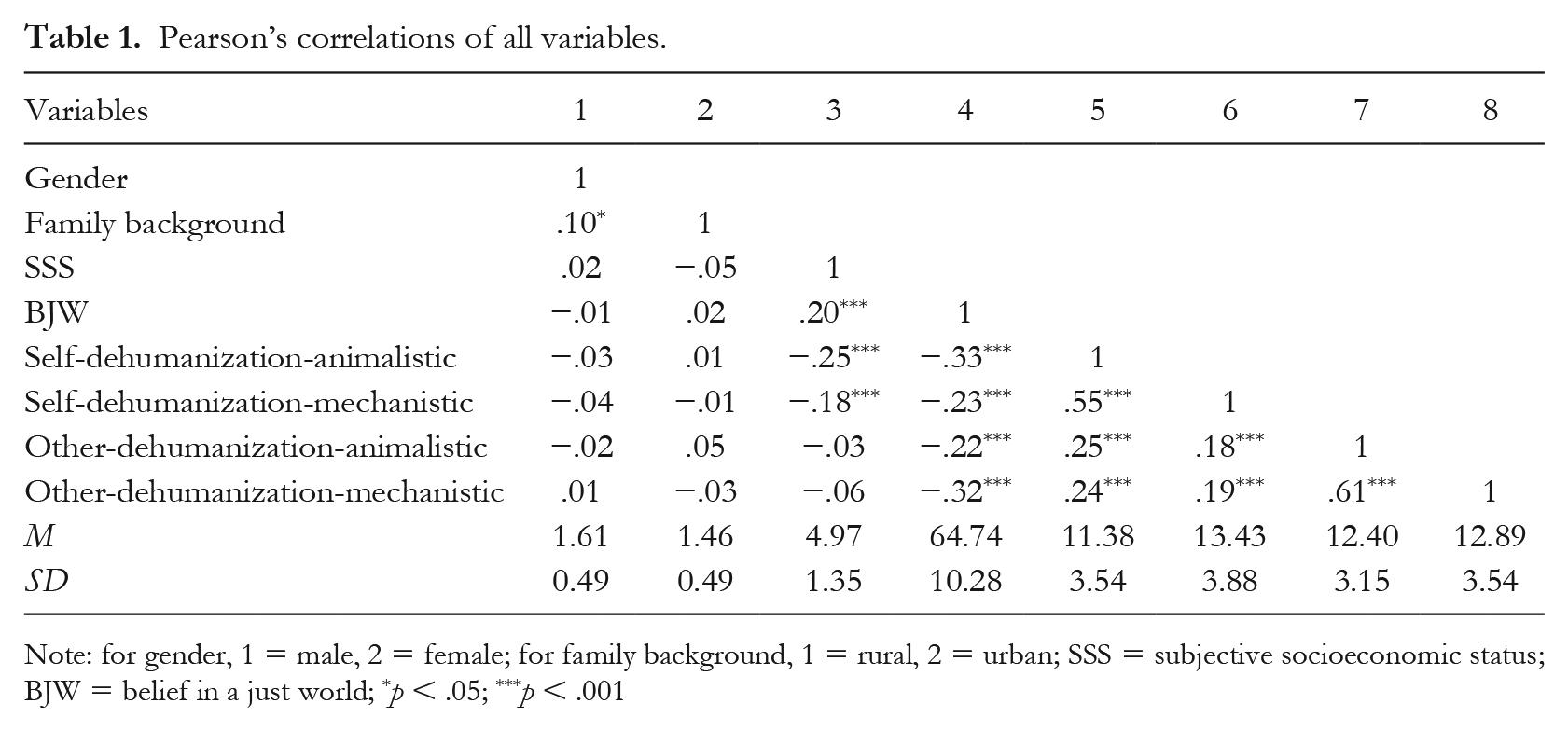
Table 1 shows correlations of all variables. SSS was positively correlated with BJW (r = .20, p < .001) but negatively correlated with self-dehumanization (r = −.25, p < .001 for self-dehumanization-animalistic and r = −.18, p < .001 for self-dehumanization-mechanistic). However, the correlation between SSS and other-dehumanization was not significant (r = −.03, p = .48 for other-dehumanization-animalistic and r = −.06, p = .10 for other-dehumanization-mechanistic). In addition, BJW negatively correlated with self-dehumanization (r = −.33, p < .001 for self-dehumanization-animalistic and r = −.23, p < .001 for self-dehumanization-mechanistic) and other-dehumanization (r = −.22, p < .001 for other-dehumanization-animalistic and r = −.32, p < .001 for other-dehumanization-mechanistic).
Pearson’s correlations of all variables.
Note: for gender, 1 = male, 2 = female; for family background, 1 = rural, 2 = urban; SSS = subjective socioeconomic status; BJW = belief in a just world; *p < .05; ***p < .001
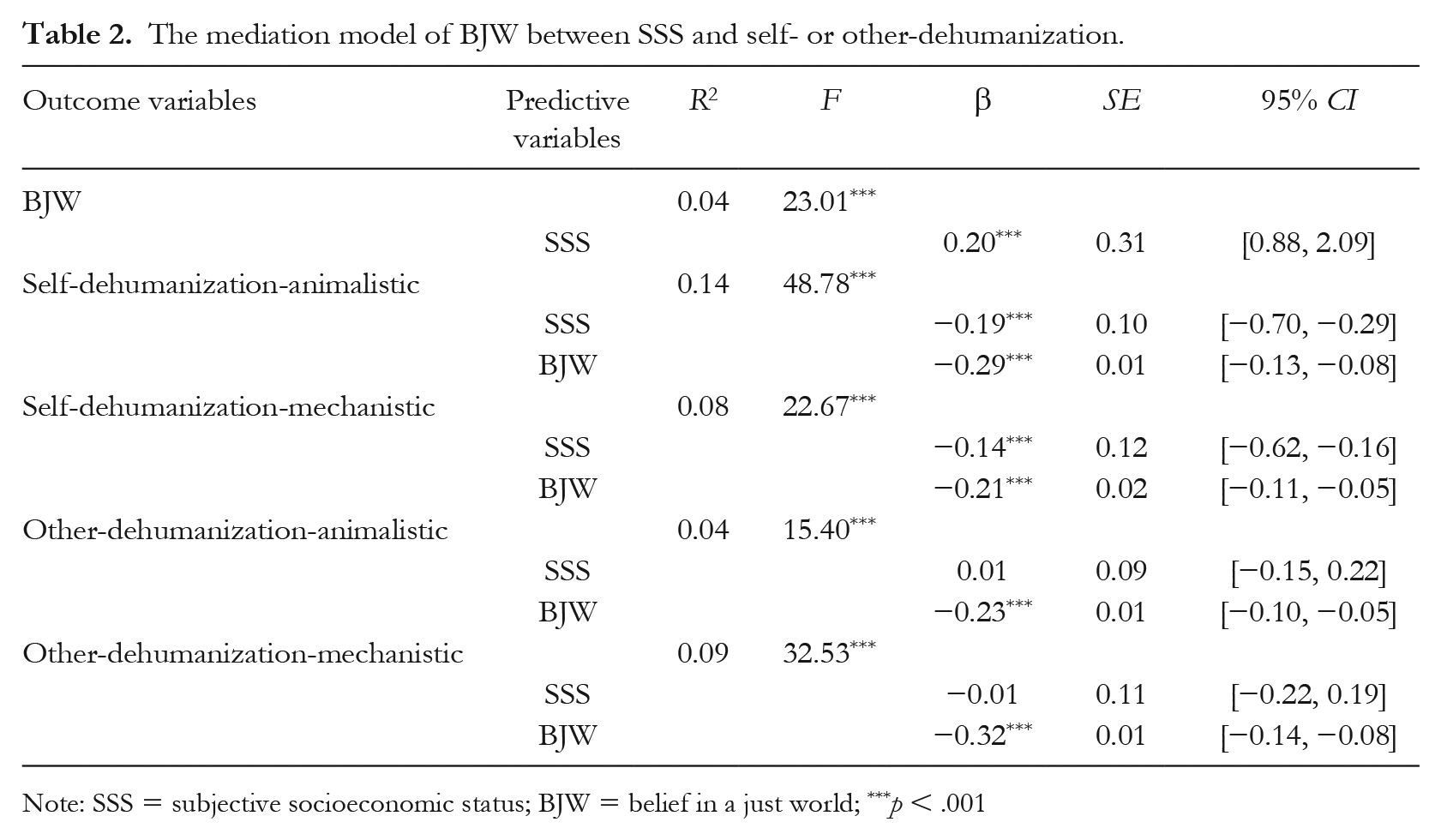
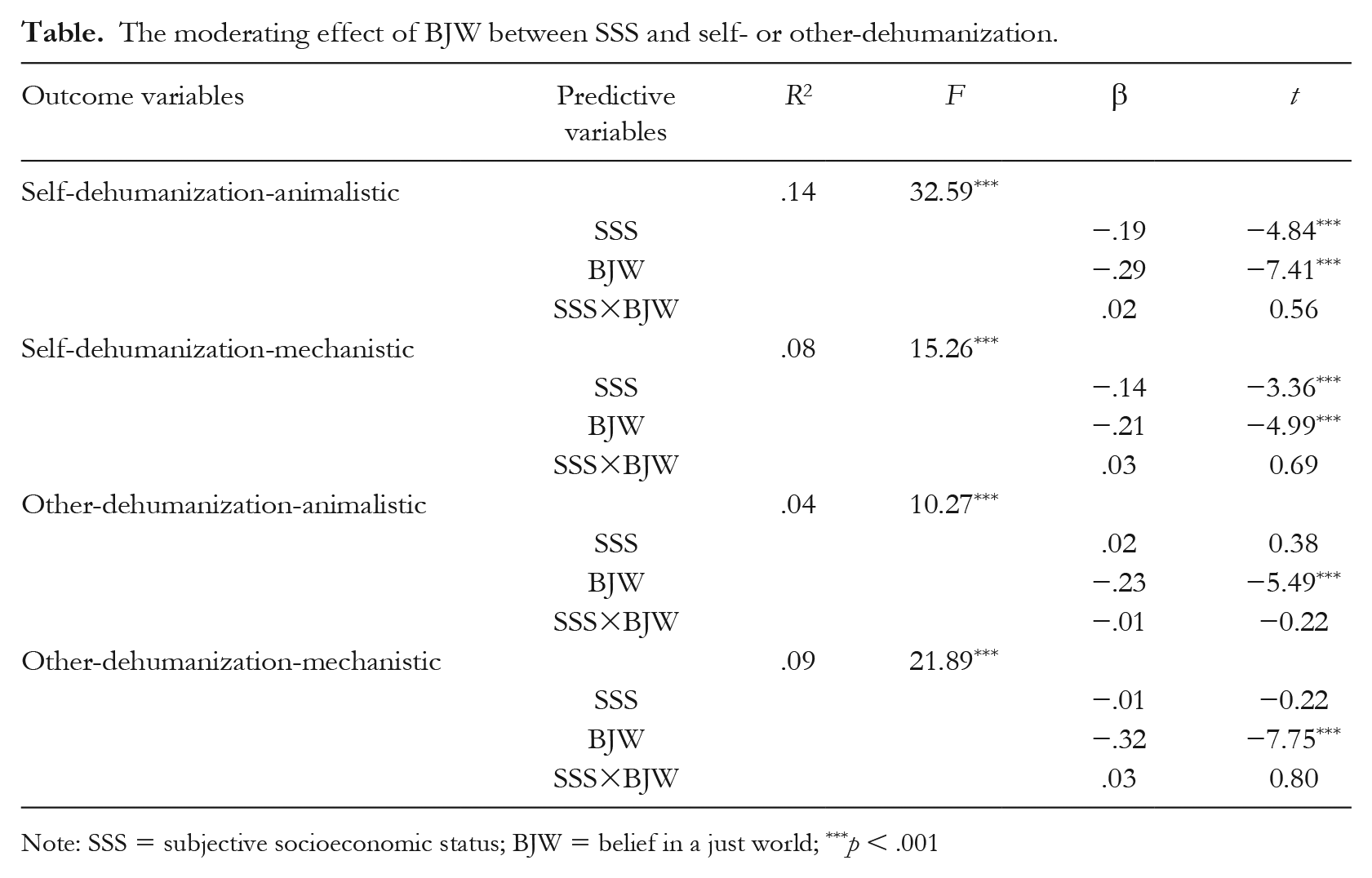
The mediation model of BJW between SSS and self- or other-dehumanization was shown in Table 2 and Figure 1. Results showed a significant indirect effect of BJW in the relationship between SSS and self-dehumanization-animalistic (IE = −0.057, SE = 0.015, 95% CI [−0.088, −0.031]) but also a significant indirect effect of BJW in the relationship between SSS and self-dehumanization-mechanistic (IE = −0.041, SE = 0.013, 95% CI [−0.067, −0.019]). As for other-dehumanization, we found that the predictive effect of SSS on other-dehumanization-animalistic (β = −.03, p = .478) as well as other-dehumanization-mechanistic (β = −.07, p = .102) was not significant. Finally, we also found that the moderating effect of BJW between SSS and self- or other-dehumanization was not significant and ruled out the moderating models (see Appendix Table).
The mediation model of BJW between SSS and self- or other-dehumanization.
Note: SSS = subjective socioeconomic status; BJW = belief in a just world; ***p < .001
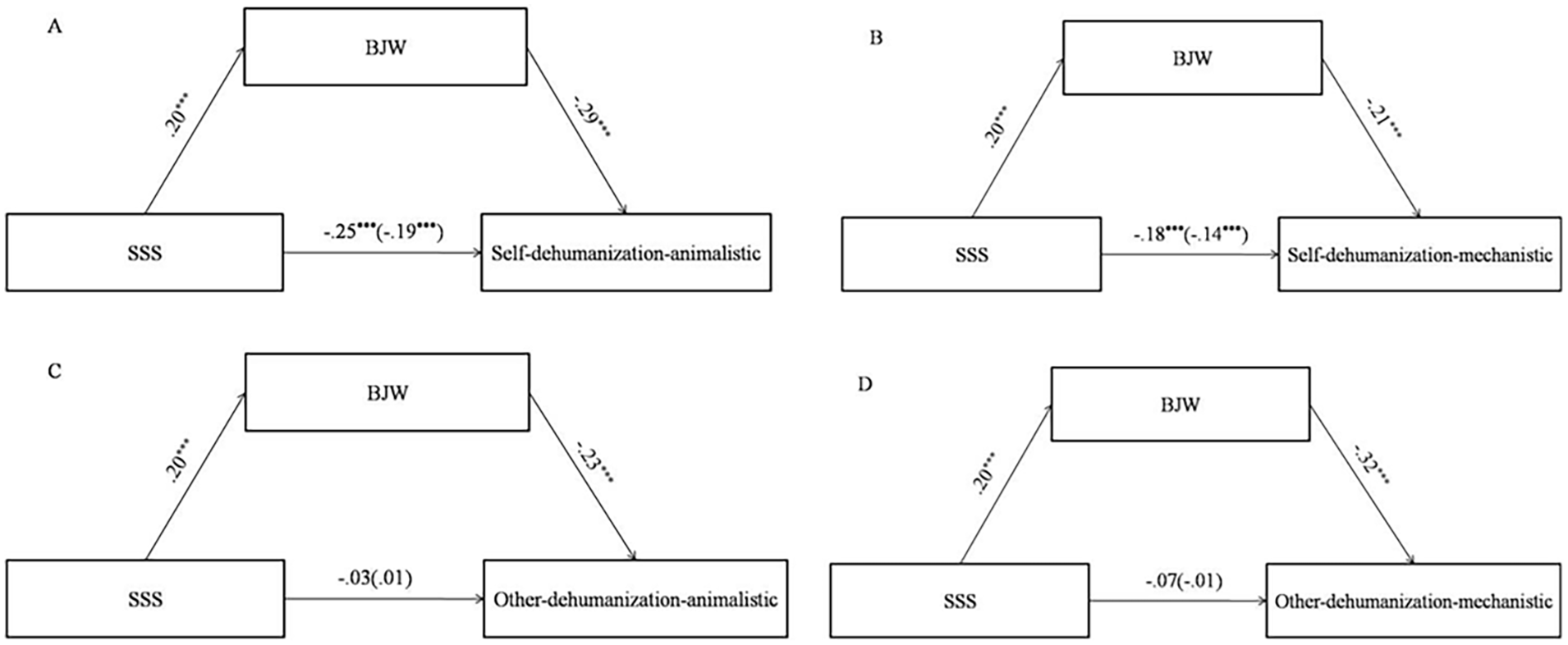
Mediation analysis of belief in a just world (BJW) in the relationship between subjective socioeconomic status (SSS) and self-dehumanization (A, B) or other-dehumanization (C, D).
Discussion
The present study used self-report questionnaires to investigate the relationships among SSS, BJW and self- or other-dehumanization. We revealed for the first time that individual’s SSS predicts self-dehumanization negatively and that lower-SSS people are more likely to ascribe less humanity to themselves. Consistent with previous studies including perceiver’s SES as a control variable and demonstrating that it does not have something to say about dehumanization towards low- or high-SES groups (Sainz et al., 2019; 2020), we found that the predictive effect of SSS for other-dehumanization is not significant. Moreover, we explored the possible mechanism from the perspective of BJW and demonstrated the mediating role of BJW in the association between SSS and dehumanization. This study is unique because many studies have revealed the effect of target’s SES on dehumanization, but studies that explore the role of perceiver’s SSS in self- and other-dehumanization are rare. Our findings broaden the domain of dehumanization by providing important reflections on the role of individuals’ SSS in the perception of their own and others’ humanity.
In the present study, we found that lower-status individuals are more susceptible to self-dehumanization. Generally, people recognize themselves in two ways: self-perception, wherein they see themselves through their own eyes (the first-person perspective); and meta-perception, wherein they see themselves through others’ eyes (the third-person perspective) (Kenny, 1994). From the first-person perspective, social class plays an important role in structuring self-concept (Easterbrook et al., 2020). Lower-SES individuals display lower levels of self-esteem (Twenge & Campbell, 2002) and self-efficacy (Mcconney & Perry, 2010), suggesting the belief of their lower capacities for rationality, maturity, agency or emotionality, which constitute the central dimensions of one’s humanity (Bastian & Haslam, 2010). Additionally, from the third-person perspective, lower-status individuals are more prone to suffer from disrespect, neglect or social ostracism within everyday social interactions with others (Kraus et al., 2012; Piff et al., 2010), which were all subtle forms of dehumanization and were considered to induce self-dehumanization (Bastian & Crimston, 2014; Bastian & Haslam, 2010). More importantly, lower-status groups are more likely to pay attention to and interiorize the opinion, actions or stereotypes that others have about them (Kraus et al., 2012). Therefore, combined with previous studies (Sainz et al., 2021; Yang et al., 2015), we speculate that lower-status people may see themselves as less human from not only the first-person perspective but also the third-person perspective.
Consistent with previous studies (Hou et al., 2017; Yu et al., 2020), we found that BJW mediated the relationship between SSS and self- or other-dehumanization. For lower-status groups, BJW serves a self-protective function, since it could avoid negative emotions caused by disadvantages in competition, promote their pursuit of long-term goals and maintain the confidence to change social status through their own efforts (Hafer & Bègue, 2005; Laurin et al., 2011). However, when the gap between the rich and the poor is widening and the reality of injustice is so serious that lower-status people cannot assimilate it, their BJW will be threatened and thus weakened (Lench & Chang, 2007). On the other hand, previous studies have demonstrated that self-dehumanization could be induced when people felt that they were unfairly treated, e.g., being ostracized (Bastian & Haslam, 2010) or maltreated by others (Jiang et al., 2021). Thus, it is not surprising that lower-status individuals may tend to self-dehumanize through weakened BJW. In addition, consistent with previous studies (Bègue et al., 2008; Quan, 2021; Silver et al., 2015), we found that BJW predicted other-dehumanization negatively. Combine with studies demonstrating the cold-blooded side of BJW (DeVaul-Fetters, 2014; Gillmor et al., 2014), our results suggest that stronger BJW is beneficial for the attribution of humanity to others generally and perhaps only shows its cold-blooded side (i.e., dehumanize disadvantaged group) when the current situation of injustice is unchangeable.
To go a step further, considering the harm of self-dehumanization, we believe the self-dehumanization of lower-status groups may be of great significance in explaining reduced social mobility and widening the gap between the rich and the poor in current-day China. Self-dehumanization, which is associated with aversive self-awareness, cognitive deconstructive states, feelings of negative emotions as well as unethical behaviour (Bastian & Crimston, 2014), has attracted increasing attention in recent years because it is so dire in its consequences. By now, although there is no direct evidence, we speculate that self-dehumanization may weaken people's belief in socioeconomic upward mobility and reduce the likelihood that lower-status people will engage in behaviours that would improve their chances of upward mobility (e.g., persist in long-term academic goals or avoid involvement in bad interpersonal relationships). In the long run, from the social aspect, this will lead to reduced class mobility and further hierarchy inequality. Thus, future research should evaluate whether and how the self-dehumanization of lower-status groups plays an important role in hindering their upward mobility on the individual level and hierarchy inequality on the society level.
In line with previous studies (Sainz et al., 2019; 2020), our study did not observe the predictive effect of perceiver’s SSS on other-dehumanization. However, this finding is distinct from a recent study demonstrating that higher-SES perceivers dehumanized beggars more for low-contact likelihood while lower-SES perceivers dehumanized norm violators more due to threat (Khatry et al., 2021). The most probable explanation for this divergence may lie in the target of dehumanization. Sainz measured dehumanization towards high- and low-SES groups, and Khatry measured dehumanization towards beggars and norm violators, whereas we used questionnaires to measure more general dehumanization to ‘others’. Similarly, previous studies have found that associations between social class and prosocial behaviour vary as a function of the target’s social class (Van Doesum et al., 2017) and contextual factors, including the cost of prosocial behaviour (Piff & Robinson, 2017) and public versus private contexts (Kraus & Callaghan, 2016). Combined with all these studies, we infer that the effect of perceivers’ SSS on their attribution of humanity to others may highly depend on the targets and situations they face. Taken together, although we did not observe the significant relationship between perceiver’s SSS and other-dehumanization, we want to claim that a worthy avenue for future research would be to further investigate whom and when higher/lower-status people tend to dehumanize under experimental conditions.
Some limitations of this study should be noted. Firstly, the cross-sectional design of the present study could not confirm causal relationships. Congruent with previous studies (Khatry et al., 2021; Loughnan et al., 2014), we consider SSS as the precursor of dehumanization in the present study. Nevertheless, we believe that our results do not exclude the possibility that people attributing fewer human traits to themselves are more likely to present lower SSS and BJW. Actually, it is most likely that lower SSS promotes self-dehumanization, which in turn aggravates lower SSS. Thus, future longitudinal or experimental studies, for instance manipulating the SES of participants by assigning them to different income groups in a fictitious society to evaluate the influence of SES (Jetten et al., 2015; Sainz et al., 2021), are needed to identify the causal relationships. Secondly, only college students who are economically dependent on their parents but have a relatively higher education level were included in our study. We believe future studies should test the associations found here with samples from the general population that have stable sources of income or fixed occupations (Khatry et al., 2021; Sainz et al., 2020). Additionally, we only recruited participants by convenience sampling in Yantai, a medium-developed city in eastern China. In recent decades, China’s rapid economic and social development has led to a widening income distribution gap, which has become the most serious social problem in China and has had profound impacts on how people perceive themselves and others (Chen & Fan, 2019). Thus, future cross-culture studies are recommended to provide a richer and more thorough understanding of the role of individuals’ SSS in the perception of their own and others’ humanity.
Footnotes
Appendix
The moderating effect of BJW between SSS and self- or other-dehumanization.
| Outcome variables | Predictive variables | R 2 | F | β | t |
|---|---|---|---|---|---|
| Self-dehumanization-animalistic | .14 | 32.59 *** | |||
| SSS | −.19 | −4.84 *** | |||
| BJW | −.29 | −7.41 *** | |||
| SSS×BJW | .02 | 0.56 | |||
| Self-dehumanization-mechanistic | .08 | 15.26 *** | |||
| SSS | −.14 | −3.36 *** | |||
| BJW | −.21 | −4.99 *** | |||
| SSS×BJW | .03 | 0.69 | |||
| Other-dehumanization-animalistic | .04 | 10.27 *** | |||
| SSS | .02 | 0.38 | |||
| BJW | −.23 | −5.49 *** | |||
| SSS×BJW | −.01 | −0.22 | |||
| Other-dehumanization-mechanistic | .09 | 21.89 *** | |||
| SSS | −.01 | −0.22 | |||
| BJW | −.32 | −7.75 *** | |||
| SSS×BJW | .03 | 0.80 |
Note: SSS = subjective socioeconomic status; BJW = belief in a just world; ***p < .001