




Abstract
Online self-harm refers to the creation, search or sharing of content that includes physical harm as well as participation in online challenges involving self-injury. In this study, we aimed to analyse the reciprocal relationships between online self-harm and various forms of victimization, including cyberbullying, online hate speech, online grooming and nonconsensual sexting, over one year. The study sample comprised 751 adolescents aged 12–15 years (M = 13.64, SD = 1.16), 54.9% of whom were girls. The participants completed self-report measures at two time points a year apart. The results showed that engaging in online self-harm at time 1 (T1) increased the likelihood of becoming a victim of cyberbullying at time 2 (T2). In turn, T1 cyberbullying increased the probability of experiencing nonconsensual sexting over one year. T1 online self-harm increased the likelihood of becoming a victim of T2 online grooming, while T1 online grooming increased the probability of experiencing nonconsensual sexting after one year. These findings highlight the need for prevention programmes to address online self-harm and thus reduce the risk of victimization on the Internet.
Self-harm behaviours involve deliberately inflicting physical harm upon oneself with or without suicidal intent (Nock, 2010). Online self-harm refers to the use of the Internet to seek, upload or exchange information related to physical self-harm. This can include searching for methods of self-injury, sharing personal experiences of self-harm or participating in forums where self-harm content is discussed or exchanged (Jacob et al., 2017; Patchin & Hinduja, 2017; Seko et al., 2015). Online self-harm can expose adolescents to significant vulnerabilities (Gámez-Guadix et al., 2022). For example, they may face an increased risk of various forms of online victimization, such as cyberbullying. Alternatively, online victimization experiences could lead to a heightened risk of engaging in online self-harm. However, empirical research on the relationship between online self-harm and different types of online victimization remains limited.
In today’s digital landscape, young people face various online risks. One such risk, cyberbullying, is where intentional and repeated harm is inflicted through devices, like smartphones, and causes emotional and psychological distress (Patchin & Hinduja, 2015). Another threat is online hate speech, which refers to the expression of Internet-based hatred towards an individual or group of people based on their belonging to a specific social group defined by race, religion, sex, sexual orientation or national or ethnic origin, with the aim of publicly inciting violence or hatred (Kansok-Dusche et al., 2022). Online child grooming is a more insidious danger, where adults manipulate minors into sharing explicit content or exploit them sexually (Schittenhelm et al., 2025). Meanwhile, nonconsensual sexting can occur when intimate images are shared without consent, thus violating trust and privacy (Henry & Powell, 2018). In this study, we aimed to examine the longitudinal and reciprocal relationships between online self-harm and two widely studied forms of victimization — cyberbullying and online hate speech — along with two concerning yet less studied forms of sexual victimization among adolescents: online grooming and nonconsensual sexting. By addressing the prospective relationships with online self-harm, we sought to provide a comprehensive understanding of how online self-harm behaviours are related to these four distinct forms of victimization. In the sections that follow, we outline the theoretical and empirical rationale supporting our objectives and the importance of investigating these potentially interconnected phenomena.
The role of information and communication technology in self-harm behaviours
Self-harm among adolescents is a significant public health issue (Fox et al., 2020; World Health Organization [WHO], 2019). It can be broadly categorized into two types: nonsuicidal self-injury (NSSI), where there is no intent to die, and suicidal behaviours involving intent (Jacob et al., 2017). NSSI is typically defined as intentional, self-inflicted damage to one’s body without the desire to end one’s life (International Society for the Study of Self-Injury, 2020). Common examples include cutting, burning and hitting oneself (Whitlock, 2010). These behaviours often begin in adolescence, typically between the ages of 13 and 16 (Muehlenkamp et al., 2019). Although suicide rates are lower in adolescence, they increase significantly in young adulthood (Muela et al., 2024). A study by Faura-García et al. (2022) revealed that approximately 17% of Spanish adolescents reported engaging in NSSI. Furthermore, national data have shown that in Spain, suicide is the leading cause of unnatural death among young people aged 15–29 years and the second leading cause of overall mortality in this age group (Instituto Nacional de Estadística, INE [Spanish Statistical Office], 2022).
The relationship between NSSI and suicide is well documented. According to the interpersonal theory of suicide, self-harm may increase the risk of suicidal behaviours (Joiner et al., 2012). However, NSSI can also serve as a strategy to avoid suicide by providing short-term emotional relief (Klonsky & Muehlenkamp, 2007; Kraus et al., 2020; Suyemoto, 1998). This complex relationship underlines the importance of understanding NSSI, especially in the context of online environments, where vulnerable adolescents may find themselves exposed to harmful influences.
Information and communication technologies have undeniably transformed adolescent social interactions and serve to facilitate personal and social development (Smahel et al., 2023). Social media, in particular, have become a primary tool for adolescent communication (Anderson & Jiang, 2018). However, alongside these benefits, the Internet has also become a platform for health and psychosocial risks. One particularly troubling trend is the use of information and communication technologies to access or disseminate content related to self-harm (Jacob et al., 2017; Stänicke et al., 2024). This content may normalize self-injury among vulnerable individuals, provide methods for self-harm or encourage secrecy around these behaviours (e.g., Brennan et al., 2022; Eichenberg, 2008; Lewis & Seko, 2016; Marchant et al., 2021).
The term ‘online self-harm’ encompasses a range of activities, including the creation, search or sharing of content that promotes physical harm as well as participation in online challenges involving self-injury (Juárez-Escribano, 2019; Mahadevaiah & Nayak, 2018). A well-known example is the ‘Blue Whale Challenge’, which comprises a series of tasks that culminate in self-injury and potential suicide (Ortega-Barón et al., 2023; Waszak et al., 2024). Empirical studies, though limited, suggest a growing trend in the manifestation of these behaviours online. Englander (2012) reported that 9% of young people in the United Kingdom had engaged in online self-harm, while in the study of O’Connor et al. (2014), 18% of the adolescents acknowledged that social media had influenced their self-harming behaviours.
Mars et al. (2015) indicated that half the adolescents in their study who reported self-harm had previously searched for related content online. The reach and influence of these behaviours have been further exemplified in studies like that of Brown et al. (2018), which identified over 32,000 images linked to self-harm posted within four weeks using popular German hashtags for NSSI. Gámez-Guadix et al. (2022) found that, among a sample of Spanish adolescents, approximately one in 10 (11%) had used the Internet to seek information or share content about self-harm. More specifically, the results revealed that the most frequent online self-harm behaviours were searching the Internet for information on how to self-harm and discussions of the self-harm, with prevalence rates of 5.3% and 3.5%, respectively.
Online self-harm and the risk of victimization
Beyond the inherent physical risks, engaging in self-harm online may expose adolescents to an increased risk of online victimization. The theory of polyvictimization (Finkelhor et al., 2007) posits that victimization rarely occurs in isolation and is often followed by further abuse. In the context of online self-harm, this suggests that adolescents involved in such behaviours may be at higher risk of various forms of victimization both offline and online.
Empirical evidence also suggests a relationship between different problem behaviours and situations. For example, Machimbarrena et al. (2018) found a significant comorbidity between various forms of online risk, such as problematic Internet use, cyberbullying and online grooming. Studies have shown that victimization, particularly in intimate relationships and among peers, is associated with increased self-harm behaviours (O’Connor et al., 2009; Sansone et al., 2007). Moreover, online victimization — especially cyberbullying — has been linked to higher rates of self-harm (Hinduja & Patchin, 2010; Messias et al., 2014; Schenk & Fremouw, 2012). Minkkinen et al. (2017) found that experiences of online victimization were significantly related to exposure to self-harm content in youth from various countries, including the United States, United Kingdom, Germany and Finland. However, studies of the temporal relationships between online self-harm and different forms of victimization are scarce.
The relationship between online victimization and self-harm behaviours may follow a temporal pattern, particularly in the context of online grooming, cyberbullying, online hate speech and nonconsensual sexting, which have been found to have reciprocal relationships (Gámez-Guadix & Mateos-Pérez, 2019). Specifically, adolescents who engage in physical self-harm and subsequently disclose, record or share these behaviours online could unintentionally make themselves visible to potential aggressors. Perpetrators may exploit the vulnerability that these adolescents demonstrate when they publicize their self-harming behaviours and view these individuals as accessible targets for victimization. For instance, predators involved in online grooming often target adolescents who appear emotionally vulnerable and seek to manipulate and control them with the aim of sexually exploiting them (Gámez-Guadix et al., 2021; Ringenberg et al., 2022). Similarly, online bullies may view self-harm behaviours as a marker of weakness or difference, which increases the likelihood of cyberbullying, online hate speech or even nonconsensual sexting.
Conversely, being the victim of various forms of online victimization could increase the likelihood of engaging in online self-harm. Studies have demonstrated that online victimization often leads to emotional distress, such as anxiety, depression and feelings of isolation (Finkelhor et al., 2023; Schittenhelm et al., 2025), which are known predictors of self-harming behaviours. For many adolescents, self-harm serves as a coping mechanism to alleviate the emotional pain triggered by experiences of victimization. Since self-harm can function as a maladaptive way to regulate emotional distress, it is plausible that adolescents victimized online may turn to self-harm as a way of managing the psychological consequences of their victimization (Meldrum et al., 2022). Moreover, self-harm behaviours can sometimes serve a communicative function, where adolescents use them to signal distress and seek help or attention from others (Gardner et al., 2021). This behaviour may extend to the online context, where adolescents who are victims of online grooming, cyberbullying, online hate speech or nonconsensual sexting may engage in online self-harm to elicit concern or support from peers, family or other online communities. Based on these considerations, the hypotheses for the present study are as follows:
(1) Online self-harm is predictive of an increase in online victimization (i.e., online grooming, cyberbullying, online hate speech or nonconsensual sexting) over time. Individuals who have engaged in online self-harm at baseline will be more vulnerable to experiencing some form of online victimization after one year.
(2) Online victimization is predictive of an increase in online self-harm behaviours over time. Specifically, being a victim of online victimization heightens the risk of engaging in online self-harm, either as a way to alleviate emotional distress or to seek social support and attention from others.
Method
Participants
The initial sample comprised 1,722 participants between 12 and 15 years of age. A total of 751 adolescents (Mage at T1 = 13.64 years, SD = 1.16) responded to all the study measures at time 1 (T1) and time 2 (T2) one year apart and were thus included in the final sample used in our analysis. Of these, 54.9% were girls, 45.1% were boys. Most of the participants (79.6%) identified as heterosexual, while 13.6% were bisexual, 3.3% were gay or lesbian, and 3.5% identified as having other sexual orientations. Most of the participants (88.5%) were born in Spain. Approximately 71.9% of the adolescents’ parents were married or living together, 12.5% were divorced, 10.8% were separated, 3.8% were single parents, and 1% were widowed.
Measures
Online self-harm
We used a scale developed to assess the frequency of online self-harm that had previously been validated among Spanish adolescents by Gámez-Guadix et al. (2022). The scale included five items that measured the likelihood of using the Internet to post about physical harm or seek information about self-harm (e.g., ‘I hurt myself and shared it online’, ‘I have looked for information online about how to self-harm’). The participants were asked to indicate how often they had engaged in these behaviours over the previous 12 months by indicating their responses using the following scale: 0 = ‘never’, 1 = ‘one or two times’, 2 = ‘three or four times’ and 3 = ‘five or more times’. This scale has shown adequate construct validity through confirmatory factor analysis and acceptable reliability (Gámez-Guadix et al., 2022). The internal consistency (Cronbach’s α) of this scale was .54.
Cyberbullying
To evaluate the presence of cyberbullying, the following definition was presented to the study participants. This definition is grounded in a widely accepted conceptualization of cyberbullying, which highlights three key characteristics: repetition, power imbalance and helplessness (Smith et al., 2008; see also Calvete et al., 2022).
Cyberbullying is the use of information and communication technologies (e.g., Messenger, WhatsApp), social networking sites (e.g., Facebook, Instagram, Twitter) or a computer, laptop, tablet or smartphone to harm others by threatening or insulting them, spreading rumours about them or scaring them in some way. It is important that the victim cannot defend themselves, and the acts occur repeatedly over a period of time.
After reading this description, the participants were asked how many times they had been cyberbullied (i.e., victimized) by others over the previous 12 months. The response options were ‘never’, ‘one or two times’, ‘between three and five times’, ‘between six and nine times’ and ‘more than 10 times’.
Online hate speech
To assess the presence of hate speech, the following definition, used in previous studies, was presented to the participants (Wachs et al., 2022): Online hate speech describes the use of new technologies (e.g., WhatsApp), social networks (e.g., Facebook, Instagram, Twitter) to offend and hurt someone based on their race, ethnicity, sex, sexual orientation or religion. Online hate speech aims to discriminate against or incite violence towards a person or group and can be expressed through degrading writings or speeches, such as posts, comments, text messages, videos and photos.
After reading this description, the participants were asked how many times they had been victimized online by others over the previous 12 months. The response options were ‘never’, ‘one or two times’, ‘between three and five times’, ‘between six and nine times’ and ‘more than 10 times’.
Online grooming
The 20-item Multidimensional Online Grooming Questionnaire was used to assess different online grooming strategies, including the use of deception, gifts, victim environment surveillance, sexualization and aggression by an adult (Gámez-Guadix et al., 2021). The participants were asked to indicate how often over the previous 12 months different situations had occurred with a person who was 18 years or older and had had sexual intentions towards them (e.g., ‘They told me they were younger than they actually were’, ‘They asked me about my family and friends’). The response scale was: 0 (‘never’), 1 (‘once or twice’), 2 (‘three or four times’) and 3 (‘five or more times’). The internal consistency (Cronbach’s α) of the scale was .91 in our study.
Nonconsensual sexting
To assess nonconsensual sexting victimization, we used a scale that evaluates the extent to which someone has shown, posted or forwarded sexual photos or videos online without the victim’s consent (Gámez-Guadix et al., 2022). The scale included the following items: (a) ‘Someone has shown a sexual image of you (photos or videos) to another person without your consent’; (b) ‘Someone has posted a sexual image of you (photos or videos) online without your consent’; (c) ‘Someone has forwarded a sexual image of you (photos or videos) without your consent’. The participants were asked about the frequency of these events over the previous 12 months using the following response scale: 0 = ‘never’, 1 = ‘one or two times’, 2 = ‘three or four times’ and 3 = ‘five or more times’. The internal consistency (Cronbach’s α) of the scale was .72 in our study.
Procedure
Ten schools, including eight public schools and two private schools, from a central region of Spain participated in this study. The parents of the students at these schools were provided with a document requesting their signed consent for their child’s participation in the study. Likewise, the students were each given an informed consent document with all the information about the study, which was read and signed by the participants before completing the questionnaires. The students were informed that their participation was strictly voluntary and their responses confidential. They were told that they could choose not to answer certain questions and that their participation in the study could be discontinued at any time and for any reason without consequences.
The participating students completed the questionnaires at T1 and T2 in their classrooms with a study assistant present. The participants were encouraged to ask questions if they had difficulty answering any of the questionnaire items. The questionnaires took 30–40 minutes to complete. After completing the questionnaires, the participants received a written document containing information about community resources and the researchers’ email addresses. This study is part of a broader research project on online child sexual abuse, which was reviewed and approved by the Research Ethics Committee of the Autonomous University of Madrid.
Results
Descriptive statistics
First, the prevalence for each variable at both time points was computed. The prevalence of online self-harm was 10.9% at T1 and 10% at T2. For cyberbullying, the prevalence was 11.1% and 9.3% at T1 and T2, respectively. Among the participants, 6.3% at T1 and 7.3% at T2 reported that they had been personally attacked via online messages containing hate speech. Regarding online grooming, the prevalence was 28% and 28.5% at T1 and T2, respectively. Finally, the prevalence of nonconsensual sexting was 3.3% at T1 and 2.4% at T2.
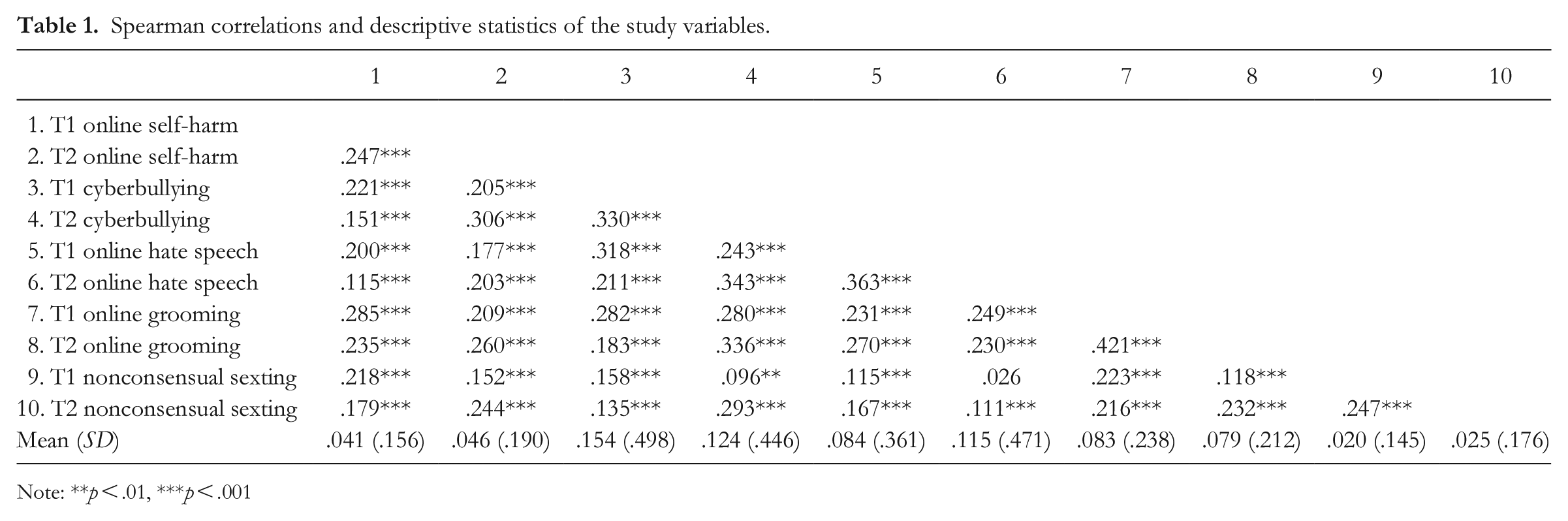
We calculated the Spearman bivariate correlations between the variables of interest due to their non-normal distribution; all the correlations were significant and in the expected direction, except for the correlation between nonconsensual sexting at T1 and online hate speech at T2. The highest correlations were established between the same variables at T1 and T2 (see Table 1).
Spearman correlations and descriptive statistics of the study variables.
Note: **p < .01, ***p < .001
Analysis of the longitudinal model
We used structural equation modelling to analyse the study’s hypotheses. The model was estimated using EQS 6.1 (Bentler & Wu, 2005). Given the violation of the assumption of normality observed in the data (normalized Mardia coefficient = 600.45), we used the robust maximum likelihood estimation method, which included the scaled Satorra–Bentler χ2 and other corrected statistics (Satorra & Bentler, 2001). All bivariate correlations between the T1 predictors (T1 online self-harm, cyberbullying, online hate speech, online grooming and nonconsensual sexting) were freely estimated in the model. The goodness of fit was assessed using the normed fit index (NFI), the non-normed fit index (NNFI), the comparative fit index (CFI), the root mean square error of approximation (RMSEA) and the standardized root mean square residual (SRMR). NFI, NNFI and CFI values of .90 or higher indicate a good fit. RMSEA and SRMR values of less than .08 reflect an adequate adjustment (Byrne, 2013).
First, we estimated a model that included all the relationships among the variables between T1 and T2. The results showed that several relationships in the model were not significant, and these were therefore dropped from the model (e.g., the relationships between T1 online hate speech and T2 cyberbullying and between T1 nonconsensual sexting and T2 online grooming). Additionally, the modification indexes provided by EQS indicated the convenience of adding correlations between the error terms for the variables at T2. Since the correlations between these variables at T2 were theoretically reasonable, we added them to the model. The adjustment indexes for the estimated final model were satisfactory: χ2 (17, N = 751) = 19.36, NFI = .934, NNFI = .963, CFI = .991, RMSEA = .014 (90% confidence interval: .000, .037) and SRMR = .038.
Figure 1 shows the standardized parameters for the estimated final model. The effect sizes of the paths between T1 and T2 ranged from small (.113) to large (.514). At the cross-sectional level (T1), the relationships between online self-harm, cyberbullying, online hate speech, online grooming and nonconsensual sexting ranged between .128 and .435 and were thus significant. At the longitudinal level, the autoregressive relationships between a given variable at T1 and the same variable at T2, which ranged from .161 for online hate speech to .514 for online grooming, were also significant.
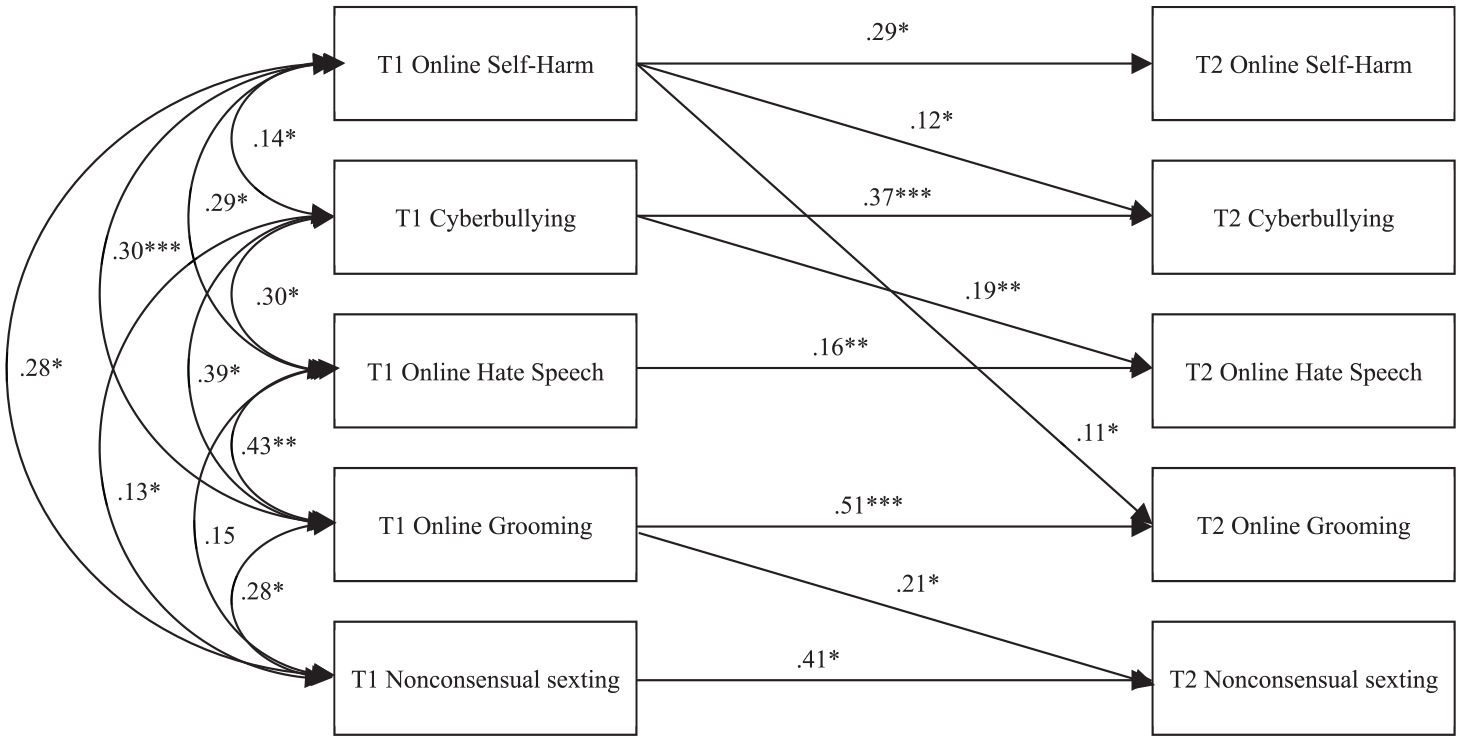
Final estimated longitudinal model on the relationship between online self-harm and types of victimization on the Internet.
For the longitudinal and reciprocal relationships, participating in online self-harm at T1 was found to significantly increase the probability of T2 cyberbullying and T2 online grooming. Conversely, being a victim of cyberbullying at T1 was found to increase the probability of online hate speech at T2. In addition, being a victim of online grooming at T1 was found to increase the likelihood of nonconsensual sexting at T2 (see Figure 1).
Discussion
Our study is the first to longitudinally examine the relationships between the likelihood of engaging in online self-harm behaviours, such as searching for or posting information about self-harm on the Internet, and various forms of online victimization, including cyberbullying, online hate speech, online grooming and nonconsensual sexting. The results revealed a pattern of associations, with online self-harm predicting an increased likelihood of cyberbullying victimization and online grooming over a year. These findings suggest that engaging in online self-harm behaviours may heighten the risk of falling victim to various forms of online abuse. A significant finding from this study is that approximately one in 10 participating adolescents engaged in online self-harm behaviour during each time point of the study.
The results highlight that online self-harm at T1 was a significant predictor of cyberbullying victimization a year later. This indicates that searching for or posting self-harm content may expose adolescents to a greater risk of being victimized by peers in online contexts. This is consistent with the findings of previous qualitative studies, which have shown that online self-harm is often associated with experiences of bullying and interpersonal rejection (Gámez-Guadix et al., 2020). Peers may encounter this self-harm content and respond with ridicule or harm, which may increase the adolescent’s vulnerability to cyberbullying. Furthermore, cyberbullying encompasses several forms of online aggression, such as harassment, exclusion, public shaming and rumour-spreading (e.g., Smith, 2012), all of which could be exacerbated by adolescents’ engagement with self-harm content. Adolescents who post about their self-harming behaviours may inadvertently signal emotional distress or vulnerability, which can invite negative peer reactions. Therefore, these results partially confirm the initial hypothesis about the longitudinal relationship between online self-harm and this specific form of online victimization.
Additionally, we found that cyberbullying at T1 predicted an increase in online hate speech victimization at T2. Adolescents who engage in self-harm online may experience cyberbullying, which in turn could expose them to online hate speech, a form of aggressive and demeaning communication that often targets personal characteristics or vulnerabilities. Although a direct mediation relationship was not established between online self-harm and online hate speech, the results suggest the possibility of a mediated relationship through cyberbullying, which should be explored further in future research. This potentially mediated pathway implies that cyberbullying may serve as a conduit through which the harmful effects of online self-harm extend to more severe forms of victimization, such as online hate speech.
The results of our study indicated that online self-harm at T1 was related to an increase in online grooming at T2. This finding underscores the potential dangers faced by adolescents who engage in online self-harm, since they may become targets for predatory adults seeking to engage in sexual exploitation. Groomers often exploit adolescents’ emotional, social or familial vulnerabilities (e.g., Gámez-Guadix et al., 2021; Ringenberg et al., 2022), and engagement in online self-harm may signal such vulnerabilities to motivated offenders. Thus, adolescents involved in online self-harm may be perceived as emotionally or psychologically distressed, which could attract predators who seek to manipulate them into exploitative and abusive relationships. This aligns with research showing that online grooming perpetrators are more likely to target adolescents who exhibit emotional or social difficulties (Gámez-Guadix et al., 2023). Therefore, these results confirm the initial hypothesis about the longitudinal relationship between online self-harm and online grooming.
In turn, online grooming at T1 predicted an increase in nonconsensual sexting at T2. While this hypothesis was not fully examined within our study, the results suggest a potential pathway, where online self-harm predicts online grooming, which in turn increases the likelihood of involvement in nonconsensual sexting over time. Groomers often manipulate their victims into sharing sexually explicit images or videos (Kloess et al., 2019; Ringenberg et al., 2022), which may be used later for coercion or blackmail. Adolescents who have already been victimized through online grooming are at heightened risk of being coerced into engaging in nonconsensual sexting, which highlights the cascading nature of victimization that can begin with engagement in online self-harm.
Contrary to our hypotheses, we found no significant longitudinal associations between forms of online victimization at T1 and an increased likelihood of online self-harm at T2. However, these findings should be interpreted cautiously, since they remain preliminary. The absence of a significant longitudinal association between online victimization and online self-harm in this study does not preclude the possibility of such a relationship in other populations or contexts. Future research is needed to explore this relationship further, particularly by examining a broader range of potential mediating variables that could influence the connection between early victimization and subsequent online behaviours. These potential variables, such as resilience, coping strategies, emotional regulation and social support (e.g., Wachs et al., 2022), may buffer the relationship between online victimization and subsequent online self-harm behaviours.
Limitations
One of the main limitations of this study was the use of paper-and-pencil self-report measures for data collection. Self-reports rely on the accuracy and honesty of participants in recalling and reporting their experiences, which can lead to social desirability bias or memory errors. In this context, the sensitive nature of self-harming behaviours and online victimization may have made some adolescents hesitant to report their experiences accurately, which may have led to the actual prevalence of these behaviours being underestimated or distorted. Another limitation is that this study was conducted with a sample of Spanish adolescents, which restricts the generalizability of the results to other cultural contexts. Differences in social media use, the prevalence of self-harm and online victimization experiences may vary significantly across countries and cultures, which suggests the need to replicate this study with international and more diverse samples. Lastly, while this study provides valuable longitudinal information, further long-term studies are needed to explore the temporal relationships between online self-harm behaviours and various forms of online victimization at different points in time. Lastly, given the exploratory nature of the model adjustment procedure, these results should be interpreted considering the inherent limitations and the need for future studies to validate these findings.
Future research should focus on determining the underlying mechanisms that explain the longitudinal relationships between online self-harm and various forms of online victimization. Specifically, studies should explore how specific psychological or social characteristics, such as low self-esteem, depression and a lack of social support, may mediate these relationships. Furthermore, future research could examine the role of protective factors, such as family support and coping resources, in reducing the risk of victimization among adolescents who engage in online self-harm.
This study offers several practical implications for prevention and intervention efforts targeting adolescents who engage in online self-harm. First, our findings highlight the urgent need to implement educational and preventive programmes aimed at raising awareness among adolescents about the risks of self-harm-related content online. Educators, families and mental health professionals should collaborate to promote the safer and healthier use of social media and other online platforms by focusing on identifying and mitigating emotional vulnerabilities that may lead to victimization. Second, the findings of our study contribute to the understanding of the complex relationships between online self-harm and various forms of online victimization. They underscore the need for targeted interventions to address the emotional and social vulnerabilities of adolescents who engage in self-harm behaviours online to reduce their risk of being victimized in the digital space. Future research should focus on disentangling the mediating mechanisms underlying these relationships and identifying protective factors that could mitigate the risks associated with online self-harm.