




Abstract
Adolescents’ use of social networks has increased exponentially. Therefore, considerable interest in studying the motives for using social network sites (SNS) and the relationships between these motives and problematic SNS use (PSNU) in adolescents has arisen. This study aimed to examine the relationships between adolescents’ motives for SNS use, frequency of use, numbers of SNS used and PSNU. A total of 1,775 students (50.4% female) aged 11–19 (mean age = 14.11) completed the Scale of Motives for Using Social Networking Sites and the Problematic Social Networking Site Use Scale. The results show that the primary motives for SNS use were entertainment, information-seeking and academic purposes. Significant correlations were found between motives for use and PSNU dimensions except for preference for interaction through SNS and academic purposes. Four user profiles were established based on the motivations for use: discreet users, leisure users, socializing users and hyperconnected users. Those in this last profile scored significantly higher on PSNU, and therefore, identifying adolescents fitting this profile is going to be key to taking appropriate preventive actions.
Social networking sites (SNS) are virtual communities in which users can create public profiles and derive value from user-generated content and perceived interactions with others (Carr & Hayes, 2015; Griffiths, 2013). According to We Are Social & Meltwater (2023), the average time a person spends on SNS is approximately two hours and 24 minutes per day, and the 16-to-24 age group spends the most time on these platforms. In Spain, teenagers aged 12–17 use an average of 5.2 social networking sites (IAB Spain, 2023) and spend just over an hour and a half on them daily (Wavemaker & LIVE Panel, 2020). In the Basque Country, people aged 15 to 19 use four social networks on average, and 90% of these young people report connecting to SNS every day (Observatorio Vasco de la Juventud, 2021). YouTube and Instagram are the SNS with the highest frequencies of use among Spanish and Basque adolescents, and TikTok is the network that is experiencing the greatest growth of adolescent users (IAB Spain, 2023; Observatorio Vasco de la Juventud, 2021). This massive use and the exponential growth of SNS use among young people has sparked interest in studying their motivations for use and their impacts on the health and well-being of adolescents.
In 1973, Katz et al. developed the uses and gratifications (U&G) theory to explain how people satisfy their needs through the use of media. The U&G theory began in the context of traditional media, and blocks of needs were identified: affective, cognitive, personal integration, social integration and leisure needs (Katz et al., 1973). In recent years, this theory has been applied to new media, including SNS.
This theory and the associated identified needs have evolved over time. The first social networks to which this theory was applied were MySpace and Facebook, for which Raacke and Bonds-Raacke (2008) identified the motivations of socialization and information. Later, in the analysis of other SNS such as Facebook (Smock et al., 2011; Valenzuela et al., 2009), Twitter (G. M. Chen, 2011), YouTube (Klobas et al., 2018) and Pinterest (Mull & Lee, 2014), new motivations of fashion, creativity, virtual exploration and organization were identified. With regard to Instagram, the main motivations for use are social interaction, documentation, self-expression, avoidance, espionage, self-promotion and entertainment (Krishnan & Hunt, 2015; Lee et al., 2015; Sheldon & Bryant, 2016).
Overall, the main motivations for SNS use among teenagers are social contact (Floros & Siomos, 2013; López-de-Ayala-López et al., 2022), entertainment (López-de-Ayala-López et al., 2022; Stockdale & Coyne, 2020), information-seeking (Stockdale & Coyne, 2020) and self-presentation (García-Ruiz et al., 2018). Several studies have observed that motivations for SNS use among adolescents differ with respect to gender. Females use SNS primarily for the purposes of maintaining their social relationships (Bonetti et al., 2010; Teppers et al., 2014), communicating with others (Dhir & Torsheim, 2016; Hunt et al., 2012) and self-presenting (Dhir et al., 2016); males use them mainly for the purposes of entertainment, playing video games (Ali et al., 2021; Gray, 2018; Muscanell & Guadagno, 2012) and establishing romantic relationships (Dhir & Torsheim, 2016; Raacke & Bonds-Raacke, 2008).
Motivations for SNS use are an important predictor of problematic SNS use (Kircaburun et al., 2020; Marino et al., 2018; Rosell et al., 2022; Stockdale & Coyne, 2020). Based on the notion that problematic use involves a set of cognitive processes and dysfunctional behaviours that lead to negative consequences in multiple domains of an individual’s life (Caplan, 2010), Stockdale and Coyne (2020), for example, found a positive association between problematic SNS use and increased motivation to connect for social purposes. On the other hand, Marino et al. (2018) and Rosell et al. (2022) found a positive association between problematic use and use motives related to improving or reducing negative emotions. This is supported by Griffiths (2013) and Stockdale and Coyne (2020), who found that using SNS to alleviate boredom and manage negative moods was associated with problematic SNS use.
The number of social networking sites used by adolescents may indicate a greater exposure to different platforms, which, along with the time spent on social networking sites, might constitute an aspect of problematic use of these platforms (Marino et al., 2018). Although there is a correlation between the time and frequency of social media use and problematic online behaviour, some argue that these variables alone are insufficient to determine such behaviour (Marino et al., 2018; Pontes et al., 2015). Previous studies have indicated that problematic users tend to spend more time on social networking sites compared to non-problematic users (Hormes et al., 2014). However, extensive or prolonged use does not necessarily imply addiction or problematic behaviour (Marino et al., 2018). Consequently, time spent online constitutes merely one aspect of the problematic use of social media, and its relationship with this phenomenon can vary significantly (Marino, 2018).
Using the U&G theory as a starting point, several studies have identified user profiles according to the motivations for SNS use. Two studies with adolescents (Sábada et al., 2021; Su et al., 2018) identified several profiles. Most of the participants demonstrated a moderate profile, scoring below average for all of the motivations examined. In contrast, the hyperconnected profile corresponded with adolescents who were highly motivated to use SNS. Finally, the intermediate profiles (organized, socializer, impetuous and escapist profiles) were orientated to specific uses. Additional studies have also identified user profiles with respect to motives for use, but their study populations were composed of adults (17 to 75 years old (Alarcón-del-Amo et al., 2011; Brandtzaeg, 2012; Bulut & Doğan, 2017; Chung et al., 2016; Kilian et al., 2012).
Although the profiles in these studies differ, four types of common profile can be observed: highly connected profiles who are highly motivated to use social networks, socializers who use social networks mainly to make friends and meet people, another profile who uses them mainly for entertainment, and finally a profile with low motivation to use social networks.
The present study
Considering this background, the present study aimed to analyse the relationships between motivations for use and problematic SNS use (PSNU) among adolescents. Adolescence is a sensitive period for the development of health risk behaviours associated with PSNU (Gámez-Guadix et al., 2013). SNS are currently important for psychosocial development in adolescence, as they generate new spaces to express and explore aspects of personal identity. The impressions that adolescents receive through SNS can be detrimental in some ways. They express themselves with some anonymity, through affective distancing and with a low level of empathy; this can make it difficult for others to assess what their messages mean (Arab & Díaz, 2015). Recent research indicates that PSNU can have negative effects on the well-being and psychological functioning of children, adolescents and young adults (Arab & Díaz, 2015; Boer et al., 2021; Bozzola et al., 2022; Marino et al., 2018; Oberst et al., 2017; Qu et al., 2023).
The present study addresses some limitations in the research field regarding motives for SNS use and their relationships with PSNU in adolescents. First, although positive relationships have been observed between certain user profiles and the presentation of psychosocial problems in adolescence (Alarcón-del-Amo et al., 2011; Brandtzaeg, 2012; Bulut & Doğan, 2017; Sábada et al., 2021; Su et al., 2018), researchers have not yet studied in detail which adolescent user profiles are associated with PSNU. This is relevant because PSNU is one of the main factors contributing to the development of psychosocial problems when it comes to the use of SNS (Bruggeman et al., 2019; Costa et al., 2019; Kim et al., 2009; Marttila et al., 2021). Second, research regarding the classification of users according to their motivations for using SNS is limited, as the ages of users span a very wide range (Alarcón-del-Amo et al., 2011; Brandtzaeg, 2012; Bulut & Doğan, 2017; Chung et al., 2016; Kilian et al., 2012). Only two investigations have involved samples of adolescents (Sábada et al., 2021; Su et al., 2018). Finally, while existing literature has indeed linked problematic social media use (PSNU) with usage motivations, no prior study has specifically examined adolescent profiles based on usage motivations in relation to PSNU from a cognitive-behavioural perspective. Although some studies have explored profiles of social media use in relation to addiction, they have not approached the phenomenon from the cognitive-behavioural framework of PSNU. Furthermore, as highlighted by Varona et al. (2022), the addiction paradigm utilized in previous research presents limitations due to conceptual overlap of certain factors, assessment instruments and cut-off points. Hence, our study also aimed to build on the Uses and Gratifications (U&G) theory through a cognitive-behavioural PSNU paradigm, delineating a set of cognitive processes and dysfunctional behaviours leading to negative consequences, rather than adopting the context of social media addiction characterized by elements such as abstinence, tolerance or relapse.
Currently, addiction model–based questionnaires often magnify the problem, since — despite being based on Griffith’s (2005) component model — they often set lower cut-off scores that do not endorse all components of the addiction model (Machimbarrena et al., 2023). Therefore, this situation may generate an artificial oversizing of the problem and the pathologization of an everyday activity (Griffiths, 2017). An instrument based on Caplan’s (2010) cognitive behavioural model would prevent this issue, as it would allow for the differentiation of problematic versus non-problematic use of social networks through its different dimensions and, therefore, the establishment of profiles (and not necessarily dichotomous categories).
In short, the primary objectives of the present study were to establish user profiles in terms of motivations for SNS use and to examine their relationships with gender, the number of SNS used, frequency of use and PSNU. Specifically, the following research questions were put forward:
RQ1: What SNS are most used by teenagers in the Basque Country, and what are their main motivations for using them?
RQ2: Is there a difference in the motives for SNS use between male and female adolescents?
RQ3: Are there relationships between motives for SNS use and PSNU?
RQ4: Are there usage profiles based on motivations for SNS use?
RQ5: Are there differences among profiles in the number of social networks used, frequency of use and PSNU?
Method
Participants
The sample consisted of 1,775 students between 11 and 19 years of age. However, only 1,703 completed the questionnaires. The mean (M) age of the respondents was 14.11 (standard deviation [SD] = 1.66). Of the sample, 50.4% (n = 895) were girls, 48% (n = 852) were boys and 1.6% (n = 28) did not identify with either of these genders. Regarding the type of school, 61% (n = 1,082) students belonged to partially state-funded private schools and 38% (n = 675) students belonged to public schools. In the Basque Country, 38.5% (137 schools) of schools are public, 59.7% (212 schools) are partially state-funded private schools, and only 1.7% (six schools) are fully private. Thus, the distribution of participants in this study is balanced relative to the distribution of public and state-funded schools in the Basque Country.
Evaluation instruments
To evaluate the SNS that the participants used, a selection of the most commonly used ones according to We Are Social & Meltwater (2023) was made and presented to the participants. Instant messaging services (e.g., WhatsApp and Telegram) were excluded as they are applications created for private communication based mainly on text.
To measure adolescents’ motivations for using SNS, we used the Scale of Motives for Using Social Networking Sites (SMU-SNS) for adolescents and youths (Pertegal et al., 2019). The SMU-SNS comprises 27 items grouped into the following nine subscales of three items each: (a) dating (e.g., ‘find a partner’); (b) new friendships (e.g., ‘make new friends’); (c) academic purposes (e.g., ‘request or share notes’); (d) social connectedness (e.g., ‘feeling connected to people’); (e) following and monitoring others (e.g., ‘curious about the people I am interested in’); (f) entertainment (e.g., ‘have fun’); (g) social recognition (e.g., ‘see who likes my publications’); (h) self-expression (e.g., ‘express how I feel and think’); and (i) information (e.g., ‘be informed of the news’). Responses are given using a seven-point Likert scale, with the options ranging from ‘completely untrue’ to ‘completely true’. This instrument underwent both Exploratory Factor Analysis (EFA) and Confirmatory Factor Analysis (CFA) for validation purposes. The EFA results led to the establishment of a nine-factor model for the final 27-item SMU-SNS, which was subsequently cross-validated using a second half-split sample. Following this, a CFA was conducted to assess the goodness of fit of the resulting model showing a good fit of the model. Finally, the measurement variance was achieved for gender and age. Regarding our results, we carried out a CFA (MLR), that also indicated an excellent fit to the data χ2(195) = 1,191.86, CFI = .97, TLI = .96, SRMR = .04, RMSEA = .03. The reliability coefficients are displayed in Table 1, but in our sample, they ranged between .80 and .95.
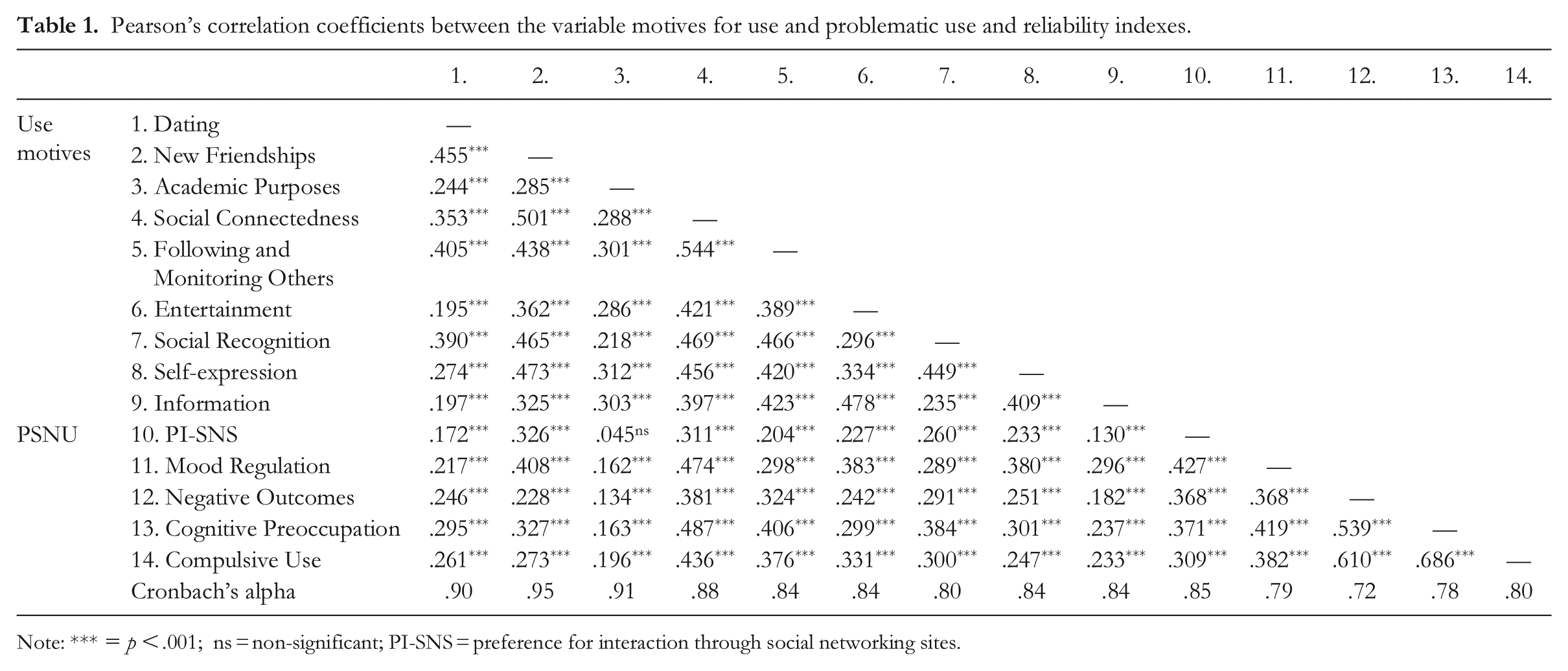
Pearson’s correlation coefficients between the variable motives for use and problematic use and reliability indexes.
Note: *** = p < .001; ns = non-significant; PI-SNS = preference for interaction through social networking sites.
To measure the time spent on SNS, two questions were asked. The first question was ‘How often do you connect to the social networks mentioned above?’, with responses given using a five-point Likert scale (‘daily’, ‘several times a week’, ‘once a week’, ‘less than once a week’ or ‘never’). The second question was ‘On the days you log on, how much time do you usually spend on the networks?’, with responses also given using a five-point Likert scale (‘less than 1 hour’, ‘between 1 and 2 hours’, ‘between 2 and 3 hours’, ‘between 3 and 4 hours’ and ‘more than 4 hours’).
The Problematic Social Networking Site Use Scale (PSNUS) (Machimbarrena et al., 2023) was used to measure PSNU. The PSNUS comprises 15 items that are grouped into the following five subscales of three items each: (a) preference for interaction through social networks (e.g., ‘I prefer to communicate with people through social networks rather than through face-to-face communication’); (b) mood regulation (e.g., ‘I have used social networks to make me feel better when I have been sad’); (c) negative outcomes (e.g., ‘my use of social networks has created problems in my life’); (d) cognitive preoccupation (e.g., ‘when I am not online, I obsessively think about connecting to social networks’); and (e) compulsive use (e.g., ‘I find it difficult to control my use of social networks’). The responses were given using a six-point Likert scale, with options ranging from 1 (‘strongly disagree’) to 6 (‘strongly agree’). The Cronbach’s alpha values for our sample are displayed in Table 1.
Procedure
The research methodology employed for this study was descriptive and cross-sectional. Participants were selected by convenience sampling. First, a stratified cluster sampling was carried out in which 18 schools were selected. These schools were initially contacted; however, only six of them agreed to participate (the remaining schools declined participation due to scheduling issues). Consequently, additional schools were selectively approached to complete the sample. Eventually, 13 more schools agreed to participate, resulting in a total of 19 schools involved in the study.
The questionnaires were completed using an established Spanish online survey platform, in the classroom setting, under the guidance of the high school’s staff and research team members.
The time required to complete the questionnaires ranged from 10 to 15 minutes. Participation was voluntary and anonymous, and no compensation was offered. Consent was obtained from parents, students and school management. The inclusion criterion was an age between 11 and 19 years. There were no exclusion criteria. The study was approved by the Human Research Ethics Committee of the University of the Basque Country (UPV/EHU) with code M10_2020_020.
Statistical analysis
To answer RQ1 and RQ2, an analysis of frequencies and measures of central tendency and dispersion of the mean were used to examine the main motivations for adolescent SNS use. To examine gender-based differences, Welch’s t-test for independent samples was used for mean difference contrast and Cohen’s d statistic was calculated as the effect size.
To answer RQ3, Pearson’s correlation analysis was used to examine the relationships between motives for use and PSNU.
Regarding RQ4, latent profile analysis was conducted. A mixture modelling statistical procedure was used to identify groups of individuals (categorical latent variables) that gave similar responses to specific continuous variables (Collins & Lanza, 2010). To categorize the participants’ motives for SNS use, a latent profile analysis was conducted using the scores obtained for the nine dimensions of the SMU-SNS (dating, new friendship, academic purposes, social connectedness, following and monitoring others, entertainment, social, self-expression and information-seeking). After conducting a preliminary analysis with all dimensions, difficulties were observed in achieving models with discriminative ability that included the dating dimension. The frequency analysis of this variable showed that 73.9% of the participants did not use SNS for this reason; therefore, this dimension was excluded from the analysis. Several fit indices were used to help establish the optimal number of latent classes: (a) the Akaike information criterion, Bayesian information criterion and sample size–adjusted Bayesian information criterion (with lower values indicating more parsimonious models); (b) the entropy criterion (used to ascertain the accuracy of classifying participants into their respective profiles [with higher values suggesting better fit]); and (c) the Lo-Mendell-Rubin adjusted likelihood ratio test (to help determine the final number of classes, where a significant p-value [i.e., < .05] indicates that the tested model fits better than the previous one) (Nylund et al., 2007).
To answer RQ5, the chi-squared test was used to compare the differences in proportions in the number of SNS used, frequency of use and time spent online between the different subgroups. In addition, a one-way analysis of variance was conducted to examine whether there were differences in PSNU among profiles. The Games-Howell test was used as a contrast test.
For data analyses, the statistical package MPLUS 8.0 (Muthén & Muthén, 2017) and the Statistical Package for the Social Sciences (SPSS) 24 (IBM®) were used.
Results
Number of SNS and motives for use
Adolescents used a mean of 3.3 (SD = 1.1) social networks, with a median (interquartile range) of 4 (2–6). The most-used network was YouTube (88%; n = 1,595); 80.5% (n = 1,459) used Instagram; 71.1% (n = 1,288) used TikTok; 37.9% (n = 687) used Twitch; 27.3% (n = 494) used Twitter; and 25.2% (n = 457) used Snapchat.
As shown in Table 1, the most common motives for SNS use were entertainment (M = 16; SD = 4.58), information-seeking (M = 15.24; SD = 5.01), academic purposes (M = 12.42; SD = 6.35), making new friends (M = 11.67; SD = 6.03), following others (M = 10.04; SD = 5.33) and social connection (M = 10.02; SD = 5.51). Dating (M = 5.55; SD = 3.95) and social recognition (M = 7.14; SD = 4.50) were the dimensions with the lowest motives for use.
Motives for SNS use by gender
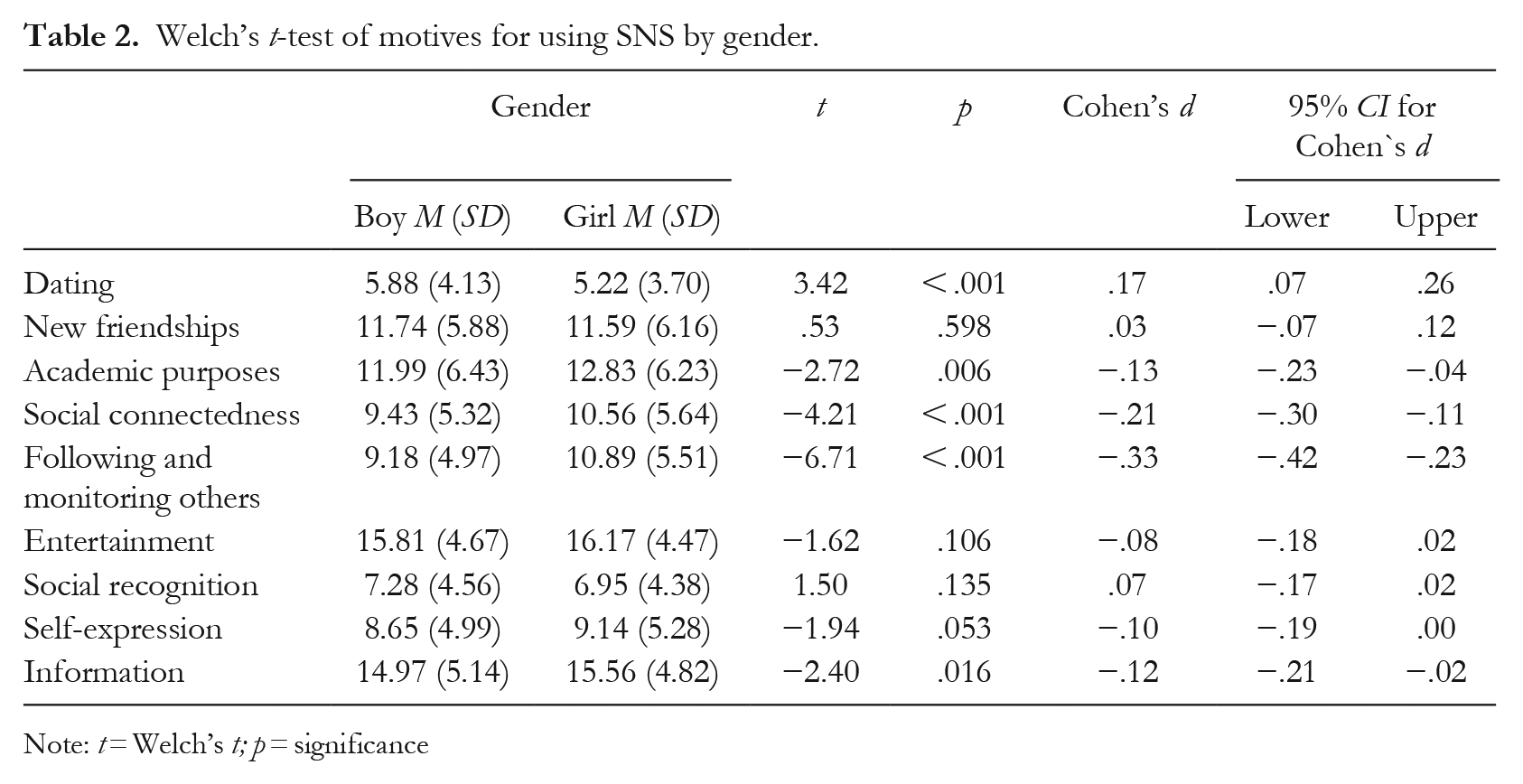
Table 2 presents the results of Welch’s t-test for the motives for using SNS according to gender. Statistically significant differences were found between boys and girls for academic purposes, social connection, following others, information-seeking and dating.
Welch’s t-test of motives for using SNS by gender.
Note: t = Welch’s t; p = significance
Relationships between motives for SNS use and problematic SNS use
The correlations between motives for SNS use and problematic use are illustrated in Table 1. Statistically significant correlations were found between the motives for use and all dimensions of the PSNUS except between the academic purpose motive and the preference for interaction through social networks dimension. The motive for use that had the strongest correlation with the dimensions of PSNU was social connection (r = .31–.49). In contrast, the motive for use that had the weakest correlation with the PSNU dimensions was academic purposes (r = .05–.13).
Latent profiles based on SMU-SNS dimensions
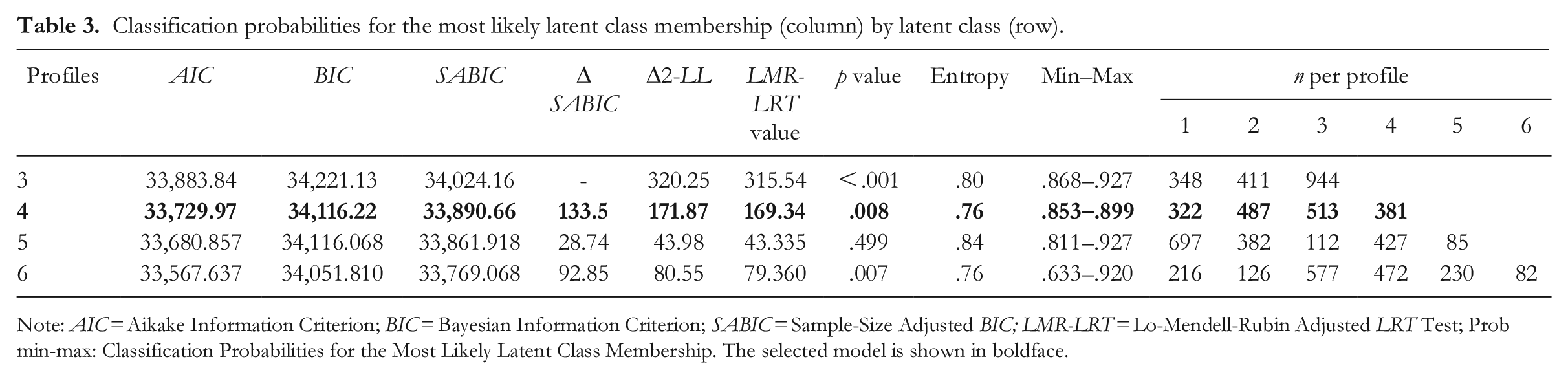
Table 3 presents the results of testing the different number of profiles (from three to six profiles) based on the seven dimensions of the SMU-SNS. The analysis of the fit indices displayed in Table 3 together with an assessment of the obtained profiles led to the selection of the four-profile solution, as the p-value for the solution with five profiles was not significantly higher than that for the four-profile solution. Furthermore, no decrease in the Akaike information criterion was observed between the four- and five-profile solutions, and the entropy values were approximately .80. Additionally, the four-profile solution provided more interpretable results.
Classification probabilities for the most likely latent class membership (column) by latent class (row).
Note: AIC = Aikake Information Criterion; BIC = Bayesian Information Criterion; SABIC = Sample-Size Adjusted BIC; LMR-LRT = Lo-Mendell-Rubin Adjusted LRT Test; Prob min-max: Classification Probabilities for the Most Likely Latent Class Membership. The selected model is shown in boldface.
Figure 1 illustrates the four profiles according to their standardized scores. The profile comprising the largest proportion of the sample (30.1%) was labelled ‘socializing users’. The participants in this profile scored above average for all dimensions except social recognition, with the friendship dimension standing out (M = 5.67; SD = 2.34). The second-largest group (28.6%) was labelled ‘leisure users’. These individuals scored below the mean for every dimension of the scale except entertainment (M = 17.74; SD = 2.69) and information-seeking (M = 15.79; SD = 4.53), for which they scored slightly over the means. The third-largest group (22.4%) was labelled ‘hyperconnected users’. These participants scored higher than the rest of the profiles for all dimensions, particularly social recognition (M = 13.98; SD = 2.89). Finally, the smallest group (18.9%) was labelled ‘discreet users’. Participants with this profile scored far below the mean for every motive (e.g., entertainment, M = 8.73; SD = 2.96).
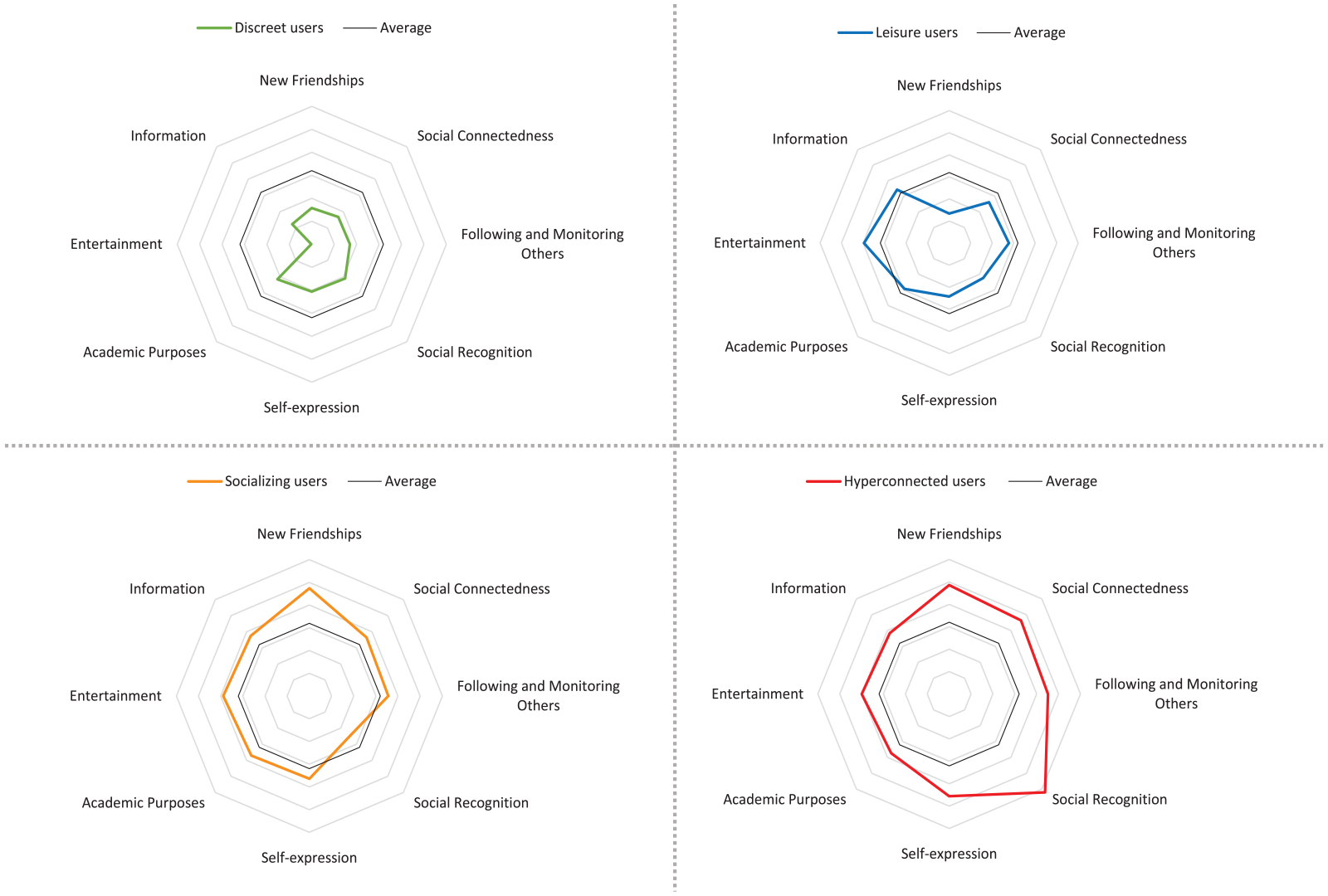
Profiles of SNS motives for each group.
Analysis of profiles with number of social networks, frequency of use and problematic use
Table 4 shows the number and percentage of the participants’ number of social networks, frequency of use of SNS and time spent in SNS according to each profile. The chi-squared test revealed statistically significant differences in the number of SNS used by profile (c2 = 149.10; p < .001; Cramer’s V = .17). An analysis of standardized residuals revealed that the socializing and hyperconnected users used four or more SNS to a greater extent than the discreet or leisure users did.
Chi-square test for number of social networks, frequency of use and time spent.
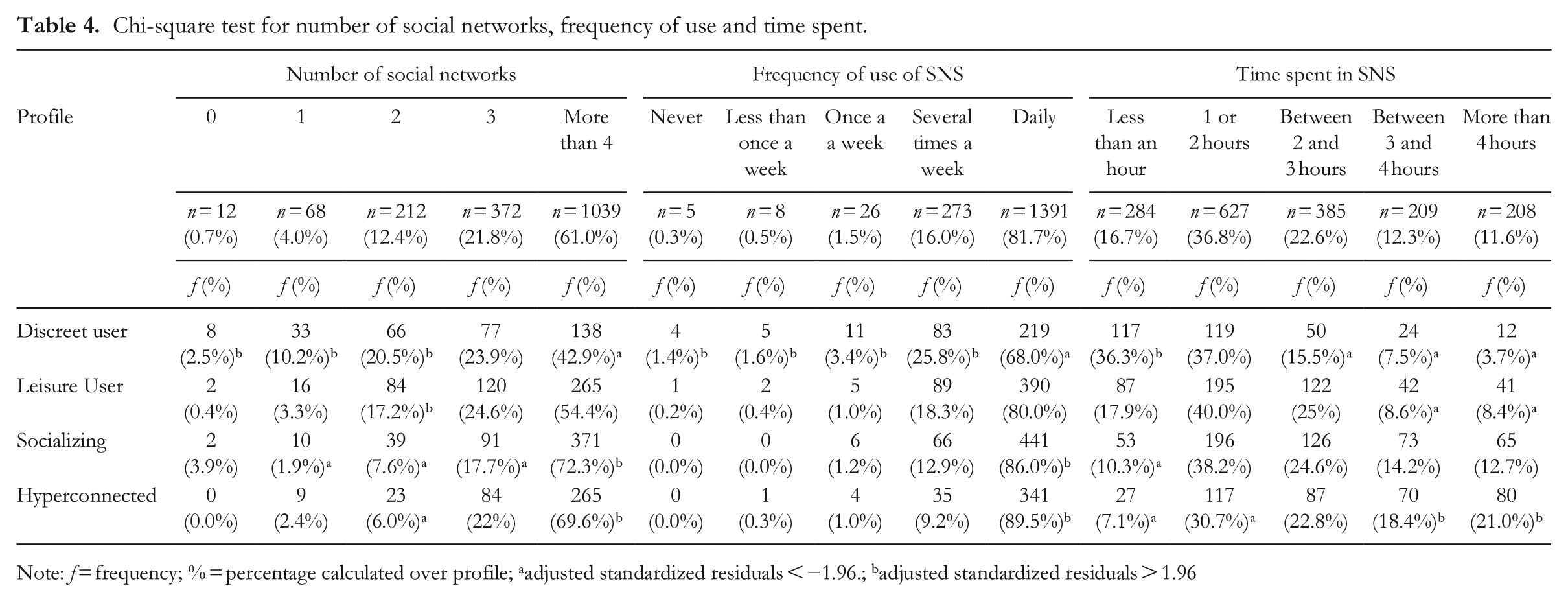
Note: f = frequency; % = percentage calculated over profile; aadjusted standardized residuals < −1.96.; badjusted standardized residuals > 1.96
Regarding the frequency of SNS use, the chi-squared test also revealed statistically significant differences by profile (c2 = 79.25; p < .001; Cramer’s V = .13). An analysis of the standardized residuals revealed that more adolescents with the socializing and hyperconnected user profiles used SNS daily than those with the discreet and leisure user profiles.
Lastly, when taking into account the time spent using SNS, the analysis revealed significant differences in the time spent using SNS by profile (c2 = 198.62; p < .001; Cramer’s V = .20). An analysis of the standardized residuals revealed that the observed frequency of adolescents with the socializing and hyperconnected user profiles spending more than four hours per day on SNS was higher than expected, while the number of adolescents spending less than one hour per day on SNS was higher for adolescents in the leisure user group than for those in the socializing and hyperconnected user groups.
Table 5 demonstrates the significant differences between the four profiles and all the dimensions of the PSNUS. Those with the discreet and leisure user profiles scored below the means for all dimensions and presented significant differences with respect to the other profiles for all dimensions. Those with the socializing and hyperconnected user profiles presented scores above the means for all dimensions. They also presented statistically significant differences with the rest of the profiles, except in regard to the mood regulation dimension, for which they only presented significant differences with the discreet and leisure user profiles.
Analysis of variance results for problematic social media use and a comparison among the four clusters.
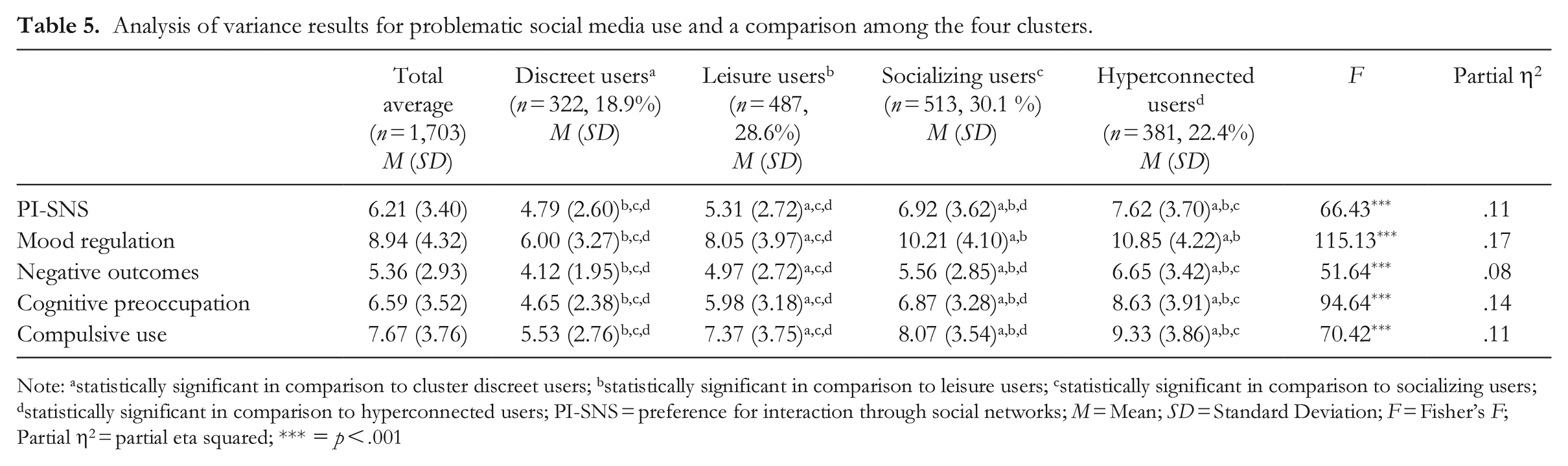
Note: astatistically significant in comparison to cluster discreet users; bstatistically significant in comparison to leisure users; cstatistically significant in comparison to socializing users; dstatistically significant in comparison to hyperconnected users; PI-SNS = preference for interaction through social networks; M = Mean; SD = Standard Deviation; F = Fisher’s F; Partial η2 = partial eta squared; *** = p < .001
Discussion
The primary objectives of the present study were to establish user profiles based on the motivations for using SNS and to examine their relationships with gender, the number of SNS used, the frequency of use and the PNU. With regard to the main SNS used by adolescents and their motivations (RQ1), adolescents used four social networks on average. The most used were YouTube, Instagram, TikTok, Twitch, Twitter and Snapchat. This is consistent with the results of a study by Wavemaker and LIVE Panel (2020), in which it was revealed that 72% of teenagers used between two and five SNS. Furthermore, additional studies have shown that the SNS most used by teenagers is YouTube, and among the top seven are Instagram, TikTok, Twitch, Twitter and Snapchat (Andrade et al., 2021; IAB Spain, 2023; Kircaburun et al., 2020; Pew Research Center, 2022; Wavemaker & LIVE Panel, 2020).
The main motives for using SNS, from most to least common, were entertainment, information-seeking, academic purposes, making new friends, following others and social connection. Dating and social recognition were the dimensions with the lowest scores for SNS use. These results are consistent with those from several other studies (Floros & Siomos, 2013; García-Ruiz et al., 2018; López-de-Ayala-López et al., 2022; Stockdale & Coyne, 2020), in which it was found that entertainment, socialization and information-seeking were the main motives for which minors utilized these platforms. For adolescents, social networks are a useful tool for satisfying the need to dispose of their own resources for socialization, an aspect that is particularly relevant at this stage of development. Thus, through social networks, adolescents strengthen their decision-making abilities, relieve their boredom and obtain information on controversial issues that they are not comfortable discussing with adults (Stockdale & Coyne, 2020).
With regard to gender-based differences in the motives for SNS use (RQ2), girls mainly used SNS for academic purposes, to feel connected with society, to follow other people and to search for information. On the other hand, boys used them mostly to look for romantic relationships. These results are broadly consistent with those of previous studies conducted among adolescents from diverse cultures (Ali et al., 2021; Dhir & Torsheim, 2016; Gray, 2018; Kircaburun et al., 2020; López-de-Ayala-López et al., 2022; Muscanell & Guadagno, 2012; Teppers et al., 2014). Therefore, it may be argued that adolescents use SNS differently according to gender and that these differences remain in different countries and cultures. One possible explanation for this difference could be that females use SNS for more functional purposes than males (Valencia-Ortiz et al., 2020), be that a more responsible use (in terms of studies and information-seeking) or a more communicative use (related to social connection and following other people). This last aspect could be risky; on SNS where image predominates (e.g., Instagram), comparison may be a source of dissatisfaction and excessive self-demand and could also generate feelings of lower self-efficacy (Fioravanti et al., 2020; Mann & Blumberg, 2022; Twenge et al., 2022). In the case of male users, it could be argued that they present a more solitary use, focused on satisfying individual interests, such as the search for new romantic relationships. In our study, no gender-based differences were found for the entertainment motivation; however, several previous studies have found such differences — males have presented higher scores in some forms of entertainment, such as the use of video games (Ali et al., 2021; Gray, 2018; Muscanell & Guadagno, 2012).
Regarding the relationship between motivations for using SNS and PSNU (RQ3), strong associations were observed for most of the dimensions of the two scales. The only dimensions that did not exhibit significant correlations were academic purposes and preference for social interaction through SNS. These results are in agreement with those of recent research in Spanish adolescent populations, in which no correlation was observed between the preference for social interaction through SNS and the search for useful information (López-de-Ayala-López et al., 2022). This may indicate that the use of SNS to search for academic information may be related to a healthier use of SNS among adolescents, since the aforementioned preference has been consided as one of the main indicators of problematic SNS use (López-de-Ayala-López et al., 2022; Svicher et al., 2021). In addition, the social connection motivation was strongly associated with the dimensions of emotional regulation, cognitive preoccupation and compulsive use. According to Caplan’s (2010) model, these last two dimensions can be grouped into a single dimension called ‘deficient self-regulation’. In addition, the motivations of making new friends and following other people were also strongly associated with mood regulation and cognitive preoccupation. These results are from cross-sectional data, so causality cannot be inferred; however, they reveal the relationship between U&G theory and PSNU. Thus, those with PSNU may tend to seek more gratification through social networks, or those users who tend to seek more gratification may have more problems with self-regulation, leading them to obtain higher scores or suffer more negative consequences related to their SNS use. In any case, the U&G theory is not sufficient to explain the relationships between motives for use and PSNU, and longitudinal studies and theories such as the self-determination theory (Ryan & Deci, 2000), emotional dysregulation (D’Agostino et al., 2017) and other frameworks should be taken into account.
Regarding the existence of profiles based on motivations for using SNS (RQ4), four profiles of adolescents were found. The ‘discrete users’ profile refers to those for whom no single motivation dominates the pattern of use. This profile is the least numerous, so adolescents in general do not use social networks without a specific motivation. Another profile comprises individuals who use SNS primarily for entertainment (‘leisure’ users). These adolescents score below the average in all motivations except information-seeking and entertainment, the latter being the most prominent. On the other hand, we found a profile of adolescents who used SNS for various tasks, although their main motive was to make friends (‘socializing’ users). This profile of adolescents is the most numerous, suggesting a significant prevalence of the motivation to establish social connections through social networks in this population. These results are consistent with other studies among adolescents that have found similar profiles of users on these platforms (Sábada et al., 2021; Su et al., 2018). Finally, users with the ‘hyperconnected’ profile obtained the highest scores in all the motives for use analysed, with social recognition reflecting the highest scores. Other studies among adolescents have also found a hyperconnected profile (Sábada et al., 2021; Su et al., 2018), although social recognition did not stand out as a motivation.
In terms of differences among profiles in the number of social networks used, frequency of use and PSNU (RQ5), the ‘discreet’ users profile used fewer SNS and spent less time online daily. Moreover, their low scores across all dimensions of the scale suggest a lack of engagement in PSNU. As for the ‘leisure’ users profile, these individuals exhibited higher daily connection times and scores on all dimensions of the PSNUS compared to discreet users, albeit still below average. Hence, it could be argued that these adolescents primarily utilized SNS for entertainment purposes without displaying signs of PSNU. However, prior research (H. T. Chen & Kim, 2013; Stockdale & Coyne, 2020) has found associations between the use of SNS to manage boredom and problematic use. This suggests that ‘entertainment’ is too broad a dimension and that it would be useful for future research to discern between different forms of entertainment.
In the case of ‘socializing’ users, adolescents within this category used four or more SNS daily and obtained above-average scores across all dimensions of the PSNUS, particularly emotional regulation and compulsive use. These findings corroborate previous studies (Floros & Siomos, 2013; Kircaburun et al., 2020), where problematic use has been found to be related to socialization motives. Furthermore, this reaffirms the hypothesis that among adolescents, interpersonal communication within these applications requires different emotional management than in face-to-face situations, which could lead to negative consequences.
Lastly, concerning the ‘hyperconnected’ profile, these adolescents demonstrated the highest scores for the number of SNS used, connection time and problematic use. For adolescents, virtual recognition (e.g., ‘likes’) has become instrumental for social approval. The need to belong to a group is very important, and the content that these individuals upload to SNS causes reactions of acceptance or rejection, which can lead to feelings of frustration. In contrast to face-to-face interaction, the feedback received through these platforms is immediate, which can lead to emotional discomfort. This could explain why hyperconnected adolescents who seek social recognition through SNS are at greater risk of problematic use of these applications. This could be particularly relevant for parents and the introduction of early parental mediation strategies that would prevent hyperconnected users from also developing problematic social networking site use.
Regarding the time spent using SNS, we found that adolescents who used SNS to socialize and obtain social recognition had the highest scores for the number of SNS used, spent more time on these applications and obtained higher scores for the dimensions of problematic use. According to some previous research, time spent on SNS is a risk factor for the development of problematic use (Marino et al., 2018; Stockdale & Coyne, 2020). However, it has also been indicated that time of use is not a determining factor for the development of PSNU, as individuals who frequently use SNS for functional purposes (e.g., school purposes) do not show indicators of problematic use (Marino et al., 2018). In our study, academic purposes and information-seeking were the motivations that carried the least weight for hyperconnected adolescents (i.e., adolescents who spent a lot of time on SNS and who engaged in problematic use). In contrast, users in the discreet profile, who had the lowest levels of problematic use, used SNS mainly for academic purposes. This may support the theory that time of use alone is not a good indicator of problematic use but that the combination of other, transcendental variables, such as motivations for use, should be taken into account.
Limitations
This study has some limitations. First, our results were based on self-reported measures, and individuals with PSNU may be unaware or unwilling to acknowledge their problematic behaviours and tendencies. In addition, because the sample is not representative, the results cannot be accurately extrapolated to the larger population or other contexts, undermining the validity and generalizability of the findings. Finally, it should be noted that most studies thus far have examined the motivations that lead to problems derived from the use of SNS; therefore, the field would benefit from studies examining the motivations for healthy SNS use. However, despite these limitations, we would like to highlight that the present study is the first to relate adolescent user profiles according to the motivations for using SNS with PSNU as measured from a paradigm other than addiction — that is, from the context of Caplan’s (2010) cognitive-behavioural model.
Future perspectives
Future research could address the limitation of self-reported measures by incorporating additional questions that assess awareness of the problem and by contrasting it with reports from parents, teachers or expert psychodiagnostic assessments. Additionally, future research might investigate the phenomenon of SNS use among adolescents through longitudinal studies, potentially enabling the elucidation of a causal relationship between the problems.
Conclusion
In conclusion, this research makes several notable contributions to the field of study. First, it describes the most-used social networks and the current primary motives for use among adolescents in the Basque Country. Second, it illustrates a relationship between high scores on PSNU dimensions and a motive scale based on the U&G theory. Moreover, our research demonstrates that it is possible to describe up to four differentiated SNS user profiles, with a particularly relevant relationship between the hyperconnected profile and PSNU. Future interventions and prevention programmes should further explore and apply this link. Specifically, the motives of use among people presenting PSNU should be explored and, in turn, preventive measures should be adopted so that people who present high scores for motives for use do not develop PSNU.
These results are relevant because SNS have become an essential part of adolescents’ lives. It is important to educate individuals from an early age on how to make good use of these applications. Learning how to use SNS should not merely be technical but should also integrate education on the psychological factors related to interactivity and information-speed management.