




Abstract
The life-long acquisition of knowledge is a major research topic in educational psychology. Many approaches based on the idea of learning as information processing treat learning primarily as the expansion of knowledge and the enrichment of existing knowledge structures with new information. In this article, we argue for a slightly different conceptualization of learning as an epistemic activity. Our proposal builds on the classical cognitive view of learning as information processing but relies on a stronger notion of knowledge, according to which knowledge is construed as justified true belief. Understanding and evaluating arguments is central to learning as an epistemic activity, particularly as many learning materials are structured around arguments. Furthermore, learning as an epistemic activity requires using source information for credibility evaluations, and the avoidance of belief biases in the selection, comprehension and evaluation of information during learning. We discuss examples of learning as an epistemic activity within the framework of the Two-Step Model of Validation and outline how this perspective on learning can guide future research.
How children, adolescents and adults acquire knowledge is a major research topic in educational psychology. Likewise, the acquisition of knowledge is seen as a major goal of formal education, starting in nursery and kindergarten and continuing from primary and secondary school through to higher education. But what do we mean with the term learning as knowledge acquisition? Since the cognitive shift in psychology, many educational psychologists have adopted a cognitive view of learning, according to which learning is information processing and successful learning is good information processing (Pressley et al., 1989). Following this perspective, educational psychologists have pursued questions such as how information is processed and understood during learning, how information is stored in memory and later retrieved to be applied in new situations, and how these processes can be promoted through learning strategies and appropriately designed instruction (e.g., Ausubel, 2012; Fiorella & Mayer, 2015; Wittrock, 2010). The cognitive view is one of the three dominant approaches to learning in psychology, alongside behaviourist and constructivist views (Mayer, 1992), and arguably a highly fruitful one. It has guided and inspired several decades of research in educational psychology. Successful theories have been developed within this framework, and the research guided by the information processing view has stimulated highly useful practical applications, from learning strategy training to improve learners’ capacity to process information (for a meta-analysis, see Donker et al., 2014), to instructional approaches to foster deep comprehension and lasting learning in the classroom (Richter et al., 2022).
Notwithstanding the merits of information processing accounts of learning, they place certain forms of learning in the foreground, whereas others tend to take a back seat. The focus of the information processing account of learning is cumulative knowledge acquisition: learning is seen primarily as the expansion of knowledge and the enrichment of existing knowledge structures with new information. However, the cognitive view of learning has evolved in recent decades, and research issues that require a view of learning that goes beyond cumulative knowledge acquisition are increasingly being considered in educational psychology. Examples of such research issues include the role of misconceptions in learning (e.g., Kendeou & van den Broek, 2005), informal reasoning (e.g., Shaw, 1996; Voss et al., 2012), mental model updating (e.g., Richter & Singer, 2018), knowledge revision and conceptual change (e.g., Chi, 2008; Kendeou et al., 2014; Sinatra & Chinn, 2012), and the related issues of epistemic cognition and the role of epistemological beliefs in learning (e.g., Hofer & Pintrich, 2004). This research is usually based on the information processing approach, but in our view it also goes beyond it and points to a slightly different conceptualization of learning that we call learning as an epistemic activity.
Our proposal builds on the classical notion of learning as information processing but relies on a stronger notion of knowledge, according to which knowledge is not equated with information but construed as justified true belief. We will argue that understanding and evaluating arguments is central to learning as an epistemic activity, particularly as many learning materials are structured around arguments. Furthermore, learning as an epistemic activity requires sourcing, that is, attending to the source of information and using information about the source for credibility evaluations, and the avoidance of belief biases in the selection, comprehension and evaluation of information during learning. We will then describe the Two-Step Model of Validation (Richter & Maier, 2017, 2018) as a framework to conceptualize the major cognitive processes involved in learning as an epistemic activity. The article concludes with a discussion of how the view of learning as an epistemic activity relates to the view of learning as information processing and a brief outline of open research questions.
Learning as the acquisition of knowledge as justified true belief
Why it may be useful to describe learning as an epistemic activity is best illustrated by situations that involve critical thinking or reflection, or those in which learners are confronted with false, unreliable, biased or conflicting information. Such situations are more common than one might think, both in formal and in informal learning. As an example from a school learning context, take a middle school literature programme that requires students to learn facts such as author names, genres and rhetorical figures but also to reflect on how the author came to write the novel or piece of poetry, their style, intent, or what the piece meant in relation to the author’s personal development. To give another example, learning in history not only incorporates the study of textbooks but also that of primary sources that need to be compared and evaluated with regard to their particular standpoint and credibility in order to get an adequate picture of historical events (Wineburg, 1991). Importantly, learning as an epistemic activity is not confined to the humanities or social sciences. Scientific discourse in the natural sciences is characterized by multiple and competing theories, often supported by ambiguous or mixed evidence, necessitating critical discourse as an integral part of learning in science (Osborne, 2010). To complicate matters even further, theoretical viewpoints, methodological approaches and standards in science are continuously evolving. Learning about science therefore critically relies on both the evaluation as well as the comprehension of scientific arguments (Britt et al., 2014).
In informal learning, people wishing to know more about a certain topic, such as socio-scientific issues debated in public (e.g., ‘Do the benefits of nuclear power outweigh its risks?’) or medical topics (‘Should my child get this vaccination or not?’), usually encounter conflicting and sometimes contradicting viewpoints when they search for information on the internet (Richter & Maier, 2018). In this situation, successful learning incorporates the formation of a reasonable and justified point of view regarding the controversial issue. Likewise, informal learning on the internet (but also the use of internet sources in formal education) carries the risk of encountering misinformation, which can range from imprecise or incomplete information to unjustified claims and biased information, to outright falsehoods (e.g., Cacciatore, 2021). Here, successful learning involves learners recognizing misinformation or unjustified claims and not incorporating this information into their world view (e.g., Sinatra & Lombardi, 2020). A third case is learning that involves conceptual change, for example when misconceptions about scientific or socio-scientific issues are corrected by refutational texts or model-based reasoning (e.g., Kendeou et al., 2014; Vosniadou, 2013
These examples illustrate what we mean by learning as an epistemic activity. This type of learning aims at the acquisition of knowledge but in a different and stronger sense than information processing accounts of learning. A conception of knowledge appropriate for epistemic accounts of learning is the ‘tripartite’ analysis (also called the standard philosophical analysis) of knowledge, according to which knowledge is justified true belief (Ichikawa & Steup, 2018). Thus, three criteria are necessary and together sufficient to ascribe knowledge to a person: the statement ‘A person P knows that X’ is true if (1) P believes that X is the case (belief criterion), (2) X is indeed the case (truth criterion) and (3) P has relevant reasons why X is the case (justification criterion).
The three criteria in the tripartite analysis require some elaboration. The belief criterion is straightforward from a psychological point of view: it means that the person who knows X also holds X to be true, or at least, believes X to be plausible. In that sense, the criterion distinguishes knowledge from other types of cognitions, such as dreams, phantasies or other thoughts about fictitious states of affairs. Of course, given the architecture of the cognitive system, most knowledge stored in long-term memory is not held to be true in the sense that P is consciously aware of their epistemic stance towards X at any given moment. But even declarative knowledge buried deep in long-term memory can move into consciousness in principle, given the right retrieval cues. The belief criterion implies that in that case, people also become aware that they believe this knowledge to be true or plausible.
The concept of truth referred to in the second criterion is notoriously difficult to grasp, and its meaning is among the most difficult and contentious issues in theoretical philosophy (Kirkham, 1992). Philosophical explications of truth are offered by correspondence, coherence and pragmatist theories of truth (for an overview, see Walker, 2017). Each of these approaches captures different aspects of our intuitive notion of truth, and each of them is compatible with and informs psychological thinking, either explicitly or implicitly. Correspondence theories of truth define the truth of a belief in terms of its correspondence to some states of affairs in the world. In psychology, a correspondence notion of truth is employed or presupposed, for example, in the psychology of perception to distinguish reliable perceptions from perceptual illusions. It is also inherent in the popular idea that learning and comprehension includes the construction of referential representations, such as mental models or situations models, of the state of affairs described in the learning materials (e.g., Johnson-Laird, 1983). Coherence theories of truth define the truth of a belief in terms of its coherence with other beliefs, including those that are based on sensations and perceptions. In psychology, a coherence notion of truth is employed or presupposed, among other fields, in the psychology of thinking and the psychology of text comprehension and learning from texts (e.g., Kintsch, 1988; Thagard, 1989; Voss et al., 2012). Finally, pragmatic theories of truth define true beliefs in terms of whether they allow successful interaction with the world. Such a notion of truth underlies, for example, the psychology of problem-solving and constructivist approaches to learning (e.g., problem-based learning, Hung et al., 2008). It is also highlighted in definitions of the mental model construct that inform much research in human–computer interaction and related fields (e.g., Norman, 1983, p. 7).
The justification of knowledge required by the third criterion can take different forms; that is, the types of relevant reasons can vary. For example, some beliefs can count as knowledge because they are true and the person who holds the belief can refer to first-hand experience as justification. For example, a person may be said to know that the sun is shining if they not only believe but also see that the sun is shining. However, far more often, the reasons that people provide to justify their beliefs are not based on first-hand experience but on what they have learned from others, for example, from parents, peers, teachers or media sources. Wilson (1983) coined the term second-hand knowledge for this kind of knowledge. For beliefs that qualify as second-hand knowledge, the person holding the belief may have reasons that are themselves beliefs that they have learned from others. For example, a medical student who believes that a specific medication is effective may justify this belief by another belief learned from others, namely that randomized control trials have shown consistently that patients treated with the medication became healthier compared to patients who received a placebo instead. In many cases, however, people may only be able to point to the source of their knowledge to justify their second-hand knowledge. Imagine, for instance, a student in lower secondary school who has just learned and now holds the belief that Mars is the fourth planet in the solar system (counting from the sun). The only justification the student may be able to give for this belief is that the geography teacher presented this information in class and that it is also found in the geography book. We will come back to the pivotal role of appeals to cognitive authority for justifying second-hand knowledge later, when discussing the role of sourcing for learning as an epistemic activity.
The notion of knowledge as justified true belief goes beyond that of knowledge as information. To illustrate this point by an example, consider the question of whether the output of AI tools such as ChatGPT (https://openai.com/blog/chatgpt) could count as knowledge or not. Such tools exploit information about the co-occurrences of linguistic units in large amounts of written texts to generate responses to a wide range of queries, and these responses are often astonishingly coherent and sound reasonable and expert-like. Moreover, the underlying model can ‘learn’ in the sense that its answers are gradually optimized based on human feedback. But the model cannot distinguish fact from fiction, propaganda from well-founded arguments, or bullshit (that is, persuasive speech with no regard or commitment to truth, Frankfurt, 2005) from reliable and justified information. The model can process, rearrange and reproduce information; it can also create new information (in a limited sense), but it does not possess an understanding of the world. In other words, the model does not hold knowledge in the sense of justified true beliefs.
Most educators and most researchers in educational psychology and other learning sciences would probably agree that gaining a proper understanding of the world should be a primary goal of education, which implies that learning should lead to knowledge as justified true belief, which goes beyond knowledge as information. Next, we will discuss the comprehension and evaluation of arguments as the core processes that need to be mastered to achieve this goal.
Learning as an epistemic activity is based on the comprehension and evaluation of arguments
Learning as an epistemic activity is based on the comprehension and evaluation of arguments. To illustrate and substantiate this point and, at the same time, clarify its broad scope, consider typical ways in which knowledge is conveyed: for example, a teacher giving a presentation in the classroom, a professor writing a textbook or an expert posting an instructional video on the internet. The people engaging in such instructional activities do not merely present information. They also claim, mostly implicitly, that the information they present is true or likely to be true. Moreover, they provide reasons for assertions they believe to be controversial, or at least imply that good reasons exist that entitle them to make their assertions. Thus, teaching essentially involves the presentation of arguments and learning essentially involves the understanding and evaluation of these arguments.
According to the well-known functional model by Toulmin (1958), the core structure of the argument consists of a claim, that is a statement whose truth value or correctness is in dispute or could be disputed, and one or several empirical or conceptual reasons (also called ground or data) that provide support for the claim. Arguments may contain additional components, which include a warrant that specifies the evidential relation of reasons and claim (often left implicit), backing evidence for the warrant, and a rebuttal that states limitations or boundary conditions for the validity of the argument.
To give an example for the elements of the Toulmin model, we paraphrase the argument presented in the first paragraph of this section (including the elements that are left implicit and that the reader must infer from the previous section): Learning as an epistemic activity is based on the comprehension and evaluation of arguments (claim) because instructional activities typically involve the presentation of arguments (reason). Understanding and evaluating arguments is essential for human learning if we view learning as the acquisition of knowledge as justified true belief (warrant). Artificial intelligence models that can process information but cannot understand and evaluate arguments do not possess knowledge as justified true belief (backing evidence for the warrant). However, people engaging in instructional activities often do not make explicit that they are presenting arguments, and even the reasons that these people have for making knowledge claims can be left implicit (rebuttal).
Even for simple arguments to be well structured, reasons must support claims through explicit or implicit inference from an accepted prior belief. For a reader to judge whether an argument is sound, they must form a representation of the claim–reason connection of the argument to be able to evaluate whether the reason provides relevant support for the claim, thus warranting the connection (Larson et al., 2009). Thus, for learning as an epistemic activity to be successful, learners need to form an adequate representation of the claim–reason relationship and they need be able to evaluate the validity of the argument.
Challenges in identifying and representing arguments
Forming an adequate representation of an argument requires learners to identify its components. Identifying the claim is the key to argument comprehension as arguments are represented hierarchically, with the claim holding the top position in the representation (Britt & Larson, 2003). However, whereas scientific communication is, at least in part, organized in a way that makes it easy for readers to identify argument components and form adequate representations, in many materials that learners encounter, argument structures are implicit or even obscured.
Scientific articles in the empirical sciences, for example, usually follow a schematic argument structure that contains all components of fully-fledged arguments (Suppe, 1998; von der Mühlen et al., 2019). The theoretical introduction of a scientific article presents the main claim that is scientifically disputed and provides reasons why it is relevant and worthwhile to investigate. Moreover, results are presented that function as data or reasons to support the theoretical claim. Finally, a detailed description of data collection and analysis methods serves as the warrant, and a discussion section provides further links between the data and main claim and covers limitations and potential alternative explanations (i.e., rebuttals and counterarguments). Thus, scientific articles are centred around the claim, the components of the argument are often explicitly labelled, presented in a canonical order, and authors of scientific articles explain how and in what respects their results support the claim. This schematic structure of scientific articles can be taught to students and forms an important part of disciplinary literacy, supporting learning as an epistemic activity in the discipline. Note that we view the structure of experimental articles in the empirical sciences merely as an example of a well-structured argument rather than an ideal for all kinds of scientific discourse. In other disciplines such as history or literary science, other forms of arguments and corresponding conventional rhetorical structures exist that may facilitate learning as an epistemic activity in these disciplines. Please also note that our description of the ‘argumentative macrostructure’ of experimental articles in the empirical sciences is highly simplified and neglects their ‘argumentative microstructure’. Empirical articles contain more fine-grained arguments on different levels, for example, in the introduction, when new theoretical claims are justified by other, more established theoretical claims or with references to the results of previous studies.
Many texts that learners encounter during formal and informal learning do not make it easy for learners to identify arguments and ‘parse’ their structure. For example, arguments may also lack linguistic markers that help learners to identify their components and infer their relationships, especially claim, reason(s) and their relationship (e.g., connectives such as ‘therefore’ or ‘because’, epistemic verbs such as ‘support’ or ‘contradict’, modal verbs such as ‘should’ or ‘could’, or qualifiers such as ‘perhaps’ or ‘likely’) (Britt & Larson, 2003). Moreover, as mentioned above, arguments are prevalent not only in argumentative texts, where one might expect them, but in many types of texts and learning materials, including expository texts. Arguments in expository texts and their components are often difficult to spot as they tend to present knowledge as factual knowledge, which obscures that it is rooted in scientific discourse. Consider the following example from an expository text on North American history: France sent Samuel de Champlain to Canada in 1603 to setup a trading post. With the help of Indians, he explored much of the St. Lawrence Valley and the area around the Great Lakes. In 1608, he started the trading settlement of Quebec. Soon, other traders and missionaries explored Canada. Small farming villages developed in the next fifty years. New France was now growing in the New World. (Schreiber et al., 1986, p. 403, cited after Slater & Graves, 1989)
Although this short text segment seems like a purely descriptive text, it presents an (inductive) argument, where the historical events described in the first sentences are provided as reasons to support the claim formulated in the final sentence that New France was now growing in the New World. To form an adequate representation of the argument, readers need to identify the claim in the final sentence and the historical facts as reasons. Such reason-first arguments are more difficult to process than typical claim-first arguments (Britt & Larson, 2003). Moreover, no linguistic markers are provided that signal the potential controversial status of the claim and the claim–reason relationship, and finally, the expository text structure and the corresponding rhetoric make it less likely that readers actively and strategically look for arguments and their components. These difficulties are typical for many learning materials and may hamper the comprehension of arguments and, hence, learning as an epistemic activity in many contexts.
In line with this reasoning, studies have shown that high school students are able to construct accurate representations of arguments if the argument structure is made explicit in the text (by introductory and summarizing paragraphs and by providing appropriate linguistic signals, e.g., Chambliss, 1995; Chambliss & Murphy, 2002). However, studies using more authentic informal arguments have revealed that even university students have difficulties identifying the key components of arguments (e.g., Larson et al., 2004; von der Mühlen et al., 2016a) and their relations (e.g., Larson et al., 2009). Informal arguments with untypical or incomplete argument structure, which also lack linguistic signals of argument comprehension, are typical for many learning materials, which presents a severe obstacle to learning as an epistemic activity.
Challenges in argument evaluation
Constructing an adequate representation of an argument, especially the identification and comprehension of the claim, the reason(s) and their relation, is also a precondition for its proper evaluation. Learners must form a representation of the claim–reason connection of the argument to be able to evaluate whether the reason provides relevant support for the claim, thus warranting the connection (Larson et al., 2009). According to Blair and Johnson (1987), arguments can be evaluated along three criteria: acceptability (i.e., truthfulness), relevance (whether the reason warrants the claim) and sufficiency (whether the reason provides enough evidence for the claim).
A similar approach to understanding and evaluating arguments is offered by Shaw (1996), who defines arguments as consisting of conclusions (i.e., claims) and premises for accepting the conclusion (i.e., reasons and warrants), based on either fact or opinion (Halpern, 1989). Shaw (1996) goes on to define three distinctive features in everyday informal reasoning. First, the elements of informal arguments (i.e., conclusions and premises) are not necessarily clearly demarcated, and reasons may even be entirely missing. Second, informal arguments are likely to be inductive, meaning that they are considered valid if the reasons are true and cogent if the argument is both strong and its premises are true. Third, informal arguments are likely to be applied to topics on which different viewpoints exist. The quality of an informal argument can therefore be evaluated by the truth of the reasons, the coherence of the link between conclusions and premises and the extent to which an argument addresses both sides of an issue. Based on these evaluative dimensions, which correspond to the three criteria formulated by Blair and Johnson (1987), Shaw (1996) distinguishes three kinds of objections reasoners can have to arguments. First, they may question the conclusion or premise of the argument, referred to as assertion-based objections (truthfulness). Second, they may question the coherence of the link between the conclusion and its premise, referred to as argument-based objections (coherence). Last, reasoners may favour alternative conclusions, referred to as alternative-based objections. Of these, Shaw describes the assertion-based objections as the least important, as truthful premises do not guarantee truthful conclusions. However, her experiments show that people are much better and faster at formulating assertion-based objections, compared to argument-based and alternative-based objections that address the soundness of the link between the conclusion and the premise, which is central for the quality of arguments. Similarly, von der Mühlen et al. (2016a) have shown that psychology undergraduates are not only less able than scientists to detect argumentation flaws in texts but that they also base their evaluation mainly on an intuitive feeling of implausibility, rather than on an analysis of the link between claims and reasons (Figure 1).
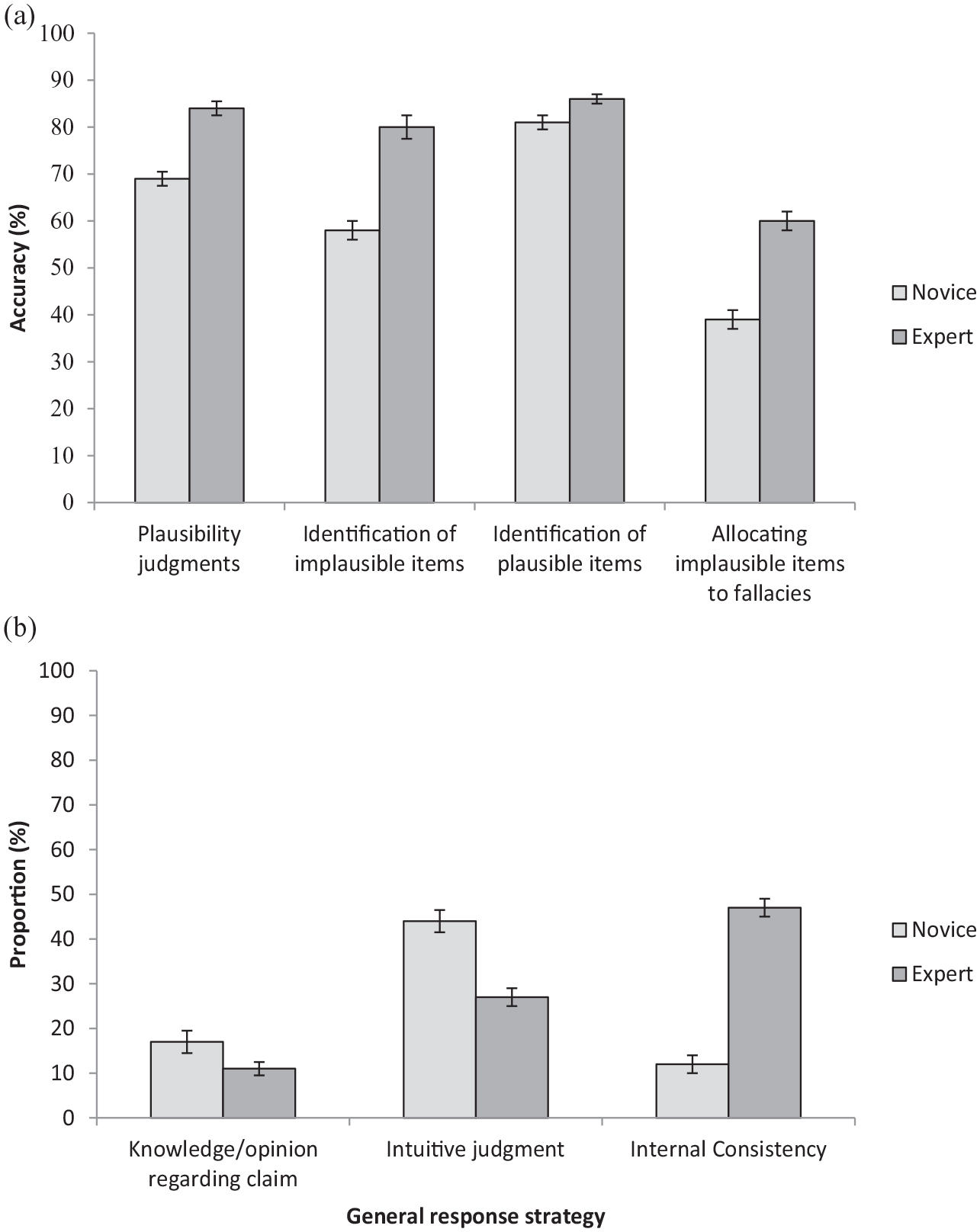
(a) Psychology students’ vs. psychological scientists’ response accuracy in detecting plausible (sound) vs. implausible (flawed) arguments and (b) the strategies that they used for argument evaluation as indicated by think-aloud protocols (adapted from von der Mühlen et al., 2016a). Students read expository texts with plausible (sound) and implausible (flawed) arguments sentence by sentence and provided plausibility judgements for each sentence.
One explanation for this asymmetry is provided by mental model theory (Johnson-Laird, 1994). The mental model approach to reasoning assumes that the reasoner uses their general knowledge to imagine a setting in which both the conclusion and premise are true. A second evaluation is the imagining of a situation in which the premise is true but the conclusion is not. The quality of an argument can thus be evaluated based on the construction of the initial mental model of the argument and by the construction of alternative mental models. Assertion-based objections to arguments are the least effortful, as they require only a check of the initial mental model, while the other types of objections require the evaluation of the link between conclusion and premise or the generation of alternative explanations, which can only be accomplished by engaging in the effortful activity of constructing alternative mental models (Shaw, 1996). To put it in more general terms: the amount of information that needs to be processed in working memory and, hence, the cognitive effort that reasoners need to invest is much greater in argument-based and alternative-based objections compared to assertion-based objections. In line with this reasoning, Münchow et al. (2019) found that university students needed more time reading flawed arguments in expository texts when they were also able to identify the arguments as implausible. In contrast, when they overlooked the argumentation flaws, they read the sentences faster. For plausible sentences that did not contain argumentation flaws, the pattern was reversed (Figure 2). Moreover, Münchow et al. (2020) found that students’ ability to detect argumentation flaws was associated with the ability to identify argument components, which was measured with an independent test. The latter finding supports the idea that the ability to construct proper representations of arguments is an important precondition of their evaluation (Larson et al., 2009).
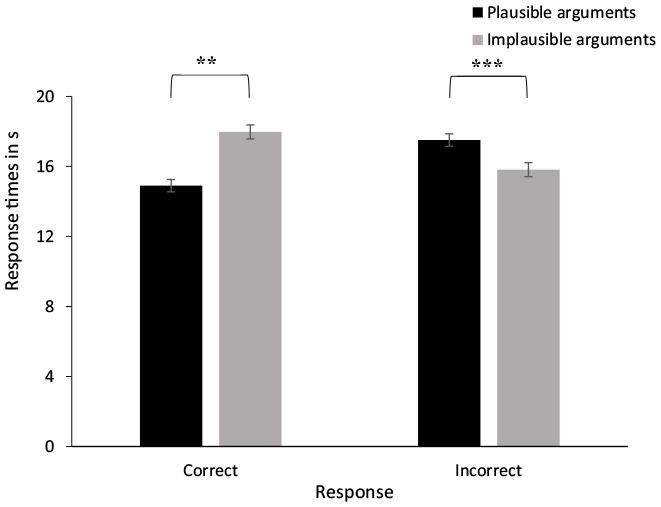
Response times (in seconds) for plausible versus implausible arguments and correct vs. incorrect evaluations of arguments (taken from Münchow et al., 2019). Students read expository texts with plausible (sound) and implausible (flawed) arguments sentence by sentence and provided plausibility judgements for each sentence.
Training argument comprehension and evaluation to support learning as an epistemic activity
The studies and theoretical approaches discussed in the previous sections suggest that the evaluation of arguments is based on rational and reflective processes that require not only cognitive resources but also evaluative strategies that focus on the internal consistency of arguments, that is, whether and to what extent the reason(s) support(s) the claim. Moreover, the evaluation and the comprehension of arguments are closely related processes. An obvious follow-up question is whether these abilities and consequentially learning as an epistemic activity can be improved through training, similar to how learning as the accumulation of knowledge can be improved through training classical learning strategies (e.g., Donker et al., 2014).
One answer to this question is that argument comprehension and evaluation in particular disciplines are likely to be taught as part of disciplinary literacy (Goldman et al., 2016) and in higher education (von der Mühlen et al., 2016a). However, there is also emerging evidence from studies with university students that targeted, often computer-based training interventions can improve these abilities. For example, argument comprehension can be fostered by conveying knowledge about the structural components of arguments and their functions within an argument, including knowledge about relevant linguistic markers, accompanied by exercises (with feedback), allowing students to practise the application of the knowledge (Dwyer et al., 2012; Münchow et al., 2023; von der Mühlen et al., 2019). According to von der Mühlen et al. (2019), the positive impact of such an argument structure training may be greater in high-achieving students, which underscores the point that the comprehension of arguments is cognitively demanding. Likewise, argument evaluation ability in high school and university students can be trained effectively with explicit and targeted training interventions (Larson et al., 2009; Münchow et al., 2023). What is lacking at this point, though, is empirical evidence that explicit and targeted training of argument evaluation has a long-term impact and benefits learning beyond the trained abilities.
Learning as an epistemic activity requires sourcing
Comprehending and evaluating the quality of arguments often requires deep knowledge about the content area. For example, to comprehend and evaluate arguments concerning controversial issues surrounding the COVID-19 pandemic (e.g., ‘Should children be vaccinated against COVID-19?’), it is important to know about the biological and medical basis of both the disease and the effect of the vaccines and understand the related research, including methodological and technical details. The example illustrates that in today’s knowledge society, with its strongly pronounced division of epistemic labour and the ensuing high degree of specialization, only experts in a certain field can be expected to possess the relevant knowledge for a proper evaluation of arguments. In contrast, for lay people, including children and adolescents, the most rational strategy may be to rely on credible, i.e., trustworthy and knowledgeable, sources (Scharrer et al., 2017). In fact, if most of the knowledge that we can possibly have is second-hand knowledge sensu Wilson (1983), it is obvious that we must pay special attention to the source of information. For the same reasons, it is also permissible and rational in many contexts to justify knowledge claims with reference to cognitive authorities, that is, expert opinions. Such arguments to cognitive authority frequently appear, for example, in textbooks (but also in other types of scientific discourse) when claims about scientific facts or theoretical assumptions are supported by references to scientific studies. The ability to identify whether the source of specific information is credible is therefore another important prerequisite for learning as an epistemic activity.
The process of attending to and evaluating attributes associated with information sources, such as author, date and venue of publication and genre, is referred to as ‘sourcing’ (Wineburg, 1991). Several of these attributes may be regarded as cues that can inform readers about the credibility of the source. For example, readers evaluating arguments for or against COVID-19 vaccinations for children might consider the author of the argument (e.g., scientific organization, political group or company) and make inferences concerning the expertise and intention of the source (e.g., intention to inform, persuade or market a product), where the information was published (e.g., outlet known for fact-checking/quality control) and formal features of the information (e.g., scientific article or political propaganda). Perfetti et al. (1999) were the first to point out that in order to achieve a complete understanding of multiple documents on a specific topic (for example, primary and secondary sources in history), such source features need to be represented along with the documents and their argumentative positions and relationships. Perfetti et al. proposed the intertext model as a descriptive representational framework for this information. Other approaches have tried to summarize source features relevant for credibility evaluations into overarching dimensions such as expertise and trustworthiness (Lombardi et al., 2014; Self, 2009).
Sourcing has been examined in numerous studies in the context of learning from multiple documents (e.g., Anmarkrud et al., 2014; Bråten et al., 2009; Goldman et al., 2012; Steffens, et al. 2014; Strømsø et al., 2010; von der Mühlen et al., 2016b; Wiley et al., 2009). One general conclusion this research makes is that sourcing is associated with more adequate credibility judgements and a better comprehension of multiple documents that convey conflicting information or arguments. A second general conclusion is that in many contexts, learners do not engage in sourcing as much as they should. Embedded sources, for example, tend to be not remembered at all (Bråten et al., 2016), despite their relevance for the validity of arguments to cognitive authority. During internet searches, high school students focus on few and unreliable cues to judge source credibility, such as domain endings (Breakstone et al., 2021) or the order in which search results are listed by search engines (Pan et al., 2007). Regarding development of sourcing skills, studies have shown that fourth-graders can already evaluate informants’ expertise and intentions in simple and explicit tasks but not in more complex and implicit tasks (Paul et al., 2018), which are typical for informal learning contexts. Beyond primary school, the source evaluation skills improve between the age of 10 and 19, but older learners still often fail to apply these skills when they are not explicitly prompted to do so (Potocki et al., 2020). A third general conclusion is that huge individual differences in sourcing exist, although the correlates and potential conditions of these differences are far from clear (see Anmarkrud et al., 2022, for a review). Again, similar to argument comprehension and evaluation skills, one likely factor is disciplinary expertise. For example, von der Mühlen et al. (2016b) compared psychology undergraduates and psychological scientists with regard to their ability to judge the credibility associated with different publications under time pressure (one minute per publication). The publications could be assigned to different publication types, for which a clear normative rank order of credibility exists (e.g., popular scientific article, book chapter, peer-reviewed article). The credibility judgements of the scientists matched the normative rank order better than those of the undergraduates. Moreover, think-aloud protocols revealed that the scientists used sourcing strategies far more often than undergraduates did, and the differences in the use of sourcing strategies fully mediated the group differences in the normative adequacy of credibility judgements.
Training sourcing to support learning as an epistemic activity
Evidence exists that sourcing skills, including credibility evaluations based on source features, can be trained in targeted interventions (for a pioneering study, see Britt & Aglinskas, 2002). For example, in their review of available studies, Brante and Strømsø (2018) identified seven training studies conducted in elementary and lower secondary school (Grades 4–9). These studies differ widely in the sourcing skills trained, the materials, the instructional approach and the duration of the training and the dependent variables used for evaluating training success. Nevertheless, the studies reviewed by Brante and Strømsø suggest that it is possible to train sourcing skills effectively, although the effect sizes indicate large heterogeneity, as may be expected given the different training approaches. A principled and theory-based training approach that is rooted in theories of multiple document comprehension was followed by Pérez et al. (2018). Their intervention was targeted at ninth-graders and focused on the source characteristics of author position (competence), author motivation (intention) and media quality. In an experimental intervention classroom study, the training approach decreased students’ use of less credible (unreliable) information sources in knowledge application tasks.
Wineburg et al. (2022) proposed and tested a fundamentally different training approach that trained high school students’ skills in lateral reading on the internet. The heuristic of lateral reading is based on the assumption that the best way to evaluate the credibility of sources (websites) is to compare the information found in one source with that provided by other sources (websites), rather than to focus on specific sources and their attributes, which can be fake or otherwise misleading. Lateral reading is what professional fact-checkers typically do to evaluate the credibility of information on the internet (Wineburg & McGrew, 2019). Wineburg et al. (2022) conducted a field experiment in high school classrooms and demonstrated that a six-lesson intervention of lateral reading was indeed successful in improving students’ ability to judge the credibility of websites.
However, while the existing approaches to training sourcing skills are promising, again none of the extant studies provide information on long-term training effects and transfer to learning as an epistemic activity.
Learning as an epistemic activity requires the avoidance of belief biases
The broad reliance of people on assertion-based objections to arguments, compared to argument-based and alternative-based objections, discussed in the previous sections points to a general mechanism: people more readily accept information that aligns with their prior beliefs and tend to reject information that is at odds with their beliefs. This mechanism, called affirmation bias, occurs at different levels of processing and, consequently, has different manifestations (Nickerson, 1998). One manifestation is the myside bias, which means that ‘people evaluate evidence, generate evidence, and test hypotheses in a manner biased towards their own prior beliefs, opinions, and attitudes’ (Stanovich et al., 2013, p. 259). The ability to tune out one’s own beliefs and evaluate the soundness of arguments independently of one’s own beliefs counts as a core aspect of epistemic rationality (Stanovich & West, 1997). Stanovich and West (1997) used the Argument Evaluation Test to assess the effect of students’ prior beliefs on their evaluation of argument quality. Using this test, they found that myside bias in argument evaluation was negatively correlated with actively open-minded thinking and partly independent of cognitive ability.
However, a confirmation bias can also occur in the comprehension of information, which is called the text-belief consistency effect (Maier & Richter, 2013a). In typical experiments investigating this effect, learners read multiple texts that take different viewpoints on a controversial issue and their comprehension for each text is assessed. In this situation, the text-belief consistency effect is reflected in better comprehension of texts whose stance is in line with learners’ prior beliefs, compared to texts that are at odds with their beliefs (see Figure 3 for an example).
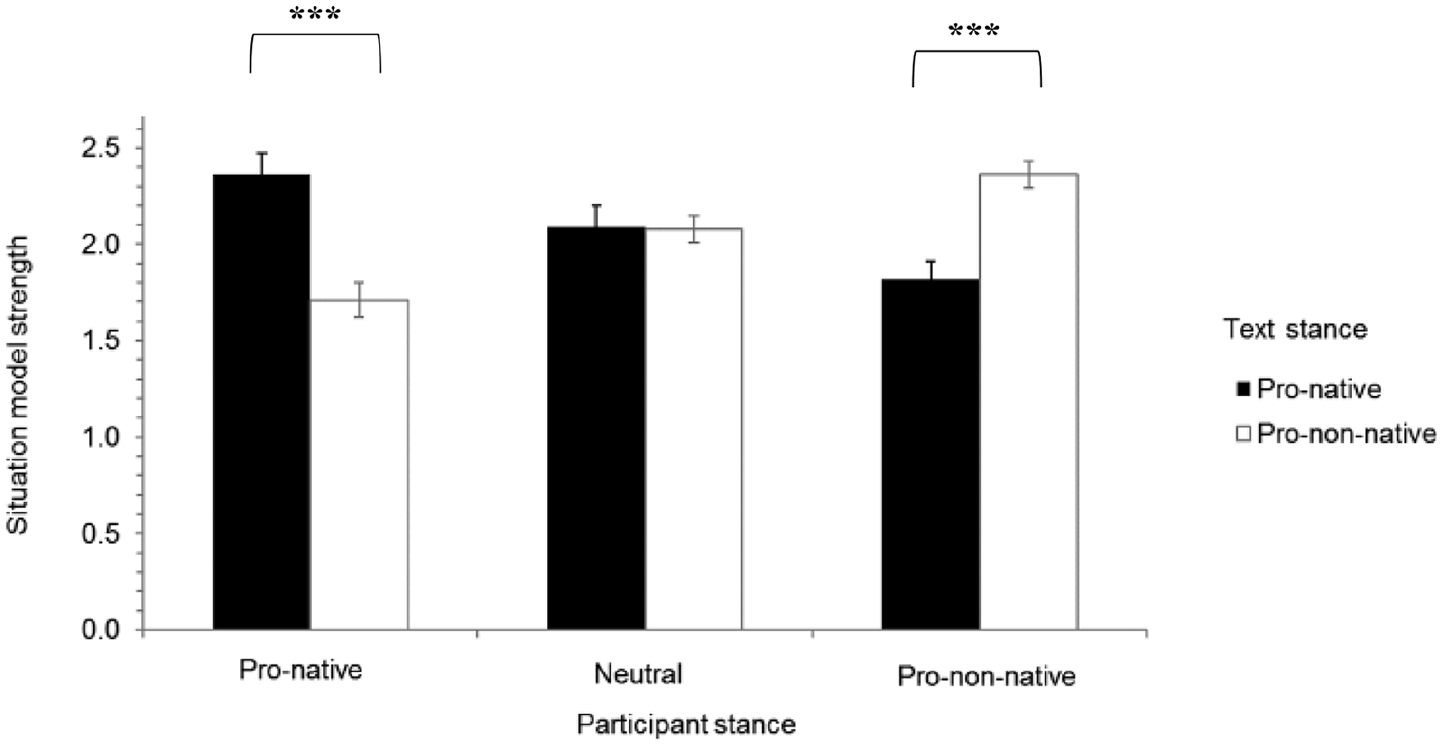
Example of a text-belief consistency effect (adapted from Karimi & Richter, 2021): Iranian students of English as a foreign language read two texts taking opposing stances on an applied linguistics issue (native vs. non-native speakers as English as a foreign language teachers). Students’ comprehension (situation model strength) measured with a recognition task was better for the text that matched their own stance towards the issue; students with neutral beliefs showed balanced situation models for both texts.
The text-belief consistency effect has been demonstrated for a wide range of different issues, from socio-scientific and medical issues (Maier & Richter, 2013a) to philosophical issues, to texts that take sides with one of two rival soccer teams (Karimi & Richter, 2023), with different types of comprehension measures including verification tasks (e.g., Maier & Richter, 2013a), essay tasks (e.g., Maier et al., 2018) and recall tasks (e.g., Wiley, 2005). Moreover, text-belief consistency effects occurred also when belief-consistent and belief-inconsistent information was varied within texts (Maier & Richter, 2013b) and, importantly, when prior beliefs were manipulated experimentally through videos viewed before reading the texts (Abendroth & Richter, 2021a). Most studies addressing this form of belief bias have been conducted with university students, but two studies have also demonstrated text-belief consistency effects in adolescent learners (Abendroth & Richter, 2020; Karimi & Richter, 2023). In sum, text-belief consistency effects seem to be a general phenomenon that characterizes learning about controversial issues (for an overview, see Richter & Maier, 2017).
Finally, in self-regulated learning, where learners are free to choose information sources and neglect others, confirmation biases can already occur at the selection stage of information, which prevents people from being exposed to information and arguments that might challenge their beliefs (selective exposure, Festinger, 1957). Such selective exposure effects may occur, for example, during informal learning on the internet, contributing to the formation of ‘information bubbles’ and the persistence of misconceptions (for meta-analytic results, see Hart et al., 2009).
Confirmation biases present a severe obstacle to learning as an epistemic activity, as they prevent learners from forming an adequate view of the world. However, they can be overcome by critical thinking, advanced epistemological beliefs and specific metacognitive strategies. For example, Karimi and Richter (2023) found evidence that critical thinking dispositions moderate the text-belief consistency effect in adolescent learners, with learners with high critical thinking scores achieving balanced comprehension. In a study by Barzilai and Eshet-Alkalai (2015), participants were better able to understand the viewpoint of multiple sources on socio-scientific controversies when they possessed ‘evaluatist’ epistemological beliefs, especially when the documents were conflicting. Similarly, Karimi and Richter (2021) found the text-belief consistency effect in reading about a controversial scientific issue to be moderated by epistemological beliefs. The text-belief consistency effect was weaker the more participants endorsed the belief that knowledge is uncertain and the more participants endorsed the belief that knowledge requires justification. Thus, learners possessing epistemological beliefs that adequately reflect the discursive nature of science seem to be less prone to text-belief consistency effects. Finally, Abendroth and Richter (2021b) taught university students three metacognitive strategies to counter the text-belief consistency effect: (1) being aware of the influence of prior beliefs; (2) monitoring for intertextual relationships and inconsistencies; and (3) using prior knowledge for argument evaluation (see also Maier & Richter, 2014). Additionally, two metacognitive strategies were taught that should be particularly useful in a multiple-text reading situation (e.g., Bråten et al., 2020): (4) monitoring for intratextual inconsistencies; and (5) memorizing facts. The successful application of these strategies was demonstrated in instructional videos (with cognitive modelling) and learners were given the opportunity to practise the strategies. This metacognitive training eliminated the text-belief consistency effect and enabled learners to achieve a balanced mental model of controversial topics, whereas classical learning strategy training (PQ4R training, Thomas & Robinson, 1972), which was used as an active control condition, did not. This finding underscores that learning strategies that have proven to be highly effective for fostering learning as information processing, as is the case with the strategies trained in the PQ4R training, differ from those that are required or useful for learning as an epistemic activity.
Besides metacognitive training, prompting learners to take a specific perspective during reading can reduce confirmation biases and, therefore, benefit learning as an epistemic activity. For example, McCrudden et al. (2017) found that asking undergraduates to take the perspective of a climate scientist reduced belief bias in the evaluation of arguments about climate change, at least for weak arguments. Abendroth and Richter (2023) prompted university students to adopt a belief-consistent or belief-inconsistent perspective during reading multiple texts about two socio-scientific controversies, observed their eye movements during reading and assessed their comprehension after reading each text. Adopting a belief-inconsistent reading perspective removed the text-belief consistency effect, leading to a balanced comprehension of the controversy. The belief-inconsistent perspective increased first-pass reading times for belief-inconsistent claims but reduced look-backs to belief-consistent information, indicating that the perspective manipulation guided learners’ information processing during reading.
Cognitive components of learning as an epistemic activity
We view the cognitive processes involved in learning as an epistemic activity through the lens of the Two-Step Model of Validation proposed by Richter and Maier (2017, 2018) (Figure 4). The Two-Step Model was originally proposed as an explanation for text-belief consistency effects (and the effects of conditions moderating these effects) in the comprehension of multiple texts with conflicting information. However, it may also be viewed as a framework to describe the cognitive processes and factors relevant for learning as an epistemic activity. The model resembles dual-stage models of information processing, which are popular, for example, in research on thinking and reasoning (e.g., Evans, 2003), as it distinguishes passive and routine processes, on the one hand, from controlled and reflective processes on the other hand. But it also differs from most dual-process models by assuming two steps of processing (rather than assuming two alternative processing modes). Moreover, the Two-Step Model is specifically tailored to text-based learning and learning as an epistemic activity.
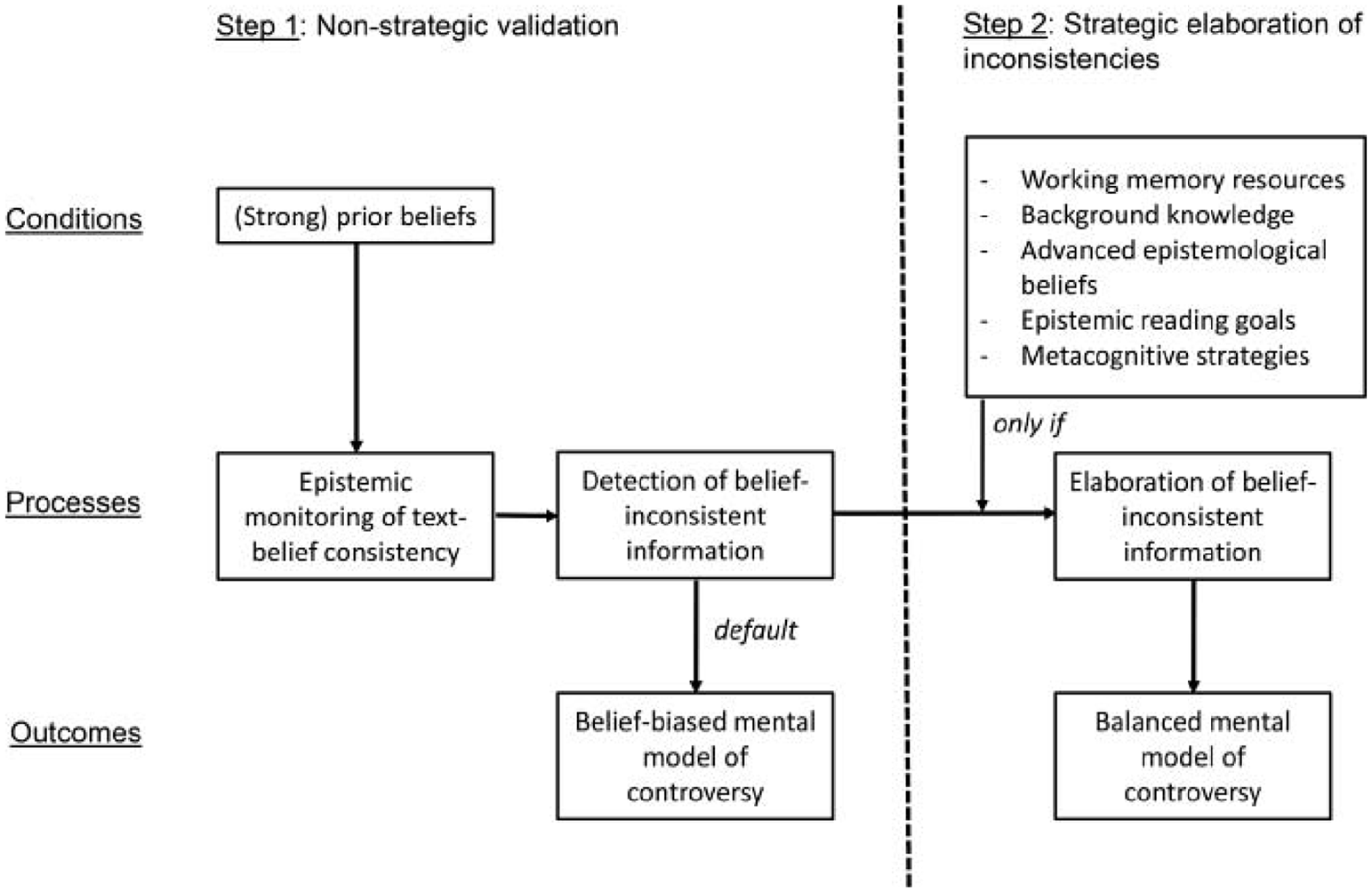
Schematic representation of the Two-Step Model of Validation (adapted from Richter & Maier, 2017).
Step 1: Activation, integration and validation of information
Step 1 in the Two-Step-Model posits that learning rests on three routine and passive comprehension processes: the activation of prior knowledge and previously encountered information (for example, information read earlier in the text), the integration of information with prior knowledge and the validation of this information based on prior knowledge and beliefs (see also the Resonance-Integration-Validation Model of comprehension, O’Brien & Cook, 2016). Whereas activation and integration of information are also core processes in information-processing accounts of learning that highlight the role of passive and routine processes (e.g., the Construction Integration Model, Kintsch, 1988), we will elaborate a little bit on the validation process, which is a new aspect that introduces an epistemic component. Validation is conceived of as a mechanism that checks the consistency of text information with the contents of the current situation model and accessible background knowledge (Richter, 2015; Singer, 2013). The existence of a routine validation process is supported by a large body of evidence from reading time, reaction time and eye-tracking experiments as well as studies with event-related potentials (for a review and discussion, see Isberner & Richter, 2014a). For example, in experiments based on the epistemic Stroop paradigm, participants read sentences or short texts rapidly presented word by word (Richter et al., 2009). The words successively form statements that can be true (e.g., ‘Jeans have seams’) or false (e.g., ‘Soft soap is edible’). At the final word of a subset of the statements, participants are prompted to provide a binary response to an unrelated task, for example, respond with one key to the word ‘TRUE’ and with another key to the word ‘FALSE’ appearing on the screen (Isberner & Richter, 2014b). When the experimental sentence is false (‘Soft soap is edible’) but participants need to respond to the word ‘TRUE’, their responses are slowed down. This epistemic Stroop effect is very robust across different tasks (e.g., spelling judgements, judgements of colour changes or responses to probe words) and linguistic stimuli (e.g., true vs. false sentences, texts describing plausible vs. implausible situations, sentences presented auditorily with matching vs. non-matching pictures, Piest et al., 2018). It has also been shown with belief-consistent vs. belief-inconsistent opinion statements (e.g., ‘The internet has made people more isolated/sociable’, Gilead et al., 2019). In sum, the epistemic Stroop effect occurs in the absence of any specific task that requires or invites the evaluation of information and is obtained across a broad range of tasks and materials. This clear pattern of results strongly suggests that information is involuntarily and routinely validated against prior knowledge and beliefs, and that validation is part of regular comprehension processes.
The routine and passive processes of knowledge activation, integration and validation described in Step 1 of the Two-Step Model of Validation are inevitably involved in comprehension and learning. Of these processes, especially the validation process can support but also hamper learning as an epistemic process, depending on whether it is based on adequate knowledge and beliefs or on misconceptions and unjustified beliefs. If based on adequate knowledge and beliefs, validation allows for the detection and involuntary rejection of false or implausible information during learning, creating a basic form of epistemic vigilance (Sperber et al., 2010). If based on misconceptions and unjustified beliefs, it can cause learners to stick to their misconceptions and to hastily dismiss good arguments if they run counter to their prior beliefs. Put differently, it can lead to belief biases such as the text-belief consistency effect (Richter & Maier, 2017). Voss et al. (1993) have shown that people holding accessible prior beliefs are as fast to evaluate the claim of an argument as they are to comprehend it. The Two-Step Model posits that if learners possess strong beliefs about a controversial issue, these beliefs will be used to validate text information, which generates implicit plausibility judgements based on the consistency of new information with readers’ prior beliefs. These implicit plausibility judgements serve as a kind of ‘quick-and-dirty’ heuristic that guides learners’ allocation of cognitive resources, leading to a deeper processing of belief-consistent information. In other words, learners tend not to engage further with information that is inconsistent with their beliefs but focus on information that is consistent with their beliefs. This information is better understood and integrated with existing prior knowledge through inferences and other comprehension-enhancing processes. This mechanism may lead to a text-belief consistency effect in the comprehension of information (Maier & Richter, 2013a) and is also likely to contribute to belief biases in information evaluation and selection during learning.
Step 2: Epistemic elaboration
People are cognitive misers (Fiske & Taylor, 1991), which implies that during learning, they usually invest just enough cognitive effort necessary to achieve representations that are ‘good enough’ to serve their current goals. In line with this common-place assumption, the Two-Step Model of Validation entails the assumption that the shallower processing of information that characterizes Step 1 of the model is the default way to process information during learning. For learning as an epistemic activity, this means that it is limited primarily to routine validation processes. Nevertheless, if learners are motivated and able to do so, they may invest cognitive resources to engage in more strategic forms of epistemic processing during learning, which we call epistemic elaboration. Epistemic elaboration includes deeper processing of belief-inconsistent information, the search for and consideration of additional information in long-term memory or in external sources, including counterarguments and counterevidence, the construction of alternative mental models and the systematic use of sourcing and corroboration to assess the credibility of information. In short: all the cognitive and metacognitive strategies discussed previously, which are instrumental for improving argument comprehension and argumentation evaluation and for avoiding or reducing belief biases (Richter & Schmid, 2010).
What are the conditions that determine whether learners engage in epistemic elaboration of information? A first and necessary condition is that learners have the cognitive resources available that are needed for epistemic elaboration. Thus, the whole range of individual and situational factors that influence the availability of general cognitive resources, such as individual working memory capacity, time pressure or extraneous cognitive load, represent boundary conditions that affect whether and to what extent learners can engage in epistemic elaboration. They also need to possess the relevant prior knowledge, such as domain or topic knowledge that is needed for argument evaluation and genre knowledge that is needed for the evaluation of source credibility.
Second and more specifically, learners need to know the cognitive and metacognitive strategies relevant for successful learning as an epistemic activity that we have discussed above, such as actively checking the quality of arguments or monitoring for textual and intertextual consistency, and they need to be able to apply these strategies effectively. According to the Two-Step Model, the declarative metacognitive component underlying these strategies and their application is learners’ epistemological beliefs (see Richter, 2010). Ideally, learners hold a mature epistemological position (such as commitment within relativism, Perry, 1970, or reflective judgement, King & Kitchener, 1994), which includes the fundamental insights that scientific knowledge may change and different views may exist but that knowledge claims can (and should) nevertheless be evaluated objectively and are not a matter of subjective opinions. Learners who do not subscribe to these views will not approach learning contents as arguments that may be questioned and evaluated on rational grounds. They simply will not see the point of using epistemic strategies. In line with this assumption, Richter and Schmid (2010, Study 2) found that endorsement of the epistemological belief that knowledge is uncertain and changing is positively associated with the use of epistemic strategies such as actively checking the quality of arguments (for similar associations of epistemological beliefs with an objective measure of argument evaluation, see Münchow et al., 2019). Moreover, the studies by Barzilai and Eshet-Alkalai (2015) and Karimi and Richter (2021) discussed above substantiate the idea that a mature epistemological position helps learners to avoid belief biases when learning about controversial topics.
A third group of conditions is motivational in nature. Most importantly, the learners’ goals during learning will affect how they approach the learning contents in Step 2. Learners will only engage in epistemic elaboration if they follow an epistemic learning goal, that is, a learning goal that involves the acquisition of knowledge as true justified belief. For example, a scientist who intends to get an overview of a research field or a person with a medical condition searching for an effective treatment, or a learner who gathers information to scrutinize the position of an intellectual or social opponent, or a learner who simply wants to satisfy their epistemic curiosity (Richter & Schmid, 2010, Study 2), will usually follow an epistemic learning goal in their learning activities. An epistemic reading goal benefits learning as an epistemic activity. For instance, in an experiment by Maier and Richter (2013b), the comprehension of belief-inconsistent information was strengthened in students who were instructed to follow an epistemic reading goal during learning about a controversial issue in educational science (the interpretation of results from the PISA study). In contrast, students trying to remember information from an expository text so that they can reproduce this information in the next exam follow a receptive reading goal. Such receptive reading goals may trigger classical learning strategies (such as generative or organizational strategies) that foster learning as information processing, but they will not trigger strategies that directly benefit learning as an epistemic activity.
Scope and limits of learning as an epistemic activity
Obviously, not all forms of learning can be characterized as an epistemic activity. For example, inductive or statistical learning is based on extracting patterns from complex stimuli for the acquisition of concepts (e.g., Brunmair & Richter, 2019). Similarly, associative learning exploits co-occurrences of features to detect regularities in a series of stimuli or events (Shanks, 1995). A third example is the acquisition and routinization of cognitive skills through practice (VanLehn, 1996). A fourth example is the acquisition of factual knowledge, which is considered indisputable, such as Newton’s laws in physics or the five types of declensions in the Latin language. These forms of learning are essential, among other things, for the acquisition of foundational skills in reading, writing and mathematics and for forming a broad knowledge base during the school years. They may be classified as forms of cumulative knowledge acquisition insofar as they usually do not involve the evaluation of arguments and the credibility of sources is usually taken at face value (such as a textbook or teacher).
That said, we would argue that even the forms of learning just described are intrinsically related to learning as an epistemic activity, for two reasons. First, at least if they are explicitly learned, cognitive skills and factual knowledge also fulfill the criteria of the tripartite analysis if they count as knowledge. Learners must believe that what they know is true, and this applies also to basic spelling rules, Newton’s laws and the way nouns are declined in Latin. They must further be able to give some form of justification for their knowledge, which may range from simple appeals to cognitive authority (‘I believe this to be true because my teacher told me’), to more elaborate and substantial justifications based on other knowledge. Second, knowledge that is considered as indisputable at a certain point in time and in a certain sociocultural context can be questioned at a later point and become the subject of scientific or social debate. An illustrative example is spelling rules that children acquire as knowledge seemingly set in stone at school but that can nevertheless be subject to changes. As recent spelling reforms in France and Germany showed, such changes are often accompanied by heated debates, with arguments put forward pro and contra the reform (Ball, 1999).
Situations like the one just described make it clear that the acquisition of knowledge is never just about the accumulation of information and that epistemic criteria such as truth or justification always play a role, at least indirectly. Viewed from this perspective, learning as an epistemic activity is a general notion that applies to most of the learning that takes place at school and in higher education, although ‘shortcuts’ are possible in areas where knowledge is considered secure and unquestioned.
Conclusion and open questions for research
We have argued that in many learning situations, learning can only be understood and investigated properly if it is construed as an epistemic activity. Classical information processing accounts of learning operate under the tacit assumption that the Gricean maxim of quality holds (Grice, 1975, p. 46), in other words, that the authors of learning materials always attempt to provide true information that is supported by the available evidence. But in a ‘post-truth’ era and considering that knowledge is evolving, what constitutes knowledge can change and different theoretical viewpoints exist simultaneously in many areas of scientific research, it seems evident that knowledge acquisition must incorporate checks of the plausibility and credibility of information to be successful. According to the Two-Step Model of Validation (Richter & Maier, 2017), meaningful learning always incorporates a basic form of plausibility check, as comprehension and validation of information are two sides of the same coin (Richter, 2015). In that sense, the model claims that it is difficult to adopt a completely neutral stance towards learning materials because information encountered during learning is always validated against available and accessible knowledge and beliefs, which serves important functions for comprehension but may also lead to belief biases during learning. Thus, evaluative processes are already an integral part of comprehension during learning.
As discussed in the present article, a central aspect of the concept of learning as an epistemic activity is that knowledge is not equated with information but construed as justified true belief. In the course of the article, we showed that learning as an epistemic activity can, in many cases, be understood as the comprehension and evaluation of arguments embedded, often implicitly, in formal and informal learning materials. We presented theoretical arguments and empirical evidence that cognitive capacities and motivation to identify components of informal arguments, evaluate their plausibility, employ sourcing skills and avoiding belief biases contribute to successful learning, culminating in the construction of (1) knowledge that a learner believes to be true, (2) knowledge that is true according to objective criteria (e.g., correspondence, coherence and pragmatism; Walker, 2017) and (3) knowledge the learner has relevant reason(s) to believe is true. We see, amongst others, at least three areas of research and practice that could profit from this conceptualization of learning and knowledge acquisition.
First, one implication of these considerations for educational psychologists is that epistemic strategies that support learners to evaluate knowledge claims and the quality of arguments are as important as classical learning strategies that support comprehension and memory. Critical thinking, argumentation or sourcing strategies are often treated as specific competencies that are relevant only in specific learning situations — and as somewhat ‘advanced’ competencies. Contrary to this view, we argue that they are at the core of successful learning in general. Research in this field would therefore profit from investigating the relationships between these competencies, as relevant and interrelated aspects of epistemic elaboration in a broad array of learning situations.
Second, from the perspectives of teaching and assessment of learning outcomes, emphasizing learning as an epistemic activity also encourages a focus on metacognition and self-regulated learning, empowering a learner to identify and evaluate the structure and plausibility of arguments embedded in formal and informal learning materials. Viewing learning as an epistemic activity implies that students should be encouraged to question, evaluate and challenge information and ideas, based on epistemic strategies. This involves critical thinking skills, as students learn to assess the validity and reliability of sources, analyse evidence and form reasoned conclusions. As previous intervention studies have shown, these competencies can be targeted individually and improved, at least in the short term. A more comprehensive approach to training these separate competencies for the explicit aim to facilitate learning as an epistemic activity could help students reflect on their own thinking and decision-making processes and understand the nature of expert knowledge, which are fundamental to teaching transferable thinking skills (see Baron, 1993). Such research endeavours should also focus on long-term training effects and transfer to general academic achievement, two questions that have rarely been addressed in previous research.
Third, from the perspective of life-long learning, the concept of learning as an epistemic activity could further help shed light on processes involved in both formal and informal learning contexts in which conceptual change occurs and learners abandon old beliefs and build new mental models of the world (e.g., Chi, 2008; Richter & Singer, 2018). This issue may be particularly important related to socio-scientific issues for which the evidentiary basis may change over time, such as the risk factors attributed to certain medications or the carbon footprint associated with certain forms of energy production. More fundamentally, much less is known about the structure and development of children’s and adolescents’ ability to comprehend and evaluate arguments and their sources, while avoiding belief biases, compared to studies of university students. As children, with less prior knowledge than adults, are more reliant on cognitive authorities and may have less cognitive capacity to employ epistemic strategies during learning, studying learning processes as epistemic activity in children and adolescents may provide very valuable information about how people construct and refine true justified beliefs.
In summary, we have provided an incomplete and selective review of studies demonstrating that it is possible to improve argument comprehension, argument evaluation, the evaluation of source credibility and the avoidance of belief biases through targeted training interventions. But far more research is needed to examine how epistemic strategies act in concert with other types of learning strategies that support meaningful learning (e.g., generative strategies, Fiorella & Mayer, 2015) and how they affect learning outcomes in different contexts and age groups. It is our hope that future research in educational psychology will expand and enrich current perspectives on learning by following up on these issues.
Supplementary Material
Please find the following supplemental material available below.
For Open Access articles published under a Creative Commons License, all supplemental material carries the same license as the article it is associated with.
For non-Open Access articles published, all supplemental material carries a non-exclusive license, and permission requests for re-use of supplemental material or any part of supplemental material shall be sent directly to the copyright owner as specified in the copyright notice associated with the article.
