




Abstract
Scholars agree that talk and scaffolding are critical to students’ learning in reading instruction. However, while many studies have focused on the role of talk, few have studied the use of gestures as scaffolding strategies. This paper answers the following questions: (i) How does the use of gestures complement a teacher’s construction of scaffolding strategies? (ii) How can the use of talk and gestures achieve dialogic scaffolding? This observation research focuses on a case study of a secondary teacher. Participants’ semiotic mediation of talk and gestures was examined closely using an analytical approach, informed by theories of scaffolding and gesture. The findings show that teacher gestures were used as learning support while students used gestures to visually represent and demonstrate their understanding. Through this interplay between talk and gesture, effective meaning-making and understanding were achieved in reading instruction.
As a pedagogic tool, teachers use talk to scaffold learning while balancing the control of dialogue between learners and themselves (D. A. Myhill et al., 2005). In recent studies, there are increasing focuses on how talk quality seems to influence learning and the development of thinking (Mercer & Dawes, 2008). According to Alexander (2008), classroom talk, in an effective and sustained way, should engage learners cognitively and scaffold their understanding. However, it is found that teachers, rather than learners, control what is said in the classroom — who says it and to whom. In fact, Tharp and Gallimore (1988) argue one kind of talk predominates: the so-called ‘recitation script’ of closed teacher questions, brief recall answers and minimal feedback, which requires children to report someone else’s thinking rather than to think for themselves. This is otherwise known as ‘monologic’ talk (p. 93). Indeed, international research still refers to the under-representation of a ‘dialogic’ practice in teaching, in which students contribute to the progression of their understanding by being given a chance to work on their own ideas (Skidmore, 2006). Lefstein and Snell (2014) explored the term ‘dialogic pedagogy’ in a study where they analysed carefully chosen video clips from primary school literacy lessons. They were investigating the educational potential of classroom talk, and the promise and problems of dialogic pedagogy. They discussed the definition of dialogic pedagogy as:
Teaching and learning processes in which (a) pupils and teacher address authentic problems and play an active and agentive role in the joint construction of knowledge and negotiation of meaning; (b) pupils are empowered to express their voices, resulting in the interaction of multiple perspectives; (c) pupils and teacher adopt an open and critical stance toward knowledge claims; (d) the classroom community is characterised by respectful, supportive and caring relationships and inclusive and reciprocal participation norms.
They found that it is more helpful to discuss the features of dialogic pedagogy as a ‘problem space’, rather than ‘best practice’, as they are often not always completely achievable in classrooms and policy environments.
From a sociocultural perspective, individuals learn not as isolated beings but as active members of society. What they learn and how they make sense of knowledge depends on what social context they are learning (Yang & Wilson, 2006). This view of learning, ‘scaffolding’, was first defined by Wood et al. (1976) as a process ‘that enables a child or novice to solve a task or achieve a goal that would be beyond his unassisted efforts’ (p. 90). In Reynolds’s (2017) review, he points out that in scaffolding, learners receive a teacher’s support and assistance in guiding questions and prompts to perform certain tasks and move to more complex ones successfully. Learning in the classroom is often a result of the interplay of a repertoire of semiotic resources, like verbal and non-verbal communication, expressed through different modalities. The skilful adoption of these multimodal resources, for example, talk and gestures, in the classroom can be described as an instantiation of the teacher’s pedagogical strategy. This study aims to explore a teacher’s utilization of multisemiotic scaffolding strategies, particularly talk and gestures, to enhance students’ ability to make meaning from their social construction of and interaction with reading texts.
Given the research aim, this study seeks to answer the following research questions: (i) How does the use of gestures complement the teachers’ construction of scaffolding strategies? (ii) How can the use of talk and gestures achieve dialogic scaffolding?
Review of literature
Monologic and dialogic talk in the classroom
Moving from recitation to exploratory talk necessitates losing control over what is said, how it is said and who says it. However, since most verbal transactions are initiated by teachers, initiate-reply-evaluate/feedback (IRE/F) is regarded as the main pattern of teacher–student interaction (Wells & Arauz, 2006). The IRE/F structure is also associated with ‘traditional’ pedagogy (e.g., Cazden, 2001), particularly because of the types of questions teachers use to initiate the exchanges. Often, these are questions to which the teacher already knows the answer, which has the effect of limiting students’ contributions. Those contributions are also positively evaluated in the teacher’s evaluation move. Therefore, the effect of the IRE/F dialogue structure on students is that they learn to follow the cues that the teacher uses to guide them towards the correct answer instead of developing the ability to participate genuinely in the discourse of the discipline (Mercer, 2005). Tharp and Gallimore (1988) argue that the IRE/F sequence is essentially a monologic recitation script, providing few opportunities for students to voice their ideas or perspectives.
Researchers propose that a dialogic discussion, on the contrary, facilitates meaning-making, higher-order thinking and academic language acquisition (Nystrand et al., 1997). Discussions allow learners to transform knowledge and understanding, a very different epistemic function than reproducing or evaluating it. One notable difference is that students have extended turns instead of one-word or short-phrase responses (Nystrand et al., 1997). In fact, a teacher adopts a dialogic form of scaffolding only if the latter consists of three parts: contingency teaching, fading, and transfer of responsibility (van de Pol et al., 2010). Here, the teacher needs to apply strategies for learning that are contingent on student responses, gradually remove support over time and then transfer the responsibility to student(s) for completing a task. These three elements are argued to work interdependently and are necessary for scaffolding to be faithfully implemented in the classroom (Many et al., 2009). As such, scaffolding is possible only when there is evidence of high-quality discourse without a teacher exercising tight control.
Gesture studies
Researchers have reported on various coding systems to measure and study gestures. Kendon’s (2004) continuum classifies gestures between the most and least language-like (e.g., McNeill, 1992). McNeill’s taxonomy is divided into two major categories: imagistic and non-imagistic gestures, depending on their concreteness level and capacity to convey imagery. Each of the gestures has its properties. Firstly, iconic refers to gestures that present images of concrete entities and actions. They are closely linked to the semantic content of the talk. Secondly, metaphoric gestures can present images of the abstract or be pictographic. Thirdly, the deictic gesture uses any extensible body part or held object for pointing. Martinec (2000) then proposes that actions can be classified into Presenting, Representing and Indexical Action. This study classified language correspondent gestures as communicative (representing action). Indexical action is classified as a communicative gesture and language-dependent gesture. These systems proved problematic as research on gesture and embodied cognition had been largely independent. This means that the types of meanings realized in these gestures are ‘not systematically discussed’ (Ngo, 2018, p. 118). Ngo (2019) further posits that systems like McNeil’s and Martinec’s do not consider the orchestration of gesture and other elements of paralanguage (e.g., facial expressions and body language) and talk, which this study aims to do.
Ngo, Unsworth, and Herrington (2022) studied teacher orchestration of language and gestures in explaining science concepts in images. The authors posit that insufficient attention has been paid to how gestures and language explain diagrams, and others argue that previous studies have not directly examined teachers’ gestures as a form of scaffolding (Alibali & Nathan, 2007). Referencing Ngo, Hood, et al. (2022), the authors provide a new linguistic perspective on ‘body language’ as ‘paralanguage’, referring to gesture, body orientation, body movement, facial expression and voice quality resources that support the spoken language (Ngo, Unsworth, and Herrington, 2022). The authors create a framework to provide comprehensive modelling of paralanguage, categorizing them into either sonovergent (always co-occurs with talk and operates in sync with rhythm) or semovergent (a bodily version of language). The latter, which would address the previously under-researched areas of gesture and embodied cognition, realize three metafunctions of meaning. It resonates with interpersonal meaning, coordinates with textual meaning and concurs with ideational meaning (p. 199).
Ngo (2019) offers a mapping gesture against the proposed discourse semantics systems. Sonovergent gestures always co-occur with talk and operate in sync with rhythm. According to Ngo, ‘they are in tune with the tones of prosodic phonology and realize textual and interpersonal meanings’ (p. 118). Semovergent gesture is the bodily version of a language’s lexicogrammar and discourse semantics as it realizes the three metafunctions: ideational, interpersonal and textual meanings (Ngo, 2019).
Hence, in this study, an analytical framework of two parts that are first informed by McNeil and Martinec will be used to distinguish the use of gestures that are either language correspondent or language dependent. Next, it is informed by Ngo’s systematic categorization of semovergent gestures. This offers a comprehensive analysis of the use of gestures by the teacher and students in the reading classroom.
Scaffolding and scaffolding strategies
In the reading instruction context, there is evidence of a teacher acting as a mediator, helping learners to ‘construct events in terms that they understand (Webster et al., 1996) by means of using their personal experiences to make sense of a broader phenomenon’ (Gibbons, 2002, p. 174). An essential feature of this performance is that it involves not simply helping to do but helping to know how to do it (Wells, 1999).
Scaffolding is seen as an interactive process between the teacher and student who must participate actively in the process (Reynolds, 2017). Despite varying definitions of scaffolding, some common characteristics can be distinguished; three key characteristics, contingency, fading and transfer of responsibility, are identified in a conceptual model (van de Pol et al., 2010). Interestingly, a generally accepted framework for the analysis of scaffolding strategies is yet to be available. However, the scaffolding classifications of Tharp and Gallimore (1988) and Wood et al. (1976) are fundamental in any scaffolding analysis research. Tharp and Gallimore (1988) speak of six means of ‘assisting performance’: modelling, contingency management, feeding back, instructing, questioning and cognitive structuring. Wood et al. speak of six scaffolding functions: recruitment, reduction of degrees of freedom, direction maintenance, marking critical features, frustration control and demonstration. These classifications are essential in this study’s analysis.
However, examining dialogic interactions among the participants in providing scaffolds to promote learning is an area that needs to be more represented in literature. Although recent research has emphasized the critical role played by the dialogic interactions among participants in supporting students’ development, reasoning and learning (e.g., Littleton & Howe, 2010), there are major methodological challenges in studying micro-analyses of ‘dialogic scaffolding’ in whole-class discourse. In Rojas-Drummond et al.’s (2013) study, the team explored two functional aspects of such ‘dialogic scaffolding’ interactions. The first is teachers’ use of dialogue to scaffold children’s learning and development (Mercer & Littleton, 2007). The second is the potential value of peer group interaction and talk to support these processes in a more symmetrical environment (Rojas-Drummond et al., 2013). They found that ‘spiral IRE/F exchanges’ represent key higher-order units of analysis which allow the researchers to study where dialogic interactions reside, particularly those that involve scaffolding processes. This research finding justifies the study’s methodological approach in analysing thematic-based extracts.
Scholars have reported findings linked to the use of gestures to scaffold learning. Teachers use gestures to ground their instructional language, linking words with objects, actions, diagrams or other inscriptions (Lakoff & Núñez, 2001). With gestural grounding, teachers can scaffold students’ understanding of instructional language (Alibali & Nathan, 2007). In science-education studies, Roth and Pozzer-Ardenghi (2013) stress the importance of apprenticeship in learning to read complex images with scaffolding provided by a more experienced viewer mediating the visual representation through language and gesture. They propose that this orchestration of gesture, language and image is ‘the source for perceiving images in didactically useful and appropriate ways’ (p. 50). In Kartalkanat and Göksun’s (2020) study of reading, they observed how different types of gestures used in reading affect children’s and adults’ recall of information. The results suggest that observing iconic gestures facilitates recall (Kartalkanat and Göksun, 2020, p. 189). Lin (2021) investigated the use of different pedagogical gestures and how they contribute to foreign or second language (L2) learners’ narrative recall. It is reported that the use of gestures benefitted the learners and that this may compensate for their low working memory capacity. The author posits that the gestures provide scaffolding that reduces the cognitive burden needed for the narrative recall (Lin, 2021). Other scholars also found that gesture and talk are closely related in L2 teaching and learning, as L2 learners usually use gestures as scaffolding and talk-related gestures to help promote and facilitate learning the L2 better and faster. Hence, this study aims to study a similar orchestration of gesture and other semiotic resources like in Roth and Pozzer-Ardenghi (2013) and extend Kartalkanat and Göksun’s (2020) investigation on the use of pedagogical gestures in a reading classroom.
Research design
Studies in social sciences often use observational research as a method applied from diverse epistemological perspectives. The epistemological perspective in which video is applied in this case study stems from the naturalist approach, as the use of gestures and talk needs to be studied in its natural setting of the classroom. While most qualitative research takes an inductive approach, this study conversely takes a top-down theory-driven approach. In examining teacher-student interactions, this study involves classroom observation with a structured deductive approach, which allows me to study specifically what salient features of (i) gestures and (ii) talk would be observed. This approach suits my research best as a strictly inductive approach may provide less theoretically relevant analysis. The theoretical framework of the study requires an observation and coding protocol setup. Rather than create artificiality in the analysis and interpretation, I found it most helpful to connect the research work on using gestures and scaffolding of learning.
Observed classroom and lessons
The observed classroom was part of the sample size from a large-scale national research project (D. J. Hogan et al., 2013). The 16 participating secondary schools were examined for the changes in teachers’ classroom practices in response to a national educational initiative. The schools were chosen using stratified random sampling. A team of 46 trained observers and coders from a research centre were involved. For this case study, a convenience sample of a secondary three (Grade 11) teacher with a class of 40 students was selected. The teacher delivered a reading instruction unit comprising three lessons with an overall learning objective of developing students’ reading comprehension skills. The three lessons were structured as follows: (i) introduction to reading passage with independent reading; (ii) whole-class and group discussion of reading passage; (iii) student independent completion of reading comprehension task. The three 60-minute lessons were viewed repeatedly as I took notes on key moments which would delineate the study of the teacher’s use of gesture and talk to scaffold student understanding. The second lesson of whole-class and group discussion of the reading passage was selected as it had the most key moments of the teacher’s use of gesture and talk. This lesson was transcribed verbatim with screen captures of appropriate gestures. Thematic extracts selected represent discourse of meaning-making experiences while the teacher was (i) discussing the text, (2) checking students’ responses and understanding of inferences from the text, and (3) scaffolding learning with contingency, fading of support and transfer of responsibility to students (Van de Pol et al., 2010). These extracts demonstrate a rich discourse between the teacher and students, including the use of gestures, as part of providing scaffolding techniques to encourage a deeper understanding of the students’ reading. Teacher-fronted activities, rather than group work, were chosen as a context frame for examining teacher questions and gestures. Finally, the selected extracts were kept consistently similar in length and turn length. This was done by counting the number of turns by the teacher and students in each selected extract — the number of turns was kept between 30 and 36 for all extracts.
Data collection
The study utilized a video-recording protocol that was shared with the teacher-participant. This ensured that the teacher was aware of the positions of the video recorders to be set up. The observation protocol was also set up to assure the teacher that the recording would not be intrusive or distracting for the students. Two researchers involved in any recording, who also ensured inter-observer reliability in the coding of their observations, were familiarized with the protocol before any recording commenced. The recordings of the semiotic mediation of talk and use of gesture in the lessons were then transcribed. This was done with the inclusion of visual contextual features described — a description of the use of gesture and a screen capture of the actual gesture was embedded within the analytic table of talk excerpts. Additionally, screen captures of the actual pedagogic discourse being examined were included, set in carefully selected thematic-based extracts. Multimodal text analysis and multimodal transcription were combined to develop insights concerning how multisemiotic meaning-making resources are integrated into a discourse level.
Analysis of data
In ensuring the reliability and validity of the analytical process, a pilot study was conducted to test the dependability (Lincoln & Guba, 1985) and trustworthiness (Mishler, 2000) of the data analysis using the adopted gesture coding systems informed by McNeill (1992), Martinec (2000) and Ngo, Hood, et al. (2022), and means and intentions of scaffolding strategies (Tharp & Gallimore, 1988; Wood et al., 1996). (Table 1).
Adopted coding system (informed by Martinec, 2000; McNeill, 1992; Ngo, Hood, et al., 2022; Tharp & Gallimore, 1988; Wood & Wood. 1996; Wood et al., 1976).
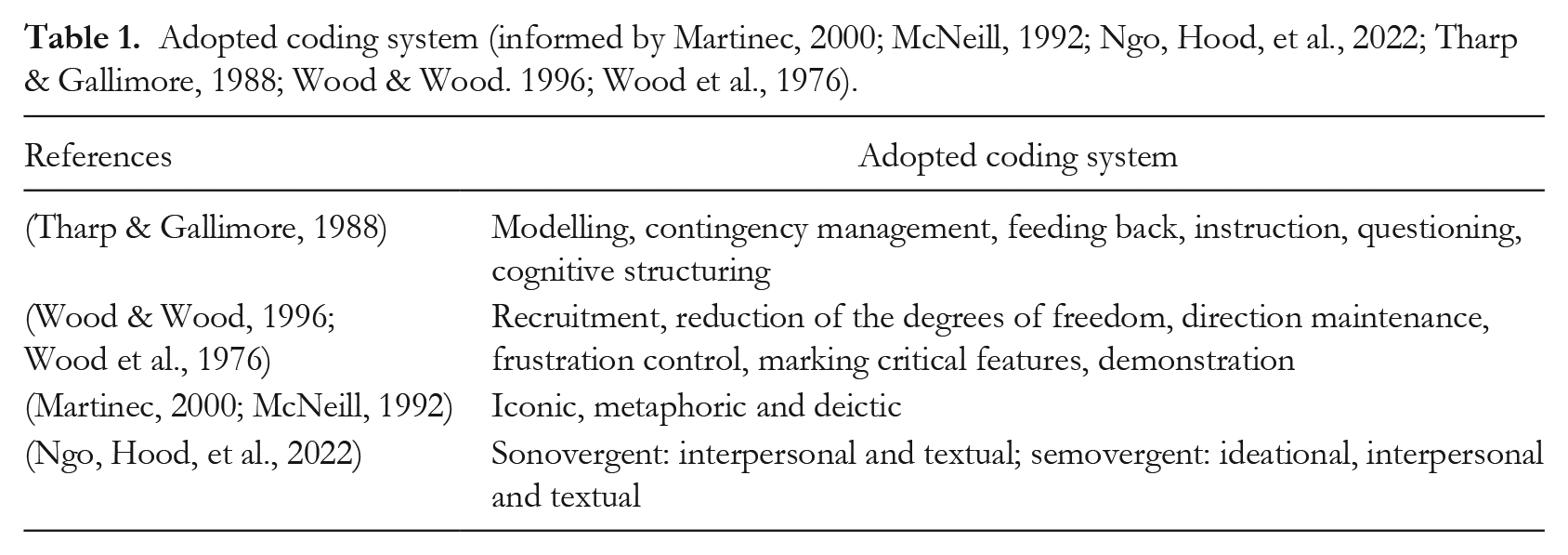
The multimodal analysis was also piloted on other thematic extracts from the larger-scale study. The study’s coding work on the types of questions and supportive scaffolding observed was also triangulated with a side-by-side comparison with the trained observers’ (from the larger-scale study) coding work, achieving about .8 inter-coder reliability — to correct for chance agreement, Kappa is used instead of a percentage agreement. The protocol for the inter-coder reliability using Kappa was done for the pilot study and final case study. The coding work comprised three passes: framing of lesson, instructional and intellectual quality (Hogan et al., 2013). The comparison involved coding work on the structure of classroom talk, its organization and epistemic focus, and the form of knowledge representation (semiotic resources like gestures). After the pilot study, I conducted an ‘inquiry audit’ on how the analysis process and the findings of the research were examined for consistency. The iterative side-by-side comparison of pilot coding and the larger-scale coding, with up to .9 similarities, ensured that the analytical process was defensible and that there could be confidence in the findings (Lincoln & Guba, 1985).
Data analysis includes a rigorous analysis of multisemiotic data of pedagogic discourse with detailed transcription and annotation of the multimodal corpus. Within each table of thematic extracts analysed, specific codes like open and closed questions, short and extended responses, teacher inputs, topic initiations/invitations, and teacher and student repairs were noted. In sum, the segments identified formed a thematic sampling, where the way in which the extracts were identified for analysis was driven by theory on scaffolding, gesture and the research questions.
The video-recording screenshots of the use of gestures were classified into different language correspondent and dependent categories of gestures: iconic, metaphoric and deictic (Martinec, 2000; McNeill, 1992). These gestures were analysed in concurrence with talk. However, despite research tending to emphasize representational meaning of gestures and how they visually represent things we are familiar with (Kendon, 2004), it will be problematic as their semiotic forms can be misunderstood (Mittelberg & Evola, 2014). They are, thus, further categorized into sonovergent (phonologically convergent) and semovergent (semantically convergent) paralanguage gestures using ideational, interpersonal and textual metafunctions (Ngo, Hood, et al., 2022). Next, to study the use of pedagogical gestures in scaffolding learning (e.g., Kartalkanat & Göksun, 2020; Roth & Pozzer-Ardenghi, 2013), only the use of semovergent (semantically convergent) paralanguage gestures was then coded for various intentions and means of scaffolding strategies (Tharp & Gallimore, 1988; Wood & Wood, 1996; Wood et al., 1976); (A) Intentions: Direction Maintenance, Cognitive Structuring, Reduction of Degrees of Freedom, Recruitment and Contingency; (B) Means: Feeding back, Hints, Instructing, Explaining, Modelling, Questioning. This analysis will inform the discussion in answering the study’s research question on how gestures complement the teachers’ scaffolding intentions and means.
Results
In this case study, Mrs Sue’s (a pseudonym) use of gestures was observed with the use of talk during a reading lesson. This was analysed in three instances of scaffolding: for contingency, fading of support and a transfer of responsibility (Van de Pol et al., 2010). The types of gestures applied were communicative correspondent and dependent — iconic and deictic (Martinec, 2000; McNeill, 1985). More iconic gestures, which were language correspondent, were used in the teacher’s interactions, compared to deictic gestures — refer to Table 2. These figures are about the relatively similar total number of turns by the teacher and student participants across all thematic extracts analysed. As it is crucial that these gestures were analysed from the perspective of discourse analysis, the study considers the uptake of what happened (or not) during the interaction by the interlocutors. As recommended by Ngo, Hood, et al. (2022), there should not be a one-to-one mapping of discourse semantic systems to paralinguistic systems, but instead, the degrees of concurrence between them should be highlighted (p. 91). The detailed multimodal analysis in the following sections will discuss semovergent gestures and how they interacted intermodally with talk to contribute to the overall meaning-making experiences in the reading classroom.
Types of gestures used by the teacher.

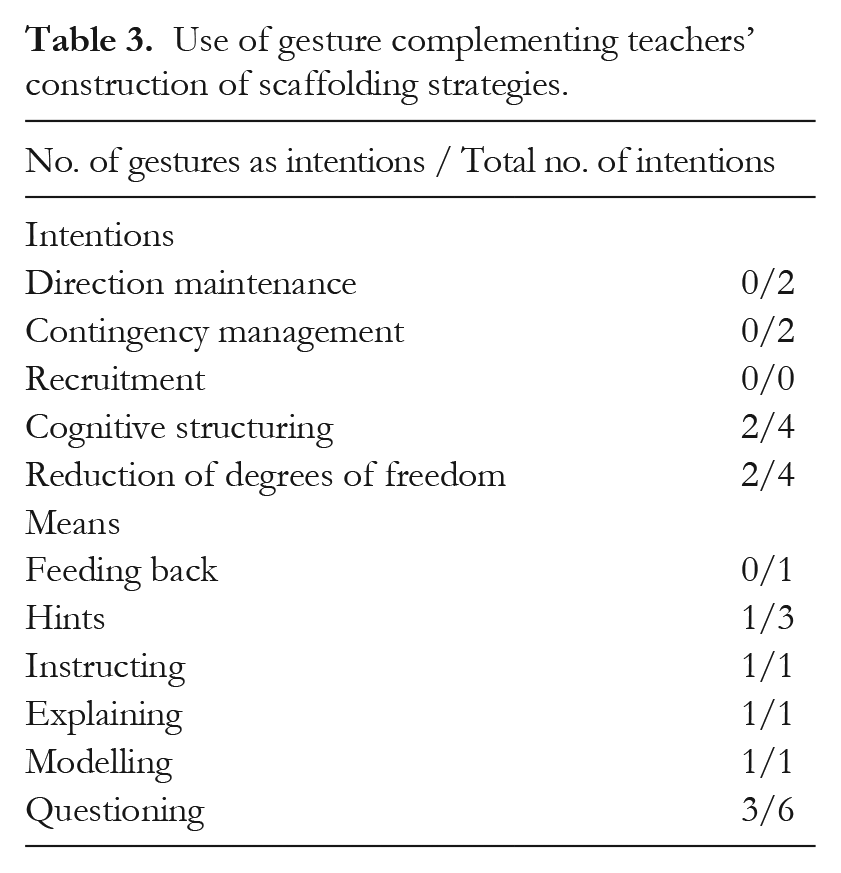
The use of gestures complemented the teacher’s intentions and means of scaffolding — refer to Table 3. Mrs Sue used gestures with the intention of reducing degrees of freedom and cognitive structuring, as well as through explaining, modelling and questioning.
Use of gesture complementing teachers’ construction of scaffolding strategies.
Teacher’s gesture as input for contingency in scaffolding
Mrs Sue (pseudonym) used Feeding back and Questioning to support students’ cognitive activity and provide cognitive structuring to assist the students in organizing and justifying their responses. Furthermore, based on the students’ responses, there was evidence of contingency and reducing the degree of freedom as she reformulated her questions to include an alternative key point for the students to consider. Figure 1, below, shows the multimodal analysis of the thematic extract discussed in this section.
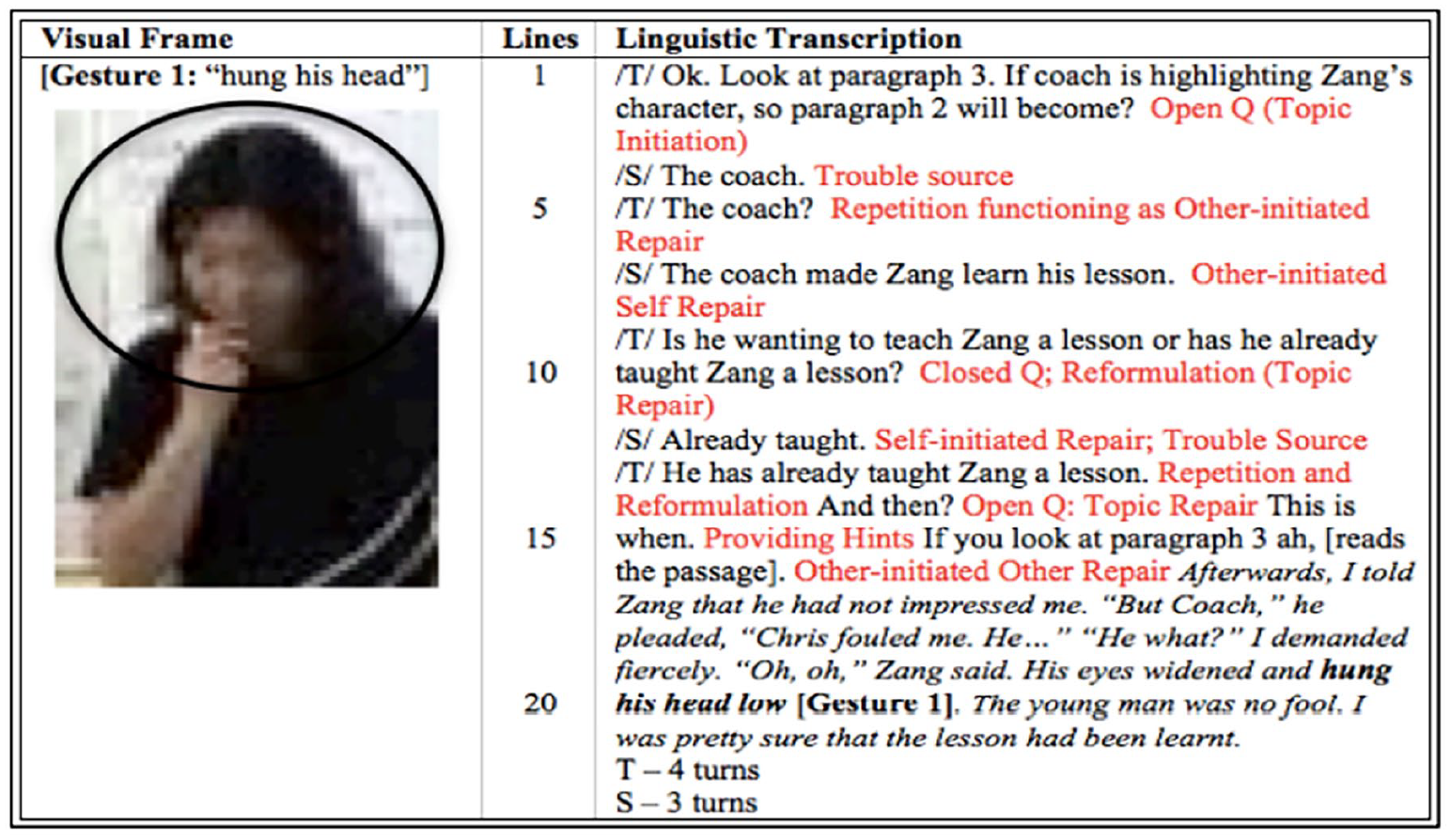
Multimodal analysis 1.
The scaffolding demonstrated in this thematic extract is an interactive process between the teacher and student participating actively. While text as a mode remained essential within this extract as both teacher and students continued to refer to the reading passage that their discussion was based on, Mrs Sue used a language correspondent-iconic gesture to represent the meaning of ‘head hung low’ (lines 18–19) as read in the passage. As she read the words, she lowered her head and looked down, acting out the representation of the phrase ‘head hung low’. The semovergent (semantically convergent) paralanguage emphasizes the phrase’s critical meaning towards understanding the inference Mrs Sue was attempting to highlight (Sime, 2008). Moreover, this gesture highlights the ideational meaning of an occurrence figure (incorporating a motion to construe a happening) with a linear, downward direction of the intended meaning by lowering her head. This communicative gesture, interacting convergently with talk (Ngo, 2019; Ngo, Hood, et al. 2022), proved successful in supporting students’ learning as it served as evidence of the teacher’s use of other semiotic resources as effective input for her contingency. This temporary support, as a gesture, was diagnosing (van de Pol et al., 2010) her students’ potential area of difficulty (Alibali & Nathan, 2007). She tailored her support by providing a hint with a reformulated question and demonstrating the critical phrase she highlighted, ‘head hung low’. This scaffolding strategy had the clear potential for facilitating students’ meaning-making and development of understanding an inference.
Teacher’s gesture as input for fading of support in scaffolding
Mrs Sue attempted to tease the meaning of ‘eyes widened and hung his head low’ as she tried to link this conceptual knowledge to justify an earlier inference — the protagonist, Zang, had learnt his lesson. Figure 2 below shows the multimodal analysis of the thematic extract discussed in this section.
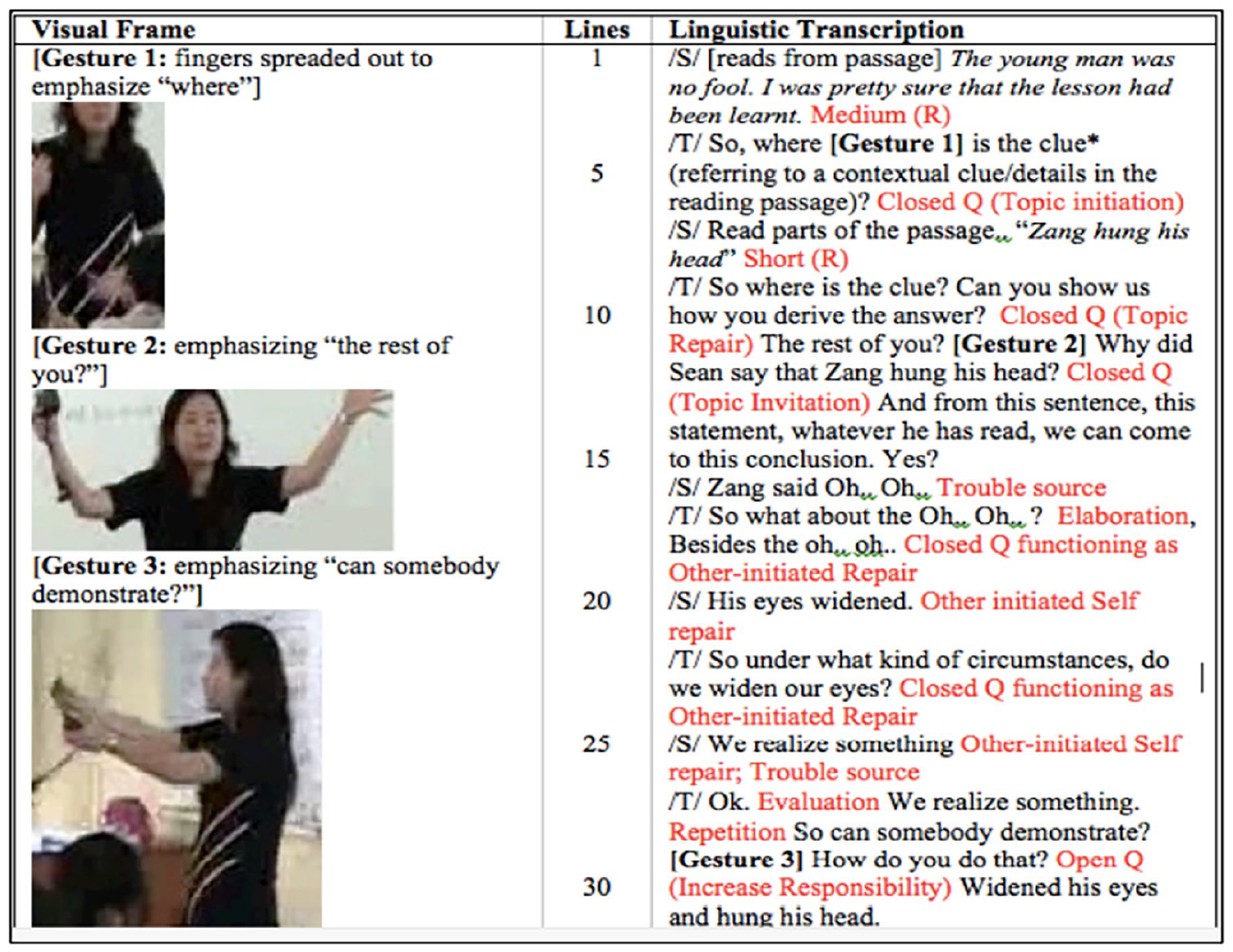
Multimodal analysis 2.
There was evidence of fading when the teacher attempted to allow a student to demonstrate his understanding of the phrase by performing it to the class — ‘So can somebody demonstrate? How do you do that?’ (lines 28–29). Mrs Sue used Questioning consistently throughout the extract to support students’ cognitive activity and give some form of cognitive structuring to get students to extend and elaborate their responses. When referring to a student’s response, she used an iconic gesture to refer to ‘the statement’ a student identified from the passage (arms spread out high in the air as if her hands were the parenthesis of the ‘floating’ sentence). In sum, the language correspondent (iconic) supported the means of questioning as she gave the students some form of cognitive structuring in elaborating on their responses. This paralinguistic deixis identifies an actual ‘other’ thing — the students and the statement referenced in the text. This semovergent gesture functions as interpersonal expressed to invoke engagement-expansion as the teacher spreads her arms out towards the students, indexing her cognitive state (Alibali & Nathan, 2007).
Student’s/teacher’s use of gestures as complements to scaffolding strategies
Mrs Sue encouraged a student to read some sentences from the reading passage out loud while acting them out to perform understanding. Mrs Sue maintained turn-taking sequences with open questions and cued elicitations, repetitions and reformulations. The multiple sequences of ‘I’ and ‘R’ produced an exploratory talk opportunity to elicit students’ further knowledge and deeper understanding. There was also a ‘we statement’ at the end of the extract to reflect the ‘shared experiences between the teacher and students. Figures 3a and 3b, below, show the multimodal analysis of the thematic extract discussed in this section.
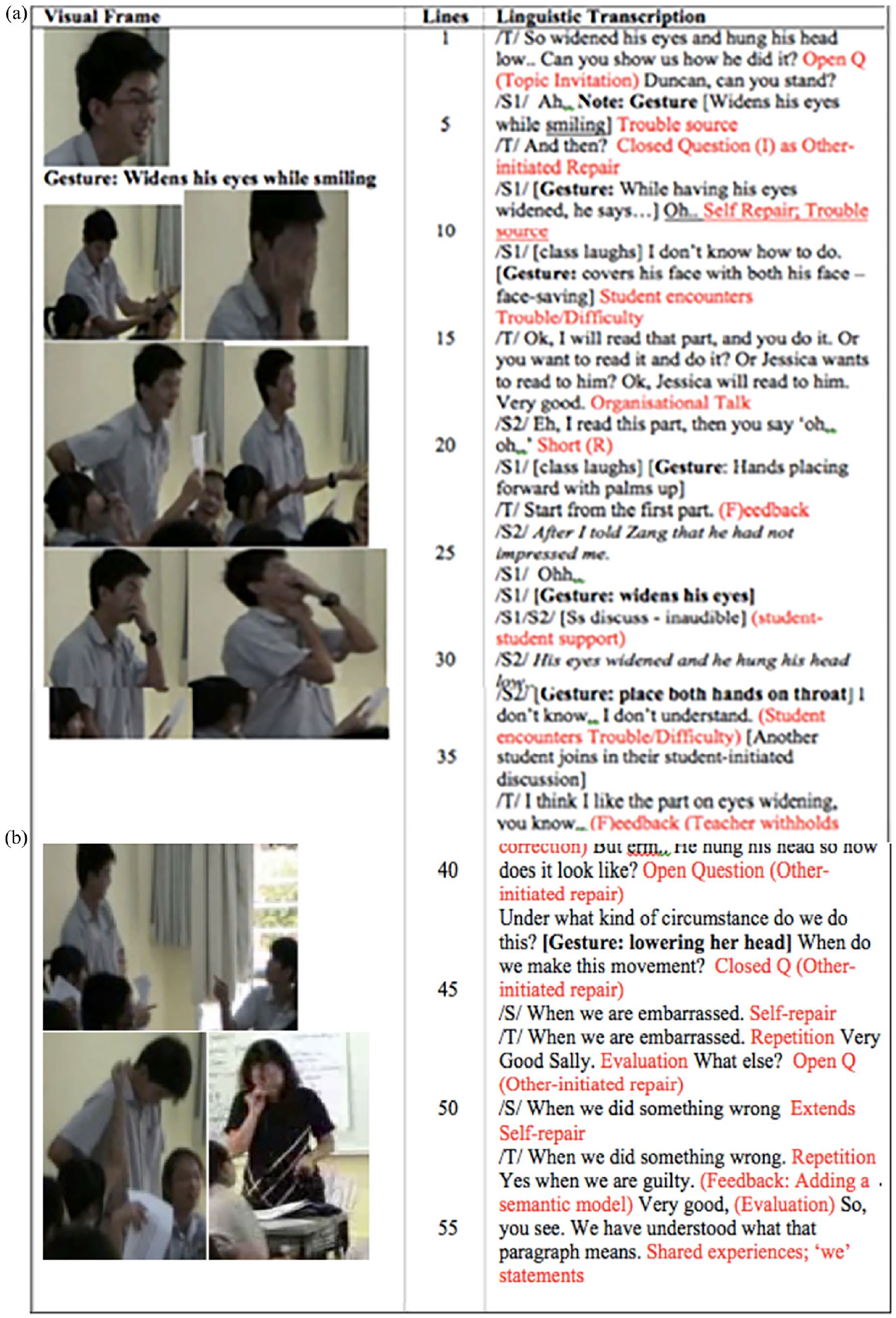
(a) Multimodal analysis 3 and (b) multimodal analysis 3.
It is interesting how, when left to ‘perform’ on his own, Duncan (pseudonym) misunderstood the meanings of ‘eyes widened’ by literally holding his eyelids ‘downwards’ with his fingers and ‘head hung low’ and by ‘choking’ his neck in a literal sense of being ‘hung’ (lines 37–38). Prompted by the student’s demonstrations of mismeanings (use of gestures) through a repair sequence and verbal declarations of trouble/difficulty, ‘I don’t know’ (line 38), Mrs Sue further scaffolded his understanding and provided sufficient learning support using the means of Questioning and Modelling until he was able to demonstrate a suitable representation of ‘eyes widened and head hung low’ as contextualized in the reading text. These teacher questions function as other-initiated repairs to facilitate the student’s meaning-making through his extended self-initiated repairs (verbal and gestures). This was prompted by Mrs Sue’s elaboration on an inference question, asking the students to explain how they knew the character was embarrassed (lines 49–51). As some students could not understand why ‘eyes widened and head hung low’ was a form of contextual clue to gain a deeper understanding of the character’s emotions, she invited Duncan to demonstrate his understanding of the phrase.
There is evidence of a gradual release of responsibility, with a joint responsibility (teacher and student) and co-construction of meaning-making to promote understanding (van de Pol et al., 2010). Therefore, there is evidence that the teacher provided support for students’ cognitive activity and gave some form of cognitive structuring to assist the student in ‘organizing’ his responses and performance. The teacher’s responses, feedback and, when appropriate, further questioning allowed her to use gestures as a scaffolding strategy to help build the bridge from what the student knows to what he understood more deeply. Furthermore, based on the student’s responses and performance, there was evidence of contingency, fading and transfer of responsibility as she provided further scaffolding strategies, adding a semantic model in her feedback, ‘When we did something wrong. Yes, when we are guilty’, to highlight to the student the appropriate emotion or feeling when one has one’s eyes widened and head hung low. There is evidence of the teacher’s and the student’s iconic gestures to reflect appropriate feelings and index their cognitive states (Alibali & Nathan, 2007) when referring to specific representations of the ‘eyes widened and head hung low’. The use of communicative gestures, which were language correspondent (iconic), effectively supported the means of questioning. The teacher gave the students cognitive structuring to infer the appropriate inference and understanding of the phrase accurately. The use of the semovergent paralanguage here emphasized the critical meaning of the phrase in the reading text.
Moreover, this gesture highlights the ideational meaning of an occurrence figure (incorporating a motion to construe a happening) with a linear downward direction of the intended meaning by lowering her head. This gesture also aligns with the material and mental processes that semantically converge with the use of talk. This finding extends Wilkinson and Silliman’s (1994) identification of supportive scaffolding as talk is linked to gestures. This development is essential as it highlights a dialogue-based, active learning approach to avoid closing the teacher-student interaction as learning is scaffolded.
Discussion
Use of gesture to complement the intentions and means of scaffolding strategies
Over two decades ago, Roth’s (2001) review of the literature indicated that gestures had been the focus of research in psychology, anthropology and other related fields. However, in recent years, significant work has been done in educational research linking gesture to cognition in L2 and L1 STEM and language classrooms. Lazaraton (2004) conducted an observational study of the talk and gestures used by a non-native English-as-a-second-language instructor. In his micro-analytic research, he observed the teacher’s gestures and non-verbal behaviour while explaining the meaning of 18 lexical items. The gestures used by the teacher in this case study were like those found in Lazaraton’s. Students in Mrs Sue’s reading lessons were given opportunities for meaning-making through multisemiotic interactions with the teacher-participant. They demonstrate uptake of these opportunities through the teacher-participant’s gestures (Radford et al., 2006). Findings in this study show that ‘a gesture occurs where the information conveyed is relatively unpredictable, inaccessible, and discontinuous’ (McNeill, 1992, p. 208). It was found that students struggled in their meaning-making experiences during the reading instruction when no gestures but only teacher talk were present (Roth, 2001). This augmentative function of gestures (Millar et al., 2006) is precisely where scaffolding occurs. However, with the intentional use of semovergent gestures (physical representations of language) in phases of scaffolding, meaning-making experiences are enhanced and understanding deepened.
According to Sime (2008), learners reported that gestures helped to relate meaning and improve comprehension. The findings showed that while talk played a central role in mediating learning, the use of gestures not only favoured students’ comprehensibility of the reading text but also supported their construction of meaning. Moreover, gestures were ‘perceived as providing scaffolding assistance within the ZPD’ (Sime, 2008, p. 264); that is, they contributed positively to the process of classroom interaction. The use of gestures in this study also constituted a crucial tool (as visual inputs and repairs — discussed in another manuscript considered for publication) for the teacher’s construction and development of scaffolding strategies. Additionally, students profited from using gestures in opportunities for self-repairs, facilitating meaning-making and deepening their understanding of inferences. It was found that students used gestures to make meaning such that they complement the intentions and means of a teacher’s scaffolding strategies. However, it seemed to depend on the role of the gesture. Overall, the findings concur with scholars that if teachers are sensitive to the moments when appropriate grounding gestures can be used (Alibali & Nathan, 2007), gestures can function as a scaffolding tool to relieve students’ cognitive burden (Goldin-Meadow, 2014).
Hence, gestures during a pedagogic discourse can successfully support students’ learning. They can serve as evidence of the teacher’s and the student’s use of other semiotic resources to identify trouble sources, self-repairs and teacher input. Teachers can tailor their support through the principles of contingency and fading using questions as other-initiated repairs. The third scaffolding principle of transfer of responsibility, if applied with a gesture, can also be successful in facilitating students’ meaning-making and development of understanding — in the context of reading instruction, they can provide support in deriving inferences from the text. Finally, it is argued that without a teacher’s provision of opportunity for students to use gestures to demonstrate their inferential understanding of the reading visually, the teacher would not be able to identify any student misconception or trouble source successfully.
Use of talk and gesture for dialogic scaffolding
Using gestures as a performative medium (Koenig, 2002), accompanying this pedagogic discourse served as rhetorical skills in non-verbal communication (Kendon, 2004). They did not seem to add value to facilitating students’ meaning-making and understanding of inferences from the reading text. Despite the close relation of these hand gestures with thinking and communication, signalling the performance of embodied cognition (Nathan, 2008), gestures in the first extract were evidently used without a link or connection to the means and intentions of scaffolding strategies adopted by the teacher. Perhaps a more deliberate use of gestures to accompany the verbal turn-taking sequences could lead to a more meaningful pedagogic discourse with a transfer of responsibility (van de Pol et al., 2010). This also showed no opportunity for student uptake of the teacher’s scaffolding strategy (Radford et al., 2006).
Interestingly, the teacher’s gestures complemented the scaffolding strategy of releasing responsibility to the students. While in the beginning the teacher might have needed to use gestures as a form of learning support, towards the end of the pedagogic discourse, students were allowed to use gestures to demonstrate their understanding. Gestures were found to complement the means and intentions of the scaffolding strategies adopted by the teacher, such that there was a contingency, fading and transfer of responsibility. Hence, talk and gestures effectively support students’ learning, facilitating meaning-making and developing a deeper understanding.
The use of the semovergent (semantically convergent) paralanguage in the extracts proved very successful in supporting students’ learning (Broaders et al., 2007) as it served as evidence of the teacher’s and, more crucially, the student’s use of other semiotic resources as effective identification of trouble sources, self-repairs and teacher input. The teacher tailored her support with the use of questions as other-initiated repairs. It was found that the scaffolding principle of transfer of responsibility successfully facilitated students’ meaning-making and development of understanding. Arguably, without the teacher’s provision of opportunity for the student to use gestures to demonstrate his inferential understanding of the key phrase, she would not have been able to identify the misconception or the student’s trouble/difficulty successfully. There is also vital evidence of the release of teacher control and power as the teacher withheld correcting the student or providing the ‘answer’. In addition, the teacher used gestures to confirm the co-constructed meaning and inference. She also ended the pedagogic discourse with high-quality feedback by adding a semantic model to embarrassment and guilt. This further solidifies the study’s contribution to research on using pedagogic gestures in intentional scaffolding of understanding in reading instruction. The iterative use of the teacher’s and student’s use of gestures complemented the teacher’s dialogic scaffolding.
Talk and gestures for dialogic scaffolding
Gestures may be significant in classroom settings because instructional discourse often challenges students’ comprehension by presenting new concepts and using unfamiliar terms. In addition, classrooms are often noisy, with multiple individuals speaking at once. Under such circumstances, gestures may play a vital role in comprehension. Teachers use gestures to ‘ground’ (e.g., Núñez, 2006) their instructional language, that is, to link their words with real-world, physical referents such as objects, actions, diagrams or other inscriptions. This grounding may make the information conveyed in the verbal channel more accessible to students. Therefore, from the findings, it is argued that by providing gestural grounding where appropriate, teachers can scaffold students’ comprehension of their reading and, in doing so, may be able to foster students’ learning and deepen understanding, evident in students’ extended responses and rich inferences in the teacher-student interactions. Moreover, aligned with scholars’ push towards broadening the scope of reading to include more intricate reading tasks (Rouet & Potocki, 2018), the use of gestures can expand students’ understanding as they seek to not only focus on the text per se but to identify differing degrees of cohesion and coherence in their reading (Rouet & Potocki, 2018).
Gestural grounding may be one way teachers scaffold students’ understanding. However, if teachers are sensitive to such a grounding function of gestures, they should vary their use of gestures, using more gestures during parts of the lesson for which students need greater scaffolding. This, too, is based on identifying trouble sources and the amount of required contingency in tackling student learning difficulties. Overall, based on the findings, the use of gestures by teachers and students seemed to suggest that they occur during the iterative process of contingency, taking into consideration students’ responses and teachers’ scaffolding strategies as teachers slowly reduce the amount of learning support and increase the transfer of responsibility to the students. Paralanguage semovergent gestures can be used intentionally in the three stages of scaffolding such that student understanding is visually represented, explicitly demonstrated and deepened.
This study also focuses on another extension of the scaffolding principle — its application in whole-class pedagogic discourse, as several scholars advocate (e.g., K. Hogan & Pressley, 1997). Bal (2009) argued that scaffolding would be used rigidly if researchers adhered so strictly to the original definition that temporary adaptive support in whole-class settings cannot be called scaffolding even though it is in the spirit of the original idea. The loose use of the scaffolding concept is the case if it is stretched so far that almost any support in classroom interaction (Meyer & Turner, 2002), or even aspects of classroom organization, artefacts and sequencing (Anghileri, 2006), are called scaffolding. Many scholars have already criticized the latter trend of over-generalization (e.g., Mercer & Littleton, 2007). Nevertheless, challenges would require whole-class interaction to have the three principles of scaffolding — contingency, fading and transfer of responsibilities. The most prominent is the challenge of working collectively with multiple student ZPDs — thus working with various layers of understanding and skills (e.g., D. Myhill & Warren, 2005). Perhaps the use of gestures could be the solution to making whole-class scaffolding easier for teachers. Students do not only get the opportunity to represent their understanding of their reading visually but also engage in iterative meaning-making experiences with the teacher’s modelling of convergent and divergent use of gestures. As gestures either enrich (divergently) or enhance (convergently) meanings made by language (Ngo, 2019), there is a vast potential for this consideration to be integrated into scaffolding student understanding of their reading. These are done intentionally as a teacher’s support fades and the transfer of responsibility (demonstrable understanding) is passed to the students.
Conclusion
In moving towards dialogic interactions and effective teaching practices, this study provides evidence that there is potential for a gradual release of control by the teacher, such that student autonomy is encouraged. In elucidating the evidence of effective teacher practice in this study, echoing Hattie’s (2012) definition, the findings suggest that the support provided by a teacher can be timely in a classroom culture of safety and success. Learning can become an interactive partnership between teacher and student (Hattie, 2012). There has not been a defined and strategic approach to support the pedagogical effect of multisemiotic discourse for teachers to adopt effectively while scaffolding the meaning-making experience in a reading classroom. Given the gap in literature specifically addressing the mediation of multimodal resources about English language learning and reading instruction, more empirical exploration is needed, particularly in promoting desirable pedagogical effects for practitioners’ uptake and professional learning.