




Abstract
Many students who experience behavioral difficulties (BD) also experience learning difficulties (LD) in school; however, little research exists on how to support the academic achievement of students with co-occurring BD/LD. Even less research exists for students who experience these co-occurring difficulties at the high school or secondary level. The goal of this synthesis was to explore the effects of academic interventions on the academic outcomes (i.e., reading, mathematics, and writing) of high school students with co-occurring BD/LD. A total of nine single-case design studies met criteria for this synthesis, including two dissertations. Four studies examined mathematics outcomes, four studies assessed reading outcomes, and two studies targeted spelling outcomes, with one study examining both mathematics and spelling. The calculated Tau-U effect sizes ranged from 0.54 to 1.0 across studies. Implications for research and practice are discussed with the goal of contributing to the small body of research on secondary-age students with co-occurring BD/LD.
In the 1990s, the seminal Peacock Hill Working Group (PHWG) came together in a call to action to discuss the state of research for students with emotional and behavioral disorders (BD; The Peacock Hill Working Group et al., 1991). Experts from around the country discussed the current research regarding students with BD and future directions for the field to take. Three key takeaways from the conversation were: (a) an increased need for epidemiological and comorbidity studies to better understand the comorbidities for students with BD, (b) an increased need for more experimental intervention studies to learn more about how to best support the academic and behavioral outcomes for students with BD, and (c) an increased need for research focused on improving practice. Thirty years following this meeting, although advancements were made in the field to support the outcomes of students with BD, the same call to actions exist (Lloyd et al., 2019), as little research has moved the needle on any of the original takeaways.
Compared to their peers with and without disabilities, students with BD often experience more academic (Wagner et al., 2004) and socio-behavioral challenges (Bradley et al., 2004). At school, students with BD are more likely to experience suspension or expulsion (Achilles et al., 2007; Sullivan et al., 2014), resulting in time outside of the classroom and away from peers. In Reid and colleagues’ (2004) meta-analytic review of academic outcomes for students with BD, the authors calculated an overall effect size of −0.64, indicating that students with BD experience substantial academic difficulties. Across academic domains, students with BD performed below their peers without disabilities. King and colleagues’ (2019) latent profile analysis confirmed the academic challenges facing elementary-age students with or at-risk for BD. Out of the academic profiles of 676 students, 37% were performing below average and 38% were experiencing severe academic deficits. As more than 50% of their sample of students with or at-risk for BD were experiencing academic challenges, there is an urgency to further examine how to support the academic outcomes for students with BD.
Students With Learning and Behavioral Difficulties
Research suggests that students with BD (e.g., Farley et al., 2022) and students with learning disabilities (LD; e.g., Landerl & Moll, 2010) experience additional academic and postsecondary challenges relative to their peers without disabilities; however, little is known about supporting the academic needs of students with co-occurring BD and LD. When a student is considered for a LD, the Individuals with Disabilities Education Improvement Act (IDEA, 2004) explicitly notes that students’ difficulties learning should not be the result of a BD. However, many students with LD experience co-occurring internalizing or externalizing behaviors (Wagner et al., 2004). For example, the National Longitudinal Transition Study-2 (NCTS2) noted that suspension rates for students with LD were 17%, compared to 44% for students with BD. Conversely, Mayes and Calhoun (2006) estimated that close to half of students with BD experience a co-occurring LD. Academically, students with co-occurring LD and BD are more likely to drop out of school (Kaufman et al., 2004), less likely to attend a postsecondary education institution or training, and experience higher rates of unemployment and incarceration (Wagner & Newman, 2012). To support the likelihood of positive, postsecondary outcomes for students with co-occurring LD and BD, there is a need for further investigation into the best ways to support them at school.
As students with BD may be under identified, due to the challenges and stigmas surrounding a BD diagnosis (Lane et al., 2010), this article will represent “BD” with the term behavioral difficulty to capture students with or at-risk for experiencing an emotional and BD, as identified by their school or by a study author. Similarly, this manuscript will represent “LD” with the term learning difficulty to capture students who have either a school-based diagnosis of a specific learning disability or experience persistent LD in school as identified by the study author or school. For this synthesis, “BD/LD” will be used to represent students with co-occurring BD and LD.
Current Research on Supporting the Academic Outcomes for Students With BD and LD
Although independent research lines in reading and mathematics have investigated the impacts of academic interventions for students with BD or LD, there is limited research that specifically targets academic interventions for supporting students with BD/LD. Research suggests that students who experience BD/LD are more likely to experience difficulties in school (e.g., Kaufman et al., 2004), thus resulting in a higher risk of school dropout. This is especially problematic as few studies targeting academic supports for students with BD/LD address high school populations, whom are of drop-out age. As it is necessary to determine effective supports for high school students with BD/LD, handfuls of syntheses have questioned the most efficacious approaches.
Previous Syntheses Targeting Reading Interventions for Students With BD/LD
From an initial synthesis (i.e., Coleman & Vaughn, 2000) to the most recent meta-analysis (i.e., Roberts et al., 2020), researchers sought to explore and understand the best ways to support the reading needs of students with BD/LD. Coleman and Vaughn (2000) found only eight studies specifically targeting reading interventions for students with BD/LD. Although Coleman and Vaughn did not calculate overall effects, the authors noted that peer tutoring interventions, which made up three out of eight studies, may be advantageous for students with BD/LD. Only one out of the eight studies included participants beyond elementary school. Twenty years later, Roberts and colleagues (2020) examined reading interventions for K–12 students with co-occurring reading difficulties and BD and identified only 11 studies. The synthesized effects of the 11 studies identified generated a significant effect size (g = 0.86, p < .01), indicating the positive effects of the reading interventions for participants. Only one study out of the 11 (i.e., Rogevich & Perin, 2008) targeted students after fifth grade.
Benner and colleagues (2010) examined the effects of reading interventions on students with, or at risk for, BD. Including single case design (SCD) in their analysis, they identified 18 SCD studies and six group design studies with participants ranging in age from Kindergarten to 18. Overall, the group design studies resulted in a significant effect size (g = 1.02), and SCD effects ranged from −0.09 to 2.71. Authors concluded that as phonologically based interventions underlined a majority of studies, their findings supplemented previously published research (e.g., Lane et al., 2007; Nelson et al., 2005) suggesting systematic phonics instruction produces positive outcomes for students with BD. As phonologically based interventions are typically provided to younger, elementary-age students, it is likely that these conclusions only apply to elementary-age students with BD.
Nelson and colleagues (2011), extending the research from Wanzek et al. (2006), examined the impact of literacy interventions on the reading and social-behavioral outcomes for students with or at-risk for reading and/or BD. Across the four identified group design studies, which all had elementary-age participants, the authors calculated an overall effect size of g = 0.49 for literacy outcomes and a negative effect (g = −0.14) for the behavioral outcomes of students. The results suggest that the literacy interventions did not positively impact students’ socio-behavioral outcomes. These results similarly align with the findings from Wanzek and colleagues (2006), which found that although interactive interventions best supported students’ social outcomes, that overall participation in a reading intervention resulted in negative effects on measures of attitude toward reading or school.
Burke and colleagues (2015) reviewed single case studies examining the impacts of reading interventions on secondary-age students (grades 6–12) with BD. Following the identification of 11 studies, with an overall moderate effect of 0.59, the authors found that although many studies’ interventions had positive reading outcomes for participants, that studies showed a wide variation in their outcomes between participants and the type of dependent measure used.
Previous Syntheses Targeting Mathematics Interventions for Students With BD/LD
Similar to reading, few mathematics intervention syntheses have targeted students with BD, and none focused on students with BD/LD. Although related syntheses note some growth in the field (e.g., Hodge et al., 2006; Losinski et al., 2019), research on how to support students in mathematics with co-occurring BD/LD is limited.
Hodge and colleagues (2006) explored the impact of mathematics interventions for K–12 students with BD. Although overall effects were not calculated, the identified studies targeted basic mathematics instruction primarily for students in upper-elementary. Losinski and colleagues (2019) similarly examined the effects of mathematics interventions and found an omnibus effect size of 2.78, with individual studies ranging from 0.33 to 26.26. The largest effects were from number sense, fractions, and word problem studies. Only three studies included a high school student. In 2008, Templeton and colleagues completed a meta-analysis to target the specific components of mathematics intervention which best supported students with BD and question if outcomes would vary as a result of participant and study characteristics. Out of the 20 studies identified, four of which took place in secondary settings, the authors determined that intervention characteristics which incorporated behavior supports did not significantly alter the mathematics outcomes for students.
Mulcahy and colleagues (2014) explored the characteristics of mathematics interventions for students with BD, and how they mapped onto Common Core State Standards (CCSS; National Governors Association Center for Best Practices & Council of Chief State School Officers, 2010). Out of the 20 identified studies with K-12 participants, the authors noticed that instruction of mathematical concepts was primarily basic computation and missing the address of problem-solving skills. This was also the case for the content for high school students, who were not accessing grade-level standards in intervention.
Ralston and colleagues (2014) reported a best-evidence synthesis of the impacts of mathematics intervention for students with BD. Out of the 27 identified studies, all SCD, 10 targeted students in middle or high school. The authors made recommendations for resources for teachers to utilize instructional strategies, peer-mediated interventions, and self-regulation interventions, all of which contributed positive outcomes to students’ mathematical performance.
Most recently, Peltier and colleagues (2020) examined the impacts of teacher-mediated interventions for students with BD. Out of the 17 studies identified, seven met the What Works Clearinghouse (WWC; U.S. Department of Education, Institute of Education Sciences, WWC, 2017) Version 4.0 study standards, and of those seven studies, only one targeted high school students. Study authors were not able to draw sweeping conclusions, as the corpus of studies was small; however, the authors did provide recommendations for evidence-based mathematical practices based on broad mathematics research.
Need for Current Synthesis
As no identified synthesis has explored the impacts of academic interventions on the academic outcomes of high school students with BD/LD, this synthesis will seek to address the research gap for this population of students. Not only is it necessary to add to the limited research for students with BD/LD, but it is important to specifically examine high school students in isolation to better understand how researchers have targeted their academic gaps through intervention. The purpose of the current synthesis is to explore the effects of academic interventions on the academic outcomes (i.e., reading, mathematics, and writing) of high school students with co-occurring BD/LD.
Method
Search Procedures
To identify articles for this synthesis, an electronic search was conducted from 1975 to June of 2022 in the following six databases: PsycINFO, Education Source, Educational Administration Abstracts, Educational Resources Information Clearinghouse (ERIC), SocINDEX, and ProQuest Theses and Dissertations Global. Results were limited to peer-reviewed journals and dissertations. The search started in 1975 per the enactment of Public Law 94-142 (Education for all Handicapped Children Act, 1975). Three search lines were utilized: (a) terms related to BD (“behav* dis*” OR “behav* problems” OR “challenging behav*” OR “emotional AND behav*” AND disabilit* OR disorder), (b) terms related to LD (“learning dis*” OR “learning diff*” OR “learning problems” OR “mild intellectual dis*” OR “reading disabilit*” OR “reading disorder*” OR “reading problem*” OR “reading difficult*” OR “math* disabilit*” OR “math* disorder*” OR “math difficult*” OR “writing disabilit*” OR “writing disorder*” OR “writing difficult*” OR dyslexia OR dysgraphia OR dyscalculia), and (c) terms related to intervention or instructional strategies (“intervention OR training OR modification OR treatment OR therapy OR strategy OR strategies OR practice OR approach OR approaches OR technique OR activities OR “behav* support*” OR instruction*).
The electronic search yielded 6,581 articles. Following deduplication, 4,965 were screened at the abstract level. To establish reliability on abstracts meeting the inclusion criteria, the authors screened 10% of the abstracts and achieved 95.5% reliability. Following an initial abstract screening, 101 articles met criteria for full-text review. The authors screened 10% of the articles that qualified for full-text review and achieved 100% reliability. Five articles were identified from the initial electronic search. Following the database screening, a forward search (i.e., checking studies that cited the five identified studies) and reference search were conducted on each of the five studies from the initial corpus. From this search, out of a review of 1,297 articles, an additional four studies were identified. Finally, a table of contents hand search was conducted from 2019 through June 2022 in the following journals, which represented where many previously identified studies and syntheses were published: Learning Disabilities Quarterly, Exceptional Children, Remedial and Special Education, Behavioral Disorders, and The Journal of Special Education. No additional articles were found during this search. The PRISMA for this search is represented in Figure 1.
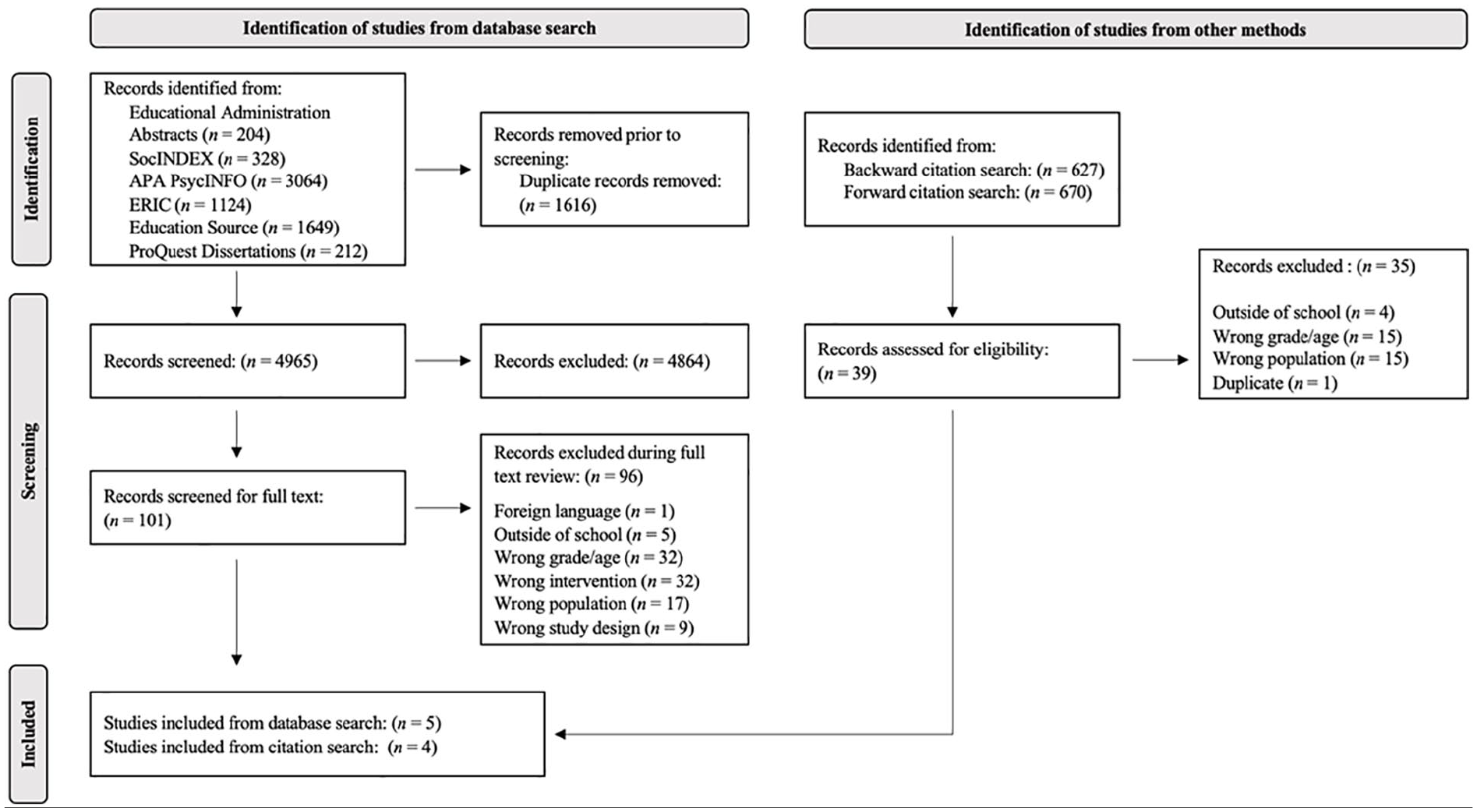
PRISMA Search.
Inclusion Criteria
Studies were included for the synthesis if they met the following criteria:
The manuscript was available in English.
All study participants were in the ninth to 12th grade.
The study sample was made up of at least 50% of students who were identified by their school or author as BD/LD.
The study used a single case design, randomized control trial, or quasi-experimental design.
The study took place within school hours at a public, private, or charter school.
The study tested the effects of an academic intervention or instructional practice on the academic outcomes for students with BD/LD.
Coding Procedures
Coding Manual
The first author developed a coding procedure and supplementary codebook based on recommended guidelines outlined for synthesis and meta-analytic research (Cooper et al., 2019) and SCD quality indicators (Horner et al., 2005), as all studies included in the synthesis utilized SCD methodology. Manuscript data were collected on the following study sections: (a) study context (i.e., classroom setting, curriculum), (b) participant characteristics (i.e., age and/or grade level, gender, race, ethnicity, socioeconomic status, language status, disability or educational risk status), (c) research design and research indicators (i.e., type of study design, participant assignment to study, attrition, fidelity, social validity), (d) intervention characteristics (i.e., number of sessions, length of sessions, number of participants per session, duration of intervention, outcome measure[s]), (e) study results (i.e., any statistical information such as group means, standard deviations, or statistics reported that could support effect size calculations), and (f) single case design quality indicators as outlined by Horner and colleagues (2005).
Coding Procedure
Prior to coding, the authors discussed the clarity of the coding items, description of coding procedures in the codebook, and revised any discrepancies. To establish reliability, the authors independently coded one study and achieved a reliability of 96.7%. The reliability interrater agreement was calculated by dividing the total number of agreements by the total number of agreements plus disagreements, multiplied by 100. All studies were double-coded, and the authors achieved an overall reliability of 94%.
Effect Size Calculation Procedures
Any reported data from study authors on effect sizes were collected in the code sheet. As single case designs were included in the inclusion criteria, to ensure that study effects could be calculated for each study, we used WebPlotDigitizer (Rohatgi, 2022) to manually extract raw data from the published study graphs. Data were moved from the application to an Excel spreadsheet and then to an online effect size calculator. Owing to the diversity of single case studies, all studies were uniformly analyzed using Tau-U. The online calculator from Single Case Research (Vannest et al., 2016) was then used to compute Tau-U for each study. Tau-U was calculated for each individual participant or condition, if applicable, then results were weighted to determine an overall effect size for each study. Further comparative analyses were not conducted due to the varying nature of the types of academic interventions included in the synthesis.
Results
Study Characteristics
The nine studies, two dissertations and seven peer-reviewed studies, included in this synthesis were published between 1989 and 2020, with one study published prior to 2000 (Skinner & Shapiro, 1989). In total, the nine studies included 27 participants ranging from ages 14 to 17 and in grades 9 to 11. All studies utilized single-case methodology as the study design, with three alternating treatment designs, two multiple baseline across condition designs, one reversal design, and three multiple baseline across participant studies. Of the nine studies, four focused on mathematics interventions (Billingsley et al., 2018; Cieslar et al., 2008; Haydon et al., 2012; Stoddard, 2019), four evaluated reading interventions (Blankenship et al., 2005; Skinner & Shapiro, 1989; Stone et al., 2008; Yang, 2020), and two assessed spelling interventions (Cieslar et al., 2008; Doll et al., 2013). One study (Cieslar et al., 2008) was a multi-component intervention which assessed both mathematics and spelling outcomes as two dependent variables. All studies used researcher-developed measures to assess the dependent variable(s). Further details of each study are presented in Table 1.
Characteristics and Outcomes of Included Studies That Met Criteria.
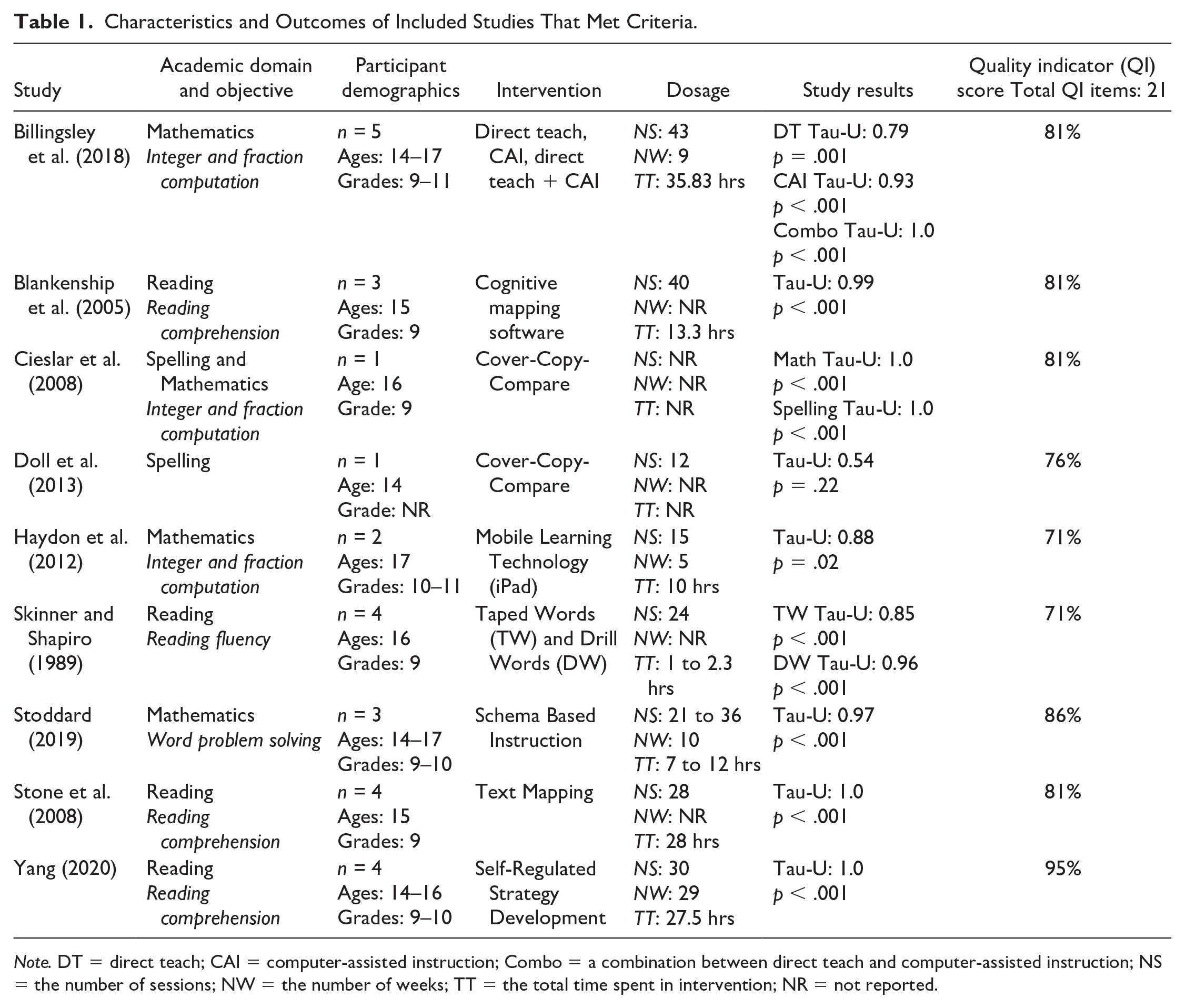
Note. DT = direct teach; CAI = computer-assisted instruction; Combo = a combination between direct teach and computer-assisted instruction; NS = the number of sessions; NW = the number of weeks; TT = the total time spent in intervention; NR = not reported.
Intervention Content
Mathematics Interventions
Three out of the four mathematics studies assessed integer and fraction computation as the dependent variables and one assessed word problem solving (Stoddard, 2019). The three studies that utilized integer and fraction computation as the dependent variable used the following three interventions: (a) direct teaching, computer-assisted instruction (CAI), or a combination of direct teaching and CAI; (b) use of an iPad; and (c) cover-copy-compare (CCC).
In the two studies which utilized technology (Billingsley et al., 2018; Haydon et al., 2012), the technology condition was compared to a traditional practice condition. Billingsley and colleagues (2018) utilized a computer program that focused on integer and fraction computation and compared it to a traditional, direct teach condition. In the direct teach condition, students received material through lecture, modeling, and hands-on manipulatives. Teachers engaged students in opportunities for practice and monitored independent practice. At the end of the lesson, students completed a skill assessment on the objective. In the CAI condition, students received their instruction on the objective from two or three interactive video or text-based examples of the content before moving to independent practice. Students moved to independent practice whether or not they mastered the content. A third condition in the study assessed the results of a combination of CAI and direct teaching. In the combination condition, students received instruction from their teacher on the new mathematics content and completed independent practice on the computer application. Overall, the combination condition received the best effects for students (Tau-U = 1.0), followed by the CAI condition (Tau-U = 0.93), and the direct teach condition (Tau-U = 0.79).
Haydon and colleagues (2012) compared the use of an iPad application to a worksheet condition during independent practice. In both conditions, students received instruction from their teacher on the mathematics skill, completed practice problems through guided practice, and had the opportunity to ask questions. For independent practice, students either completed practice computation problems on a worksheet or through an application on the iPad. Use of the iPad had an overall effect of Tau-U = 0.88.
Cieslar and colleagues (2008) utilized CCC (McLaughlin & Skinner, 1996) with integrated mathematics and spelling instruction. In the CCC mathematics condition, the student encountered a computation problem then copied it from memory. First, the student copied the incomplete problem. Then, the student observed the modeled completion of the problem. Following copying the completed problem from memory, the student compared their copied problem and answer to the original problem. Use of CCC, in the mathematics instruction, had an overall effect of Tau-U = 1.0.
Only one study (i.e., Stoddard, 2019) assessed the impacts of an intervention on word problems as the dependent variable. Students utilized schema-based instruction (SBI; Jitendra et al., 2009; Montague, 1992) to tackle multiplicative-compare problems (i.e., comparing quantities with a common metric) or vary-type problems (i.e., ratios or rates). Students followed the typical SBI sequence of (a) identifying the problem type, (b) using a schematic diagram, (c) writing a mathematical sentence to represent the problem, and (d) writing the solution. The SBI intervention had an overall Tau-U effect of 0.97.
Reading and Spelling Interventions
Of the studies measuring the impact of reading interventions, three out of four assessed reading comprehension, and one targeted reading fluency (Skinner & Shapiro, 1989) as the dependent variable. The studies targeting reading comprehension (Blankenship et al., 2005; Stone et al., 2008; Yang, 2020) used text mapping or self-regulated strategy development (SRSD) as the interventions.
Blankenship and colleagues (2005) utilized a computer-based text mapping software to assess students’ reading comprehension outcomes on their textbook chapter tests and quizzes. In text maps (e.g., Scanlon et al., 1992), students fill out pertinent content information from a text into a graphic organizer. Students in the study were taught how to use the computer-based software prior to the students using the technology. The independent completion of a text map prior to taking a chapter assessment had an overall effect of Tau-U = 0.99.
Stone and colleagues (2008) utilized a paper-based text map in their study. As students read through narrative texts, they filled out the organizer with story details such as conflict or characters. First, their teacher worked with them to identify each story element in the story and how to fit them into the map. Once students were proficient at filling out the map with their teacher, they filled it out independently. Upon completion of the map, students completed their comprehension assessment. The text map had an overall effect of Tau-U = 1.0.
Yang (2020) utilized SRSD to support students’ summarization and comprehension skills for expository science texts. Using the SRSD metacognitive framework (Harris & Graham, 1985), students combined a TWA (i.e.,
Skinner and Shapiro (1989) was the only study to examine reading fluency as an intervention and study outcome. The study compared the intervention outcomes between using taped words and drill words. In the taped words condition, students read a list of words along with an audiotape recording of the words. In the drill words condition, students were tasked with reading the list of words aloud then repeating the words. Both conditions were timed, and students were assessed on the number of words read correctly. Students scored higher (Tau-U = 0.96) in the drill words condition than the taped words condition (Tau-U = 0.85).
Both studies which examined spelling (Cieslar et al., 2008; Doll et al., 2013) used CCC to master spelling words. Both studies utilized the typical CCC procedure (i.e., memorize the spelling, cover the original word, write the word from memory, and compare your spelling to the original). Participants in both studies worked with no more than 10 words per word set before moving onto new words. The use of CCC for spelling by Cieslar and colleagues (2008) had an overall effect of Tau-U = 1.0 and by Doll and colleagues (2013) Tau-U = 0.54.
Efficacy of Interventions
Overall, Tau-U effect sizes across studies ranged between 0.54 and 1.0. All effect sizes are presented in Table 1. Mathematics interventions ranged from 0.79 to 1.0, reading interventions ranged from 0.85 to 1.0, and spelling interventions ranged from 0.54 to 1.0.
For completing integer and fraction computation, many interventions carried positive effects for participants. Studies that utilized technology (i.e., Billingsley et al., 2018; Haydon et al., 2012) had high effects. Students in the CAI condition (Billingsley et al., 2018) had an overall effect size of 0.93 and students who used the iPad application (Haydon et al., 2012) to complete their mathematics problems had an overall effect of 0.88. Although technology outcomes were high, students performed best in the combination condition of CAI plus direct teaching, (Tau-U = 1.0). The use of SBI (Stoddard, 2019) and CCC (Cieslar et al., 2008) also had strong effects for mathematics outcomes. Using SBI to complete word problems, students had an overall effect of 0.97, while CCC had an overall effect of 1.0.
In reading interventions, studies which utilized a text mapping procedure led to positive outcomes for students. Computer-based mapping (i.e., Blankenship et al., 2005) had an overall effect of 0.99 on textbook-based reading comprehension and the paper-based text mapping (Stone et al., 2008) had an overall effect of 1.0 on narrative text outcomes. The SRSD intervention (Yang, 2020) had an overall effect of 1.0 on the expository reading outcomes for science texts. To assess reading fluency, the drill words procedure produced stronger effects (i.e., 0.96) than the taped words procedure (i.e., 0.85).
Intervention Components and Study Quality
The use of technology was the most popular intervention component, with three studies (Billingsley et al., 2018; Blankenship et al., 2005; Haydon et al., 2012) including a technological component to the intervention. For Billingsley and colleagues (2018) mathematics outcomes, the technology components paired with instruction from the teacher or interventionist prior to independent practice with the technology led to the best outcomes over use of technology alone or direct teaching alone. Using the text mapping software supported students raising their reading comprehension scores compared to their baseline performance. In addition, using the iPad application supported higher effects compared to the worksheet condition for students.
No interventions included additional behavioral components to support the behavioral goals of students. Although this synthesis only examined academic interventions, studies have examined the impacts of behavioral components on the academic outcomes for students with BD (e.g., Roberts et al., 2020) when they are included.
Across studies, the average quality indicator score was 80.33%. Individual study scores ranged from 71% to 95%. This range is similar with Moeller and colleagues’ (2015) systematic review of the application of the single case quality indicators (Horner et al., 2005), which noted a range of 68% to 91% out of 120 single case studies in special education. Studies included in the present synthesis rarely included a participant selection process which could be replicated, did not include a valid dependent variable nor describe the measure with replicable precision, or report a strong fidelity of implementation score across the intervention.
Discussion
The purpose of this synthesis was to determine the effects of academic interventions on the academic outcomes for students with co-occurring BD/LD in grades 9 through 12. Among the nine studies, there was limited variability in the intervention effects. This may be in part due to the individualized approach of single case design research, the limited number of studies total and per subject area, as well as the small number of participants. Despite the limited variability of effects, and relatively positive outcomes, there remain many unknowns regarding how to support the academic achievement for BD/LD students in high school.
Recommendations for Researchers
Since the earliest initial review of studies targeting reading interventions for BD/LD students (i.e., Coleman & Vaughn, 2000), there has been limited research focusing on the academic outcomes for students with co-occurring BD/LD. Between 2000 and 2022, only six peer-reviewed studies were published that met criteria for the present synthesis. As with much of academic intervention research, the published research on BD/LD focused on elementary-age students. However, students at the secondary level have pressing academic, behavioral, and social needs that merit research efforts. It is recommended that researchers expand their research efforts to include populations of secondary-age students with co-occurring BD/LD to learn more about how to support the academic outcomes for this population of students.
To learn more about how to support the academic achievement of secondary-age students with BD/LD, additional studies that utilize academic interventions targeting grade-level standards can be prioritized in future research. Although research is limited for the short- and long-term academic outcomes of students with BD/LD, established research lines highlight the academic deficits for students with BD (e.g., Reid et al., 2004) and LD (e.g., Gersten et al., 2001) separately. If grade-level standards are not targeted in intervention, then students are not getting specific support to help them with grade-level content, which could result in larger academic skills gaps for BD/LD students. In the present synthesis, no mathematics intervention targeted grade-level mathematics standards and instead focused on elementary mathematics skills. Although students with BD/LD likely have learning gaps in high school, more research is needed on how to support such gaps through intervention research on high school level mathematics. More intervention research for secondary-age students with BD/LD must include grade level standards to learn how to target skill gaps while growing academic knowledge.
Future research can also consider the types of assessments used in intervention research. All studies in this synthesis implored researcher developed measures to assess study outcomes. Although researcher developed measures can support proximal skill assessment, since the assessments are often not validated nor shared with replicable detail (i.e., sharing example questions, academic standards, or testing conditions), it can be challenging to replicate findings or use the findings to make comparisons across student performance. The addition of standardized measures would allow researchers to make comparisons across studies as well as have normative findings for participants.
Implications for Practice and Limitations
Due to the small number of studies overall and per academic content area, it is challenging to make specific recommendations for practice. However, an overall recommendation could be that high school is not too late to design appropriate interventions that yield meaningful effects for students with BD/LD. Although all mathematics interventions used different intervention types, two interventions utilized technology. The use of technology, especially when paired with direct instruction, may be a beneficial way to support students’ independent practice. To support students’ reading comprehension, the use of text maps was successfully integrated across narrative and expository texts. When text maps are paired with meta-cognitive components of SRSD, they could be beneficial to students with BD/LD at the secondary level.
There are associated limitations with this synthesis. Owing to the limited number of research articles published in this field, there are challenges drawing overall or content-based conclusions for researchers and practitioners. Second, only Tau-U could be calculated as a comparable effect size across studies as a result of the variety of SCD studies included. Third, due to the nature of SCD, most interventions took place over a short duration and focused on a finite skill. Although this allowed the author to draw conclusions on the academic skillsets being measured, meaningful academic progress across time could not be assessed. In addition, this type of 1:1 attention does easily translate to classroom practices, as many high school students likely do not receive 1:1 intervention.
Conclusion
Overall, there is an urgent need for more high-quality research that targets grade-level standards for high school students with BD/LD. Over the last 20 years, the research on supporting the academic development for students with BD/LD is limited and that research is even more limited at the secondary level. Although overall effects from this synthesis were not aggregated to a total effect size, the interventions themselves demonstrated promising outcomes for high school-age students with BD/LD. To continue the original call to action from The Peacock Hill Working Group et al. (1991), research must continue to advance for students with BD/LD by increasing the number of high-quality, experimental studies and disseminating findings to practitioners.
Footnotes
Declaration of Conflicting Interest
The author(s) declared no potential conflicts of interest with respect to the research, authorship, and/or publication of this article.
Funding
This research was supported by the U.S. Department of Education’s Office of Special Education Programs, through Grant H325H190003. The opinions expressed are those of the authors and do not represent views of the U.S. Department of Education.
