




Abstract
The number line is a powerful tool for supporting students’ understanding of fraction magnitude. Fractions are a critical component of mathematics instruction in the elementary and intermediate grades. More specifically, understanding fraction magnitude is central to mathematical development. Yet, fractions are challenging for many students, particularly students with or at risk of learning disabilities (LD) in mathematics. This article shares (a) key recommendations when planning and implementing fraction number line instruction, (b) sample fraction number line activities for supporting students’ understanding of fraction magnitude and overall mathematics achievement, and (c) strategies for helping students grasp the abstract number line representation.
Fraction learning is a notoriously challenging topic of the mathematics curriculum that presents stumbling blocks to many students, particularly students with or at risk of learning disabilities (LD) in mathematics (Dyson et al., 2020; National Mathematics Advisory Panel [NMAP], 2008). A study that explored students’ growth in fraction knowledge from third grade through sixth grade found that students receiving special education services in school, many of whom had diagnosed LD, were 2.5 times more likely to experience low growth in fraction conceptual understanding and 11.5 times more likely to experience low growth in fraction arithmetic than their classmates who were not receiving special education services (Hansen et al., 2017). One particular stumbling block is fraction magnitude understanding or the ability to comprehend, estimate, and compare the sizes of fractions (Fazio et al., 2014). Difficulty interpreting fraction magnitude has consequences for students’ learning, as it can negatively impact their ability to (a) use strategies to verify if solutions are reasonable, (b) develop algebraic thinking, and (c) understand medication regimens in adulthood (NMAP, 2008).
The number line is recommended as a key instructional tool grounded in research evidence for supporting students’ fraction magnitude understanding and amplifying their overall mathematics success (Fuchs et al., 2021). Fraction intervention research has demonstrated the effectiveness of the use of the number line for advancing fraction learning among students struggling with mathematics across several grades, including third (Hamdan & Gunderson, 2017), fourth (Fuchs et al., 2016), fifth (Jayanthi et al., 2021), and sixth grades (Barbieri et al., 2020). The use of number lines in fraction instruction is also supported by the Common Core State Standards for Mathematics (CCSSM; National Governors Association Center for Best Practices & Council of Chief State School Officers [NGAC & CCSSO], 2010). Grade 3 mathematics expectations include (a) understanding a fraction as a number on the number line (CCSS.MATH.CONTENT.3.NF.A.2) and (b) understanding two fractions as equivalent if they are the same size or the same point on a number line (i.e., CCSS.MATH.CONTENT.3.NF.A.3.A). Grade 4 expectations support the use of the number line as a visual for solving word problems involving fractions (i.e., CCSS.MATH.CONTENT.4.MD.A.2; NGAC & CCSSO, 2010).
Despite extensive support for use of number lines to promote fraction learning, fraction instruction in the United States has traditionally emphasized the part–whole interpretation of fractions. Students are often taught to interpret
This article offers key recommendations and sample activities for fraction magnitude instruction using number lines, with a particular focus on research-informed strategies for students with or at risk of LD in mathematics. One framework commonly used to support students of all levels is multi-tiered systems of support (MTSS). Within MTSS, Tier 1 mathematics instruction is delivered universally, while Tier 2 and Tier 3 are delivered to targeted groups or individuals who require more support. The use of number lines for supporting mathematics understanding is effective at Tier 1 and has also demonstrated efficacy as a Tier 2 support for fraction learning (Jayanthi et al., 2018). The visual representational nature of the number line supports its usefulness for Tier 3 and special education levels of support (Gersten et al., 2009). Recommendations and activities in the present article—targeting fraction magnitude understanding, fraction equivalence, and fraction comparisons using the number line—are beneficial for students with LD in mathematics but also helpful for students at risk of math difficulty as well as students at all skill levels and thus beneficial for Tier 1, Tier 2, and Tier 3 instruction.
Key Recommendations for Planning and Implementing Fraction Number Line Activities
Six recommendations specific to number line instruction and supported by guidance in the recent What Works Clearinghouse Practice Guide (Fuchs et al., 2021)—a guide that distills contemporary, high-quality, evidence-based research studies focused on mathematics intervention into practical classroom strategies—are described.
Select Appropriate Number Line Formats
When planning a fraction number line activity, consider which number line format fits best with the goals of the activity, students’ current level of fraction magnitude understanding, and students’ familiarity with the representation. Number lines can be presented in multiple formats to illustrate fraction magnitude: (a) three-dimensional, concrete representations such as fraction bars and rulers; (b) two-dimensional, semi-concrete representations including drawings of number lines and pictures of rulers; and (c) virtual number lines on a screen (e.g., the free platform Math is Fun provides a digital fraction number line students can manipulate to explore equivalent fractions) or as a mental image in one’s head (Fuchs et al., 2021). A unique format example is a walkable fraction number line displayed on the ground that engages students in a whole-body, multimodal fraction learning experience (Bustamante et al., 2022). Concrete number line representations can be beneficial for early learners or those impacted by LD in mathematics followed in complexity by two-dimensional, semi-concrete number line illustrations. The most abstract level is for students to generate a mental image of a number line in their minds to support ongoing use and generalization of the representation over time.
Include Arrows at Both “Ends” of the Number Line
The ways in which number lines are visually presented are important for facilitating students’ understanding. A critical feature is the inclusion of arrows at both “ends” of the number line, to reinforce that the number line extends infinitely in both directions and that an infinite number of divisions are possible along the number line (Fuchs et al., 2021). Furthermore, numbers increase in value as you move to the right on the number line and decrease in value when moving to the left, allowing the representation of negative values.
To bring students’ attention to these arrows and to encourage discussion about their meaning, teachers can present number lines with minimal features (e.g., numbers 0 and 1 labeled; arrows) and ask students “What do you notice?”—a popular open-ended prompt for use in mathematics instruction to incorporate student perspectives into classroom discourse and to motivate students to engage in sensemaking (Buchheister et al., 2019). Teachers can further facilitate discussion and promote student curiosity by asking “What do you wonder?” (Ray-Riek, 2013) or more targeted prompts as needed to encourage student discourse about why the arrows are included to represent the infinite nature of number lines.
Introduce Fraction Concepts on the Number Line With Familiar Denominators
When introducing fraction concepts on the number line, limiting instruction to include only denominators that are familiar to students (e.g., halves, fourths) can help students grasp foundational concepts (Dyson et al., 2020; Siegler et al., 2011). This approach mirrors a strategy that is also useful for whole number concepts in earlier grade levels (Dyson et al., 2015) and has demonstrated effectiveness for fraction magnitude learning on the number line for students struggling with mathematics (Barbieri et al., 2020). The CCSSM (NGAC & CCSSO, 2010) expectations for understanding fractions as numbers in Grade 3 focus only on denominators 2, 3, 4, 6, and 8. After students demonstrate an understanding of a familiar denominator (e.g., halves), other denominators can be introduced in a logical progression.
Direct Students’ Attention to the Length of the Number Line
The use of number lines with varied lengths throughout fraction number line lessons (e.g., 0–1 number line and 0–2 number line) is critical for supporting students’ magnitude understanding of fractions less than, equal to, and greater than 1 (Resnick et al., 2016). Yet, students often misinterpret the length of number lines. A common assumption is that all number lines start at 0 and extend to 1, with students placing
To circumvent students’ tendency to think all number lines are 0–1, help students build a habit of first identifying critical features of number lines before they begin actions such as partitioning or locating fractions along the line. The previous recommendation of asking students “What do you notice?” to encourage student noticing of the number line arrows can also be used for students to notice the length of the number line. If students build a habit of recognizing number line lengths in early fraction instruction lessons focused on the 0–1 number line, they will be better prepared for the introduction of number lines that extend beyond 1 in subsequent lessons.
Use Representational Gestures Along the Number Line
Representational hand gestures convey a spatial object, event, or an abstract concept (Goldin-Meadow, 2011) and can be leveraged for enhancing students’ learning of mathematics content (Ping & Goldin-Meadow, 2008). Gestures are particularly beneficial for abstract, challenging mathematics topics such as fractions and are well-suited for fraction magnitude instruction on the number line (Barbieri et al., 2020). Representational gestures help students understand that the point where a fraction is located on the number line is not merely a hash mark but also represents the fraction’s magnitude or the distance between 0 and that fraction (Barbieri et al., 2020; Fuchs et al., 2021). Chunking gestures can be particularly salient for (a) visualizing the magnitude of a unit fraction along a number line and (b) directing attention to the spaces between hash marks to combat students’ tendency to incorrectly focus on the hash marks themselves as the objects to be counted along the number line (Solomon et al., 2015). As illustrated in Figure 1, teachers can create a chunking gesture by placing their index finger and thumb in a bracket-like position at the start and endpoint of a magnitude (e.g., 0 to the unit fraction
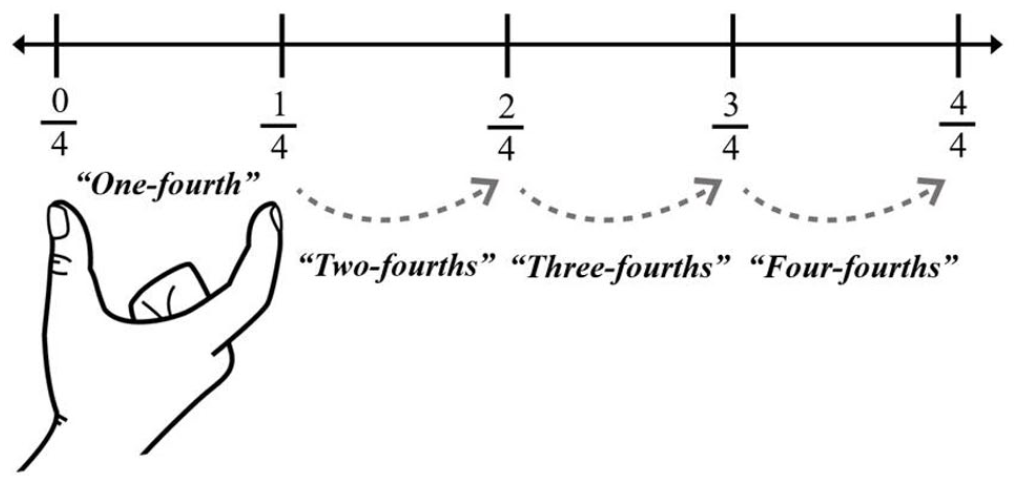
Representational gestures along the fraction number line.
Use Precise Mathematical Language
Language plays an important role in fraction learning (Hughes et al., 2016). When teaching fractions it can be tempting to use informal mathematics language to help students grasp critical ideas, such as referring to the denominator of a fraction as the informal term “bottom number.” However, using informal fraction terms can do students a disservice. Students who only know the term “bottom number” will encounter confusion when engaging with a problem on a mathematics test that uses the formal mathematical term “denominator” (Hughes et al., 2016). Without regular exposure to formal fraction-related terms (e.g., numerator, denominator, equivalent), students may struggle to solve fraction problems correctly. Unfortunately, this is especially true for students with or at risk of LD in mathematics (Forsyth & Powell, 2017).
Precise mathematical language for fraction instruction is particularly relevant for supporting students’ fraction magnitude understanding (Hughes et al., 2016). Consider the fraction
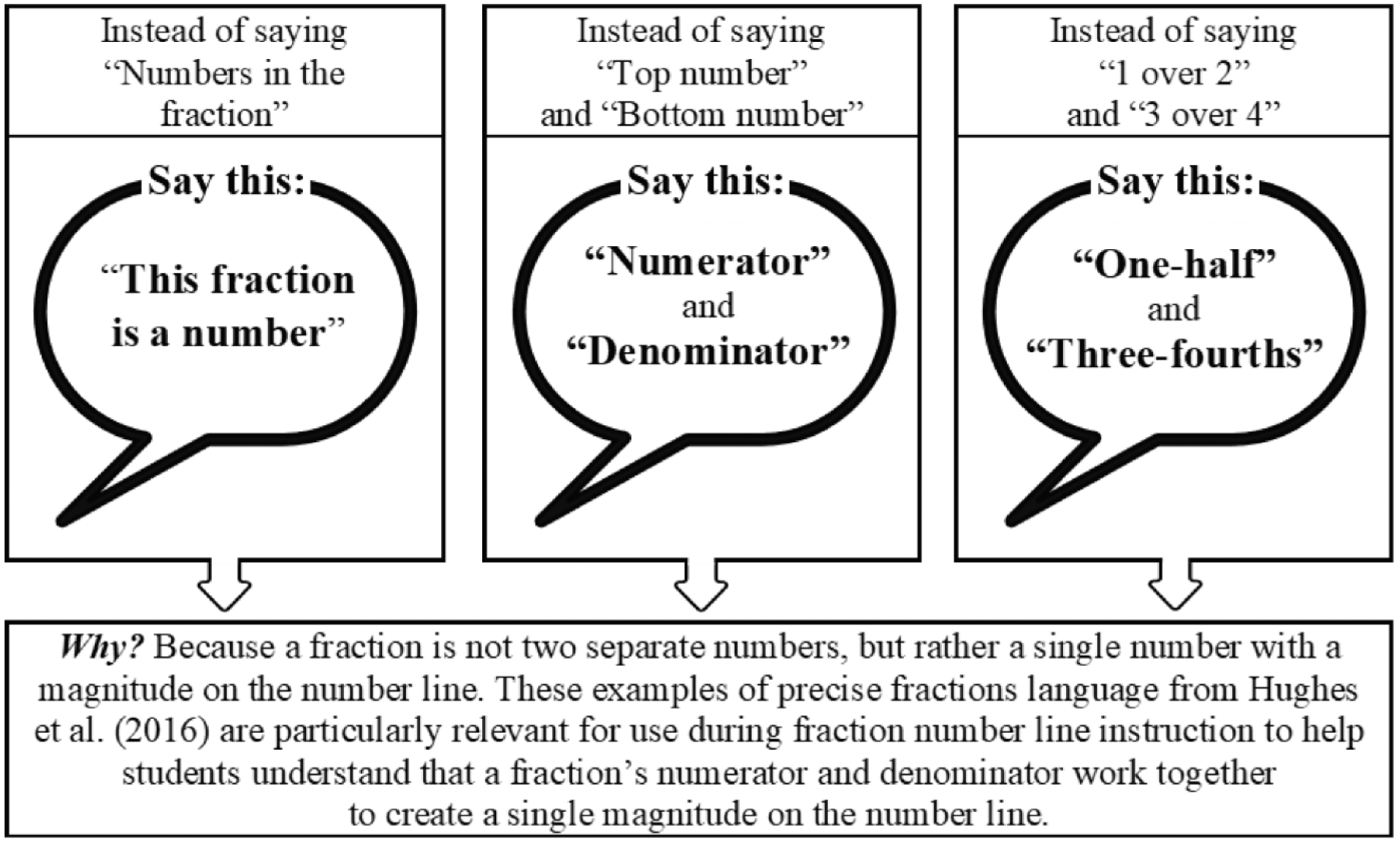
Precise mathematical language for promoting students’ fraction magnitude understanding during number line instruction.
Fraction Number Line Activities
The following are overviews of sample fraction number line activities that support learning objectives targeting fraction magnitude understanding. The activities can be adapted for use across MTSS tiers and in special education intervention. The key recommendations described previously are embedded throughout the activities to illustrate their implementation.
Fraction Magnitude and Equivalence on the 0–1 Number Line
Once students demonstrate an understanding of the concept of a fraction with concrete representations such as fraction bars or tiles, students can begin using semi-concrete number lines for advancing their understanding of fraction magnitude (Fuchs et al., 2021). A paper-folding activity is an introductory activity for learning about fraction magnitude on the 0–1 number line. The activity starts with a familiar denominator, halves.
1. Distribute papers with a 0–1 number line that extends the full length of the sheet, as shown in Figure 3. The number line should include arrows on both “ends,” touching the sides of the sheet, to represent the infinite nature of the number line representation.
2. Ask students to identify the number marked on the left (“0”) and the number marked on the right (“1”), to help them build a habit of identifying critical features of number lines before engaging in number line activities.
3. Guide students to fold the paper in half, so that the number line is visually split at the midpoint into two equal parts.
4. Explain that the location on the number line where the paper was folded shows where the fraction
5. Bring students’ attention to the idea that the denominator represents the number of partitions in one whole (i.e., there are two equal parts to make the whole).
6. Help students label the other marks on the number line in halves (i.e., label 0 as
When students are comfortable identifying halves on the 0–1 number line, the paper-folding activity can be extended to introduce equivalent fractions. After completing the above task, distribute new papers with a 0–1 number line that again includes arrows on both “ends,” perhaps printed on a different color sheet than the prior task to indicate use of a different unit fraction. Ask students to fold the new sheet of paper into two equal parts and make a hash mark where the fold intersects the number line. Guide students to separate each half into two equal parts and make a hash mark; they will then label zero-fourths, one-fourth, two-fourths, three-fourths, and four-fourths along the line (Figure 3). Help students line up their two number line papers so that both number lines are visible, as shown in the final step of Figure 3. Ask students to identify fractions located at the same positions on the number lines (e.g.,
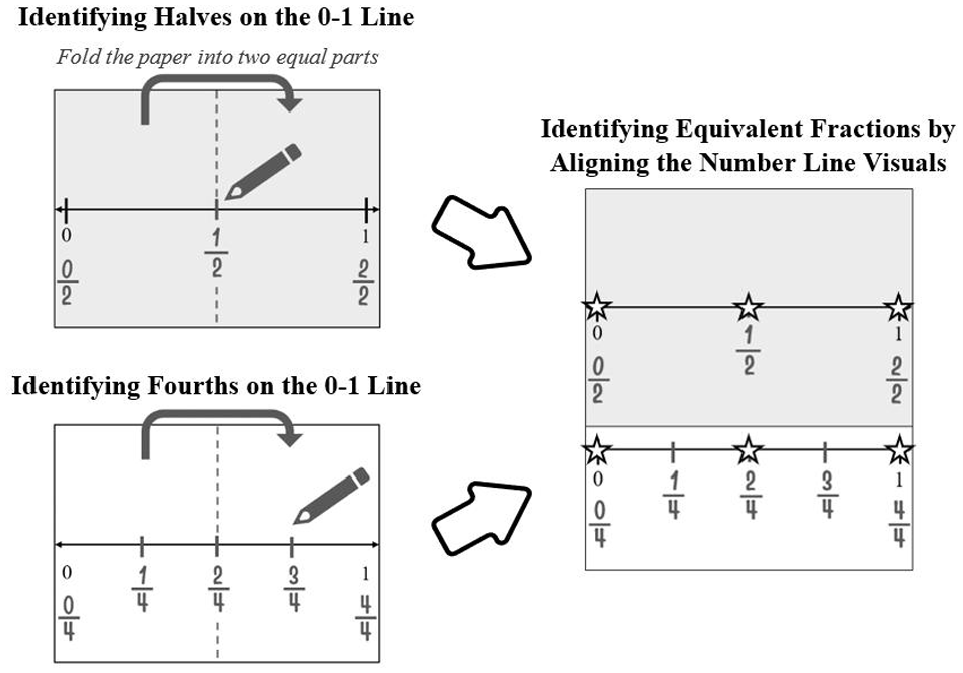
Paper folding activities to facilitate understanding of fraction magnitude and equivalence on the 0–1 number line.
Fraction Magnitude and Equivalence on Number Lines That Extend Beyond 1
The early stages of fraction number line instruction typically focus on fractions less than 1 (Vosniadou et al., 2008), which can lead students to a common misunderstanding that fractions are “really small” or “less than 1” (Resnick et al., 2016). Placing improper fractions (e.g.,
1. Display a 0–2 number line, with arrows at both “ends.” For this sample activity, the number line has pre-marked locations that partition the number line into fourths.
2. Ask students “what do you notice?” One goal is for students to identify and discuss the length of the number line (i.e., 0–2). In absence of this step, students may assume that the number line starts at 0 and extends to 1. Students may also notice the number of partitions (e.g., the spaces between 0–1 and between 0–2 are split into four equal parts). Encourage student use of precise mathematical language when responding to the prompt; for example, support students in noticing and attending to the equal partitions and model the precise mathematical language of “four equal parts” rather than simply “four parts.” Ask more specific questions if students need additional support to identify and discuss key components of the visual representation (e.g., “What numbers do you notice on the line? What do the numbers tell us about the line?”)
3. Count along the number line from 0 to 2, increasing by the unit fraction
4. When all fourths are labeled on the number line, use the full representation to show that for fractions less than 1, the numerator is less than the denominator. For fractions greater than 1, the numerator is greater than the denominator. Use the precise mathematical terms numerator, denominator, and improper fraction.
This activity can be extended to introduce or strengthen students’ understanding of fraction equivalence. Two examples include (a) displaying a second number line that shows each whole partitioned into fourths but uses whole number and mixed number equivalencies and (b) including both fourths and their equivalencies on a single 0–2 number line (see Figure 4).
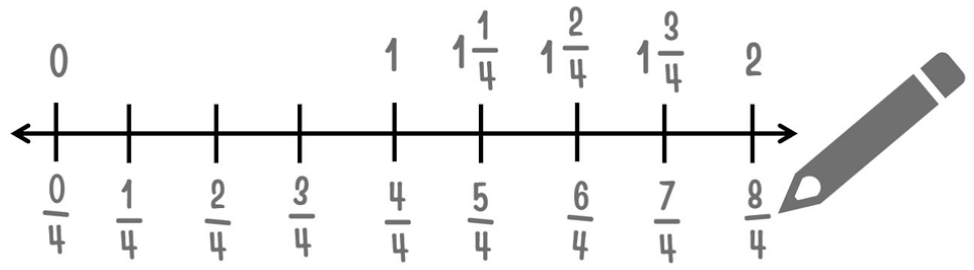
Using the 0–2 number line to show fractions less than, equal to, and greater than 1.
Fraction Comparisons Using the Number Line
As students gain experiences locating fraction magnitudes on number lines, they can move toward using number lines to reason about how fraction magnitudes relate to or compare to one another or to benchmark numbers. Such activities support, for example, the Grade 3 CCSSM expectation to compare two fractions and justify the results by using a visual fraction model (i.e., CCSS.MATH.CONTENT.3.NF.A.3.D; NGAC & CCSSO, 2010). Fraction comparison number line activities support continued numerical development (Siegler et al., 2011) and bolster students’ performance in other tasks such as determining the reasonableness of answers to a fraction arithmetic problem and ordering fractions by size (Fuchs et al., 2021).
1. Have a number line prepared ahead of time with the benchmark numbers of 0, 1, and 2 in place or have students draw a number line with these benchmark numbers.
2. Present students with a fraction and ask them to point to the approximate location of the fraction on the number line with the benchmark numbers in place. If students are given the fraction
3. Following their approximation, ask students to describe the fraction as less than, equal to, or greater than one (or any other benchmark number of your choosing).
4. Once students become familiar with the activity, extensions to the activity can include: comparison of multiple fractions, ordering fractions by size, and/or including additional benchmark numbers for more challenging comparisons.
Helping Students Grasp the Meaning of the Number Line
While number lines demonstrate effectiveness for advancing students’ visualization and learning of fraction magnitude (Gersten et al., 2017; Gunderson et al., 2019), the abstract nature of the number line representation can take time to grasp for students with or at risk of LD in mathematics. Two strategies for helping students who are struggling to understand the number line representation are (a) anchor number lines in meaningful contexts, and (b) use concrete representations such as fraction tiles alongside number line representations.
Anchoring number lines in contexts that are meaningful to students can be powerful for students’ motivation and mathematics learning. For example, number lines can be presented as a 5-mile racecourse for a fundraiser run in the community. The racecourse context provides many opportunities for different stories about the run and associated fraction number line activities. Students could be tasked with locating all the water stations along the course for the runners (Barbieri et al., 2020; Rodrigues et al., 2016), to be placed at every half-mile. Students can visualize the runners starting the race, running
The second strategy to use concrete representations such as fraction bars alongside number lines (e.g., Lannin et al., 2020) is illustrated in Figure 5. Students can build a number line using concrete fraction manipulatives that are of consistent and equal length units. The manipulatives can be connected to the semi-concrete number line representation, by lining up the fraction bars to the number line equivalent. The manipulatives can be removed in subsequent activities, once students grow in confidence connecting the concrete manipulatives to the number line visual.
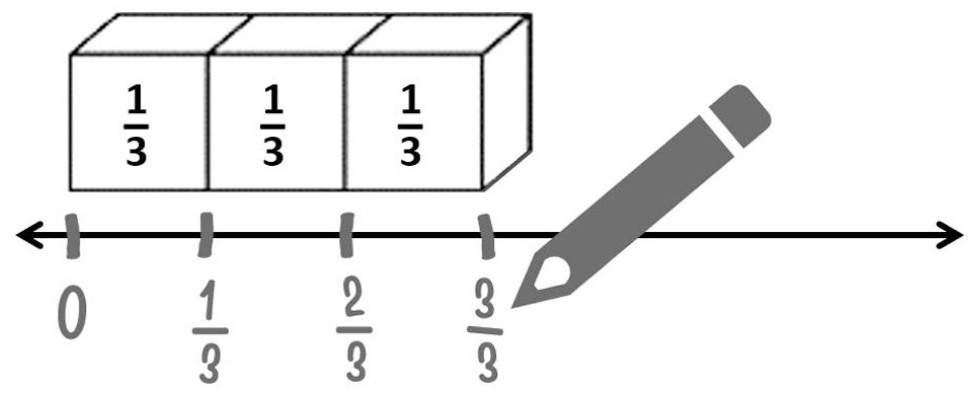
Using concrete fraction manipulatives and a semi-concrete number line.
Conclusion
Fraction number line instruction understandably can be intimidating for both students and teachers. It combines a challenging, abstract topic of the mathematics curriculum (i.e., fractions) with a challenging, abstract representation (i.e., the number line). Fortunately, research points to several recommendations for using the number line in fraction instruction that have demonstrated effectiveness for advancing fraction magnitude understanding for students with or at risk of LD in mathematics. This article shares research-informed recommendations and activities for fraction number line instruction, with a particular focus on recommendations for students struggling in the area of mathematics. Intentional implementation of fraction number line activities that leverage recommendations grounded in research evidence can promote students’ fractions achievement and bolster their overall mathematics success.
Footnotes
Declaration of Conflicting Interests
The author(s) declared no potential conflicts of interest with respect to the research, authorship, and/or publication of this article.
Funding
The author(s) received no financial support for the research, authorship, and/or publication of this article.
