




Abstract
The purpose of this study was to examine the relation between teachers’ reports of classroom adversity, a measure of classroom hardship, and student problem behavior in a sample of students with or at risk of emotional/behavioral disorders. We also examined the extent to which this relation varied as a function of multiple domains of classroom quality. A series of multiple regression models, adjusting for the nesting of students within classrooms, were conducted. Models revealed a significant effect of the interaction between classroom adversity and classroom emotional support on teachers’ reports of student problem behaviors. This effect indicated that in low-adversity classrooms, teachers differed in their reports of students’ problem behaviors depending on their level of emotional support. In high-adversity classrooms, however, teachers’ reports of students’ problem behaviors were relatively similar regardless of their level of emotional support. Findings suggest classroom adversity is likely an important contextual factor to consider when examining student outcomes and that teacher emotional support may mitigate the influence of classroom adversity. We conclude with a discussion of the implications of this work for research and practice.
Approximately 12% to 20% of students have or are at risk of an emotional/behavioral disorder (EBD; e.g., Ringeisen et al., 2020). The underlying characteristics of EBD are conceptualized across two distinct yet often co-occurring domains: externalizing and internalizing challenges (Forness et al., 2012; Willner et al., 2016). Externalizing challenges include symptoms such as defiance, aggression, and disruptive behaviors. Internalizing challenges include symptoms such as social withdrawal, sadness, and anxiety (Achenbach & Rescorla, 2000). Persistent challenging behaviors can have an impact on students’ long-term behavioral and academic success, and students with or at risk of EBD are at a much higher risk for negative educational and social outcomes than students from other disability categories and their peers without disabilities (Wagner & Cameto, 2004). Longitudinal studies also document that children who display externalizing and/or internalizing problems are at an increased risk of poor economic and social outcomes into middle age (e.g., future unemployment, criminal convictions, lower earnings, poor health; Alatupa et al., 2013; Vergunst et al., 2023). Unfortunately, less than 1% of students are formally identified with emotional disturbance (ED) and receive support for this disability under IDEA (National Research Council and Institute of Medicine, 2009). As a result, most students with or at risk of EBD, a broader category used in the research literature to describe children with challenging behavior who may not have an ED label and corresponding services, are educated primarily in general education classrooms and as such may not receive all necessary supports (Mitchell et al., 2019). Considering trends in the developmental and academic trajectories of these students, identifying factors in classrooms that promote or hinder psychosocial adjustment for students with or at risk of EBD is an important goal.
A growing body of work has recently signaled that classroom adversity, a collective classroom characteristic, contributes to student outcomes, teaching processes, and teacher well-being (Abry et al., 2017, 2018; Granger et al., 2021, 2023; McLean, Abry, et al., 2020). Classroom adversity is a measure of risk exposure and hardship (i.e., ecological risk) in classrooms that impacts the academic and socio-emotional outcomes of individual students. These include factors such as student challenges with family-home life, inadequate nutrition, student health, and disruptive behavior problems. Classroom adversity predicts high levels of individual student externalizing behaviors in early and late elementary grades (Abry et al., 2017), illustrating the potential for classroom adversity to be related to the experiences and outcomes of students with or at risk of EBD. However, studies have yet to examine the influence of classroom adversity on the outcomes of students with or at risk of EBD specifically, despite this being a subpopulation of students who may have more to gain from positive classroom settings and interactions compared with other students (Belsky, 1997).
The degree to which classroom adversity is related to student problem behavior may be magnified or buffered by high-quality classroom environments. Classroom quality is typically measured by a combination of emotional support (i.e., the nature and tone of interactions between teachers and students), instructional support (i.e., the provision of developmentally appropriate and flexible learning experiences), and classroom organization (i.e., a physical space and lessons that are structured to facilitate successful learning). High-quality classroom environments are foundational for short- and long-term student success (Cunningham et al., 2022; Pianta et al., 2008) and are particularly important in early elementary grades as the learning tools (e.g., regulatory skills, interpersonal competencies, and problem-solving) students acquire early in life serve as a foundation for the development of more advanced skills (Heckman et al., 2006). Furthermore, high-quality classroom environments promote the well-being and positive developmental trajectories of students with and at risk of EBD (Carr et al., 2019).
Classroom Adversity
Classroom adversity is likely a salient characteristic of the classroom, as prior work has illustrated that teachers’ instructional and other decisions are indeed influenced by collective classroom factors and student dynamics. For example, it has been shown that teachers adjust learning opportunities for students to meet the needs of the aggregate classroom group (Nurmi & Kiuru, 2015). Additionally, the ability composition of small learning groups affects the level and type of instruction teachers deliver (Wilkinson & Fung, 2002) and elementary teachers are shown to increase their emotional support, instructional support, and classroom organization in response to the number of students who show active task avoidance early in the school year (Pakarinen et al., 2014). To date, studies of collective student characteristics have primarily focused on one risk characteristic at a time (e.g., percentage of low socioeconomic status students or classroom collective levels of aggression; see Abry et al., 2018). To illustrate, in a sample of high needs elementary schools, classroom quality interacted with aggregate student externalizing behaviors to predict change in student social and academic adjustment (Hoglund et al., 2015). A focus on a single risk characteristic may be limited, although, as individuals often face multiple personal and environmental risk factors at once (Belsky, 1997), which makes this cumulative risk more harmful compared with single- or no-risk exposure (Evans et al., 2013). As such, a more comprehensive measure of cumulative classroom level risk may better reflect the collective challenges faced by teachers and students in a classroom context. However, we currently have a limited understanding of how teachers respond to a comprehensive assessment of collective classroom risk factors, how this collective risk influences individual student outcomes, and how these processes might unfold for EBD students specifically.
Classroom Adversity and Teacher Perceptions of Student Problem Behaviors
To our knowledge, only two studies have examined the influence of classroom adversity on student outcomes. First, Abry and colleagues (2017) highlighted that classroom adversity was associated with individual student outcomes, specifically that classroom adversity was concurrently and positively associated with externalizing behavior for elementary school-age students (Abry et al., 2017). Second, Abry and colleagues (2018) demonstrated that classroom adversity was related to student literacy outcomes directly and indirectly via classroom management (negatively) and controlling instruction (positively). This work also revealed a negative direct longitudinal association between classroom adversity in first grade and student executive functioning in third grade. A larger body of work has shown that collective classroom characteristics influence student outcomes (e.g., Hoglund et al., 2015; Wilkinson & Fung, 2002). To illustrate, aggregate classroom-level externalizing behaviors may challenge students’ abilities to form close relationship with their teacher and friends due to the disruptive atmosphere that may undermine social relationships and create risks for peer problems (Barth et al., 2004; Chang, 2004; Hoglund & Leadbeater, 2004; Thomas et al., 2011). Furthermore, Hoglund and colleagues (2015) suggest that classroom aggregate externalizing behaviors may challenge teachers’ ability to provide a supportive classroom due to difficulties bonding with students in these classrooms, increased disruptions during lesson delivery, and poor engagement from students in the learning process.
Classroom Quality and Student Outcomes
Classroom quality has primarily been conceptualized as a teacher-driven, multidimensional construct with core dimensions including emotional support, instructional support, and classroom organization (Howes et al., 2008; Mashburn et al., 2008). Each of these dimensions on their own have been found to be important for student development and classroom instructional processes (Hamre & Pianta, 2005; Mashburn et al., 2008; McLean et al., 2016; Perry et al., 2007). Emotionally supportive teachers are sensitive to student’s needs and interests and are responsive and warm toward students (Pianta et al., 2008). Similar to an authoritative parent, they also balance high warmth and high demand in their classroom management and expectations for students (Connor et al., 2009; McLean, Sparapani, et al., 2020). On its own, teachers’ emotional support for students predicts critical student outcomes including learning, competence, academic achievement, and motivation (O’Hare et al., 2020; Ruzek et al., 2016; Tennant et al., 2015; Wentzel et al., 2016), and is particularly important for improving the outcomes of students at risk of school failure (Hamre & Pianta, 2005). Relatedly, the emotional support teachers provide to students may serve as a buffer for children who enter school with lower early developmental skills such as oral language and challenging behavior (Chow et al., 2023; Chow & Wehby, 2018). In regard to instructional quality, teachers who provide high-quality instructional support provide scaffolding, create opportunities for conceptual development and offer appropriate questioning and feedback to their students (La Paro et al., 2004; Pianta et al., 2008). Teachers’ instructional support, and instructional quality more broadly, supports student outcomes across many dimensions including engagement and achievement (Howes et al., 2008). Finally, in classrooms with a high level of classroom organization, teachers establish clear and stable routines, monitor students carefully to keep them involved in academic tasks, and provide activities that are interesting to students (Emmer & Stough, 2001; Pianta et al., 2008). Organized classrooms can enhance student’s social and academic adjustment and are predictive of student engagement and on-task behavior as well as increases in social competence and academic achievement (Cameron et al., 2008; Mashburn et al., 2008; Rimm-Kaufman et al., 2009).
Classroom Adversity and Classroom Quality
A larger body of work has examined the influence of classroom adversity on teacher characteristics and teaching practices (Abry et al., 2018; Granger et al., 2021; McLean, Abry, et al., 2020). Abry et al. (2018) reported that teacher-reported classroom adversity was negatively related to observations of teachers’ classroom management quality, and teachers in higher adversity classrooms were less effective in preventing disruption and maintaining and regaining order in their classrooms—all essential elements of classroom quality. Additionally, classroom adversity was positively associated with observed controlling instruction (another element of classroom quality); teachers were more likely to use structured, teacher-directed activities in classrooms with higher level adversity. Finally, classroom adversity was negatively associated with the amount of time teachers spent on academic instruction. Recently, McLean, Abry, et al. (2020) investigated links between classroom adversity and early-career elementary and middle school teacher well-being and found that teachers who reported high levels of adversity also reported more depressive symptoms in their first year of teaching. Granger et al. (2021) reported that high levels of classroom adversity increased the likelihood of negative teacher–student interactions with elementary students with and at risk of EBD. Finally, Granger et al. (2023) reported a positive relation between teachers’ efficacy in instructional strategies and classroom organization quality at low levels of classroom adversity. However, there was a negative relation between teachers’ efficacy in instructional strategies and classroom organization quality at high and average levels of classroom adversity. Taken together, this work shows that teachers are aware of collective classroom risk factors, and they adjust instruction and learning opportunities for students to meet the needs of the aggregate classroom group (Nurmi & Kiuru, 2015).
Present Study
The present study examines the relationship between classroom adversity and student problem behavior and the extent to which this relation varies as a function of three dimensions of classroom quality: emotional support, instructional support, and classroom organization. By investigating the simultaneous influences of classroom ecological factors on student outcomes, we hope to provide the field with more nuanced information on when, where, and how to provide targeted support in the classroom to improve the outcomes of students with or at risk of EBD.
Prior work supports a connection between classroom adversity and student outcomes; however, this work leaves unanswered questions about the extent to which this relation exists for students with or at risk of EBD. Furthermore, we do not yet know the extent to which classroom quality may magnify or buffer the association between classroom adversity and student outcomes. As such, we currently have limited insight into how collective student risk characteristics and classroom contextual characteristics, such as classroom quality, contribute to teachers’ appraisals of individual students’ behaviors. To fill this gap, our study tested (a) the direct associations among classroom adversity, each of the three dimensions of classroom quality, and student problem behavior and (b) the extent to which each of the three dimensions of classroom quality modified the relation between classroom adversity and student problem behavior.
We anticipated that classroom adversity would be positively related to students’ problem behaviors, as being in a classroom with high rates of classroom adversity may serve as an additional risk factor for students’ social and academic adjustment (Bradshaw et al., 2010; Thomas et al., 2011). For example, a classroom with high rates of adversity may offer fewer opportunities for students to learn from the teacher and from peers which may interfere with student’s engagement in classroom tasks and their ability to develop more proficient academic and behavioral skills (Barth et al., 2004; Pakarinen et al., 2010; Rimm-Kaufman et al., 2002).
We also expected that classroom quality may modify the association between classroom adversity and student problem behaviors, where high levels of each classroom quality dimension would diminish the association between classroom adversity and student problem behavior. For example, in a classroom with a high proportion of students experiencing adversity, a teacher may be likely to perceive this and experience heightened stress, and this heightened stress may lead that teacher to interpret their students’ behaviors as more severe Alternatively, in a classroom where a teacher has created and maintained high-quality systems of organization, instruction, and emotional support, this heightened stress response may be less likely and in turn, the teacher may perceive student behaviors as less severe. In this classroom setting, students may indeed display fewer problem behaviors, which may also reduce student problem behaviors.
We examine these questions at the pretest time point of an intervention trial designed to support teachers of students who have been screened and identified as displaying high levels of externalizing challenges that place them with or at risk of EBD. We focus on externalizing behaviors as they often disrupt classroom routines and are reported more often by teachers when compared with internalizing problems (Harrison et al., 2012).
Method
Setting and Participants
Teachers and their students with or at risk of EBD were recruited from three elementary schools in a large urban school district in a Mid-Atlantic state. The mean number of total students per school was 364 (SD = 73.9) and consisted of predominantly Black students (94%, 93%, and 98%, by school respectively) from an urban community (82%, 96%, and 96% free and reduced-price lunch, by school, respectively). The schools indicated that no formal schoolwide positive behavior interventions and supports were in place and Tier 1 supports and classroom management practices were implemented with variability, although generally at low levels of fidelity, across classrooms. To illustrate, the average CLASS scores were considerably lower than scores found in other studies (e.g., Jennings et al., 2017; Sandilos et al., 2014). Jennings et al. (2017) noted CLASS scores of 4.86 (Classroom Organization), 2.75 (Instructional Support), and 4.92 (Emotional Support) in 224 elementary classrooms and Sandilos and colleagues (2014) noted scores of 5.16 (Classroom Organization), 3.03 (Instructional Support), and 5.26 (Emotional Support) in 426 elementary classrooms. This suggested that the included schools lacked high-quality Tier 1 supports.
Although not a focus of this study, the intervention focused on evidence-based practices shown to reduce student problem behaviors and increase high-quality teacher–student relationships. These practices include building supportive relationships, rules, precorrection, opportunities to respond, praise and a final module helps the teacher learn to link these practices together. Teachers first participate in a 1-day training session. At the training teachers are given a manual that includes a definition of each practice and steps for successful implementation with focal students. Supporting research and high-quality examples of each practice are also provided. Following the training teachers receive 14 weeks of practice-based coaching with performance feedback. The coaching process is cyclical and collaborative, teachers and coaches set a new goal each week for using a specific practice. To be eligible to participate in the intervention, teachers were required to have at least one student in their classroom identified as a student with or at risk of EBD (see Sutherland et al., 2020). The present study used pretest data collected between approximately October and November 2017, which occurred prior to teacher randomization into treatment or comparison conditions. Teachers were paid US$100 for their participation, and all study activities were approved by district and university human subjects protection boards.
Twenty-six teachers were eligible for inclusion and participated because they (a) taught in grades Kindergarten to third grade and (b) served at least one student identified as being with or at risk for EBD. Forty-five students were eligible and participated because they (a) were enrolled in a participating teacher’s classroom, (b) displayed externalizing behaviors that interfered with participation in the classroom (e.g., disruption, aggression) as indicated by the Systematic Screening for Behavior Disorders (SSBD; Walker et al., 2014), and (c) had caregiver consent to participate. To determine eligibility for participation (SSBD Stage 1), teachers nominated up to five students in their classroom who displayed chronic problem behavior based on a list of example and nonexample behaviors. Caregiver consent was then obtained, and systematic screening for the risk of EBD took place using the SSBD Stage 2. After screening, one to two focal students per classroom were selected to participate in the study, depending upon returned caregiver consents and the most elevated scores on the SSBD. All focal students who screened into the study met the criteria for “at risk” as defined by the normed cutoff criteria on the SSBD (see Walker et al., 2014). Although students did not need to meet a threshold for clinically significant levels of externalizing behavior for inclusion, it was possible that student participants did have a clinical diagnosis or special education classification (e.g., ED) or disability. See Table 1 for participant demographics.
Demographic Characteristics of Teacher and Student Participants in Study of Effects of Teacher Emotional Support.
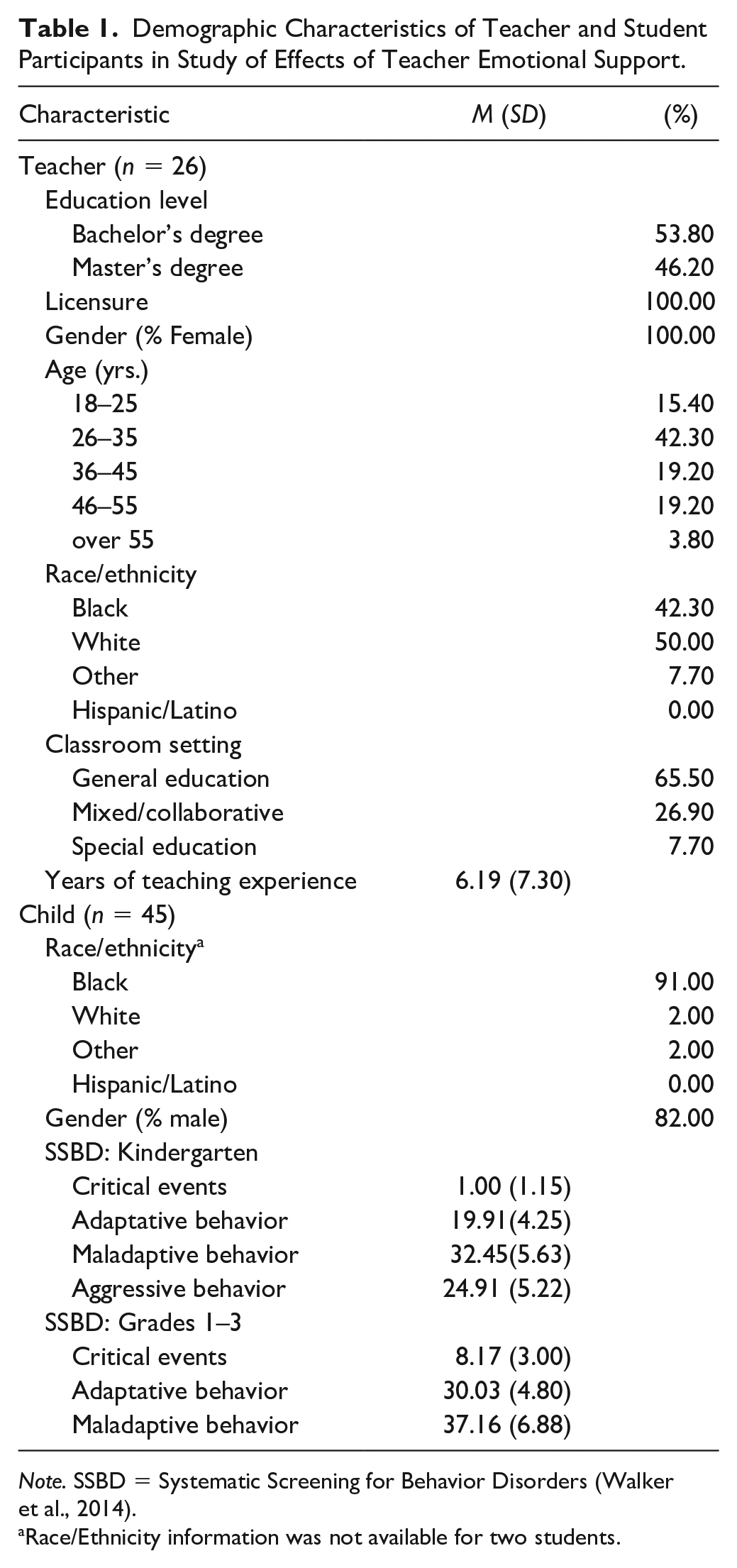
Note. SSBD = Systematic Screening for Behavior Disorders (Walker et al., 2014).
Race/Ethnicity information was not available for two students.
Measures
Focal Student Problem Behavior
Focal student problem behavior was measured with the Social Skills Improvement System (SSIS; Gresham & Elliott, 2008); a 76-item teacher-report measure, allowing for the evaluation of social skills and problem behaviors of young students. Each item on the SSIS is rated on a four-point frequency scale, with responses ranging from 0 (never) to 3 (almost always). Items are grouped into two subscales: Social Skills (e.g., completes tasks without bothering others) and Problem Behaviors (e.g., talks back to adults), with higher scores indicating more social skills or more problem behavior. These subscales are standardized by student gender and nationally normed on a representative sample (Gresham et al., 2010). For the current sample, internal consistency for the Problem Behavior subscale was acceptable with Cronbach’s alpha equal to .89.
Classroom Adversity
Classroom adversity was measured with the Problems Preparing Children for Academic Success scale, used as part of the National Institute of Child Health and Human Development (NICHD) Study of Early Child Care and Youth Development (SECCYD) and originally adapted from the Schools and Staffing Survey (National Center for Education Statistics, 1993). Using a five-point scale ranging from 1 (not a problem) to 5 (serious problem), teachers responded to the prompt, “How much of a problem are the factors below in preparing your students to succeed academically?” The 17 factors were home/family life, parent cooperation/support, child health, inadequate nutrition, low intelligence, cultural differences, English proficiency, nonstandard English, special learning problems, behavioral problems (disruptive), inadequate supplies, student/teacher ratio, student mobility, students not ready socially, students not ready academically, students have attention problems, and student tardiness/absenteeism. Ratings were averaged across the 17 items (α = .86), with higher scores indicating higher teacher-perceived classroom adversity.
Classroom Quality
The Classroom Assessment Scoring System (CLASS; Pianta et al., 2008) is an observational instrument designed to evaluate classroom quality. The CLASS addresses 10 separate dimensions of classroom experiences over three domains, including emotional support, classroom organization, and instructional support. The first, emotional support, encompasses the level of warmth, respect, positive affect, teacher sensitivity, student-centered focus in instruction, and responsiveness in a classroom. The second domain is classroom organization and includes an assessment of behavior management strategies, productivity, and instructional learning formats. The last domain, instructional support, is characterized by teacher’s promotion of higher-order thinking skills (i.e., concept development) as well as the quality of feedback and language modeling provided to students.
Trained observers scored each of the dimensions supporting the broader domain using a 1 to 7 scale with three categories: low (1, 2), mid (3, 4, 5), and high (6, 7). A minimum of four observation cycles were completed in each classroom during the pretest time point, and dimension scores were averaged across cycles to create broad domain scores. Observations were conducted in 20-min cycles within 2-hr windows (Pianta et al., 2008). A higher score indicates higher quality for each dimension. For the current sample, internal consistency was acceptable with Cronbach’s alpha equal to .81 for emotional support, .93 for classroom organization and .88 for instructional support. Prior work suggests the CLASS provides an authentic, contextualized assessment of teacher and student interactions in classroom settings as evidenced by interrater reliability, normal distributions and adequate range, construct validity, and validity (Cortina et al., 2015; Hamre et al., 2013).
Four certified observers conducted observations using the CLASS. Observers were research staff hired to conduct classroom observations. Observers had at least a bachelor’s degree and experience in classroom settings but were not required to have previous experience with observational coding. Observers collected data in each classroom to achieve coder balance across classrooms/teachers. Observers participated in a two-day training led by a certified CLASS trainer and passed the reliability test to achieve initial certification. Interobserver agreement data were collected on 23% of all CLASS observations (balanced across classrooms and observation cycles) and these data were used to calculate intraclass correlations (ICCs), which assess the extent to which multiple raters assess subjects (in this case observations) similarly (Koo & Li, 2016). ICCs are appropriate metrics for interobserver agreement in situations where multiple observers are assigning scores to subjects using continuous scales (Koo & Li, 2016), as was the case here. ICC values range between 0 and 1, with values less than .5 indicating poor reliability, values between .5 and .75 indicating moderate reliability, .5 serving as a generally accepted cutoff for acceptable reliability, and values above .75 indicating good to excellent reliability (Koo & Li, 2016). Mean intraclass correlations (ICCs) among observers in the present study were .81, .87, and .58 for emotional support, classroom organization, and instructional support, respectively, indicating adequate reliability among observers on all CLASS dimensions. During data collection, certified observers brought coding questions to the coding team and supervisor to promote high levels of interobserver agreement and prevent coder drift. At these meetings questions were resolved and clarifications were sent to the full coding team.
Data Analysis
To answer our research questions, we fit a series of multiple regression models, accounting for nesting using cluster-robust standard errors, that included several teacher covariates: teacher education level (coded as 0 = Bachelor’s; 1 = Master’s), years of teaching experience, and teacher race/ethnicity (coded as 0 = Black; 1 = White; 2= Other). We built models sequentially using Mplus 8.7 (Muthén & Muthén, 2017), beginning with a main effects model, and then three interaction models that included classroom adversity by the three subscales of classroom quality. Given the limited number of teachers/classrooms in the study, we chose to model the interactions in separate model sets for each aspect of classroom quality (emotional support, classroom organization, and instructional support). We grand mean centered the independent variables to ease interpretability (Peugh & Enders, 2005) and generated interaction terms by multiplying each of the three subscales of classroom adversity by classroom quality. Descriptive information for all study variables is presented in Table 2.
Descriptives for Study Variables
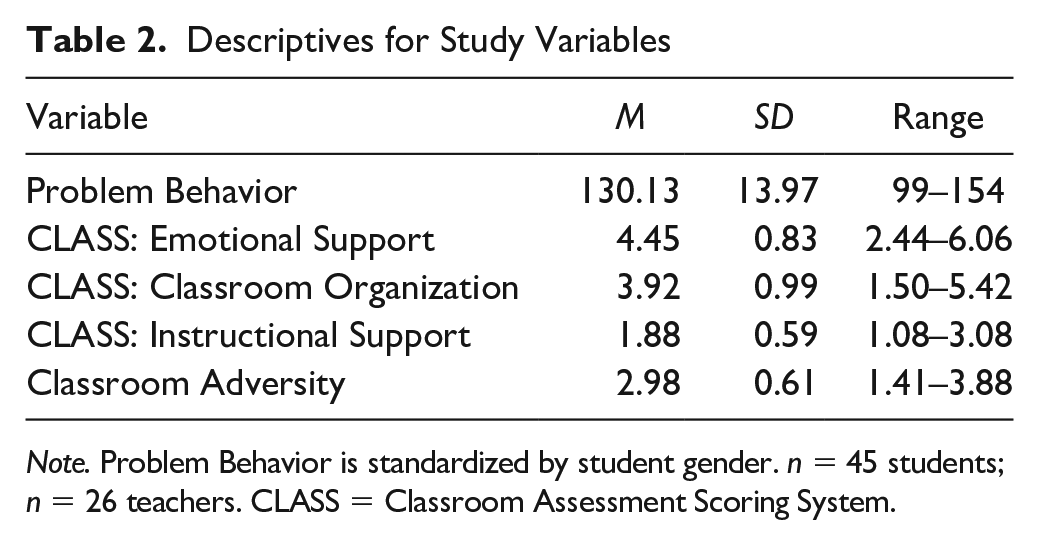
Note. Problem Behavior is standardized by student gender. n = 45 students; n = 26 teachers. CLASS = Classroom Assessment Scoring System.
Results
Preliminary Analyses
First, we examined the descriptive statistics, including variable distributions, pertaining to all study variables. Tabachnick and Fidell (2007) suggest that when levels of skewness and kurtosis are two times the standard error of the variable they should be transformed. All variables were within this range and therefore did not require any transformations. Additionally, complete data was available for all variables (no missing data).
Classroom Adversity, Classroom Quality, and Student Problem Behavior
Main Effects Model
In the main effects model, classroom emotional support and classroom organization were not significantly related to focal student problem behavior (Bs = −5.53; −6.13, ps = .35; .11, respectively). Classroom instructional support and classroom adversity were also not statistically significantly related to focal student problem behavior (Bs = 9.01; 6.98; ps = .06; .07, respectively; see Table 3).
Student Problem Behavior Predicted by Classroom Adversity and Classroom Quality
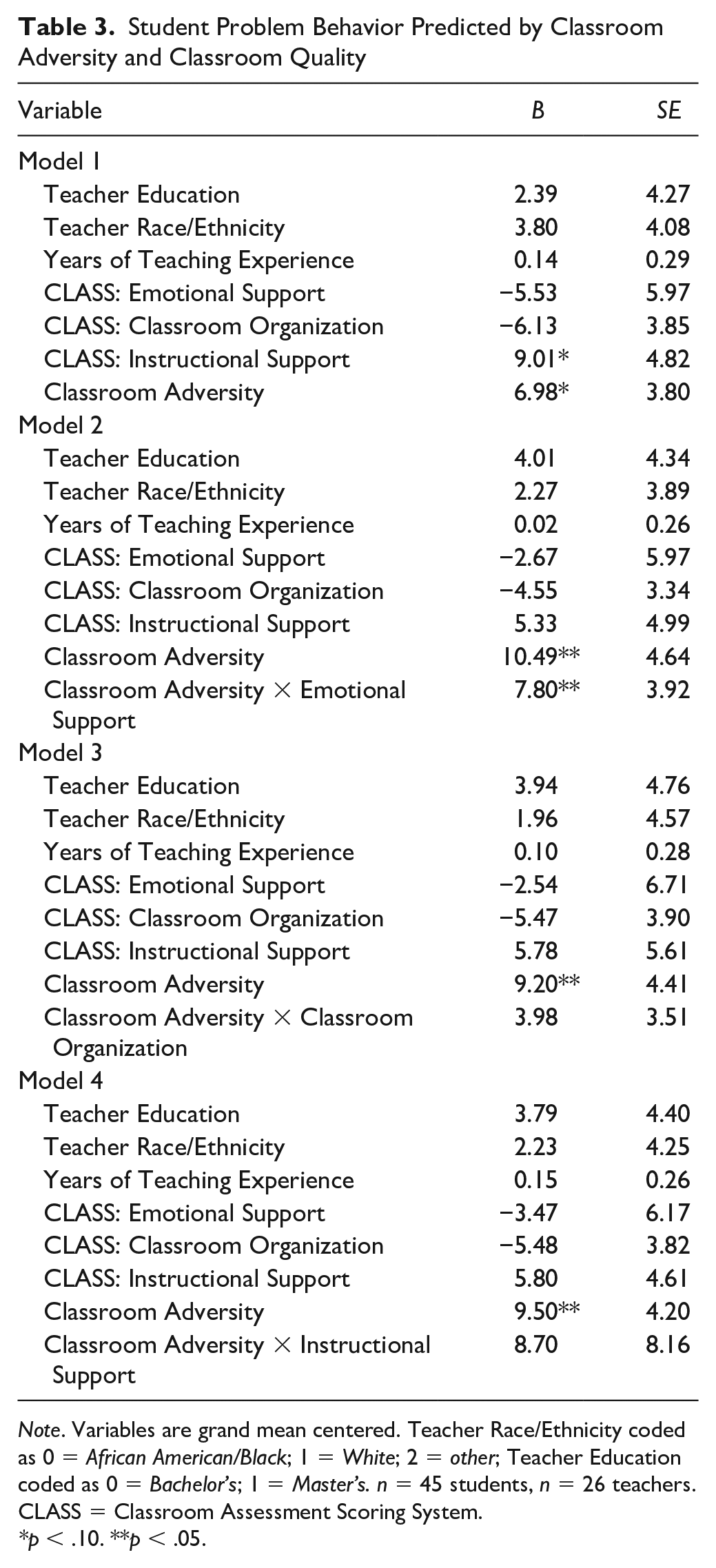
Note. Variables are grand mean centered. Teacher Race/Ethnicity coded as 0 = African American/Black; 1 = White; 2 = other; Teacher Education coded as 0 = Bachelor’s; 1 = Master’s. n = 45 students, n = 26 teachers. CLASS = Classroom Assessment Scoring System.
*p < .10. **p < .05.
Interaction Models
In Model 2, we added the interaction term between classroom adversity and emotional support as an additional predictor of focal students’ problem behavior. The main effects were subsumed by a significant interaction between classroom adversity and emotional support (B = 7.80, p < .05). To interpret this interaction, we examined the regression slopes depicting associations between emotional support and classroom adversity at the sample mean and 1 SD above and below for classroom emotional support (Jaccard et al., 1990). There was a significant positive relation between classroom adversity and focal student problem behavior at each level of classroom emotional support: low (t = 4.20, p < .001), average (t = 18.54, p < .001), and high (t = 28.75, p < .001). However, an examination of the simple slopes revealed a disordinal interaction; a cross over effect was present at high levels of classroom adversity, indicating the magnitude of the effect of classroom adversity on student problem behavior was less influenced by classroom emotional support in classrooms with high levels of adversity (see Figure 1; Lee et al., 2015).
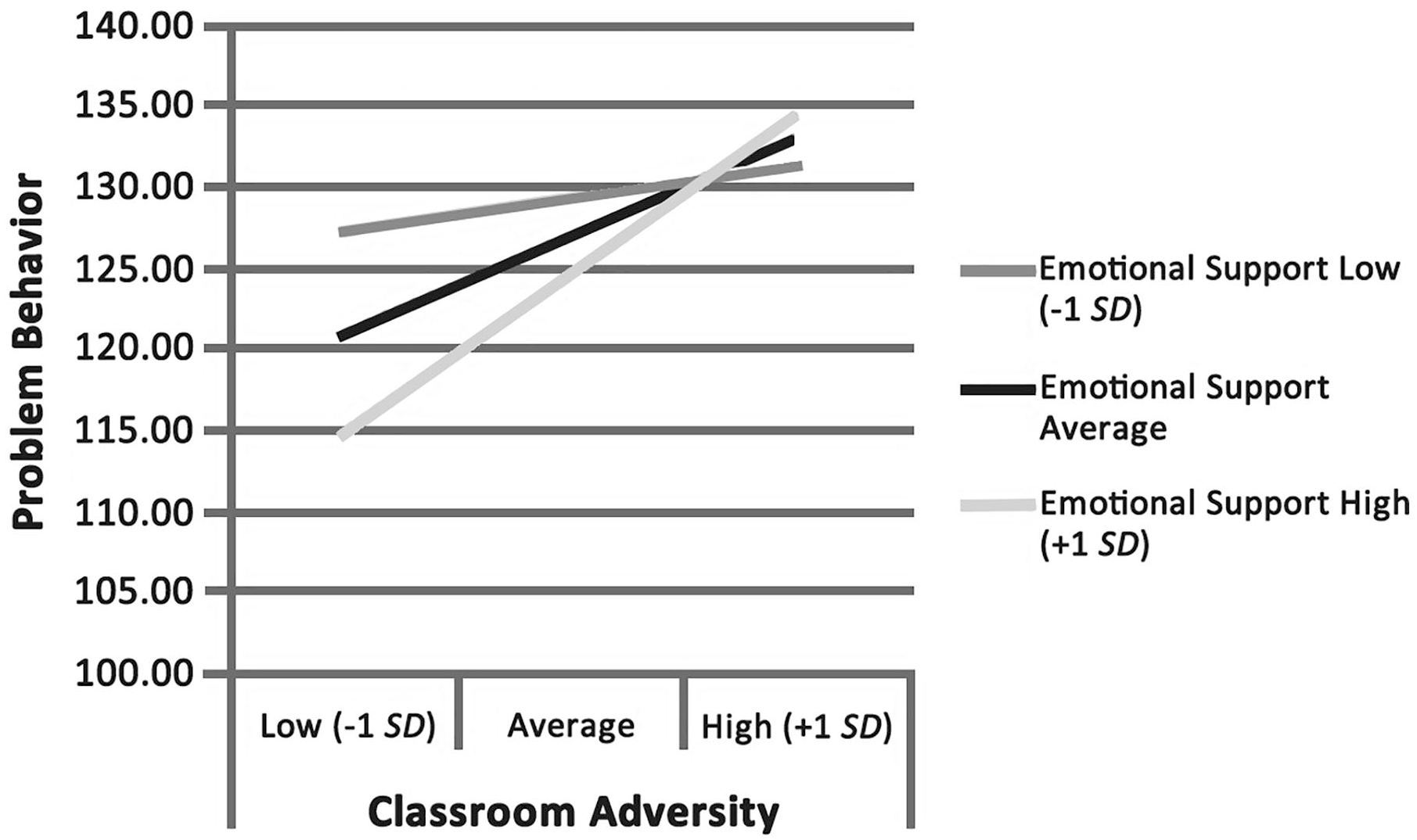
Student Problem Behavior Predicted by Classroom Adversity and Emotional Support.
In Model 3, we added the interaction effect between classroom adversity and classroom organization. The interaction effect was not a significant predictor of focal student problem behavior. Similarly, in Model 4, we added the interaction effect between classroom adversity and instructional support; however, the interaction effect was not a significant predictor of focal student problem behavior. Interestingly, in both Model 3 and Model 4, classroom adversity was a significant predictor of focal student problem behavior (Bs = 9.20; 8.70; ps < .05, respectively; see Table 3) at average levels of the interacting variable.
Discussion
In this study, we investigated the associations between classroom adversity and student problem behavior in a sample of focal students identified as with or at risk for EBD as well as the potential moderation effects of three observed indicators of classroom quality. We anticipated that high levels of classroom quality would diminish the association between classroom adversity and teacher reports of focal student problem behavior. Findings partially aligned with what we expected: In all three of the models with interaction effects, classroom adversity was indeed positively associated with focal student problem behaviors at average levels of the interacting variable. This conditional relation may be because adversity increases teachers’ stress, which is then related to how they perceive and assign judgments about their focal students’ problem behaviors. Appraisal theory supports this hypothesis and suggests that individuals rely on cues in their environment to make judgments about what is happening in their immediate environment (Parkinson & Manstead, 2015), with implications for their resulting emotions and actions. These cues can include the affect and behavior of others as well as the physical features of the environment itself.
Similarly, it may be that teachers in classrooms with lower levels of classroom adversity may have more emotional/cognitive capacity to appropriately appraise and respond to focal student problem behavior (Granger et al., 2022). Higher emotional/cognitive capacity may also allow teachers the freedom to better individualize instruction, implement planned activities, and engage in behaviors that are known to facilitate student engagement and positive behavior. This is consistent with prior work that shows teachers’ own characteristics and experiences can influence how they perceive their students. For example, when teachers experience more positive school climates, they report fewer problem behaviors in their classrooms (O’Brennan et al., 2014), and when teachers experience more positive emotions, they rate students’ attention as higher and problem behaviors as less severe (Aldrup et al., 2018; de Ruiter et al., 2019, 2020; Frenzel et al., 2018, 2020; Kunter et al., 2011).
Models of teachers’ job demands and resources also support this finding (Bakker & Demerouti, 2007; Demerouti et al., 2001). Teachers in classrooms with lower levels of adversity may have more resources available to them, and may have a higher capacity to implement these resources to theirs’ and their students’ benefits. Conversely, higher levels of classroom adversity may also be a symptom of an under-resourced school/community; teachers in these classrooms may have less access to resources and support that may help ensure high classroom quality. Also, even in the presence of resources, higher levels of adversity may limit teachers’ ability to use, engage in, or benefit from job resources due to the added cognitive, emotional, and time use demands of an adverse classroom environment on the teacher, although this remains to be tested.
In contrast to our expectations, we did not detect any significant relations among the three indicators of classroom quality and focal student problem behaviors. It may be that the measurement period played a role in this finding; measures were collected during the pretest time point in October/November and thus teacher effects may not have been present yet. It is possible the school contexts also influenced this finding. In the present study, schools indicated that no formal schoolwide classroom management or behavior interventions and supports were in place. Universal supports (e.g., strategies that prevent challenging behavior among all students such as precorrection, classroom rules, and opportunities to respond) were implemented with some variability across classrooms, and teachers engaged in classroom management practices but at low levels of fidelity (see Sutherland et al., 2020). Given our findings, it may be that because universal supports were minimally present, the main effects of classroom quality alone were not predictive of focal student problem behaviors. It may be that a lack of variation in a teacher’s foundational classroom supports deflated any potential relations between CLASS indicators and focal student problem behavior. It is also possible that the three dimensions of classroom quality assessed in the present study may not associate in the same ways, or according to the same timeline, for students with or at risk of EBD in comparison to their peers. Prior work relating classroom quality and similar teacher-driven classroom elements to students’ behavioral outcomes describes these processes among all students in a classroom, rather than singular focus on students with or at risk of EBD, as was the sample of interest in the present study (Chang, 2004; Oliver et al., 2011). It may be that students with or at risk of EBD are less influenced by the quality of the classroom environment on its own and may need to experience a high-quality classroom along with other supports (i.e., parent/guardian support, paraprofessional support, etc.) before impact is detected in behavioral outcomes. It may also be that the benefit of a high-quality classroom is heightened when students with or at risk of EBD experience multiple years of high-quality classrooms simultaneously, rather than within a single academic year.
When exploring the interactions among classroom adversity and classroom quality indicators, a moderating effect was detected whereby classroom adversity had differential associations with teacher reports of focal student problem behavior depending on the level of classroom emotional support. Specifically, there was a positive association between classroom adversity and focal student problem behaviors at each level of classroom emotional support. However, an examination of Figure 1 reveals that the level of emotional support in a classroom may do less to buffer focal student problem behavior within classrooms with high levels of adversity. These direct and moderated associations held after controlling for classroom quality, teacher education, years of teaching experience, and teacher race/ethnicity. These findings highlight important variability in the relation between classroom level adversity and teachers’ perceptions of focal student problem behavior as a function of teachers’ level of emotional support. This may be due to several factors. First, in more emotionally supportive classrooms, students likely enjoy closer relationships with their teacher and peers because the collective group of students and the teacher share respectful, caring interactions and teachers have a genuine interest in scaffolding student learning and social interactions (Hamre & Pianta, 2005). Figure 1 suggests that this emotional climate may partially mitigate the effects of collective classroom risk on individual focal student outcomes at low to average levels of classroom adversity. However, at high levels of classroom adversity, the distinction between low, average, and high emotionally supportive classrooms was less defined. This may be because high levels of classroom adversity increase the stressors that teachers experience which may challenge their ability to nurture a supportive classroom; perhaps due to difficulty bonding with students, fewer opportunities to lead lessons as expected, and/or a struggle to engage students in the learning process (Hamre & Pianta, 2005; Ladd & Burgess, 2001; Pianta et al., 2008). These associations may be particularly likely if teachers feel ineffective in connecting with and supporting their students or as a result use more reactive than proactive strategies in their classroom management approaches. These complex, moderated effects could also serve to support that multiple classroom elements in tandem are necessary to influence the development of students with or at risk of EBD.
A body of literature is emerging that focuses on the complex connections among student outcomes, teachers’ behaviors, emotional experiences, and personal characteristics (e.g., personality, teaching beliefs), and how these factors might be further associated with classroom contextual factors (e.g., number of students; Malmberg et al., 2010; Sabol et al., 2020). Previous studies have demonstrated the role of classroom adversity in predicting classroom quality, externalizing behavior, teacher well-being, and negative interactions between teachers and students at risk of EBD (Abry et al., 2017, 2018; Granger et al., 2021; McLean, Abry, et al., 2020). This study extends the literature by linking the influence of classroom adversity to the problem behavior of focal students with or at risk of emotional and behavioral disorders. We also add to a literature that highlights the importance of teachers’ emotional support on the behavioral outcomes of students with or at risk of EBD. Findings from the present study improve our understanding about how classroom adversity may cumulatively produce a load on teachers that influences well-known teaching processes and highlight the need for context-specific teacher support and services. It is important to continue to assess the extent to which classroom quality interacts with other key classroom contextual and teacher factors to influence outcomes of students with or at risk of EBD. This work can inform approaches to intervention that aim to improve teacher-driven classroom processes by leveraging the key elements of classroom context.
Limitations
In this study, we use cross-sectional data and are bound to the limitations, both related to methodology and substantive interpretations of our results, that our dataset imposes. Future studies stemming from this pilot data should prospectively design longitudinal studies to allow for analyses to move in the direction of causal inference. For example, scholars could measure teachers’ emotional support, as well as other measures of classroom quality, over the course of the school year to determine if classroom quality mediates the relation between classroom adversity and student problem behavior. This could inform direct intervention and professional development efforts relative to teacher skills and behavior and how to most effectively support students across multiple developmental domains (Cunningham et al., 2022), particularly those who may come to school facing additional challenges outside of the classroom environment. It is also important to note that the models included in the present study are based on a small number of teachers and students from a homogeneous sample from one community; as such, interpreting and generalizing these findings should be done cautiously. Future work should consider replicating this work amongst a larger sample of teachers and students from a heterogeneous sample. Additionally, although adequate interrater reliability was achieved across all CLASS domains, the mean ICC among observers for instructional support was comparatively lower than was observed in the other two domains, and so findings should be interpreted in consideration of this reliability score.
Study findings were also based on teachers’ reports of student problem behavior. Future work should look to replicate findings using observations of student behavior. However, it is relevant to note that prior work demonstrates teachers’ judgments of student behavior are generally accurate, showing strong correlations with observations of student behavior by an outside party, are fairly consistent, and have moderate correlations with parent ratings of the same behaviors (e.g., Liu et al., 2001; Urhahne & Wijnia, 2021). Furthermore, teachers’ perceptions of their students have great potential to influence students’ classroom experiences and outcomes (Fan, 2011; Hamre & Pianta, 2005; McLean, Sparapani, et al., 2020; Murray et al., 2008; Südkamp et al., 2012) with this association likely operating at least in part through teacher-driven classroom elements such as instructional practice and responsiveness to students. Therefore, despite the general limitations inherent in teacher self-report, we offer that teachers’ perceptions are particularly valid in the present study given the potential for these perceptions to serve as motivations for teachers’ enacting teaching practices and building relationships.
This study also includes teacher-identified focal students with or at risk of EBD as the sample. We acknowledge that our study is limited by the parent study that aimed to support teachers in their delivery of evidence-based instructional practices and thus are capturing a small picture of the whole classroom environment. Furthermore, data were not collected on students’ clinical diagnosis or special education classification (e.g., ED) or disability. Future work should look to examine how teachers’ perceptions of student challenging behavior may be influenced by these classifications. Future work should also use multiple sources of data to identify students (e.g., attendance, office discipline referrals, grades, systematic screening data). Additionally, future research could sample other students in the classroom (e.g., those not identified as at risk for EBD) as well as collect data on other variables that the research base identifies as key social, emotional, and learning outcomes that classroom and teacher quality interventions are likely to promote. Examples of these include but are not limited to academic outcomes, adult-child interactions, and social and peer relationship data (Heller et al., 2012; Rudasill et al., 2010). Another sample-specific consideration is the lack of congruence between teacher and student race. Our teacher sample was 42% Black, while our student sample was predominantly Black (over 90%). This mismatch is an important one, especially given what is known about the influence of teacher-student race match/mismatch and teacher-student relationships, perceptions of student achievement and problem behavior, and student outcomes (Ainsworth-Darnell & Downey, 1998; Morgan & Hu, 2023; Woodson & Harris, 2007). For example, teacher-child race mismatch between preschool teachers of young children with problem behaviors is related to less classroom management self-efficacy and greater perceived conflict with children with emotional and behavioral challenges (Kunemund et al., 2020). Future work should examine the influence of teacher-student race match/mismatch on teacher reports of student problem behaviors amongst students with or at risk of EBD and how classroom adversity and classroom quality may play a role in these perceptions.
We also acknowledge that the measure of classroom adversity, although previously used and collected as a part of the National Institute of Child Health and Human Development (NICHD) Study of Early Child Care and Youth Development (SECCYD), is limited. Future studies should conduct item-level analysis to determine the appropriateness of an average, unweighted scale of adversity in measuring multiple constructs that likely differentially influence the classroom as a whole and, importantly, individual student classroom experiences. Understanding the construct of classroom adversity in a more nuanced way can help begin to disentangle the contributions of within-person, student-level attributes and the variables associated with the multiple contexts each student interacts with, including the home and community environments. Future work should also assess and evaluate the current range of items and consider expanding the item pool with consideration about context sensitivity and practitioner feedback to ensure the construct is contextually relevant. Doing this work will provide intervention and professional development researchers with more precise targets of focus, which can improve efficiency of programming and likely lead to stronger, more impactful teacher and student outcomes.
Implications
Although our study is descriptive and exploratory, we have identified several implications for policy, practice, and equity. In terms of education policy, our findings suggest that there may be unintended, negative consequences for teachers and their students with or at risk of EBD if classrooms are highly adverse. In these classrooms, teachers may benefit from pre-service and ongoing career training designed to help teachers use positive behavioral supports with students with or at risk of EBD as these classrooms may provide added challenges that make it difficult for teachers to assess and respond to the behavioral needs of this sub-sample of students. Teachers may also benefit from ongoing support. To illustrate, in the context of coaching-based interventions, teachers frequently rate the teacher–coach partnership as a key lever in program implementation (Snyder et al., 2021). Future work should consider the value of close and warm teacher–coach partnerships when working to support teachers and their students with or at risk for EBD, particularly in classrooms that are characterized by high adversity. Furthermore, teachers may require connections to resources beyond program specific efforts. To illustrate, teachers may connect to mental health resources through conversations with their coach or seek support for implementing practices outside of the targeted program (Granger et al., 2023). Finally, school administrators can play an important, protective role in the organization of classrooms to help support the learning environment by ensuring particularly challenging, potentially external factors, are evenly distributed. These issues are important to attend to, given the current landscape of teaching in the United States, the attrition from the profession, and the challenges facing teacher induction and training programs nationally (Goldhaber et al., 2021; Harper et al., 2022).
Our results also inform practices and decision-making relevant to teacher training and continuing education. For pre- and in-service teachers, explicit training on the role of outside factors that contribute to teacher appraisals of students, for example, how challenging students are behaviorally, and how socially withdrawn students are, are important perceptions that can have strong and immediate impacts on teaching practices. Teachers should know how their own characteristics, their students’ characteristics, and the broader context impact how they appraise and respond to student behavior. An active attunement to these impacts and how perceptions influence instruction and their relationships with students is a skill that teachers are well-equipped to employ.
Relative to educational equity, the setting of the present study is in schools and classrooms where the vast majority of students are Black, but also with a range in teacher race or ethnicity. Although we do not explicitly study these phenomena in this study, we recognize that these relations play out differently with a White teaching majority teaching Black students versus schools and classrooms with a Black teacher majority teaching Black students. Thus, supporting culturally responsive approaches for teachers via asset-based professional development (e.g., culturally responsive teaching, Gay, 2018; culturally relevant teaching, Ladson-Billings, 2017; culturally sustaining pedagogies, Paris & Alim, 2017) can help support teachers to view students, families, and communities as strengths, leveraging assets to support the teaching and learning process.
Conclusion
This study extends previous work on the role of classroom adversity on student outcomes and examines the extent to which classroom quality influences this relation in a sample of students with or at risk for EBD. Classroom adversity is likely an important contextual factor to consider when examining classroom experiences and student problem behavior. Identifying factors that contribute to links between high-quality classroom experiences and student outcomes can improve the precision of intervention development and implementation and inform practice and policies that support teachers ability to deliver high-quality classroom instruction in context of collective classroom demands.
Footnotes
Declaration of Conflicting Interests
The author(s) declared no potential conflicts of interest with respect to the research, authorship, and/or publication of this article.
Funding
This research was supported by grants from the U.S. Department of Education’s Institute for Education Sciences (R305A150246).
