




Abstract
The Individuals with Disabilities Education Act allows states some autonomy in altering the disability category terminology and definitions, given that the changes do not exclude students eligible under the federal language. Several states have used this flexibility for the emotional disturbance category historically. This study provides a contemporary analysis of the interstate variation in the emotional disturbance category through a comprehensive evaluation of state department education policy documents for differences in terminology, definition, and disability-specific evaluation procedures and guidance. The work is contextualized by previous reviews of similar but different purposes relevant to the time periods in which they occurred. Data from the current study show continued convergence toward the language in the federal definition. Results present notable differences related to cultural considerations, the social maladjustment exclusionary clause, and the provision of mental health services. Implications for research and policy are discussed.
Accessing significant mental health services and special education benefits in schools is contingent on meeting legally defined criteria for an educational disability (versus a medical definition). The Individuals with Disabilities Education Act (IDEA) federally identifies 13 disability categories under which students ages 3 to 21 may qualify for special education services. One of these is emotional disturbance (ED), representing a relatively small percentage of the special education-eligible population. Students served by IDEA qualify under the ED category (U.S. Department of Education, 2023) at a rate of just 5% when the estimated number of children and youth demonstrating need is significantly higher (e.g., Lebrun-Harris et al., 2022). The federal definition of ED is based loosely on early studies of students in school settings (Bower, 1960), describing characteristics and conditions for meeting or excluding eligibility criteria. State policy leaders may adopt the federal terminology and definition or may establish their own so long as the changes do not exclude students covered under the federal definition (U.S. Government Accountability Office, 2019). This autonomy in definition and policy is limited only by the provision to not exclude students from services and the subsequent risk of a state losing access to federal funding for special education due to lack of compliance.
The current federal definition for ED has a three-part anchor for one or more of the five characteristics and an inclusion and exclusion clause (Section 300.8 (c) (4) of IDEA):
“(i) Emotional disturbance means a condition exhibiting one or more of the following characteristics over a long period of time and to a marked degree that adversely affects a child’s educational performance:
(A) An inability to learn that cannot be explained by intellectual, sensory, or health factors. (B) An inability to build or maintain satisfactory interpersonal relationships with peers and teachers. (C) Inappropriate types of behavior or feelings under normal circumstances. (D) A general pervasive mood of unhappiness or depression. (E) A tendency to develop physical symptoms or fears associated with personal or school problems.
(ii) Emotional disturbance includes schizophrenia. The term does not apply to children who are socially maladjusted, unless it is determined that they have an emotional disturbance under paragraph (c)(4)(i) of this section.”
Federal and state administrative definitions and disability-specific evaluation procedures directly impact students and service providers. Who receives services, under what conditions, and the naming of the disability category vary and have demonstrated evolution over time and across states (Cullinan et al., 1986; Epstein et al., 1977; Wery & Cullinan, 2013). The need for access to special education services for students with disabilities (Bradley et al., 2008; Kauffman et al., 2007) and the qualifications/characteristics needed to access those services in school settings are not readily uncoupled. Interstate variation may serve as a proxy for agreement or disagreement in the ongoing debate about who qualifies for ED.
Brief History of the Definition of Emotional Disturbance
Educating and/or serving students with ED in U.S. systems dates back hundreds of years before the federal legislation to do so (e.g., Benjamin Rush, a physician in the 1790s, conceptualized mental illness; Dorthea Dix petitioned Congress for funding to build institutions in the 1840s; Elizabeth Farrell taught ungraded classrooms in the early 19th century to prevent youth-delinquency; Wills-Jackson, 2019). The scientific investigation of outcomes grew in proportion to services and facilities (e.g., Farrell, 1914; Haring & Phillips, 1962; Wills-Jackson, 2019), and eventually, a definition of “emotional handicaps” developed from the scientific inquiry of the time (Bower, 1960, 1969). Eli Bower’s work was adopted and adapted by Congress in the creation of a federal category definition for PL 94-142.
However, the adopted definition was a contentious decision (Algozzine et al., 1978). Perhaps the most notable of the objections came from Eli Bower, when he explained that the changes to his definition by Congress “do serious damage to the integrity of the research and conceptual base from which the definition is drawn” (Bower, 1982, p. 55). Disagreements and criticisms about eligibility language, processes, and services have not abated over time (e.g., Algozzine et al., 1978; Executive Committee of the Council for Children with Behavioral Disorders, 1987; Forness & Kavale, 2000; Forness & Knitzer, 1992; Smith et al., 2015), and many have advocated for alternative definitions (Forness & Kavale, 2000; Forness & Knitzer, 1992). Scholars in the field point to vague language (Cullinan et al., 1986; Hanchon & Allen, 2018), arbitrary exclusions (e.g., social maladjustment; Cloth et al., 2014), and circular and contradictory language (Epstein et al., 1977). The social maladjustment exclusion clause is arguably one of the most criticized portions of the federal ED definition (Center, 1990; Cloth et al., 2014; Merrell & Walker, 2004; Skiba & Grizzle, 1991; Smith et al., 2015). The exclusionary clause indicates that students identified as “socially maladjusted” who do not also meet the previously described ED criteria are not eligible for special education services under this category. While a complete discussion of the complexity of the exclusionary clause is beyond the scope of what we can cover in this introduction (see Cloth et al., 2014; Smith et al., 2015), this is just one illustration of how vague language in the ED definition impacts the ability of school personnel to reliably and objectively differentiate between students that qualify for services and those that do not.
Prior Surveys of State Emotional Disturbance Policy
The first identified survey of state programs and procedures occurred in the early 1970s and included questionnaires and telegrams to achieve a 100% response rate from 51 state directors of special education (Schultz et al., 1971). This survey essentially served as a baseline for an emerging field. Descriptive results were reported by four geographic regions and provide historical context for the evolution of services and definitions that follow. During the early 1970s, some states regulated and limited entitlements to service to 2 or 3 years maximum. Early state reporting documents caseloads of 75 for crisis interventionists and informs a procedural evolution from a time when eligibility determinations were made in many states by a superintendent alone. Overall findings indicate a “lack of consensus regarding the target population” and “inconsistency in terminology and definition” (Schultz et al., 1971, p. 318).
The next review, and the first post-PL 94-142 examination of states’ ED definitions, was also a survey of state directors using mail and telephone (n = 51; Epstein et al., 1977). The responses and a literature review provided 11 unique definitional components, and these served as the variables of interest in a state definition analysis (Epstein et al., 1977). One state did not yet have a definition (LA), and another encouraged noncategorical services (MA), so 49 records made up the sample. Findings indicate vast differences across states. All state documents (n = 49) referred to disorders of emotion/behavior. Just 17/49 included the exclusionary clauses present in the federal definition, and 8/49 referred to prognosis.
While initial policy reviews state terminology and definitions associated with the ED category uncovered high levels of interstate variability (Epstein et al., 1977; Mack, 1980), findings from later reviews (Cullinan et al., 1986; Wery & Cullinan, 2013) revealed progressive convergence toward the federal terminology and definition features. As an illustration, Cullinan et al. (1986) reported that 38% of state definitions were identical or nearly identical (i.e., missing no more than one feature) to the federal definition, and later that percentage jumped to 96% with Wery and Cullinan (2013). In 1977, Epstein and colleagues revealed vast differences in ED definitions across states. Decades later, Wery and Cullinan (2013) replicated the definition analysis procedures of Epstein et al. (1977). The research team found high levels of similarity across state definitions in most of the 11 component categories, except for the certification (i.e., eligibility depends on a specific individual(s) or assessment procedure) and special education needed (i.e., a student requires specialized services) components. Results indicated a range of 7 to 11 components for 90% of the sample, and neither prognosis nor etiology was present in any state definition, a substantive change from Epstein et al. (1977). As predicted (Cullinan et al., 1986), the federal definition’s influence appeared to move state administrative definitions toward increasing similarity.
Purpose of the Current Study
Indicators selected in past reviews appear to imply a trend toward commonalities across states that, if present, should imply corresponding consistent ED identification rates. However, current state identification rate differences (Office of Special Education Programs [OSEP], 2020) provide a rationale to re-investigate state ED policy to evaluate differences, particularly in relation to contemporary issues such as over- or under-representation of students by identity status. A key consideration—perhaps the most important—in eligibility for special education services under the ED category is students’ cultural background (Garwood & Carrero, 2022). The acceptability of behavior is and has always been directly related to culture and context (Fong et al., 2016; Skinner, 1984). However, discussion about ED definition language associated with the consideration of cultural or ethnic norms is noticeably absent from prior reviews (Cullinan et al., 1986; Epstein et al., 1977; Mack, 1980; Wery & Cullinan, 2013). Furthermore, it is important to note that terminology and definitional differences are not the only considerations. In their review, Pennington et al. (2014) found that state-level evaluation procedures for autism varied to a greater degree than definitions. Summary data on state administrative language for disability-specific evaluation procedures for the ED category is limited (e.g., assessments, observations, required professionals, guidance on qualifying data). Epstein et al. (1977) identified and assessed the certification component of the definition as one aspect of assessment.
The purpose of the current study is to replicate the methods of previous reviews (Cullinan et al., 1986; Epstein et al., 1977; Wery & Cullinan, 2013) and expand the data collection to additional issues of contemporary concern. Results would then provide an updated overview of state terminology and definitions and include more information on the disability-specific evaluation procedures for the ED category. Procedures for the current study mirror Wery and Cullinan (2013) by evaluating state documents for terminology, using the 11 definition components outlined in Epstein et al. (1977), and including federal definition features and similarity using the scoring developed by Cullinan et al. (1986). Expanded analyses include (a) adding a definition component focused on the consideration of culture and (b) engaging in a broader and deeper analysis of disability-specific evaluation procedures, which may be housed in different or an additional state guidance content. Replicating procedures from prior reviews offers the opportunity to continue documenting changes across time and assess current patterns against those identified in the literature. Expanding the scope of the review to include new elements reflected in the contemporary discourse broadens the field’s understanding of current practice and may highlight areas of difference for future study. There are six research questions in this study:
Method
Data Collection
The research team conducted a comprehensive online search of all state education agency (SEA) websites, online text, attachments, and reference documents for state special education (a) terminology, (b) definition, and (c) disability-specific evaluation procedures and guidance that corresponded with the IDEA disability category of ED. The first author served as the primary screener to identify the most recent state materials online. This screening occurred as an initial electronic search in Spring 2021, and it was replicated approximately one year later in Summer 2022 to serve as a “reliability check” to ensure the documents represented the most recent state information. The research team gathered currently active (i.e., posted on the website as the most up-to-date information; not out-of-date or archived guidance materials) documents and downloaded copies of state administrative code or rules when referenced by the SEA. In the event active document links on the website presented contradictory language, screeners retained the document with the most recent revision date. When needed (e.g., website difficult to navigate or language unclear), the first author emailed the SEA representatives to request assistance locating documents or confirming the absence of an official state language on the topic. This resulted in the research team corresponding with five states (IL, IA, KY, MA, NY). The screening process produced multiple documents for most states.
Document Coding
All resource documents were scrutinized a minimum of twice before and during data collection/extraction. First, coders manually read the relevant document sections in their entirety as filed by state on a shared drive (available with permission from the first author). Second, reviewers searched using a “control F” shortcut for relevant key terms (e.g., emotional, behavior, eligibil*, evaluation, social maladjustment, cultur*). Data extraction and responses to coding questions were recorded on an electronic coding form.
State Terminology and Definition Components
The initial section of the coding form focused on state terminology and definition components. Coders first recorded the category term (e.g., emotional disability, ED). Then, they evaluated the definition for the presence of the 11 components initially featured in the review by Epstein and colleagues (1977) and replicated by Cullinan et al. (1986) and Wery and Cullinan (2013). The definition components, as described in Epstein et al. (1977), are “disorders of emotion/behavior, interpersonal problems, learning/achievement problems, deviation from the norm, chronicity, severity, etiology, prognosis, exclusions, special education needed, and certification” (pp. 419–420). The coding form incorporated the full description for each component from the three previous reviews (i.e., copy and paste) to allow for direct comparisons. See Cullinan et al. (1986), Epstein et al. (1977), and Wery and Cullinan (2013) for full descriptions. This study added a twelfth definition component—cultural/ethnic norms (i.e., the definition includes language related to the consideration of culture/ethnicity).
The research team identified that some state policy leaders differentiated between the definition and eligibility criteria within the documents, and others used the terms interchangeably or in a nondisaggregated manner (e.g., some documents use sections and headers to differentiate, and dome documents combine all information narratively). This study defines the term “definition” as including elements listed as definition or eligibility criteria but not inclusive of elements described as disability-specific evaluation procedures. Prior reviews indicate evaluation of the state ED definitions as the source for the 11 components of interest. This study is more expansive in the documents collected and analyzed. Coders evaluated both the state definition and disability-specific evaluation procedures for the 11 components. Results are disaggregated to allow corresponding analysis with prior reviews.
Federal Definition Features and Similarity
The second part of the electronic coding form centered on the degree to which the state definition mirrored the federal definition. Replicating procedures from Wery and Cullinan (2013), coders reviewed each state definition for the inclusion of the following 10 features of the federal ED definition: “longtime, marked degree, adversely affects educational performance, inability to learn [that cannot be explained by . . .], relationship problems, inappropriate behavior or feelings, unhappiness or depression, physical symptoms or fears, schizophrenia included, and socially maladjusted excluded unless ED” (Wery & Cullinan, 2013, p. 46). After the coding process, the research team analyzed the data to determine the similarity between the state and federal definition overall and then specifically on the five characteristics of ED (i.e., inability to learn, relationship problems, inappropriate behavior or feelings, unhappiness or depression, and physical symptoms or fears) using the three-point scale outlined in Cullinan et al. (1986). The three-point scale identified definitions as identical or nearly identical (four or five characteristics), somewhat similar (two or three characteristics), or fundamentally different (zero or one characteristic).
Disability-Specific Evaluation Procedures and Guidance
The last portion of data collected concentrated on disability-specific evaluation procedures and relevant guidance. To develop this portion of the form, the research team first reviewed the evaluation coding categories outlined in Pennington et al. (2014), and then they used this information along with their knowledge of this disability category to select common evaluation procedures specifically relevant to ED. Looking at ED-specific evaluation language, coders reviewed all records for the following items: (a) behavior rating scales, (b) observations, (c) interviews, and (d) participation of a licensed mental health or medical professional. Coders reported if these four procedures were required, suggested (i.e., used language such as you may consider using the following), or not addressed. Following this, the coders indicated if the documents provided additional clarification on (e) the social maladjustment exclusionary clause and (f) the “over a long period of time” phrase in the definition. Finally, the form asked raters to indicate if the disability evaluation procedures included (g) language on the consideration of cultural or ethnic norms. Coding items (e) through (g) were reported as addressed or not addressed, with the social maladjustment category also having the option of not applicable if the state chose not to use the exclusionary clause. The seven eligibility evaluation coding items only applied to the category-specific language section of the selected documents.
Interrater Reliability
The first author served as the primary coder for all state policy documents, and a second independent rater coded documents from 10 states (20%) selected by a random number generator. Coders were trained (taught data extraction codes and procedures) by the first author in a 25-min virtual training. All research team members served as independent reviewers. Overall, interrater agreement across coding categories was 89%, which falls within the acceptable reliability standard of 80%. Disagreements ranged across coding categories but occurred with the greatest frequency in the special education needed and certification component categories. An error analysis indicated difficulty with operational definitions and interpretation of documents. Coders resolved disagreements through discussion using a re-review of state documents. Clarifying operational definitions resulted in a re-coding of all documents for those category areas, and this resulted in 100% agreement.
Results
Results are presented narratively by research question using standardized frequency data. In addition, results are shown in tables to illustrate findings across codes.
State Category Terms
The “term” or language used to describe the categorical disability is the most commonly shared aspect of the definition across states. Most use language and terminology that mirrors federal language, with 48% of states adopting ED. Other common categorical terms include emotional disability (24%), emotional and/or behavioral disorder (8%), and emotional behavioral disability (8%). Summary data shows a total of nine different disability category terms. All but one state’s category term contained the word emotional, and 82% of states opted for a category term with the word emotional without the word behavior. Two states used a category term with the modifier serious.
State Definition Components
Coders assessed the ED definitions for the 11 components originally identified in early reviews (Epstein et al., 1977). Six components (i.e., disorders of emotion/behavior, interpersonal problems, learning/achievement problems, deviation from the norm, chronicity, and exclusions) existed across all the state definitions (100%). In contrast, etiology and prognosis were presented in none. The remaining three components, severity (98%), special education needed (32%), and certification (8%), varied across state definitions. This study included an additional code of interest, cultural/ethnic norms, and found this present in 26% of the state definitions. Coders also evaluated the disability-specific evaluation procedures for the components, and if the analysis considered the language from both the definition and evaluation procedures, the percentage of states showing the special education needed (42%), certification (38%), and culture/ethnic norms (42%) components would increase. See Table 1 for a comparison of ED definition components over time.
Comparison of ED Definition Components Over Time.
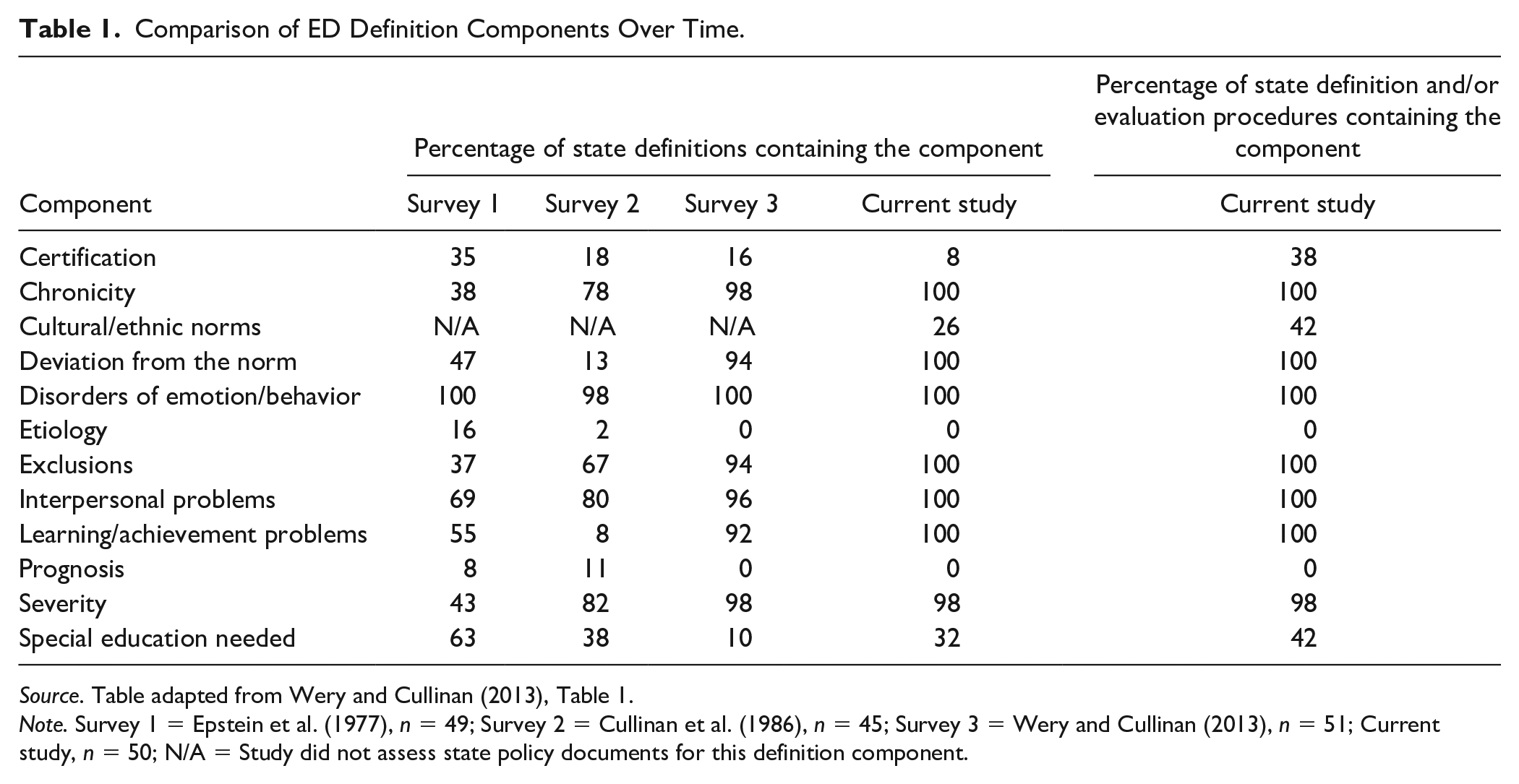
Source. Table adapted from Wery and Cullinan (2013), Table 1.
Note. Survey 1 = Epstein et al. (1977), n = 49; Survey 2 = Cullinan et al. (1986), n = 45; Survey 3 = Wery and Cullinan (2013), n = 51; Current study, n = 50; N/A = Study did not assess state policy documents for this definition component.
Federal Definition Features and Similarity
Overall, the majority (72%) of state definitions included all 10 features found in the federal definition. While most features were found in all definitions, three features were omitted in one or more state definitions (adversely affects education performance, present in 98%; inability to learn, present in 98%; schizophrenia included, present in 78%; socially maladjusted excluded unless ED, present in 86%). An analysis of the dataset focusing on the five characteristics of ED using the 3-point scale from Cullinan et al. (1986) reveals all state definitions were identical or nearly identical (i.e., four or five characteristics).
Disability-Specific Evaluation Procedures and Guidance
A total of 39 state documents included category-specific evaluation procedures for the ED category beyond the definition and general evaluation procedures that applied to all disability categories. State policy leaders chose to include the requirement for the use of behavior rating scales in 10 states (suggested, n = 11), interviews in 12 states (suggested, n = 8), and observations in 24 states (suggested, n = 8). Policies in several states required the participation of a licensed mental health or medical professional in the evaluation process (required, n = 19; suggested, n = 11). All state definitions included the “longtime” feature, designating that the condition or behaviors need to exist over an extended period of time. Clarification regarding the specific length of time or guidance on deciding whether a student meets the time criteria existed in 18 state policy documents, with the most common recommendation to provide evidence of behaviors lasting at least 6 months. Some state documents (e.g., LA, MN, SC, WI) also included language to allow for short duration or “sudden onset” of severe or intense behaviors or mental health conditions likely to continue. State policy leaders provided further guidance on the meaning of the term social maladjustment in 13 states (n = 7, not applicable), and they included language related to the consideration of cultural or ethnic norms in 21 states. See Table S1 in the online supplemental materials for disability-specific evaluation procedures by state.
Discussion
This comprehensive policy review aimed to develop an updated national typology of state-specific disability category terminology, definitions, and evaluation procedures for ED. The research team replicated the procedures of three related studies (Cullinan et al., 1986; Epstein et al., 1977; Wery & Cullinan, 2013) to allow for direct comparisons. Data from the present analysis align with the findings from the previous reviews, showing state policy leaders adopting similar category terminology over time and continued convergence toward the language in the federal ED definition. Results reveal fewer unique category terms (n = 9, present study; n = 17, Wery & Cullinan, 2013), increases in the use of the term emotional disability, a continued preference for the word emotional over behavior, and fewer state terms containing serious as a modifier. The appraisal of state definitions for federal definition features highlighted a greater proportion including all 10 features, and small increases across all feature categories compared to the data presented in Wery and Cullinan (2013). However, the present data represent a slight decrease in the number of state definitions incorporating the social maladjustment exclusion clause, considering a more recent review concentrated on only that feature (Cloth et al., 2014). Despite the well-established criticisms in the research literature, state policymakers overwhelmingly favor adopting the language directly from the federal definition.
Epstein and colleagues (1977) outlined 11 components representing the concepts they found in at least one state definition of ED at the time they reviewed state policy. An evaluation of current state definitions for these components shows similar inclusion rates across most components compared to Wery and Cullinan (2013), apart from special education needed and certification. Data represent a considerable increase in the number of state ED definitions specifying that the student must require specialized services above and beyond those provided in general education, returning to the rates shown in Cullinan et al. (1986). The figures in the certification component, in this case, a decrease, may be misleading if one only looked at the state definition. According to past reviews, this category represents language where eligibility depends on the decision of a certain group or individual (e.g., doctor, mental health provider, school psychologist) or specific assessment procedure (e.g., psychiatric evaluation). A re-examination of the components considering the disability-specific evaluation procedures reveals that 38% of state documents, the highest rate across all previous reviews, include a requirement related to this component. Given the subject matter of the component, state policy leaders may have believed the discussion of this component was more appropriately placed outside of the formal definition, underlining the importance of taking a comprehensive look at state policy beyond category definitions.
Overall, replicating procedures from previous reviews showcased the many similarities across state definitions for ED, with only a few categories showing variability. The current study expanded the work of Cullinan et al. (1986), Epstein et al. (1977), and Wery and Cullinan (2013) by coding for cultural/ethnic norms as an additional definition component and a more in-depth analysis of various disability-specific evaluation procedures. These additional analyses, in conjunction with the certification component, present noteworthy differences in state policy that are relevant for discussion related to cultural considerations, the social maladjustment exclusionary clause, and the participation of licensed mental health and medical professionals.
Cultural Considerations
This study expanded the examination of prior codes of interest to include cultural considerations as a topic of significant contemporary relevance. Although the federal definition of ED does not mention culture, these results indicate that 42% of states (n = 21) reference the consideration of culture in either their definition or disability-specific evaluation procedures. State leaders electing not to include references to culture specifically in describing the definition or assessment of ED may be relying on the overarching IDEA provision of nondiscriminatory assessment to communicate the expectation of cultural sensitivity in the special education evaluation process. This is unknown and worth continued examination.
The special education evaluation language related to nondiscriminatory assessment in IDEA generally focuses emphasis on the selection and administration of assessments (Section 300.304 (c) (1)). Language related to cultural awareness in the evaluation of initial referrals and the interpretation of results is largely lacking, and culture is not otherwise addressed. The SLD definition is the only federal category description with a directive to consider culture in the eligibility determination. Yet, the ED category reflects similar or higher rates of disproportionate representation of students from racial minority groups than the SLD category (e.g., Black students; OSEP, 2021). Policymakers in several states (42%) believed that the ED definition and/or disability-specific evaluation procedures required an emphasis above and beyond the general provision of nondiscriminatory assessment. The additional language is likely in response to the potentially subjective nature of social-emotional and behavioral assessment and the resulting impact if biases are left unchecked (Hanchon & Allen, 2018). The impact of culture and context (Fong et al., 2016; Skinner, 1984), fundamental aspects of normative behavior, raises questions about the adequacy of a definition or evaluation procedures for ED without explicit cues and guidance to consider and address cultural differences.
Dissimilarities in the emphasis placed on the consideration of culture in the special education evaluation process may have the potential to impact identification rates. Under-identification of students with disabilities is a problem in and of itself because students needing services do not receive them. Conversely, over-identification results in finite resources allocated to students who may not need them. Students receiving services for ED as a result of over-identification are then subject to the biases that come with the ED label. Special education is intended and designed to help students and to allocate resources toward that task; however, students identified with disabilities related to behavior face stigma and false stereotypes about competencies in academics and social-emotional/behavioral skills (Epstein et al., 2017; Ford et al., 2020). Black students, in particular, are more likely to be identified with ED than their White peers (OSEP, 2021), with an approximate 10% discrepancy between representation in the national population (13.79%) versus in the ED category (22.98%). Disproportionate representation is a contentious topic. Briefly, some studies of representation report that Black students are under-represented in special education (see Farkas et al., 2020; Morgan et al., 2017), while others in the research community pushback on the methodology and conclusions (see Fish, 2019; Ford & Russo, 2016; Whitford & Carrero, 2019). While a detailed discussion of over- versus under-representation is beyond the scope and intention of this paper (state definitions and evaluation procedures), we believe there is wide agreement that cultural prejudices, bias, and errors in the evaluation process, for any reason, have consequences.
Congress identified racial and ethnic disproportionality in special education as one of their top priorities in the 1997 and IDEA (2004) amendments (Council for Exceptional Children Division of Behavioral Disorders, 2012), instituting disproportionality as a priority area for monitoring and enforcement. However, two decades later, the data continue to demonstrate potential problems in the disproportionate representation of students of color in the ED category (U.S. Department of Education, 2023). Part of the solution to addressing disproportionality may be modifying the actual definition. Forness and Kavale (2000) explain, “consideration of appropriate cultural or ethic norms [should be] inherent in the definition itself” (p. 267). The current limited focus on nondiscriminatory practices in the IDEA fails to prompt practitioners to interpret initial referrals and the evaluation results through a culturally responsive lens. This feels particularly remiss in our current social justice reckoning. Definitions and evaluation procedures for the ED category require culturally affirming language above and beyond the general evaluation language in the IDEA.
Social Maladjustment Exclusion Clause
The social maladjustment exclusion was and remains another significant concern for the term’s ambiguity and the absence of a federal definition to offer guidance. The lack of clarity at the national level leaves the term open to state interpretation and subsequent establishment of policy and guidance. Results of this study indicate fewer than half of the states (40%) address the issue of the ambiguity of the exclusionary clause. The first group of states (n = 7) chose to exclude the social maladjustment exclusion clause from their definition, thus eliminating the confusing element. State leaders are free to choose policies that exceed the minimum requirements of the law (i.e., removing exclusions increases access). On the other hand, the second group of states (n = 13) chose to address the vagueness of the exclusionary clause by providing additional clarification on the meaning of the term. Guidance ranged from a few sentences (e.g., GA, KS) to several paragraphs (e.g., CO, CT, OK, MI).
Vague language within an administrative definition, without supplemental guidance, can lead to subjective decision-making and inconsistent assessment practices, potentially resulting in what Hanchon and Allen (2018) describe as an “I know it when I see it” approach to identification (p. 178). It goes without saying that eligibility decisions with this type of mindset are easily influenced by biases. As an illustration, Scardamalia et al. (2019) asked 179 school psychologists to use the federal ED definition criteria to make an eligibility determination with a case study and found extremely poor reliability. Policy leaders may need to consider how the ambiguity of the social maladjustment exclusion clause can contribute to patterns of differential access to special education based on where a student lives (intra- and interstate variability).
Licensed Mental Health Providers and Medical Professionals
Students with disabilities benefit from and are afforded by law (i.e., IDEA), a multidisciplinary team approach in the special education evaluation processes. Navigating a special education evaluation for a student experiencing complex mental health conditions may extend beyond the expertise of the testing and special education personnel. Teams can, but are not required to, invite licensed mental health care providers and medical professionals to contribute to the evaluation process according to federal policy. However, this review revealed just over 38% of states (n = 19) went beyond the option of participation to require special education evaluation teams to include a licensed mental health or medical professional for ED evaluations. Increasing the diversity of expertise within the multidisciplinary team has the potential to improve the validity of the evaluation, and the subsequent Individualized Education Program (IEP) developed based on the evaluation data.
Conceptually, it would be hard to argue that this is not a step in the right direction. However, one may want to consider the implications for the participation requirement in the current environment of rising student mental health needs and a critical shortage of school and community-based mental health services (Reinert et al., 2022). Costly services and a diminished mental health workforce impact a parent’s ability to obtain a clinical diagnosis by an outside licensed psychologist or psychiatrist if the state requires it (e.g., AK, AR). This state-level eligibility decision may require something that some schools, families, and students cannot access in their current environment. The question is, then, how does this impact accessibility to the rights, protections, and services a student is entitled to with IDEA? State policymakers may need to evaluate how to mitigate any unintended consequences of requirements in resource-limited educational environments while preserving the integrity of the evaluation process. These are the compelling research questions to be addressed in the future.
Limitations
Readers should consider the results of this policy analysis with an understanding of two primary limitations. First, the research team did not formally confirm by 1:1 interviews with state officials that state documents found on the SEA websites represented the most recent policy with state-level education representatives. It is possible that some states failed to post updated documents on their website in a timely manner. However, a research team member did contact SEA representatives in several states for clarification when needed (i.e., website difficult to navigate, language unclear, and unable to locate necessary documents). Second, an analysis of state-level policy does not account for district-level variability in applying the regulations. Some states may have more variability than others. For example, SEA representatives from Kentucky shared they are a “local control state,” meaning that school districts make many educational decisions related to IDEA at the local level. Districts are afforded the same flexibility as states in applying IDEA regulations if they meet minimum federal and state-level standards. It may be helpful in the future to replicate this analysis within one state to evaluate intra-state variability.
Implications for Future Research
An updated national typology of state-specific terminology, definitions, and disability-specific evaluation procedures of the ED category offers implications for future research. For example, additional research should explore state ED identification rates (including student demographic characteristics) in relation to definition and evaluation procedure variation. In a previous review, Wery and Cullinan (2013) found that the social maladjustment exclusion clause (i.e., present, absent) was the only federal definition element that affected state identification rates at a statistically significant level. Future research should expand the statistical analyses beyond federal definition features to include other areas of variation, such as definition components (e.g., certification, culture) and disability-specific evaluation procedures (e.g., guidance on social maladjustment, length of time) to analyze the relative impact of each element on current identification rates. In addition, researchers may consider reviewing district-level ED category policy documents within a state to evaluate intra-state variability.
Conclusion
Scholars in the field have long argued the inadequacies of the federal ED definition (Forness & Kavale, 2000; Forness & Knitzer, 1992; Freeman et al., 2019; Mitchell et al., 2019), and this manuscript is neither the first nor will it be the last to call for significant updates. Yet, despite the criticisms, this policy review reveals that the majority of state leaders chose to adopt the language from the federal definition. In essence, a growing trend toward what most in the field would consider an inherently flawed definition (Hanchon & Allen, 2018). National surveys show noticeable increases in the rates of clinical levels of social-emotional and behavioral needs for children over the last several years (Lebrun-Harris et al., 2022), yet the percentage of students served under the IDEA ED category shows a consistent gradual decrease since 2008 (OSEP, 2020). These statistics appear to illustrate the disconnect between the field’s evolved understanding of emotional and behavioral disorders and a dated federal definition. For example, Hanchon and Allen (2018) point out that the Diagnostic and Statistical Manual of Mental Disorders has gone through five revisions since the time the federal ED definition was written.
While state policy is growing in similarity in some areas, this study uncovered notable differences are emerging. Several state leaders have opted to push forward with the needed changes (e.g., adding culture as a consideration, providing guidance on the vague social maladjustment exclusion clause, allowing for instances of sudden onset). Although beneficial for those states, the longstanding inaction at the federal level to update the definition may further solidify the disparities between states—contradicting the primary purpose of IDEA—ensuring universal access to rights, protections, and services under the law.
Supplemental Material
sj-docx-1-bhd-10.1177_01987429231215352 – Supplemental material for Definitions of and Evaluation Procedures for Emotional Disturbance: A Tale of 50 States
Supplemental material, sj-docx-1-bhd-10.1177_01987429231215352 for Definitions of and Evaluation Procedures for Emotional Disturbance: A Tale of 50 States by Mary Rose Sallese, Justin D. Garwood, Kimberly J. Vannest, Tammy Kolbe and Alex Carlson in Behavioral Disorders
Footnotes
Declaration of Conflicting Interests
The author(s) declared no potential conflicts of interest with respect to the research, authorship, and/or publication of this article.
Funding
The author(s) received no financial support for the research, authorship, and/or publication of this article.
Supplemental Material
Supplemental material for this article is available on the Behavioral Disorders website with the online version of this article.

References
Supplementary Material
Please find the following supplemental material available below.
For Open Access articles published under a Creative Commons License, all supplemental material carries the same license as the article it is associated with.
For non-Open Access articles published, all supplemental material carries a non-exclusive license, and permission requests for re-use of supplemental material or any part of supplemental material shall be sent directly to the copyright owner as specified in the copyright notice associated with the article.
