




Abstract
Our research addresses the underexplored role of multinational enterprises (MNEs) in tackling the grand challenge of skilled refugee employment through multi-stakeholder collaborations. While refugee workforce integration is largely shaped by macro-institutional forces and a multitude of actors, the potential contribution of MNEs has received limited attention in extant research. Adopting an MNE-centric lens, this paper explores how MNEs could become more active participants in the broader refugee employment ecosystem by engaging in collaborative initiatives that foster sustainable integration pathways. Through theoretical and practical insights, the study identifies strategic bilateral partnerships that MNEs can leverage to enhance refugee integration outcomes while advancing corporate social responsibility agendas. Key examples illustrate how businesses can foster resilient and scalable employment pathways for skilled refugees.
Keywords
Introduction
When refugees reach their resettlement destinations, their successful integration is seen through a lens of multiple markers (Ager and Strang 2008). Among critical areas like housing, health, and education, workforce integration stands out as a cornerstone of successful resettlement (Lee et al. 2020). However, in many receiving countries, refugees struggle to achieve long-term, meaningful employment (Bache 2020; Oguzertem 2020). Existing research consistently shows that refugees are more likely to remain concentrated in low-paid, precarious, or informal forms of work within receiving-country labor markets (Lumley-Sapanski 2021; Dimitriadis 2023). They are also disproportionately represented in labor-intensive sectors (van Doorn, Ferrari, and Graham 2023). This employment pattern cannot be attributed to a single cause. Rather, it is embedded in a set of structural conditions within host-country labor markets, including exclusionary systems of qualification recognition (Krahn et al. 2000; Bloch 2009), language and cultural adaptation requirements (Eggenhofer-Rehart et al. 2018), and institutional arrangements that often prolong displacement and relocation processes (Del Carpio and Wagner 2015), frequently accompanied by psychological distress (Warfa et al. 2012). As a result, refugees’ employment opportunities are more likely to be confined to forms of employment characterized by weak regulatory protections, insecure employment relations, or a reliance on informal labor arrangements, thereby reinforcing fragmented and unstable career pathways. Therefore, refugee workforce integration is a complex and challenging endeavor (Newman et al. 2018), often described as one of the grand challenges of contemporary society (George et al. 2016).
Grand challenges refer to large, complex problems that affect society on a global scale, such as climate change, poverty, and inequality (George et al. 2016). These challenges require coordinated efforts from multiple sectors, including governments, businesses, and civil society, to develop sustainable solutions. To address the grand challenge of refugee workforce integration, researchers and practitioners alike called for businesses, as the direct providers of employment opportunities, to support refugees in their career journeys (Legrain 2016; UNHCR 2018). Amid the diverse landscape of employer types, recent literature highlights the underexplored yet promising role that could be assumed by multinational enterprises (MNEs) (Szkudlarek, Roy, and Lee 2022; Hajro, Žilinskaitė, and Bretones 2024). Accordingly, this paper examines the ramifications of shifts in global migration patterns for MNEs and explores how leveraging their international presence might be harnessed to address the challenges and opportunities of refugee workforce integration.
It is precisely within these structural conditions that the potential roles of different types of employers diverge. Among employers, local businesses, especially small and medium-sized enterprises (SMEs), play an irreplaceable role in local and regional labor markets. These employers frequently provide entry-level and transitional employment, informal mentoring, and access to local economic networks, which are especially important during refugees’ early stages of labor market entry (Boese 2015). Indeed, available evidence suggests that refugees are disproportionately employed in SMEs or are self-employed, often concentrated in low-skilled or precarious work, with limited opportunities for advancement (Boese 2013; Ortlieb and Weiss 2020). These patterns highlight both the importance of local employers and the structural constraints they face, including limited resources, narrower internal labor markets, and reduced capacity for large-scale or sustained integration initiatives.
MNEs, by contrast, are companies that operate in multiple countries, managing production or delivering services across national borders (Rugman and Verbeke 2004). Their relevance to refugee workforce integration stems not from normative assumptions about their social responsibility, but from systematic organizational differences in scale, scope, and institutional embeddedness (Szkudlarek, Roy, and Lee 2022; van der Straaten, Narula, and Giuliani 2023; Leonidou et al. 2024). While refugees’ career trajectories may, and often do, span employment in SMEs and self-employment, we argue in this paper that MNEs occupy a distinct structural position that warrants analytical attention, including their transnational operational networks, cross-country labor markets, and access to cross-border resources which enable forms of engagement that are less readily available to local employers (Szkudlarek, Lee, and Jansen-Nicorescu 2022).
Firstly, MNEs possess unique internal resources, such as policies, procedures, processes, and training programs, based on their (often long-standing) cross-cultural knowledge, accrued through hiring people of multiple backgrounds in different countries and regions (Lenartowicz, Johnson, and Konopaske 2014). Secondly, the know-how in dealing with multiple stakeholders, including governmental organizations, support organizations, and unions across different institutional contexts (Bjelogrlic 2020), is also a unique strength that could aid MNEs’ active engagement in refugee workforce integration. Thirdly, a wide range of networks, such as those within global supply chains (Marano et al. 2024), allows the socially-purposed initiatives of MNEs to be impactful across different levels of business operations. Lastly, having experienced a wide range of challenges in expanding into multiple geographic locations, MNEs have resilience and the ability to overcome a large degree of challenges, for example, by combining and leveraging resources and expertise in value creation (Rygh 2020; Sebhatu and Enquist 2022; Karakulak and Faul 2024). It is important to note that these characteristics do not render MNEs inherently more effective or more responsible actors than local employers or SMEs. Rather, their potential role in refugee workforce integration remains contingent upon specific institutional constraints, governance arrangements, and accountability mechanisms. Their engagement can not only enhance the effectiveness of refugee integration efforts but also redefine MNEs’ role in migration issues, from being simply a provider of jobs or a fulfiller of corporate social responsibility (CSR) agendas, to becoming an active coordinator and catalyst of stakeholder value co-creation.
However, this potential must be approached with caution, as MNEs have also faced criticism for exploiting vulnerable refugee populations. Documented instances include labor abuses such as inadequate wages, unsafe working conditions, and the systemic exploitation of refugee workers (Hajro et al. 2023; Ascencio, Singh, and Alhorr 2024). These concerns raise important considerations about the role of MNEs in safeguarding refugee rights and promoting their long-term welfare. Critics also caution that MNEs’ engagement may be driven more by reputational gains, financial incentives and CSR branding than by genuine commitment to long-term refugee inclusion (Ranabahu, de Vries, and Basharati 2025). Moreover, reliance on MNE-led initiatives risks sidelining local employers, potentially leading to uneven or unsustainable integration outcomes (van der Straaten, Narula, and Giuliani 2023). In light of both the criticisms directed at MNEs and their considerable resources and expertise that could support positive outcomes for refugee workforce integration, every exploration of the role of MNEs in advancing refugee employment should proceed with caution. We argue that while MNEs possess distinct capabilities that position them well to address refugee employment on a global scale, ethical considerations must remain central to both research and practice in this area.
As noted in the call for this special issue (Hajro, Žilinskaitė, and Bretones 2024) and further articulated by Wehrle et al. (2025), we respond to the pressing need for more research on how MNEs can foster refugee inclusion and employment and explore how their transnational reach, resources, policies and capabilities can complement and interact with other stakeholders involved in refugee workforce integration. Our paper draws on existing work on refugee workforce integration, coupled with a stakeholder perspective (Abzug and Webb 1999; Freeman, Phillips, and Sisodia 2020).
Stakeholder theory highlights the importance of engaging various groups of actors in value creation (Freeman 2010). According to this perspective, businesses, governments, and other entities can achieve mutual benefits by aligning their interests toward common goals. The theory emphasizes the reciprocal nature of value exchange, which is central to the successful coordination of efforts across sectors. We argue that, in line with stakeholder theory, by leveraging the diverse expertise, resources, and networks of stakeholders, MNEs can navigate the complexities of refugee integration more effectively and thus cross-fertilize value propositions for all stakeholders involved. On this basis, the paper conceptualizes MNEs as interdependent nodes with conditional influence in the effort to integrate refugees into the workforce, characterized by ongoing practical tensions and shaped by institutional and governance contexts.
Our conceptual paper makes the following contributions. First, we advance a multi-level account of shared value complementarities between MNEs and stakeholders in refugee workforce integration. We discuss tensions as alignment problems among complementary objectives across the macro, meso, and micro levels, making explicit how, despite coordination frictions, value creation is feasible. In doing so, our paper offers both a holistic perspective and a nuanced analysis of the complexities involved in engaging diverse stakeholders across multiple sectors. Secondly, we explain that there is an opportunity in bilateral collaborations between businesses, and more specifically, MNEs, and each of the key stakeholders, to strategically utilize expertise to close the knowledge gaps, leverage financial and human resources, and positively contribute to the actions of each stakeholder (cf. Pinkse and Kolk 2012, for a similar discussion on a multi-stakeholder approach to climate change). We use real-life examples of existing MNE activities to demonstrate a range of collaborative efforts that are already taking place. We shed new light on understanding the role of MNEs in creating and maintaining a sustained collaborative relationship between businesses and each stakeholder, focusing on reciprocal gains through the sharing of each other's unique resources and expertise. We propose that each stakeholder needs to perceive and realize such value to ensure sustained commitment to the cause. Lastly, given the findings of inter- and multi-disciplinary research in this space, combined with the understandings of how grand challenges can be addressed through multi-stakeholder engagement, we list a future research agenda that can further advance the efforts of refugee workforce integration, especially in the field of migration studies.
Stakeholder Theory as a Conceptual Lens for Refugee Workforce Integration
Stakeholder theory provides a valuable conceptual lens for addressing grand challenges (Olsen, Sofka, and Grimpe 2016; Brammer et al. 2019; Quayle, Grosvold, and Chapple 2019). By framing solutions as outcomes of multi-stakeholder engagement rather than isolated organizational action problems, stakeholder theory offers valuable insights for addressing such challenges (Hennchen and Schrempf-Stirling 2020; Stahl et al. 2020; Westerman et al. 2020). Emerging initially as a response to the limitations of shareholder-centric views of the firm, stakeholder theory shifted the analytical and normative focus from maximizing returns for investors to recognizing the legitimate interests of all parties affected by organizational activities (Freeman 2010). Early formulations emphasized the identification of stakeholders, mapping who has a stake and what that stake entails. As the theory evolved, it moved beyond a descriptive function toward a richer understanding of stakeholder interaction and relationship management. Contemporary scholarship views stakeholder engagement not as a one-off transaction, but as a continuous, bidirectional process of relational value creation, centered on long-term interaction, mutual trust, reciprocity, and the cultivation of aligned interests (Schaltegger, Hörisch, and Freeman 2019; Freudenreich, Lüdeke-Freund, and Schaltegger 2020).
While the need for multi-stakeholder coordination in addressing refugee workforce integration is acknowledged (Kornberger et al. 2018; Knappert et al. 2023), there remains a limited understanding of how such coordination can be established and sustained. Within this context, the exploration of the role that could be played by MNEs is virtually absent. To address this gap, we adopt stakeholder theory and draw upon insights from business scholarship to uncover the motivations of various stakeholders involved in refugee employment, to analyze how MNEs could interact with governments, support organizations, educational institutions, media, and research institutions, and to provide sustainable solutions for engaging multiple actors in the complex challenge of refugee workforce integration.
One of the core principles of stakeholder theory is relational value creation. Stakeholder theory emphasizes that stakeholder engagement should be understood as an ongoing relational process rather than a transaction (Maak 2007; Mitchell et al. 2016). In this process, value creation emerges through continuous interaction, trust, and shared understanding (Freudenreich, Lüdeke-Freund, and Schaltegger 2020). Understanding how stakeholders can collaborate to align resources and create robust, enduring, co-created value is crucial (McGahan 2021). Applying stakeholder theory, Olsen, Sofka, and Grimpe (2016) identified that, in addressing a grand challenge, stakeholders’ responsibilities involve sharing knowledge and resources to achieve common social goals. The calls for the sharing of resources and knowledge implicitly assume that businesses and their stakeholders possess such resources and knowledge that would be valuable for the collaboration, and for each of the stakeholders. Indeed, the diversity of stakeholders involved in refugee workforce integration suggests that each of them comes with different motivations and possesses potentially complementary capabilities (Boddewyn and Doh 2011; Rygh 2020; Lee and Szkudlarek 2021). When these capabilities and resources are combined, the stakeholders can contribute to the cause more effectively. Without each other, the impact each stakeholder can make in addressing the grand challenge is limited (Ozdemir et al. 2023). In the context of refugee workforce integration, this implies that, within the stakeholder theory framework, MNEs can be positioned as actors whose engagement with a broad range of stakeholders becomes analytically salient for the coordination of social and commercial objectives. When enacted in practice, these principles suggest that MNEs may be viewed not only as employers but also key actors in fostering social cohesion, enhancing workforce diversity, and strengthening organizational resilience, thereby potentially redefining their role in migration issues (Reade, McKenna, and Oetzel 2019).
This relational perspective reinforces the logic of communal sharing in value creation (Bridoux and Stoelhorst 2016). It suggests that stakeholders are mutually dependent on one another's resources, legitimacy, and knowledge to achieve common goals (Manetti and Toccafondi 2012). This interdependence is especially evident in refugee workforce integration initiatives. Previous research demonstrated that each stakeholder leverages distinct resources and expertise to facilitate this complex process (Lee and Szkudlarek 2021; Knappert et al. 2023). The compatibility of these resources often leads to symbiotic relationships, where mutual dependence fosters more effective outcomes (Knappert et al. 2023). This dynamic is particularly evident between employers and support organizations, where both parties rely on each other's strengths; support organizations provide refugee-specific know-how, and businesses contribute resources and networks to create sustainable employment solutions (Lee and Szkudlarek 2021). However, successful collaboration across stakeholders is not guaranteed (Natter and Welfens 2024). When there is misalignment, as Henriksen (2024) cautions, refugee priorities risk being sidelined. Therefore, sustaining effective collaborations over time depends on stakeholders’ shared perception of tangible benefits (Siltaoja and Lähdesmäki 2015), and thus, their awareness and reliance on the reciprocal value of stakeholder collaboration.
While applying stakeholder theory to refugee workforce integration is a promising avenue, it is not without limitations. First, the roles and responsibilities of different stakeholders are difficult to delineate, as the contested content and scope of their relationships with firms create ambiguity that complicates governance (Oubihi and Elouidani 2016). This ambiguity becomes particularly salient in complex partnerships where overlapping mandates and expectations can blur accountability. Second, as Jensen (2001) has argued, pursuing multiple objectives simultaneously can weaken strategic focus. In the case of MNEs, this may involve responding to humanitarian imperatives emphasized by support organizations, meeting labor market demands highlighted by governments, while also simultaneously navigating cross-border operations and maintaining global profitability. Unlike domestic firms, MNEs must navigate these pressures across multiple institutional and cultural contexts, where their transnational reach both amplifies their influence and exposes them to heightened scrutiny. When these competing priorities converge, corporate commitments risk being diluted, sometimes reduced to symbolic gestures rather than substantive integration efforts (Schons and Steinmeier 2016). Despite these challenges, stakeholder theory remains a valuable conceptual lens, emphasizing value creation and interdependence for more inclusive labor market environments.
Approach
Research on refugee employment and MNE activity reveals a significant gap between theory and practice. While MNEs have already undertaken modest efforts in this domain (Reade, McKenna, and Oetzel 2019; Szkudlarek, Roy, and Lee 2022), limited academic work exists that explores how these businesses collaborate with other stakeholders to integrate refugees into the workforce. To address this gap, we engaged with the existing literature as a sensitizing lens to surface recurring stakeholder roles and patterns of interaction. Rather than conducting an exhaustive review, our engagement with prior research was purposive and aimed at identifying foundational actors and relational dynamics that informed the development of our conceptual framework. For this process, we began with the key articles on the topic published in the field of international management, including Knappert et al. (2023), Lee et al. (2020), and Szkudlarek et al. (2021; 2022)
Due to the scarcity of scholarly work that directly examines and details MNEs’ engagement in refugee workforce integration, we opted for real-life, illustrative examples of corporate initiatives. This process led us to those affiliated with the Tent Partnership for Refugees. Tent is a global intermediary that mobilizes and supports employers in refugee recruitment, training, and workplace inclusion, and systematically curates corporate practices across different countries and industries (Szkudlarek et al. 2021; Prendergast and Moraes 2024). The illustrative examples were selected because they represent initiatives that are actively implementing refugee workforce integration, offering a relevant and diverse set of illustrations of how MNEs engage with this issue. At the same time, these cases have abundant details publicly available on the Tent's website and other publicly available forums, showcasing their intended impact. It is important to emphasize that these examples are not intended as systematic case studies or evaluative evidence. Instead, they are used as illustrations to show a range of ways in which MNEs engage with refugee workforce integration across different institutional contexts, sectors, and stakeholder configurations, thereby reflecting the diversity of MNE engagement in this area. Positioned in this way, they serve as real-world touchpoints that complement the conceptual arguments advanced in the paper. The vignettes of selected cases are presented in Appendix 1.
Collaboration, Challenges, and Complementarities Between MNEs and Stakeholders: A Multi-Level Perspective
The integration of refugees into the workforce presents a complex grand challenge that can be mapped across macro, meso, and micro levels (Lee et al. 2020; Omanović, Tarim, and Holck 2022). At each level, diverse stakeholders intersect, generating not only opportunities for collaboration but also challenges of coordination. In this paper, we do not frame these tensions as conflicting goals and values but rather as stemming from complementary objectives that require careful alignment to be realized effectively (Knappert et al. 2023). MNEs need to strategically manage these interactions to enable value co-creation, balancing economic imperatives with social responsibility and leveraging complementarities to support refugee integration (Reade, McKenna, and Oetzel 2019). Figure 1 presents our conceptual model of MNE–stakeholder interactions. Our findings are presented across three levels of analysis (macro, meso, and micro) to exemplify the complexity of the constellation of actors within the refugee employment ecosystem.
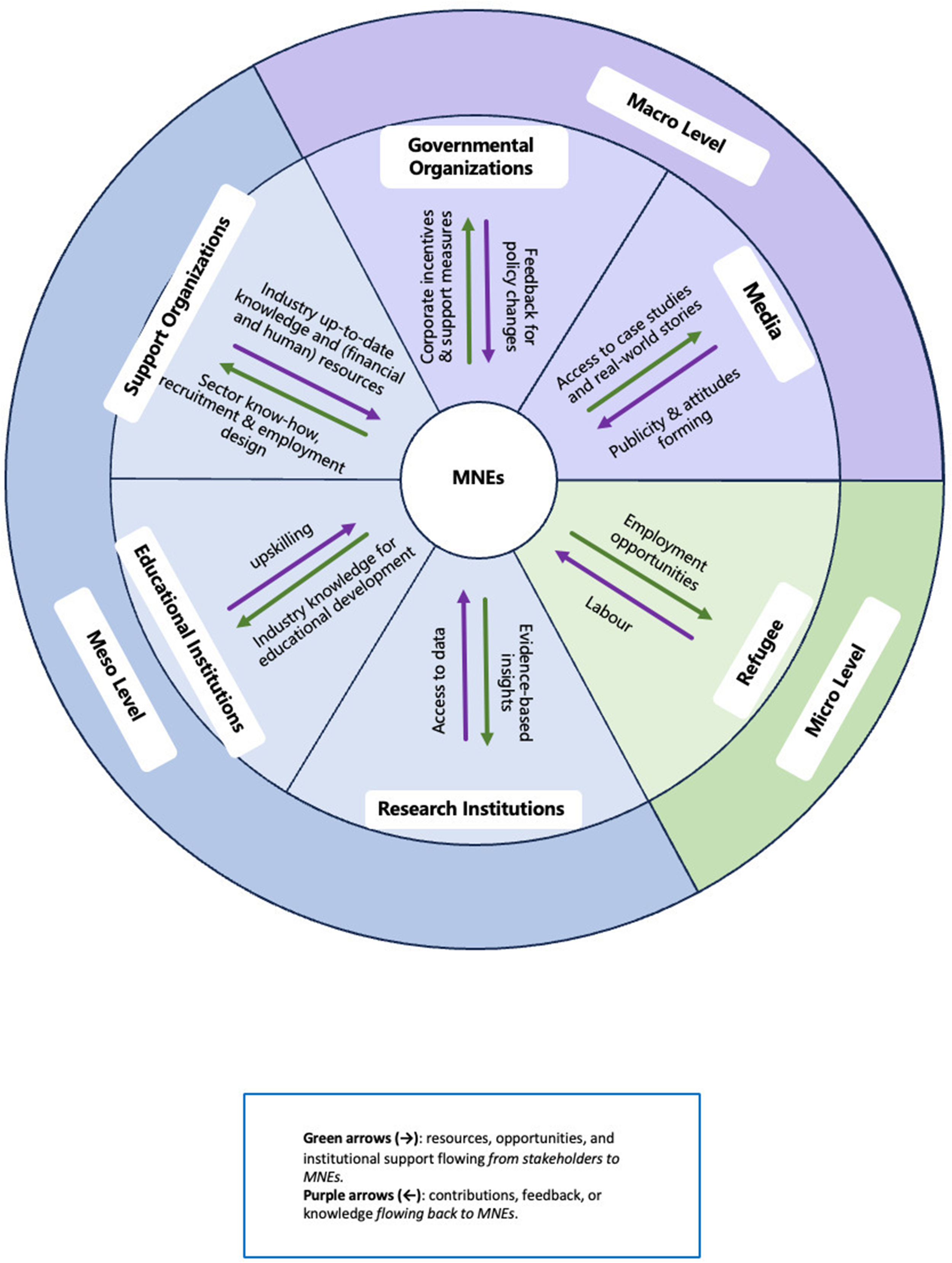
Conceptual model of MNE–stakeholder interactions in refugee workforce integration.
Macro Level: Government and Media
At the macro level, governments and the media jointly shape the external environment of refugee workforce integration. Governmental organizations are particularly influential, as they establish the legal and regulatory environment in which refugee workforce integration occurs (Chowdhury 2021; Hirst et al. 2021). Governments act as gatekeepers in determining refugee resettlement and refugee status (Bache 2020; Oguzertem 2020), legal and employment rights and access to social welfare (Reid and Al Khalil 2013; Zetter and Ruaudel 2018), and access to services like healthcare, housing, and education (Robinson and Coleman 2000; Fozdar and Hartley 2013), all of which directly impact employment opportunities for refugees (Jacobsen 1996; Tahiri 2017). Through policymaking and resource allocation, governments play a key role in refugee workforce integration (Fozdar and Hartley 2014; Boese and Phillips 2017). For instance, they offer incentives to businesses that hire refugees (McDermott 2011), set procurement targets for contractors working with the public sector (Denny-Smith et al. 2021; Loosemore, Alkilani, and Hammad 2021), and develop active labor market policies directed at refugees (Shutes 2011; Fossati and Liechti 2020).
Refugee workforce integration is not shaped by policies at a single national level, but is embedded in a multi-level governance structure that spans supranational, national, and regional levels. For example, in the European Union, supranational frameworks set minimum standards for labor market access, while leaving substantial discretion to member states in terms of timing, design, and implementation (Schenner and Neergaard 2019). This combination of coordination and national discretion contributes to highly differentiated and fragmented institutional arrangements governing refugee employment. Beyond the national level, responsibility for implementation is often further devolved to regional or local authorities. The practical implementation of labor market integration, such as training provision, job matching, and employer engagement, is often devolved to regional or local authorities (Caponio and Borkert 2010; Ambrosini and Boccagni 2015). As a result, variations in institutional capacity and policy priorities across regions further shape uneven pathways into employment for refugees.
Within this multi-level governance environment, the agency of policymakers also warrants attention. Policymakers, from national ministries and local authorities to public employment agencies, supranational bodies at regional levels, and international organizations at the global level, jointly shape the strategic frameworks within which refugee labor market integration takes place (Desiderio 2016). Positioned at the intersection of governance structures and implementation, they function both as rule-makers and as coordinators, translating institutional commitments into actionable programs (Mutz 2011). In particular, individual policymakers can exert disproportionate normative influence on the acceptance of refugees as a legitimate segment of the workforce and shape the discursive environment in which integration policies are debated and implemented (Pettrachin 2021).
It is within this differentiated and layered institutional environment that MNEs encounter persistent and complex challenges in engaging with refugee workforce integration. Visa frameworks illustrate these challenges. For example, many countries, such as Germany, the United Kingdom, and Australia, offer refugees or asylum seekers temporary visa options with restrictions on work hours and locations, and requirements for frequent periodic renewals (Czaika and De Haas 2017; Ziersch et al. 2021). Such arrangements complicate long-term career and workforce planning for both refugees and MNEs that hire them. Moreover, visa complexities can sometimes delay employment due to varied processes across regions, showcasing the challenge of navigating governmental inconsistencies and operating effectively in multiple jurisdictions (Czaika and De Haas 2017; Groutsis, Collins, and Reid 2024). While MNEs depend on predictable government policies, restrictive or fragmented visa regulations frequently impede their ability to employ refugees, even when they are motivated to do so (Szkudlarek, Lee, and Jansen-Nicorescu 2022). Other systemic barriers can further exacerbate these difficulties. Lengthy, bureaucratic procedures for recognizing foreign qualifications, for example, often delay refugees’ labor market entry and erode their human capital during waiting periods (Lee et al. 2020). Extended and often unsupported asylum processes, during which refugees are excluded from labor market participation, can also produce lasting “scar effects” that hinder subsequent employment opportunities (Marbach, Hainmueller, and Hangartner 2018). For MNEs, this creates significant challenges, as they are confronted with candidates’ diminished employability and increased training costs once work rights are eventually granted.
While much attention is placed on how governments shape MNEs’ practices in refugee workforce integration, the potential for reverse influence should not be underestimated. MNEs, by virtue of their cross-border operations, can actively inform and shape institutional environments. By sharing lessons learned from different regulatory contexts, they can provide policymakers with insights into which arrangements effectively foster refugee employment and which may inadvertently constrain it (Papademetriou and Benton 2016). Such practice-based knowledge is crucial for governments seeking to balance labor market protection with the need for inclusive employment pathways.
Beyond informing policy, MNEs can also act as advocates for systemic change. Drawing on their global networks and corporate legitimacy, they are well-positioned to push for policies and incentives that align business objectives with integration goals (Liou and Rao-Nicholson 2021; Ghauri 2022; Roy, Gehrke, and Claes 2024). For example, MNEs may lobby for flexible employment pathways or support bilateral agreements to streamline refugee work authorization. In doing so, they create political momentum for reforms that serve both national interests and organizational imperatives. These forms of engagement do not imply MNEs necessarily seek or can bring about policy change. Instead, they indicate that under conditions of institutional uncertainty, MNEs may become involved in policy dialogue or coordination as a way to navigate regulatory constraints and support more predictable operating conditions.
This reciprocal exchange underscores that the relationship is not one-directional. Governments offer a structural framework and institutional legitimacy, while MNEs provide practice-based feedback that enhances the relevance and adaptability of policies (Reade, McKenna, and Oetzel 2019). The result is co-value creation: governments are better equipped to design inclusive labor market frameworks, and MNEs gain more predictable and enabling regulatory environments. This dynamic reduces institutional uncertainty and ensures that refugee workforce integration is not just a compliance matter but an opportunity for shared resilience and long-term societal benefit.
Different national and regional contexts illustrate how these dynamics play out in practice. For example, in the United States, MNEs like Airbnb and Chobani opposed restrictive asylum work permit policies, advocating for more favorable conditions (Hesson 2019) (See Vignette 1). Similarly, in Malaysia, businesses like Unilever and Hilton urged the government to grant refugees legal work rights, a campaign later supported by UNHCR (IDEAS 2019) (See Vignette 2). These examples illustrate how MNEs can attempt to influence policy changes that support refugee workforce integration. In Germany, the case of Stuttgart illustrates a context-specific configuration in which local authorities called on firms to support refugee employment (Torfa et al. 2023). MNEs responded by providing training and jobs and helping develop new institutional mechanisms. These cases illustrate how MNEs may be embedded in refugee workforce integration processes in different ways. Depending on the institutional and governance context, MNEs may assume roles as policy advocates, collaborative partners, or implementing participants, with their scope for action and influence varying accordingly.
Another key actor within the macro system is the media. Media discourse exerts profound influence over the perceived legitimacy of refugee integration efforts. Media coverage can significantly impact MNEs’ refugee integration initiatives (Szkudlarek, Roy, and Lee 2022). On the one hand, positive media narratives help foster supportive public perceptions, strengthen CSR reputations, and inspire broader business participation (Wang and Chaudhri 2019). For example, Unilever's social and environmental initiatives were widely praised as evidence of corporate responsibility (Woolfson and Boland 2023). Similarly, IKEA has actively used media platforms to highlight its commitment to refugee integration, positioning itself as a leader in CSR (Eder 2021; Hui-Miller 2021; Large Format Retail Association 2021; Australian Retailers Association 2023; White 2023) (See Vignette 5). MNEs can use media platforms to promote their refugee integration initiatives, enhancing their CSR image and encouraging more businesses to participate, shifting public discourse in support of refugee integration (Osland 2022). MNEs can collaborate with the media to share their success stories, highlight their contributions to refugee employment, and inspire other businesses to follow suit. Media engagement also helps companies enhance their CSR profiles, which can improve their reputation both locally and globally (Turner et al. 2019). Through sustained media narratives and visibility, MNEs can ensure that the stories shared are not only compelling but also accurately reflect the broader social and economic impacts of refugee workforce integration.
On the other hand, media coverage can also pose challenges. Negative portrayals perpetuate stereotypes and may discourage companies from hiring refugees (Johnson 2011; Ryan and Tonkiss 2023). Unilever illustrates this paradox: although praised for its social initiatives, it was also criticized for “virtue signaling,” prioritizing image over financial performance (Woolfson and Boland 2023). In response, Unilever has since worked to communicate the long-term benefits of refugee integration to the broader community, countering negative portrayals by emphasizing the positive economic contributions of refugees (Unilever 2019; 2020). Research suggests that businesses are particularly sensitive to media coverage of their refugee recruitment initiatives (Szkudlarek 2019). While positive narratives facilitate supportive public perceptions, negative portrayals perpetuate stereotypes and may discourage companies from participating in refugee hiring. MNEs that openly promote their refugee integration efforts risk public scrutiny, which may lead to reputational risks if media narratives shift unfavorably. The tensions between corporate narratives and media scrutiny reflect the challenge of coordinating complementary logics. Through transparent communication, active responsiveness to criticism, and the cultivation of long-term trust with media, these interactions can move beyond potential friction and generate reciprocal benefits: MNEs gain legitimacy and reputation, media gain narratives and public attention, and refugee integration gains stronger social support.
At the same time, media environments are not uniform or neutral but shaped by distinct national and regional contexts. During the European “refugee crisis,” media in frontline countries such as Greece and Serbia emphasized humanitarian narratives that gave space to refugees’ individual voices, whereas media in Western European states like France, the UK, Germany, and the Czech Republic leaned toward securitized and defensive framings that diminished refugee subjectivity (Georgiou and Zaborowski 2017). Hungary's media coverage went further, focusing almost exclusively on economic threats and border control, virtually erasing the individuality of refugees (Georgiou and Zaborowski 2017). These variations underscore the need for MNEs to adapt media strategies to different socio-institutional contexts: in contexts dominated by humanitarian narratives, highlighting personal stories and community contributions may resonate more strongly, while in securitized environments, framing refugee employment in terms of economic benefits and social stability may be more effective. Through these interactions with the media, MNEs not only strengthen their CSR profiles but also contribute to the integration of diverse stakeholder resources and motivations, thereby expanding the scope of co-value creation and fostering a more sustainable and enduring social environment for refugee workforce integration.
Meso Level: Support Organizations, Educational and Research Institutions
At the meso level, interactions among MNEs, support organizations, educational institutions, and research institutions can represent an important dimension of refugee workforce integration. Unlike macro-level actors such as governments and the media, which define institutional and discursive environments, meso-level stakeholders are often directly influential in the design, implementation, and/or evaluation of integration initiatives. Although many of these stakeholders share a general commitment to refugee workforce integration, they operate under distinct institutional logics that shape their priorities and practices. These differences can generate friction, but they also represent complementary resources and perspectives.
Support organizations 1 can be understood as part of the broader “third sector,” a social domain oriented toward the delivery of social support and services, and distinct from both market actors and public sector organizations (Salamon and Sokolowski 2016). They are often characterized by great flexibility, community embeddedness, and a reliance on mixed resources, including volunteers (Krasniqi 2024). This positioning allows them to reach marginalized groups such as refugees and to provide social services that are more personalized and context-sensitive. While the important roles volunteers play in refugee support is widely recognized (Tomlinson and Egan 2002; Nardon et al. 2020), volunteers typically participate through support organizations rather than acting independently. Thus, their contributions are primarily oriented towards language support, career guidance, social connection, and emotional support. As volunteers’ involvement is generally organized and coordinated by support organizations, this study includes volunteers within their support infrastructure (Karakayali 2017; Feischmidt, Pries, and Cantat 2019).
Support organizations are often the first point of social and professional connection for new refugee arrivals (Godin and Renaud 2002; Steimel 2017; Baran et al. 2018), guiding them through expectation management, career journeys, self-sufficiency, sensemaking and empowerment (Tomlinson and Egan 2002; Nardon et al. 2020) and are often key sources of knowledge and professional networks for refugees (Behnia 2007; Stock 2019). They are often key actors in refugee workforce integration, offering employment support services (Lacroix, Baffoe, and Liguori 2015) and cultural training to both refugees and employers (Jabbar and Zaza 2016). They act as co-shapers of the refugee employment landscape, offering expertise and resources that condition the ways in which MNEs participate in workforce integration (Mayblin and James 2019; Lee and Szkudlarek 2021; Wang and Cooper 2022).
Across national contexts, the support organization landscape varies considerably, reflecting different welfare regimes and service delivery arrangements. In some settings, particularly in parts of Europe, refugee support is embedded within more formalized institutional frameworks through which policy objectives are translated into operational practices (Bešić, Fóti, and Vasileva 2022). Within these arrangements, support activities are coordinated through publicly structured systems that shape program design, funding mechanisms, and performance monitoring. In such institutional environments, diverse support organizations, including non-governmental and hybrid service providers as well as public service organizations, act as key delivery actors, providing frontline, refugee-centered services such as skills assessment, career guidance, vocational training, and broader forms of social support (Omanović, Tarim, and Holck 2022). By contrast, in the Australian context, the government fully outsources the design and delivery of refugee employment services to a diverse set of support organizations (Lee and Szkudlarek 2021). As a result, support organizations predominantly take non-governmental or hybrid forms and occupy a central role in both service provision and coordination.
It is within this institutionally embedded meso-level environment that collaboration between MNEs and support organizations takes shape. Many MNEs depend on support organizations to help them navigate local labor markets and regulatory landscapes, which is crucial for accessing and hiring refugee talent. For example, organizations such as Community Corporate in Australia collaborate with MNEs such as ServiceNow, providing digital skills training and job placements that facilitate refugees’ transition into the workforce (ServiceNow 2022). This initiative addresses critical labor shortages while improving refugee employability (Community Corporate 2024; InDaily 2024) (See Vignette 3). By connecting refugees with businesses, support organizations enable MNEs to make informed hiring decisions and support long-term workforce integration. These partnerships allow MNEs to access local insights and services that are critical to effective hiring and support for refugee employees.
While the example above highlights opportunities for successful collaboration MNEs and support organizations often have different motivations and approaches, which can create friction. Support organizations typically prioritize refugee well-being, advocating for fair wages, safe working conditions, and robust support systems like language training and mental health resources. In contrast, MNEs may focus more on operational efficiency, productivity, and profitability. Research suggests that businesses find refugee inclusion in their workforce a time-consuming effort on top of their business-as-usual duties (Phillimore and Goodson 2006). To make this collaboration sustainable, both parties need to maintain open dialogue and a mutual commitment to balancing operational goals with personal support measures, such as flexible scheduling, training, and supportive policies. These efforts should focus on fostering shared value and mutual benefits, such as gaining access to a valuable talent pool for MNEs and job security for refugees. Research found that resource and knowledge-sharing were among the ways to make this collaboration work (Lee and Szkudlarek 2021). To this end, MNE– support organizations’ interactions can constitute a process of relational value creation. For employers unfamiliar with refugee employment, support organizations offer guidance on sourcing candidates and navigating legal and cultural complexities (Szkudlarek 2019). In turn, support organizations gain access to financial resources, expertise, and networks from MNEs that enhance their capacity to support refugees over the long term (Juzwiak, McGregor, and Siegel 2014). Through corporate volunteering initiatives, for example, MNEs provide career coaching and other forms of job readiness support (Nardon et al. 2020). Globally, extensive networks of support organizations, at times spanning multiple countries, can connect MNEs to refugee talent pools beyond their immediate geographic locations (Talent Beyond Boundaries 2024). With MNEs increasingly active in developing economies, insights on human resources can be transferred to refugee-receiving countries, while supranational organizations such as UNHCR could coordinate resettlement more effectively by leveraging MNEs’ cross-border employment networks and know-how.
The second set of stakeholders at the meso level is educational institutions, including vocational training centers, higher education institutions, and certification bodies, who are key players in addressing the skill gaps that often hinder refugee employment (Streitwieser et al. 2019; Wehrle, Kira, and Klehe 2019). Differences in accreditation standards across countries can not only limit refugees’ ability to gain recognition for qualifications earned in their home countries but also pose significant challenges for MNEs to understand refugees’ skillsets (Lee et al. 2020). Refugees frequently possess qualifications from their home institutions that are not recognized in receiving countries, which limit their employment prospects. To address this gap, educational institutions enhance the institutional legibility of refugees’ skills through formal degrees, retraining programs, and transitional or bridging certification pathways (Correa-Velez and Onsando 2009; Desiderio 2016; McCarthy 2018). In doing so, they reduce uncertainty and screening costs for MNEs during recruitment processes. In this sense, educational institutions do not merely perform a skills-development function; they also constitute an important entry point into potential talent pipelines for MNEs. For MNEs, refugee jobseekers represent a group of future workers with long-term potential, yet one that is often underestimated.
It is important to recognize that educational institutions often operate within slow and heavily regulated systems that lack flexibility, while MNEs tend to seek faster and more streamlined employment pathways. This divergence does not represent a fundamental conflict of goals but rather reflects distinct institutional logics: educational institutions prioritize standardization and the credibility of credentials, whereas MNEs emphasize efficiency and operational feasibility. Under conditions of effective coordination and communication, the two sides can go beyond their individual contexts by cultivating long-term partnerships. In this way, they can integrate the expertise of educational institutions with the practical insights of MNEs, achieving relational value creation that combines resources and motivations. Through collaboration with MNEs, educational institutions can design curricula and training programs that are more closely aligned with labor market demands, thereby addressing skill shortages and supporting refugee career development (Krahn et al. 2000; Correa-Velez, Barnett, and Gifford 2015; Szkudlarek, Roy, and Lee 2022; Leonidou et al. 2024). When effectively coordinated, these logics can become complementary, helping refugees develop credible, adaptable skills and supporting their timely entry into the labor market.
Concrete examples highlight the implementation of such mechanisms. For example, Cisco's partnership with the University of Information Technology and Management in Poland to train Ukrainian refugees through the Cisco4Ukraine initiative exemplifies how educational institutions-MNE collaborations could benefit both refugees and companies (Cisco4Ukraine 2024) (See Vignette 4). MNEs’ participation in the design of training programs that are aligned with labor market demands (Hirst et al. 2021) can ensure that refugees are equipped with the skills businesses need, thus reducing the time and resources companies would otherwise spend on in-house training. Moreover, MNEs can advocate for the creation of internationally recognized accreditation pathways, which would reduce the bureaucratic barriers many refugees face in transferring their qualifications (Desiderio 2016).
The third group of stakeholders at the meso level comprises research institutions. Collaborations between MNEs and research institutions can be highly complementary: researchers can gain access to real-world data and corporate contexts that enrich their studies, while MNEs benefit from cutting-edge research to inform their practices, supporting their efforts in addressing broader societal challenges (Do Couto e Silva Neto et al. 2013; Bazhan et al. 2025). For instance, studies commissioned by the Tent Partnership for Refugees and conducted by higher education scholars and research agencies exemplify how MNEs can collaborate with research institutions to assess consumer behaviors and brand reputations associated with refugee employment initiatives (TENT 2022, 2023) (See Vignette 6). Such research not only informs business practices but also contributes to refugee workforce integration by offering data-driven insights and evidence-based solutions (George et al. 2016; Buckley, Doh, and Benischke 2017; Romme 2017). MNEs benefit from these collaborations by gaining access to real-world data and academic frameworks that inform and improve their integration practices (Okigbo, Reierson, and Stowman 2009; Refstie and Brun 2012). Moreover, cross-national research facilitated by MNE-research institutions collaborations can help identify best practices that are transferable across different political and legal contexts, contributing to more globally sustainable solutions for refugee workforce integration. Rigorous studies can help evaluate the effectiveness of various approaches, offering valuable recommendations for refining refugee workforce programs (Schibel et al. 2002).
This reciprocal relationship exemplifies relational value creation: research institutions contribute methodological rigor, evidence-based insights and long-term knowledge production, while MNEs contribute resources, practical experience, and social influence. Through sustained collaboration, the two sides integrate their respective resources and motivations, enabling a two-way translation between knowledge and practice that generates durable, shared value. However, it is important to note that the two sides often operate under different priorities: for example, research institutions such as universities emphasize rigor, impartiality, and the generalizability of the knowledge produced, whereas MNEs focus on timely, context-sensitive, and actionable solutions (Irwin 2019) and reputational gains (Aguilera-Caracuel and Guerrero-Villegas 2018). By fostering continuous dialogue and establishing joint agendas, partnerships can remain practically relevant without compromising academic integrity, thereby promoting a productive interaction between academic research and corporate strategies in the field of refugee workforce integration.
Micro Level: Individual Refugees
At the micro level, refugee workforce integration dynamics are shaped by the tension between individual aspirations and organizational practices. Employment is widely recognized as a key condition for successful refugee integration (Knappert et al. 2023). It provides a means to regain independence after displacement, to learn the language of the receiving country in daily practice, and to rebuild confidence and mental well-being (Bloch 1999; Hussam et al. 2022). Refugees enter the labor market with specific career aspirations, life needs, and cultural identities (Nardon et al. 2020), yet corporate recruitment processes often require rapid adaptation to established standards. This misalignment can lead to skill devaluation, identity conflict, and experiences of workplace discrimination (Lee et al. 2020; Nardon et al. 2020). Refugees often feel the weight of social suspicion and doubt regarding their legitimacy and capacity to integrate (IPSOS 2019), which translates into everyday vulnerabilities, where they are frequently exposed to exploitation, exclusion, and underemployment (Campion 2018). In workplace interactions, these challenges are compounded by cultural differences and language barriers that may cause friction in teamwork, communication, and socialization (Smit and Rugunanan 2014).
Despite these constraints, refugees are not passive recipients of these dynamics. Through language acquisition, the building of networks, and career adjustments (Krahn et al. 2000; Bloch 2009; Eggenhofer-Rehart et al. 2018), they demonstrate agency and resilience by resisting or reinterpreting institutional and organizational constraints. Refugees also contribute diverse experiences and perspectives that can enrich workplace cultures and strengthen connections between organizations and local communities (Szkudlarek, Roy, and Lee 2022; Roy, Gehrke, and Claes 2024). Accordingly, the relationship between refugees and MNEs is not merely an economic exchange but a dynamic interaction that encompasses collaboration and complementarity.
MNEs’ engagement at the individual level may extend beyond the provision of employment alone. For instance, some MNEs support refugee employees through workplace-based language programs, mentoring schemes, or peer-support mechanisms that facilitate organizational socialization and help refugees understand organizational norms and expectations (Roy, Gehrke, and Claes 2024). Mental health and well-being represent another critical individual-level dimension. By fostering inclusive organizational climates and reducing discrimination and social isolation, MNEs can indirectly support the well-being of refugee workers, thereby facilitating workplace integration (Butler, Paolillo, and Scuderi 2023). Such interactions embody complementarity: by aligning refugee diversity with corporate responsibility, they generate opportunities for relational value creation rooted in trust and reciprocity.
At the individual level, the structural barriers identified at the macro and meso levels are experienced in very tangible ways. Employers are often uncertain about refugees’ qualifications and legal status, fearing that language barriers, cultural differences, or trauma-related stress may hinder job performance (Santangelo, Rocha, and Sofka 2025), leading to the undervaluation of refugees’ human capital (Guo, Al Ariss, and Brewster 2020). These barriers become concrete survival challenges at the individual level, shaping refugees’ ongoing struggles for recognition, communication, and stability, and ultimately constraining their ability to secure meaningful and sustainable employment (Campion 2018; Lee et al. 2025). In some contexts, MNEs may engage in policy dialogue or advocacy aimed at easing transitions from refugee permits to employment-based permits, thereby reducing uncertainty for both employers and individuals (Liou and Rao-Nicholson 2021; Ghauri 2022; Roy, Gehrke, and Claes 2024).
For MNEs, this implies that supporting refugee integration requires not only resources and cultural sensitivity but also flexibility in organizational practices to accommodate diverse needs and to appropriately respond to the complexity of meso and macro-level contexts. Such responsibility extends beyond simply providing jobs: it includes flexible approaches to credential recognition, in-work support, and mechanisms for cross-cultural communication. Understanding these dynamics as a matter of shared cross-level responsibility, rather than a simple exchange of labor for wages, allows potential frictions to be reframed as opportunities for value co-creation.
Discussion
Migration, as a phenomenon, inherently operates across multiple levels, influencing and being influenced by a diverse array of stakeholders across sectors (Papademetriou and Benton 2016; Panizzon and van Riemsdijk 2019). Despite this, there has been surprisingly little effort to incorporate stakeholder theory into migration studies (with recent exceptions in Kandilige and Adiku 2020; Mortier, Oosterlynck, and Raeymaeckers 2025; Umpierrez de Reguero, Bauböck, and Wegschaider 2025), even though its principles could bring significant theoretical value to understanding such a multifaceted issue (Olsen, Sofka, and Grimpe 2016). Stakeholder theory provides a robust framework for analyzing and addressing the interdependencies among actors integral to migration processes (Garkisch, Heidingsfelder, and Beckmann 2017). Building on this foundation, the present study utilizes stakeholder theory in the analysis of refugee workforce integration, with a focus on complementarities, reciprocity, and the potential for relational value creation.
A Multi-Level Perspective on Refugee Employment
Refugee workforce integration is a complex, multi-level process that requires sustained interaction and coordination (Lee et al. 2020; Omanović, Tarim, and Holck 2022). At the macro level, governments, policymakers, and the media shape external conditions through institutional arrangements and discursive framings; at the meso level, support organizations, educational institutions, and research institutions collaborations create opportunities for sustainable practices in refugee workforce integration; and at the micro level, refugees’ agency interacts with organizational practices, exposing both everyday frictions and possibilities for constructive engagement. Unlike SMEs, MNEs have the scale, resources, and transnational networks to influence multiple levels of this ecosystem simultaneously. Their global operations allow them to draw on diverse experiences and transfer effective practices across borders, while their visibility and legitimacy position them as agenda-setters in public debates (Millar, Choi, and Chen 2004). To this end, MNEs are uniquely equipped to align micro-level organizational practices with meso- and macro-level frameworks, thereby advancing refugee workforce integration in ways that smaller firms often cannot.
From the perspective of stakeholder theory, interactions are not only about aligning institutional logics but also about creating relational value (McGahan 2021). Our paper demonstrates that each stakeholder can contribute distinct resources, motivations, and priorities, which can yield durable solutions only when integrated through reciprocal value creation. By mapping these reciprocities, our model illustrates how complementarities can be mobilized to generate value for individual stakeholders while simultaneously advancing the collective impact of MNE engagement in refugee workforce integration initiatives. Within these reciprocities, each stakeholder contributes invaluable resources and forms of value. Sustainable solutions, therefore, do not stem from unilateral initiatives but from long-term interaction, trust-building, and the integration of complementary resources and motivations. These are achievable if MNEs engage in transformative rather than adaptive practices (Lee et al. 2025). Refugee labor market integration should thus be understood as a co-creation process among stakeholders; one that transcends transactional exchange and shifts toward enduring partnerships where social impact and organizational goals can be pursued in tandem.
Positioning MNEs as Interdependent Actors
By analyzing dynamics across the macro, meso, and micro levels, this paper repositions MNEs as interdependent actors embedded within a broader stakeholder ecosystem. We argue that, despite their substantial resources and reach, MNEs remain under-theorized in the refugee workforce integration literature. Crucially, their contributions are not intrinsic but highly contingent on institutional environments, governance arrangements, and the configuration of stakeholder relationships. Under particular institutional and organizational conditions, MNEs are more likely to mobilize their distinctive resources, capabilities, and knowledge to support refugee integration; yet in the absence of clear accountability mechanisms and external constraints, such engagement risks remaining symbolic or largely reputational. These considerations are particularly critical given the recurrent portrayal of MNEs in migration studies as perpetrators or exploiters of migrant workers (Mahmood, Welch, and Kennedy 2009). Without denying the validity of these critiques, this paper does not seek to rehabilitate MNEs or to cast them in an inherently positive light. Rather, we emphasize the conditionality of their involvement: in the absence of strong accountability, ethical commitments, and sustained stakeholder engagement, refugee employment initiatives are highly susceptible to becoming symbolic or reputational exercises. Consequently, recognizing the potential role of MNEs requires foregrounding governance, transparency, and genuine stakeholder dialogue as necessary preconditions for advancing inclusive labor market outcomes.
From this perspective, the constructive potential of MNEs as interdependent actors can be seen in several ways, each of which should be understood as a possibility rather than a guaranteed outcome (see Figure 1). Across levels, our model outlines how MNEs can be involved in the facilitation of refugee workforce integration through value co-creation. MNEs can, for example, embed refugee employment targets into core HR and talent strategies, rather than CSR alone as an add-on, thereby providing a comprehensive social support structure (micro-level). MNEs can also engage in diverse forms of partnerships with support organizations, educational institutions and researchers through shared metrics, role clarity and co-investment to initiate, design and deliver refugee-specific programs (meso-level). Further, by engaging with policymakers and media, MNEs can foster positive institutional environments and counter deficit-based narratives (macro-level). These practices, taken together, constitute a minimal toolkit for avoiding window dressing by anchoring refugee employment initiatives in organizational routines, governance mechanisms, and multi-actor accountability rather than discretionary goodwill.
More specifically, in terms of inclusive employment leadership, MNEs may, under favorable institutional and organizational conditions, leverage their extensive networks and global reach to provide opportunities for refugees that go beyond economic benefits to broader social contributions. In such contexts, MNEs may help establish benchmarks for responsible and inclusive employment practices. Emerging evidence and our conceptual work demonstrate this constructive potential (Roy, Gehrke, and Claes 2024; Lee et al. 2025). By prioritizing these efforts, MNEs can inspire other corporations and stakeholders to support refugee employment on a larger scale. However, such leadership does not stem from organizational scale alone; instead, it is shaped by external normative pressures, internal incentive structures, and power relations among stakeholders within collaborative networks. Stakeholder theory reminds us that whether MNEs are able to balance operational objectives with social and ethical responsibilities in practice depends on how governments, support organizations, educational institutions, the media, and research institutions are embedded in governance arrangements and their capacity to shape agenda-setting processes (Friedman and Miles 2002). Only when shared value creation is institutionally designed and operationally implemented in ways that benefit relevant stakeholders can such inclusive employment leadership be sustained.
MNEs may act as catalysts of interdependence and value creation. While their role has been underexplored in extant literature, real-life examples show that, in certain contexts, MNEs’ leadership can catalyze these interdependencies, mobilizing governmental resources, integrating support organizations and their services, ensuring that refugees receive the training they need, improving public perceptions towards refugee employment with media discourse, providing insights on what does and does not work in refugee employment initiatives through research with academics, and directly creating meaningful employment opportunities for refugees. Through purposeful alignment with each group, MNEs can create value for each stakeholder involved in a way that strengthens both local economies and refugee livelihoods. It is important to note, however, that such coordination entails inherent risks. Where collaborative arrangements lack transparency, shared objectives, or mechanisms to mitigate power asymmetries, MNE-led initiatives may instead concentrate decision-making authority and shift risks onto less-resourced partners. Interdependence, therefore, does not necessarily translate into equitable value co-creation.
Moreover, MNEs may play a mediating role in stakeholder engagement and coordination. With extensive experience in internationalization and in dealing with multiple stakeholders simultaneously across various country contexts, MNEs may possess the skills, expertise, and knowledge to mediate and negotiate issues and conflicts that may arise (Millar, Choi, and Chen 2004). By strategically leveraging complementarities across macro, meso, and micro levels, MNEs may reduce transaction costs and reputational risks while advancing sustainable and inclusive refugee employment solutions. It is important to note, however, that these capabilities alone do not guarantee inclusive outcomes. Whether coordination efforts contribute to inclusive refugee employment solutions depends on the extent to which governance arrangements enable meaningful participation by other stakeholders.
Finally, MNEs may possess certain advantages in navigating and adapting to diverse regulatory and cultural contexts across borders. In multi-stakeholder settings, MNEs may demonstrate flexibility and responsiveness by tailoring employment programs to align with local laws and societal norms. By doing so, they set a precedent for other companies, demonstrating how to approach refugee integration in a way that respects each country's unique conditions and maximizes local impact. At the same time, such flexibility is inherently ambivalent and may also be used to evade responsibility or dilute labor standards. Taken together, through a stakeholder theory lens, our model does not position MNEs as “natural leaders” in refugee workforce integration. Rather, it conceptualizes MNEs as conditionally influential nodes of interdependence in the effort to integrate refugees into the workforce. By effectively leveraging their resources and influence to unite diverse stakeholders, MNEs have the potential to set an example in creating sustainable, ethical, and inclusive employment pathways for refugees.
Future Research Agenda
Our investigation into collaborations between MNEs and stakeholders presents reciprocal value creation as key to addressing the grand challenge of refugee workforce integration. Reciprocity is crucial for generating and sustaining productive social impact (Becker 1986). The idea of reciprocity in a bilateral collaboration lies with the essential need to hold the contributing stakeholders together (Hamilton 1965). We propose that reciprocal advantages from the engagement sustain stakeholder involvement and advance sustainable solutions. Through the discussion around refugee workforce integration, our paper demonstrates how reciprocal benefits arise from sharing resources and knowledge, creating value for each actor while generating greater social value.
While our paper focuses on a selected number of stakeholders, the future-focused research agenda could take a much broader perspective. For example, while our study focuses on bilateral relationships, multistakeholder engagements that reflect the complexity of interactions deserve close scholarly attention. Stakeholders do not operate in isolation. Research suggests that, given the overwhelming numbers of refugees globally, many governmental organizations are largely dependent on support organizations’ services (Dean and Nagashima 2007). At the same time, support organizations are heavily influenced by governmental organizations in the scope and type of refugee support they can provide (McDonald et al. 2008), as many depend on public funding (Simich, Beiser, and Mawani 2002; Tahiri 2017). Similarly, researchers are often recipients of governmental funding (Lupia 2014), whilst policymakers are informed by the work of researchers (Brun and Lund 2014; Salehyan 2019). Overall, in tackling this grand challenge, multi-stakeholder engagement is inevitable due to the complexity of the issue and the intricacy of stakeholders’ operations. Collaborative efforts across stakeholders can, therefore, improve refugee employment and integration outcomes and are an urgent point for future-focused research agendas.
Moreover, our research focused on a number of identified key stakeholders contributing to the refugee employment landscape. Future studies could investigate other groups indirectly influencing refugees’ integration into a new country. For example, research has highlighted the role of unions in helping refugees adjust to the local environment (Bergfeld 2017; Erdoğdu 2018). Further research into the roles of these and other more peripheral stakeholders and their interactions with businesses, particularly MNEs, could enhance our understanding of stakeholder management and value creation through bilateral collaboration within a multi-stakeholder setting. To date, scholarly discussions in migration studies have primarily focused on policy-makers, migrants themselves, support organizations and international agencies such as the UNHCR. Not to mention, the interactions between these stakeholders and MNEs have rarely been investigated in migration studies (Maharjan et al. 2024). We hope that our paper serves as a steppingstone for integrating discussions of MNEs and their roles, along with inter-dependencies with multiple stakeholders, in migration scholarship and its theoretical developments in understanding refugee workforce integration.
Conclusion
Given refugees’ vulnerability in the labor market and the unique circumstances of their relocation (Jackson and Bauder 2014; Roy, Szkudlarek, and Caprar 2020), both academia and the business sector need greater sensitivity to develop practical solutions and deepen the theoretical understanding of refugee workforce integration. As global entities, MNEs are uniquely positioned to address this challenge (Ghauri 2022; Szkudlarek, Roy, and Lee 2022; Leonidou et al. 2024). Understanding the key economic, social, and regulatory drivers of high-skilled refugee employment can help MNEs and policymakers craft better strategies and business models. Promoting refugee workforce integration requires preparation and sensitivity. Through collaborative approaches with external stakeholders, MNEs can build their knowledge and improve outcomes for refugees (Wilkinson, Santoro, and Major 2017). While MNEs can become knowledge leaders in supporting refugee workforce integration, they cannot accomplish this alone. Our paper aims to contribute to tangible solutions by highlighting the reciprocal gains of bilateral collaboration within a multi-stakeholder setting.
Footnotes

Funding
The authors received no financial support for the research, authorship, and/or publication of this article.
Declaration of Conflicting Interests
The authors declared no potential conflicts of interest with respect to the research, authorship, and/or publication of this article.