




Abstract
International migration has historically been an urban phenomenon. Despite the increasing presence of immigrants in non-urban areas and political initiatives aimed at regionalization, research in Europe continues to exhibit a pronounced urban analytical bias. This paper examines the geographies of immigrant and refugee settlement along the urban–rural continuum in Sweden, Germany, and Switzerland. Using (multistate) event history models, we first examine changes in migration stocks in urban, suburban, and rural municipalities, emphasizing the role of immigrant subgroups in regional population changes. Second, we analyze internal origin–destination flux to enhance our understanding of the spatial adjustment processes of immigrants in the context of new immigrant destinations in Europe. Results suggest that immigrants contribute little to suburbanization and ruralization processes, with both initial settlement and secondary moves predominantly directed toward urban areas. EU and non-EU immigrants exhibit stable trajectories post-arrival; in contrast, refugees subjected to a dispersal policy tend to relocate in significant proportions to urban areas once mobility restrictions are lifted. In the three countries, secondary moves by refugees have resulted in an increased concentration of this population in urban areas, reaching proportions comparable to those of the non-European immigrant group not subjected to this policy. The consistency of this finding across the three countries raises significant questions regarding the effectiveness of the dispersal policy from a demographic perspective. Furthermore, transitions from urban to suburban or rural municipalities remain uncommon and do not demonstrate clear associations with the duration of residence or socioeconomic status, as predicted by the spatial assimilation model.
Introduction
Immigration is the main driver of population growth in many European countries. However, the way in which immigration affects the macrolevel population structure varies substantially within countries. Cities are the point of entry for most migrants, with some urban areas becoming increasingly diverse (Castles and Miller 2009; De Valk and Willaert 2012). At the same time, the economic consequences of population decline in many peripheral regions have become a major concern for political decision-makers. Although it has become clear that international migration cannot counteract population aging at the national level, population sorting can play a decisive role at the regional level (United Nation 2001). As a result, state governments are increasingly trying to manage migration flows at the subnational level to ensure greater spatial mixing and regionalization of immigration.
Initiatives toward regionalization of immigration take many forms. Dispersal policies that seek to distribute refugees more evenly across the different parts of the country are one of the most striking examples. In addition, several sectors of the rural economy are increasingly relying on and actively recruiting foreign workers to sustain their activities. As a result, small towns and rural areas are increasingly functioning as entry points for both refugee populations and labor migrants in the EU (King, Lulle, and Melossi 2021; Rye and Slettebak 2020). However, it is unclear whether these so-called new immigrant destinations (NIDs thereafter) are successful in retaining newcomers, how this population affects the macro-level population structure in the long term, and what the logics of spatial adjustment are in the context of NIDs.
Recent studies have shown that dispersed refugees to rural areas tend to relocate to more densely populated regions once mobility restrictions are lifted (de Hoon, Vink, and Schmeets 2021; El Moussawi and Schuermans 2021; Mossaad et al. 2020; Vogiazides and Mondani 2021). The spatial adjustment process of immigrants to NIDs is less documented. Although employment opportunities may initially draw labor migrants to rural areas and small towns, these places often lack specific infrastructures and amenities known to attract and retain immigrants (e.g., affordable housing, co-ethnic networks, employment opportunities for partners) (McAreavey 2012; Ulceluse, Bock, and Haartsen 2021). This can have a negative impact on the region's ability to retain immigrants, causing them to relocate to areas where such services are plentiful, typically in large cities. In contrast, the literature has abundantly examined the spatial adjustment patterns of immigrants within and from large cities. Evidence, mostly from the United States, suggests that the relocation occurs in the opposite direction, that is, away from “concentration neighborhoods” in gateway cities toward the suburbs and rural areas (Farrell 2016; Massey and Denton 1988). Nonetheless, the changing patterns of immigrant settlement in NIDs and immigrants’ contribution to suburbanization or ruralization processes have received very limited attention in the European context (see Winders 2014 for exception).
This paper provides a cross-national comparison of the geographies of immigrant and refugee settlement in three European countries where the regionalization of immigration is an explicit policy objective. Using individual-level longitudinal data from Sweden, Switzerland, and Germany, we examine migration stocks by time since immigration and origin–destination flux across the urban–rural continuum in each country. Two objectives structure this paper. First, the paper examines the distribution of immigrants in NIDs and whether these populations contribute to processes of suburbanization or ruralization. For this purpose, we examine the probability of different types of immigrant groups (i.e., EU immigrants, non-EU immigrants, and refugees) to live in urban, suburban, and rural areas by year since arrival in the destination country using longitudinal models. An examination of changes in migration stocks over time provides insight into the capacity of places to attract and retain immigrants. Additionally, an analysis of whether refugees and immigrants are over- or under-represented relative to the locally born population in different places offers an overview of the macro-structural impact that these populations have on regional demographic developments. Second, the paper emphasizes the spatial adjustment process of immigrants to and from NIDs. To this end, we examine origin–destination moves and their determinants using multistate models and determine who is more likely to live, stay, and move to different locations over time.
This study develops previous research in a number of ways. First, it offers a novel assessment of immigrant's mobility to and from NIDs in three European countries. Although research has identified the emergence of NIDs as one of the most significant shifts in international migration trends in recent years (Winders 2014), most research to date has been limited to the US context. The process of suburbanization and ruralization has markedly different implications for immigrants in Europe compared to those in the United States. In Europe, affluent urban centers often exist alongside socio-economic divides in the suburbs, where some areas exhibit considerable wealth while others are economically disadvantaged, often correlating with a significant proportion of immigrants. In some contexts, such as the suburbs of southern European cities or French cities, suburbanization has been, in contrast to the American case, associated with a worsening of the living condition (Arbaci and Malheiros 2010). The typical upward residential trajectory from inner urban centers to suburbs is unlikely to materialize in the same manner as observed in the United States. This study documents mobility along the urban–rural continuum, specific to the European context.
Second, this paper contributes to theoretical discussions on spatial adjustment processes of immigrants by considering the geographical context of reception. Prior research suggests that the maturity of a locality's immigration system and its historical experience with immigration profoundly shape both the extent and character of immigrant spatial incorporation and adjustment trajectories (Hasman and Krizkova 2023). Inadequate infrastructure affects immigrants’ outcomes, and institutional commitment to facilitating successful integration is geographically variable (Popke 2011). The spatial assimilation model, as originally theorized, may manifest differently when NIDs serve as initial places of settlement. In such contexts, secondary migration may be less contingent upon acculturation and socioeconomic improvement and more on local attributes, including economic opportunities, housing markets, and the overall receptiveness of a locality. Consequently, traditional markers of the spatial assimilation model may not as well capture the processes of spatial (im)mobility. As argued by Winders (2014), NIDs offer tremendous opportunities to test whether dominant knowledge of contemporary migration processes applies in new contexts of reception. We seize this opportunity and consider the geographical context at both origin and destination, alongside traditional markers of the spatial assimilation model.
Third, this study compares the settlement process and adjustment behaviors of different migrant groups in three countries: refugees who are subject to settlement policies, and immigrants from EU and non-EU countries who are allowed to freely choose their place of residence. Studies examining secondary moves among dispersed refugees do not provide any comparison point with other immigrant groups or the locally born population. While a significant share of refugees relocate to more densely populated areas once mobility restrictions are lifted, it remains unclear whether this population is more or less concentrated than other immigrant groups (or the native-born population) in the long run. Our approach allows for a discussion of the role of each population sub-group in regional population change in national contexts.
Finally, studies on the locational choices of immigrants mostly focused on regional factors rather than individual factors. When such factors are considered, they are often not disaggregated into specific origin–destination profiles. We highlight variations by individual characteristics and population subgroups. NIDs are expected to attract specific socio-demographic profiles, and secondary moves will also be highly selective along these lines. Therefore, one can identify the role played by international migrants in regional variations in population development.
Immigrant Locational Choices
International migration is traditionally viewed as an urban phenomenon (Heider et al. 2020). Most immigrants settle and relocate within urban areas (de Hoon, Vink, and Schmeets 2021; De Valk and Willaert 2012): cities offer job opportunities, multicultural environments, (community) networks, and specific infrastructures and services specifically designed to help newcomers adapt. Nonetheless, three decades of research on NIDs, mostly in the United States, shows that immigrants increasingly settle outside established urban gateways, mostly in the suburbs but also rural and small town areas (e.g., Farrell 2016; Hall, Tach, and Lee 2016). New geographies of settlement are also developing in Europe, with international migrants increasingly dispersed between urban and rural areas (Bock, Osti, and Ventura 2016; McAreavey 2017). Recent estimates put the number of foreign-born living in the EU's rural areas at over 5 million (Fabrizio et al. 2019).
What drives immigrants’ location choice is generally explained through pull factors, i.e., attractive characteristics in potential destinations, and push factors, i.e., negative elements in the region of residence that make people leave (Lee 1966). Economic factors such as wages and housing prices, together with the presence of an immigrant population which directly relates to the availability of immigrant group-specific amenities, are generally considered as the main drivers of immigrant location choice. Employment opportunities influence location choice as immigrants tend to settle initially in proximity to their workplace. Large cities with a strong service sector typically offer better employment prospects and attract highly skilled professionals in innovative sectors, as well as manual workers seeking jobs in industries such as catering and cleaning (Sassen 2001). Nevertheless, processes of gentrification, deindustrialization, and suburbanization are increasingly responsible for the relocation of employment and affordable housing opportunities outside of metropolitan areas (Alba et al. 1999; McAreavey 2012). In addition, the restructuring of the rural economy, local labor shortages, and enlargement of the European Union have led to an increase in the number of foreign workers in rural places (Loomans, Lennartz, and Manting 2024; McAreavey and Argent 2018).
The presence of ethnic networks is another key driver of immigrant location choice and a central theme in migration research. Established immigrant groups can provide support and guidance in finding employment or accommodation. Group size also matters in accessing ethnic-specific resources and infrastructure, such as places of worship, facilitating the preservation of cultural practices, and the transition to a new society. Spatial assimilation theory predicts that as immigrants achieve socioeconomic success and become more familiar with the host society, they become less reliant on the resources provided by their ethnic enclave. As a result, immigrants will move away from ethnic enclaves toward neighborhoods or regions with better quality housing and public services where the majority population predominates (Alba et al. 1999 ; Massey and Denton 1985). Although this process has typically been conceptualized in terms of desegregation within urban contexts, it has been proposed that even migration across different types of regions may be indicative of spatial assimilation. A relocation from gateway cities to the suburbs or to rural areas could be perceived as an indication of desegregation and, consequently, an indicator of integration (Finney and Catney 2016). In the United States, suburbanization is seen as a key step in a process of spatial assimilation (Alba et al. 1999; Massey and Denton 1988). Such evidence is, however, still largely missing from European contexts.
A handful of studies have exploited refugee dispersal policies as a way to avoid self-selection into places and exogenously examine the regional factors that attract and retain immigrants to certain locations (see Åslund (2005) for Sweden, Damm (2009) for Denmark, and Mossaad et al. (2020) for the United States). The studies confirmed that the main push factors are the lack of co-ethnic networks, employment opportunities, and affordable housing which likely explains the magnetic effect that large cities have on recent immigrants (Damm 2009). In Germany, Wiedner and Schaeffer (2024) showed that instead of following employment opportunities, dispersed refugees prioritized non-labor-market resources at first such as affordable housing and proximity to social networks. As a result, refugees often end up living in economically disadvantaged areas due to the spatial overlap with these resources.
Migration to and from NIDs
Migration scholars have documented the emergence of NIDs across Europe (see Bayona-Carrasco and Gil-Alonso 2012 for Spain; Catney 2016 for the UK; Fonseca 2008 for Portugal; Fromentin 2019 for France; Heider et al. 2020 for Germany; Křížková and Ouředníček 2020 for Czechia; Tammaru et al. 2013 for Estonia; Zorlu and Mulder 2008 for the Netherlands). These studies focus primarily on initial settlement in NIDs and how regional differences in economic opportunities drive migration flows. Subsequent moves are rarely explored.
Over the past two decades in Sweden, the country has experienced an increase in seasonal employment and the recruitment of low-paid and low-skilled workers in the agricultural and agri-food processing sectors (McAreavey and Argent 2018). Immigrants to rural areas are mostly of Nordic and European origin, older and less educated, while more educated migrants tend to settle in metropolitan areas (Hedberg and Haandrikman 2014; Khaef and Haandrikman 2024). Other specific population inflows to rural Sweden have been identified, including those motivated by lifestyle changes, such as the migration of Dutch families fleeing overpopulation and work pressure (Eimermann 2015), and the partner-related migration, mostly by women from Thailand (Haandrikman 2014).
In Germany, a study by Tanis (2020) examining the location choices of recent European migrants revealed that favorable labor market conditions exerted a significant influence on regional attractiveness, while regional population characteristics were less strongly associated with place selection. Initial location in rural places is still a relatively marginal process in the country, with immigrants mostly settling in large cities and highly urbanized areas (Heider et al. 2020). Nonetheless, the findings of this study indicate that immigrants are not attracted to cities per se, but rather to the existing ethnic networks (for the initial migration) and factors related to distinct stages of their personal lives, such as education or changes in family status (Heider et al. 2020).
Cities also play a central role as arrival places for immigrants in Switzerland (da Cunha and Both 2004), especially for the highly skilled who have largely integrated the knowledge-based sectors of the economy since the late 1990s (Wanner and Steiner 2018). Nonetheless, it is argued that the demographic contribution of immigrants to the Swiss re-urbanization process remains of transient nature (Lerch 2023). On the one hand, there is a strong turnover of recent immigrant populations in gateway cities (Fioretta and Wanner 2017). On the other, those who remain for an extended period of time demonstrate comparable residential preferences for peri-urban zones to those observed in the locally born population (Lerch and Wanner 2010).
However, despite recent advances in the field of migration research on immigrant settlement in NIDs, questions remain regarding the capacity of these new places to not only attract but also retain immigrants. NIDs are characterized by a lack of established co-ethnic networks and often have limited infrastructure and services (e.g., public transport, language classes, differentiated schools) specifically designed to help newcomers adapt (Glorius, Bürer, and Schneider 2021). McAreavey (2012) argued that although immigrants are attracted to new destinations due to employment opportunities in specific industries, these places often lack routes leading to upward social mobility, such as access to better-paying and more secure employment positions. This implies that both socioeconomically integrated migrants and those who rely more on ethnic networks and infrastructures may move away from these new destinations. The residential experience of immigrants in the suburbs is even less well documented. However, studies report that the infrastructure in these areas is similar to that in rural areas, but with easier access to these resources due to their greater proximity to urban areas (Boost and Oosterlynck 2019; El-Kayed et al. 2020; Loomans, Lennartz, and Manting 2024).
In the United States, studies have shown that immigrants living in NIDs are significantly more likely to move internally than those living in traditional destinations (Kritz, Gurak, and Lee 2013). On the contrary, a recent study by Haandrikman and colleagues (2024) in Sweden revealed that not only are immigrants increasingly heading to rural and small-sized areas, but they also tend to remain there. Those who undertake secondary migration mainly relocate to mid-sized towns rather than to metropolitan areas. Nonetheless, studies examining secondary migration flows across the urban–rural continuum in Europe (or other classifications overcoming metropolitan areas) remains extremely rare.
Two studies on dispersed refugees stand out in this regard. For the Netherlands, de Hoon, Vink, and Schmeets (2021) examined the residential trajectories of refugees after dispersal across the territory distinguishing settlement in or move to cities, suburbs, and rural municipalities. The authors found high levels of onward mobility after initial placement: during the 11-year observation period, half of refugees relocated, with those allocated to rural municipalities being the most likely to leave. Similarly in Sweden, Vogiazides and Mondani (2021) explored the regional distribution and inter-regional mobility of refugee cohorts exposed to different placement policies. They found that, compared to refugees who had arranged their own housing, refugees subject to a placement policy were more likely to move across region types, typically from less to more urbanized regions. Both the Dutch and Swedish studies used sequence analysis techniques to describe the heterogeneity of residential trajectories across settlement types. However, they did not report on the overall geographic distribution over time, nor did they make comparisons with the geographical patterns of locally born or other immigrant populations.
Another key question for research on NIDs is the extent to which regional attractiveness varies with individual characteristics and how this phenomenon affects the socio-demographic structure of territories. Studies show that in- and out-migration from NIDs are highly selective in terms of socio-demographic profiles (Goodwin-White 2018). This phenomenon appears to exacerbate existing patterns of spatial polarization (Khaef and Haandrikman 2024). Immigrants to rural areas are characterized by lower levels of education, are more likely to be married, older, and from a rural background (Farmer and Moon 2009; Lichter and Johnson 2009), although this population is becoming increasingly heterogeneous (McAreavey and Argent 2018). Moves to less densely populated areas and rural environments are also motivated by family circumstances with immigrant families being more likely to make a secondary move to such places (Trevena, McGhee, and Heath 2013; Zorlu and Mulder 2008). The sociodemographic profiles of immigrants to the suburbs are more diverse and reflect the distinct character of these areas. In some cases, the suburbs are characterized by high standard residential areas and an idyllic way of life, while in others they exhibit characteristics associated with pockets of poverty and a concentration of social housing (Van Kempen and Murie 2009). The existing literature documents both processes among immigrants in Europe (see Peach 1998 for an example of the former in the UK; see Bolt, Van Kempen, and Van Ham 2008 and Bonvalet, Carpenter, and White 1995 for examples of the latter in the Netherlands and France).
Refugee Dispersal Policies
In Germany, the federal states (Länder) are responsible for the reception and processing of asylum applications. The EASY quota system (Initial Distribution of Asylum Seekers) initially allocates asylum seekers to one of the 16 Länder based on two factors: population (by a factor of 1/3) and tax revenue (by a factor of 2/3) (Federal Office for Migration and Refugees). During the assessment procedure and for a period of up to 18 months, asylum seekers are obliged to reside in a reception center (Erstaufnahmeeinrichtung). Subsequently, asylum migrants are allocated a private or communal residence within a municipality (population size being the primary criterion for spatial distribution) within the state. Until a refugee status is granted, they are usually not allowed to change municipality. Even after being granted a refugee status, freedom of movement remains constrained. During the initial three-year period following the decision, refugees are only permitted to relocate within the assigned federal state. In seven of the states, mobility is even restricted to a specific county or municipality during this period.
Switzerland employs a comparable dispersal policy. Asylum seekers are initially hosted in one of the five federal reception centers, where they reside for a period of up to three months. Thereafter, asylum migrants (with or without a decision on their claim) will be exogenously assigned to one of the 26 cantons. The distribution quota is determined by the population size of each canton (SEM 2019). The canton is then responsible for providing accommodation, material support, and assistance to this population who must reside within the canton of attribution (ECRE 2025). A similar process to that observed in Germany is followed, whereby individuals are initially accommodated in a cantonal communal center before being assigned a subsidized flat (or, for those who are able to do so, moving to an apartment of their own in the private housing sector). A person is only granted complete freedom of movement once they have received a long-term residence permit (C-permit), which can only be issued after a period of ten years. During this interim period, individuals who have been recognized as refugees (B-permits) or granted subsidiary protection (F-permits) are permitted to relocate only within the assigned canton. Some exceptions are possible, but they are subject to the canton’ approval. If the person receives social assistance, they are unlikely to be approved. Nevertheless, changes of municipalities within the assigned canton are possible for those who can arrange housing on their own.
Since 1994 and until recently, Sweden has operated a hybrid placement system, whereby asylum migrants are offered the choice of arranging their own housing or being accommodated by the Swedish Migration Agency (SFS 1994). In general, those who arranged their own housing lived with family or friends in metropolitan areas, whereas state-hosted refugees were accommodated in small or medium-sized cities (Statistic Sweden 2016). Swedish municipalities were encouraged, though not obliged, to enter into agreements with the national Migration Agency in order to receive asylum seekers. Accommodation can be in an apartment or communal center. Once refugee status is granted, municipalities become responsible for integration and housing programming. Municipalities may offer subsidized housing for refugees, although this is not a common practice in large cities due to the limited availability of housing units (Bevelander). It is important to note that areas where mobility is restricted generally encompass rural, suburban, and urban municipalities, which does not preclude the possibility of mobility toward more or less populated areas.
Data
We use individual-level longitudinal data from three sources: the Swiss population register (2012–2019), the Swedish population register (2010–2016), and the German Socio-Economic Panel (2010–2021). The datasets allow us to follow immigrant and refugee populations over time since arrival in the country and offer comparable temporal and geographical units of observation on spatial mobility. The three countries are home to a significant population of immigrants and refugees (United Nation 2024) and exhibit higher rates of internal mobility than other countries (Rowe 2020), making them suitable case studies for exploring the direction of flows and the impact of these geographical trajectories. Furthermore, all three countries implement a refugee dispersal policy, providing a common framework for comparative analysis.
For Switzerland, we use full-population register data from the Swiss population and income registers for the period 2012–2019 (Statpop—CCO) linked by the Swiss Federal Statistical Office. The registers are continuously updated with information on demographic attributes, legal status, income, and municipality of residence for all individuals formally registered in the country. Immigrants are identified based on their country of birth (i.e., born abroad). Refugee status is derived from the residence permit and includes recognized refugees, as well as asylum seekers, and people with a subsidiary protection.
For Sweden, we gather information from the Swedish population register for the entire population via the Microdata Online Access (MONA) platform for the period 2010–2016. The register also contains information on socio-demographic characteristics and municipality of residence, all of which are dated. The “Longitudinal Integrated Database for Health Insurance and Labour Market Studies (LISA)” complement the register with variables on education and income. Refugee status is derived from the “Longitudinal Database for Integration Studies (STATIV)” which is integrated into the register and collects data on specific life domains pertinent to immigrant populations.
For Germany, we use the German Socio-Economic Panel (version 38.1) from 2010 to 2021. The Institute for Employment Research (IAB), the Research Centre of the Federal Office for Migration and Refugees (BAMF-FZ), and the Socio-Economic Panel (SOEP) at the German Institute for Economic Research (DIW Berlin) collaboratively carry out a representative longitudinal study of refugees in Germany. Biographical information on immigrants is provided through the BIOIMMIG file. Immigration type, such as refugee migration or EU migration, are identifiable through linking the immigration biography to the main data files. Legal entry pathway, such as refugee migration or asylum seeking, is self-identified by the respondents. The German sample contains 206,431 person-years, as shown in Table 1.
Sample Characteristics.
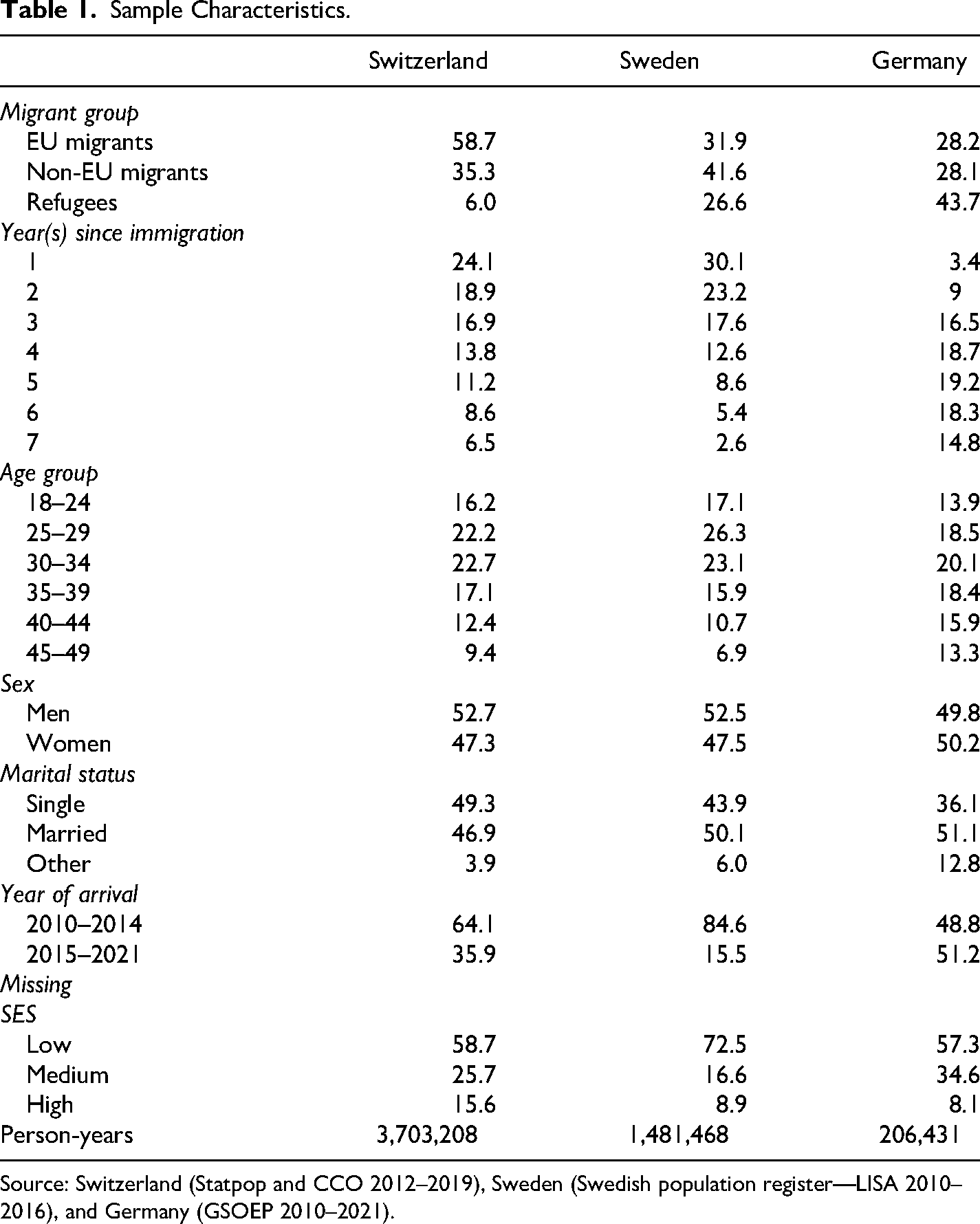
Source: Switzerland (Statpop and CCO 2012–2019), Sweden (Swedish population register—LISA 2010–2016), and Germany (GSOEP 2010–2021).
The analytical sample consists of recent immigrants and refugees aged 18–49 who have a legal residence status and migrated to one of the three countries between 2010 and 2021. The native-born population is used as a reference group category for the spatial distribution of the population in each country.
Analytical Strategy
The analysis focuses on immigrants’ and refugees’ place of residence during the first seven years following immigration in Sweden, Switzerland, or Germany. The dependent variable in all analyses is the type of municipality people live in namely, urban, suburban, or rural municipalities. The coding of municipalities is based on the authoritative classification from each countries statistical office which account for similar criteria, i.e., population size and density, and commuting (share or distance). The classification for Germany only distinguishes between urban and rural areas. It is not possible to further disaggregate these categories. Although it is possible to use proxy variables to triangulate suburbs, such as using population density by municipality, we elected to use the original categories as intended by the data owner for the sake of clarity and accuracy. It is important to note, however, that despite the use of similar criteria to classify municipalities, spatial units are not fully comparable across countries. The experience of living in a rural region in a small, highly connected country like Switzerland is likely to differ from that of living in a larger country with more isolated regions, such as Sweden. A nuanced interpretation is achieved through an examination of both within-country comparisons (differences between groups within each country) and between-country comparisons (same groups across countries).
We examine the residential histories following immigration using event history models on yearly longitudinal data. Immigrants and refugees enter the risk population from arrival in the country until the seventh year of residence. Right censoring occurs in cases of emigration, death, age 50, a lost in follow-up (survey data for Germany), or the end of observation (2016 for Sweden, 2019 for Switzerland, and 2021 for Germany).
The first set of analyses focuses on migration stocks. We estimate multinomial logistic models and present the unadjusted predicted probability to live in urban, suburban, or rural municipalities by time since immigration. The share of native-born (aged 18–49) in each settlement type is used as a baseline comparison for each country.
The second set of analyses emphasize migration flux. We examine origin–destination moves using a multistate model. We estimate the probability of living in urban, suburban, and rural municipality at time t + 1, conditional on living in each type of municipality at time t. There are three possible states and three possible outcomes: the person lives in an urban (suburban, or rural) municipality, and stay/move to an urban (suburban, or rural) municipality.
The first variable of interest is the immigrant groups, which is divided into three categories: immigrants born in one of the EU/EFTA member states, immigrants born outside the EU/EFTA, and refugees. The distinction between immigrant groups is based on the differing administrative regulations that govern their respective mobility. While EU immigrants are permitted to circulate and work within other EU countries, such opportunities are more constrained for non-EU immigrants, who require prior authorization to enter and sometimes relocate within these countries. Refugees face even greater constraints on their mobility, as explained in Section 4. The second variable of interest is the number of years since immigration to the country of residence. This variable is used as the baseline risk in the models. The observation period spanned a range of one year (e.g., for an individual who immigrated in 2015 and emigrated in 2016) to seven years (e.g., for an individual who immigrated in 2010 and who is still in the country in 2016). The datasets gather demographic attributes including sex, age, marital status, country of birth, and the year of arrival in the country. Socioeconomic variables vary by country and allow us to capture either the level of education (Germany) or income (Switzerland and Sweden). The variable is divided into three levels: low, medium, and high SES.
Results
The composition of the immigrant population differs considerably in the three countries. The refugee population was oversampled in the German dataset, constituting 44% of the sample. In Sweden and Switzerland, this demographic constitutes 27% and 6% of the respective total populations. Sweden is characterized by a higher share of non-EU immigrants, while Switzerland has a higher share of EU immigrants. In Germany, the share of EU and non-EU immigrants is the same (around 28%).
In our sample of recent immigrants, i.e., those who have been in the country for no more than seven years, immigrants who have been in the country for between one and three years are over-represented in Switzerland and Sweden and under-represented in Germany. In terms of the period of arrival, Germany counts more immigrants who arrived more recently, i.e., between 2015 and 2021. The sociodemographic profiles of the foreign-born population also differ in the three countries. The immigrant population in Germany is slightly older than in Switzerland and Sweden, yet all age groups are sufficiently represented. The proportions of men and women are fairly similar in all countries, with a small over-representation of men in Switzerland and Sweden. Singles are overrepresented in Switzerland while married individuals are overrepresented in Sweden and Germany. Finally, Sweden counts the highest share of foreign-born residents in the lower socio-economic category, followed by Switzerland and Germany. In contrast, Switzerland has the highest share of foreign-born in the higher socio-economic category, followed by Sweden and Germany.
Migration Stocks
The first set of analysis examines both within-group (Appendix A.1 in the supplementary materials) and between-group (Appendix A.2 in the supplementary materials) differences in the probability of living in urban, suburban, and rural municipalities by population subgroup and year since arrival in Sweden, Switzerland, and Germany. The results are summarized in the form of unadjusted probabilities in Figure 1.
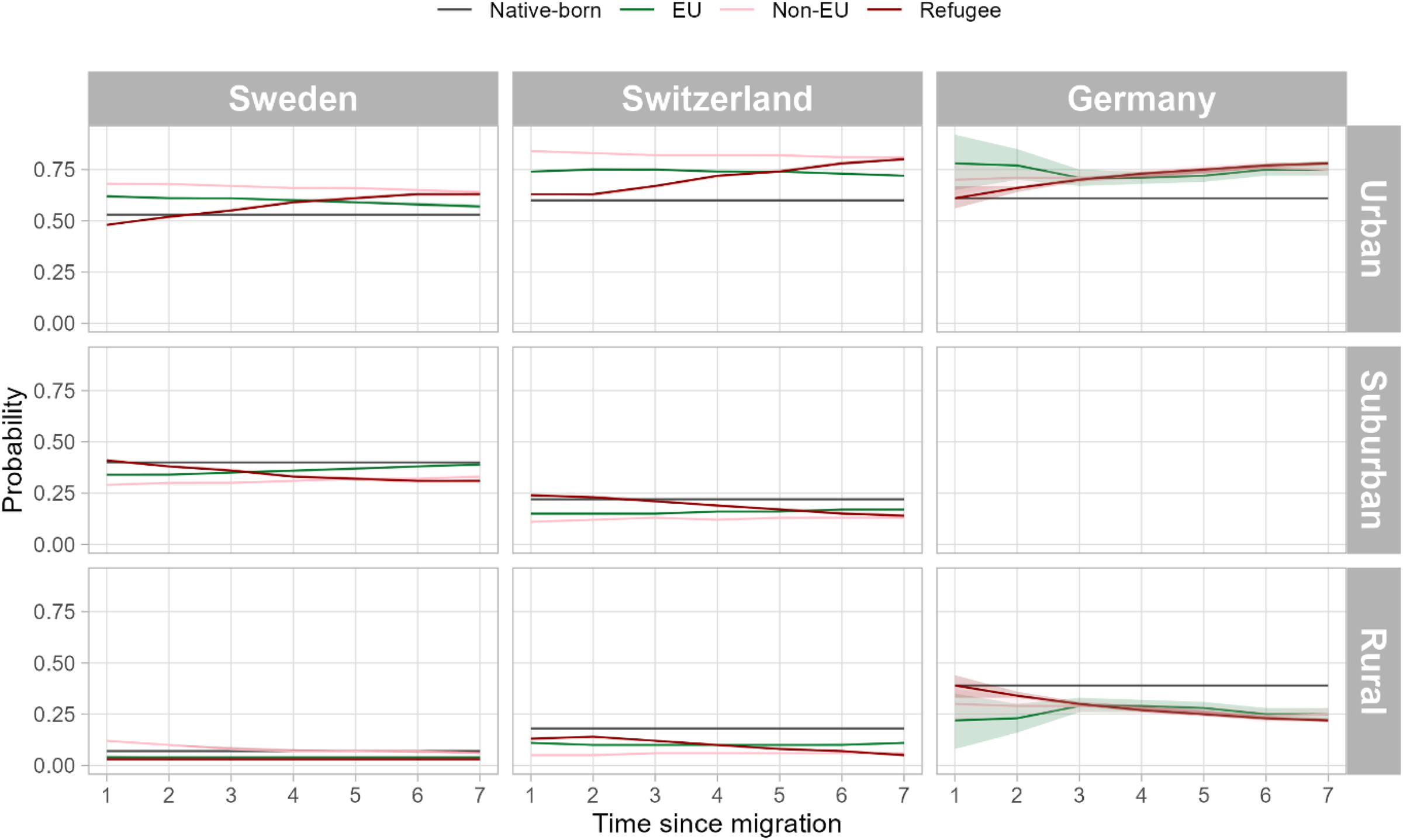
Unadjusted Probability to Live in Urban, Suburban, and Rural Areas by Population Subgroups and Time Since Immigration in Sweden, Switzerland, and Germany.
First, the capacity of places to attract and retain immigrant populations can be described by the changes in migration stocks over time (the within-group differences). To this end, we examine whether the probability of residing in urban, suburban, or rural areas increases or decreases between the first and seventh year in the country for each population subgroup. The most significant variations are observed among the refugee population. As intended by the dispersal policies, the probability of refugees living in each type of location is nearly identical to that of the native-born population in the first two to three years following arrival. Once mobility restrictions are lifted and refugees are allowed to move more freely, the probability of living in urban areas rises rapidly in all three countries, with Sweden, Germany, and Switzerland all experiencing an increase of 0.15, 0.17, and 0.18, respectively (i.e., the difference in probability between the seventh and the first year, see Appendix A.1 in the supplementary materials). In each country, the probability of refugees living in urban areas even reached the level of the non-EU group after seven years.
In contrast, the probability of EU and non-EU immigrants living in the different areas remains relatively stable over time. In Sweden, we see a slight decrease in the probability of living in urban areas over the first seven years for both EU (−0.04) and non-EU immigrants (−0.05). In Switzerland, this decrease is even less pronounced (−0.02 for the EU group and −0.03 non-EU group). In Germany, the patterns of the EU group resemble that of the EU groups from Sweden and Switzerland (−0.03 difference in probability between the seventh and first year) but the non-EU group shows an increase in urban areas over time (+0.05). The slight decrease in the probability of EU and non-EU immigrants living in urban areas is counterbalanced by an increase in the probability of living in suburban areas (with the exception of Germany, where this dimension is not available), whereas the net migration balance in rural areas is close to zero. In Germany, the observed pattern is one of divergence between groups in their propensity to settle in different locations during the initial three-year period. Following this, convergence occurs, with all foreign-born groups displaying an almost equal probability of residing in urban and rural areas.
Second, the contribution of immigrants and refugees to urbanization, suburbanization, or ruralization processes can be described by their over- or under-representation in these respective areas compared to the native-born population (the between-group differences). In general, all foreign-born groups are over-represented in urban areas in comparison with the native-born populations of the three countries. In contrast, they are under-represented in both suburban and rural areas. After a seven-year period, the refugee-native-born gap in urban areas is the highest in Switzerland (probability difference of 0.21 between refugees and native-born populations), followed by Germany (0.17% points), and Sweden (0.10% points) (see Appendix A.2 in the supplementary materials). This over-representation of refugees in urban areas is accompanied by a greater under-representation in suburban areas in Sweden and in rural areas in Switzerland.
The non-EU group is also clearly over-represented in urban areas after seven years (in an almost identical way as the refugee population). In Sweden, under-representation among the non-EU group is most pronounced in the suburban areas, while in Switzerland it is most pronounced in the rural areas. Finally, the geographical distribution of the EU group is most similar to that of the native-born population in Sweden. In Switzerland and Germany, the gap with native-born population remains important after seven years (0.12 and 0.14 difference, respectively).
Migration Flux
The second part of the analysis accounts for origin–destination moves and their determinants using a multistate model for each country. Figure 2 reports the annual probability of moving from the current type of municipality to another type of municipality by immigrant sub-groups.
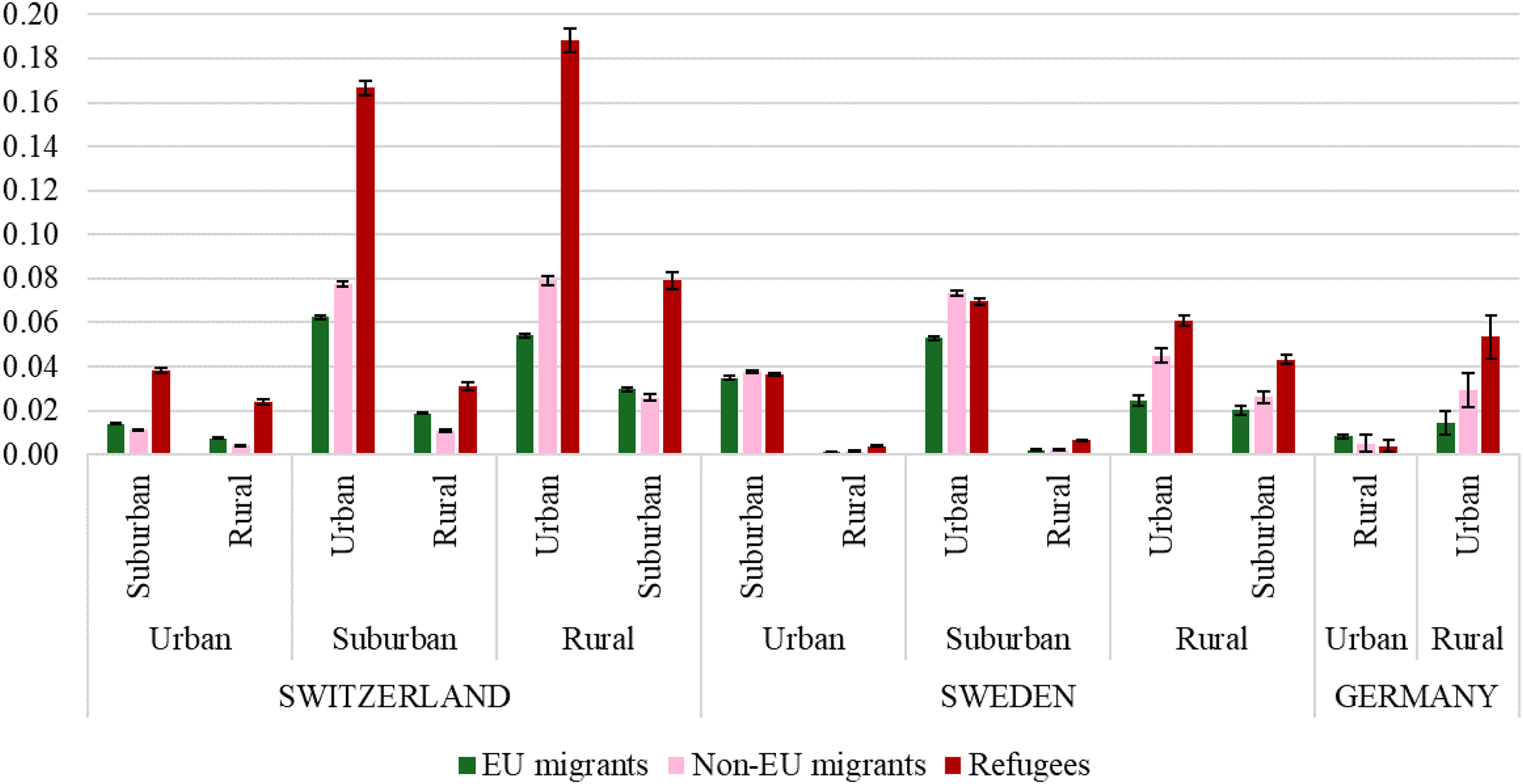
Origin–Destination (Annual) Probabilities by Population Sub-Group.
The probability of relocation across different types of municipalities is highest in Switzerland, followed by Sweden and Germany, which is in line with the general pattern of mobility previously identified in these countries (Causa and Pichelmann 2020, Delaporte et al. 2023). Urban locations gather the largest share of the immigrant population and have the lowest out migration probability. Urban residents mostly move toward the suburbs in Sweden and Switzerland, while urban to rural moves are very unlikely in the three countries. For those residing in suburban areas, the probability of relocation is greater in urban than in rural areas. Again, suburban to rural moves are uncommon, especially in Sweden. The population of rural areas displays a relatively high level of mobility, with individuals relocating to both suburban and urban areas. However, the latter receives a greater influx of migrants from rural communities.
Refugees are the most mobile population, in all types of locations and in all countries. The non-EU group represents the second most mobile demographic. The majority of these individuals relocate from suburban and rural regions to urban areas. The EU group exhibits the lowest level of mobility, yet when compared to the non-EU group, it displays a greater propensity to move to rural areas.
Next, we examine whether there are differences in the demographic and socioeconomic profiles of individuals who move to and from different types of municipalities. Figure 3 shows detailed origin–destination probabilities by socio-demographic profiles (see also Appendix A.3 in the supplementary materials). Two general results emerge from this model. First, out migration probabilities are the highest among rural residents of all profiles. For example, both younger and older immigrants are more likely to leave rural areas than their counterparts in urban or suburban areas. This applies to all categories of each variable. Second, the demographic profile of the movers is found to be consistent across urban, suburban, and rural settings. Immigrants and refugees who leave their current type of municipality tend to be younger, male, single or separated/widowed, and have a medium to higher SES.
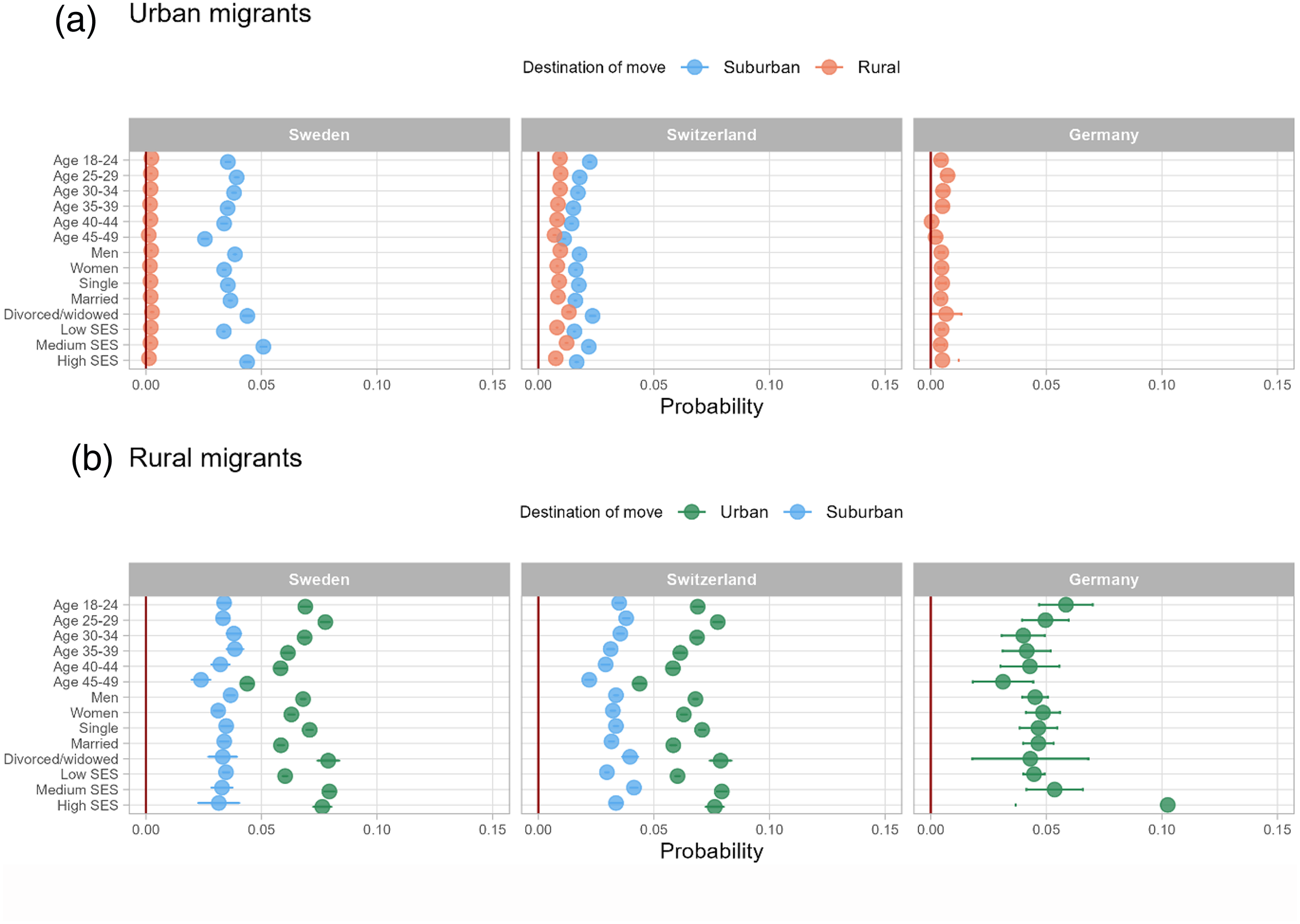
Origin–Destination Probabilities by Socio-Demographic Characteristics. (a) Origin: Urban, (b) Origin: Rural.
Choosing a secondary location also varies by number of years after arrival in the country: immigrants are generally more mobile during the first two years. This trend is consistent across all directions and aligns with the logic of housing adjustment, where long-distance moves are often followed by short-distance relocation, as documented in the literature (Lacroix and Zufferey 2019). According to the spatial assimilation model, immigrants with higher SES and who spend a longer time in the country are expected to be more likely to relocate from urban (typically, places with a larger share of immigrant populations) to the suburbs or rural areas. However, while we found that immigrants with lower SES are less likely to move in this direction, we did not observe a straightforward positive gradient in the propensity to move based on socioeconomic status. Additionally, moves in this direction do not increase with the amount of time spent in the country.
Discussion and Conclusion
This paper has provided insights into the spatial distribution and mobility of immigrants and refugees in NIDs across three European countries—Germany, Sweden, and Switzerland. NIDs were defined as non-urban areas, specifically distinguishing between suburban and rural regions. The paper has made a number of contributions by questioning: (1) the demographic role played by immigrant sub-groups in regional variations in population development, and (2) the dynamics of spatial adjustments within the context of NIDs as potential origin and destination points.
Regarding our first inquiry, the results showed that international migration is predominantly an urban phenomenon, as evidenced by both initial settlement patterns and secondary moves. The overwhelming majority of immigrants initially settle in urban locations, and those who relocate are more likely to move to than from urban areas. This trend is evident in all three countries studied. Over the seven years of observation, immigrants from all groups were clearly overrepresented in urban areas compared to their locally born counterparts, indicating that immigrants significantly contribute to urbanization processes. In contrast, there is minimal evidence to suggest that immigrants play a substantial role in suburbanization and ruralization.
Another approach to examining the demographic influence of immigrants in NIDs involved distinguishing between population subgroups and investigating migration selectivity. The analysis revealed that there was no discernible differential contribution in terms of socio-economic profiles. The characteristics of movers and stayers were found to be similar across urban, suburban, and rural settings. This finding indicates that secondary moves do not exacerbate existing patterns of spatial polarization, as suggested by prior research (see Khaef and Haandrikman 2024).
The second inquiry possesses theoretical merits, as it enhanced our understanding of the spatial adjustment processes of refugees and immigrants by considering the geographical context at origin and destination. The results indicate that, regarding urban–rural mobilities, both EU and non-EU immigrants exhibit relatively stable trajectories. There is limited evidence of secondary migration from urban to suburban areas, and even fewer instances of such movement to rural regions. In the United States, such residential trajectories, especially the process of suburbanization is considered as a critical component in the spatial assimilation process; however, our findings did not support this assertion. Although we have not explicitly tested the spatial assimilation hypothesis, two key indicators of this phenomenon—namely, the duration since immigration and socioeconomic status (considered as a time-varying variable)—were incorporated into the analysis. These factors did not demonstrate a strong association with transitions from urban to suburban or rural municipalities.
Spatial adjustment was more common in the opposite direction, that is, from rural or suburban areas to urban areas. It was argued that, because NIDs are often viewed by policymakers as economic zones, significant mismatches arise between infrastructure and needs when social spaces are altered, creating a gap between policy rhetoric and lived experiences (McAreavey and Argent 2018; Phillimore 2015). NIDs were also described as having limited routes to upward social mobility (McAreavey 2012). For immigrants who initially settle in NIDs—often due to economic opportunities—moving away from NIDs may be a more desirable outcome than the opposite. The fact that individuals with lower SES are less likely to move away from rural and suburban area questions the mechanisms and implications of such (im)mobility. A substantial body of literature, predominantly derived from qualitative studies, shows that immigrants in Europe's rural regions often encounter exploitative conditions related to wages, employment, and living standards (O’Reilly and Rye 2021). This paper further documents a phenomenon of relative spatial inertia for the more precarious ones.
Refugees subject to a dispersal policy had very distinct trajectories. They tend to relocate to urban areas in significant proportions once mobility restrictions are lifted. This finding is in alignment with previous research (de Hoon, Vink, and Schmeets 2021; Vogiazides and Mondani 2021). However, our approach also involved a comparative analysis of their levels over time with respect to both immigrant groups and the native-born population. It is noteworthy that, in all three countries, the proportion of refugees initially aligns with that of the native-born and attains the level of the non-EU group after seven years. While these analyses do not yield counterfactual results—that is, they cannot determine the proportion of refugees in urban areas had they not been subjected to a dispersal policy—they do, at a minimum, raise significant questions regarding the policy's effectiveness from a demographic perspective.
In interpreting the results, it is important to consider the limitations of this study; the majority of which are intrinsic to a comparative setting. The primary limitation pertains to the typology of the spatial units. One may legitimately contend that the urban/suburban/rural typology serves as a relatively simplistic proxy for NIDs. Further research may consider incorporating additional indicators into the definition of municipalities, such as historical migration trends. In addition, the typology does not consider the socioeconomic status or other standards of living within the municipalities. One potential upward residential trajectory in Europe involves a move from socioeconomically disadvantaged suburbs to more affluent ones. Future research would benefit from addressing these nuances to gain a better understanding of the implications of various residential trajectories to and from NIDs. Nonetheless, we argue that even a simplistic classification for the purpose of cross-country comparisons offers a valuable complement to the ubiquitous analysis of intra-metropolitan mobility of immigrants. Challenges also arise when using survey (Germany) and register data (Switzerland and Sweden) in a comparative setting. Sample differences stem from an underrepresentation of recent immigrants in Germany, as well as limited presence of short-term or circular labor migration in the three countries. Despite our efforts to account for the repeated and stepwise nature of migration flows, the early stages of the immigration process, as well as the most mobile groups, are only partially represented in the narrative, mostly for Germany. Furthermore, the operationalization of mobility as our key concept presents some limitations primarily due to the absence of information on emigration. Selective attrition has significant implications for our understanding of spatial dynamics, migration selectivity, and the demographic contributions of immigrants to regional development. Nevertheless, the results showed more similarities than differences across countries, and the comparisons conducted both within and between countries facilitated a more nuanced interpretation of the findings.
It is noteworthy that, despite the political will for the regionalization of immigration in numerous countries, the scientific knowledge generated to inform governmental assessments of migration policies remains limited. This study contributes to this assessment by documenting the geographical patterns. However, we argue that further knowledge accumulation is essential to anticipate future territorial development in relation to international migration flows. Of particular importance is the necessity for future research to explore the factors that attract and retain immigrants in NIDs. The distinction between whether immigrant settlement in cities is a result of a preference for urban areas per se or a spatial overlap (Wiedner and Schaeffer 2024) between the attributes of cities and the characteristics sought by immigrants when choosing where to live carries markedly different implications for policymakers. More generally, this paper advocates for a context-sensitive understanding of immigrant spatial adjustment by explicitly considering contextual characteristics in NIDs, migration selectivity (including migration motives), and their interplay.
Supplemental Material
sj-docx-1-mrx-10.1177_01979183251394007 - Supplemental material for Immigrant and Refugee Mobility Across the Urban–Rural Continuum in Three European Countries
Supplemental material, sj-docx-1-mrx-10.1177_01979183251394007 for Immigrant and Refugee Mobility Across the Urban–Rural Continuum in Three European Countries by Julie Lacroix, Chia Liu, Mary Abed Al Ahad, Hill Kulu, and Gunnar Andersson in International Migration Review
Footnotes

Funding
The authors disclosed receipt of the following financial support for the research, authorship, and/or publication of this article: This paper is part of the MigrantLife project that has received funding from the European Research Council (ERC) under the European Union's Horizon 2020 research and innovation programme (Grant agreement No. 834103). The paper also received funding from the Swiss National Science Foundation for the project Magnet Cities? Immigrants’ Inclusion Across the Urban–Rural Continuum (Grant: 10.004.608).
Declaration of Conflicting Interests
The authors declared no potential conflicts of interest with respect to the research, authorship, and/or publication of this article.
Supplemental Material
Supplemental material for this article is available online.
References
Supplementary Material
Please find the following supplemental material available below.
For Open Access articles published under a Creative Commons License, all supplemental material carries the same license as the article it is associated with.
For non-Open Access articles published, all supplemental material carries a non-exclusive license, and permission requests for re-use of supplemental material or any part of supplemental material shall be sent directly to the copyright owner as specified in the copyright notice associated with the article.
