




Abstract
Existing national panel surveys are limited in their ability to capture the dynamic nature of migrants’ cross-border trajectories, often losing track of individuals once they leave a country. This results in fragmented data on migrants’ life courses. To address this gap in understanding, we propose conceptual and methodological innovations, including improved survey methods and refined sample definitions, aimed at overcoming this data deficit. We also present best-practice examples that highlight the potential of these approaches to enhance empirical migration research and better align it with contemporary theoretical advancements.
Keywords
Introduction
International migration has grown during the last 50 years, and it is estimated that in 2020, about 280 million people lived outside the country where they were born (McAuliffe and Triandafyllidou 2021, 23). Thus, immigration and emigration increasingly shape the social, political, and economic development of today's societies (Bansak, Simpson and Zavodny 2020, chap. 1). It is of decisive importance for policymakers to improve their knowledge about the determinants and impacts of migration for sending and receiving societies. It is therefore hardly surprising that research endeavors and the associated findings on migration and its individual and social consequences have increased significantly (Gold and Nawyn 2019). Within the social sciences, perspectives that understand migration as a multidimensional process have gained in importance. The life course approach (e.g., Bernard, Kalemba and Nguyen 2022; Mulder and Hooimeijer 2012; Sheftel 2023; Wingens 2011) and, above all, the transnational perspective (e.g., Levitt and Glick Schiller 2004; Massey, Goldring and Durand 1994) have proven to be particularly fruitful to frame research regarding migration and migrants’ integration (Erlinghagen 2021; Jong and Valk 2020).
On closer inspection, however, empirical migration research has been limited in its ability to keep pace with these increasingly complex theoretical models. Current empirical studies often suffer from the lack of migration flow data adequately covering migrants’ cross-border life courses (McAuliffe and Triandafyllidou 2021, 29). Following a definition of the United Nations (2012), migration flow data are a dynamic measure covering the aggregated number of people crossing international borders, within a predefined timespan (e.g., within a given month or year). Although it would already be a considerable gain if data on migration flows were available in aggregated form (see e.g., Azose and Raftery 2019), the aim and aspiration of migration research should be to adequately depict the underlying individual migration trajectories with corresponding longitudinal data. As there is currently hardly any aggregated data available and even less data on individual migration histories, the “impact of migration on the individual and on sending and receiving communities and countries is only partly understood. […] Our understanding of migration is handicapped by fragmentation of research and training along disciplinary lines and inadequate measurements” (Willekens et al. 2016, 897).
As a result, empirical studies often have difficulties, e.g., investigating individual determinants and consequences of mobility between geographical or social spaces in a transnational life course perspective (Erlinghagen 2021; Ette et al. 2021). A central reason for this inconsistency between theoretical and empirical research in the field of migration is, from our perspective, that empirical migration research relies primarily on national panel surveys. As a consequence, national panel surveys typically track individuals only as long as they reside in the nation-state that is the target region of the survey. Thus, emigrants are surveyed only until they leave the target country, and at best immigrants are observed after their arrival in the target country. Consequently, migration research is often “fragmented into research on migration determinants (migration decision) and research on migration consequences (integration or assimilation) around the event of crossing national borders” (Erlinghagen 2021, 1340).
This problem is mainly rooted in the fact that internationally mobile individuals (migrants) are “hard-to-interview,” “hard-to-identify,” and “hard-to-sample” (Tourangeau 2014). First, migrants are “hard-to-interview” and “hard-to-identify” since established interviewer-based survey modes are not suitable for collecting data on individual migration histories. Second, migrants are “hard-to-sample,” with the result that surveys do not often sufficiently include recent immigrants and emigrants.
However, rethinking and expanding existing survey modes and sample definitions could help to significantly increase knowledge about internationally mobile individuals. Therefore, the primary aim of this Methods Note is to address why these deficits in longitudinal data on individual migration histories are particularly virulent in studying migrants as a geographically mobile population. We thereby aim to compile arguments and as well suitable data collection strategies for placing a stronger emphasis on such data in the future, especially within existing national large-scale panel projects.
A Call for a Multi-Sited Perspective: Immigrants Are Emigrants—and Vice Versa
Collecting data on individual migration histories would be a necessary first step in overcoming significant limitations of current empirical migration research, especially concerning the transnational life course perspective (e.g., Erlinghagen 2021). The availability of such data within panels could almost automatically resolve fragmentation in research on migration determinants and consequences around crossing national borders. Hence, individual flow data representing individual migration histories would provide completely new analytical opportunities. To date, research focusing on migration outcomes has mostly relied on “mono-sited” (Beauchemin 2014) comparisons between immigrants and resident populations within the receiving countries. These are without question important findings, yet a comprehensive understanding of migration outcomes requires an enhanced analytical perspective and additional comparison of developments in emigrants’ lives (e.g., social status) with those experienced by non-mobiles from the same origin society (Erlinghagen et al. 2021). A “multi-sited” (Beauchemin 2014) perspective in which migrants are understood not only as immigrants to a receiving country but simultaneously as emigrants leaving their country of origin (e.g., Ghimire et al. 2019) helps researchers to better understand determinants of migration, and in particular, the outcomes of migration for the individual life course over time. Such a multi-sited approach would not only include individuals’ flow data but also benefit from harmonized transnational panel surveys covering the non-mobile population of the sending country and the resident population in the (main) receiving countries.
Utilization of Web-Based Survey Modes
One major reason for not collecting individual migration flow data within national surveys, and thereby losing track of individuals who leave the country, are survey costs and resources that are strongly related to survey mode. For decades, interviewer-administered surveys were the gold standard of data collection. Hence, carrying out interviews all over the world was not feasible for both organizational and financial reasons (Couper and Ofstedal 2009). These restrictions made migrants a “hard-to-interview” group, and national panel surveys often fail to identify participants who emigrate after their last interview (see for example Schupp et al. 2008). It is often not possible to unequivocally differentiate emigrants from survey drop-outs. Moreover, emigrants are a “hard-to-identify” group because interviewers or panel organizers can only determine that a person can no longer be reached by their old address or phone number, not the reason the person is inaccessible (Vidal and Lersch 2021; Watson 2020; Watson and Wooden 2014).
During the past two decades, digitalization has brought new opportunities that can help overcome these two restrictions (hard-to-interview and hard-to-identify) by a step change toward a web-push (Dillman 2022). In such a design, surveys are mainly conducted online after an initial often offline invitation to participate, e.g., via mail or telephone (Cornesse et al. 2022; Genoni et al. 2021; Steinhauer et al. 2024). Follow-up contact with survey participants can then be organized primarily by email (or depending on the target group via specific messengers or social media platforms). This online-first contact strategy combined with a web survey mode saves a lot of organizational and financial resources (not only in the case of international mobile participants). Hence, if properly implemented, internationally mobile individuals are, at least with respect to organizational and financial resources, less difficult to interview via web mode. Moreover, unlike other types of addresses (e.g., postal address, phone number), especially email addresses do not often need to be changed when moving, making them more stable, which is particularly advantageous for interacting with geographically mobile individuals and which also makes migrants easier to identify (Bengochea, Fernández and Montiel 2025). Consequently, recent studies have already demonstrated that web-pushes with an online-first contact strategy are enhancing the possibility of cost-efficiently surveying internationally mobile individuals even after several border crossings, thereby generating flow data representing individual migration histories within surveys. This is a cost-effective approach that also allows for ease of scaling up migration surveys. Additional cases can be included in any number of target countries without substantially increasing costs (e.g., Décieux et al. 2021; Wassink and Massey 2022). Moreover, online surveys generally allow participants a high degree of flexibility. Respondents can decide when and where they answer questions and whether they want to pause the survey and resume it later (Cornesse et al. 2022; Dillman 2017; Lee et al. 2018). This flexibility not only decreases panel attrition and increases survey comfort, but is also especially advantageous when surveying individuals across different time zones as is often the case in studies of international mobility (Ghimire et al. 2019). Studies have also shown that (internationally) mobile groups are very well-suited to participate in online surveys in terms of social characteristics, because they tend to be younger, more educated, and have a greater affinity for digital technologies, all traits that correlate positively with participation in online surveys (Ette et al. 2020; Fiorio et al. 2021; Guichard 2020; Kauppinen, Nikolka and Poutvaara 2020; Keusch and Yan 2017; Schlosser and Mays 2018; Zhan and Deole 2022).
At least concerning scalability and flexibility, the web survey methodology affords plentiful advantages for gathering information on the cross-border life courses of internationally mobile individuals. This methodology affords researchers the opportunity to conduct panel studies in virtually all geographic areas, which would have been impossible using other survey modes due to a lack of feasibility and resources.
Rethinking and Expanding Existing Sample Definitions
Migrants are usually a small group compared to non-mobile populations within the origin society and in the receiving countries, and are therefore considered “hard-to-sample” (Tourangeau 2014). Of course, the total number of immigrants living in a country can be quite high. In Germany, for example, immigrants and their children comprise about 30% of the total population. In this scenario, sampling the immigrant population is not challenging. But from a survey methodological perspective, we should not be satisfied with immigrants randomly sampled as a static part of the resident population in a country without regard to how long the immigrants have lived in the country. Such a sampling approach results in non-trivial problems: None of the collected data would cover return or onward migration flows between the time of immigration and the time of sampling. Consequently, information about the selective composition of the immigrant sample is missing. Therefore, analyses relying on a selective immigrant sample would be at risk of biased conclusions, e.g., regarding determinants of societal integration or inequalities (Constant and Massey 2004).
One solution for this selectivity problem could be to specify an analytical sample that consists of only recent immigrants, ensuring they could be observed and surveyed shortly after moving and could be followed up on even after emigrating again in consecutive panel waves. However, the share of recent immigrants among all immigrants in a sample is usually too small, particularly if longitudinal analyses aim to compare stayers with return or onward migrants. Considering Germany as one of Europe's major immigration countries, only about 0.5%–2.5% of the resident population has immigrated each year (see the official migration figures of the German Federal Statistical Office). In a representative sample of 10,000 participants from this population, only 50–250 recent immigrants should be observed each survey year. Hence, even if this number cumulates over time, these are low case numbers for valid analyses. The same problem of low case numbers would also occur for emigrants.
The problem of small case numbers of recent immigrants and emigrants cannot be properly addressed by simply oversampling these groups in a given sample frame representing the resident population. Therefore, independent samples of new immigrants, recent emigrants, and recent return migrants (defined as nationals who recently moved from abroad back to their country of origin) should be drawn. This would lead to multi-sited surveys consisting of a core sample of the resident population complemented by three sufficiently large samples: recent emigrants, recent immigrants, and recent return migrants. If it is possible to identify new immigrants, emigrants, and return migrants in population registers that should also provide reliable contact information (as is, e.g., the case in Germany), a probability-based sampling approach would be the ideal sampling procedure. Although probability samples are still the gold standard of empirical research, surveys based on non-probability samples, e.g., recruiting participants from social media (Pötzschke 2022) or their social networks (Merli et al. 2022) or spin-off samples of emigrants from a national panel within the country of origin (Massey and Zenteno 2000), could be considered as alternatives, especially when no registers are available for the group of interest. Moreover, non-probability sampling strategies could help reach super-mobile individuals with multiple places of residence or who are (repeatedly) sent abroad as “expatriates” by their employer for only short periods, and could also create an opportunity to sample undocumented migrants. Data from non-probability samples cannot adequately replace studies relying on probability samples, but could complement and help to improve our understanding of the determinants and consequences of migration.
Enhancing the Methodology of Migration Research: Recommendations
Current migration research is limited in scope due to methodological shortcomings that primarily arise from established survey modes and sample definitions in population surveys. To overcome these limitations, we recommend the following three survey methodological enhancements to complement existing approaches:
1.
As mentioned above, migrants classically belong to hard-to-survey populations and a crucial challenge is finding an adequate procedure to get access to this group. The ideal procedure usually is an independent probability-based register sample in order to achieve the best possible data quality and sampling frames that are ideally independent of any selection process except of being registered. However, in practice, such a design approach is often not possible or feasible due to several issues (e.g., no suitable register for the target group). A first alternative procedure is to open existing panel designs to follow-up respondents even if they migrate abroad and leave the initial ‘target country’ of the sample and thereby, e.g., derive a spin-off sample of recent emigrants. The success of such an open sampling strategy depends on whether we can assume that there are enough participants in the original population sample who subsequently emigrate abroad or have recently returned from abroad. However, this may only be practicable in countries or regions where emigration and return migration is very frequent. A second alternative that can be applied is a multi-actor design (e.g., Hank et al. 2024). In this case existing sampling concepts (such as family or household) are widened for internationally mobile individuals. Then access to internationally mobile relatives is gained via so-called anchor persons regularly sampled (e.g., via population register) within a national panel survey. To get in contact with international mobiles, these anchor persons were asked if they have relatives (e.g., former household or family members) who recently migrated abroad and if they would provide their contact information. By means of this procedure, it is then possible to contact and survey individuals living outside the primary target country or region of the initial sample. Such a multi-actor strategy can also be used to develop a sample network from the anchors (De Haas 2010). These anchor-based strategies are confronted with the danger that the resulting sample of migrants named by the anchors may introduce additional sources of uncertainty and may potentially lead to more biased results. An additional alternative is non-probability samples, for example via social media. These are usually much cheaper and easier to implement. However, these approaches face the problem that they are no longer a random sample and therefore at risk of substantial biases due to unknown selection mechanisms.
Regardless of the sampling strategy, for reasons of feasibility and cost-efficiency, the researcher is also faced with the question of whether to extend the sampling frame the migrant sample to only a few carefully selected countries or to choose an open design and include all potential destination countries in the sampling frame.
2. Migration research also needs (panel) studies that are open to collect
There are two common approaches for collecting flow data on individual migration histories as part of a survey. The first is to ask retrospective questions about the migration biography during the survey without ongoing tracking. Such an approach is most often used within cross-sectional survey projects. However, this approach is accompanied by the problems that are relevant to all retrospective questions, namely biases and vagueness due to missing or inaccurate memories, especially for events that lie further in the past (e.g., Lugtig, Glasner and Boevé 2016). A more sophisticated approach is to collect flow data within a panel survey by continuing to interview respondents, even if respondents move across national borders. In this approach, individual migration trajectories including the border crossings that, e.g., take place between the survey waves are directly conducted and by this close to the actual migration event.
However, for reasons of practicability and the costs involved, surveys following up with respondents even after they have moved abroad may not be feasible for most panel projects, especially projects using face-to-face interviews. It is hardly conceivable that a panel study having a large number of interviewers travelling to emigrated participants in order to interview them abroad. Consequently, different ways of at least limiting costs and efforts exist: Some studies limit their design to only a small number of particularly meaningful destination countries where they follow-up with their respondents. Other studies only follow up with their respondents for one particular survey wave. A further alternative is to offer a self-administered mode instead of an expensive interviewer-administered mode, and here in particular a web mode for the internationally mobile respondents, which usually drastically reduces the organizational and budgetary problems (e.g., Ette et al. 2021).
3. Stronger efforts to
Since our focus is on gathering high-quality data for migration research, input harmonization (Wolf et al. 2016, 504) is particularly relevant here. Input harmonization refers to the standardization of survey instruments, usually meaning that the same survey instruments are used across different surveys to operationalize the same theoretical concepts. Moreover, two different harmonization reference directions are possible here. The first is to harmonize the migrant samples with national data from the (former) destination country. The other direction is to harmonize the emigration and remigration data with national survey data form the country of origin.
Existing Examples of Best Practices from Recent Migration Research
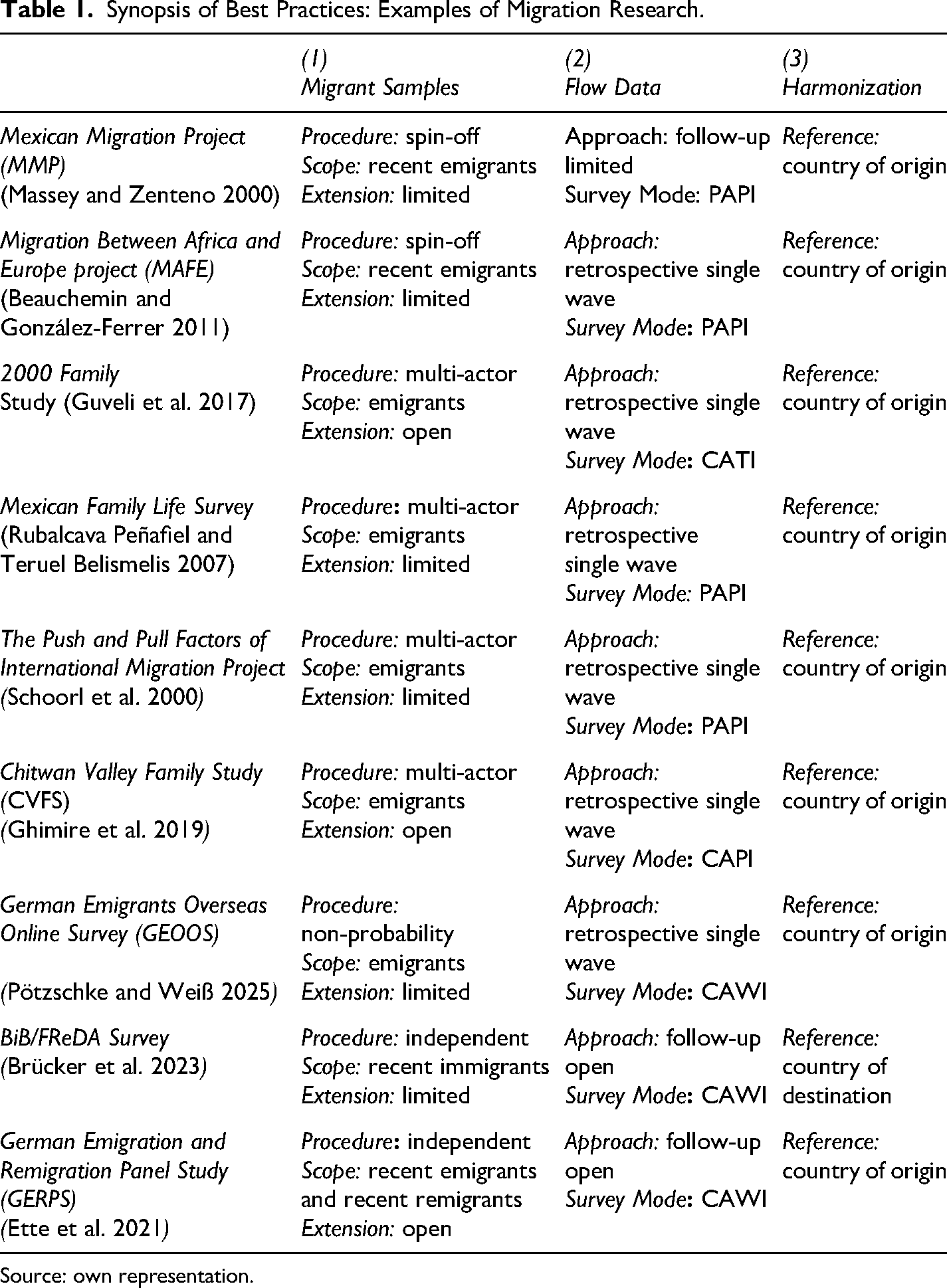
Although migration research principally suffers from the methodological lacunas described above, several survey projects have successfully tackled at least some of these shortcomings. As a condensed overview, Table 1 provides a synopsis of best practices from migration research projects that have already applied some of the methodological improvements proposed above. By listing these, our aim is not to provide a full or systematic literature review or an in-depth case study of each of these best-practice examples. Instead, we aim to broadly and comprehensively illustrate how the problems and challenges addressed in (1) to (3), have already been approached in existing studies and can be approached in future practice. We deliberately focus here on examining these three central aspects. However, details on these studies can be found in the corresponding detailed study documentations we e.g., reference to in Table 1. Thus, we can provide a broad overview of the wide range of possibilities and practices, as well as their problems, limitations, strengths, and weaknesses.
Synopsis of Best Practices: Examples of Migration Research.
Source: own representation.
The synopsis in Table 1 is structured in three columns along our methodological recommendations for future migration research. The synopsis is therefore structured as follows:
Recommendation (1) “migrant samples”: Here we distinguish studies along three dimensions: procedure, scope, and destination country. “Procedure” refers to whether a migrant sample (a) is drawn as an independent sample, e.g., as a probability-based register sample; (b) is derived as a spin-off of an existing (probability-based) population sample; (c) consists of a multi-actor sample established through information provided by an anchor person; or (d) is recruited through as a non-probability sample e.g., from social media. “Scope” refers to which migrant group is covered by the sample: (recent) emigrants, (recent) immigrants, and/or (recent) remigrants. “Extension” differentiates between studies that have (a) a limited sampling frame concerning the destination countries of the international mobiles (e.g., limited to one specific country/the most common destination country) or (b) an open sampling frame that covers all possible destination countries.
Recommendation (2) “flow data”: With regard to flow data, we distinguish studies according to two dimensions: approach and survey mode. “Approach” differentiates (a) studies that collect individual flow data retrospectively and within one single wave, (b) studies that follow up with respondents and collect individual flow data via panel surveys with a limited design (e.g., only follow up respondents that return to the home country or on-migrate to specific countries), and (c) panel studies that follow up with respondents and collect flow data within an open approach that gathers data on on-migrations to all possible destination countries during the survey. “Survey mode” indicates how the data are collected, e.g., via personal interviews (CAPI), telephone interviews (CATI), paper and pencil interviews (PAPI), or web-based interviews (CAWI).
Recommendation (3) “harmonization”: We rely only on input-harmonized survey projects and differentiate on one dimension of reference. We distinguish between studies that harmonize their survey instruments and/or generated variables (a) toward surveys of migrants’ country of origin, or (b) toward surveys of migrants’ destination countries.
Our comparison of various migrant sample projects summarized in this synopsis in Table 1 reveal significant diversity in methodologies and approaches, reflecting the complexity of studying migration patterns. With regard to our first recommendation on migrant samples, it turns out that the selected projects exhibit a wide range of sampling methodologies, each tailored to their specific research goals and contexts. The Mexican Migration Project (MMP) and the Migration Between Africa and Europe Project (MAFE) used spin-off samples from existing national population samples. The 2000 Family Study, the Mexican Family Life Survey, the Push and Pull Factors of International Migration Project, and the Chitwan Valley Family Study (CVFS) used a multi-actor design based on an anchor concept. The 2000 Family Study approached respondents’ internationally mobile family members, but the Push and Pull Factors of International Migration Project and the CVFS extended the household concept of the national panel, also including those who were still considered household members but did not reside in the household. In contrast to all of those projects, GEOOS used a non-probability social media sampling, and the BiB/FReDA Refugee Survey and the German Emigration and Remigration Panel Study (GERPS) used independent, probability-based register samples. Concerning the scope of the migrant samples, all projects using an anchor or spin-off sampling procedure, as well as GERPS and GEOOS, focused on emigrants. Projects with spin-off samples and GERPS specifically focused on recent emigrants, with GERPS also targeting recent remigrants in the sample. The BiB/FReDA Survey focused on recent immigrants. Both projects with spin-off samples limited their sampling frame to a small number of destination countries; the Mexican Migration Project (MMP) focused on Migration between Mexico and the United States (US), and the Migration Between Africa and Europe project (MAFE) on flows from Sub-Saharan Africa to six European countries (Belgium, France, Italy, the Netherlands, Spain, and the UK). GEOOS focused on emigrants living outside of Europe, and two of the anchor-based surveys limited their destination countries to major ones, with the Mexican Family Life Survey focused only on Mexican emigrants to the US, and the Push and Pull Factors of International Migration Project focused on emigration flows from Turkey, North-Africa (Egypt, Morocco), and Sub-Saharan Africa to the European Union. The other two anchor-based projects followed an open sampling approach, namely the 2000 Family Study and the Chitwan Valley Family Study (CVFS). The BiB/FReDA Survey sampled recent immigrants from Ukraine to Germany, and GERPS has utilized an open sampling frame, targeting internationally mobile Germans regardless of their destination country.
With regard to our second recommendation on flow data, we can observe that there are different ways to generate such flow data within a survey. In the best-practice projects we identified, both commonly applied approaches, retrospective questions and follow-up approaches, can be found. Generally, projects with an anchor procedure tend to use retrospective questions within one single wave to generate their flow data and do not pursue an on-migration design. But the four anchor projects differ in their survey mode: two used PAPI, one used CATI, and one used CAPI. In contrast, the register-based surveys used retrospective questions and an open follow-up approach, following respondents even if they migrated abroad, regardless of whether they returned to their home country or moved to a third country. In addition, both projects used a web-push approach leading to CAWI. Projects with a spin-off sampling procedure applied different flow data approaches. Although the Migration Between Africa and Europe Project (MAFE) used only retrospective questions within one single wave to generate flow data, the Mexican Migration Project (MMP) also produced flow data during the survey but limited to Mexicans former in the US who remigrated back to Mexico. Both projects with a spin-off sampling design used PAPI questionnaires. GEOOS relying on CAWI mode also used only retrospective questions to generate flow data within one single wave.
With regard to our third recommendation on data harmonization, all best practice projects mentioned here relied on input harmonization approaches to achieve the best possible data quality and the broadest possible analytical potential for migration research. Moreover, all projects, except the BiB/FReDA Survey, used the country of origin as their reference for harmonization. The BiB/FReDA Survey, focusing on recent immigrants, referenced its input harmonization toward the country of destination.
Overall, this synopsis of best practices highlights diverse methodological approaches used in various migrant research projects, emphasizing the complexity of conducting individual migration histories. Despite their differences, all presented projects share the common feature of collecting cross-border data on distinct target groups. However, the strategies in which they conducted their data and the scale, e.g., the number of target countries involved, varied, largely depending on the specific objectives of each project. All these best practice studies should be seen as examples, providing a structured yet adaptable framework, but should not constrain future projects in scope or methodology.
Conclusion
In an increasingly globalized world, knowledge about the extent, causes, and consequences of migration is of crucial importance. Only on the basis of scientific findings is it possible to assess the consequences of migration for individuals and for society as a whole and, if necessary, to respond politically. Even though migration-related knowledge has grown enormously in recent decades, there are still many blind spots where we have little or fragmentary knowledge. To date, migration research has not been sufficiently successful in tracing and analyzing individual migration trajectories across geographical borders on the basis of data.
This article identifies existing data deficits as a major cause and makes suggestions as to how the underlying challenges could be solved. The three innovations in data collection appear to us to be fruitful in overcoming or at least significantly reducing the existing data deficits in migration research. First, a central requirement is the development of surveys that pursue a multi-sited perspective. In the future, our aim must be to be able to directly observe internationally mobile life courses beyond national borders through the use of appropriate individual flow data. Second, web-based surveys should be used consistently for implementation, at least as a complementary mode, as they make it feasible to map current life circumstances, particularly repeatedly in a longitudinal section, regardless of the changing locations of respondents as this mode offers respondents high levels of flexibility, e.g., so respondents across time zones can participate at times convenient for them. Moreover, the web mode offers the highest levels of scalability (e.g., the number of respondents and target countries) for comparable data quality. Moreover, for most projects aiming to follow internationally mobile respondents across a larger number of destinations, web surveys would be the only realizable strategy and alternative to having no quantitative data. Third, the established sampling strategies should be reconsidered and expanded in order to ultimately arrive at valid results. In particular, this involves drawing separate samples for new migrants – whether newly emigrated or newly returned individuals.
There are existing studies applying and implementing these requirements across various projects. It is important to learn from this experience and to develop suitable, tailored methodological solutions for specific challenges and specific research questions. Also it may not always be feasible to implement all of our recommendations due to practical constraints (specific research question, difficult field access, limited financial resources, short project durations). Moreover, it might be that web surveys, while promising, may not be universally accessible to all migrant populations, especially in cases where technological access or digital literacy is limited. However, technological advancements have significantly improved the viability of web surveys for migration research. Although web samples have historically skewed younger, digital accessibility is expanding across all age groups, and especially in migrant groups as they use online tools to stay connected with their families and communities, reducing web access limitations over time (Bach, Cornesse and Daikeler West et al. 2024). Moreover, even if practical constraints prevent direct implementation of our recommendations, these may help researches to provide a more cautious and precise interpretation and classification of empirical findings and, by this, more nuanced conclusions and also to clarify their analytical limitations within more conventional designs.
We therefore hope that our recommendations can help researchers and policy makers recognize, understand, discuss and ideally overcome these limits of quantitative research on migration so they may support more informed decisions when designing future research projects. In addition, we trust that it will become clear that the collection of meaningful, longitudinal data is particularly essential for migration research. In this respect, we also anticipate that existing data infrastructures, policy makers, and national and international research funders will recognize the urgent need to improve the data infrastructure for migration research and consider this need in their decisions regarding funding programs and funding budgets.
Footnotes

Funding
The authors received no financial support for the research, authorship, and/or publication of this article.
Declaration of Conflicting Interests
The authors declared no potential conflicts of interest with respect to the research, authorship, and/or publication of this article.