




Abstract
This article reflects on what migration studies have accomplished when researching the role of welfare in migration. It highlights that conventional migration theories do not sufficiently account for how people understand welfare and how they interpret and react to welfare perceptions. The article calls for more attention to the interplay of welfare's subjectivity and migration processes to better understand (im)mobility aspirations and decisions. This dynamic interplay can be captured through the concept of welfare mobilities and studied by combining old and new migration theories within a more integrated analytical framework. The article provides an empirical example of the insights that this approach can bring and shows the need to conceptualize welfare as a structure, a process, and an experience to achieve a more comprehensive understanding of its role in migration decision making.
Introduction
Welfare is a contested and morally loaded concept — it concerns how we think people live and how we should live (Daly 2011). The welfare concept originated and is mostly used in wealthier and highly industrialized regions of the world. This raises questions about how it applies to the so-called Global South (Dean 2011), or whether the welfare concept is even useful in overcoming Western-centric perspectives in migration studies. Nonetheless, an increasing number of studies examine the interplay between welfare and migration. Welfare and migration interactions are also hot topics in political and public debates, and public attitudes to social welfare expenditure, immigration, and economic insecurities are intertwined (Burgoon and Rooduijn 2021).
In an interconnected world that is highly influenced by social media, historical legacies of colonialism, and migration, the welfare concept can provide valuable insights into how people perceive local and global inequalities. It can help us understand what shapes these perceptions, how people reflect on and react to perceived inequalities (through their positionings, expectations, and aspirations about how people should live), and how this subjectivity in welfare influences migration aspirations and decisions.
This article examines how migration studies have explored welfare's influence on migration decision making and suggests future research directions, focusing on welfare's interconnected political and psychological aspects of subjectivity, including people's perceptions, self-reflections on exclusion and inclusion, and related affective states, desires, and recognition claims (Fischer 2007, Krause and Schramm 2011). The article calls for greater attention to the diverse spatial, temporal, and social environments that influence how people understand and experience welfare, as well as the role of welfare's subjectivities in migration, mobility, and immobility aspirations and decisions.
The remainder of the article is organized in two parts. The first part examines what migration studies have accomplished to better understand the role of welfare in migration decision making, and what is still missing, focusing particularly on conceptual and theoretical aspects. Next, it describes the multifaceted nature of the concepts of welfare and migration, introducing the concept of welfare mobilities to capture their dynamic interplay and subjectivity. Addressing the gaps in the role of welfare in migration decision making, welfare mobilities denote interrelated and changing meanings, aspirations, expectations, and decisions regarding welfare and (im)mobility. Drawing on migration studies, it then discusses how welfare mobilities are spatially, socially, and historically contingent. Finally, it proposes how older and newer theoretical approaches to migration and welfare can be combined to better understand the role of welfare subjectivities in migration decision making.
The second part of the article demonstrates the insights that a theoretically eclectic, multisited, and multilevel approach to welfare mobilities can bring, drawing upon empirical examples. These insights are crystallized through an integrated welfare mobilities analytical framework, presented alongside a case study 1 that showcases the importance of taking an actor-centered, social constructionist approach, in which reality is subjective, socially constructed by social interactions in everyday life, and shaped by people's circumstances in the present and their projections toward the past and the future (Berger and Luckmann 1991).
The narratives of four Moroccan men, drawn from this multisited study on Moroccan migration to Europe from the late 1990s to 2021, highlight experiences of exclusion from positive developments in different welfare regimes, a welfare paradox. The factors contributing to these four men's feelings of exclusion, unfulfilled aspirations, and lack of control and choice included precarious employment and limited social mobility, security, and access to social rights. Perceptions of inequality and estrangement were also triggered by their increased aspirations and expectations about what life should be, and which actors they felt should contribute to people's welfare. These expectations and aspirations were shaped by changes in lifestyles and values brought about by transformations in welfare regimes and migration processes. Migration, voluntary immobility, multisited arrangements, and onward migration were different ways of reacting to and resisting perceived inequality, material insecurity, and discrimination.
The article concludes with the contention that, to fully grasp the role of welfare in migration decision making, we need to understand welfare as a structure, a process, and an experience. It also calls for an increased focus on welfare subjectivities across global regions to fully comprehend how they are influenced by diverse and evolving spatial, historical, social, and natural environments.
Dimensions and Levels of Welfare and Migration
Before examining migration studies’ approaches to welfare and migration interactions in people's migration decision making, it is essential to define and reflect upon these concepts. This section offers a comprehensive overview of the multiple dimensions and levels of welfare and migration.
Beyond any intellectual and ideological perspectives on how people live and should live, one way to approach the complexities of the welfare concept is to focus on three of its inherent ethical underpinnings: basic needs, equality, and freedom (White 2010). As White argued, these three ethical aspects are captured at the individual level by the capabilities approach to welfare and justice (Sen 1992, 1999a, 1999b, 2008). The capabilities approach is central to understanding migration from the perspective of the interactions between development, social transformations (ST), and people's (im)mobility aspirations and freedoms to choose where to live (de Haas 2003, 2021). The capabilities approach also enables us to move beyond a focus on resources and needs in the welfare–migration interplay. It captures diverse individual experiences of social justice shaped over time by local, national, and transnational contexts (Eichsteller 2021).
In this approach, freedom does not necessarily refer to the maximization of individual freedoms. Instead, it can be understood in terms of freedom of movement and freedom to remain, and how people with different migration backgrounds make choices within political, social, historical, and economic contexts, as well as based on relations with others — within communities and their past and present cultural, religious, or political characteristics (Rajendra 2015) — that is, within existing and perceived welfare structures.
The capabilities approach also allows conceptualizing welfare as people's opportunities to achieve ways of doing and being that they value, and as their ability to pursue such opportunities without discrimination or constraints. This ability contributes to people's well-being, which relates to biological survival at the individual level; and to social status and opportunities for participation and inclusion within communities (Stewart 2005, White 2010). Well-being denotes the satisfaction of (objective) needs and (subjective) wants in a wide range of life domains, including physical, material, social, and emotional dimensions (Felce and Perry 1995). This satisfaction is conditioned by people's circumstances and preferences (Boarini, Kolev, and Mcgregor 2014).
This approach to welfare helps us understand people's capacity to be reflexive and creative (Williams, Popay and Oakley 2005) toward what they perceive are their social positions within social relations of power and inequality, and how they react to such perceptions — for instance, in terms of their self-esteem, identities, and possible strategies to take control over their lives (Williams, Popay, and Oakley 2005). Welfare provides conditions to achieve mutual security, dignity, and respect (Williams 1999), but a myriad of elements likely influence access to opportunities, what people value, what they do, and their well-being. Elements influencing well-being include health, personal relationships, political freedom, the natural environment, people's past and present perceptions (including perceptions about other people), or expectations about the future (Schwarz and Strack 1999, Van Praag and Frijters 1999). Being included in groups (families, communities, or political systems) also conditions people's opportunities and choices (Stewart 2005). Many other elements influence or relate to well-being, such as gender, age, race, ethnicity, socioeconomic status (including immigration status), personality traits, social support, discrimination, religiosity, location, or the infrastructures in those places (Das et al. 2020).
In essence, the welfare concept refers to far more than merely maximizing resources and securing basic needs. Beyond its protective aspects, welfare also concerns expectations about social life, and the welfare concept does not focus on the role of the state alone. Nonstate actors also shape social stratification processes, livelihoods, and well-being; and gender, religion, social networks, or nonprofit organizations are often more relevant factors than the state (Gough 2004).
In this sense, the concept of welfare regime captures the interactions between the public sector, the private sector, communities, nonprofit organizations, and households that, through institutional arrangements, policies, and practices, provide livelihoods and well-being at the individual or collective level (Gough 2004; Wood and Gough 2006). Here, “regime” implies the power relationships that result from different actors’ interactions and constrain people through rules and norms (Gough 2004).
From this perspective, welfare has macro-, meso-, and microlevel aspects. At the macrolevel, for instance, actions of nation-states shape the broader economic context. At the mesolevel, communities and households also shape welfare, and their interactions shape what is accessible to people. Furthermore, how communities and households interact with other actors shapes microlevel experiences of well-being.
In the migration literature, we also study migration from the macro-, meso-, and microlevel perspectives. Migration is not static but a process in constant change. At the macrolevel, migration is an inherent part of broader processes of ST (Castles 2010, de Haas et al. 2020) — fundamental shifts in the way society is organized that go beyond continual processes of social change (Castles 2010).
Local and regional histories and processes of colonization have influenced mobility and migration, whether they are now categorized as internal or international, and the distinctions between migration and asylum (Astolfo and Allsopp 2023; Purkayastha 2023). Immobility and migration (either within or across borders) are related processes resulting from the interaction of actors, rules, procedures, and flows of information that reflect the functioning of the state, which is also continually changing (Xiang 2016). These interactions are also influenced by mobility regimes consisting of global and local government powers, policies, and other actors that facilitate or constrain migration, spatial and social mobility, and immobility (Glick Schiller and Salazar 2013). Mobility regimes and welfare regimes are intertwined in shaping people's access to basic needs, opportunities, and freedoms, for instance, in terms of care provision and mobility (Brandhorst 2020).
At the mesolevel, migration processes themselves transform communities through direct and indirect feedback mechanisms (Mabogunje 1970) that are linked to the circulation of people, goods, and ideas between different places. Through interactions with migrants, as well as through more impersonal channels of information, images, and ideas (e.g., through TV series, social media, houses built by migrants, etc.), migration generates positive and negative feedback loops that transform communities and their aspirations, as well as patterns and drivers of migration (de Haas 2010; Jolivet 2015; Bakewell and Jolivet 2016). Migration triggers mobilities of the mind (Zelinsky 1971) — transformations and intensifications of people's perceptions and thoughts at several levels, including geographical and temporal ones.
Finally, at the microlevel, migration is also a process in continuous change, reconsideration (Boyer 2005), and rerouting (Schapendonk et al. 2018) over the life course. Individual and household migration projects evolve with migrants’ experiences in different contexts, their dynamic individual and collective practices, and the information and knowledge they accumulate over time and across space (Boyer 2005). From the individual perspective, migration is more than a linear process (Collyer 2007; Schapendonk 2010) from one place to the next, with one household member, moving to one place and followed after some time by the spouse and perhaps children or other family members. Mobilities are processes that are driven by not only needs, but also desires to become and transform, and not necessarily the outcome of rational economic choices (Collins 2020; Czaika, Bijak, and Prike 2021).
Subjectivity in Welfare Mobilities
The entanglements between the above-mentioned levels and dimensions of migration and welfare and their changing character can be brought together by the concept of welfare mobilities. Welfare mobilities refer to interrelated and dynamic ideas, meanings, perceptions, aspirations, expectations, reflexivities, and decisions regarding welfare and spatial mobility. Spatial mobility encompasses long-term migrations, short- and long-distance geographical mobilities, translocal lifestyles, and immobilities.
Subjectivity is inherent in this definition of welfare mobilities. How do people understand how they should live? How do individual, family, community, and national (migration) histories shape these understandings? In which ways people's mobility aspirations and decisions represent planned or unplanned ways of positioning themselves within perceived welfare regimes in different places? What shapes welfare mobilities for different social groups in different natural and social environments? How does change affect welfare mobilities? All these aspects are relevant because they bring us from macrolevel perspectives of welfare regimes to actual, day-to-day microlevel welfare experiences and mobility realities.
This section argues that welfare subjectivities in contexts of migration develop through changing everyday social interactions in different places, and that there are four mechanisms that shape them: people's social positions (section “Social inequalities”); their orientations toward the past, present, and future (Emirbayer and Mische 1998) (section “Temporal dynamics”); their interactions and comparisons in more than one location (section “Multisited comparisons”); and their place attachments and estrangements (section “Place attachments”).
These four mechanisms shed light on welfare mobilities and how they evolve through migration itself, in combination with other life-course events at the individual, household, community, and structural levels. The four mechanisms also indicate that welfare mobilities change over time, and that people's multisited positioning places them hierarchically within more than one unequal social system (Anthias 2016). These processes shape people's meanings, desires, and silent claims for security, recognition, and transformation (Krause and Schramm 2011; Anthias 2016; Schramm, Krause and Valley 2018; Collins 2020).
Social Inequalities
Social positions and subsequent material needs shape distinct lifestyles, preferences, and tastes (Bourdieu 1973), an aspect highlighted in the lifestyle migration literature (Benson and O'Reilly 2009b). According to Bourdieu, social positioning and the level of material need shape people's “habitus” — their propensity to have particular values, tastes, preferences, and practices. As such, a specific “classed” habitus generates in turn a particular lifestyle (Atkinson 2015). For instance, social positions can shape ideas of what a “normal life” is. For those facing material insecurity this might mean a better standard of living and more dignifying jobs (Galasińska and Kozłowska 2009; Mcghee, Heath and Trevena 2012).
People's administrative status within mobility regimes and positions in labor markets, which are often racialized, are two additional examples of social positions that are likely to influence welfare mobilities. For instance, on the objective side, these factors determine the extent to which people have access to basic needs, equality of opportunities, and freedoms. Undocumented migrants who do not have access to formal employment and do not contribute to social security cannot access unemployment benefits if they lose their job. However, more subjectively, the same migrants may have access to public health care but may lack information about their rights and think they are not entitled to such health care because they are “illegal.” Or they could be well-informed about their rights but still avoid hospitals because they fear health care personnel will call the police and report their irregular status, which could lead to their deportation (see for instance Sabates-Wheeler and Feldman 2011).
Temporal Dynamics
Subjectivities in welfare mobilities also depend on life-course factors, a long-neglected aspect in the migration literature (Wingens et al. 2011). Life-course elements include aging, previous experiences, and future plans at the microlevel; age-related regulations and social norms at the mesolevel; and structural social change (Wingens et al. 2011).
Changing basic needs, and, for instance, deteriorating health, often triggers migrants’ return to their country of origin (Ahmed and Hall 2016) or reunification processes to move closer to migrant children (Hall and Hardill 2016). Linked to social positions, life-course changes influence perceived needs and priorities. This is what Zhao and Huang (2021) showed in their study on migrant grandparents in China. Grandparents’ migration aspirations differed when they positioned themselves as caregivers or as aging migrants with an increasing need for support. As caregivers, these grandparents decided to migrate within China to help their migrant children by caring for their grandchildren. However, when considering their future as care recipients, grandparents hesitated to stay with their children or return to their place of origin before becoming a burden.
People's perspectives regarding present and past experiences and future expectations also shape migration aspirations and decisions (de Jong and de Valk 2020; Andrejuk et al. 2021; Jolivet and Pereira 2021; Vah Jevšnik 2021). At the broader community level, when societies reach higher levels of material and physical security, economic, social, and political structural changes tend to gradually shift people's values and beliefs (de Haas 2006; Czaika and Vothknecht 2014). At the macrolevel, welfare regimes also evolve with the dynamics of the global political economy, with spatial mobility consequences. In China and Vietnam, for instance, the emergence of globalized factories, labor market liberalization, and the breakdown of the socialist welfare regime explain the rise of internal migration to urban areas (Lin and Nguyen 2021).
Temporal dynamics influencing welfare mobilities are not necessarily linear (Collins and Shubin 2015), they have material, relational, and subjective dimensions (Lévy and Li 2021) and involve changes in different places. A lack of control or choice in timings, time-related uncertainties and anxieties, cumulative effects of intertwined structural and personal events, or unequal speed of social change in places of origin and destination are all aspects of time that may cause people to re-evaluate their mobility aspirations and decisions (Collins and Shubin 2015; Kilkey and Ryan 2021; Lévy and Li 2021).
Multisited Comparisons
Welfare regimes are not necessarily spatially circumscribed in a particular country. However, people may generalize what welfare looks like in different nation-states. In everyday life, for instance, many people (especially, but not exclusively migrants) make transnational arrangements for social protection — see Faist and Bilecen (2015) or Levitt et al. (2017) among many others. What contributes to welfare may be spread among multiple spatial dimensions and shape migration, (im)mobility, and multisited lifestyles to make the most of different places (Jolivet 2020a).
The flow of ideas, goods, and people inherent in migration (Mabogunje 1970; Zelinsky 1971) shapes people's ideas in the areas of origin and destination of migration in similarly significant ways as digital interactions through social media and the like (Dekker, Engbersen, and Faber 2016, Dekker et al. 2018). At the intersection of transnational and virtual spaces, digital welfare arrangements also shape migration decision making. An example is provided by Godin and Donà (2021) — in France, in the “Jungle” refugee camp in Calais (before its demolition in 2016), an Afghan migrant aspired to move onward to the United Kingdom. Using his mobile phone in the refugee camp, he studied computer engineering through an online distance learning program. Subsequently, he enrolled in a program for refugees in a French university and decided to stay in France (Godin and Donà 2021).
In addition to combining and comparing the potential advantages offered by different sites, people make comparisons with other individuals and social groups in different places. Social comparisons provide insights on how people assess their social positions and their inclusion within groups (Stock 2021). Comparisons are particularly relevant in migration contexts because the flow of ideas, goods, and people triggers imaginations and expectations of how life could be in other places (Mabogunje 1970). Multiple frames of reference shape the perceptions of what is available elsewhere. Subsequently, aside from unfulfilled aspirations, people could develop feelings of relative deprivation when they compare their situation to that of others and perceive that they lack something they should and could have, which they find unfair (Runciman 1966; Smith et al. 2012), something that can influence the migration decision making (Stark and Taylor 1989).
Place Attachments
Place attachments also shape welfare mobilities. These are emotional bonds that connect people to places. They imply relations of physical or psychological proximity and the desire to stay in particular places (Lewicka 2024). Place attachment or belongingness also implies claims for inclusion or resistance to exclusion (Antonsich 2010). Place attachments are dynamic and multisited processes shaped by social inequalities. They are also linked to emotional dimensions of welfare.
As summarized in Barglowski and Bonfert (2022), emotions play a crucial role in shaping the welfare and social protection practices during migration, through inclusion and belonging experiences fostered by social networks (Faist et al. 2015; Dankyi, Mazzucato, and Manuh 2017; Faist 2017; Lafleur and Romero 2018; Bilecen 2020; Barglowski and Bonfert 2022). Therefore, place attachments allow us to look at migration as an “ongoing emotional journey” (Ryan 2008), as (ambivalent) emotions evolve throughout multiple natural and social environments, life circumstances, and changing points of reference (Boccagni and Hondagneu-Sotelo 2023). Place attachments evolve as people settle within particular structural and institutional contexts (Barglowski and Bonfert 2023).
One way to understand where and how migrants develop different place attachments, and how these processes develop over time through political and socioeconomic structures, is through exploring processes of embedding and disembedding — changing degrees of attachment to different aspects of social life such as employment, housing, immigration status, or interpersonal relations (Ryan and Mulholland 2015; Grzymala-Kazlowska and Ryan 2022). Another way to capture place attachments is to look at social anchoring — processes of adaptation, settlement, and identity transformation through which people establish meaningful points of reference and support that bring a relative degree of sociopsychological stability (Grzymała-Kazłowska 2013; Grzymala-Kazlowska and Ryan 2022). Finally, homemaking is another lens for understanding how people make themselves at home with the opportunities accessible to them in the present. It can involve multiple places and is shaped by racialization and gendered dynamics, as well as people's projections toward the past and the future. Homemaking involves a sense of stability and predictability while it can also be liberatory (Blunt 2005; Boccagni and Hondagneu-Sotelo 2023).
Research has mainly focused on the processes of place attachment after migration. However, these concepts can help to unpack the connections and estrangements experienced in places of origin, as well as from transnational locations, and can provide tools to explore welfare mobilities at different stages of the migration process, including for those who have never migrated.
We do not know much about how entangled social inequalities, temporal dynamics, multisited comparisons, and place attachments shape ideas, meanings, perceptions, aspirations, expectations, and decisions regarding welfare and spatial mobility. As highlighted by Faist et al. (2021), little research has been conducted on the interactions between aspirations and decisions, the structural factors that lead to inequality, and people's perspectives on their own social positions in different places. People's perceived opportunities, (labor) market positions and social status may differ depending on the places and groups they have in mind (Eichsteller 2021; Faist et al. 2021) — their social and spatial frames of reference.
Understanding these frames of reference in transnational contexts requires paying attention to people's perspectives at different scales (from the neighborhood to the global level) while bearing in mind that people do not always differentiate between these different scales and may consider them all together in a holistic manner (Erdal 2020). Additionally, an appreciation for welfare mobilities requires exploring how these multiscalar environments are experienced and the consequences of various decisions and choices, which may depend on people's worldviews, perceptions of change, and how they are embedded in broader systems (Erdal 2020). The simultaneity of perspectives also implies paying attention to people's assessments and positionings informed by their past experiences and (im)mobility trajectories (Lévy and Li 2021).
Theorizing Welfare Mobilities
No theory explaining migration decision making fully addresses welfare mobilities, and many studies on the above-mentioned mechanisms influencing subjectivities have mainly focused on situations after migration has occurred. We do not need new theories to bridge this knowledge gap. Instead, we can combine existing theoretical approaches to postmigration welfare with theories that directly or indirectly explain the role of welfare in migration decision making. It is impossible to cover this extensive literature or explain the nuances of each approach in these few pages. Instead, what follows reflects on the overlapping aspects of a wide range of older and newer theoretical approaches in migration studies, and identifies three key dimensions for achieving a more comprehensive and integrated understanding of the role of welfare in mobility aspirations and decisions — welfare's multidimensional, translocational (Anthias 2013, 2016), and dynamic dimensions.
Welfare Mobilities beyond Economic and Protective Dimensions
To capture both economic and noneconomic aspects of welfare and migration, it is helpful to combine the welfare magnet hypothesis with other migration theories, such as the new economics of labor migration (NELM), the lifestyle in migration approach, and the aspirations–capabilities framework. At the microlevel, this multidimensional approach to welfare offers the means to capture tensions, intersections, and ambivalences between material security and subjective well-being, and their role in (im)mobility aspirations and decisions.
Academic interest in welfare's role in mobility dates back to the 1950s, when Tiebout (1956) highlighted that structural facilities and services funded by local taxes (such as roads, parks, hospitals, and education services) could attract residents assuming they had equal employment opportunities, mobility freedoms, and awareness of the public provisions available in different places. Borjas (1999) was the first to provide a systematic comparison of internal and international migrants to test this hypothesis. This hypothesis complemented theories of migration that mainly focused on structural economic aspects of social life, such as labor and income — especially neoclassical theories (Lewis 1954; Todaro 1969; Harris and Todaro 1970; Borjas 1990).
Borjas highlighted differences according to people's previous migration decisions and experiences, their skills, and their position in the labor market. He argued that regions with generous benefits would attract low-skilled migrants in particular (Borjas 1999). His study also indicated that mobility decisions are influenced by migrants’ relatively limited social networks in the places of destination. “Welfare magnets” would influence migration in two ways. First, state-provided welfare arrangements can attract migrants who would otherwise not have migrated. Second, migrants who have failed in their migration projects do not return to their place of origin because of welfare provisions in the destination country. In other words, welfare arrangements can “retain” migrants.
Studies on welfare magnets have generally focused on how states contribute to welfare, mainly through cash or in-kind benefits (also called welfare benefits). Over time, analyses have become more sophisticated, including various public expenditures, such as pension benefits, incapacity benefits, health care, or unemployment benefits (Razin and Wahba 2015), and other factors such as migration policies (Razin and Wahba 2015) and migrants’ administrative status in the country of destination (Kaushal 2005). Finally, a few studies have looked at the retention effects of welfare in countries of origin, especially Kureková (2013) and Mahendra (2014). The welfare magnet hypothesis has remained contested because of mixed empirical evidence. Findings confirm or refute the hypothesis depending on the methodology studies used (Allard and Danziger 2000).
Reacting to neoclassical approaches that narrowly view migration as an individual income-maximizing strategy, the NELM approach contributes to understand mesolevel factors that shape migration decision making. This is arguably the migration theory that comes closest to incorporating social security and risk-reduction considerations in understanding mobility decisions. NELM conceptualizes migration as a collective project within one household, family, or community to geographically spread income resources and economic risks (Stark 1991).
Migration is understood as a response to social interactions, perceived income inequalities, and feelings of relative deprivation (Stark and Bloom 1985; Stark and Taylor 1989; Stark 1991). As synthesized in Jolivet (2020a), migration is also a way to cope with economic risks due to the lack of stability in occupations often linked to productive activities with uncertain outcomes (such as agriculture), or when people lose income because of unemployment, illness, or retirement (Stark and Levhari 1982; Lauby and Stark 1988; Massey et al. 1998; Taylor 1999). Accumulating resources through migration helps to manage risks not covered through institutional schemes linked to failures in labor, credit, and insurance markets (Lauby and Stark 1988; Taylor 1999). Diversifying income through migration also enables people to devote economic resources to education, productive activities, or consumer goods when they do not have access to credit in their places of residence (Massey et al. 1998; Taylor 1999).
The NELM approach considers how individuals interact with other members of the community and broader macrolevel factors. A key aspect of this approach is that it implies that people's pool of resources is translocal, and that migration does not always involve only one place of origin and one destination. Some members of the household, family, or community remain in the place of origin, others could move internally and some could migrate internationally (Massey et al. 1998).
Other migration theories, such as the aspirations–capabilities and the lifestyle approaches, have moved beyond the material elements of welfare to incorporate noneconomic aspects. Both approaches emphasize the microlevel, the role of agency in migration, and their interactions with structural contexts.
Aspiration–capabilities theories focus on how abilities, capabilities, and aspirations affect migration, with Carling (2002) and de Haas (2003) leading the way. Carling has distinguished between the aspiration and the ability to migrate — that is, the difference between voluntary and involuntary (non)migration depends on people's preference to stay or migrate and their ability to do so (Carling 2002). Alternatively, de Haas (2003, 2021) has used Sen's concept of capability to study both the impacts of migration on development and how development itself shapes migration. Aspirations–capabilities approaches have also focused on aspirations and decisions to stay (Schewel, 2020b).
Aspirations–capabilities approaches allow us to move beyond ideas of basic needs and protection in welfare, highlighting the relevance of people's abilities to act and choose. According to these approaches, an increase in freedoms and the power to act and choose shifts life aspirations. These shifts often occur at a higher speed than the structural changes necessary to enable people to achieve their dreams (de Haas 2021). In turn, these shifts also lead to unfulfilled aspirations or aspiration gaps (Czaika and Vothknecht 2014) that can perpetuate migration over time, even though overall development might have increased.
Research on lifestyle migration complements perspectives on noneconomic aspects of welfare and mobility decisions. This theoretical approach focuses on the pursuit of an improved quality of life and a more meaningful, self-fulfilling lifestyle through migration. This approach aims to understand lifestyles in migration rather than the migration of a particular social group (Benson and O’Reilly 2015), although initial studies mainly focused on relatively privileged migrants (Benson and O'Reilly 2009b). More recent studies have focused on less privileged groups, such as Turkish-German migrants in Turkey (Kilinç and King 2017), Polish workers in Ireland (Bobek et al. 2018), or labor migrants in Norway (Lynnebakke 2021). In these studies, a relaxed lifestyle, professional growth, a more supportive and friendly community, adventure, or preferred natural environments and climates are elements that people consider in their migration decision making. A quieter, safer, and less polluted environment to raise children (Benson and O'Reilly 2009a; Benson 2010) or the possibility of spending more time with them (Korpela 2018) are also lifestyle considerations in migration aspirations and decisions.
Aspirations for a more fulfilling lifestyle may also include better quality and access to public services or child benefits (Saar and Saar 2020; Ingellis and Stornaiuolo 2022). Dissatisfaction with perceived shrinking budgets for health care and education and discontent with transportation infrastructure or personal liberties are also triggers of migration aspirations and decisions. In a study by Garry and Hall (2015) for example, dissatisfaction with the welfare regime in the country of origin (the United Kingdom) and the attractiveness of a friendlier and more protective community in the country of destination (New Zealand) were some of the aspects that drove migration — an important reminder not to limit thinking about welfare to “South–North” migration.
Welfare Mobilities across Multiple Social and Geographical Locations
Similar to NELM, newer theoretical approaches focusing on global and transnational social protection point to the transnational and translocal character of the interplay of welfare and migration. These approaches point to manifold social and spatial elements that could help better understand welfare mobilities, although they typically concentrate on the protective aspects of welfare. Furthermore, with some exceptions such as Ryndyk, Suter, and Odden (2021) or Serra Mingot (2022), the transnational social protection (TSP) approach has tended to focus on contexts where migration has already taken place rather than exploring welfare's role on the migration decision making.
Linked to approaches focusing on social networks connecting places of origin and destination and transnational dynamics (see, for instance, Lubbers, Verdery and Molina [2020] for a systematic review), studies on TSP provide insights into how welfare regimes are experienced in practice, focusing on transnational arrangements that involve state and nonstate actors in different countries (Bilecen and Barglowski 2015). In the TSP literature, social protection can be understood as the combination of actors, policies, programs, and institutions that provide for and protect people across national borders in situations related to old age, death, incapacity, health, family, unemployment, housing, and education, as well as within labor markets (Levitt et al. 2017). Social protection also refers to measures to respond to threats caused by wars, violence, environmental degradation, natural disasters, or the impacts of human-induced climate change (Faist 2017). This approach broadly acknowledges informal arrangements (Faist 2013, Levitt et al. 2017) and provides insights into how economic considerations are intertwined with cultural and political aspects of social life.
TSP studies highlight the relevance of a translocational lens (Anthias 2013), that is, the importance of multiple local and transnational social contexts that intersect to grasp what shapes diverse and changing experiences of social protection. The TSP approach recognizes the unequal access to social protection depending on migrants’ degree of transnationality, gender, legal status, education level, occupation, race, or class (Faist et al. 2015; Anthias 2016; Amelina 2017; Levitt et al. 2017; Lafleur and Romero 2018). TSP arrangements result from specific gendered welfare regimes, mobility patterns, and social norms, and the subsequent (perceived) rights and access to such resources (Bilecen and Barglowski 2015; Bilecen et al. 2019). The changing capacity of state and nonstate actors in the countries of origin and destination, the place of residence, or the characteristics of migrants’ social networks also influence TSP practices (Levitt et al. 2017).
The evolution of global social policies and programs also influence national policies and local communities, as well as more personal experiences of welfare and social protection of migrants and their family members depending on whether such transformations generate risks or opportunities (Yeates 2009; Yeates and Holden 2022). Some research specifically examines migrants’ entitlements and strategies to access social protection in their origin and destination communities (Lafleur and Vintila 2020b). State-provided protection against income loss and assistance in terms of health, employment, old age, or at the family level exist beyond national borders and could influence people's transnational experiences of welfare and their (im)mobilities. However, global social protection is far from uniform. The type of protection national and subnational state actors provide and where they provide it beyond their administrative borders depends on manifold historical (including colonial and migration histories), political, socioeconomic, and cultural contexts. The scope of programs also varies; some policies exclude some groups based, for instance, on their religious affiliation or their socioeconomic position (Lafleur and Vintila 2020a; Burmeister-Rudolph, 2023a, 2023b; Ersanilli 2023).
Welfare Mobilities as Dynamic
There are also theories that complement each other to explain entangled changes over time at the macro-, household-, and individual levels in multiple geographies, and their influence on migration decision making. At the microlevel, these approaches contribute to a better understanding of dynamic migration processes that encompass aspects such as becoming a migrant, actively choosing to remain in place even in periods of hardship, or perceiving transformations in different places. These dynamic approaches to migration include perspectives on how communities transform through migration, or how households form and sustain themselves through their members’ interactions and movements across different locations (Mabogunje 1970; Zelinsky 1971; Skeldon 1997; Douglass 2006; Castles 2010, de Haas 2010, Preece 2018, Collins 2020).
Focusing on the life course and decisions regarding welfare and migration, the dynamic model of migration (de Jong and de Valk 2020) is particularly relevant. It understands migration decisions as a dynamic evaluation of macrolevel characteristics in different places, considering personal needs, dreams, and available opportunities. This model highlights multiple decision points over the life course. People make decisions at different life stages and are influenced by changing structural circumstances. Such decisions are also informed by earlier evaluations and historical contexts. Thinking and doing around welfare change with the household life course and because of external factors such as the 2008 global economic crisis. For example, in Portugal, international migrants’ material insecurity increased because of higher unemployment rates, and lower salaries and social support. To readjust their livelihoods to the new circumstances, some people migrated onward to countries such as Belgium, France, or the United Kingdom. Others stayed, but adapted their livelihood practices (Pereira Esteves, Cruz Dos Santos Fonseca, and Da Silva Macaísta Malheiros 2018).
Perceived changes are likely to affect each household member's aspirations and decisions regarding staying or moving differently. In addition to gender dynamics, generational views on obligations and expectations partly explain intrahousehold differences (Huijsmans 2014; Jolivet, 2020a). Migrants’ ways of thinking and doing around welfare acquired in the country of origin, their “welfare habitus,” also influence practices in the destination and evolve as they experience new realities (Jolivet and Pereira 2021).
Other theoretical approaches emphasize the role of structural social changes in migration decision making. Livelihood approaches were one of the first to incorporate noneconomic aspects of welfare and migration and to embed economic considerations in broader dynamic sociocultural contexts. These approaches conceptualize individual behaviors as rooted in historical repertoires and contexts of social differentiation (de Haan and Zoomers 2005). They focus on the various ways people use agency to improve their living conditions in changing contexts of poverty and precarity, providing insights into changing aspects of welfare as opposed to the more static structural dimensions of welfare regimes, such as the power relationships resulting from different actors’ interactions that shape status hierarchies and opportunities.
Livelihood approaches pay particular attention to the history of places and the dynamic and diverse ways in which people deal with place transformations (Bebbington 2004; de Haan and Zoomers 2005; Zoomers and Otsuki 2017). Studies focus on how people make sense of and react to temporary crises in a particular place (Zoomers and Otsuki 2017), as well as to broader ST such as processes of globalization or neoliberalism (Bebbington 2004). These approaches focus on people's ability to think creatively about coping with material insecurity, and what happens at the local level (Bebbington 2004).
Castles (2010) also theorized the interplay between mobility and social change. He proposed studying migration processes by linking them to broader ST and paying attention to how human agency shapes responses to structural changes in different places and social domains. De Haas et al. (2020) further developed this approach through a framework to understand ST in the economic, demographic, cultural, technological, and political spheres of social life. Studies applying this ST framework indirectly show how states shape multidimensional welfare regimes where economic, cultural, and political dimensions evolve at different speeds (Rodriguez-Pena 2020, Schewel, 2020a, Vezzoli 2024, Wielstra 2020; Berriane, Natter, and De Haas 2021). This framework helps understand welfare as a process — a succession of events, changes, and unequal transformations in different domains that shape individual and collective welfare.
The ST framework captures how communities and individuals perceive changes in different domains, and how these perceptions shape migration and immobility. For instance, Vezzoli’s (2024) research on Cisternino, a small agricultural town in southern Italy, revealed that from the 1970s onward, state intervention at the national, regional, and local levels increased people's experiences of security, among others through its welfare benefits programs and the development of public employment opportunities. This increased security was one of the many factors that reduced emigration from the area.
Changes in a particular dimension, such as culture, at a specific point in time, and the contrasting stagnation in another dimension, such as the economy, could affect migration processes differently than if both dimensions were more aligned. For instance, in Morocco, rapid cultural changes over the last 30 years have transformed people's ideas about what is a good life, whereas economic changes have been slower over the same period. The resulting mismatch between available economic opportunities and people's life aspirations triggered migration aspirations. Development, processes of individualization and secularization, or more freedom for women have also contributed to transformations in people's values (Berriane, Natter, and De Haas 2021).
A Comprehensive Approach to Welfare Mobilities — Structure, Process, and Experience
The nuances and overlaps in conceptual and theoretical approaches to welfare and migration present a clear invitation to study welfare mobilities as an integrated whole, with manifold elements that continuously interact with and influence each other. In other words, welfare mobilities should be seen as a “total social fact” (Mauss 1925) 2 requiring a comprehensive lens to capture welfare's multidimensional, translocational, and dynamic dimensions and how these influence mobility aspirations and decisions. This section crystallizes the concept of welfare mobilities through an integrated analytical framework (Figure 1) and presents an empirical example highlighting the insights that it can bring.
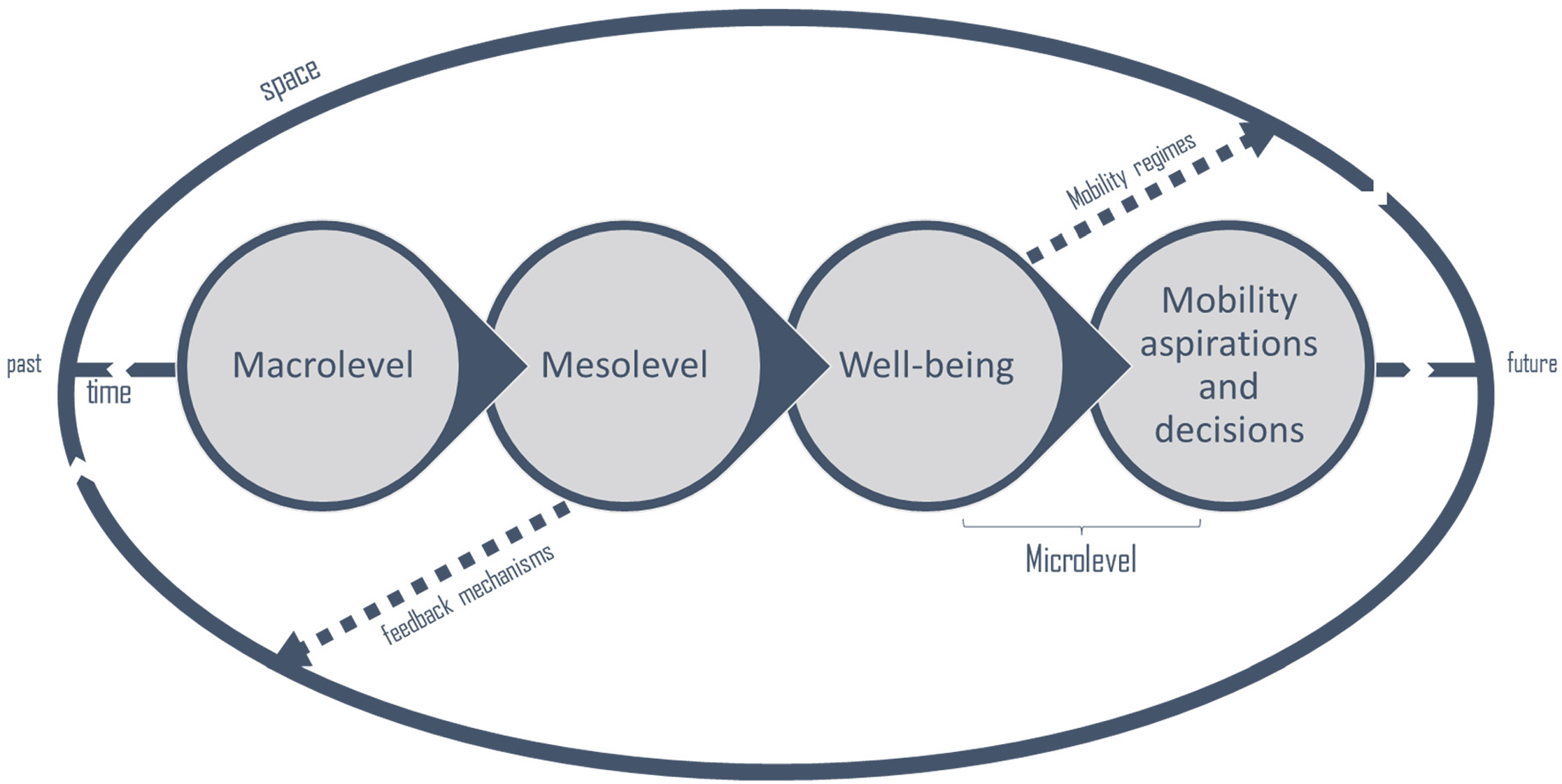
Integrated Framework to Understand Welfare Mobilities.
The welfare mobilities integrated framework considers different actors’ interactions over time at the local, translocal, and transnational levels to include approaches to internal and international mobility and consider welfare dynamics within and beyond national borders. The framework incorporates macro-, meso-, and microlevel welfare components, since we cannot understand how people experience welfare at the microlevel without considering the mesolevel environments and the macrolevel welfare regime(s) in which they are embedded. These interrelated components influence how people interpret, position themselves, and react according to their perceptions of the welfare structural context. Likewise, depending on their own welfare experiences, people find themselves more or less able to access basic needs, opportunities, and freedoms, or to participate at the community level. In the aggregate, these individual situations can shape the broader macrolevel welfare regime.
Additionally, the welfare mobilities framework considers the economic and noneconomic dimensions of welfare and understands migration beyond the idea of a singular, long-term change in the usual place of residence. In line with the idea of continuous change, where “movement and attachment is not linear or sequential but capable of rotating back and forth and changing direction over time,” the framework embraces simultaneity in contexts of migration (Levitt and Schiller 2004). Temporal dynamics and processes must also be seen as central to welfare mobilities. Spatially, the integrated framework includes multiple spaces that individuals, families, and communities have in mind when thinking about and comparing life in a particular place and elsewhere. In addition to mobility regimes, migration feedback mechanisms play a key role, because they connect interactions over time and space. They shape the perceptions and aspirations of communities, individuals, and ideas of what life should be.
We now turn to presenting some insights derived from taking an integrated approach to welfare mobilities through a multisited study of Moroccan migration toward Europe from the late 1990s to 2021. This mixed-methods study included people with different migration experiences — people who had never migrated, people with previous internal or international migration, and people who migrated more than once (onward migrants). The study mainly focused on men and women with a secondary education degree or lower (women were underrepresented) and comprised four research sites — two in Morocco (Tangier and the oasis of the Todgha valley), one in Spain (the province of Almería), and one in Norway (Oslo). The selected research sites are embedded in three nation-states with differentiated welfare regimes in terms of the level of security they provide, their main sources of security, and their cultural practices around welfare (Jolivet 2023).
The study adopted a bricolage approach (Denzin and Lincoln 1999; Rogers 2012) for its research design, data collection, and data analysis. It used several quantitative and qualitative datasets from primary and secondary sources collected between 2007 and 2021 (Appendix 1). I was directly involved in the data collection, cleaning, and analysis of all datasets. To complement the datasets, the study analyzed relevant official national and global statistics encompassing World Development Indicators, the World Values Survey, Spanish longitudinal register data, 3 and Statistics Norway data. A mixed-methods methodology facilitated a combination of deductive and inductive approaches.
The study combined descriptive statistics and qualitative analysis. The latter was based on a constant back and forth between data and migration theories (Glaser and Strauss 1967). This approach allowed for better capture of the multiple and diverse contexts under study (Golafshani 2003). For each research site, the study used one main migration theory as a starting point, based on fieldwork observations, available data, and results from previous studies. Additional theoretical perspectives and primary or secondary data were incorporated. Through so doing, the study applied existing theories of migration — for example, the lifestyle migration approach — while also exploring new avenues to understand the interactions between welfare and human (im)mobility. The analysis for each research site started with thematic coding in Nvivo. The codes were then merged into broader categories.
The bricolage approach was more than a pragmatic choice. Working on the same research question in four research sites embedded in different welfare regimes, using diverse datasets and theoretical approaches enabled me to embrace and reflect on multiple perspectives, add depth, and achieve a more holistic picture of the interplay between welfare and migration, and its role in migration decision making. This approach also freed me to go beyond taken-for-granted understandings of welfare such as its economic and protective aspects and encompass the quality of life dimensions often neglected in studies focusing on migration decision making in marginalized groups or people from lower-income countries. Finally, this approach was used to triangulate the findings. By comparing, relating, and validating them in the four research sites, it emerged that approaching welfare as a structure, process, and experience is essential to understand its role in migration decision making.
In the following section, the selected narratives illustrate a counterintuitive lack of material security and subjective well-being despite positive advancements in different welfare regimes. The narratives come from three interviews I conducted in the Todgha valley, El Ejido (Almería), and Oslo, and one interview gathered in Tangier by a research team led by Professor Mohamed Berriane (Université Mohammed V-Agdal) for the EUMAGINE project.
Welfare Paradoxes in Contexts of Migration
Before migrating in 2021, Saïd 4 lived in the Todgha valley (Morocco). His desire to migrate was kindled when he was six. As a child, he aspired to have what migrant children had, such as Nike or Adidas sports shoes and a bike. As a teenager, he wanted to get a car as fast as the ones migrants had. While migrants were able to afford a car, his dad had had to work hard and save for many years before he could buy one. In 2020, Saïd was almost 40 years old and pondered his future — about his income when he retired and about the education and security he would be able to provide for his children, if he ever had any. He kept wanting to migrate and postponed any marriage and family plans until he could fulfill his persistent migration aspirations. Lifestyles had changed in the oasis: “Now, people want more, (…) and women aspire to marry a ‘complete man’, who aside from having a job, has a good salary, a car, a house and the ability to afford a holiday trip once a year.”
In 2011, Sami was 32 years old. He lived in Tangier (Morocco), where after some time working as a watchman in the harbor, he was employed in a barbershop despite having earned a university diploma. He aspired to migrate to a country where his qualifications would be more valued than in Morocco. When he was younger, he wanted to become a civil servant, but never achieved his goal. He had even taken part in a movement called “diplomés chômeurs” (the unemployed graduates). This group consists of people with a secondary or tertiary education diploma who feel entitled to public employment and who demonstrate periodically for such jobs to become available. Over time, this movement has also protested against rising costs of living and corruption and has demonstrated against violations of human rights (Badimon Emperador 2007). Referring to recent developments in his neighborhood and Tangier, Sami said: What could I say, transformations? We see that Tangier has remained the same. The system is always the same. We do not see anything. Perhaps in a few years, I don’t know (…). [Economically] yes, now there's more activity. There are ongoing constructions, but (…) for the youth, what do they have to do with all of this?
About 400 kilometers away from Tangier, Abbas had been living for 5 years in El Ejido (Spain) until the outbreak of the 2008 global economic crisis. He aspired to work in construction to achieve some social mobility, but in fact, he had never been able to find a job anywhere else but in the intensive agricultural sector. This is what he thought about Spain: Look, Spain has money, look at housing [prices] – 20 million, 25 million [pesetas]
5
, (…) a one-hectare greenhouse costs 800,000 euros; there's money, but you don’t get help at all. The Spanish do, but not migrants. (…) The Spanish talk and get a severance pay of 1,000 euros or more, and Moroccans do not get anything; how is that?
Further away in Oslo, Hassan, born in Rabat (Morocco), after living 14 years in Spain had moved to Norway in 2013 because of the long-term effects of the 2008 economic crisis. He worked night shifts as a cleaner. He aspired to return to Spain: Here, there is money, but I don’t save or live life. All the money is for the groceries, to rent, to eat, and that's it. (…) There is no life. No life at all. Here, it is for the rich or the businessmen who are stealing from the poor. These people that have vacation homes in Spain. These are the people who live well off. But the normal person, the poor person, it is impossible.
These are four examples of experiences of exclusion from positive aspects of different welfare regimes. They show the gaps in both welfare regimes and mobility regimes. Reading between the lines, these stories are about unfulfilled aspirations, perceptions of inequality, and a mismatch between what these four men expected their access to welfare should be and what they experienced — estrangement and lack of control and choice. The four men also express a shared feeling of misalignment between the high speed of positive developments in their social environments and their own lack of social and spatial mobility.
These feelings of exclusion might seem perplexing considering the rather positive developments in the welfare regime of Morocco over the past few decades, and the fact that two of these men had migrated to high-income countries with welfare regimes that could provide more security than the welfare regime of Morocco, or at least that is what many people in Morocco think. According to his colleagues, Saïd was also relatively better off than other men of his age — his family had several properties, and he was the only member of staff with a written contract and access to formal social protection. This is a welfare paradox — living in better welfare regimes does not lead necessarily to experiences of higher material security or subjective well-being.
These narratives highlight four entangled factors that contribute to experiences of exclusion and lack of social mobility: social inequality due to limited access to social rights and employment security in secondary labor markets, temporal comparisons, multisited social comparisons, and ambivalent place attachments. The integrated welfare mobilities framework helps to explain the seeming welfare paradoxes across the study's various contexts of migration. First, it often takes time for international migrants to gain full access to social rights in Spain and Norway. There are some legal residence or work requirements that need to be met to access some state-provided resources. These requirements can be difficult to meet, particularly for irregular migrants and those who live or work in contexts of informality.
Second, welfare levels in Morocco have improved dramatically in the past few decades if we consider welfare outcomes such as life expectancy at birth, the percentage of young children immunized against measles, and female school enrolment in secondary education. To a lesser extent, but starting from a higher level at baseline, improvements are also visible in Spain and Norway. Despite these improved welfare outcomes, the levels of social inequality (measured through the income share held by the lowest and the highest 10% of the population) have remained unchanged or have even slightly increased in Norway and Spain (Table 1).
Welfare Outcomes.
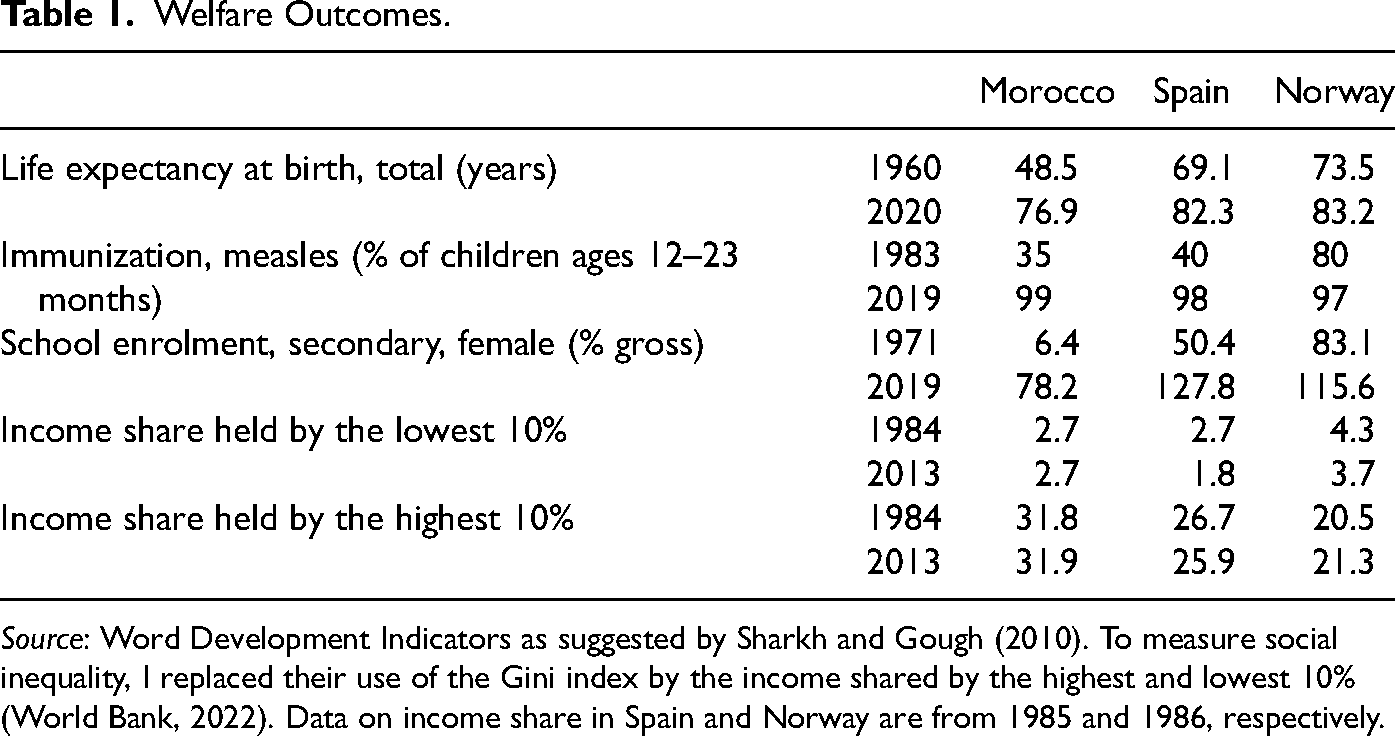
Source: Word Development Indicators as suggested by Sharkh and Gough (2010). To measure social inequality, I replaced their use of the Gini index by the income shared by the highest and lowest 10% (World Bank, 2022). Data on income share in Spain and Norway are from 1985 and 1986, respectively.
Additionally, there is an increasing segmentation of labor markets, and lower-skilled or manual work (as in the case of these four men) tends to be temporary and poorly paid, and often people occupying these positions work long or night shifts. Despite (improved) access to (state-provided) resources over time, the lack of social mobility and insecure and often informal jobs inherent to these secondary labor markets constrain access to material security in case of income loss, opportunities, and the ability to do and choose what people value. Such working conditions also negatively affected these men's self-image and overall well-being.
Third, people's subjective temporal comparisons also played a role in their feelings of lack of social mobility or exclusion. Positive changes in welfare regimes over time, either in the place of origin or elsewhere, increased expectations and aspirations for positive change at a more individual level. In line with other studies such as Berriane, Natter, and De Haas (2021), the study identified that development and migration processes change ideas regarding welfare. This shift in ideas and imaginations often occurs at a higher speed than positive structural development.
A closer look at what has changed in the Todgha valley in terms of aspirations and expectations helps to capture to what extent migration feedback had affected ideas around welfare and migration (Jolivet, 2020b). There are tangible examples of the impact of 60 years of international migration (mainly to Europe). For instance, migrants’ houses are bigger, newer, and better equipped than traditional houses, and these newer houses are visible in both the main urban center and the most remote villages in the valley. It is the same new houses that increased men's employment opportunities in the construction sector.
There are also more intangible effects; migration has played a role in the mobilities of the mind in the oasis — people have changed their views on what a life should be and what roles different actors should play to achieve it (migrants, family members, the state, or employers). New lifestyle aspirations include desires to live in a welfare state. Aspirations have changed from the search for self-reliance through migration, to expectations that state actors and employers must play a fundamental role in people's livelihoods and quality of life, through formal contracts and social security programs.
Expectations about what migration can bring in terms of welfare have also changed. In the first decades of outmigration from the Todgha valley, migrants provided not only for the family, who mostly stayed in the place of origin, but also for the community. The challenging economic context in Europe after the 2008 economic crisis increased migrants’ precarity and employment insecurity. In this context, people who live in the Todgha valley expect much less from migrants than in the past. They were aware that migrating to Europe does not always guarantee success in terms of improved income and quality of life. This acknowledgment of the challenges that migrants face in Europe comes from direct exchanges with migrants and more indirectly through information gathered on TV, the internet, and through their observations in the oasis. The effect of such observations on migration fluctuates over time, along with shifts between periods of economic growth and periods of high unemployment.
The four men's feelings might also arise because people tend to focus on their everyday lives and challenges in the present and do not appreciate what they have achieved over time, or how their quality of life has improved in comparison to that of previous generations. People might also be focusing on (new) aspirations for the future rather than on the past or the present. In this latter case, we are talking about a hedonic treadmill, like the one that Czaika and Vothknecht (2014) observed with quantitative methods and explained by the fact that the migration experience itself increases aspirations.
Fourth, the four men's embeddedness in precarious labor niches meant they compared themselves with other people that they perceived more privileged in terms of material security and access to social rights. They compared themselves with neighbors, returned migrants, family members living in Europe, civil servants, or migrants in Canada. These multiple and multisited groups of reference for social comparison triggered feelings of relative deprivation and were particularly relevant in Tangier, at the Strait of Gibraltar, only 14 kilometers away from the Spanish coast. Historically and geographically connected to Europe over generations, Tangier has witnessed different lifestyles of Europe, and these multisited frames of reference have shaped ideas about life in Tangier and imaginations about how it could be. To name one example, the city was an international free zone for 30 years in the first half of the twentieth century, jointly administered by Belgium, Italy, France, the Netherlands, Portugal, Spain, Switzerland, the United Kingdom, and the United States.
Nevertheless, by 2011, at a time of global economic recession, despite its better state-provided resources, people in Tangier tended to think that living in Europe would not improve their lifestyles. Although social rights and labor rights could be more accessible in Europe, its social environment was often perceived as hostile. Many respondents thought that in Europe, there is racism, discrimination, and that migrants have lower salaries than Europeans. In addition, informal support from family and members of the community, freedom of movement, and the possibility to freely practice their religion were important lifestyle aspects that many would miss if they migrated. In sum, while welfare regimes in Europe could act as welfare magnets and trigger feelings of estrangement toward the place of residence, human warmth, family life, informal care and protection, and local cultural practices shaped their place attachments and represented lifestyle magnets in Morocco.
In the highly segmented labor market of Almería's agri-food industry in Spain, migration, immobility, and mobility were all strategies to achieve migrants’ material security and subjective well-being. The study found various nuances in how migrants react to Almeria's fragile welfare resource environment (Levitt et al. 2017). Work in the secondary market of the agri-food industry was both a driver of migration and mobility and a cause of immobility — it had both mobility and retention effects. Although many migrants aspired and decided to move onward to other Spanish and European destinations, the discontinuous work, and informality of Almería's agricultural sector were also perceived to offer opportunities. For many migrants who are unable to migrate legally, this secondary labor market often provides opportunities to obtain the necessary work and residence permits that enable migrants to access social security through formal employment. In this sense, conditions of informality and precarity are an entry gate toward longer-term social mobility.
Work in agriculture also remains relatively constant, even in times of economic downturn, and therefore, functions as a safety net in situations of unemployment elsewhere. In this case, staying in or returning to Almería province were common patterns during the economic downturns of the 2008 global economic crisis and the 2020 COVID-19 outbreak that caused the temporary closure of many businesses outside the agri-food industry. Compared to other more urban destinations in northern Spain or Europe, Almería also offers opportunities to achieve what some consider a better quality of life: a more relaxed lifestyle, proximity to family members, and the benefits of the solidarity of a large Moroccan migrant community. For some, immobility and informality in Almería were strategies to adapt to and resist the insecurities that people face (Preece 2018), as much as mobility, onward migration, and multisited arrangements were for other Moroccan migrants in Almeria or Oslo.
Concluding Remarks
The welfare paradox experienced by these four men serves as a diagnosis of the unmet aspirations and challenges experienced by many people, indicating that even the most secure welfare regimes currently do not work for everyone. This applies to welfare in general and to welfare in relation to mobile populations, as mobility regimes add an extra layer of constraints to some social groups. This paradox invites us to change the way we think about welfare beyond its taken-for-granted economic and protective dimensions. Welfare extends beyond merely maximizing resources and meeting basic needs. It comprises the opportunity to achieve ways of living that people value and their ability to pursue such opportunities without discrimination or constraints. The diverse spatial, temporal, and social settings in which people live shape how they perceive and experience welfare. In their turn, these subjective perceptions and experiences of welfare affect people's migration, mobility, and immobility aspirations and decisions. By paying more attention to the subjective aspects of welfare and how they intersect with migration processes, we gain crucial new insights into the role of welfare in migration decision making.
This study advances three conceptual avenues to achieve a more comprehensive understanding of welfare's role in migration decision making. First, it introduces the concept of welfare mobilities to capture the dynamic and subjective nature of welfare and migration interactions. Welfare mobilities denote interconnected and changing meanings, aspirations, expectations, and decisions regarding welfare and spatial mobility. Whether rural, urban, internal, or international, in this definition, human mobility includes long-term migrations, nonmigratory mobilities (such as commuting), translocal lifestyles, and immobility. Welfare mobilities are spatially, socially, and historically contingent. They are shaped by changes in everyday social interactions in different places; social positions and comparisons; perspectives on the past, present, and future; and place attachments and estrangements. Welfare mobilities provide valuable insights into how people perceive local and global inequalities.
Second, welfare mobilities demonstrate that we should understand welfare simultaneously as a structure, a process, and an experience. It is important to pay attention to what changes over time in welfare regimes, what does not change, and subsequent experiences of inclusion or exclusion. Third, to better capture the role of welfare in migration, this article proposes an integrated analytical framework that combines diverse theoretical approaches to migration. This framework allows for the inclusion of both economic and noneconomic aspects of welfare (broader sociocultural contexts, abilities to act and choose, and aspirations regarding quality of life and meaningful lifestyles), as well as its dynamic and translocational dimensions.
A greater focus on welfare subjectivities across various global regions will expand the ability of the integrated framework proposed in this article to be applied to contexts with distinct social and environmental characteristics, cultural practices, migration histories, and colonial legacies.
As welfare is so central to people's efforts to improve their capabilities and well-being, incorporating welfare in mainstream migration theories is essential for achieving a more realistic understanding of migration processes and migration decisions. Therefore, the theoretical perspectives advanced in this article could also enhance governments and other policymakers to achieve a more fundamental understanding of how welfare regimes may shape and be shaped by human mobility patterns in highly complex, and often counterintuitive ways, and to design policies that enhance the potential of migration to play a positive role in improving people's welfare and well-being. This integrated welfare mobilities approach can be used as part of a blueprint for addressing future social and natural transformations.
Supplemental Material
sj-pdf-1-mrx-10.1177_01979183241275564 - Supplemental material for Subjectivity in Welfare Mobilities: Rethinking Welfare as a Structure, a Process, and an Experience
Supplemental material, sj-pdf-1-mrx-10.1177_01979183241275564 for Subjectivity in Welfare Mobilities: Rethinking Welfare as a Structure, a Process, and an Experience by Dominique Jolivet in International Migration Review
Footnotes
Acknowledgments
I am grateful to Oliver Bakewell, Hein de Haas, Anita Fábos, Carla Ferreira Rodrigues, Fernanda Sousa Duarte, and the anonymous reviewers for their valuable comments on earlier drafts of this article.
Declaration of Conflicting Interests
The author declared no potential conflicts of interest with respect to the research, authorship, and/or publication of this article.
Funding
The author disclosed receipt of the following financial support for the research, authorship, and/or publication of this article: This work was supported by the European Regional Development Fund (ERDF) and the Spanish Ministry of Economy and Competitiveness (Ministerio de Economía y Competitividad), European Commission, FP7 program, European Research Council under the European Community's Horizon 2020 Programme (H2020/2015-2020), Junta de Andalucía (Consejería de Innovación y Ciencia), Matched funding from the Oxford Martin School of the University of Oxford, NORFACE Transnational Research Programme on Welfare State Futures (grant numbers SEJ2007-66658/GEOG, 244703, 648496, SEJ-1390, and 462-13-068).

Supplemental Material
Supplemental material for this article is available online.
Notes
References
Supplementary Material
Please find the following supplemental material available below.
For Open Access articles published under a Creative Commons License, all supplemental material carries the same license as the article it is associated with.
For non-Open Access articles published, all supplemental material carries a non-exclusive license, and permission requests for re-use of supplemental material or any part of supplemental material shall be sent directly to the copyright owner as specified in the copyright notice associated with the article.
