




Abstract
This comparative analysis examines the historical trajectories and contemporary trends of immigration policies in Canada and Australia, elucidating the enduring influence of past practices on current frameworks. Focusing on the pre-1960s through post-2000s eras, the study reveals how both nations’ migration policies have shifted from racially based to skills-based approaches, with a recent emphasis on language proficiency as a key selection criterion. Drawing on institutional isomorphism theory, the study argues that Canada and Australia exhibit normative and mimetic isomorphic processes, reflecting cultural values and mutual learning in policy development. It contends that these isomorphic practices are rooted in colonial legacies and may perpetuate historical hierarchies. Through an analysis of key events and occurrences, the study highlights the convergence of legal and regulatory regimes between the two nations, characterizing it as colonial isomorphism. This comprehensive examination provides insights into the sociocultural and historical factors shaping immigration policies, showing that migration policies in different nations appear to follow normative, coercive and mimetic isomorphic processes.
Introduction
Immigration policies communicate societal and national preferences and ideologies (Walsh 2008). This article provides a comparative analysis of Canadian and Australian immigration policy trends and patterns from a comparative historical perspective. It highlights the contextual underpinnings of immigration policy trends in Canada and Australia to understand the extent to which past immigration policy patterns continue to influence current immigration policies. The article seeks to understand policy drivers from an historical to contemporary context to understand how and why specific immigration policy approaches were adopted in the two countries. Using the theoretical framework of institutional isomorphism, we provide analysis of Canadian and Australian immigration policy trends dynamics to show their evolution, outcomes and potential social and economic impacts.
Although many studies with varied foci have reported on immigration policies (e.g., Akbari and Macdonald 2014; Birrell 2003; Chiswick and Hatton 2003; Green and Green 2004; Hawkins 1991; Walsh 2008), historical-to-contemporary cross-country immigration policy trends analysis focusing on Canada and Australia have received limited attention, though pivotal in this space. The few cross-country studies (e.g., Hawkins 1991; Ongley and Pearson 1995; Walsh 2008) cover short, divergent eras. This study contributes to the literature by analyzing policies from before the 1960s through to the 2000s and showing evidence of isomorphic processes between the two nations.
We compare Canadian and Australia immigration policy trends over three successive periods. The first period, pre-1960s, is characterized by European settlement, dispossession of First Nations, and the development and implementation of policies that prioritized white migrants, in particular, British in Australia and British and French in Canada. The second period, the 1960s to the 1970s, saw a shift in both countries from migration policies based on race to policies based on skills/human capital. The third period covers from the 1980s to 1990s through to post-2000s. The 1980s and 1990s saw both countries consolidate their skilled migration programs under the rationale that migration would drive economic growth. The post-2000 period has seen a retention of the skilled migration programs, but a strengthening of the language requirements, suggesting that migrants must better integrate into the host culture. We find that the migration policies of Canada and Australia mirror each other across all eras, suggesting isomorphic processes.
Our comparative-historical analysis unpacks policy developments in both nations over time. We analyze sequences of events in order to understand immigration policy development processes in both contexts and develop explanations for what has occurred (Falleti and Mahoney 2015; McCutcheon and Meredith 1993) through descriptive and trend analyses which, though having causal relationship inferences constraints, contribute to informing future research directions (Kennedy and Bishu 2022).
In our analysis we identify key events across Canada and Australia that shaped their respective immigration policies. Events are “spatially and temporally bound happenings” (Falleti and Mahoney 2015, 212) that can be compared across cases. They have elements that can be present in multiple cases. Occurrences are happenings that are “distinctive to a single case” (Falleti and Mahoney 2015, 213). Both events and occurrences take place within particular spatial and temporal contexts, and the contexts are what give them meaning.
We used Canada and Australia as case studies as the two countries are both immigrant-settling nations with similar origins, institutional ideologies, and historical trends (Walsh 2011). They both share a similar colonial past as members of the British Empire (Ashkanasy, Trevor-Roberts and Earnshaw 2002) even though Canada also has a French identity (Mann 2012). Historical ontology and epistemology are essential (Nkomo and Hoobler 2014) to appreciate where we have been and our way forward. The study assumes that historical institutional practices and ideological positions, attitudes, and cultural dispositions (Kaufman 2011) are likely to shape current immigration policies. The current policies suggest a preference for people with near native national language abilities. We suggest that while seeming colorblind, these policies harken back to early twentieth century language tests that prevented non-whites from migrating to Canada and Australia, covertly continuing racialised migration under the guise of colorblind policies (Berg 2011; Poynting and Mason 2008). Policies articulated by governments can potentially influence the treatment and acceptance of immigrants in the broader society.
While there are other settler nations that have colonial histories, for example, New Zealand and the United States, we focus here on Canada and Australia as two similar sized former British colonies that share key features in their migration programs. Nevertheless, it is likely that there was isomorphism with other former British colonies. It is out of the scope of this study to do a detailed analysis of these other contexts.
Isomorphism
Institutions are emergent products of what people do as “they don’t ‘exist’” in any sense “above the action” (Jenkins 2008, 158). Institutions control and order everyday life by providing the environment that create “the rules of the game” for operation (Menard 1995, 164). Institutional theory suggests that groups and organizations use rules and regulations for compliance and legitimacy purposes to secure their own positions (DiMaggio and Powell 1983). Organizations in similar field tend to contribute to isomorphic practices, structures, and behavior (Ng and Burke 2010).
Isomorphism refers to how organizations in a field become increasingly similar over time. The literature identifies two forms: competitive isomorphism and institutional isomorphism. In competitive isomorphism it is thought that organizations become increasingly similar in order to survive through natural selection-like processes which favor the development of common ways to handle the field's challenges (Hannan and Freeman 1977). There might be a case for competitive isomorphism across migration policies. If we consider that there is a global market for migrants, then migrant receiving countries may be competing with each other, particularly if they are seeking migrants from the same source countries. For example, Hassam (2007, 819) claims that “in 1957, Australia's inability to compete for British migrants with Canada, its major competitor, caused much anxiety about Australia's capacity to attract sufficient British migrants to maintain a White Australia.” This suggests possible competitive isomorphism.
DiMaggio and Powell (1983) observed three isomorphic processes in their theorization of institutional isomorphism. They argued that normative, coercive, and mimetic forces lead organizations to similarity. Normative forces ensure conformity to established standards. Coercive forces occur when there is a power imbalance and the more powerful force the less powerful to conform, such as in governments mandates. Mimetic forces involve imitation of other successful competitors in similar organizational environments and are common in fields that are uncertain (Farquharson 2013; Glover et al. 2014; Ng and Burke 2010; Opare-Addo 2023).
While institutional isomorphism is well understood in the context of organizations, we argue that it can also provide insight into government policy fields. In the case of comparative migration policy, an analysis of isomorphic processes helps to explain why migration policies in Canada and Australia have often mirrored each other over time. In particular, normative and mimetic isomorphism appear to be at play. Normative processes include how cultural values, such as cultural homogeneity as a source of social cohesion, and societal norms shaped immigration policies in Canada and Australia. Memetic forces refer to the two countries learning from and mimicking each other. While the two nations do not have coercive power over each other in this field, it may be possible that external coercive forces contribute to isomorphism. We posit that Canada and Australia's immigration policies are more likely to be influenced by normative and mimetic isomorphic practices that ensure not only social and cultural conformance, but also dominance over First Nations and non-white migrants to preserve the established status quo through socially engineered immigration policies.
Looking at Canadian and Australian immigration policies through the lens of institutional isomorphism, provides insights into the forces shaping these policies, enabling the identification of patterns of similarity and divergence, and understandings of how historical and institutional factors have influenced the immigration frameworks in each country. We propose that the type of isomorphism observed across these two cases can be characterized as colonial isomorphism. Colonial isomorphism refers to convergence of the legal, regulatory, and legislative regimes between a colonizer's colonies. For Canada and Australia, we argue that British colonization and its associated development of racialized hierarchies in its colonies led it to approaches that were isomorphic, with laws and policies that were passed in one colony later being adopted in others. This has continued in the postcolonial period.
Settlement, Dispossession and White Canada and Australia Immigration Policy Development, Pre-1960s
This section outlines the initial migration polices of Canada and Australia. Our analysis uncovers the following sequence of events: Both nations were settled by Europeans who dispossessed the First Nations inhabitants of the land. Settlement led to nation-building around an ideology of cultural and racial homogeneity, which led to immigration policies in both countries that preferenced immigrants from the colonizing nations. These racialized/racist policies formed the basis of migration until the post-World War II (WWII) period, where population and other pressures led to the loosening of restrictions whereby nonpreferred European migrants were allowed in. While there were local specific occurrences and timings that were different, the sequences of events leading from settlement to policy to policy easing were similar in both nations. We suggest that the British colonial government was undertaking similar processes of dispossession and institution of ideologies of racial homogeneity as a source of social cohesion across these two colonies.
Canada
First Nations people, who constitute 4.9% (1,673,785) of the total Canadian population (Statistics Canada 2016), were the first inhabitants of Canada for thousands of years before European settlement (Kelley and Trebilcock 2010; Romaniuc 2003). Accordingly, they are “considered as a founding nation of Canada” (Uribe 2006, 3). Canada as known today, was colonized by two groups, the French and the English (Henry 2002). It became a self-governing entity within the British Empire on July 1, 1867, with the passage of the British North America Act (Knowles 2007), which formalized the dispossession of the First Nations (Lacchin 2015). However, Canada had long been a multicultural society even before it was formally declared a nation in 1867 (Wong and Guo 2015; Winter 2007). For instance, “Black, Chinese, Irish, East Indian, and Jewish settlements go back, in some cases, over 200 years” but were small in numbers and perceived as marginal to the Canadian mainstream (Wilson 1993, 651). Their existence was denied and resisted by dominant colonial groups just as the presence of the First Nations peoples was rejected (Lacchin 2015).
Since Confederation in 1867, Canada has passed several significant immigration Acts (see Hawkins 1991 for a discussion), including the Immigration Act 1869, for immigration and settlement controls where for example, the department of agriculture, through the Act, campaigned for people from the United States, Britain, and North Western Europe by offering free land and travel for settlement (Green and Green 2004); the Chinese Migration Act 1885, which limited the intake of Chinese immigrants (Hawkins 1991); and, in 1897, the Alien Labour Act, which was passed to deny the entry of non-European immigrants (Knowles 2007). Further, amendments included the Immigration Act 1906 excluded nonpreferred immigrants and led to the deportation of unwanted immigrants (Kelley and Trebilcock 1998). The Immigration Act 1910 (amended in 1919) prohibited “immigrants belonging to any race deemed unsuited to the climate or requirements of Canada” (quoted in Green and Green 2004, 106), and the Immigration Act 1919 instituted literacy tests for prospective immigrants who would enter Canada (Green and Green 2004).
Canada had an assimilationist approach to migration where migrants had to conform to British culture (Banting and Kymlicka 2010). Determined to achieve a homogeneous population, Canada designed its immigration policies to limit the entry of nonpreferred immigrants, including those from Southern and Eastern Europe (Green and Green 2004; Kelley and Trebilcock 1998) and those from Asia, Africa, and the Middle East. Immigrants from Britain, the United States, the Irish Free State, Australia, New Zealand, and South Africa were considered as the preferred immigrants whose admission was based on purely country of origin, albeit immigrants from Northern and Western Europe enjoyed almost equal treatment as those from the preferred countries while those from Eastern and Southern Europe encountered stricter regulations (Green and Green 2004). Immigrants from other regions had to enter through sponsorship of family ties (Green and Green 2004). However, the exclusion of non-Europeans was justified by differences in customs, habits, and mode of life (Walsh 2012). Non-European immigrants were denied entry because they were considered outsiders, different to the preferred immigrant sources (Walsh 2012). Agriculturalists and unskilled immigrants from the preferred regions were targeted for nation-building, population, and economic growth (Bonikowska, Green, and Riddell 2010; Green and Green 1999). However, in times of critical need for labor, such as in the 1870s, nonpreferred immigrants, such as the Chinese, were recruited for railway construction work that was deemed dangerous and poorly paid (Abu-Laban and Gabriel 2011). Nevertheless, the same Chinese laborers were subsequently restricted entry after the completion of their service (Abu-Laban and Gabriel 2011).
Assimilation of Non-British Europeans in Canada
In the 1930s, Canada's economy was affected by the global depression. This led to immigration stagnation as Canadian borders were closed to all migration except farmers with capital from Britain and the United States (Green and Green 1999). The depression of the 1930s contributed to negative sentiments towards immigrants as they were considered a threat to jobs (Kelley and Trebilcock 1998). The post-war era of the 1940s ended the autonomous British dominance in Canada and Australia. An influx of displaced people from Europe began to arrive after WWII. In 1947 Prime Minister William Lyon Mackenzie King emphasized the need to encourage growth of Canada's population (Green and Green 2004). He stressed the need for legislation, regulation, and vigorous administration that would ensure the careful selection and permanent settlement of such numbers to advantageously add to the economy. Yet he cautioned against altering the fundamental character of Canada's population by admitting Asians (Green and Green 1999). This discourse was also present in Australia during this period.
When it became evident in the 1950s that immigrants from the preferred British regions could no longer deliver the skills required to build the nation (Li 2000), the Canadian government extended its search of immigrants to include people from central, eastern, and southern Europe (Green and Green 1999). Many of the immigrants who arrived from Italy and other Mediterranean countries in the 1950s and early 1960s had lower educational levels compared to the native-born population (Reitz 2001). According to Reitz (2004) while in 1871 61% of the Canadian population had been from Britain, 31% from France, and 8% of other origins, by 1951, those of British origins in Canada had diminished to 48%, though the French remained at 31% and others had increased to 21%. The change in demographic composition was due to a lower number of immigrants from Britain.
Australia
Similar to Canada, Aboriginal peoples were the original inhabitants of the land of Australia before European settlement. Australian colonial history begins from 1788 as British convicts and their overseers arrived in Australia (Lewis, French and Phetmany 2000). With settlement, First Nations were dispossessed and their rights to their own land were removed (Jupp 1995). As put by Bertone and Leahy (2003, 107): “White Australians stole the land from its ancient indigenous [sic] owners.” Prior to European settlement, the Aboriginal population was estimated to be between 300,000 and 1.5 million, consisting of around 6000 different tribes who spoke more than 200 distinct languages. By federation in 1901, the number had declined to about 94,000 as a consequence of conflict and other factors such as disease from European settlers (Mence, Gangell and Tebb 2017).
After federation in 1901, Australia passed the Immigration Restriction Act 1901, popularly known as the White Australia Policy, for the prevention of non-Europeans and other migrants considered undesirable from entering permanently into Australia (Mence, Gangell and Tebb 2017). Similar to Canada's literacy test, the Immigration Restriction Act 1901 introduced a dictation test that selected immigrants based on immigrants’ ability to write out a text of 50 words in any European language at the discretion of customs officers (Mence, Gangell and Tebb 2017), suggesting mimetic isomorphism processes were occurring. The test succeeded in excluding the entry of Asians and other non-Europeans to Australia (Jupp 1997; O'Donnell and Mitchell 2000) and keeping Australia culturally homogenous.
Australian immigration policy developments and goals prior to the 1960s were fundamentally similar to Canada's in the stated need of labor for nation-building, population, and economic growth (Mence, Gangell and Tebb 2017; Walsh 2008). Like Canada, in its determination to be culturally homogenous, Australia sought British migrants by providing them with assisted passage from 1831 until 1947 (Mence, Gangell and Tebb 2017). Most British immigrants who arrived in Australia were farmers, domestic workers and laborers in the agricultural industries such as wool and sheep farming (DIMA 2001). Many also arrived to escape from widespread poverty and unemployment caused by social disturbances resulting from industrialization in the United Kingdom (Jupp 1995). The assisted passage scheme partly provided the Australian government with the authority to shape the composition and selection of immigrant flows, and together with the dictation test, the power to control which people were selected.
Similar to Canada, after WWII and its aftermath, the Australian government was keen to increase its population (Phillips, Klapdor and Simon-Davies 2010). As British immigrant numbers fell below needed numbers, it became necessary to seek immigrants from elsewhere (Mence, Gangell and Tebb 2017), but without changing the White Australia policy (Walsh 2012). Arthur Calwell, who became Australia's first immigration minister in 1945, declared that Australia must “populate or perish,” and promised that for every non-British immigrant, there would be ten times as many from the United Kingdom (Mence, Gangell and Tebb 2017, 26; Jupp 2001). In 1947, Calwell signed an agreement with the International Refugee Organisation to allow displaced persons from non-British European refugee camps to come to Australia as a ready labor pool (Mence, Gangell and Tebb 2017) under regulated conditions to avoid creating wage competition with the locals (Jupp 2002).
In 1957 a “Bring out a Briton” campaign was launched in Australia to encourage communities to sponsor British families (DIMA 2001; Mence, Gangell and Tebb 2017). Nonetheless, in 1958 a revised Migration Act was introduced to abolish the dictation test (Jupp 1997), but “although not referred in the legislation, it remained government policy to exclude non-Europeans” (Teicher, Shah and Griffin 2002, 216). The policy outcomes for the pre-1960s were that by the 1947 population census, the non-European population (apart from Aboriginal people, who were not counted) amounted to only 0.25% (Mence, Gangell and Tebb 2017) compared to 90% who were of British background (Jupp 2001, 2002). With regard to employment, while continental Europeans were allowed entry into Australia, they were relegated to heavy manufacturing industries due to lack of linguistic proficiency and professional barriers (Walsh 2012). Immigrants were incorporated in the agriculture, manufacturing sector and gained the label “factory fodder” (Walsh 2008). They worked in industrial occupations, for example, the automotive, footwear, garment, steel, and food processing industries and these occupations were commonly labeled as “migrant work” (Walsh 2012).
It is clear that migration policies in Australia and Canada share similar features, indicating isomorphism between the two nations. Both nations implemented race-based migration policies that included language tests, both sought to increase migration in the post-war period to improve economic outcomes and meet population targets, and both aimed to be culturally homogenous. Both were seeking to increase population at a time when the post-war European economy was booming, reducing economic incentives for Europeans to migrate, thus leading to an easing of the policies that prioritized British migrants and opening up migration opportunities to nonpreferred European groups, but not yet to the rest of the world. While it is not clear whether the isomorphic processes were normative or mimetic, the alignment of the policy approaches indicates isomorphic processes were present.
A New Era of Non-Discriminatory Immigration Policy, 1960s–1970s
The 1960s saw the beginnings of a shift away from race as the basis of migration policy in both Canada and Australia. Global pressure was put on both countries to remove racial discrimination in migration policy, and internal pressures to increase population also intensified. These led to the implementation of skills-based migration policies and an increase in non-European migrants in both nations. Canada moved away from its discriminatory policies first, suggesting mimetic isomorphism in Australia's later changes.
Canada
In 1962 Canada abandoned its discriminatory immigration policy. This was after a series of antidiscrimination uproars that occurred domestically and worldwide. Domestic advocacy groups, including the Canadian Council of Churches, the Canadian Jewish Congress, the Negro Citizens Association and the Canadian Congress of Labour, challenged the government's continuous practices of discrimination against non-European immigrants (Triadafilopoulos 2010). Social groups drew encouragement from the human rights revolution and opposition to colonization that took hold in the developing world (Abu-Laban 2018). By the early 1960s, the rise of the civil rights movement in the United States which protested against ethnic and racial discrimination also paved the way for other disadvantaged groups including women to pursue their rights. Additionally, diplomats and officials within the Department of External Affairs complained about the negative repercussions of the Canadian immigration policy on the nation's diplomatic and trade relations and requested reform in the department's discriminatory approach (Triadafilopoulos 2013). It was argued that racially restrictive policies prevented Canada from maintaining a progressive image within the British Commonwealth and the United Nations (Triadafilopoulos 2010, 2013).
Simultaneously, Canada also experienced the “unwelcome reverse side of immigration” (Knowles 2007, 186). Due to lack of job opportunities and dissatisfaction with their experiences in Canada, one in every three or four immigrants returned to their country of origin or immigrated to the United States (Knowles 2007). According to Knowles (2007) even locally born Canadian professionals including doctors, trained businessmen, university professors, and scientists were leaving in greater numbers than had ever previously occurred. All these factors collectively ushered in changes to immigration policies in Canada. On January 19, 1962 Ellen Fairclough, the first female Cabinet Minister, announced a new Canadian immigration regulation, Immigration Act, Immigration Regulations, Part I, (PC 1962-86). This effectively removed racial discrimination from the Canadian immigration policy, allowing for unsponsored immigrants with the necessary education, skill, or other qualifications to be considered suitable for admission, regardless of color, race, or national origin (Rawlyk 1962). Fairclough stated: If a person can qualify on these … grounds and has sufficient means to establish himself in Canada until he finds employment, or, alternatively, is coming forward to approved employment… he or she is admissible, subject to the normal requirements of good health, good character and so forth. This means that any suitably qualified person, from any part of the world, can be considered for immigration to Canada entirely on his own merit, without regard to race, colour, national origin or the country from which he comes. (Quoted in Rawlyk 1962, 298)
In 1967, Canada initiated its first use of a points system as a method for selecting immigrants (P.C. 1967-1616). The system provided a scale for assessing immigrants based on their human capital features including education, age, language, and other factors (Green and Green 2004). Applicants were selected on the basis of recognized skills that aligned with occupational sectors in need of workers (Green and Green 2004). A new Immigration Act, 1976 was implemented in 1978 to guide the basic principles and objectives of Canadian immigration policy and gave top priority to family and refugee applicants (Green and Green 1999; 2004). As we will see, Australia's immigration policy changes in the 1970s mirrored these.
Immigration policy changes in the 1960s diversified the composition of immigrants to Canada. For example, in 1961, whereas 85% of Canada's immigrants were European-born, this had declined to 79.8% by 1971 (Statistics Canada 2016). Conversely, Asia-born immigrants who were less than 2% in 1961, increased to 4.6% by 1971, African immigrants increased from 0.1% to 1.2%; those from the Caribbean and Bermuda rose from 0.4% to 2.1%; while Central and South American-born individuals went from a 0% to 1.1%, all in the same period of 1961 to 1971 (Statistics Canada 2016). This indicates a shift not only in the Canada's immigrant demographics but also a potential change in the emerging workforce characteristics, as immigrants were selected for skills rather than cultural affiliation.
Australia
In the case of Australia, a change in the discriminatory immigration policy did not occur until a decade after Canada had changed its policies. The White Australia Policy of 1901 was officially abolished in 1973 under the leadership of Prime Minister Gough Whitlam (Hawkins 1991; Jupp 2002). Prime Minister Whitlam made it clear that “an island nation of predominantly European inhabitants situated on the edge of Asia” cannot “afford the stigma of racialism” (quoted in Hawkins 1991, 94). By this time, intellectuals, and religious and ethnic organizations were arguing against the White Australia Policy (Lopez 2000) and calling for a more universal and rational policy as implemented in Canada. The successful recruitment and settlement of southern and eastern European migrants had already undermined the White Australia Policy (Hiebert, Collins and Spoonley 2003). The “process of de-colonization in Africa and Asia” also proved a challenge to migration policies that were based on racial exclusion (Teicher, Shah and Griffin 2002, 213). All these factors cumulatively led to the demise of the racist White Australia Policy, similar to the innovations a decade earlier in Canada.
Legislation, including the Racial Discrimination Act 1975, which outlawed the use of racial criteria for any purpose, was passed that prevented the use of race, color, gender, ethnic origin, religion, or nationality in the selection of migrants (Tavan 2013; Walsh 2008). Like Canada, the Australian government was “concerned with improving Australia's international image and refuting charges of racism from both home and abroad” (Ongley and Pearson 1995, 772). Also like Canada, the goal of the new Australian immigration policy was to select people based on a points system (O'Donnell and Mitchell 2000).
Australian immigration policy in the 1970s stressed skilled migration (Cobb-Clark and Connolly 1997). This was contrary to policy prior to the 1970s that focused on family reunification and admission of immigrants with generally low human capital, but with racial homogeneity. Accordingly, the number of British and European immigrants started to decrease from the 1970s while the number of migrants from neighboring Asian countries began to increase (Collins 1993) a situation similar to Canada. Collins (1993) noted that, the intake proportion of European immigrant was about 97% in the 1950s, but that fell to less than 60% in the 1970s. However, unlike the increase in the nontraditional immigrants that occurred shortly after the nondiscriminatory policy in Canada, Australia was slower in admitting non-European immigrants (Ongley and Pearson 1995). Nevertheless, the policy changes were very similar to those enacted by Canada ten years prior, indicating isomorphism.
Immigration Policies, 1980s to Post-2000s
By the 1980s both nations had fully shifted from racially based migration policies to skills-based and points-based migration policies. Both countries experienced economic recessions that shaped their approach to migration: migration became a source of economic growth in an increasingly globalized world, where skilled migrants were highly mobile. While migration from English-speaking nations remained high, migrants from non-English speaking backgrounds increased in number, and there was also an increase in poor labor market outcomes for such migrants. Finally, this period saw a marked decrease in family migration, which had been a mainstay in earlier times. Skilled migration became the dominant form in both nations, continuing the practice of isomorphism in migration policy.
This era also saw a global shift towards neoliberalism, which these two nations were part of. It has been argued elsewhere, in the context of these two nations, that this shift signaled a move toward immigration control of populations under the marketization of migration, where points were used to identify the desired combinations of human capital and reduce risk and undesirability (Walsh 2011). Rather than focusing on this global trend, in our analysis we explore the continued isomorphism between the two nations in the neoliberal era.
Canada
In the 1980s, Canada experienced a recession that impacted its immigration policies (Knowles 2007). In 1982, the Canadian government announced that only independent migrants with prearranged employment could be admitted (Green and Green 2004). However, a report to Parliament in 1985 indicated that the Canadian fertility rate had fallen below replacement levels (Green and Green 2004). Further, an ageing population was projected by 2040, as the number of people aged over sixty-five would reach 10 to 11million (Knowles 2007). Increased immigration levels were proposed as a means for resolving these issues and increasing population growth (Green and Green 2004). Being apprehensive of the population decline, the Canadian government later lifted the policy requiring prearranged employment, allowing for a constant flow of skilled immigrants (Green and Green 2004) to support economic growth. The permanent immigration intake increased substantially from 99,354 in 1986 to 226,071 per annum by 1996 (CIC Facts and Figures 2010). The number of economic immigrants increased from 35,797 in 1986 to 128,349 by 1997 whereas the family class decreased from 112,641 in 1993 to 50,865 by 1998 (CIC Facts and Figures 2010).
Since 2002, the Canadian immigration program has been governed by the Immigration and Refugee Protection Act 2002 (IRPA) which replaced the Immigration Act 1976 (IRCC Facts and Figures 2016), with the responsibility for immigration being shared with the provinces (Richardson and Lester 2004). The IRPA defines “three basic categories of permanent residents, which correspond to major program objectives: reuniting families, contributing to economic development and protecting refugees” (IRCC Facts and Figures 2016, 3). Unlike migration periods of the pre-1960s, the majority (52.6%) of individuals who currently arrive in Canada are economic immigrants who have been selected for their skills and ability to contribute to Canada's economy in comparison to those who arrived under the sponsored family class (26.3%), refugee class (19.9%), or all others (1.2%) (IRCC Facts and Figures 2016). Economic immigrants include skilled workers, business immigrants, provincial and territorial nominees, and caregivers (IRCC Facts and Figures 2016). The skilled worker component includes immigrants who possess demonstrable ability to facilitate their entry into the labor market and be successfully established in Canada by meeting selection criteria that assess factors such as English or French language abilities, and work experience (IRCC Facts and Figures 2016).
In 2008, Citizenship and Immigration Canada introduced the Canadian Experience Class, allowing temporary skilled foreign workers and international students to transition to permanent residency without leaving Canada (Watt, Kitagawa and Krywulak 2008). Designed to retain adaptable workers (Ferrer, Picot and Riddell 2014), the Canadian Experience Class visa mirrors Australia's onshore processing program for international students, introduced in 2001. Similarly, in 2015 Canada introduced an Express entry system to facilitate speedy migration processing time based on points criteria, after which the highest ranking in the pool are invited to apply for permanent residence (Government of Canada 2017). This is comparable to Australia's SkillSelect [sic] system, a two-step system launched in 2012 to facilitate flexibility in selection by employers while ensuring rigorous strategic program processes. This requires prospective immigrants to lodge an expression of interest online first before an invitation to migrate is processed (DIBP 2014). While Australia historically modeled its immigration policies on Canada from 1901 to 2000, the trend appears to have reversed post-2000, with Canada now adopting elements of Australia's approach. Canada's adoption of elements from Australia's model post-2000 reflects increasing competition for skilled migrants, as both countries prioritize attracting highly qualified workers to drive economic growth. This trend also suggests a move towards greater government control over migrant selection, ensuring that immigration not only aligns more closely with labor market demands but the kind of individuals who enter.
In 2012 Canada increased its English or French proficiency requirement for skilled migrants. Canada's earlier skilled migration program awarded maximum points to people with higher education levels. Chiswick and Miller (2002) found evidence that English language fluency enhances earnings among foreign-born individuals from non-English-speaking countries (see also Boyd and Cao 2009). They emphasized the importance of incorporating English language proficiency as a criterion in immigration selection processes. While host-language proficiency is crucial for effective social and economic integration, the deliberate use of language proficiency as a screening criterion may reflect an implicit preference for certain national identities (Berg 2011). Boucher (2020, 2539) noted that “language testing can raise the spectre of ethno-linguistic discrimination” as it provides easier access for native speakers than for foreign language speakers. Carlsen and Rocca (2021, 483) asserted that “indeed, there is no systematic research to date to support the assumption that language requirements have a positive effect on integration.” This shows the complexity around using language as a key criterion for immigration purposes. Since 2012 a maximum of 28 points are awarded for language ability, making language the most important factor in the Canadian immigration selection process for skilled workers (Government of Canada 2012). These policy changes are meant to improve immigration policy outcomes by facilitating the effective employment integration of immigrants. However, they also advantage native English or French speakers. Canada now awards its highest points (28) for language proficiency points (28), more than it awards for education (25 points) suggesting that individuals with superior education but lower language ability are disadvantaged compared to the previous era, signaling that education is no longer Canada's top priority. As we show below, Australia increased its language proficiency requirements in 2007. Whereas in previous eras isomorphic changes to Australian policy followed Canada, here we see Canada following Australia.
The shift from the pre-1960s immigration policy marked progress toward equity, yet language proficiency acts as both a selection and exclusion factor in the post-1980s era. McLeod (2023, 4) suggested that language testing is “less about ensuring the applicants are successful in the host country and more about governments setting a barrier to entry as political debate surrounding immigration intensifies.” As pointed out by Carlsen and Rocca (2021, 480), while “language is a means of communication,” it is “also a signal of identity and group belonging.” Language proficiency requirements can be readily misused by policymakers, who may justify them as essential for linguistic integration: “while a real agenda of exclusion and control, may be hidden” (Carlsen and Rocca 2021, 480) thus, potentially concealing the intentional or unintentional use of language as a tool for shaping group identity and restricting certain populations from entering or remaining in a country (Carlsen and Rocca 2021; McLeod 2023). Given population composition changes overtime (Figure 1), continued attention to inclusivity is imperative for a truly representative immigration landscape and socioeconomic outcomes.
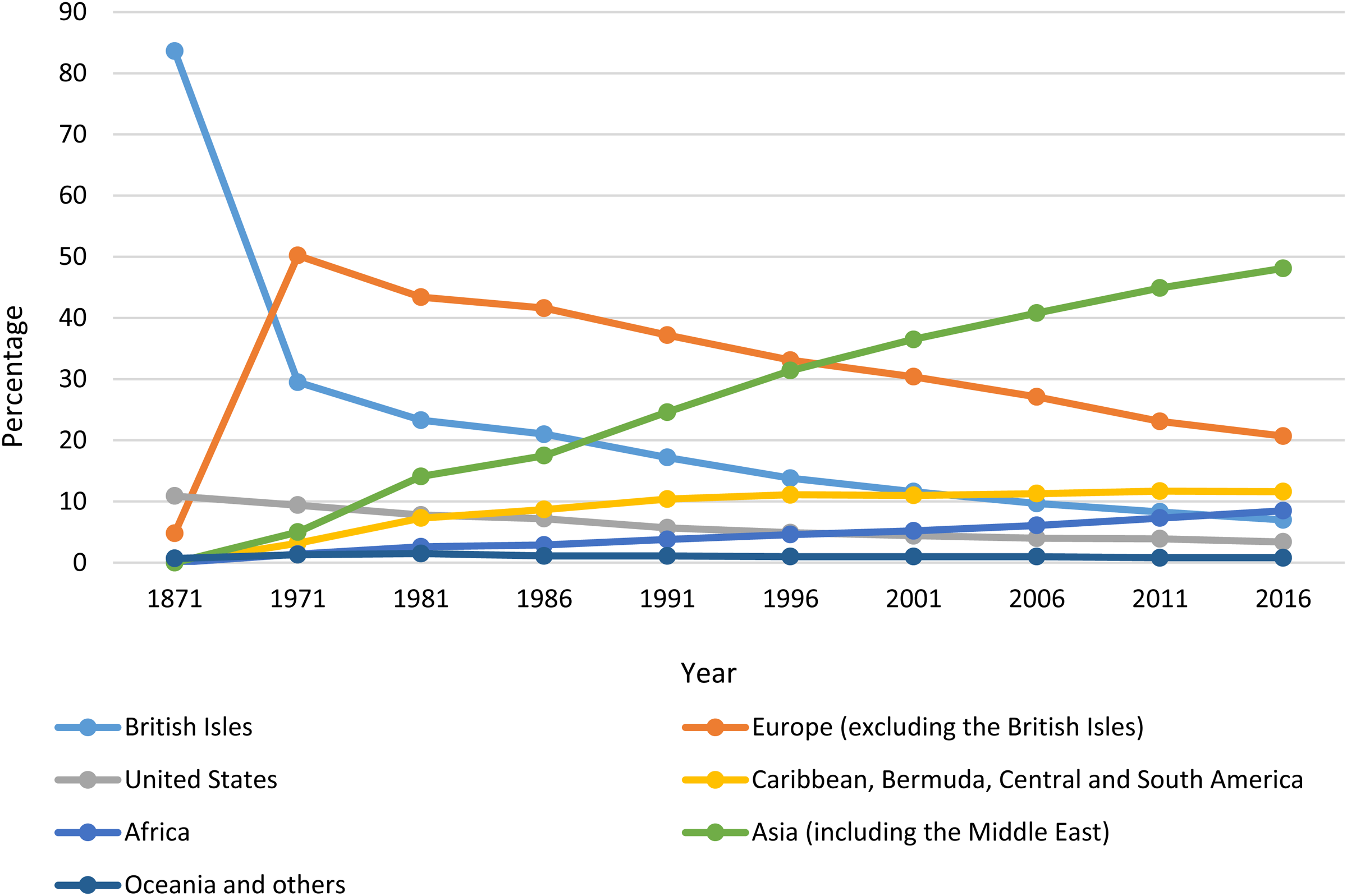
Immigrants’ place of birth, Canada, 1871 to 2016. Source: Statistics Canada 2023.
Australia
Unlike Canada, the Australian immigration program has continued to be governed by the Migration Act 1958. Immigration is solely a federal responsibility in Australia even though a number of new visa categories were introduced in the late 1990s under the State Specific and Regional Migration Scheme (SSRM) for facilitation of growth in “lagging economic regions.” These have contributed to state government involvement in migration (Hugo 2014, 381). However, in contrast with Canada, the Australian permanent migration program consists of two main parts: (i) the Migration Program and (ii) the Humanitarian Program (Phillips and Spinks 2012). The Migration Program includes the skilled, the family, and the special eligibility streams (DIBP 2013-2014). The skilled migration program focuses on individuals who have skills, proven entrepreneurial abilities or unique capabilities that would support the economic development of Australia (DIBP 2013-2014). Like Canada, the family stream supports family development and reunion of family members such as spouses, children, parents, and some other members of extended families (DIAC Migration Program 2010-2011; DIBP 2013-2014). The special eligibility stream on the other hand, caters to the resettlement of former Australian residents who meet particular criteria, or for resolving the status of some groups of people who have been permitted to reside in Australia as long-term temporary residents for humanitarian purposes (DIAC Migration Program 2010-2011; DIBP 2013-2014). Since 1997–1998, the skilled stream has been the main component of the migration program; increasing from 51.5% in 1997–1998 to 67.6% in 2014–2015 in contrast to 32.3% for the family stream and 0.1% for the special eligibility stream (DIBP 2014-2015). Seven out of the top ten source countries were previously nontraditional and non-English speaking (DIBP 2014-2015).
Similar to Canada, in the 1980s and the 1990s, the Australian economy also experienced an economic downturn. Two severe and protracted economic recessions occurred during the early stages of both the 1980s and 1990s, with unemployment rates reaching 10.3% in June 1983 and 10.7% in September 1992 (ABS 2011). Since then, immigration policies in Australia have strongly focused on the economic benefits migrants bring to the nation. In 1982, the Fraser government commissioned a conference into the economic viability of immigration. According to Birrell (2003), the investigations proved inconclusive with immigration perceived as economically mildly positive. However, the achievements and successes of countries such as Japan, Hong Kong, and Singapore challenged the Australian government's approach to expand its immigration parameters to Asian countries (Birrell 2003). In 1988 a Committee to Advise on Australia's Immigration Policies examined Australian immigration and recommended a high intake of immigrants who were “skilled, entrepreneurial and youthful” from some of the Asian countries (Birrell 2003, 37).
By 1996, the return of the conservative Australian Coalition parties to government led to major reforms. From mid-1999, a subcommittee appointed by the government to examine issues of skilled migration recommended that applicants wishing to come to Australia had to gain recognition of their qualifications from the relevant Australian authority in their field and prove that they had at least “Vocational English” assessed through the International English Language Testing System (IELTS) (Birrell 2003). This was a significant policy change from those applying before the late 1990s. As in Canada, a key criterion for selection in the late 1990s was possession of occupational skill. The Coalition reforms shifted the focus from the family stream to a highly skilled stream program, which brought a surge in the intake level of the skilled immigrants, increasing from 18.5% (10,100) in 1984 to 51.6% (34,670) by 1998 (Phillips and Spinks 2012). This change not only increased the arrival of skilled immigrants, but also those from non-English speaking backgrounds (NESB) in Australia (see, e.g., Hawthorne 1997). The term “NESB” immigrants as used in Australia included all overseas born immigrants except those from Canada, Ireland, New Zealand, South Africa, the United Kingdom and the United States of America as these countries are considered to be English-speaking countries (DIBP 2011). This term “NESB” however, may “signify cultural and racial differences in migrants” rather than the lack of English language proficiency (Hawthorne 1997, 397).
Since 1999 Australia's immigration policy has been reformed to ensure that immigrants with poor English language proficiency, unrecognized credentials, qualifications in low labor market demand occupations, and/or older age (i.e., 45 years and over) are excluded at the point of entry into Australia (Hawthorne 2014). These reforms are meant to allow Australia, like Canada, to “select for success,” enabling skilled immigrants to better integrate into the labor market (Hawthorne 2014, 2). Like Canada, a key shift in the 2000s has been the stronger focus on language-based criterion as part of the migration program. Since 2007, skilled immigrants are mandated to have high English language levels (Hawthorne 2014). However, no points are awarded to people who meet the Australian English language threshold of IELTS 6 or equivalent, instead 20 points are awarded to those who achieve IELTS score level 8 (Hoang and Hamid 2017), a level so high that even proficient native-speakers may not achieve it (Boucher and Amy 2019). Alternatively, the Australian government recognizes holding a valid passport issued by the United Kingdom, the United States, Canada, New Zealand, or the Republic of Ireland and being a citizen of one of those countries indicative proof of an applicant's competency in English (Department of Home Affairs 2018). Although individuals from the main English-speaking countries are exempt from the IELTS test, they can sit it if they wish to gain points for English proficiency (Hoang and Hamid 2017), providing an advantage for individuals from the main English-speaking countries. This creates potential “covert racial or national discrimination” against individuals of non-English linguistic backgrounds (Smith-Khan 2021). This is an important policy concern given the significant demographic shift in immigrant population in Australia (Figure 2).
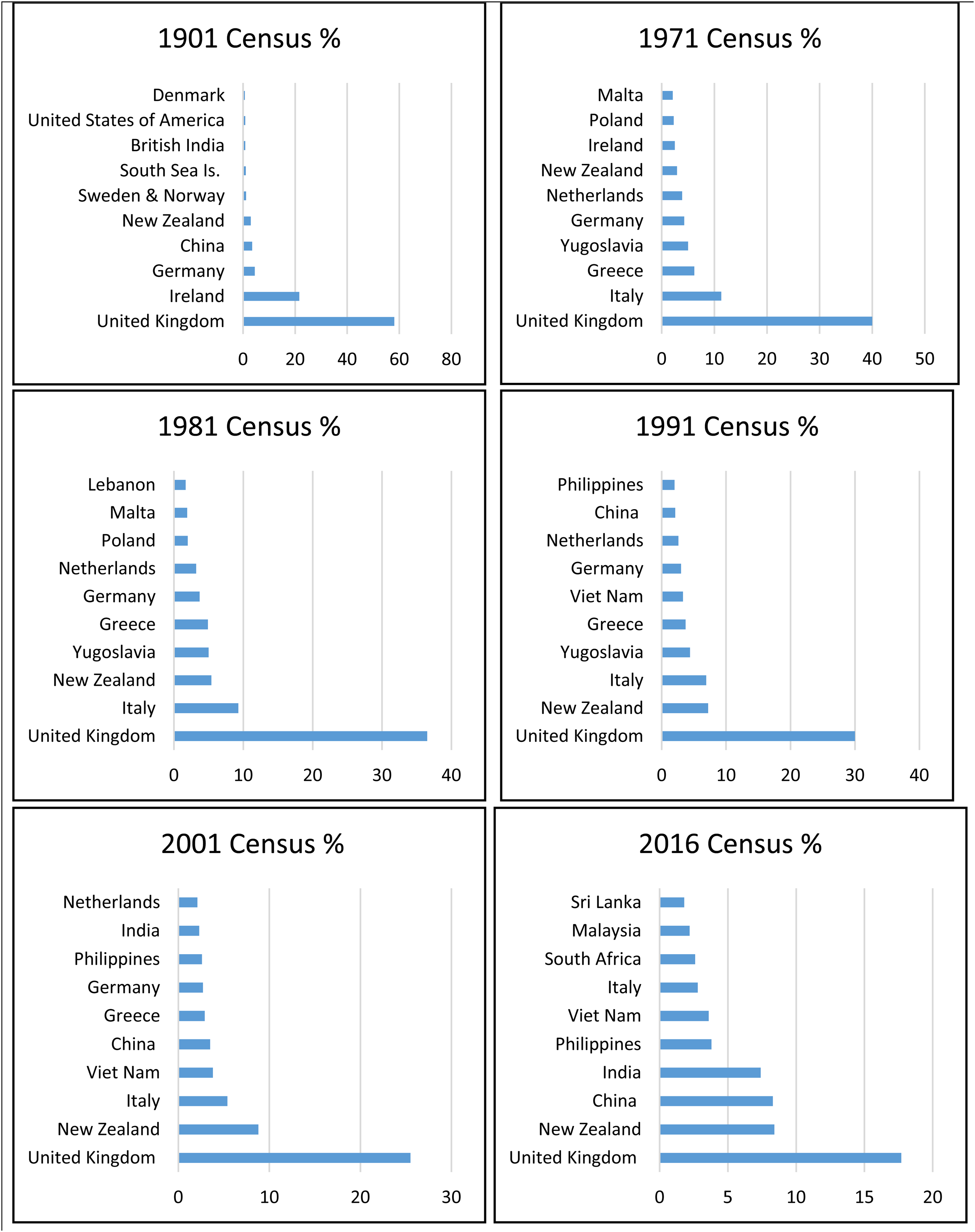
Top 10 countries of birth for the overseas-born population, Australia, 1901–2016. Source: Parliament of Australia 2018.
Table 1 compares the current points awarded by Canada and Australia to potential skilled migrants. It shows that the two countries use very similar points systems to determine eligibility.
Migration points by criterion and nation.
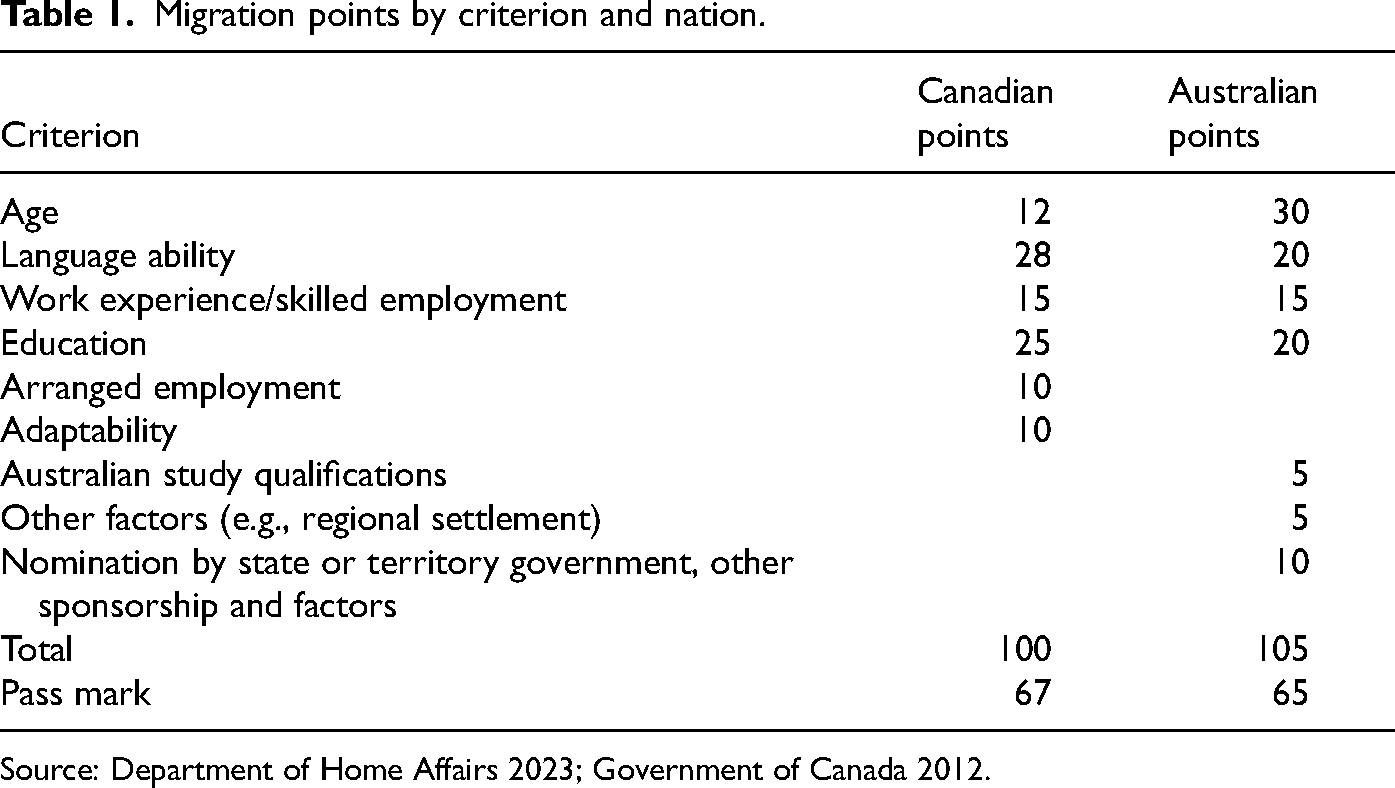
Source: Department of Home Affairs 2023; Government of Canada 2012.
It is evident that policy changes in Canada and Australia since the 1990s with regard to language proficiency level continue the isomorphism of previous eras.
Discussion
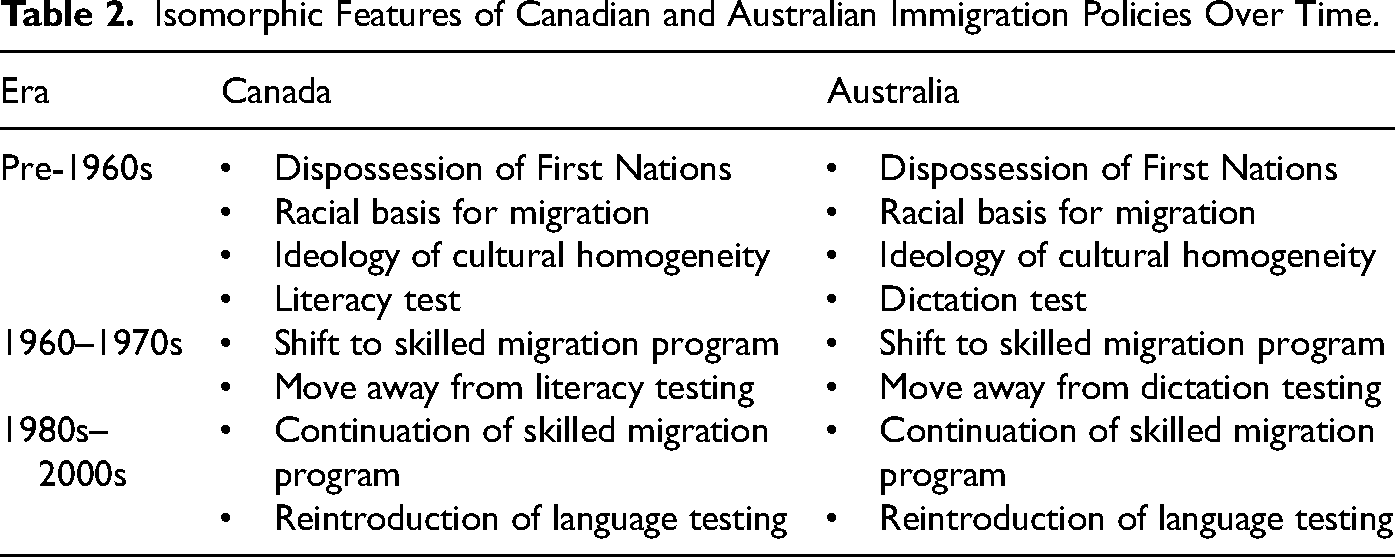
Our analysis shows isomorphism in migration policies between Canada and Australia across all three eras. Table 2 compares the immigration policies of the two nations over time. Canada is listed first as Australia followed its policy moves. Although the details of the current points-based migration programs in the two countries have some differences, the programs are essentially similar, as they have been since British settlement in both places, even though Canada also has a Francophone preference.
Isomorphic Features of Canadian and Australian Immigration Policies Over Time.
The period preceding the 1960s in Canada and Australia witnessed a systemic manifestation of racialized exclusion within immigration policies. This era was characterized by an ideological inclination toward favoring specific races and countries of origin, resulting in a predominantly and purposive homogeneous white culture. In Australia, the preference was distinctly given to British immigrants, while in Canada, British, and French migrants were favored, highlighting the prevalence of racialized exclusion during this time (Green and Green 2004; Jupp 2001; 2002; Reitz 2004; Walsh 2008). The historical context reveals a deliberate implementation of policies grounded in racial ideologies, utilizing mechanisms such as literacy and dictation tests to exclude individuals based on racialized linguistic and cultural criteria. This inclusion of racial bias into the immigration apparatus reflects a broader adherence to institutional normative isomorphic forces across the British colonies, aligning with legally established standards influenced by societal norms, public opinions, and cultural values. The complex challenge faced by both nations in balancing the influx of economic migrants with domestic concerns underscores a normative isomorphism inherent in their policy decisions. This analysis highlights the enduring impact of historical immigration practices and the intricate interplay between social obligations and normative forces in shaping immigration policies.
The 1960s to 1970s marked a pivotal period of institutional evolution in migration policies in Canada and Australia, demonstrating the concept of coercive isomorphism elucidated by DiMaggio and Powell (1983). Both nations, under external pressures and the influence of global norms, responded to coercive pressures, particularly from advocacy bodies, to harmonize their immigration policies with international standards. This era witnessed a departure from racially discriminatory practices, replaced by a shift towards skills-based criteria, exemplified by the implementation of “points systems” in Canada, later emulated by Australia (Reitz 2012). While these changes were ostensibly motivated by moral responses to internal and external advocates, as well as a desire to enhance international reputations (Ongley and Pearson 1995), a subtler form of preference emerged as points systems prioritized particular forms of human capital (Walsh 2011).
Notably, during the 1960s to 1970s, individuals from traditionally preferred regions tended to be more educated than those from nonpreferred sources. Consequently, as migration policies transitioned from racial to skilled criteria, they continued to predominantly attract individuals from previously favored regions. Thus, despite apparent shifts responsive to evolving political and societal expectations, the transformative impact of the move away from racialised immigration policies was somewhat limited. Broader isomorphic pressures internally impacted the extent of change in immigration policies in both countries, revealing the intricate interplay of external influences and persistent internal dynamics.
In recent decades, both Canada and Australia have retained and refined their skills-based criteria. A key refinement has been increasing language ability in their selection criteria. This has ostensibly been done in both locales in order to ensure that migrants are able to integrate into work, however it is also reminiscent of earlier racialized criteria. Maximum points are now awarded to immigrants with superior host language ability (Hawthorne 2014). This echoes issues of exclusion and raises concerns about fair competition for nonproficient language speakers (Boucher and Amy 2019). As in the past where “Non-Europeans were cast as permanent outsiders who were different, undesirable and undeserving of residence or membership” (Walsh 2012, 372) and therefore denied entry, the host language criterion can be used to vigorously exclude nonhost language proficient applicants. “The English language requirements appear to skew the skilled immigration program in terms of national origin and, possibly, race” (Berg 2011, 110).
Mimetic isomorphism is observed in the tendency of Canada and Australia to emulate successful immigration models or adopt practices from each other. It demonstrates how nations with similar political and economic structures, inherited from British colonization, such as Canada and Australia, may mimic each other's policies to enhance perceived effectiveness. The pursuit of best practices in immigration management from one nation to another illustrates the mimetic pressures at play. Canada's adoption of elements from Australia's model post-2000 illustrates competitive isomorphism, where countries adapt their policies in response to external pressures to remain competitive. As both nations prioritize attracting highly skilled workers to sustain economic growth, their immigration systems increasingly mirror each other. This convergence reflects the need to optimize migrant selection, ensuring that immigration policies not only respond to labor market demands but also shape the specific profile of incoming migrants. At the same time, colonial isomorphism remains evident in the structural similarities inherited from their shared governance traditions, influencing how they regulate migration and integrate new policies.
The OECD notes significant tertiary education enrollment growth in emerging regions, notably sub-Saharan Africa, the Arab states, East Asia, the Pacific, Latin America, the Caribbean, and South and West Asia, with annual averages ranging from 6% to 8.4% over four decades (OECD 2012). This surge, particularly in Asia, positions these regions as potential sources of skilled immigrants for OECD countries, including Canada and Australia. Shifting from overtly discriminatory policies to a focus on human capital factors including education, skills, and other qualifications (Ferrer, Picot and Riddell 2014; Green and Green 2004), possibly the policies did not anticipate rapid capability of meeting the requirements from previously excluded regions, leading to heightened language proficiency as a prominent factor in current immigrant selection criteria. The nuanced evolution in immigration policies reflects a complex interplay of historical legacies, societal expectations, and global dynamics.
Competitive and institutional isomorphism can create exclusionary barriers by standardizing practices that favor larger or more established groups, excluding marginalized ones. Governments must ensure policies are inclusive and adaptable to avoid unintentionally leaving certain groups behind.
Conclusion
The article systematically examines the immigration policy trajectories of Canada and Australia from the pre-1960s to the post-2000s in three phases, emphasizing the crucial role of historical context in shaping their unique paths. The colonial history of both nations leaves lasting imprints on their immigration narratives. Through an exploration of past policies, the analysis reveals that colonial isomorphism has shaped Canadian and Australian immigration policies. Despite shifts over time, fundamental inequities persist, manifesting in different subtle forms, echoing the adage that “the more things change, the more they actually stay the same” (Nkomo and Hoobler 2014, 255). The legacy of colonization and racial preferences extends to the introduction of points-based immigration policies, particularly focusing on language proficiency, possibly indicating a subtle preference for traditionally preferred source nations, impacting less proficient English and French speakers.
This article contributes to the field of international migration studies by applying institutional isomorphism theory to the immigration policy field, providing a framework for explaining the mechanisms by which nations’ immigration policies become similar. A colonial form of institutional isomorphism provides a lens for analyzing the convergence and divergence of Canadian and Australian immigration policies. The interplay of mimetic, coercive and normative pressures in this colonial form of isomorphism, embedded within historical and institutional contexts, has shaped the trajectory of immigration policy in both nations.
The legacy of colonization and historical racial preferences, evidenced in the evolution from overtly discriminatory policies to points-based systems, underscores the imperative for ongoing scrutiny of policies to ensure equity and justice in the immigration systems of both Canada and Australia. Policymakers must remain vigilant to subtle forms of discrimination, incorporating safeguards to mitigate unintended biases. Regular policy reviews and adaptations, community engagement, and active promotion of integration and inclusivity are recommended for a more inclusive immigration system in both nations.
The article suggests several future research. Firstly, colonial isomorphism is likely be present in other former British colonies, and future research could investigate colonial bureaucracy and its mechanisms for sharing immigration policy approaches across different colonies. Secondly, research using methods like interviews and surveys could also help explain how isomorphic processes are enacted across contexts. Lastly, we have argued that colonial isomorphism is a type of institutional isomorphism that occurs between nations that share a colonial history. It would be interesting to explore it in non-British colonial contexts.
Footnotes
Acknowledgments
A special appreciation goes to Dr. Emmanuel Opare-Addo for his invaluable support. The authors also wish to thank the editor, the associate editor, and the reviewers for their constructive feedback that helped shape the manuscript.
Data Availability Statement
Data that support this study are included in the article and also publicly available.
Declaration of Conflicting Interests
The authors declared the following potential conflicts of interest with respect to the research, authorship, and/or publication of this article: This paper forms part of a project conducted by the first author.
Funding
The authors disclosed receipt of the following financial support for the research, authorship, and/or publication of this article: This study received funding support from the Australian Postgraduate Award scheme at Swinburne University, Australia.
