




Abstract
Youths of a country seem to be less interested in going abroad when the per capita GDP of the country reaches a certain level. This education abroad and income paradox is supported by data from a number of countries/regions whose education abroad numbers have peaked. A rough value of $30,000 US in per capita income in purchasing power parity terms seems to be the threshold for a country's interests in education abroad to decline. If confirmed, this per capita GDP threshold can be used as a numerical tool to forecast the future supply of international students in different source countries.
The global mobility of international students pursuing higher education has expanded markedly in the first quarter of the twenty-first century. In 2000, approximately 1.6 million students were studying abroad; by 2024, that number had risen to an estimated 6.9 million (ApplyBoard 2025). Studying overseas involves substantial financial costs. Since the 1980s, leading English-speaking destination countries, including the United States, the United Kingdom, Australia, Canada, and New Zealand, have implemented differential tuition fees for international students. These fees are now typically three to four times higher than those charged to domestic students (Oduwaye, Kiraz and Sorakin 2023). In this context, a favorable economic condition in the source country plays a crucial role for students' access to educational opportunities abroad (see Liu 2021). Yet, despite continued economic growth, the number of students studying abroad from several traditionally strong source countries/regions in East Asia, such as Japan, Korea, Hong Kong, and Taiwan, has plateaued or even declined during the twenty-first century. This trend calls into question the presumed positive correlation between national affluence and outbound student mobility. A parallel may be drawn with the well-established inverse correlation between a country's per capita GDP and its fertility rate. As noted in previous research (Simon 1969; Wrong 1958), higher incomes tend to coincide with lower birth rates, a dynamic known as the demographic-economic paradox (Birg 2000). This study explores whether a similar paradox may exist between per capita income and international student mobility.
The Theory of International Student Mobility
One prevalent theoretical framework to explain the pattern of international student mobility at the macro-level has been the world-systems theory which sees different countries of the world as parts of one single global system of labor division (Wallerstein 2004). More importantly, the global system is stratified into core, semi-peripheral, and peripheral regions, with economic and political power heavily concentrated in core countries, while peripheral and semi-peripheral nations often remain dependent on the core and subject to exploitation by the core. Given these systemic inequalities, students from peripheral and semi-peripheral countries tend to migrate to core countries for higher education (e.g., Shields 2013). They are pushed to study overseas by the unfavorable conditions in their home countries, such as lack of educational opportunities, poor living conditions, and poor career prospects, and they are pulled at the same time by the favorable condition in the host countries, such as higher quality of education, better living conditions, and better post-graduate work opportunities (Mazzarol and Soutar 2002). This theory is reflected in contemporary mobility patterns. At present, the leading source countries of international students are two semi-peripheral nations—China and India. For instance, these two countries account for approximately 54% of all international students in the U.S. (Nash 2024). The primary destinations for international students remain the four Anglophone countries—the U.S., U.K., Australia, and Canada—which collectively host 45% of international students globally (ApplyBoard 2025).
The world-systems are dynamic and constantly evolving (Wallerstein 2004). According to the International Monetary Fund (IMF) forecasts in 2023, China and India will lead world economic growth from 2023 to 2028, contributing 22.6% and 12.9%, respectively, to new world GDP growth (Tanzi 2023). An important question to ask here is whether they will continue to be top source countries of international students, as they continue to grow their economies, gradually transitioning away from the periphery and toward the core. To answer this futuristic question, this study will look into four historical cases of Japan, Korea, Hong Kong, and Taiwan, who were strong source countries of international students historically, but their education abroad numbers peaked in the new century. In particular, this study will examine the historical per capita GDP growth trends of these four countries/regions and their historical education abroad numbers. Correlational analysis is the examination of the relationship between two or more variables (e.g., Prematunga 2012). As a correlational analysis, this study seeks to explore the relationship between a country's per capita GDP level and its young people's interest in study abroad. A working hypothesis of this study is that there might be a per Capita GDP threshold for the decline of young people's interest to study overseas in a country. This study also seeks to explore whether such a threshold can be identified through historical data. The ultimate goal and the intended contribution of this study are to forecast the future trends of international student mobility from major source countries.
The Cases of Japan and Korea
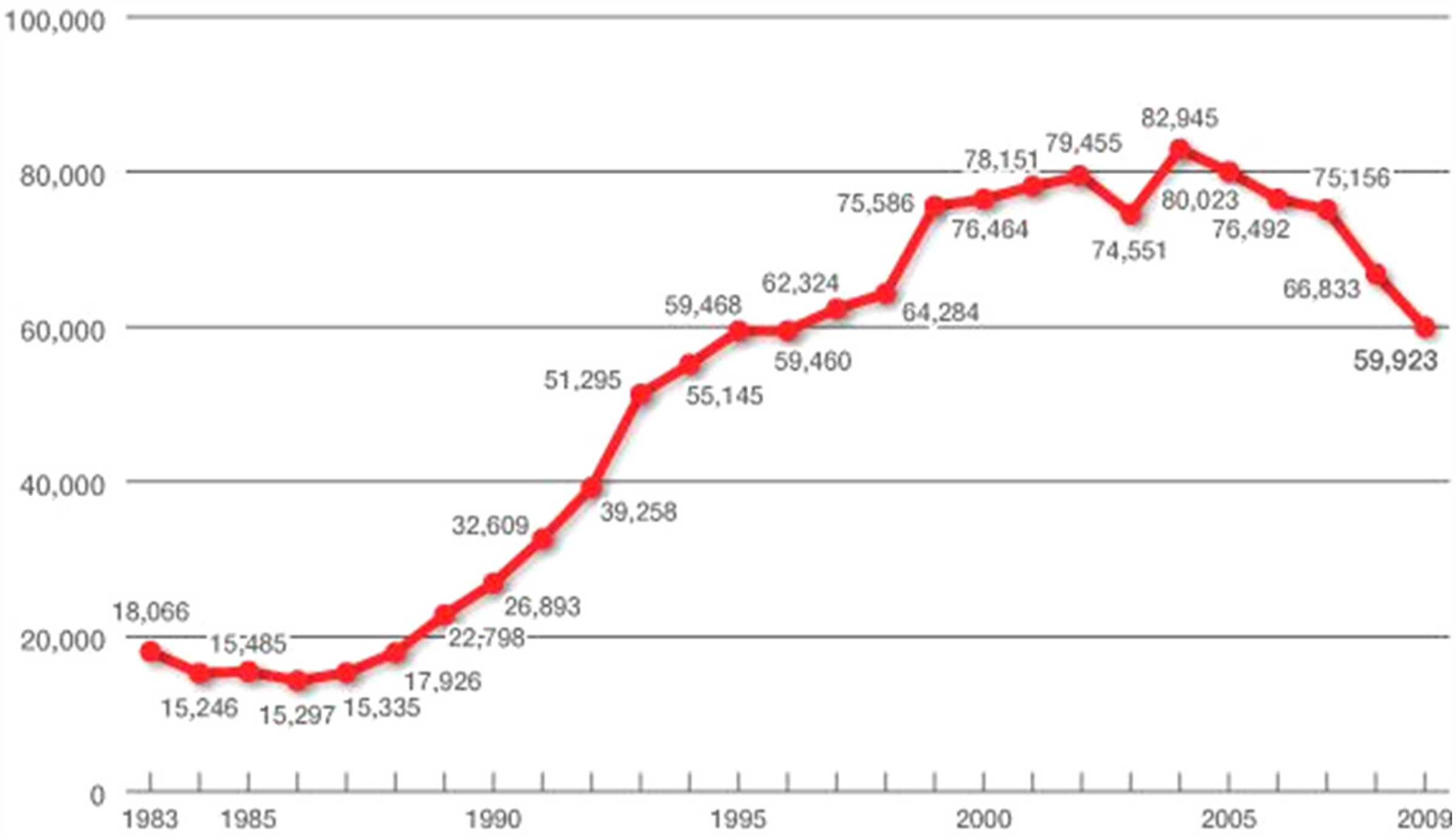
Japan was a strong source country of international students historically. However, the number of Japanese students studying overseas peaked in 2004 at about 82,945 students of the year (see Figure 1: Takayuki 2012). This peak was followed by a decline in the number of students studying abroad in subsequent years, though there has been some recovery recently. In 2004, the per capita GDP of Japan in purchasing power parity (PPP) was approximately $ 30,836.4 US, using data from the IMF (IMF-Japan 2024). The PPP value is adopted as it represents the economic output per person, adjusted for differences in price levels between countries, giving a more accurate representation of the standard of living and economic productivity. After 2004, Japan's per capita GDP continued to grow, but not the number of students pursuing education abroad opportunities. Since then, Japanese scholars have voiced their concern over the associated risks of this declining number, and the Japanese government has put out funding measures to encourage more students to study overseas (see e.g., British Council 2023). The number kept declining though.
Number of Japanese Students Studying Overseas Takayuki (2012).
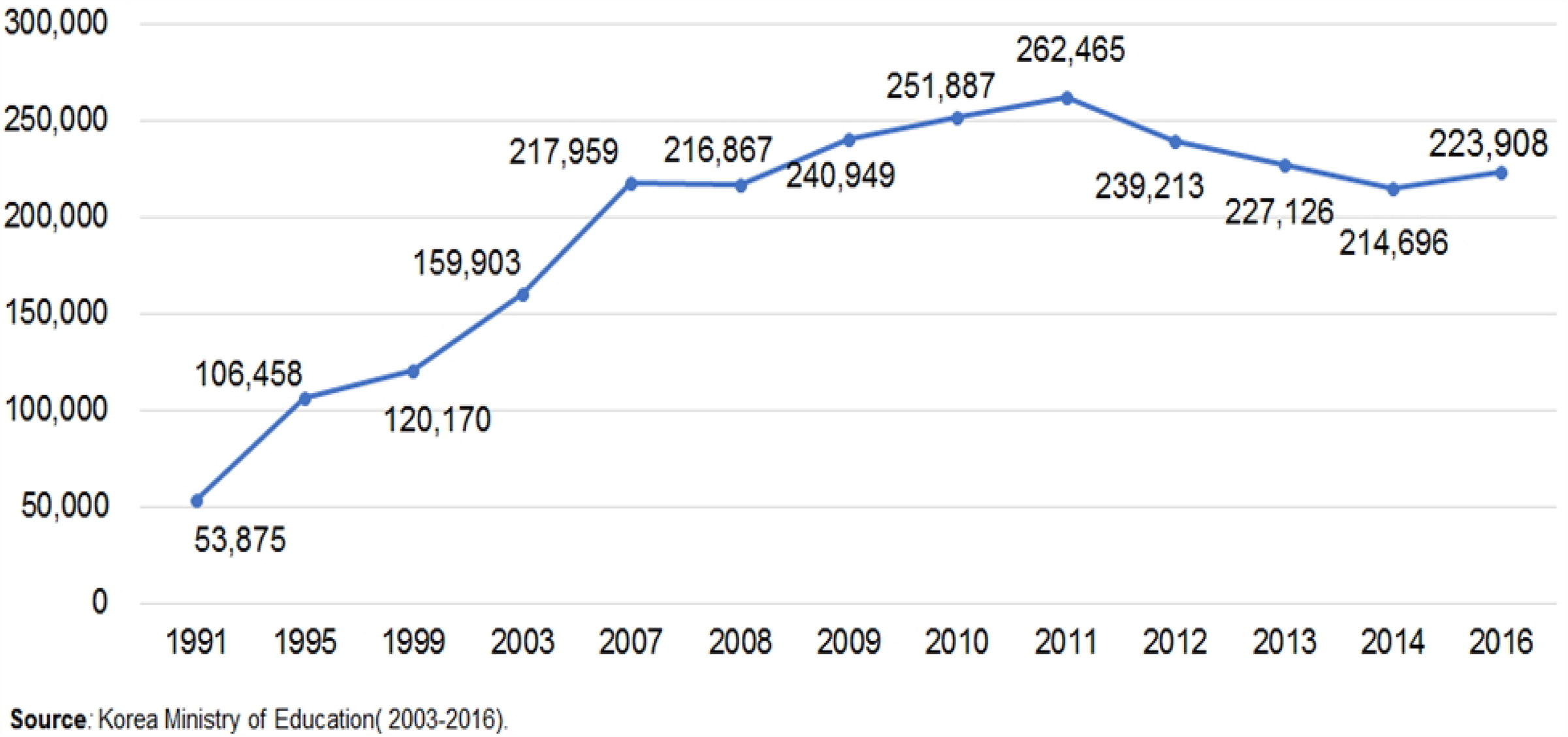
The number of Korean students studying overseas peaked in 2011 at about 262,465 students (see Figure 2: Korean Council for University Education 2024). This was the highest recorded number of South Korean students pursuing education outside their home country. In 2011, the per capita GDP of South Korea in PPP was approximately $ 32,546.8 US, if we consistently use the IMF data (IMF-Korea 2024). This is very close to Japan's per capita GDP number when its number of education abroad students peaked. Similarly, the per capita GDP in South Korea continued to grow after 2011, but not the number of students studying abroad from Korea. Is around $30,000 US per capita GDP in PPP terms a universal income threshold for a country's declining interest in education abroad? Let's move on to examine another two regions, Hong Kong and Taiwan, whose education abroad numbers have also peaked in the past 20 years.
Number of Korean Students Studying Overseas (Korean Council for University Education 2024).
The Cases of Hong Kong and Taiwan
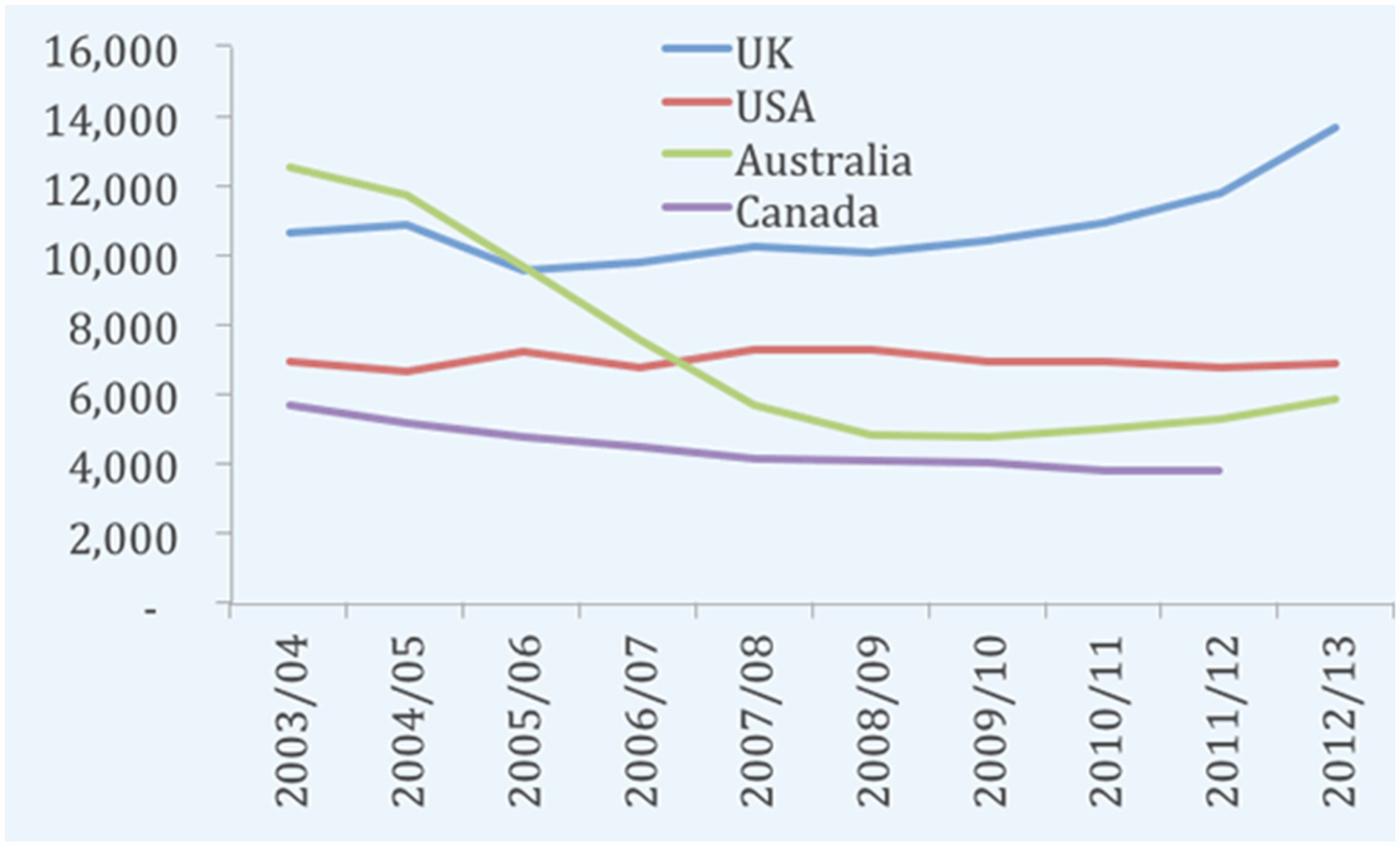
The number of Hong Kong students studying overseas seems to have peaked around the early 2000s. Based on Figure 3 from British Council (2015), Hong Kong student enrollments in major English-speaking study abroad destinations began to trend down or plateau from 2003 to 2004. In 2003, the per capita GDP of Hong Kong in PPP was approximately $ 31,022.4 US., also based on the data from IMF (IMF-Hong Kong 2024). This is a very similar threshold to Japan and Korea when their education abroad numbers peaked. Also similar to Japan and Korea, the per capita GDP of Hong Kong continued to grow in the new century, but the education abroad number stabilized, despite the recent spike due to security concerns after the passing of the National Security Law in China.
Hong Kong Enrollments in major English-Speaking Study Abroad Destinations (British Council 2015).
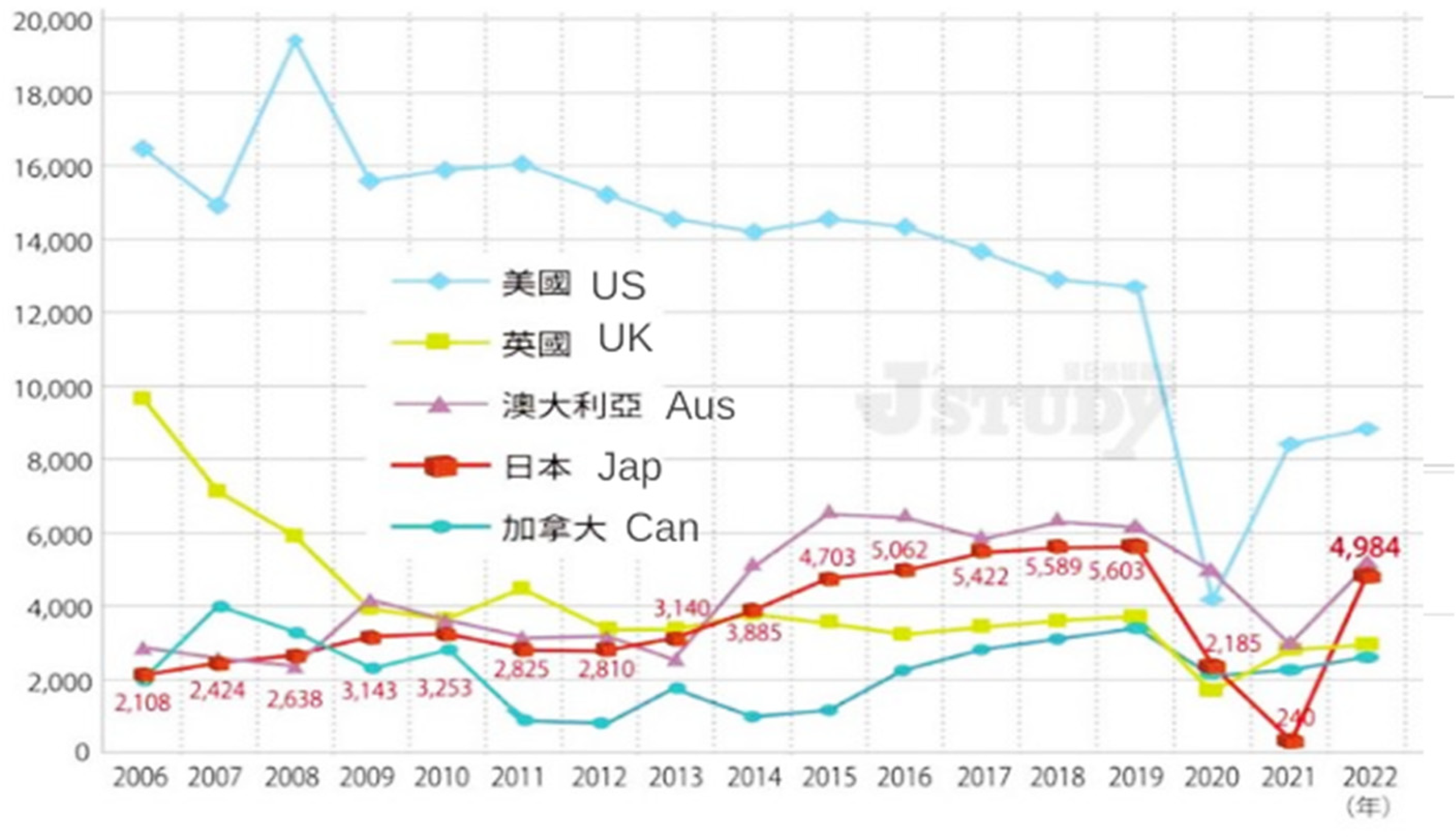
The number of Taiwan students studying overseas experienced a general declining trend, starting around 2006, particularly shown in the quickly decreasing number of students heading to the U.S. and the U.K. (see Figure 4: J'Study 2024). The numbers of Taiwan students heading to other major destination countries, such as Australia, Japan, and Canada, stabilized with only slight fluctuations from year to year. In 2006, Taiwan's per capita GDP in PPP terms was approximately $ 31,220.7 US (IMF-Taiwan 2024). This is surprisingly similar again to the per capita GDP numbers of Japan, Korea, and Hong Kong, when their numbers of education abroad students peaked. The per capita income of Taiwan has also had steady growth after 2006.
Taiwan Students’ Education Abroad Trends and Changes (J'study 2024).
Possible Reasons
There are not many developing countries/regions that have peaked in their students’ interest in studying abroad. But an analysis of the above four peaked countries/regions in the new century all surprisingly point to a consistent number of around $30,000 US in per capita GDP (in PPP terms) as an income threshold for the start of the decline of interest in education abroad among its youths. Thus, there is indeed an education abroad and income paradox. Are there ways we can explain this education abroad and income paradox? Why do students stop going abroad when they are financially more capable of doing so? Based on the world-systems theory that we reviewed above (Wallerstein 2004), students are always moving from poor periphery or semi-periphery countries to rich core countries for higher education. In other words, economic disparity between home and host countries is a necessary condition for large-scale international student mobility. When the income level of students’ home countries reaches a certain level, the economic disparity goes down and the drive for students to leave home for universities overseas starts to go down too. In addition to improved living standards and work opportunities at home, a better economic situation in the home country means more investment in the home country's higher education sector. More investment in the higher education sector means better quality of higher education at home. Students can stay close to home and still receive the best education in the world. They are less willing to put up with the challenges of studying abroad, though more of them are financially capable of doing so.
Reaching the threshold of $30,000 per capita GDP in PPP terms in these four countries/regions did not result in a total stop of students’ outbound mobility. In all four cases, there has been a decline and then a continuation of a stable stream of students studying abroad. There have been short-term spikes as well. The $30,000 per capita GDP value is a very rough and tentative value waiting to be verified by data from other countries. However, based on the tentative findings of this study, we may divide all major source countries of international students into three categories. Some are pre-threshold countries, such as India and Nigeria. Their per capita incomes are far from the $30,000 level yet, and their students are very much interested in studying overseas and in pursuing the post-graduation work and immigration opportunities offered by major host countries. Some are near-threshold countries, such as China. Their per capita income comes close to the $30,000 mark, and Chinese students seem to be very much open to either staying on to work in host countries or heading home upon graduation, depending on the work opportunities in both places. Some are post-threshold countries, such as Japan and Korea. Their per capita incomes have far exceeded the $30,000 level, and students from these regions do not seem to be as interested in staying on in their host countries to live and work. A more important goal for them might be to increase their linguistic and cultural exposure, and to improve their career prospects back home. In post-threshold countries, studying abroad often stops being only a private and family decision, but also a public policy issue for a country. To increase the population's knowledge and expertise about foreign countries and cultures, both for national security reasons and economic resilience reasons, a national government often needs to roll out funding policies to stimulate students’ interest in studying overseas.
Potential Implications
The tentative income threshold for the peaked interest in education abroad can be used as a rough but useful tool to analyze the recruitment prospects for international students from different source countries. In the first place, for the countries whose per capita incomes have exceeded $30,000, i.e., post-threshold countries, we know that the number of education abroad students from there will not likely grow too much and too fast. We can expect the current level to sustain though. China has been the biggest supplier of international students in the past two decades. To consistently use the GDP number provided by the IMF, the current per capita GDP (in PPP terms) in China is $ 24,991.1 US (IMF-China 2024). It is projected to grow to over $30,000 in 2028. So China is a near-threshold country. We can cautiously predict that the number of students coming out of China might continue to grow for another 4 to 5 years, and then it might decline or plateau. The number of international students from India has shown a fast increase in the past few years, quickly surpassing the number of Chinese students in a number of major host countries, such as the U.S., the U.K., Australia, and Canada. Also based on the data from the IMF, India's per capita GDP in 2024 is less than $10,000 (IMF-India 2024) and will take a while for it to reach $30,000, depending on the rate of economic growth in the country over the near term. So India is a pre-threshold country. The same is true for other emerging markets, such as Nigeria, Vietnam, and Malaysia. We can expect the numbers of international students from these countries to continue to grow. Through the utilization of this tool, we can determine the optimal allocation of our limited resources in international recruitment, strategically directing greater investment toward high-growth markets.
When recruiting from these three different markets, our marketing messages should also differ in accordance with their income levels. For the past-threshold countries, the threshold being $30,000 US or so in per capita GDP, our messaging should focus on the opportunities for language and cultural studies in the host countries, and how the improved intercultural competences will enhance their job prospects back home. For the near-threshold countries, our messaging should center on choices in both host and home countries, and how the experiences studying overseas allow them the options to either stay on to work overseas or head home to work if opportunities are better back home. Studying overseas opens one more door for learning and employment. For pre-threshold countries, post-graduation work and immigration opportunities are likely to be more important. Our messaging should help analyze the host countries’ immigration policies and work opportunities, but also encourage them to consider heading home, for the obvious ethical reasons. It needs to be stressed here again that the income threshold number is arrived at in this paper on the basis of only four countries and regions in East Asia. It should be used with much caution. First, the number needs to be verified by data from other countries and regions. Second, there are many other factors that impact students’ mobility patterns, and we need to be sensitive to changes of these other factors, particularly short-term ones. We still remember the impact of the COVID-19 Pandemic on student mobility. We can also see the impact of countries’ geo-political policies on students’ international mobility. As we mentioned above, countries’ public spending on education abroad scholarships is another factor to watch out for.
Summary
Similar to the economy and fertility paradox, there seems to be an education abroad and income level paradox as well. Youths of a country seem to become less interested in going abroad when the per capita GDP of the country reaches a certain level. Based on education abroad and per capita GDP data from Japan, Korea, Hong Kong, and Taiwan, countries/regions whose education abroad numbers have peaked in the new century, this paper has determined a rough value of per capita GDP $30,000 US (PPP) as an income threshold for a country's interests in education abroad to decline. This value, if further verified, can be used as a numerical tool at the macro-level to forecast the future supply of international students in different source countries. The number of students studying abroad tends to peak when this income threshold is reached. But as this income threshold is still a tentative number, it must be used with caution.
