




Abstract
Migrants’ engagement in digital platform work is pervasive in many cities around the world and certainly in Canada's metropoles (Toronto, Vancouver, and Montreal). While highly precarious, platform work has been shown to offer pathways into labor market integration for newly arrived migrants. Based on 62 qualitative interviews with digital platform workers, this article compares the work experiences of newcomers, settled migrants and nonmigrants engaged in platform work in Canada's three largest cities. The study examines how the different stages of their immigration journey shape the ways in which migrants (versus non migrants) perceive and evaluate their engagement in digital platforms. Satisfying urgent needs, achieving stability and allowing for personal development are three key elements that emerge from this study. These findings invite us to consider what are the main elements in current notions of “quality work” among migrants and nonmigrants and to consider how platforms shape broader labor market integration processes
Introduction
Many researchers have argued that platform work provides multiple advantages over traditional work by eliminating barriers that prevent people, such as people with disabilities and caregiving responsibilities, among many others, from participating in the labor market (Vallas and Schor 2020). Despite these documented advantages, other researchers have highlighted the precarious conditions that digital platform workers face, such as the lack of regularity and predictability to ensure a work-life balance (Warren 2021). For those engaged in platform-mediated work, the work often comes with the need to be available “on-demand” (Duggan et al. 2020; Warren 2021), and such working arrangements have a significant impact on achieving work–life balance (Warren 2021).
The digital platform economy has been driven, to a large extent, by the influx of migrants who are willing to take on these jobs (Van Doorn, Ferrari, and Graham 2023). Without them, platforms would face significant challenges in maintaining a sufficient labor supply, which could impact their ability to attract investment capital. However, while digital platforms have benefited from the availability of migrant workers, these workers face significant challenges. Compared to regular jobs in the formal economy, digital platform work often lacks access to compensation and standards that offer financial stability and opportunities for growth. Digital platform workers are not afforded the same legal protections and benefits as employees in regulated jobs (Wheelahan and Moodie 2022).
Despite the above concerns documented in the literature, for migrants, digital platform work has been shown to function as a stepping stone for labor market integration (Lam and Triandayllidou 2021). Labor market integration is normally associated with formal, decent, and state-protected work (Triandafyllidou, Isaakyan, and Baglioni 2023). But digital platform work offers a temporary solution to new arrivals who cannot access good quality jobs, even though some have degrees and qualifications (Altenried 2021). However, the “convenience” and low entry point of digital platform work should not direct our attention away from the complex barriers that migrants face both at the labor market and more broadly. For recent arrivals, these barriers can take many forms, such as language barriers, lack of recognition for foreign qualifications, lack of networks as well as discrimination based on ethnicity or nationality. For settled migrants some of these barriers may also persist including ethnic, religious, and racial discrimination, or lengthy processes for credential recognition (Barratt, Goods, and Veen 2020).
This study focuses on the two important observations identified above notably that (a) digital platforms would not exist if it was not for the plentiful pool of migrant labor that fills the ranks of digital platform workers (Van Doorn, Ferrari, and Graham 2023), and (b) that while digital platform work is precarious, uncertain, offers no opportunities for training and advancement, and no social protection, it is at times preferred, and considered as “good work,” by migrants as it offers a low threshold of entry, flexibility of hours, and lack of hierarchy (Lam and Triandafyllidou 2021).
These observations suggest that migration status and migration experience can be important mediating factors that shape workers’ experience in digital platforms both subjectively (in terms of perceptions) and objectively (in terms of actual job (in)security and barriers faced in their integration into the labor market). Relevant studies so far have examined migration status as a variable affecting the experiences of migrant workers in digital platforms particularly when such status is temporary or insecure (see for instance Orth 2024; contributions to the Special Issue by Andersen et al. 2024). These studies have not examined though separately migration status and the lived experience of being a recent or settled migrant. This article delves specifically into this aspect treating migration status and migration tenure (length of being a migrant at destination) as separate mediating factors that condition the experience of migrant workers on digital platforms and shape their subjective perceptions of the quality of their work, as well as the systemic barriers and structural inequalities that they face. The study includes nonmigrant digital platform workers as the control group against which migrants’ experiences are compared.
This study brings together 62 semistructured qualitative interviews with digital platform workers conducted in spring and summer 2023, in Canada's three major metropolitan areas, notably Toronto, Montreal, and Vancouver. Our interviewees include in equal parts newly arrived (zero to five years from arrival) migrants, settled migrants (five years or more at the country of residence) and nonmigrants. The study looks at the ways in which our research participants navigate the opportunities and challenges of digital platform work and make sense of the “quality” of their work.
The paper starts by briefly introducing the Canadian context in order to contextualize the study (the Canada's immigration approach section) and then turns to review the notion of quality of work that offers the analytical framework used to analyze our data. The methodology section presents our methodology while the navigating digital platforms and making sense of work quality section presents our findings which compare the experiences and perspectives of recent migrants and settled migrants with those of nonmigrants. The concluding section offers reflections how process and experience of migration is a critical factor to consider in understanding how digital platform work shapes perceptions of quality and potential policy implications.
Canada's Immigration Approach
Canada's immigration system attracts immigrants through permanent or nonpermanent avenues. Permanent avenues include family, refugee, and economic class. Nonpermanent immigrants arrive typically through various permit pathways (Crossman, Hou, and Picot 2020; Lam and Triandafyllidou 2024), such as through work or student permits. In recent years, this trend toward “two-step” migration — entering through a temporary pathway before qualifying for permanent status — has become a reality for many and a viable option to permanence (Niraula, Triandafyllidou, and Akbar 2022; Banerjee, Lam, and Lamb 2023; Reitz 2023). While researchers have explored the benefits of such a system, such as providing a smoother transition process (Crossman, Hou, and Picot 2020), the downfalls include creating a situation where gaining stability begins a lengthier and more complicated process (Anonymous citation 2024), and temporary migrants have to take on more jobs that might be exploitative without the guarantee that these jobs will lead to permanence (Crossman, Hou, and Picot 2020).
These trends work against a backdrop of barriers to gainful employment that Canada's immigrants have faced in the past. The 2021 census found that a large portion of migrants arrive with postsecondary education, with recent immigrants accounting for nearly half of the growth in the share of Canadians holding a Bachelor's degree or higher (Statistics Canada 2022). Yet overqualification, underemployment, labor underutilization, and skills–job mismatch have been prominent issues for immigrants (Lu and Hou 2020; Statistics Canada 2022; Banerjee, Lamb, and Lam 2024). There has been a significant increase in economic migrants who were recent graduates, and it takes time to translate educational experience into wage outcomes (Crossman and Hou 2022). However, scholars and policy makers have noted that immigrants face many barriers to gain working experience in Canada in the first place, with many resorting to settle for jobs beneath their education and training, whereas immigrants were twice as high an overqualification rate in jobs (Statistics Canada 2022). These trends coincide with the greater likelihood for immigrants to be employed in platform work (Jeon, Liu, and Ostrovsky 2019), involuntary part-time work and other forms of nonstandard forms of employment (Hira-Friesen 2018; Lamb, Banerjee, and Verma 2021).
Assessing Quality of Work in a Digital Platform Economy
Many workers including migrants who face employment challenges at their new country of residence, use platforms as an immediate and short-term solution to unemployment or as a source of supplementary income despite low pay and poor working conditions (Wood et al. 2019; Myhill, Richards, and Sang 2021). Research has revealed that workers’ assessment of the quality of their work is multidimensional and largely depends on the alternatives available to them (Triandafyllidou, Isaakyan, and Baglioni 2023). In providing a multidisciplinary look at markers of job quality in the digital platform economy, Goods, Veen, and Barratt (2019) noted three dimensions: economic satisfaction related to income, social satisfaction related to perceived autonomy and stability, and psychological satisfaction related to enjoyment.
Drawing on the economic perspective, Dunn (2020) finds that workers in the digital platform economy attribute the quality of their work on the feeling that it is voluntary — they can decide when to work — and on the financial income that it generates. Indeed, beyond financial sustainability, job quality relates to nonmonetary aspects. Despite not having welfare coverage (such as pension, health insurance, paid sick days, or vacation days) (Muntaner 2018; Dunn 2020) digital platform workers view autonomy, notably the freedom and flexibility to choose when they want to work, as a reason for entry into platform work. In addition, this flexibility serves as an open door to hold multiple jobs (Prasad 2023).
Yet this flexibility comes at a cost, as it often leads to extremely long working hours in conditions of insecure income and unstable employment (Cano, Espelt, and Morell 2021). For digital platform workers to earn enough and maintain satisfactory ratings, they must work extremely long hours and know the peak times to work (Dunn 2020). Labor control incentives and algorithmic nudges push digital platform workers to work more when there is high demand thus further limiting their autonomy (Altenried, Bojadživev, and Wallis 2021; Scheiber 2022). Ultimately, the subjective feeling of autonomy may remain high albeit the actual freedom and flexibility in digital platform work are severely restricted by the ebbs and flows of demand and supply of the platform business model.
Research on independent workers shows that these workers who have multiple workplaces leverage personal holding environments (such as to routines, places, people), which in turns help to manage emotions (Petriglieri, Ashford, and Wrzesniewski 2019). For instance, being able to choose which gigs to take on and how to do the work contributes to positive feelings (Ravenelle 2019; Petriglieri, Ashford, and Wrzesniewski 2019). For digital platform workers, the ability to relate emotionally can both enrich their experiences and create greater stress (Malin and Chandler 2017; Caza et al. 2022). Many digital platform workers tend to work in isolation where the opportunity for making connections to share their work concerns and social support is nonexistent (Tran and Sokas 2017).
Being a migrant further exacerbates the challenges and opportunities discussed above in relation to digital platform work. Navigating the new country's migration regulations (obtaining or renewing a work permit, for instance or applying for long-term status) creates both a higher dependency on digital platform work and a greater need for autonomy and flexibility (Maury 2020; Lam and Triandafyllidou 2024; Orth 2024). Nevertheless, migrants like nonmigrant workers search for not only socioeconomic attainment but also for a feeling of stability, safety, community and belonging through their employment (Kearns and Whitley 2015; Geurts and Phalet 2025). It is important therefore to examine whether and how platform work satisfies or not those complex needs beyond providing a source of income.
Methodology
This study has adopted a qualitative approach given that our interest is in understanding the experiences of different types of digital platform workers, and the ways in which they make sense of such experiences. We conducted 63 semistructured interviews with digital platform workers during the period May to November 2023, with targeted recruitment in the three of Canada's metropolitan cities — Vancouver, Toronto, and Montreal. The first and third authors of the study and an additional research assistant conducted the fieldwork. All three interviewers acknowledged their positionality as Canadians of Asian, Caribbean, and North African descent and as immigrants (none of the researchers is Canadian-born) but also as researchers who could be perceived by the interviewees as those who hold power and a higher level of knowledge. They tried to undo such power dynamics by reflecting on their own experiences and narratives.
The study adopted a purposive sampling strategy, focusing on digital platform workers who were engaged in platform work during the time of recruitment including four individuals that had worked in digital platforms until recently but were no longer working at the time of the interview. Recruitment was conducted through social media, digital platform workers’ networks and in-person. Our interviewees were engaged in a variety of digital platforms such as Uber, Ubereats, Skipthedishes, Doordash, TaskRabbit, Care.com, and BookJane. We intentionally sought for people engaged in a variety of platforms beyond ride hailing or food delivery with the aim of providing a fuller picture of digital platform work and its varieties. We intentionally excluded digital platform work that is performed entirely online (e.g., translation or copyediting).
Interviews were audiorecorded and transcribed (with a few exceptions where detailed notes were taken in writing if the participant did not feel comfortable with audiorecording). Most interviews lasted between 30 and 60 min. Interviews were also conducted over video or phone, based on the participants’ location and preference to meet. We also used snowball sampling as participants were able to share the study with their peers and networks (Biernacki and Waldorf 1981). Participants were given a small honorarium for their time to participate.
Focusing on Goods, Veen, and Barratt (2019) three levels of job satisfaction discussed earlier, we used an abductive approach, as this allows us to examine differences in the quality of work experienced by migrants, moving from specific observation to a plausible explanation (Behfar and Okhuysen 2018). From existing literature, we looked at the different types of satisfaction or lack thereof as defined by Goods, Veen and Barratt (2019). We then coded for categories that pertain to quality of work such as “income dependency,” “flexibility,” “motivation,” “autonomy,” “connection,” “competency,” and “work–life balance.”
As we were specifically interested in the role of migration status and migration experience as factors shaping engagement in digital platform work, we specifically coded axially for migrations status (Corbin and Strauss 1998; Gioia, Corley, and Hamilton 2013) looking at how migration status and experience relate to the type of satisfaction or lack thereof expressed by our interviewees. The researchers met regularly to discuss emergent themes until consensus was reached with a view to ensure reliability in coding and discuss the analysis. Table 1 shows the composition of our research participants along main sociodemographic variables.
Composition of Participants.
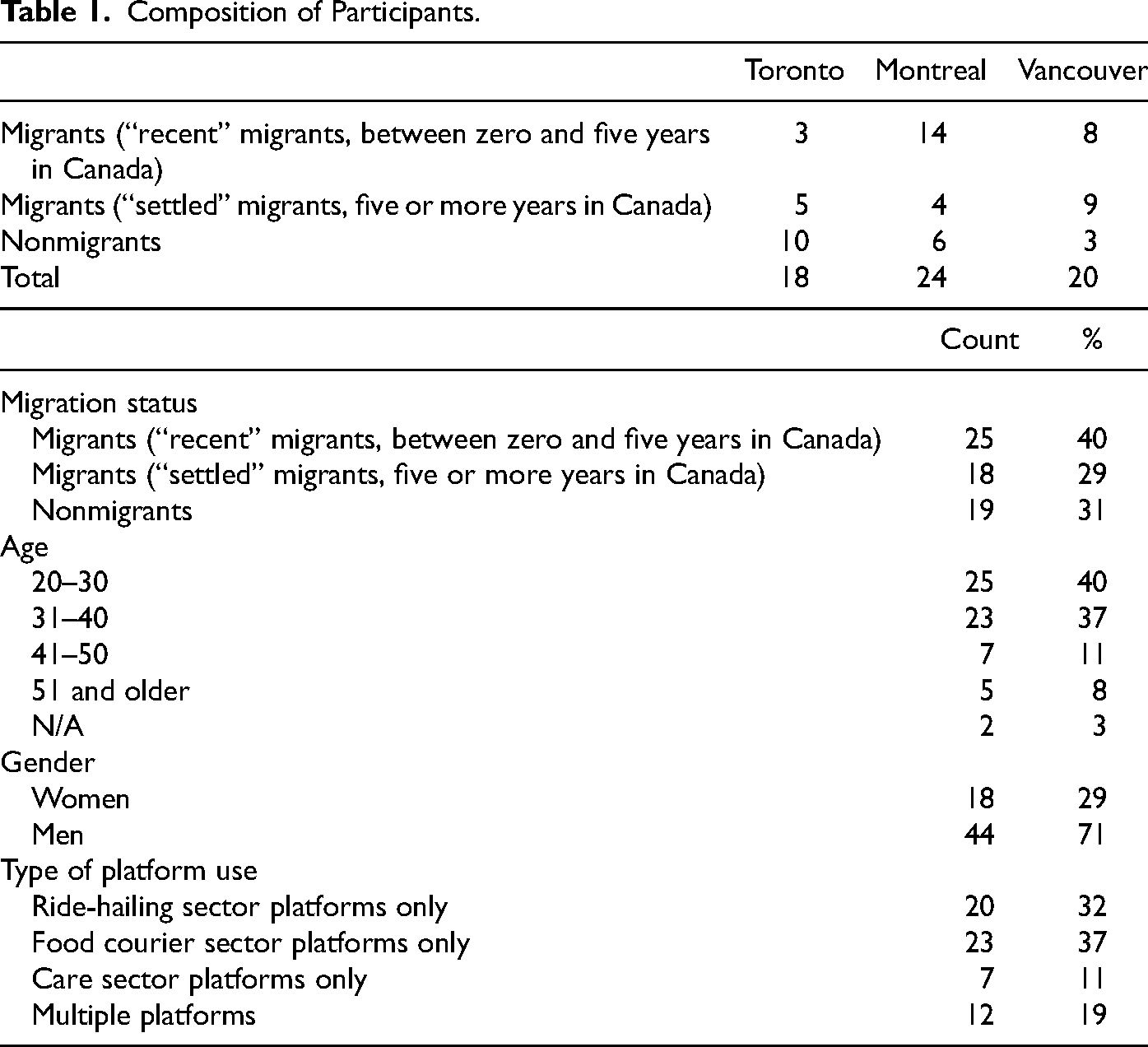
We coded our participants by migration status, with recent migrants being those who had been in Canada from zero to five years and who are considered to be still adapting to life in their new country. Our second group of participants included people who have been in Canada for at least five years, which we coded as “settled migrants.” The third group of interviewees is Canadian-born individuals. Our definitions are not the same as how Statistics Canada (2017) defines the recent migrants, but we follow in line with other scholarly research that categorize migrants based on their time since migration (see Wong 2020)
Navigating Digital Platforms and Making Sense of Work Quality
As we analyze the experiences of the three groups of research participants, we examine how migration status and migration tenure (length of stay at destination and related lived experience) interact to shape their complex and multilayered understanding of quality of work. The temporal dimension of tenure shapes priorities and choices as the workers struggle with systemic barriers (deskilling, discrimination, under employment) and structural inequalities (age, gender, socioeconomic status). In contrast, the group of nonmigrants faced socioeconomic inequalities but no migration-related barriers.
Recent Migrants
This group of migrants is characterized by minimal to no working experience in Canada, and they have lived in the country for less than five years. These are also people that still had their previous country experiences fresh in their minds and kept comparing the present with the recent past. Their assessment of job quality was based on (a) the urgent need to make ends meet, and (b) their still recent premigration work experiences and related expectations of finding work in their field of expertise. Maria, an architect from Mexico who arrived in Canada two years ago, voiced how her desire to find work in her field was not fulfilled and, in that sense, digital platform work became an option to reconcile with that tension of ideal versus reality. Yes, my first purpose was improving my English, but in terms of employment goal, I was hoping to work in my area of expertise, but it did not happen. But as I needed to pay bills, I worked in different organizations, including a local platform economy.
Recent immigrants who came for study purposes viewed such platform work as a means to achieve also autonomy in managing their academic and work commitments while meeting economic needs. They appreciated the convenience of accessing work easily and receiving payment immediately. This is especially compared to other forms of employment where they would have to work full shifts and adhere to an organization's payroll schedule.
Ahmet
1
arrived in Montreal two weeks prior to the interview. He is 23 years old and an international student. He started working on a digital platform to make ends meet. He was at the point of abandoning his studies and did not feel he could ask for further financial help from his parents. He also felt deceived by what was written in the social media about studying in Canada. I knew about Uber Eats even [before] getting here … when I was preparing for my visa and study permit back in my home country, I was checking YouTube, seeing what life is like, what the lifestyle is about … what kind of work is available. What I’ve seen on YouTube is all lies. Everyone is doing it [driving Uber]. I know some people that quit their jobs to become like Uber. I’m fluent in three languages, so I honestly thought this this would be an asset for me. Since Canada is all about differences. People are different here. But sadly it wasn't.
Recent migrants with temporary status pointed to platform work as a means for broader connections contributing positively to their feeling of belonging in the new environment. Peter, an international student who has been in Canada for six months, described his positive experience with fellow platform workers. I’m new. So, I try to interact with them, and asked, how long you’ve been doing UberEats. And then some of them say, I’ve been doing the job for like, a couple of years, a couple of months. And then I ask a few questions like, which spot is the best in terms of getting all those deliveries at a certain hour of the day? So, I’ve been able to get good answers, which have been helpful. It's difficult to get access to jobs these days. So even jobs like McDonald's, KFC, Tim Hortons. It's difficult even to get a job there. It's even difficult [when] you have the certifications that are required. But, they really want experience, Canadian experience. So, you’ll find yourself as an African; you don’t fit into any of these places.
While offering a path to overcome broader labor markets hurdles such as the “Canadian experience” requirements, digital platform work does not offer a sense of psychological satisfaction and enjoyment to recent migrants. Christy, an international student who arrived in Canada two years earlier, used BookJane to find work in the broader caring sector. She described platform work as partly alienating, as it sets people apart from those who have full-time jobs and work at one particular site or with one specific employment agency. Moving between childcare centers gave her a heightened sense of instability and alienation in the context of an overall condition of temporary permit and temporary stay in Canada. When you keep on working at different locations, you don’t get a sense of belonging. It's fine for some days. But if you plan this thing for the long run for me, I don’t think I can because I know my calibre. I don’t belong.
Settled Migrants
We classified settled migrants as being in the country for more than five years. They have gone through the initial phases of labor market integration, even though they still struggle to find jobs commensurate to their educational profile and previous professional experience in the country of origin. Close to 60 percent of our 17 settled migrant interviewees leveraged platform work as a part-time source of income while engaging in other types of employment. The percentage of their income that was based on platform work might fluctuate, depending on how much time they were able to devote to this secondary occupation. In their case, the temporal urgency of achieving economic satisfaction and a basic level of autonomy and stability has given way to a desire for more balance between the different layers of quality of work. Settled migrants appreciated the combination of economic gains, autonomy and stability, as well as enjoyment. They found digital platform work helped achieve this balance. Paul, a 45-year-old settled migrant in Montreal who is a full-time carpenter, used TaskRabbit to find additional customers. He thus complemented his day job through additional work on TaskRabbit over evenings and weekends to cater for his family. I do plumbing, flooring, and tiling, I do carpentry. Most of the things that are related to building renovation are listed here (on TaskRabbit). When I came to Canada, I started with a company as a building maintenance. I needed more money so I need to do more work. The only way I can do that is to get all this platform. I registered myself, and then people can at least see what I can do … the platform has become a useful tool for me to supplement my income, and I am grateful for it. I want this period to end as soon as possible so I can go back to school and finish my studies; at the moment, I enjoy delivering food on my bike because it helps me stay sane and not think about my future. I am sure I will still do it later because something about it helps increase my self-confidence during these challenging times. I do not have to talk to anyone for a job when I need money, but not in the winter. I'm still questioning the position of keeping this app because at the end of the day, the very last line, the end of the contract, says that your hourly rate can change. It can be changed at any time without your approval. So now, I don't only call the childcare center; I call BookJane to find out if you guys are really going to pay this amount of money before I accept. The problem with working for platforms like Uber is the deceiving flexibility. It is true that you have total control over when you want to start working. However, experience shows me that if I want to make enough, I have to be en route at specific times of the day and week. For example, I cannot spend the mornings with my family or drop off my kids at school because I am busy driving people to work. Therefore, I know that if I drop my kids, I will miss a crucial part of my income that day. Similarly, on the weekends, I never spend time with my family because I work late in the evening because that is when work is available. So, I thought flexibility was, in fact, a trap in a vicious circle of working during rush hours. Sometimes, I finish my day and go home to have dinner with my family, but my friend calls me to say the subway is down and drivers are in demand. While I want to stay home, I have to be out when the subway is down, when there is no public transportation at night and during rush hours. I have been doing this for two years now; I divorced because I am unable to balance my responsibilities. For example, I have a gym membership, but I use it to shower only. I actually want to live with the flexible shift. Yeah, that's why I switched to BookJane, so I can only work when I want. You know, my main job is the mortgage broker, but it's not so busy now. So, I just do mortgage broker and BookJane, which is a little bit of a secondary source of income.
Nonmigrants
Nonmigrants form a contrasting group in this study as they face no struggles of adjustment to a new country or migration-related systemic barriers in terms of skills’ recognition or lack of Canadian experience. They do though face other forms of structural inequalities which they seek to navigate through digital platform work. This group of participants emphasizes the additional value that platform work offered through offering all three elements of job satisfaction: income, autonomy and stability, and enjoyment.
Nonmigrants in our sample used platforms in addition to their day job and after completing family responsibilities. This balance for them — like for all platform workers — can be fragile at times; while it is an available option, some who were using platforms to balance their family life acknowledge that with time, family dynamics change, and young kids may be affected due to the additional work constraint. Unlike migrants who expressed a stronger feeling of dependency on the platforms, nonmigrants emphasized the need to find opportunities to develop and grow in several of their work, including financial, emotional, or social.
For nonmigrants — unlike their migrant counterparts — often have the ability to make the decision to leave platform work. Nonmigrant participants used platforms as a supplementary source of income to achieve something else that they desired (more consumer power, savings, a trip, or simply financial security). Even for those who use platform work as the sole source of income, there was fear of having no alternative options due to the precarity of migration tenure and labor market barriers. For example, when one nonmigrant realized that the conditions in platform work changed and algorithms lowered their income, they decided to leave. That participant explained: “The same trip was $25, now it is $5; Uber used to have better incentives, but now it is not worth the risk.”
We found that that platforms became a tool to develop and grow in important areas for nonmigrants’ lives, such as have flexibility over how they could achieve their career aspirations. In this example, Linda, a nonmigrant, decided to leave her full-time position in childcare and start her own business for extra income, yet used platforms as a way to facilitate this transition: Well, that's one of the reasons I chose to work with BookJane and because I'm starting to do my own business. Yeah, because daycare doesn't make a lot of money. Everyone knows that. There are so many things going on, so I am just thinking that maybe I can try my own things. That's why I'm staying [at] BookJane because I like the time and it is flexible. Nobody can tell me when to work.
For nonmigrants, simply the fact that they do not have the stressors of having to go through the process of the migration or uncertainties of entering an unknown labor market, they are able to view platform work in an additive manner to their lives. They were able make informed decisions as to the degree of fulfillment that it could provide for them should they choose to enter or continue in platform work. This is not a luxury available to settled migrants or recent migrants who also have work and family considerations, but cannot afford to prioritize all issues at once.
The low entry threshold and flexibility characteristics of platforms were acknowledged by nonmigrant participants. A common narrative from nonmigrants is how they were able to use platform work in balancing their family obligations and hence improving their autonomy and enjoyment. I really enjoy for working Uber, the app is easy to use and in terms of connecting with customers I enjoyed talking with different people. Also, it is a nice balance for me as I work with children in school, Uber create opportunity for me to interact and connect with adults most of the time.”
Concluding Remarks
Researchers have documented the struggles that migrants encounter when first entering the labor market, facing systemic barriers such as discrimination, deskilling, and underemployment (e.g., Fuller 2015; Zhang and Banerjee 2021). Migrants are more likely to be using means of nonstandard employment to find work (Lamb, Banerjee, and Verma 2021).
In the study of platform work and job quality, the economic, social, and psychological dimensions have been explored as key characteristics as to how quality of work functions (see Goods, Veen, and Barratt 2019; Dunn 2020). We extend these characteristics further by arguing that the immigration experience becomes a variable in understanding how these dimensions are experienced. The process of labor market integration for recent migrant digital platform worker agencies is multidimensional, encompassing social, spatial, and temporal aspects, and it often develops in nonlinear ways (Anonymous citation 2018). In the journey to labor market integration, migrants’ experiences are shaped by various factors, including structural and familial/relational forces that influence their integration. In light of those barriers, taking on digital platform work through platform-mediated intermediaries becomes a means to find grounding in the new country of residence.
While it is known that migrants face these labor market barriers (Weiner 2008), which has led many to enter into platform work as the perceived better option than other forms of contingent and precarious work, to our knowledge, no research has taken a comparative approach to understanding migration status and experience shapes perceptions of quality of work.
Our findings suggest that the migration status and length of migration tenure (settled versus recent) mediate platform work experiences shaping perceptions of “good work” Building on Dunn (2020) and Goods, Veen, and Barratt (2019) we show how migrants actively negotiate the different types of job satisfaction privileging one over the other in line with their actual conditions and needs. While economic achievement remains primary, autonomy and stability as well as enjoyment also prove to be important.
This research points to a few novel elements regarding quality of work: the notion of urgency emerges as an important aspect. The ability to immediately satisfy a need or address a problem shows that quality of work cannot be assessed statically but needs to consider the temporal urgency of a need. Second it shows that autonomy is closely intertwined with stability — without stability autonomous agency cannot be exercised and quality of work cannot be enjoyed. Third, being a migrant puts limits to the aspirations of digital platform workers for achieving work–life balance and refusing exploitative platform work. It is only nonmigrants in our research that can shed dependency from platform work and decide to not engage further. Similarly it is only them who can use platform work as a means for further development and growth, departing from the stage of mere enjoyment to a higher level of psychological satisfaction. Our findings align with those of Holtum et al. (2022) that nonmigrants can focus on using platform work when it is convenient for them. They were able to use such flexible work to achieve long-term career aspirations like starting one's own business or meeting family care needs while also earning income.
While these findings may not be surprising as they reflect broader structural barriers that migrants face at different moments of their arrival and migration experience, they are important in helping us understand how definitions of quality of work evolve in the current context of new work arrangements. Earlier definitions that emphasized working conditions including type of contract, pay, welfare protection or training, and career opportunities give way to a more essential, aspirational element that goes beyond the specific job and work arrangement. Future research could consider how these findings can be reflected in formal definitions of quality of work and in the regulation of future work arrangements and in policies that combat structural inequalities in the labor market.
Footnotes
Acknowledgments
This research has been made possible thanks to the generous support of the Social Sciences and Humanities Research Council of Canada, under the Canada Excellence Research Chair in Migration and Integration program, at Toronto Metropolitan University.
Declaration of Conflicting Interests
The authors declared no potential conflicts of interest with respect to the research, authorship, and/or publication of this article.
Funding
The authors received no financial support for the research, authorship, and/or publication of this article.

Notes
Appendix
Short form of our interview guide; as these are semistructured interviews, we built upon the questions depending on the response from participants and the questions would differ depending on the immigration status.
What did your life look like prior to coming to Canada? Did you have any employment goals in mind prior to arriving in Canada? If yes, can you please describe them? How did you find work in the digital platform economy/what are factors leading to your work right now? Do you also hold other jobs at this time? What are they and how often do you work on them for? How have you found connecting with others while using the platforms? How do you find work through platforms compare with your work in the past? If you have to give an estimate, how much of your overall monthly income comes from working on the platform economy? Are there are any barriers that you faced in achieving these goals? On a scale of 1 to 5, how would you rate your current satisfaction working on the platform economy right now? Has it changed from when you first started? Do you plan on stay in the platform economy?